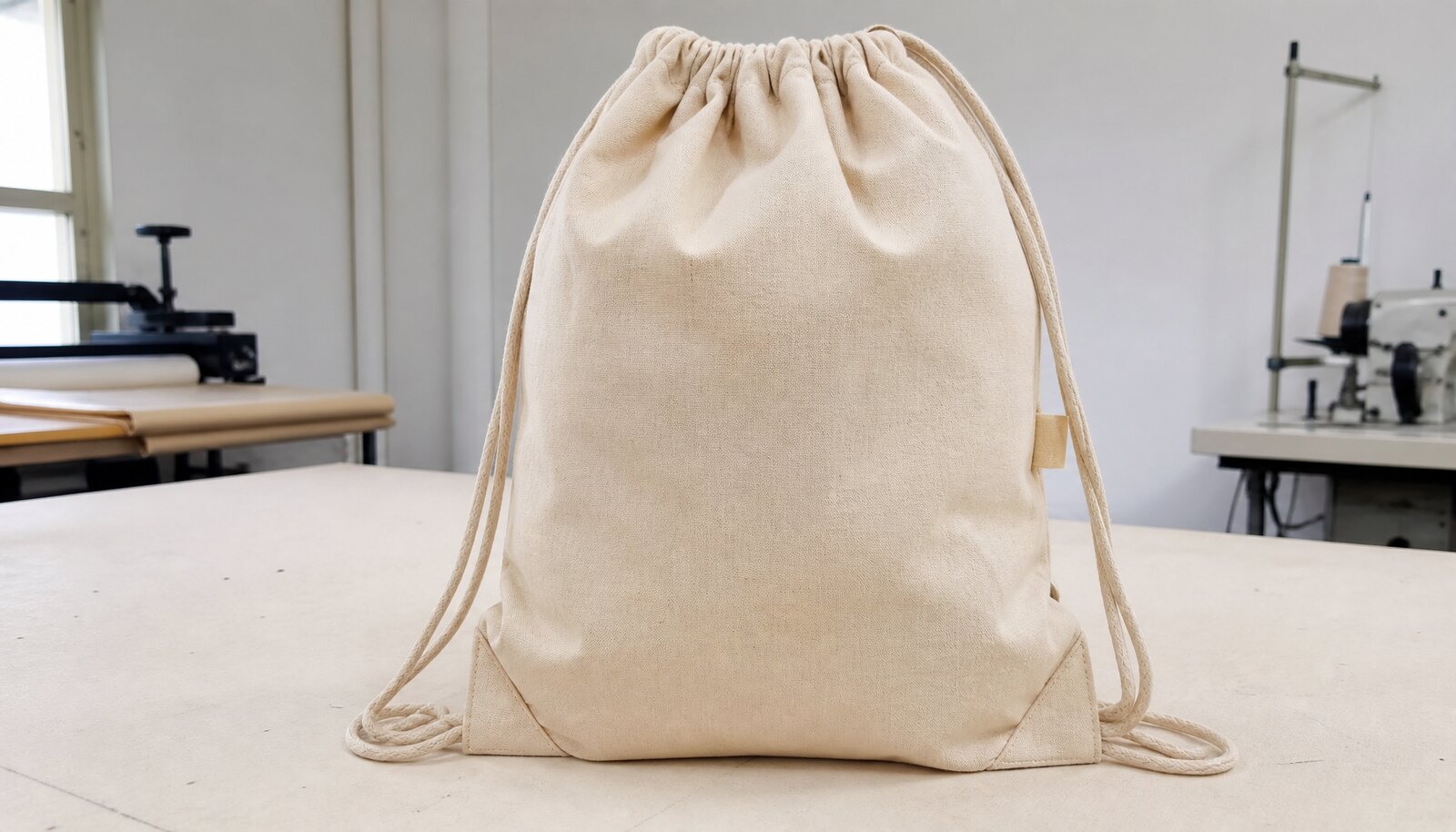
Why the proof matters more than the quote
For boutique wineries, a cotton drawstring backpack is not just a giveaway. It sits in the tasting room, gets photographed by guests, and often carries the winery logo longer than a flyer or paper bag. That makes the proof the real control point. If the logo scale, fabric shade, or print position is wrong on the proof, the unit price is irrelevant because the mistake will be repeated across the whole run.
The best RFQs treat proofing as a production gate, not a design exercise. The buyer should force agreement on artwork size, bag body color, print method, cord spec, and carton packing before the PO is released. Otherwise the supplier can quote one version, sample another, and ship a third. For a winery program, that creates rework risk, delayed launch, and a product that looks off-brand in front of retail customers.
- Lock the final logo file before the supplier starts screens or strike-offs.
- Tie the quote to one approved bag specification, not a range of possible materials.
- Treat proof approval as the moment when changes stop being free.
Choose a bag spec that prints cleanly
The print proof starts with the substrate. For wholesale cotton drawstring backpacks for boutique wineries, a body fabric around 240-320 GSM usually gives enough structure for merchandising without becoming bulky or expensive to sew. Lighter cotton can save cost, but it often shows the weave more aggressively, lets dark ink sink unevenly, and makes the bag look soft on the shelf. Very heavy canvas can improve presentation, but it also increases sewing difficulty and adds weight to freight and packing.
Size and construction matter as much as fabric weight. A bag that is too narrow for the intended contents will distort the logo when filled, especially around the front panel and seam lines. Buyers should fix the finished size, seam allowance, gusset depth if any, drawcord type, and reinforcement points before asking for a proof. For winery use, a clean front panel with enough flat space for the logo usually matters more than decorative extras.
- Use cotton canvas or twill with enough body to keep the face panel flat during printing.
- Keep the print area away from side seams, cord channels, and heavy fold lines.
- Specify cord type, cord diameter, and reinforcement so the bag does not sag unevenly when filled.
Pick the print method the artwork can survive
Most winery logos do best with 1-2 color screen print. It gives sharp edges, predictable coverage, and a clean look on natural cotton. If the logo is built from fine serif text, thin lines, or a small emblem, screen print usually survives the proof stage better than a cheap transfer that looks fine in a mockup but breaks down on woven fabric. Embroidery can work for a premium feel, but it is not the default choice for flat logo work on a backpack face panel because it can pucker the material and distort small lettering.
Complex art creates a different decision. Gradients, multiple color transitions, and photographic treatments often force a transfer method or a simplified redraw. That is where proofing saves money. If the artwork needs simplification, the supplier should show the adjusted art before production and state exactly what changes were made. Do not accept a proof that hides the problem by shrinking the logo until it is barely legible.
- Use screen print when the logo is simple and the brand color has to stay consistent.
- Use a transfer only when the artwork complexity justifies it and durability is still acceptable.
- Require the supplier to show the minimum line weight and smallest readable text on the proof.
Compare sourcing routes before you compare quotes
The cheapest quote is not always the least risky route. A factory direct quote usually gives the best visibility into fabric, printing, sewing, and packing because one team controls the whole chain. That makes proofing easier: one mockup, one strike-off, one production reference. The tradeoff is that the buyer must be precise. If the RFQ is vague, the factory will fill in the blanks with its own standard and the buyer may not notice until the sample arrives.
Trading companies, marketplaces, and domestic decorators can all be useful, but they change the proofing workflow. A trading company may be better at communication and small-order flexibility, yet the actual factory may still make the production decision. Marketplaces can be fast for basic bags, but substitutions are common if the spec is loose. Local decorators can help with speed and last-mile service, but the landed cost often rises once bag sourcing, print labor, and freight are separated into multiple invoices.
- Factory direct works best when the buyer already knows the spec and wants control.
- Trading companies are better when the buyer needs language support and multi-item bundling.
- Marketplace sourcing is only safe when the design is simple and the proof standards are already familiar.
Read the proof like a production document
A usable proof should show more than a front image of the bag. It needs the finished size, print size, logo position from the seam reference, material color, cord color, label placement, and the print method or screen count if relevant. The proof should also identify the substrate, because cotton color changes the way ink reads. A logo on natural unbleached cotton can look warmer and slightly softer than the same logo on bright white cotton, and that difference needs to be visible before the buyer signs off.
The strongest proofs are traceable. The supplier should number the version, date it, and note whether it is a digital layout, a printed strike-off, or a mixed proof set. If the logo includes small type, fine outlines, or a winery name with a narrow font, the buyer should insist on a close-up detail view. Do not approve from a tiny thumbnail in an email thread. Approval should be tied to one version only, or proof drift will creep in as comments are exchanged.
- Require front, back, and detail views if the print appears on more than one panel.
- Use measured dimensions on the layout, not relative placement alone.
- Keep one approved version archived so future reorders do not restart the debate.
Set sample approval rules before production starts
For this product, a digital proof is not enough when print coverage, fabric texture, or color matching matters. A pre-production sample or strike-off on the final material is the cleaner approval method. It tells you how the ink sits in the weave, whether the logo edges stay crisp, and whether the bag still folds flat after sewing. If the supplier is using a natural cotton body, the sample also shows how much the base color influences the logo tone.
The approval rule should be simple and written down. One sample becomes the gold sample, sealed and stored by the buyer or the supplier, and all bulk pieces are compared against it. If there are multiple buyers in the approval chain, the factory should know who has final authority. Without a single approval owner, sample comments tend to multiply and the production team starts guessing which version to follow.
- Approve one reference sample and keep it unchanged.
- Write down acceptable color variance, print edge quality, and stitch condition.
- Test the sample under daylight-style light and warehouse light if the bag will be merchandised indoors.
Read the quote as a cost stack
A clean quote should show more than a unit price. It should separate the cost of the bag body, printing, sampling, setup, labels, carton packing, and any special finishing. The buyer needs to see MOQ logic in the quote, because MOQ usually comes from fabric roll efficiency, screen setup, cut loss, and sewing batch size. If a supplier hides those drivers, the quote may look cheap until the second order or a small revision arrives.
This is also where landed cost comparison matters. A lower ex-factory price can still produce a higher landed cost if cartons are weak, packing is inefficient, or the freight basis is poor. Compare quotes on the same terms: same bag size, same print method, same carton pack, same approval method, and same incoterm. If one supplier is quoting from an earlier art version or a lighter fabric, the number is not comparable.
- Ask for unit pricing at MOQ and at the next price break.
- Require setup, sample, and packing charges as separate lines.
- Compare quotes only after the spec is normalized.
Packing and lead time are part of the proof
Packing changes how the bag arrives, and that affects the proof. A printed cotton backpack folded too tightly can pick up hard crease lines across the logo. A loose pack can rub the print against carton walls and create scuff marks before the shipment leaves the factory. For winery programs, flat-folded packing with a clean carton liner is usually safer than aggressive compression. If the bags will sit in retail or tasting-room inventory for a while, the buyer should also ask about humidity control and carton dryness because cotton picks up storage conditions quickly.
Lead time needs the same discipline. The quote should state when the clock starts, and it should usually start after proof approval, not after PO release. That matters when the artwork is still moving or when the buyer wants to review a strike-off. Seasonal winery launches can be tight, so the schedule should include time for artwork correction, sample transit, approval turnaround, and a realistic buffer for repacking if the first sample fails.
- Specify carton pack count and folding method before production begins.
- Confirm that the factory can hold approved samples for reorder reference.
- Build a schedule that includes proof revision time, not only sewing time.
Common proofing mistakes that trigger rework
The most expensive mistakes are usually small. A logo placed too close to a seam can shift once the bag is sewn. Thin type can disappear against natural cotton. A color approved on screen can read too dark or too dusty on fabric. Another common issue is assuming the supplier knows what the buyer means by premium. One team may mean heavier fabric and crisp print, while the other thinks it means a decorative label and a higher price. If that mismatch is not corrected in the proof stage, the finished backpack will miss the brand brief even if it technically matches the quote.
The practical fix is to keep the approval chain short and the proof language exact. The buyer should specify what is non-negotiable, what can flex, and what requires a new approval round. That makes the production team move faster because it removes guesswork. For boutique wineries, the goal is not only to avoid defects. It is to receive a bag that looks deliberate on a shelf, survives handling, and stays consistent across repeat orders.
- Do not approve a logo that is scaled down until fine text is unreadable.
- Do not accept a proof that omits seam reference points or fabric color.
- Do not compare two quotes if their bag spec, print method, or packing standard is different.
Specification comparison for buyers
| Spec decision | Recommended option | When it fits | Buyer risk to check |
|---|---|---|---|
| Fabric weight | 240-320 GSM cotton canvas or twill | Retail-facing winery bags that need structure and a clean print surface | Too light can show through and buckle under print; too heavy raises cost and makes the bag stiff |
| Print method | 1-2 color screen print for logos; transfer only for complex art | Most boutique winery logos, tasting-room merch, and gift-with-purchase runs | Fine text, gradients, or thin strokes can disappear or look crowded on textured cotton |
| Sourcing route | Factory direct with a signed proof and one named production contact | When you need tighter control over fabric, print, and packing | If sales and production are split across intermediaries, corrections can get lost between versions |
| Proof type | PDF layout plus physical strike-off on final fabric | When logo placement, ink opacity, or fabric color matters | A digital mockup can hide print spread, seam interference, and color shift on cotton |
| MOQ logic | One fabric color and one print version per run | When the order is under a few thousand pieces or artwork is still being refined | Mixing colors, print locations, or cord styles can inflate setup cost and delay approval |
| Supplier route | Single factory handling cutting, printing, sewing, and packing | When you want accountability for one proof package and one carton standard | Multi-site sourcing can create blame gaps if the print matches but the sewing or packing does not |
| Packing format | Flat-folded with tissue or carton liner, carton marks on all master cases | Retail, tasting-room, and distributor orders that will be repacked or shelved | Loose packing can crease print areas; overpacked cartons can scuff ink and crush seams |
| Lead time plan | Sample first, then production start after signed approval | When the bag is tied to a launch, event, or seasonal winery program | Lead time quoted from PO date is not the same as lead time from proof approval |
Buyer checklist before sampling
- Final artwork file is vector or high-resolution with outlined fonts and named Pantone targets if color matters.
- Bag size, fabric weight, cord type, and print position are fixed before the quote is compared.
- The supplier has confirmed whether the proof will be PDF only, printed strike-off, or both.
- MOQ, setup charges, sampling fees, and overrun allowance are written into the quote.
- A pre-production sample or sealed approved sample will be kept as the production reference.
- Carton pack count, master carton size, and packing method are approved before mass production.
- Lead time is stated from proof approval, not only from purchase order release.
- Inspection criteria cover print registration, color tolerance, stitch strength, and clean edge finishing.
Factory quote questions to send
- What exact fabric weight, weave, and shrinkage allowance are you quoting for the backpack body?
- Is the quoted print method screen print, transfer, embroidery, or a mix, and what setup cost belongs to each?
- How many colors are included in the quoted price, and what changes if the artwork needs a second print position?
- Will you send a physical strike-off on the final material before bulk production starts?
- What is the MOQ per color and per artwork version, and what happens if we split sizes or cord colors?
- Which items are included in the unit price, and which are separate line items such as sampling, carton marking, or labels?
- What is your standard carton pack quantity, carton size, and overpack tolerance?
- From which milestone does lead time start, and how many days are reserved for proof correction and sample approval?
Quality-control points to confirm
- Artwork placement is measured from seam reference points, not guessed by eye.
- Print registration holds within an agreed visual tolerance, with no visible blur, double hit, or misaligned edges.
- Ink coverage is even on the cotton weave, with no pinholes, washout, cracking, or smearing on the first rub test.
- Color matches the approved proof under daylight-style lighting and does not shift dramatically on the final fabric lot.
- Stitching around cord channels, side seams, and stress points is straight, balanced, and free of skipped stitches.
- Cord knots, metal tips, or plastic tips are secure and consistent across the carton.
- Labels, hangtags, and side branding are placed in the approved position and do not cover print areas.
- Cartons are dry, clean, and packed to avoid fold marks across the printed face of the bag.