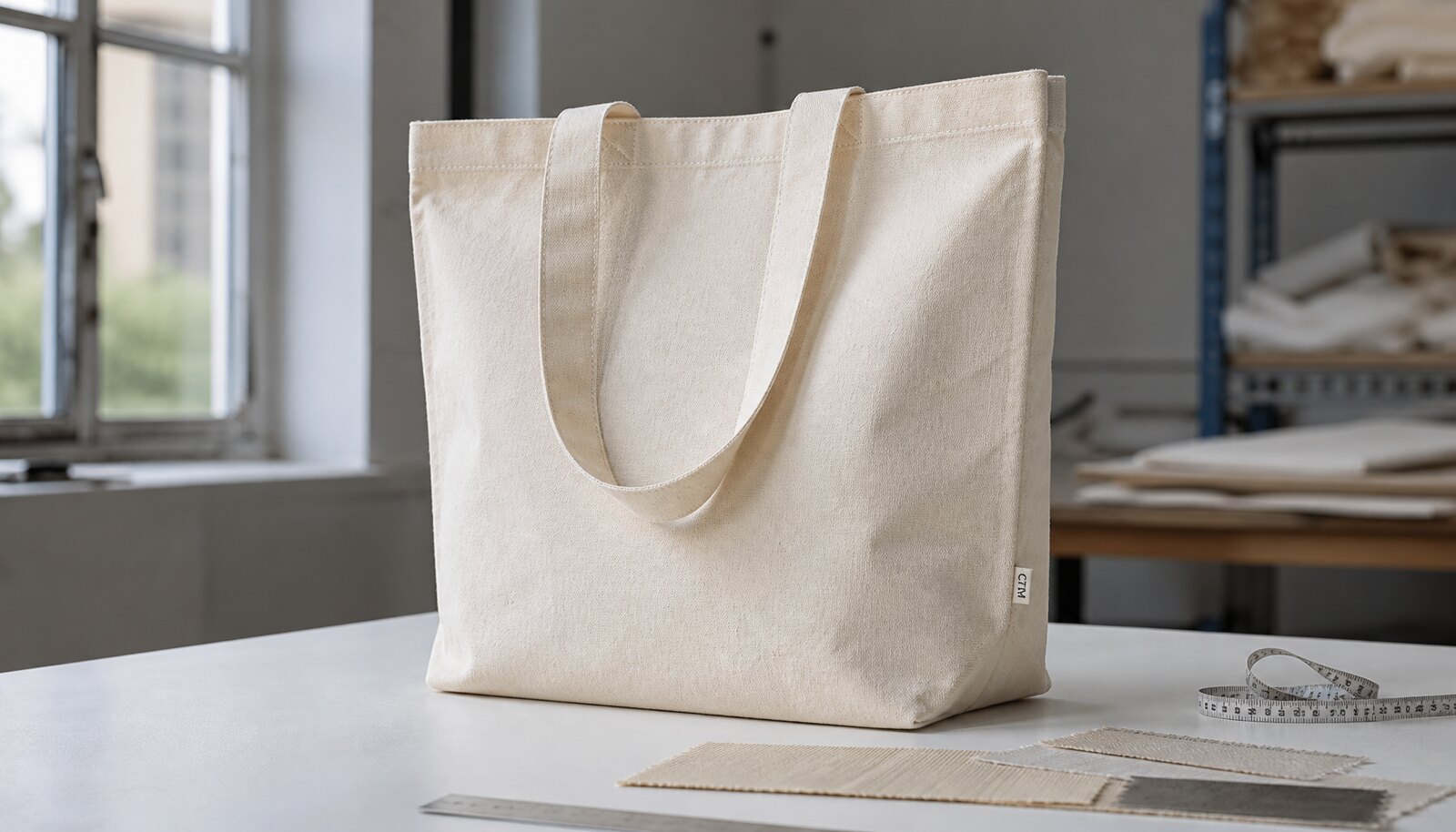
Why plain tote bags still need a full spec
Plain tote bags for printing are often bought as if they were simple blanks, but the commercial risk sits in the details. A tote is a sewn product first and a branding surface second. If the fabric is too open, the print bleeds. If the stitching is weak, the handles twist. If the blank is inconsistent, the same artwork can look sharp on one lot and dull on the next. Procurement needs a bag spec, not just a logo file.
The question is not whether a supplier can make a tote. Most can. The question is whether they can make the same tote repeatedly, within the same dimensions, with the same ink behavior, and with the same pack format. That matters for retail reorders, distributor programs, event kits, and promotional campaigns where the bag is part of a wider brand system. A weak spec creates avoidable noise later: print complaints, carton disputes, and reapproval loops.
The practical fix is to define the bag as a component. Put fabric, size, construction, decoration, and packing into one document, then ask suppliers to quote against that version only. Once the blank is pinned down, the decoration quote becomes meaningful and the comparison is cleaner. The fewer assumptions you leave open, the easier it is to separate a true value quote from a low quote that only looks attractive.
- Treat the tote as a sewn item with a decoration process, not as a generic printed good.
- Lock the blank spec before comparing print prices.
- Use one RFQ structure so every supplier quotes the same product.
Start with fabric weight, weave, and finish
Fabric is the first sourcing decision because it drives hand feel, opacity, durability, and freight. For plain cotton tote bags, many buyers start around 100 to 150 GSM for light promotional use, 180 to 220 GSM for standard retail or everyday reuse, and 250 GSM or more when the bag needs a firmer body or heavier carry. Those are not universal rules, but they are useful buying bands when you want suppliers to quote against something concrete.
GSM alone is not enough. Two fabrics can both be labeled 200 GSM and still behave differently if one has a tighter weave, more stable yarn, or a different finish. A loose weave may look fine in a sample photo, yet the print can sink into the fibers and the bag may distort after folding. A tighter weave usually prints cleaner, but it can cost more and change the feel buyers expect from a promotional tote.
If the tote is meant for premium retail presentation, note whether you want a soft washed look, a crisp natural finish, or a structured body. That detail helps the factory choose a blank that supports both printing and merchandising. Ask for composition, weave style, finishing treatment, and tolerance on GSM. If the supplier cannot name those items clearly, the quote is not specific enough to compare with other offers.
- Use GSM as the starting point, then confirm weave and finish.
- Ask for the actual blank fabric or a photo of the exact stock cloth.
- Do not compare suppliers unless composition and finish are aligned.
Choose the print method by art, volume, and surface
The print method should follow the artwork and the order profile, not habit. Screen printing is usually the most practical choice for simple logos, solid colors, and repeat programs because it gives strong coverage and better unit economics at scale. Digital or transfer methods are more flexible when the design includes gradients, fine lines, or multiple colors, but they can add cost or change the hand feel. If the bag is meant for long reuse, that surface feel matters.
The decision becomes clearer when the artwork is split into production scenarios. A one-color logo on one side is not the same job as a two-sided multi-color illustration. Ask suppliers to quote those separately if the design is still under discussion. That lets procurement compare the real cost of design choices before the artwork is frozen. It also avoids the common mistake of approving a cheap logo version and later discovering that the final art needs a more expensive process.
Print area and placement matter as much as method. A large centered print needs careful registration and can increase waste if the fabric stretches during curing. A smaller chest-size mark may cost less but can disappear visually on a large tote. Define the artwork window, the maximum print size, and the Pantone target if color consistency matters. For review, ask for a strike-off or printed sample that shows the actual coverage and edge quality, not just a digital proof.
- Use screen print for simple logos and stable repeat orders.
- Use digital or transfer for detailed, multi-color, or short-run art.
- Quote print area, placement, and color target separately from the bag body.
Compare sourcing routes by MOQ and accountability
Different sourcing routes solve different buying problems. A local decorator is usually best when the order is small, urgent, or heavily customized and you need direct communication. A direct factory usually wins when the program repeats, the spec is stable, and you want tighter control over fabric and packing. A trading company or sourcing office becomes useful when the order combines multiple SKUs, multiple factories, or a long approval chain that needs one coordinator.
MOQ is one of the clearest differences. Stock-blank decorators may accept lower quantities but often charge more per piece and may have less control over blank consistency. Direct factories often want larger minimums, but they can spread setup over volume and keep dimensions and packing more repeatable. Trading companies can smooth the intake, yet they add margin and you need to know who owns the final inspection if the blank bag, print, and packing come from different places.
Accountability is the hidden tradeoff. If one party sources the blank and another party prints it, any defect can be blamed on the handoff. That is manageable only if the PO makes the responsible party explicit. For a recurring tote program, the cleanest model is a single supplier that owns the blank, the print, and the pack. It is easier to enforce reorders, resolve claims, and keep the product stable over time.
- Use local decoration for speed when the order is small and urgent.
- Use a direct factory when the program will repeat and the spec is stable.
- Use a trading company only when coordination value outweighs the added margin.
Write an RFQ that exposes the real cost drivers
A useful RFQ for plain tote bags does more than ask for a unit price. It forces the supplier to show the cost drivers that matter: fabric spec, print method, setup charge, packing format, cartonization, and logistics assumptions. Without that structure, suppliers can look competitive on the headline number while quietly substituting a thinner fabric, a looser seam, or a simplified pack. Procurement then compares quotes that are not actually equivalent.
Separate the base bag cost from the decoration cost. That distinction matters because a buyer may later reorder the bag blank with a new logo or a different print size. If the quotation is combined into one figure, you lose visibility into what changed. Ask for pricing by color, by print side, and by volume band. If the supplier discounts setup at higher volume, you need to see where that break occurs so you can choose the right quantity instead of guessing.
The best quote also names the assumptions behind it. Ask whether artwork cleanup, plate making, sample shipping, inner packing, barcode labels, and master carton labels are included. If the supplier has not made those items explicit, the price is not yet procurement-ready. Requiring every bidder to complete the same line items in the same order is one of the easiest ways to keep budgets from drifting.
- Break the quote into bag, print, packing, and freight assumptions.
- Ask for pricing by color, side, and volume band.
- Make the supplier confirm what is included and what is extra.
Use samples as production references, not sales props
A pre-production sample should be treated as the reference point for bulk, not as a courtesy item. If the sample uses different fabric, a different print process, or a hand-finished seam that will not be repeated, it is not a valid approval. That sounds obvious, but it is one of the most common reasons tote programs drift. The buyer approves something attractive, then receives a production lot that technically matches the order but not the sample experience.
The review should be measured, not only visual. Check finished dimensions, handle drop, print location, seam quality, and fold style. If the artwork has a specific color target, compare it under the same lighting condition every time rather than relying on memory. For a simple branded tote, the print should read cleanly from the expected viewing distance and should not look off-center when the bag hangs. For a retail tote, the tactile impression is part of the product and the sample should match the desired hand feel as closely as possible.
The supplier should confirm in writing what the approved sample controls and what tolerances remain open. For example, the sample may establish fabric type, print placement, and pack method, while still allowing minor thread trimming variance. That distinction protects both sides. It gives the factory room for normal process variation while giving procurement a clear basis for rejection if the bulk run deviates in a meaningful way.
- Approve a sample only if it uses the same blank, print method, and pack method as bulk.
- Measure the sample against the spec sheet rather than judging by eye alone.
- Keep the approval tied to an order number and version-controlled artwork file.
Define packing rules before production starts
Packing is easy to ignore because it looks like a logistics detail, but it changes the economics and presentation of plain tote bags. A bag packed loose in a carton ships differently from a bag folded to a retail spec, polybagged, tagged, and labeled. Those choices affect labor, carton size, carton count, protection against moisture and dirt, and how much work the receiving warehouse must do before the bags are usable. For retail or distributor programs, packing is part of the product definition.
The buyer should specify fold direction, inner pack count, whether each bag needs a polybag or tissue wrap, and whether barcode or hangtag labels are required. If the bags will be sold through retail channels, check the presentation of the printed area after folding. A well-printed bag can still arrive looking poor if the fold line crushes the logo or the carton pack leaves sharp creases across the front panel. The supplier should show a packed sample or clear pack photo before the bulk run starts.
Packing also affects freight. Tote bags are light but bulky, so carton dimensions can change landed cost more than the bag unit price itself. Ask for carton size, gross weight, and estimated CBM in the quote. That lets logistics compare air, sea, and courier with more discipline. It also prevents the common situation where the bag is cheap, but the oversized carton makes the shipment expensive to move.
- Write fold, pack count, and label placement into the order.
- Ask for a packed sample photo if retail presentation matters.
- Use carton dimensions and CBM to judge freight impact early.
Set QC thresholds a factory can actually test
Quality control gets stronger when the acceptance criteria are measurable. For plain tote bags, the usual failure points are size drift, crooked handles, poor seam formation, print shift, ink rub-off, stains, and shade variation. Generic language such as “good quality” does not help anyone inspect the shipment. A better method is to define the acceptance window in the spec sheet or PO and tell the supplier which defects are automatic rejects. That gives the factory a practical target before production begins.
There is no single universal tolerance for every tote program, but a useful buyer practice is to narrow the most visible items first. Print placement should be checked against a defined centerline or placement window. Handle lengths should be equal within a small tolerance so the bag hangs level. Finished dimensions should be checked against the approved pattern or sample so the tote fits the intended use. For logo work, many buyers set a tighter print-registration window on small marks and allow a slightly wider one on larger graphics if the design remains legible.
Shade and cleanliness deserve the same discipline. The fabric should match the approved sample or agreed shade band, and the lot should be free from oil marks, broken yarns, holes, or contamination that would show in retail handling. If the tote is going through a wash or heavy-use program, ask for a basic rub or wash confirmation on the printed area. That is not a substitute for formal testing, but it is a practical way to catch weak curing or unstable ink before the goods ship.
- Use measurable tolerances for size, print placement, and handle symmetry.
- Define automatic rejects for stains, holes, broken stitches, and major shade variation.
- Tie inspection to the approved sample and version-controlled specification.
Plan lead time and freight as one problem
Lead time is not just sewing time. It includes fabric sourcing, print setup, sample approval, drying or curing, sewing, packing, carton labeling, and handoff to freight. If the order needs a special blank fabric or a new print setup, the schedule extends. Buyers often underestimate how much time disappears into artwork revisions and sample loops. The fastest way to miss a deadline is to start bulk production before the sample and pack format are fully signed off.
Freight planning matters because tote bags are usually light but bulky. That means the real cost can swing based on carton efficiency, not only on ex-works price. Ask for gross weight, carton dimensions, and CBM while the quote is still open. That helps procurement compare the landed cost of a lower unit price with a tighter, more efficient pack. In some cases, a slightly more expensive supplier wins on total cost because the cartons are smaller and easier to move.
Separate three clocks: sample lead time, production lead time, and transit time. If the supplier quotes a single number, ask them to split it. That makes schedule risk visible and lets you protect the deadline if one stage slips. It also gives your freight forwarder enough information to choose air, sea, or split mode. For recurring programs, this separation becomes a planning tool for future reorders as well.
- Track sample time, bulk time, and transit time separately.
- Use carton dimensions and CBM to compare landed cost, not just bag price.
- Do not lock shipping method until the packed volume is known.
Compare landed cost, not just the first quote
The cheapest unit price is often the wrong decision if the spec is loose. Two suppliers can both say they offer plain tote bags for printing, yet one may be quoting thinner fabric, a wider tolerance, or a simpler pack that shifts cost downstream. A procurement comparison should normalize the spec before comparing numbers. If the quote does not state GSM, print method, packing count, and carton size, it is not yet suitable for a buying decision.
Landed cost should include the base bag, decoration, packing, cartonization, and freight assumptions. It should also consider reorder behavior. A supplier who can repeat the same blank and print result on the next buy may justify a slightly higher unit price if it reduces claims and approval time. That is especially relevant for branded programs that reorder by season or by channel. The cost of inconsistency usually shows up later, not on the first invoice.
A practical habit is to compare at least two scenarios: the minimum acceptable spec and the preferred spec. If the price gap is small, the preferred spec usually wins because it creates less risk and better brand presentation. If the gap is large, the business case is clearer and the discussion can focus on where the spec can be tightened without compromising durability or print quality. Either way, the quote comparison becomes a sourcing decision, not just a price check.
- Normalize quotes to the same fabric, print, packing, and freight assumptions.
- Include reorder stability and claims risk in the cost review.
- Use minimum spec versus preferred spec to understand the real tradeoff.
Specification comparison for buyers
| Spec decision | Recommended option | Typical MOQ / lead-time effect | Buyer risk to check |
|---|---|---|---|
| Small launch run | Local decorator or stock-blank printer | Usually the lowest MOQ and fastest path, but setup and handling can raise unit cost | Confirm the quoted bag is a real stock blank, not a substitute, and verify print area before approval |
| Repeat branded program | Direct factory with stable blank fabric and in-house decoration | Best at mid-to-high volume, with better reorder consistency and cleaner accountability | Ask who owns fabric, sewing, print, and packing so one party is responsible for the finished unit |
| Pantone-sensitive branding | Factory with controlled screen print and documented ink mixing | Setup can be moderate, but proofing may extend lead time | Check whether the supplier is matching to a formula or only to a visual reference |
| Detailed or multi-color art | Digital print or transfer on a tight weave blank | Works well for short-to-mid runs, but cost rises faster at scale | Confirm hand feel, opacity, and peel resistance on the approved sample |
| Lowest landed cost | Direct factory with standard fabric, standard size, and one-color print | Usually the strongest economics at scale if the spec is tight | Make sure the low quote is not hiding thinner GSM, looser seams, or oversized cartons |
| Retail presentation | Factory that can fold, insert, label, and barcode to a defined pack spec | Adds labor and time, but reduces warehouse rework | Get pack count, carton dimensions, and label placement in writing |
| Multi-sku order | Trading company or sourcing office coordinating multiple factories | Useful when colors, sizes, or add-ons vary across the PO | Clarify who performs final QC if the blank bag, print, and packing come from different places |
Buyer checklist before sampling
- Define finished dimensions, including body width, height, gusset depth, and handle drop, and state the tolerance against the finished bag, not the cut piece.
- Specify fabric composition, weave, and GSM. If hand feel matters, note whether you want soft, crisp, or structured.
- State the print method, artwork size, print side, Pantone target, and file format so the supplier does not assume a simpler decoration process.
- Quote quantity by SKU, color, and print version so volumes do not get blended across different builds.
- Approve a pre-production sample made from the same blank fabric, same thread, same print method, and same packing style used in bulk.
- Write packing instructions for fold direction, inner pack count, carton count, and label placement, especially for retail or distributor inventory.
- Ask for separate timing on sample lead time, bulk production time, and ship-ready date; one combined lead time is too vague.
- Request carton dimensions, gross weight, and estimated CBM before freight is booked so logistics can compare air, sea, and courier options on the same basis.
- Set a defect rule for print registration, seam breaks, shade variation, oil stains, and hole damage, and mark which defects are automatic rejects.
- Ask the supplier to confirm what is included in the unit price: blank bag, setup, print, packing, labels, cartonization, and any artwork changes.
Factory quote questions to send
- What blank fabric are you quoting, including composition, weave, and GSM, and what tolerance do you hold on that spec?
- What is the exact print method, how many colors are included, and what setup charge applies if the artwork changes?
- What is the MOQ by color and by design, and how does the price change at the next volume break?
- Can you make a pre-production sample on the same blank fabric and with the same print method that will be used in bulk?
- What are the exact finished dimensions, handle length, handle drop, seam allowance, and printable area?
- What packing format is included in the quote, and what is the surcharge for polybag, insert card, hangtag, barcode label, or retail fold?
- What are the carton dimensions, gross weight, carton count, and estimated CBM for one production lot?
- Which defects do you treat as rejectable in bulk, and how do you handle replacement, credit, or rework if a lot misses spec?
Quality-control points to confirm
- Fabric GSM should match the agreed spec within tolerance, and the fabric should not feel noticeably thinner or looser than the approved sample.
- Finished bag dimensions should stay within the approved tolerance for width, height, and gusset depth so the tote packs and hangs consistently.
- Handle lengths should match within tolerance, and both handles should be attached symmetrically so the bag hangs level when loaded.
- Print placement should stay within the approved location window, with no visible skew, shift, or crop error that weakens the logo.
- For small logo work, many buyers set a print-registration window around 1.5 to 2 mm; larger graphics can use a wider window if the art still reads cleanly.
- Ink should be fully cured and resistant to visible rub-off on the inside fold line and at other high-contact areas.
- Seams should be straight and continuous, with no skipped stitches, broken thread clusters, open corners, or loose bartacks at stress points.
- Fabric should be clean and free from holes, oil marks, broken yarns, severe shade banding, or contamination that would show in retail display or customer use.
- Packing should match the approved fold, count, and carton label format so warehouse receiving does not need to reopen cartons to verify contents.