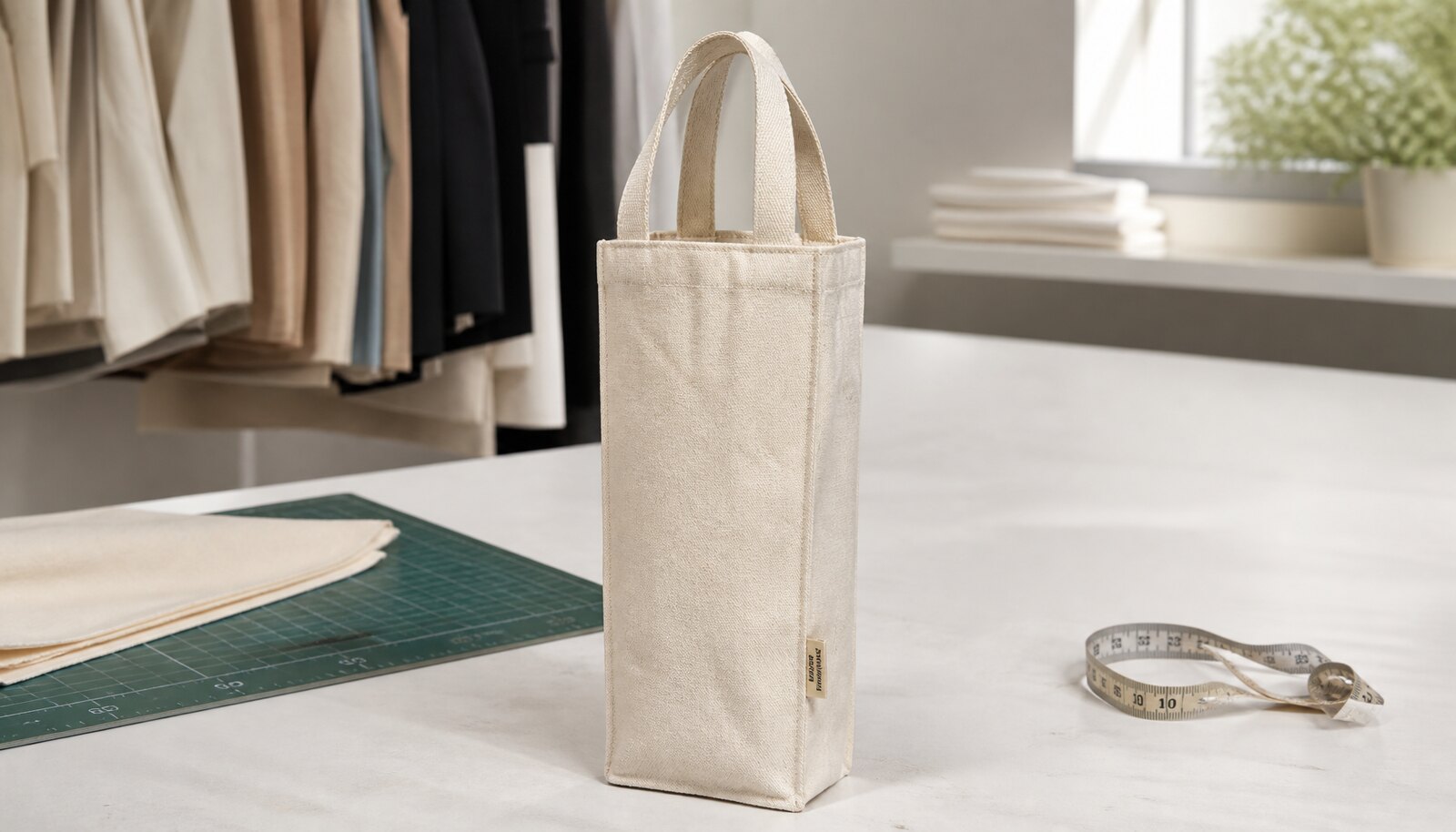
Start With the Decision the Bag Must Support
A buyer guide for personalized wine bags with logo only works when it is built around a decision, not a slogan. Start by defining whether the order supports retail shelf display, tasting-room sales, a gift set, an event giveaway, e-commerce fulfillment, or private-label resale. Each channel changes the acceptable cost, the required finish level, and how much risk you can tolerate on print detail, hand feel, and packing appearance.
The second decision is the bottle family. A standard Bordeaux bottle, a Burgundy bottle, a Champagne bottle, a split, a two-bottle pack, and a magnum do not create the same shape problem. Measure the actual sample bottle and note body diameter, shoulder width, neck height, closure style, and any hardware the bag has to clear. If you only send a nominal size, suppliers guess at fit and usually guess differently.
When the procurement file is clean, everyone works from the same version: buyer, merchandiser, factory, and inspector. That file should include the SKU, artwork revision, approved bottle sample, packing format, and the owner for each open item. The goal is not a long document; it is a record that lets a factory quote and produce without reinterpreting the requirement.
- Use one reference bottle for all sampling and QC decisions.
- Separate must-have requirements from nice-to-have presentation details.
- Record the use case before asking for price so the quote matches the channel.
- Keep a revision number on the spec, artwork, and sample approval record.
Choose the Right Build Before Comparing Prices
The comparison table is useful only if you read it as a tradeoff map, not a shopping list. Cotton canvas usually gives the best balance between cost, print quality, and repeatability. Jute creates a more rustic presentation and can work well for premium natural branding, but the weave is coarser and small type often loses clarity. Felt and nonwoven options are economical for promotions, yet they usually look less premium and can deform more easily under heat or rough handling.
Construction matters as much as fabric. A bag that looks fine on the bench can still fail once a heavy bottle is inserted, especially if the opening is too tight, the seam allowance is too short, or the base reinforcement is weak. Two-bottle carriers and magnum bags need extra attention on divider support, side seam strength, and handle or cord reinforcement because the weight distribution changes the stress points.
Failure mode should drive the design choice. If the bag will be stacked, shipped long distance, or handled by retail staff all day, prioritize structure and seam integrity. If it is a quick promotional item, you can accept lighter fabric and simpler decoration. If the logo has small text or thin lines, avoid coarse jute or heavy embroidery unless you have already confirmed that the artwork survives the chosen method.
- Use cotton or canvas when the logo has small details or multiple lines of type.
- Use jute when the brand wants a natural look and can accept a rougher surface.
- Use nonwoven or felt when price and speed matter more than tactile quality.
- Use reinforced carriers or dividers when shipping two bottles or larger formats.
Specify Materials and Decoration as a Matched Pair
Materials and decoration should be evaluated together because each fabric constrains the logo method. Screen print is usually the most efficient choice for cotton canvas and works best with strong shapes, limited colors, and generous spacing. On jute, the weave can interrupt fine detail and create a slightly irregular edge, so bold artwork performs better than small type. Hot stamp and foil can look sharp on smoother surfaces, but they are less forgiving on rough, porous, or textured fabrics.
Embroidery adds perceived value and can make personalized wine bags with logo feel more durable, but it also introduces a few procurement risks. It can pucker on lightweight fabric, distort small letters, and require a backing that changes the inside feel of the bag. Woven labels and sewn patches are often easier to repeat on reorder programs because they reduce the setup dependency of a print screen or foil die, although they add sewing time and can alter the outside appearance if placed carelessly.
Ask suppliers to state the constraints instead of only confirming that they can do the logo. A credible factory should be able to tell you where the method performs best, what minimum line width they recommend, whether the substrate sheds or frays, and what problems they expect during production. If you are targeting a regulated market, ask for the material declaration and any relevant test report that supports your own compliance file. If a recycled content claim is part of the brief, require evidence for that claim separately rather than assuming the bag material or label is documented.
- Use screen print for simple logos, strong contrast, and controlled cost.
- Use embroidery only when the artwork can survive thread density and backing material.
- Use woven labels or patches when you want stable branding across repeat orders.
- Ask the supplier to explain likely print defects on the chosen fabric before approving artwork.
Write the RFQ So Quotes Are Comparable
A quote becomes useful only when every supplier is priced against the same scope. The RFQ should separate the base bag, decoration, sample stage, setup fee, packing, and shipping term. If one supplier is quoting a lighter fabric, a simpler inner pack, or a smaller logo area, the lower price is not a true comparison. It is just a narrower scope.
The most common source of bad comparison is missing specification detail. You need finished size, bottle reference, artwork file format, logo placement, color count, packaging configuration, carton target, and any special handling such as inserts or moisture protection. For orders with multiple colorways or versions, ask the factory to price each variation separately so you can see where the real cost drivers sit. If a supplier is only willing to quote one blended number, you lose the ability to compare options intelligently.
It also helps to request alternate quote lines. Ask for the same bag with stock fabric and with custom material, with print and with a sewn label, or with and without a divider. That gives you a clean view of where the cost and lead time are coming from. For procurement, the best quote is rarely the cheapest line; it is the one that shows the actual levers you can control when you need to reduce cost or improve quality.
- Specify bag size, bottle reference, artwork version, and decoration method in the RFQ.
- Request separate pricing for samples, setup, and bulk production.
- Ask for quote lines by color, version, and packaging configuration.
- Compare same-incoterm quotes only, or the freight assumptions will distort the result.
Use Samples to De-Risk the Order
For personalized wine bags with logo, the sample is not just a visual approval; it is the proof that the chosen fabric, logo method, and pack-out can work together. Request a pre-production sample that uses the actual fabric, actual decoration method, and actual bottle reference. If the factory proposes a substitute because the planned material is unavailable, treat that as a deviation and decide whether the sample is still meaningful. The sample should be versioned, dated, and linked to the exact artwork file.
The sample review should include more than the front view. Ask for front, back, side, inside seam, bottom, logo close-up, closure, and packed-carton photos. If the bag has a divider, lining, or insert, verify those details on the sample rather than assuming they will be replicated in bulk. A physical approval sample is worth keeping for any repeat program because it provides a real benchmark when production quality starts to drift.
If color matters, do not rely on a named color alone. Use a physical swatch or a Pantone reference and confirm whether the match is visual only or color-managed by the factory. For multi-step decoration, ask whether the color order or heat sequence changes the final appearance. When the sample differs from the approved expectation, capture the deviation explicitly and decide whether to reject, revise, or accept with written tolerance.
- Approve against the actual sample, not only against a photo.
- Keep a signed or sealed reference sample for repeat orders.
- Record all deviations on the sample sheet before bulk production starts.
- If the decoration method or fabric changes, require a new sample.
Build a QC Plan With Real Acceptance Criteria
Good QC language separates critical, major, and minor defects. Wrong bag size, wrong artwork, wrong color, missing divider, contamination, and mixed SKUs are critical because they affect usability or brand trust. Seam breaks, severe logo misplacement, open edges, or a carton count mismatch are major because they can create returns or rework. Loose threads, small wrinkles, and cosmetic marks may be minor if they stay inside the agreed tolerance and do not affect display or function.
Tolerance should be specific enough to guide inspection without becoming unrealistic. A practical starting point for many cotton or canvas bags is a finished size tolerance around plus or minus 0.5 cm, while jute or nonwoven may need a looser band if the fit still passes with the approved bottle. Logo placement can often be controlled to within a few millimeters when the artwork is simple and the factory uses stable fixtures. The most important rule is that the bottle still inserts and sits correctly after production variation is applied.
Testing should reflect the actual load and handling path. For a single-bottle carrier, many buyers use a static hold check at the planned bottle weight and a short rub test on the decoration. For two-bottle or reinforced carriers, increase the load target and inspect the divider and handle attachment points carefully. A useful shipment gate is simple: no wrong artwork, no open seams, no broken structural stitch, no contamination, and no carton mismatch. If a defect class is recurring, stop shipment until the supplier explains the root cause and the correction plan.
- Set zero tolerance for wrong SKU, wrong logo, wrong color, contamination, and missing inserts.
- Check for open seams, skipped stitches, or loose thread longer than 1 cm on visible faces.
- Run a dry rub test on printed areas and confirm there is no visible transfer or peeling.
- Verify carton count, SKU labels, and pack configuration against the approved packing list.
Treat Packing and Labeling as Part of the Product
Packing choices affect damage rate, receiving speed, and even the appearance of the bag when it reaches the shelf. For ocean freight, inner polybags, moisture control, and sealed master cartons matter because natural fibers can absorb humidity and pick up odor. For air freight or express, carton size and gross weight drive cost more aggressively, so you should compare the protection level against dimensional weight before you finalize the pack-out. If the product will go directly into retail or fulfillment, label placement and fold direction need to match the receiving process.
Packing errors are one of the easiest ways to turn an acceptable bag into a rejected shipment. Common problems include over-compressed units that crease the print, mixed art versions in the same carton, labels that block retail display, and carton marks that do not match the packing list. If the order ships to multiple destinations, create a packing map by SKU, color, and carton sequence so the receiving team does not have to open every box to sort it.
Ask the supplier to show you the exact master carton layout before the PO is released. That layout should state units per carton, carton dimensions, pallet or loose-load preference, humidity protection, and whether the cartons are intended for retail shelf replenishment or bulk warehouse use. If the supplier changes the pack format later, require a revised carton photo and a written confirmation so the change does not become a receiving dispute.
- Define inner pack count, fold direction, and whether each unit is polybagged.
- State master carton limits and whether palletization is required.
- Require shipping marks, SKU, color, and quantity on more than one carton side.
- Ask for carton photos and measurements before dispatch.
Vet the Supplier Beyond the Unit Price
A low price only matters if the supplier can actually reproduce the approved bag. Ask whether the factory controls cutting, sewing, decoration, packing, and final inspection in-house or whether any step is subcontracted. If a third party handles printing or embroidery, ask who owns the quality issue if artwork shifts, color changes, or the bag arrives packed incorrectly. A supplier that can trace the process end to end is easier to manage when the order has several versions or a tight schedule.
Material and compliance evidence should fit the market you are selling into. If you need fiber content, recycled content, odor control, azo, formaldehyde, heavy metals, REACH-related limits, or other market-specific documentation, ask for the actual report or declaration rather than a verbal promise. Not every market needs the same file, so only request what is relevant, but do request it early. A supplier that cannot explain decoration constraints by fabric usually does not have enough production depth to support a repeat program.
Also pay attention to labeling and traceability. Ask whether the factory can print or apply SKU labels, batch codes, or barcode stickers in a controlled way and whether they can maintain lot-level traceability across fabric, printing, and packing. That matters when a defect appears after delivery because you need to know whether the issue started in the fabric, the decoration run, or the packing step. The best suppliers make that chain visible without being asked twice.
- Confirm which steps are in-house and which steps are subcontracted.
- Ask for actual production-site photos, not stock images or marketing renders.
- Request the exact compliance documents relevant to your market.
- Check whether the factory can maintain lot traceability and version control.
Compare Bids on Total Risk, Not Just Price
Two quotes can look similar and still hide very different risk profiles. One supplier may include only the base bag and decoration, while another may include packing, labels, and a stronger carton spec. One quote may assume a stock material, another a custom weave or custom dye lot. One factory may quote a low unit price but require new setup charges on each reorder. The only way to compare them properly is to isolate the cost drivers and remove the hidden assumptions.
A strong procurement comparison looks beyond unit price and asks which quote is least likely to create rework. If one supplier gives you clear sample stages, realistic tolerance language, and a concrete QC method, that quote may be cheaper in practice even if the price is not the lowest. Rework, stock write-offs, delayed launches, and claims cost more than a modest unit-price difference. For personalized wine bags with logo, repeatability usually matters more than a tiny savings on the first PO.
Use a simple bid comparison sheet. Capture the same fields for each supplier: material spec, decoration method, sample fee, setup fee, packing format, MOQ by version, lead time, compliance docs, and shipping term. Then add a short risk note on each supplier, such as artwork handling, responsiveness, in-house capability, or packing clarity. That gives you a procurement record you can defend later if the winning bid was not the cheapest line on paper.
- Separate base price, setup, sample, packing, and freight assumptions.
- Compare the same spec version across all suppliers.
- Ask for reorder pricing so you know whether setup is reusable.
- Note the risks that could turn a cheap quote into an expensive order.
Lock Release Criteria, Reorders, and Claim Protection
Before shipment, assemble a final release package that includes the approved spec, artwork proof, reference sample photo set, inspection record, carton photos, packing list, and any approved deviation. That package is what protects you if a customer later claims the bag was made to the wrong standard. It also gives you a clean starting point for the next PO so you do not have to reconstruct the requirement from email history or memory.
Reorders deserve the same discipline as the first order. Small changes in fabric weight, closure length, logo placement, or carton pack can create inconsistency even when the product name stays the same. Keep version control on the artwork and the manufacturing spec, and require the supplier to confirm whether they are using the exact same material lot, decoration setup, and pack-out. If anything changes, decide whether the change is acceptable, needs a new sample, or requires a revised PO.
A practical release rule is simple: if the order still contains any critical defect, hold it. If it only has minor defects and those defects are within the agreed tolerance and do not affect function or brand presentation, release can be considered. That discipline is what turns personalized wine bags with logo from a one-off purchase into a repeatable procurement item.
- Keep one file per SKU, color, and artwork version.
- Require a current inspection record before release.
- Treat material, decoration, and packing changes as controlled revisions.
- Use the same reference sample for reorders unless you formally approve a new version.
Specification comparison for buyers
| Build | Best use | Decoration fit | Main risks | Indicative ex-works band |
|---|---|---|---|---|
| 8 oz cotton drawstring single-bottle bag | Event giveaways, tasting-room sales, low-cost promo packs | Screen print, woven label, simple one-color transfer | Light fabric can show seam distortion and logo show-through | $0.40-$0.80 |
| 10-12 oz cotton canvas gusseted bag | Retail shop programs, repeat gifting, general merchandising | Screen print, embroidery, woven patch | Higher cost; rough weave can soften fine detail | $0.75-$1.80 |
| Jute bag with cotton lining | Rustic gift sets, seasonal packaging, premium natural look | Bold print, woven label, patch | Loose weave can distort small type and shed fiber | $0.90-$2.20 |
| Felt or nonwoven promotional bag | Budget campaigns, trade show handouts, short-term promotions | Large print, die-cut label, simple decoration | Lower perceived value; some finishes deform with heat | $0.35-$1.20 |
| Two-bottle carrier with divider insert | Gift bundles, reseller packs, trade promotions | Logo print, badge, embroidered patch | Divider must hold bottle necks apart in transit | $1.60-$3.80 |
| Magnum reinforced bag | Large-format bottles, collector sets, premium presentation | Screen print, woven label, embroidery if fabric allows | Needs stronger seams and a wider opening | $1.50-$4.00 |
Buyer checklist before sampling
- Measure the actual bottle family first: standard Bordeaux, Burgundy, Champagne, split, two-bottle pack, or magnum.
- Send the exact bottle dimensions, including body diameter, shoulder width, neck height, and closure hardware if the bag must clear it.
- Define the use case: retail shelf display, winery tasting-room sales, gift set packaging, e-commerce resale, or event giveaway.
- Choose the build before asking for price: cotton canvas, jute, felt, nonwoven, lining, gusset, divider insert, drawstring, ribbon tie, flap, or handle style.
- State the logo method, artwork size, placement, color count, and whether Pantone matching is required.
- Set MOQ by color, artwork version, and packing format, not just one total quantity.
- Ask for a pre-production sample, then approve both the bag build and the decoration on the same sample.
- Require a written packing spec covering folding direction, polybag use, barcode label placement, and master carton count.
- Request compliance documents up front: material declarations, relevant test reports, and any required chemical or odor controls for your market.
- Confirm whether the factory is making, printing, and packing in-house or subcontracting any step, and require disclosure before PO release.
Factory quote questions to send
- What exact bag build is included in the unit price: fabric type, GSM or oz, lining, gusset, base reinforcement, handles, closure, and insert, if any?
- What decoration method is quoted, what logo size and print area are included, and is the setup charge one-time or repeated on reorders?
- What is the MOQ by color, print version, and packaging configuration, and does the MOQ change if I add a woven label, patch, or divider insert?
- Can you quote the same bag as a stock-fabric build and as a fully custom build so I can compare lead time, risk, and price?
- Which steps are completed in-house at your site, and which steps are subcontracted to another plant or decorator?
- Can you provide photos or a short process record showing cutting, sewing, decoration, finishing, and packing at the actual production site?
- What dimensional tolerance do you commit to for finished size, opening width, logo placement, and carton count?
- What material declarations or test reports can you provide for odor, azo, formaldehyde, heavy metals, phthalates, or REACH-related limits, as applicable to my market?
- What sample stages do you include, what do they cost, and how many days are needed for each approval step?
- What packing format, carton dimensions, gross weight, and shipping term are included in the quote, and what assumptions are you using for carton loading and volume?
Quality-control points to confirm
- Check fabric hand feel, color, weave density, and visible stains before cutting.
- Measure finished length, width, and handle drop against the approved sample.
- Verify that the reference bottle fits without forcing, snagging, or excess slack that could let the bottle fall out.
- Inspect logo placement, edge sharpness, ink coverage, embroidery tension, or label alignment.
- Run a static load check using the heaviest planned bottle and confirm that seams, handles, and closures do not fail or deform.
- Rub printed areas with a dry white cloth and confirm that there is no visible smudge, peeling, or color transfer after a short rub test.
- Check that no open seam, broken stitch, or loose thread longer than 1 cm appears on visible surfaces.
- Verify carton count, bundle method, moisture protection, and shipping marks before release.