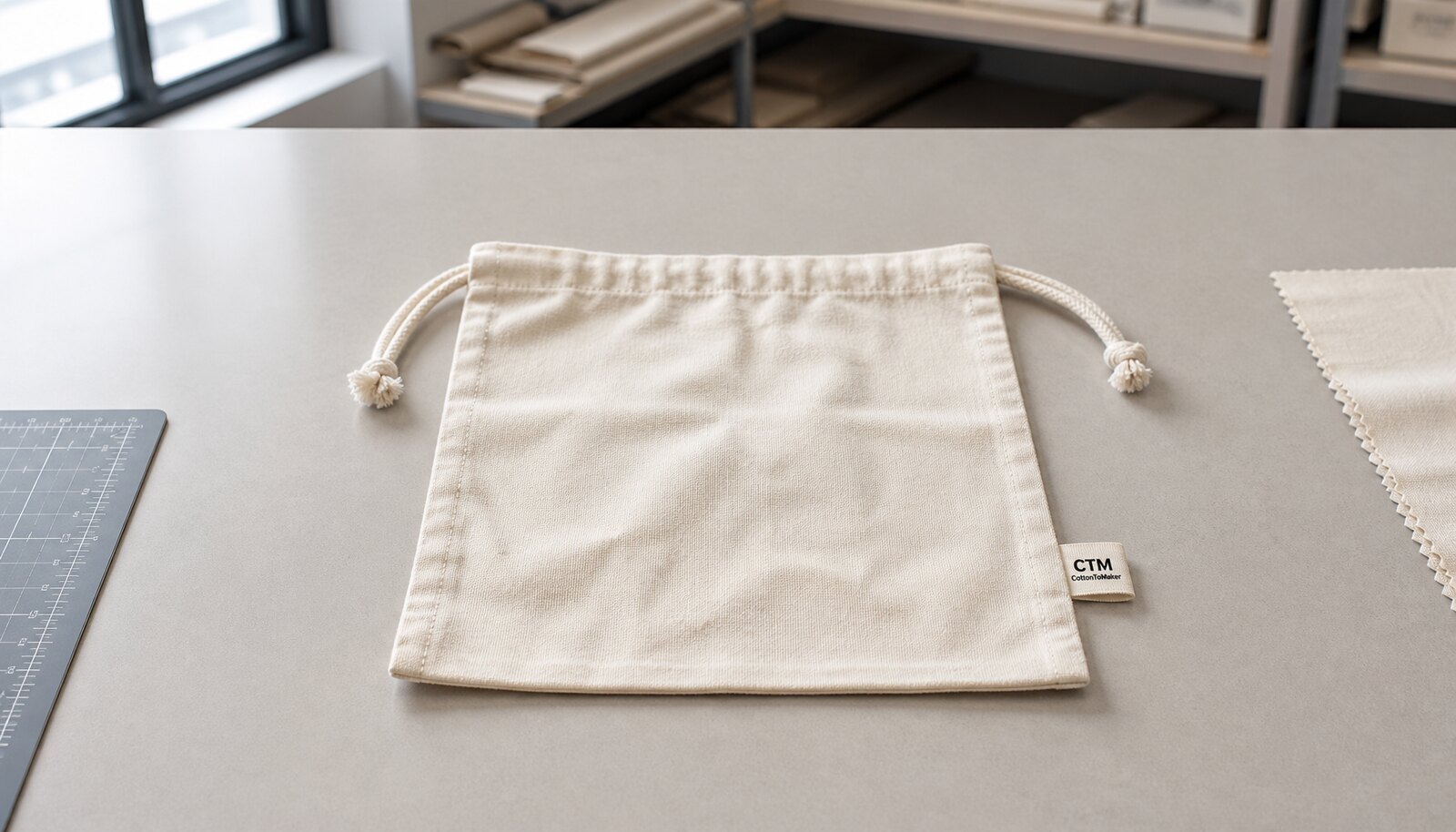
What buyers mean by personalized string bags, and why the wording matters
In procurement, personalized string bags can describe three different product families, and the quote changes as soon as the supplier interprets the brief differently. Some buyers want small drawstring pouches for jewelry, cosmetics, or gift sets. Others mean lightweight string bags for promotions, event kits, or retail inserts. A third group wants packaging that is branded and shelf-ready, but still simple enough to stay low cost. If the RFQ only says personalized string bags, one supplier may quote a soft pouch, another a flat cotton bag, and a third may send a stock item that looks close but is wrong for the channel.
The fix is to describe the product by use case, fill weight, finished size, and branding method. A pouch that holds a phone charger has different seam strength, cord length, and fabric weight than a bag that carries apparel or bundled merchandise. In the RFQ, spell out whether the bag must sit flat, close fully, stand on shelf, or tolerate repeated opening. That one paragraph removes most quote confusion and a lot of sample churn.
It also helps to name the buyer scenario. A trade-show giveaway can tolerate lighter fabric and a simpler finish. A retail gift bag inside a premium kit usually needs cleaner stitching, more stable print placement, and tighter packing control. Buyers who describe the channel, the fill item, and the end user usually get more usable quotations than buyers who only ask for a logo bag.
- State the end use first: retail gift, promotional insert, travel kit, e-commerce packout, or subscription pack.
- Separate appearance requirements from functional requirements such as closure strength, reusability, and shelf presentation.
- If the team uses the term string bag loosely, attach a reference photo and a dimension sketch with the RFQ.
Fabric and construction choices that change the quote
Fabric is the first major cost driver, and the weight choice should follow how the bag will be used. For cotton drawstring pouches, lighter promotional grades are often used for very small items or giveaways, while sturdier retail or gift packaging usually moves into heavier material. The right weight is not about sounding premium; it is about whether the bag holds shape, prints cleanly, and survives the intended handling path. If the fabric is too light, the bag wrinkles and collapses. If it is too heavy, it can become expensive quickly and may not cinch neatly.
Construction details matter just as much as fabric. A narrow cord tunnel can cut sewing time but may twist the cord or make closing awkward. Reinforced side seams, clean top hems, and consistent cord lengths matter when the bag is going through automated packing or retail handling. If the design includes a lining, contrast fabric, metal eyelets, or a gusset, the supplier should quote those as separate operations. Otherwise the first price looks attractive and the change order wipes out the savings.
Buyers should be careful about claims that sound precise but are not tied to the supplier's actual process. Ask for the fabric specification in the format the factory actually uses internally: composition, weave or construction, weight, width, dye method if relevant, and whether shrinkage has already been considered in cutting. Two bags can share the same label in an email and still perform very differently in production.
- Use a fabric weight band in the RFQ rather than only cotton, canvas, or nonwoven.
- Specify whether the bag must be single-layer, double-layer, lined, or gusseted.
- Ask for seam construction details if the contents are sharp, heavy, or high-value.
- Request fabric width and shrinkage assumptions if the supplier is cutting from roll goods.
Branding methods: choose the one that matches artwork, volume, and fabric
The logo method should follow artwork complexity, fabric weight, and order size. Screen printing is usually the cleanest answer for simple logos, flat branding, and larger runs because it keeps unit cost under control. Heat transfer works when the design has more colors or fine detail, but it needs a supplier that understands adhesion, surface prep, and rub resistance. Woven labels and sewn patches are useful when the bag needs a more retail-ready look and the logo must survive handling, folding, and abrasion.
Embroidery sounds premium, but it is not always the right choice on lightweight string bags. On thin cotton, dense stitching can pucker the fabric and distort the opening area. If the buyer wants embroidery, the factory should show how it will back the stitching and control density around the seam or tunnel. For any method, require the art in vector format, define the logo size in millimeters, and lock the Pantone reference if color accuracy matters. The less the supplier has to guess, the more predictable the first sample becomes.
Buyers comparing supplier quotes should also ask whether setup is a one-time charge or a per-color charge. A one-color screen print may look inexpensive until the supplier adds separate fees for each ink screen, color match, or positioning adjustment. If the artwork may change later, it is worth asking for the re-order price as well as the first-run price. That keeps the procurement team from selecting a quote that is only attractive on the first shipment.
- Screen print for simple logos, larger volume, and the lowest setup burden.
- Heat transfer for smaller runs with more colors or fine detail, provided the fabric can hold the decoration.
- Woven label, sewn patch, or embossed detail for a more retail-oriented finish.
- Ask whether artwork setup, screens, or color matching are one-time charges or repeated on every order.
How to read supplier quotes without getting misled
MOQ is not just one number. It usually reflects fabric roll minimums, print setup, sewing line efficiency, and packing labor. A supplier may quote a low MOQ for blank bags, then raise the minimum once the logo changes from one color to two colors. The buyer should ask for MOQ by size, color, and decoration method. If the project needs several colorways, the real MOQ is often the smallest production lot that still makes the fabric and print setup efficient, not the headline number in the email.
The quote itself should break out the main cost blocks. At minimum, it should show the bag spec, fabric type, print method, sample fee policy, packing format, and carton details. If the supplier gives one unit price with no reference to setup, packing, or carton count, the quote is incomplete. For internal comparison, ask for pricing at a few realistic volume bands, such as a pilot order, a core launch order, and a replenishment order. That makes the curve visible and helps the buyer see whether the supplier is truly competitive or only cheap at one volume point.
For personalized string bags, the price drivers are usually practical: fabric weight, print colors, number of sewing operations, pack configuration, and whether the order is produced in one batch or split across dates. Buyers should also ask whether the supplier is quoting ex-works, FOB, or delivered terms. A low ex-works price can be meaningless if cartons are oversized or if the freight cube is poor. The most useful comparison is not price per unit in isolation; it is landed cost per sellable unit under a real packing and shipping plan.
- Request MOQ by size, color, and artwork, not a single headline number.
- Ask for unit pricing at several order bands so the price curve is visible.
- Make sure setup, packing, and label fees are shown separately.
- Compare quotes on the same Incoterm and the same carton count.
Sample approval should remove ambiguity before bulk production
A sample is only useful if it is tied to a clear approval standard. For personalized string bags, the sample should confirm dimensions, fabric handfeel, cord length, logo placement, print density, seam finish, and packing format. If the first sample is merely close, the factory may treat that as permission to continue with the same variation in bulk. That is how a small mismatch becomes a full shipment issue. The buyer should sign off on the sample with notes that define what is acceptable and what must be corrected before production starts.
The better way to manage approval is to split it into a physical sample and a documentary approval. The physical sample confirms fit and finish. The documentary step captures the final art file, Pantone values, carton spec, and packing count. If the bag will be used in a retail program, compare the sample under the same lighting the customer will see, not only under the sample-room lights. A good sample process saves more money than a hard negotiation because it prevents rework, reprinting, and delayed shipping.
It is also worth asking which sample type is being sent. A sales sample may show the look but not the final process. A pre-production sample should reflect the approved fabric, size, print, and packing spec as closely as possible. If the order is first-time, artwork-heavy, or tied to a fixed launch date, request a top-of-production sample or first-off-run sample before the rest of the order is packed. That gives procurement one more chance to catch process drift while there is still time to correct it.
- Check sample dimensions against the target spec, not against the factory's usual tolerance.
- Approve final artwork, carton count, and packing format together so there is no mismatch later.
- If the order is first-time or artwork-heavy, request a top-of-production sample before full packing.
- Record what was approved in writing, including photos and marked-up measurements.
QC thresholds that matter on the factory floor
For drawstring bags, the most common defects are small but expensive: uneven seams, loose threads, crooked logos, inconsistent cord lengths, and poor closure action. A QC plan should not stop at visual appearance. It should define acceptable measurement tolerances, stitching quality, print accuracy, and basic use performance. For a small pouch, a tolerance around plus or minus 0.5 cm may be practical in some programs, but that should be validated against the bag size, material behavior, and end use rather than copied from a generic checklist. The point is not to invent a universal number; it is to set the number before production and apply it consistently.
Functional testing should match the intended use. If the bag holds light retail items, the main risks are print rubbing, cord fray, and open-edge seam failure. If it holds heavier contents, the load test and cord attachment points become more important than the look of the drawstring. The factory should be able to show first-off samples, in-line checks, and a finished inspection record. For branded goods, one rejected carton can cost more than the entire sample round, so the QC thresholds need to be specific enough that an inspector can use them without interpretation.
A practical inspection setup usually has three layers. First, a pre-production review confirms fabric, print file, and pack spec. Second, an in-line check catches recurring sewing or print errors while the run is still adjustable. Third, a finished-goods inspection reviews the packed cartons before release. Many buyers use a standard statistical sampling approach such as AQL-based inspection by lot, but the important point is to define the sample size, defect categories, and acceptance threshold in advance. If the supplier knows how many units will be inspected and what counts as critical, major, or minor, the conversation becomes far less subjective.
- Define measurement tolerances for height, width, cord length, and logo position.
- Set a load or pull test that reflects the real use case, with a safety margin.
- Require finished inspection records for stitching, print quality, and carton count.
- Use an AQL-based lot inspection or an equivalent sampling plan and write the acceptance threshold into the PO.
Supplier verification: who really controls the bag, the print, and the pack
A polished sales contact is not the same thing as a reliable factory. In this category, the buyer should verify whether the seller is the direct manufacturer, a trading company, or a local finisher. That matters because the party that controls the sewing line and print process is usually the one that can fix quality problems fastest. If the supplier is a trading company, ask which factory will make the bag, whether that factory is disclosed, and who owns the final release decision. If the answer is vague, your QC risk goes up even if the unit price looks attractive.
Traceability is the practical test. Ask how they track fabric rolls, print lots, and finished cartons. A good supplier can tie the production batch back to a material receipt, sewing line, and inspection record. For procurement teams buying into retailers or marketplaces, that paper trail matters because it helps isolate issues if a defect appears after delivery. It is also useful to ask who signs the inspection documents and whether the person signing is the same team that actually packed the goods.
Document review should be part of supplier qualification, not a late-stage request. Ask for business registration details, recent audit results if available, sample photos from a similar process, and documents that show they can handle the required decoration or packing method. If the supplier claims compliance capability, request evidence that matches the actual order: lot photos, test reports tied to the product type, and records showing when the inspection was performed. Generic certificates that are not linked to your order are less useful than a clean lot record and a clear corrective-action process.
- Confirm whether you are buying from a direct factory, trading company, or local finisher.
- Ask who owns final QC and who actually releases the shipment.
- Request traceability for fabric rolls, print lots, and packed cartons.
- Review lot-specific documents instead of relying on generic certificates alone.
Packing and carton decisions affect retail readiness and freight cost
Packing is often treated as an afterthought, but it drives both handling quality and freight cost. A drawstring bag that ships loose in a master carton may be fine for wholesale storage, while a retail program may need each bag folded a specific way, bagged individually, labeled, and counted into inner packs. If the packout is not written clearly, the supplier will choose the fastest method, not the one that supports your channel. For e-commerce or store replenishment, the pack format should also protect the cords from tangling and keep the logo facing the same direction in the carton.
Carton size matters because it changes cube, chargeable weight, and warehouse handling. Ask the factory to propose a carton count that balances protection and freight efficiency. If the order is export-bound, confirm master carton marks, gross weight, net weight, and moisture protection. A simple packing spec can save labor at the destination and reduce the risk of crushed corners, scuffed prints, or mixed sizes in one carton. The goal is to make the goods easy to receive, not just easy to produce.
For buyers comparing quotes, packing is one of the easiest places for hidden cost to appear. A supplier may quote a good bag price and then add charges for polybags, headers, barcode labels, carton inserts, or special folding. If the item is retail-facing, insist that the quote show the exact pack configuration and the number of labor steps. That gives procurement a fair view of what the supplier is actually offering and avoids a painful mismatch between the carton appearance in the factory and the shelf-ready unit at the destination.
- Specify whether the bags are bulk packed, inner packed, or individual polybagged.
- Ask for carton count, carton dimensions, and gross weight before booking freight.
- Use a pack format that prevents cord tangling and keeps retail-facing orientation consistent.
- Make labels, barcode placement, and carton marks part of the written spec.
Lead time, schedule risk, and landed-cost comparison
Lead time for personalized string bags is usually driven by more than sewing capacity. Material availability, print setup, artwork approval, sample revision, and carton procurement all add time before the first finished carton is ready. A first order typically needs more buffer than a repeat order because the factory has to stabilize the process. If the bag includes custom dyeing, special labels, or multi-step packing, the schedule should include extra time for each dependency. The buyer who asks only for a ship date often receives a date that assumes everything goes right. The better question is where the schedule can slip and who owns each step.
Landed-cost comparison should look beyond the ex-factory unit price. Freight, duty, local handling, repacking, and rejected cartons can change the economics fast. A cheaper blank bag with expensive local printing can cost more than a higher-priced direct factory order once the full path is counted. The practical comparison is simple: compare total landed cost per sellable unit, not only the supplier's unit quote. If the supplier cannot provide carton dimensions, pack counts, and a realistic production schedule, the landed-cost model is still incomplete.
For procurement teams, it helps to build a simple comparison sheet with three lines: unit price, expected non-product charges, and risk cost. Non-product charges include freight, duty, brokerage, local decoration, repacking, and inspection. Risk cost is the expected cost of defects, delays, or relabeling if the item misses the channel spec. That framework keeps the team from overvaluing a low factory quote that only looks good before the rest of the bill arrives.
- Add buffer for first orders, new artwork, and special packing.
- Compare total landed cost per sellable unit, not just factory price.
- Treat freight, duty, and repacking as part of procurement, not afterthoughts.
- Ask the supplier where schedule slip is most likely and who owns each dependency.
A practical quote comparison framework for buyers
When quotes arrive, the fastest way to compare them is to normalize three things: the bag specification, the production path, and the commercial terms. Two offers may both say personalized string bags, but one may use a lighter fabric, a different print method, and loose packing while the other includes retail folding, barcode labels, and carton inserts. Those are not equivalent offers. Procurement teams should line up the quotes on one sheet and note the differences in fabric, decoration, packing, and freight assumptions before comparing price.
A useful internal template is to list the supplier, manufacturer type, fabric spec, decoration method, MOQ, sample terms, production lead time, packout, carton data, payment terms, and Incoterm. Then add a column for what is not included. This is where hidden charges usually appear: one supplier excludes screens, another excludes hang tags, and a third excludes packing labor above a certain quantity. If the quote omits something material, treat it as a risk, not as savings.
If the project is important enough to source carefully, run the quote against a decision grid. Give points for manufacturing control, clarity of documentation, packing readiness, repeat-order pricing, and compliance support. Then weigh unit cost against risk. This is often more useful than choosing the lowest bid and hoping the details work out later. In B2B procurement, the cheapest bag is not always the cheapest program.
- Normalize quotes by spec, packing, Incoterm, and included operations.
- Capture exclusions in a separate column so hidden charges are visible.
- Use a simple scorecard for cost, control, documentation, and repeatability.
Specification comparison for buyers
| Spec decision | Recommended option | When it fits | Buyer risk to check |
|---|---|---|---|
| Lowest unit cost at scale | Direct factory quote with one body fabric, one decoration method, one pack format, and one carton spec | Repeat programs, forecasted replenishment, and artwork that will stay stable for multiple buys | Confirm whether screen setup, label sewing, inner polybags, and carton marks are included or quoted separately |
| Small test order | Local decorator using stock blanks or a factory with low-MOQ materials and minimal setup | Pilot launches, event testing, or channel validation where speed matters more than optimization | Check blank-bag source, shade variation, cord consistency, and whether the stock blank is truly the same construction as the quote |
| Multiple colorways or logos | Supplier that can coordinate variants while keeping one approved spec and one QC standard | Retail launches with regional artwork, retailer-specific branding, or staggered rollouts | Ask who makes the bag, who decorates it, and who owns final approval for every variant |
| Retail-ready packing | Factory that can fold, bag, label, and carton-pack to a written packout spec | E-commerce, store shelf, subscription box, and gift set programs | Demand line-by-line pack instructions; vague packing notes usually lead to rework or mixed pack counts |
| Thin fabric with clean branding | Screen print or sewn label on a bag body that can accept decoration without distortion | Light cotton, nonwoven, or economy drawstring pouches where embroidery would pucker the fabric | Check ink bleed, registration drift, curing, and whether the bag still cinches smoothly after branding |
| Fast replenishment after demand proof | Domestic converter or local printer finishing imported blanks with a fixed decoration spec | When speed is more valuable than absolute landed cost | Freight, duty, and local labor can erase savings if the blank is cheap but the finishing path is expensive |
| Compliance-heavy retail supply | Audited factory with lot traceability, documented QA, and repeatable packing controls | Chains, marketplaces, and buyers who need paperwork and batch-level records | Request lot-specific documents tied to your order, not generic certificates issued long before production |
| One-off event deadline | Stock-holding supplier with simple artwork and a fixed ship date | Urgent campaigns where the design is final and delivery matters more than tight cost optimization | Expect less control over exact shade, size tolerance, and finish than a fully custom run |
Buyer checklist before sampling
- Name the exact product type: drawstring pouch, lightweight string bag, or retail gift bag, so the supplier does not quote the wrong construction.
- State the end use, fill item, and target fill weight before asking for price.
- Confirm finished size, measurement tolerance, and acceptable shrinkage after printing or pressing.
- Specify fabric composition, weave or construction, and weight band rather than only saying cotton, canvas, or nonwoven.
- Lock the print method, print position, number of colors, and final artwork file format.
- Ask for MOQ by size, color, and artwork version, not just one global MOQ.
- Request sample type, sample fee, revision limit, and approval timing before bulk production starts.
- Define packing in writing: bulk pack, inner pack, individual polybag, barcode label, carton mark, and carton count.
- Ask for carton dimensions, gross weight, and units per carton so freight and cube can be estimated correctly.
- Set measurable acceptance criteria for stitching, cord length, logo placement, shade variation, and load performance.
Factory quote questions to send
- What exact fabric construction, composition, and weight band are you quoting for the body and the cord tunnel?
- Is the quoted price for blank bags, printed bags, or fully packed retail units?
- What is the MOQ by size, color, and print method, and where does the price break change?
- Does the unit price include printing, setup, label application, folding, inner packing, and carton labeling?
- Can you quote separate pricing for blank bags, one-color print, and multi-color print?
- What sample will you send first: sales sample, pre-production sample, or first-off-run sample?
- What are your standard measurement tolerances for width, height, cord length, and logo placement?
- What carton size, packing quantity, and gross weight do you recommend for export?
- What inspection records, test reports, or lot photos can you provide before shipment?
- Who is the actual manufacturer, and what part of the job would be subcontracted, if any?
Quality-control points to confirm
- Measure finished bags against the approved spec sheet: width, height, opening, seam allowance, cord length, logo position, and carton count.
- Set an AQL plan before production. For most buyer shipments, inspect by lot using a standard sampling method such as ISO 2859-1 or a buyer-defined equivalent, then record critical, major, and minor defects separately.
- Define pass/fail criteria in the PO or QC sheet: no critical defects, major defects below the agreed limit, and minor defects only within the tolerated sample count.
- Check stitching density, seam straightness, corner reinforcement, thread trimming, and cord tunnel integrity.
- Verify fabric shade consistency by lot and by carton, especially if material came from more than one dye batch.
- Test the closure action: cords should run smoothly, cinch evenly, and not snag at the tunnel exit or eyelets.
- Check print quality under practical light: registration, edge sharpness, ink bleed, curing, and rub resistance after handling.
- Run a load or pull test that reflects actual use, then inspect for seam opening, cord slippage, tunnel damage, or torn stitching.
- Review first-off or top-of-production samples before full packing when the order is first-time, artwork-heavy, or schedule-critical.
- Confirm packing count, barcode readability, shipping marks, carton integrity, and moisture protection before cartons leave the factory.