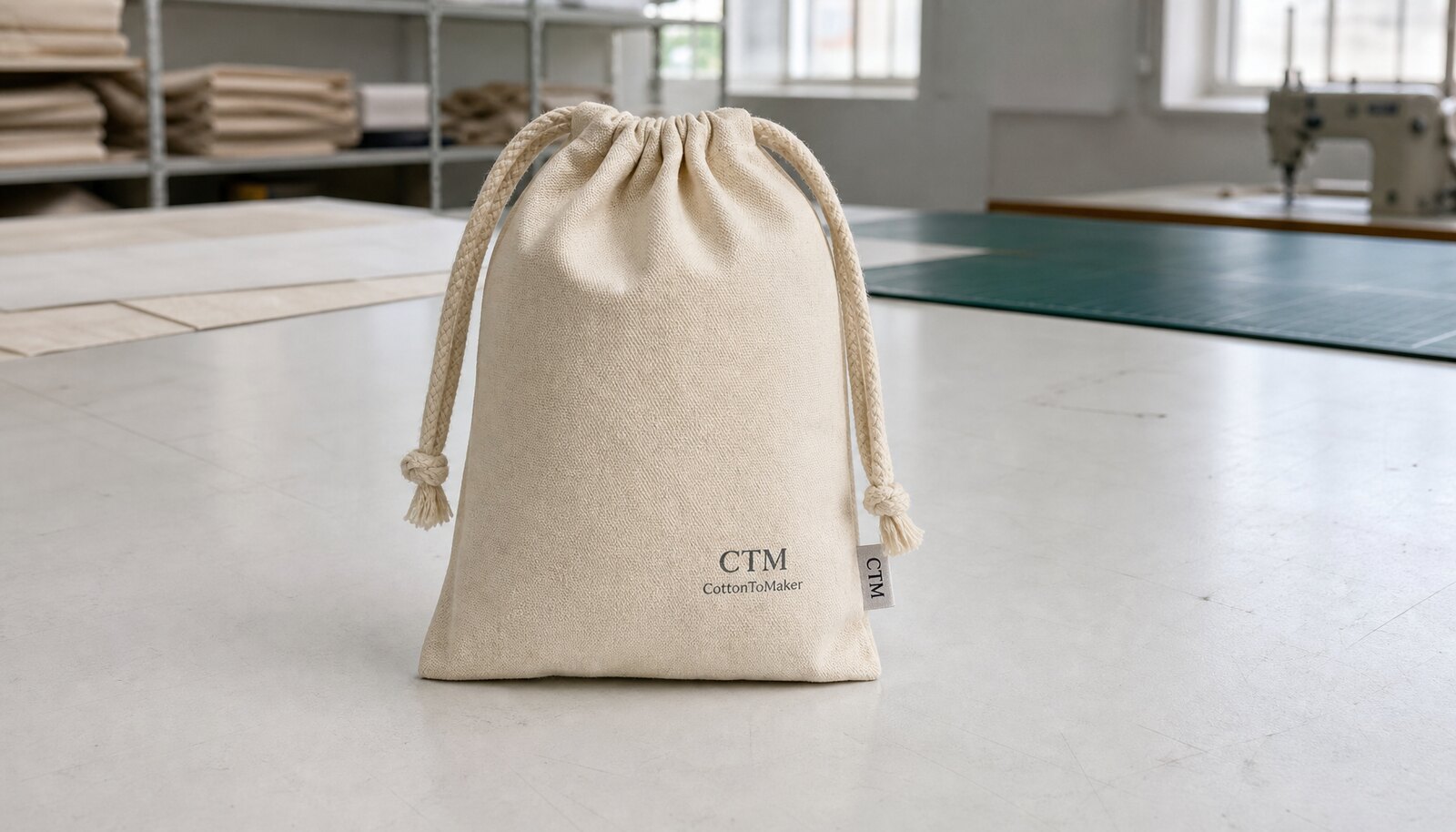
Start With the Use Case, Not the Bag
Personalized small drawstring bags look simple, which is exactly why procurement teams often under-spec them. The item may be tiny, but the commercial use can be very different: jewelry packaging, cosmetic sampling, event gifting, subscription inserts, retail resale, or internal bundling. Each use case changes the risk profile. A pouch that only protects a folded insert does not need the same seam strength, color consistency, or cord durability as a bag a consumer will reuse at home. If the buyer does not define the use case first, the supplier will fill in the blanks with assumptions, and those assumptions are rarely aligned with the program.
A good RFQ begins with what will go into the pouch, how often it will be opened, whether the bag is visible on shelf, and whether the end customer will keep it. That context affects fabric choice, closure feel, logo visibility, and how much finishing effort is justified. A 9 x 12 cm jewelry pouch and a 12 x 18 cm retail accessory pouch can both be called small, but they are not the same product commercially. One can prioritize speed and unit cost; the other may need better hand feel, more consistent dimensions, and cleaner presentation. Buyers should not ask for pricing until they can answer those basic questions clearly.
- Define the contents, including sharp edges, moisture sensitivity, or the need for surface protection.
- State whether the bag is packaging only, a gift item, or a sellable retail pouch.
- Write finished size in centimeters and clarify whether the measurement includes the channel or only the body.
Build the Spec Around Fabric, Weave, and GSM
Fabric is the first real price lever for personalized small drawstring bags. Lightweight cotton or muslin in the 90-120 gsm range is usually suitable for samples, jewelry, sachets, and light promotions. For better retail presentation or repeated handling, 120-150 gsm is often a safer middle ground because it balances cost, print clarity, and a more substantial hand feel. If the pouch is supposed to feel premium, stand up better on a shelf, or survive repeated use, canvas or a heavier plain weave in the 160-220 gsm range can work well, but the supplier must also adjust stitching and channel construction so the bag does not feel oversized or bulky at the opening.
GSM alone does not tell the whole story. Two bags with the same nominal weight can behave very differently if one is loosely woven and the other is tightly woven. The weave impacts how the cord glides, how print sits on the surface, and whether the pouch keeps its shape after packing. Buyers should also ask whether the fabric is stock greige, bleached, dyed, or custom finished. A stock natural cotton pouch may be cheaper, but if the pouch is going into a controlled retail environment, the shade variation, lint level, and surface consistency need to be understood before the PO is released.
Shrinkage is another area that gets ignored until the first sample comes back undersized. Cotton can shrink after printing, washing, or heat exposure, and suppliers handle that differently. Some factories pre-shrink fabric, others build shrinkage into the cut size, and some do neither. Buyers should ask for the supplier’s shrinkage assumption and the test condition behind it. For a pouch that must remain dimensionally accurate, a small difference in fabric behavior can move the logo too close to the seam or reduce the usable opening more than expected.
- 90-120 gsm: light promotions, jewelry, sachets, and low-cost packaging.
- 120-150 gsm: better for reusable pouches and retail-facing programs.
- 160-220 gsm canvas: stronger visual presence, but it typically increases sewing difficulty and bulk.
- Ask whether the fabric is pre-shrunk, custom dyed, or stock natural, because each changes the final fit and cost structure.
Match Decoration Method to Order Size and Brand Risk
Decoration is where many quote comparisons become misleading. A one-color screen print, a multi-color digital print, a woven label, and embroidery all create different unit costs, setup demands, and defect risks. For simple logos on cotton, screen printing is usually the cleanest commercial choice because it can be repeatable and cost-effective. It works especially well when the logo is not too fine and the order size justifies the setup. Digital print can support more detailed artwork and short runs, but buyers should confirm how the ink behaves on the chosen fabric and whether the result stays soft enough for a pouch that will be folded or tied repeatedly.
Heat transfer can be practical for short runs or artwork with fine detail, but it is less forgiving if the pouch is compressed in transit or handled heavily. Embroidery is often requested for premium perception, yet on a small pouch it can create puckering, uneven tension, or a hard spot near the opening. That is a commercial trade-off, not a design preference. For many small drawstring formats, a woven side label or a single-color print produces a cleaner retail result than dense embroidery. Buyers should also keep the logo away from the drawstring channel and seam lines so the artwork does not distort when the pouch is closed.
The right decoration method also depends on how the bag will be sold. If it is a premium retail pouch, buyers should care about the feel of the decoration, not just visibility. If it is an insert item or a promotional giveaway, unit cost and acceptable defect rate may matter more than surface nuance. Suppliers can price very differently when they assume different commercial intent, so that intention should be stated before any price is accepted.
- Use screen print for simple logos and more stable unit cost.
- Use digital or transfer printing when the artwork needs more color detail or the quantity is small.
- Use embroidery only if the fabric weight can support it without puckering or hard spots.
- Keep decoration away from the channel and seam line to avoid distortion when the pouch is pulled closed.
Read MOQ as a Production Constraint, Not a Sales Tactic
MOQ on personalized small drawstring bags is usually tied to actual manufacturing constraints: fabric roll utilization, print setup, cutting yield, sewing line efficiency, packing labor, and the number of variants in the order. A supplier is not inventing the floor at random. If the order uses stock fabric with a one-color logo and standard packing, MOQ can be relatively low. Add custom dyeing, multiple sizes, woven labels, hangtags, or specialized retail pack-outs, and the practical floor rises fast. That is why buyers should separate the MOQ for the base pouch from the MOQ for the final decorated product.
A useful way to think about MOQ is to ask what changes when the order gets smaller. Does the supplier raise the unit price, reduce packing detail, limit color options, or relax the inspection standard? Sometimes the low MOQ quote is not really cheaper; it simply compresses the product into the factory’s simplest route. If the brand expects repeat orders, it may be better to lock a slightly larger opening order on a stable spec than to chase the absolute minimum and then pay for inconsistency later. In other words, MOQ should be evaluated against the repeat-program plan, not treated as a standalone win.
For many factories, a one-color print on stock cotton may sit around 1,000 to 3,000 pieces, while custom fabric, more complex graphics, or multiple size breaks can move the practical MOQ to 5,000 pieces or more. Those numbers are not universal, but they help buyers understand the direction of travel. The important part is to ask the supplier which line item is driving the floor and whether there is a lower-risk way to structure the first order. Sometimes the answer is a simpler label, a stock cord color, or a single combined size run rather than multiple sub-SKUs.
- Ask separately for MOQ on fabric, decoration, labels, and pack-out.
- Expect the MOQ to rise when you add size breaks or multiple colors.
- A lower MOQ often means a simpler spec, not just a smaller order.
Use a Commercial Comparison Table, Not a Route List
Procurement teams get more value from a spec-based comparison than from a route-based one. When suppliers quote personalized small drawstring bags, the meaningful differences are usually fabric weight, weave, decoration method, seam construction, cord details, packing standard, and QC rigor. Two quotes may both say “cotton pouch,” but one could be 100 gsm stock cotton with a one-color screen print and bulk carton packing, while the other is 140 gsm fabric with woven branding, folded retail pack-out, and tighter tolerance control. Those are not equivalent bids.
To normalize quotes, buyers should compare the same finished size, same fabric type, same GSM, same cord specification, same decoration method, same pack count, and same Incoterm. If a supplier changes any of those variables, the quote must be reopened or adjusted. When the commercial team has a clean matrix like that, it becomes much easier to see whether the price gap is due to material, process, or simply markup. The most useful supplier is not necessarily the cheapest one on the first sheet; it is the one that can explain the spec clearly and stand behind the numbers after sampling.
- Normalize all quotes to the same size, fabric, GSM, print method, and packing.
- Ask suppliers to separate setup charges from recurring unit cost where possible.
- Do not compare a stock-bag quote against a custom-dyed or retail-packed quote as if they were the same product.
Verify the Supplier Before You Request Final Pricing
Supplier verification should happen before the buyer treats a quote as real. A clean commercial proposal is useful only if the factory can actually make the item at the quoted spec. For personalized small drawstring bags, the key question is whether the supplier controls the steps that matter: sewing, cutting, print application, and final packing. If those steps are subcontracted, the quote may still be workable, but the risk profile changes. A supplier who only acts as a coordinator can be fine for some programs, but the buyer needs to know where quality is truly being controlled.
The evidence request should be practical, not ceremonial. Ask for photos of similar pouches from multiple angles, not just the front artwork. Request inside seam images, channel finishing shots, and carton photos from a comparable order. Ask who the actual maker is, where the factory is located, what inspection process is used, and whether they can provide a recent audit or quality record from a comparable line. If the supplier claims to be a factory, the factory should be able to explain the production flow without hesitation. If the response is vague, the buyer should treat that as a sourcing signal.
This matters because small pouches can fail in ways that are not obvious from the front view. A supplier can show a clean logo sample while hiding uneven seam allowance, weak corner reinforcement, or rough channel stitching. Buyers should verify the ability to keep measurements, manage fabric shrinkage, and maintain clean pack-out at scale. If the order is for retail resale, the supplier’s ability to maintain appearance consistency is part of the commercial value, not an optional extra.
- Ask whether sewing, printing, and packing are in-house or subcontracted.
- Request photos of the inside seams, channel, and carton pack-out from a similar product.
- Treat vague answers about factory identity or process ownership as a sourcing risk.
- Ask for a recent inspection summary or sample QC record on a comparable pouch line.
Approve Samples With Measured Criteria and Failure Modes
Sample approval should be a measurement exercise, not a quick visual thumbs-up. For small drawstring bags, the buyer should check finished width, finished height, channel depth, seam allowance, cord length, and print placement against the agreed spec. A sample that looks attractive can still be commercially wrong if the opening is too narrow, the logo sits too close to the seam, or the cord pulls unevenly. The approved sample should represent the intended bulk method, not an isolated lucky piece.
A practical approach is to approve one master sample for each critical variant and keep it physically labeled. If there are multiple colors, multiple logos, or multiple sizes, each variant should have its own reference point. Buyers should also measure multiple pieces from the sample lot, not just the best-looking one, because variation is the real issue in production. For small pouches, a tolerance of plus or minus 0.5 cm on finished dimensions is often workable, but tighter tolerances may be needed if the item nests into another package or displays in a retail set.
It also helps to ask what can go wrong, not just what looks good. Does the fabric fray at the cut edge? Does the cord knot slide? Does the print crack when the pouch is folded? Does the seam pull open near the channel after repeated use? When the buyer identifies likely failure modes during sampling, the factory can be asked to control them before bulk production starts. That is much cheaper than arguing about defect ownership after the shipment is complete.
- Measure at least 10 sample pieces before approval.
- Check the cord pull several times to see whether the tunnel twists or jams.
- Approve the actual fabric color, not only the artwork proof.
- Keep one labeled master sample for each critical size or artwork version.
Write Packing Instructions as if the Product Must Survive Transit
Packing is easy to underestimate because it looks like a logistics task, but for personalized small drawstring bags it can affect appearance, yield, and claims. Loose bulk packing is the cheapest route and often works for internal use, but the bags may arrive wrinkled, dusty, or uneven. Retail-ready packing costs more because it adds folding logic, inner polybags, labels, and sometimes insert cards or barcode application. That extra work is often justified if the product is going into store replenishment, e-commerce fulfillment, or branded gifting programs where presentation matters.
The buyer should define how the pouch is folded, whether it is flat packed or lightly stuffed for shape, how many pieces go into each inner bag, and whether the carton is mixed or single-SKU. For export or long warehouse dwell times, carton quality matters more than many teams assume. Thin cartons can crush soft pouches and distort print areas, especially if cartons are stacked too high or exposed to humidity. Ask for master carton dimensions, weight limits, and whether a liner or desiccant is needed when the route is sensitive. If a suffocation warning is required in your market, include that in the spec rather than expecting the factory to infer it.
Carton drop and pack tests are worth considering when the bags are going into an e-commerce or retail program. A simple inner-pack structure can break down during transit if the carton is weak or the load shifts. Buyers do not need a laboratory for every pouch order, but they do need enough packing detail to avoid a product that looks clean in sample form and messy in the destination warehouse.
- Specify inner pack count, fold method, and carton count per SKU.
- Check whether barcode placement blocks the logo or care instructions.
- Use stronger cartons if the pouch is printed, embroidered, or crease-sensitive.
- Include carton marks, warning labels, and any retailer-specific pack rule in the PO.
Plan Quality Control Like a Factory, Not a Guess
Quality control for personalized small drawstring bags should be specific enough that the factory can actually inspect against it. Size tolerance is only the starting point. Buyers should define stitch density or at least the expected seam consistency by seam type, then set requirements for seam allowance, thread security, and channel finish. On small pouches, loose thread ends and uneven seam width are more visible than on larger bags, and weak finishing near the channel can cause the drawcord to catch or the opening to deform. A strong QC note does not need to be overcomplicated, but it does need to be measurable.
AQL logic is helpful because it gives both sides a common language for acceptance. The buyer can define major, minor, and critical defects and then use a sampling plan that fits the order size. Critical defects might include open seams, missing cords, or contaminated fabric. Major defects could include bad print placement, visible hole damage from needles, or color mismatch beyond the agreed standard. Minor defects might include slight loose threads or small cosmetic irregularities that do not affect use. The point is not to make the list long; the point is to make it unambiguous.
Colorfastness should be handled carefully if the pouch will be reused or washed. If the program requires it, ask the supplier which test standard they follow and what pass level they can document. Similarly, needle damage limits should be stated so the factory knows what is acceptable around the channel, corners, and print area. Buyers who want manufacturing-level scrutiny should ask for a pre-shipment inspection format, a carton count check, and photo evidence of packed goods before the shipment leaves the factory.
- Define major, minor, and critical defects in the PO or tech pack.
- Ask for an AQL inspection plan rather than a vague “100% checked” promise.
- Set requirements for seam allowance consistency, stitch integrity, and channel finishing.
- Include colorfastness, needle damage, and loose-thread limits where the end use makes them relevant.
Normalize Landed Cost Before You Choose the Supplier
The cheapest factory price is not the lowest landed cost. Personalized small drawstring bags often carry hidden cost items that only appear once the production spec is finalized: artwork setup, custom labels, carton printing, insert cards, freight, destination handling, and the cost of correcting an under-specified sample. Procurement teams should build a landed-cost view that starts with the factory quote and adds every known downstream expense. If one supplier includes carton marks and another does not, the quote gap is not comparable until those items are normalized.
A practical landed-cost model should also account for process risk. A lower unit price can be wiped out by delayed sampling, rework, poor pack-out, or the need for urgent air freight. If the bag is part of a launch or seasonal program, lead time risk may be more expensive than a modest unit-cost difference. That is why the best commercial comparison is not “who quoted the lowest price,” but “which supplier can deliver the agreed spec at the lowest total cost with acceptable risk.” Buyers who structure the decision this way usually make better repeat sourcing decisions and avoid one-off bargain mistakes.
When comparing multiple offers, use the same assumptions for shipping terms and documentation. A quote on EXW basis should not be measured against a DDP quote without adjusting the transport and clearance costs. The same is true for testing and compliance. If one supplier has included third-party test support and another has not, the procurement team needs to add that expense before the comparison is complete. Once the quote is normalized, the trade-offs are usually much clearer: lower fabric cost versus better finish, lighter packing versus better transit protection, or lower MOQ versus less control over presentation.
- Compare total landed cost, not just factory ex-works pricing.
- Add missing items such as cartons, labels, test fees, freight, and destination handling before ranking offers.
- Do not mix EXW, FOB, and DDP quotes without converting them to the same basis.
- Include the cost of delay and rework when the item is tied to a launch or seasonal drop.
Specification comparison for buyers
| Supplier route | Best-fit commercial scenario | Fabric / construction strengths | MOQ and pricing pattern | QC / verification risk to check |
|---|---|---|---|---|
| Direct factory with in-house sewing and decoration | Repeat retail or promotional programs where spec stability matters | Better control of fabric GSM, seam construction, cord channel, and print placement | Usually sharper unit price at scale, but may require higher MOQ and clearer artwork readiness | Verify that sewing, printing, and packing are truly in-house and not split across subcontractors |
| Trading company or sourcing agent | Multi-SKU programs or buyers consolidating several packaging items | Can coordinate pouch, label, carton, and accessory sourcing in one file | Often more flexible on cross-category buying, but margin can be embedded in the quote | Ask for factory identity, inspection records, and who signs off on defects |
| Specialist pouch factory | Small pouch programs where finish quality and repeatability matter | More likely to understand tunnel stitching, cord behavior, and neat retail presentation | MOQ may be moderate; pricing is usually more predictable when the spec is mature | Request comparable pouch samples, not just tote bag references |
| General bag factory | When pouches are one line within a broader bag program | Good if the same factory already makes cotton goods, totes, or packaging items | Often competitive if the product shares materials or print lines with existing SKUs | Confirm they can hold small-format tolerances without distorted openings or weak corners |
| Local decorator / regional print shop | Short-run launches, event drops, or urgent replenishment | Fast for stock pouches and simple decoration, especially if lead time is tight | Low setup friction, but base bag availability and fabric control may be limited | Check whether the pouch itself is controlled or merely decorated after purchase |
| Contract packer with outsourced sewing | Kitting, gifting, or retail pack assembly programs | Useful when pouch insertion, labeling, and final pack-out are the main job | Commercially attractive for assembly-heavy orders, not for construction quality | Separate sewing QC from packing QC and request proof of both |
Buyer checklist before sampling
- Write the finished size in centimeters and state whether the channel, seam allowance, or body-only measurement is being used.
- Specify the fabric type, weave, and target GSM, then tie it to the item weight and intended use.
- Choose the decoration method before requesting price, because print setup and yield change by process.
- State whether the pouch is packaging only, a gift-with-purchase insert, or a retail product with reuse expectations.
- Lock cord material, diameter, length, and end treatment, including knots, tips, or concealed ends.
- Request a pre-production sample on actual fabric color, not just a digital proof.
- Define pack-out: units per inner bag, cartons per SKU, carton marks, barcode placement, and retail-ready labeling if needed.
- Confirm quote basis and exclusions: EXW, FOB, DDP, testing, labels, hangtags, cartons, inserts, and freight.
- Set measurable acceptance criteria for size tolerance, print position, seam appearance, and defect limits.
- Compare lead time from sample approval and deposit, not from the first inquiry date.
Factory quote questions to send
- What is the MOQ by size, fabric color, and artwork version?
- Is the fabric stock, custom dyed, or custom woven?
- Which decoration process is being priced, and what setup charges are included?
- What finished dimensions are you quoting, and what tolerance will you hold in bulk production?
- What GSM, shrinkage allowance, and pre-shrinking assumption are built into the price?
- What cord type, diameter, and length are included in the unit price?
- What packing standard is included, and what items are charged separately?
- Can you share photos and measurements of a similar pouch, including inside seams and channel finishing?
- Which testing or third-party certification records can you provide for similar material or print claims?
- What is the production lead time after sample approval, and what usually causes delays?
Quality-control points to confirm
- Finished width and height should match the agreed tolerance, typically plus or minus 0.5 cm for small pouches unless the spec requires tighter control.
- Seam allowance should be defined in the tech pack, commonly 0.5-1.0 cm depending on fabric weight and construction; inspect for consistent allowances on left/right sides.
- Stitch density should be specified by seam type, with the sewing line checked for even SPI, skipped stitches, broken thread, and back-tack security at stress points.
- Needle damage limits should be clear: no visible holes, snags, or fabric runs around the channel, corners, or logo area beyond the approved standard.
- Cord pull should be smooth with no snagging, tunnel twisting, or uneven tension after repeated open-close cycles.
- Print placement should stay within the approved registration tolerance; for small logos, a 2 mm shift may be acceptable, but dense or multi-color artwork usually needs tighter control.
- Color should be checked against the approved swatch under daylight and D65-like viewing conditions; ask for colorfastness references if the pouch will be handled, stored, or washed.
- For colorfastness, request supplier evidence against the relevant standard used in your market, such as wash, rub, or crocking testing with a stated pass method.
- For reusable retail pouches, define rub or wash requirements in the PO if the claim depends on it; do not assume the factory’s standard is enough.
- Pack count, barcode, carton mark, and inner pack quantity should match the PO exactly, with sample carton labels checked before bulk packing.