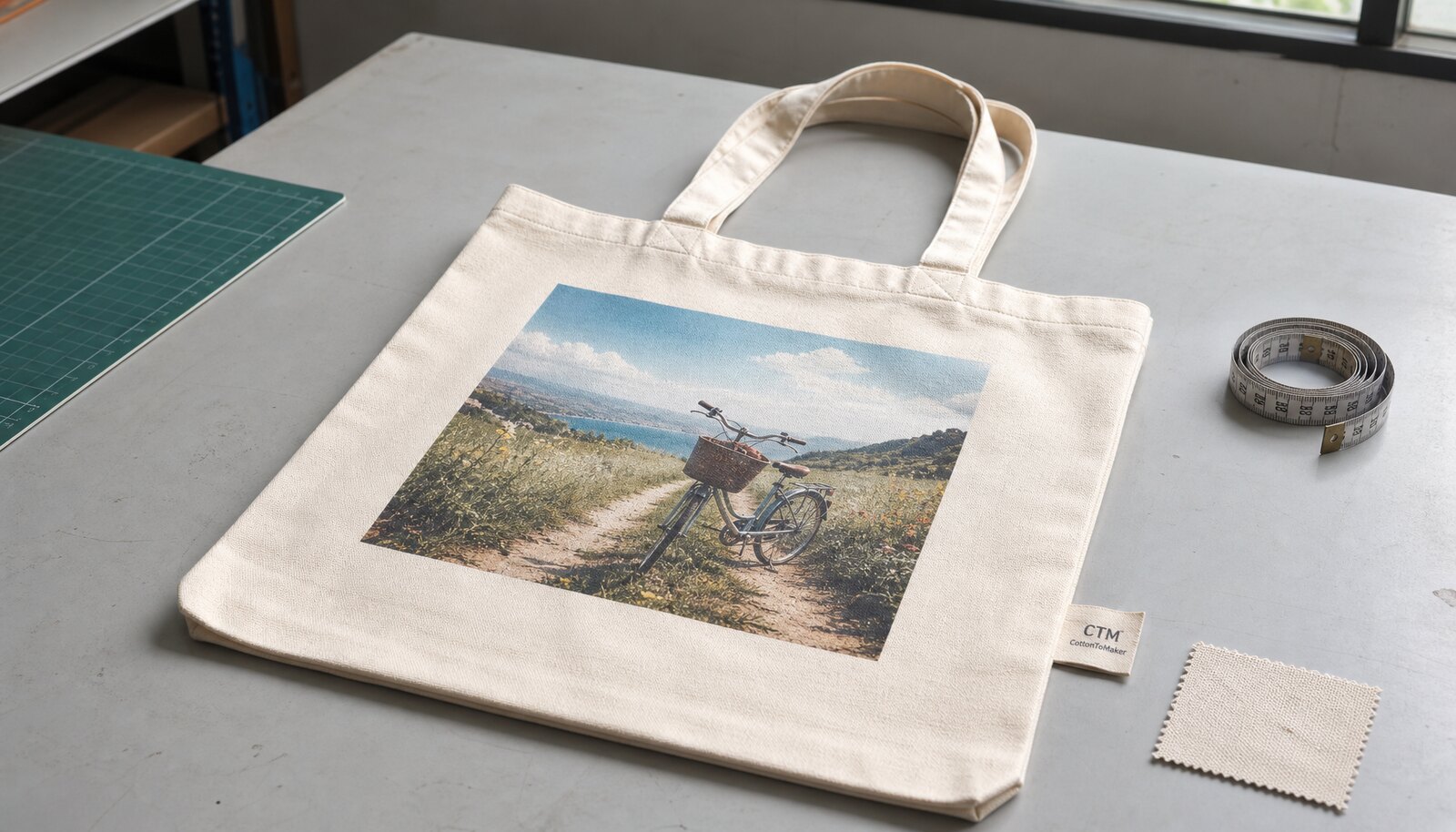
Why photo totes fail in sourcing
Personalized photo canvas tote bags look simple from the outside, but they are harder to source than a standard logo tote. The image itself is only one part of the product. The canvas weave, fabric color, print method, folding line, and packing method all change how the photo reads once the tote is sewn and shipped. A file that looks sharp on screen can lose contrast on open-weave canvas, and dark areas can become muddy if the printer or fabric is not the right match.
The buying issue is not whether the tote can carry a photo. It is whether the finished bag will reproduce the image cleanly enough for the channel you are selling into. A retail brand needs consistent color and clear facial detail. A promotional buyer may care more about unit cost and speed. Before you ask for a quote, define whether this is a merch SKU, a gift item, or a volume giveaway, because that decision changes the acceptable print method, inspection level, and packing spec.
- Use the intended channel to set the acceptable image quality, not the sample image alone.
- A tote sold at retail needs tighter print control than a one-time event bag.
- If the artwork includes faces, skin tones, or fine text, the supplier should show actual production output, not a mockup.
Start with the canvas body, not the artwork
For photo printing, the base tote matters more than buyers expect. A 12 oz canvas, roughly 340 gsm, is a common starting point because it balances print stability, body, and cost. If you want a more premium hand feel or a bag that keeps its shape better on a shelf, move toward 14 oz or 16 oz, about 400 to 450 gsm. Very light canvas can show the weave too strongly and reduce image clarity. Very heavy canvas can increase freight cost and make the bag feel stiff in hand.
The finish of the fabric matters as much as the weight. Natural cotton canvas, bleached canvas, and dyed canvas do not accept print the same way. A bleached body can make whites and bright colors appear cleaner, while a natural body gives a warmer, more eco-looking result. Dyed canvas can work, but it adds one more variable to color control. If you are planning a dark photo or a high-contrast design, ask the factory to print a strike-off on the final fabric lot. If the tote will hold books, groceries, or samples, ask for reinforcement at the handle base and the bottom seam. The bag should be built for use, not just for the first photo.
- For photo-heavy artwork, avoid very slubby or uneven canvas unless the texture is part of the design.
- Ask whether the fabric is pre-shrunk or washed, because shrinkage can shift print placement after sewing.
- If you need a dyed body, have the supplier confirm colorfastness and whether the dye lot changes the final print result.
Choose a print method that can hold the image
For personalized photo canvas tote bags, direct digital print is usually the most practical route. It handles gradients, skin tones, and mixed-color images without forcing the buyer to pay for multiple screens. It also works better when you need several personalized versions in one program. The tradeoff is that the printer must control fabric pretreatment, ink saturation, curing, and wash performance well enough to keep the image clean on woven cotton.
Screen print still has a place, but mainly when the image can be simplified into a small number of colors or when the brand wants a bolder graphic look. Heat transfer can work for very short runs or fast trials, but it often feels less integrated into the fabric and can become a risk on a reusable tote. Sublimation is only relevant if the fabric construction supports it; on normal cotton canvas it is generally the wrong process. Buyers should treat print method as a commercial choice, not a decoration preference.
The practical rule is simple: the more photographic the image, the more you should push toward a digital path with a real fabric proof. If the supplier wants to switch methods to save cost, ask them to show what detail will be lost and whether that loss is acceptable for your channel.
- Use digital print when the photo includes gradients, faces, or a full-color background.
- Use screen print only when the design can be flattened without losing the message.
- Demand a final-fabric strike-off with the actual print method, not a color proof from a separate material.
- If a supplier proposes heat transfer, ask about edge lifting, hand feel, and whether the graphic can survive folding without visible damage.
MOQ and pricing logic are tied to personalization
MOQ on photo totes is usually driven by three things: fabric reservation, print setup, and sewing efficiency. A factory can often keep digital print setup lower than a multi-screen job, but it still needs a minimum run to justify cutting, finishing, and packing. If your order has many personalized versions, ask whether the factory will combine them in one production batch or charge a separate minimum for each artwork file. That is where quotes drift apart.
A quote becomes easier to compare when the supplier separates the bag body from the print and from the packing. A direct factory may show one unit price that includes everything, while another quote may exclude labels, polybags, or individual inserts. For procurement work, that is not detail. It is the difference between a quote you can use and a quote you have to rebuild. Common breakpoints in this category are often 300, 500, 1,000, and 3,000 pcs, but the useful number is the one the factory applies to your exact art file and packing spec.
If the supplier refuses to itemize, ask for a cost stack in plain terms: fabric, sewing, print, trim, packing, sample, carton, and inland handling. If they still only offer one lump sum, ask what is excluded. The answer usually tells you whether the quote is usable or just convenient.
- Ask for MOQ by artwork, not only by total quantity.
- If you need multiple photo versions, confirm whether they can share the same fabric and sewing run.
- Treat a very low unit price as incomplete until you see the setup, packing, and sampling lines.
How to read a factory quote without missing cost
A useful quote for personalized photo canvas tote bags should name the fabric weight, finished size, handle length, print area, print method, artwork count, packing method, carton size, lead time, quote validity, and any inspection or sample fees. If the supplier only gives you a single unit price, the quote is not ready for buying. You need enough data to compare one factory against another on the same basis, otherwise the cheapest line item often hides the weakest spec.
Do not compare quotes by the final number alone. Compare the assumptions. One supplier may be using a thinner 10 oz canvas, a smaller print area, and bulk packing. Another may be using 12 oz canvas, a larger print window, individual polybags, and a sewn brand label. That second quote can look higher and still be the better commercial decision. The same logic applies to sample fees. If a supplier charges for sample development but gives you a production-accurate proof, that fee can save a much larger remake later.
A practical comparison sheet should show four columns: what is included, what is excluded, what is the assumption behind the price, and what changes the price. That format keeps the conversation out of vague territory and makes supplier negotiation much easier.
- Demand separate lines for bag body, print, trim, packing, sample, and any extra tooling.
- Confirm whether the print price is for one side or both sides.
- Check whether the quote includes barcode stickers, tissue paper, or retail inserts if you need them.
Sample approval should use the final fabric and final print path
For a photo tote, the sample is the decision point, not a formality. A PDF proof tells you layout and color intent, but it does not tell you how the image will sit on woven canvas. Approve a pre-production sample made on the same fabric, with the same print method, same label, same handle construction, and same folding direction that will be used in bulk. If the order is color-sensitive, request a strike-off before the sewn sample so the factory can correct the print profile early.
When you review the sample, look at the parts that usually fail in production. Faces should not be cropped awkwardly. Dark zones should not fill in and lose detail. Fine edges should not bleed into the fabric texture. The tote should also survive practical handling, so fold it, rub it, and carry weight in the sample before approval. If the sample looks good flat but fails at fold lines, the bulk run will not improve on its own.
Set a sample turnaround expectation in advance. For a routine repeat program, the buyer may only need a few days after the supplier receives complete artwork and fabric confirmation. For a new image or new fabric lot, allow more time because the print result may need one or more correction rounds. The important part is not the exact number of days; it is that the supplier agrees to the path from first proof to final approval.
- Approve the sample under the same lighting you will use for final sign-off whenever possible.
- Write down the accepted crop, placement, and color tone so later disputes do not become subjective.
- If the bag is sold retail, approve packaging at the sample stage, not after the first bulk carton arrives.
QC thresholds that matter on photo canvas totes
Photo totes need both visual QC and basic functional QC. Start with size tolerance, handle length, stitch strength, and seam cleanliness. Then move to image quality. A tote can be technically within size tolerance and still be unacceptable if the photo has heavy banding, missing facial detail, or a shifted crop. For many buyer programs, size tolerance around plus or minus 1 cm is workable, while handle and print placement should be tighter if the artwork is centered or symmetrical.
The supplier should also define what defects trigger rejection. Loose threads may be acceptable in very small numbers if they do not affect use, but open seams, stain marks, broken bartacks, missing labels, and print smears are not. For image-heavy work, visual review should happen before packing, because a bad image packed into retail cartons is expensive to sort later. If the order is large enough, ask the factory to share in-process QC photos from cutting, printing, and final packing. That does not replace inspection, but it gives you evidence that the order stayed on spec.
Ask for the factory’s own defect classification. A practical system separates critical defects, major defects, and minor defects. Critical defects affect safety or legal use, major defects affect saleability or function, and minor defects are cosmetic issues that do not change use. That classification makes inspection decisions faster and keeps arguments from turning subjective.
- Set size tolerance, handle tolerance, and print placement tolerance before production starts.
- Use a sample photo review standard for the image itself and a functional standard for seams and handles.
- Reject any tote with print smear, obvious banding, or a crop that cuts off the subject in a way the buyer did not approve.
A practical defect map for buyer inspection
When a supplier says the order passed QC, ask what they actually checked. For photo canvas totes, the most common defect groups are not hard to name: print color shift, banding, poor registration, crop error, seam skip, loose thread, stain, label error, count shortage, and packing damage. If the factory can’t group defects this way, it is harder to know whether their inspection is meaningful.
A usable inspection sheet should record the defect count by type and severity. For example, one or two loose threads may be a minor issue, but a print smear across a face is a major or critical issue depending on the market. If the bag is a retail item, the standard is stricter than for a one-time handout. The buyer should decide in advance which defects are repairable and which defects are immediate rejects. That decision matters when you are reviewing photos from the line or from final inspection.
If the supplier refuses to share the inspection method, ask for the simple things: how many pieces they check, whether they inspect at random or by lot, whether there is a rework bin, and whether cartons are sealed only after final sign-off. Those answers are more useful than broad claims about 'strict QC.'
- Ask for the factory’s defect tally by category.
- Separate repairable defects from reject-level defects before bulk starts.
- Do not accept a quality claim without a sample report or photo evidence.
Packing choices change retail value and freight cost
Packing is not an afterthought on personalized photo canvas tote bags. Bulk packing is efficient for wholesale and distribution, but it can crease the print face or create a cleaner-looking bag that still arrives with handling marks. Individual polybag packing is better for ecommerce or retail presentation, though it adds labor, material, and carton volume. The right answer depends on the channel, not on what the factory prefers to do by default.
If the tote is going to a distribution center, ask for carton dimensions, gross weight, and pack count before you confirm the order. Those three points affect freight quotes, warehouse receiving, and unpacking labor. For larger programs, also ask whether the supplier can palletize cartons, because pallet strategy changes how easily the shipment can be received and stored. On air freight, compact cartons matter more; on ocean freight, stackability and pallet dimensions can matter more. In humid shipping lanes, a simple moisture barrier or desiccant can reduce print and fabric issues in transit. If the artwork is sensitive, have the factory fold the bag in a consistent way so the print area is not bent at the wrong line every time.
If the packing spec is not documented, you will lose control of the cost comparison. A carton that looks inexpensive may be oversized, poorly stacked, or awkward for your warehouse. Packing is part of landed cost and part of brand presentation.
- Choose bulk packing for cost efficiency when the customer will re-pack or display the product later.
- Choose individual packing when the tote ships direct to consumer or needs shelf-ready presentation.
- Confirm that packing labels, carton marks, and count labels match the buyer’s warehouse requirements.
- Ask whether the cartons can be palletized to your destination standard, and whether the factory can use the pallet size you need.
Lead time, schedule risk, and landed cost need one view
Lead time for this product depends on more than sewing capacity. A new art file needs artwork prep, print testing, sample approval, fabric reservation, cutting, printing, sewing, packing, and final inspection. For a repeat order, a factory may complete production in a few weeks after approval. For a new photo design or a new supplier, the process stretches because the print result has to be proven on the final cloth. The schedule risk is highest when the buyer changes artwork after sample approval or asks for packing changes late in the run.
Landed cost should be viewed as a full stack, not just a factory unit price. Include bag body, print, trim, packing, cartons, inland movement, freight, duty, and the cost of expected waste or rework. A supplier that gives a cleaner quote with fewer hidden assumptions is often cheaper in practice than a low headline price that later adds charges for labels, extra proofing, or packaging changes. If you are comparing direct factory versus trader, ask which party owns the print calibration, which party signs off the sample, and which party will fix defects if the image comes out wrong. Those answers tell you where accountability sits.
A practical buyer step is to build one landed-cost worksheet and use it across every quote. If one supplier is quoting on bulk pack and another on polybag pack, normalize them before comparing. If one route is direct factory and another is a managed trader, separate the service fee from the product cost. This makes the commercial decision visible instead of buried inside a friendly headline price.
- Plan extra time for first orders and for any program that uses face detail or brand-critical color.
- Treat artwork changes after sample approval as schedule risk, not routine revision.
- Use the same landed-cost worksheet across suppliers so freight and packing do not distort the quote comparison.
Specification comparison for buyers
| Spec decision | Recommended option | When it fits | Buyer risk to check |
|---|---|---|---|
| Sourcing route | Direct factory with in-house digital print and sewing | Best for photo-heavy artwork, repeat programs, and tighter control over color and lead time | Confirm the factory controls print calibration, sewing, packing, and final inspection; ask who owns rework if the print is off-spec |
| Canvas weight | 12 oz to 16 oz natural canvas, about 340 to 450 gsm | Works for retail totes, merch drops, and premium promotional bags that need body and print stability | Too light can show through and buckle the print; too heavy can flatten detail and raise freight cost |
| Fabric option | Natural cotton canvas for the most predictable print feel; bleached canvas for brighter whites; dyed canvas only when the color is part of the design | Choose based on image contrast, shelf presentation, and whether the tote is meant to feel natural or premium | Ask for the final fabric lot, because bleaching or dyeing can shift the photo result and the color tolerance |
| Print method | CMYK digital print on fabric with a proof from the final production cloth | Best for full-color photos, gradients, and small to medium runs | Need wash fastness, edge sharpness, and proof that dark areas do not muddy on woven canvas |
| Alternative print route | Screen print for simplified artwork; heat transfer for very short runs or sample trials; sublimation only if the fabric construction supports it | Useful when the photo has been simplified into a graphic treatment or when the buyer only needs a short launch run | Check whether the method is compatible with the fabric, and whether the image loses detail, hand feel, or durability |
| Handle construction | Self-fabric or cotton webbing handles with bartacks at each stress point | Good for everyday retail use and moderate carry weight | Check stitch count, handle length tolerance, and whether the handle is sewn through a reinforcement patch |
| MOQ logic | 300 to 500 pcs per art file for digital print, higher if the factory must reserve special fabric or custom packing | Useful for launch tests, seasonal drops, and distributor trials | Do not let one low unit price hide a higher setup fee or a minimum charge for artwork changes |
| Sampling route | Pre-production sample on final fabric with final print method and final trim | Needed for any new image, first order, or brand-critical color work | A PDF mockup is not enough; the risk is approving an image that changes once it hits woven canvas |
| Packing route | Bulk pack with barcode label, or individual polybag with retail insert if the channel needs it | Best for wholesale replenishment, ecommerce, and retail distribution | Check carton count, moisture control, and whether packaging adds creasing to the printed face |
Buyer checklist before sampling
- Define the final bag size, handle length, canvas weight, and whether the tote needs a gusset or flat body.
- Provide the exact print area and a final artwork file in the format the factory asked for, not just a low-resolution screenshot.
- State whether the order is for retail resale, gift-with-purchase, event giveaway, or ecommerce fulfillment, because the packing spec changes the quote.
- Request a sample on final fabric with the final print method, final label, and final packaging direction.
- Separate the quote by bag body, print, trim, packing, and sampling so unit price comparisons stay honest.
- Ask for confirmed MOQ by art file and by colorway, especially if the supplier will not mix image versions in one run.
- Specify the acceptance criteria for color shift, crop position, stitch quality, stain tolerance, and print edge sharpness before the order is released.
- Confirm lead time from sample approval, not from the first inquiry date.
- Get carton size, carton count, gross weight, and pallet count if you need an accurate freight estimate.
- State the destination market so the supplier can flag packaging, labeling, or compliance issues early.
Factory quote questions to send
- What is the exact canvas weight in gsm and the finished bag construction?
- Is the photo printed by direct digital print, heat transfer, screen print, or another method, and what is the expected wash performance?
- What is the MOQ per artwork, per colorway, and per size?
- Does your quote include sample making, print setup, labels, and retail packing, or are any of those charged separately?
- Can you quote the same bag with bulk packing and with individual polybag packing so I can compare landed cost?
- What is the tolerance for size, handle length, and print placement on the production run?
- Will the photo be printed on one side or both sides, and is the print area full bleed or bounded by a safe margin?
- What is your standard lead time after sample approval, and what part of the schedule is most likely to slip?
- Can you share carton dimensions, carton quantity, gross weight, and pallet count for freight planning?
- What visual and functional checks do you perform before packing, and can you share a QC report format?
Quality-control points to confirm
- Verify canvas weight against the approved spec and reject obvious underweight substitutions.
- Inspect the photo for clarity at normal viewing distance, not only at close range on a screen.
- Check that the image crop matches the approved layout and that key faces or logo elements are not cut off.
- Measure bag body size, gusset depth, handle length, and handle drop against tolerance.
- Pull on each handle attachment point to confirm bartack strength and stitch consistency.
- Look for open seams, skipped stitches, loose threads, oil spots, and fabric slubs that distort the print.
- Rub-test the print for smearing or excessive surface dusting before packing approval.
- Confirm label placement, barcode accuracy, carton count, and final packing method.
- Review at least one packed carton from the run to confirm folding and crease pattern do not damage the print face.
- Document the approved sample with photos and written tolerance notes before bulk production starts.