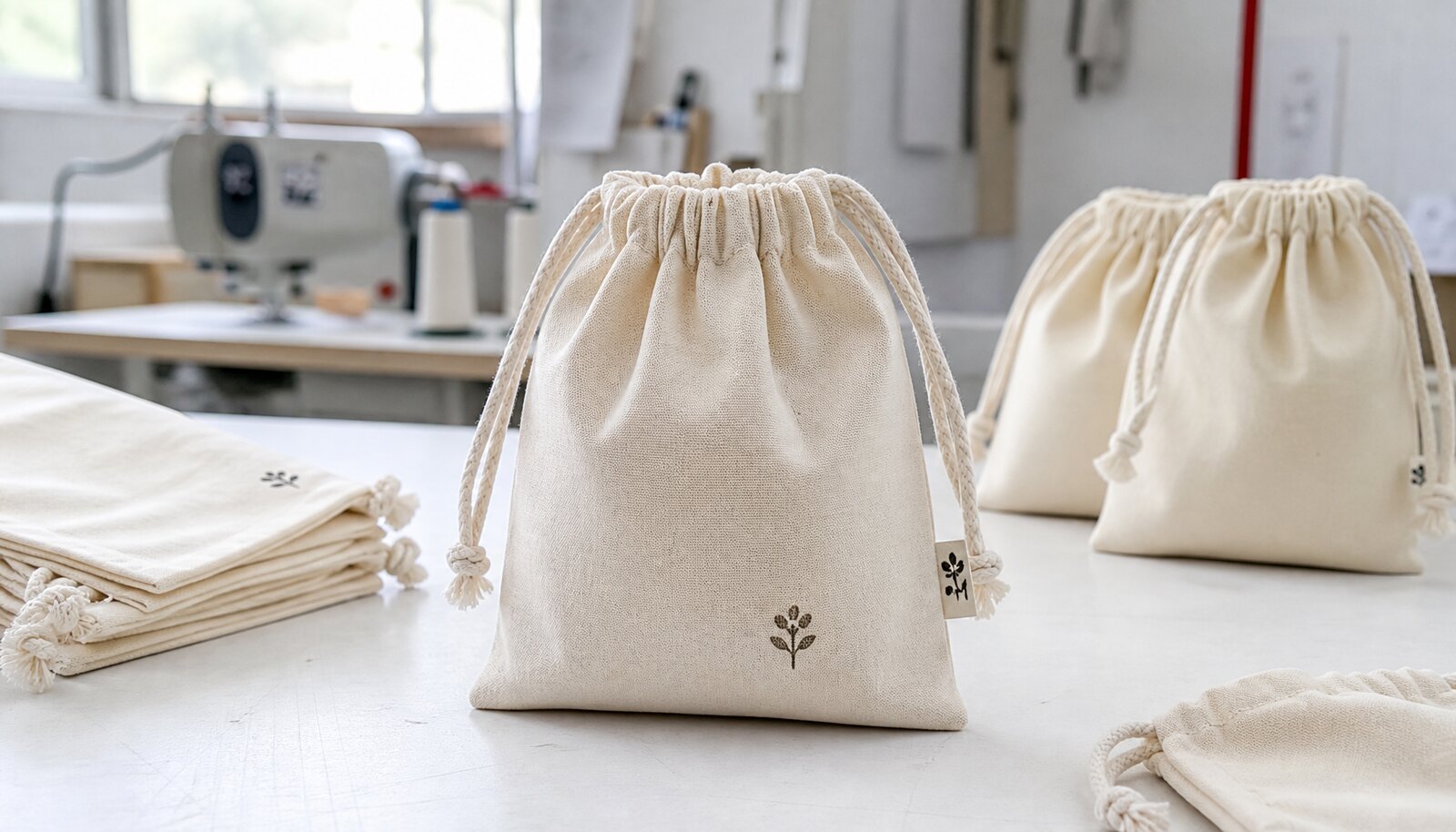
What buyers are actually sourcing
Personalized mini drawstring bags are usually bought as a packaging component, not as a standalone accessory. That matters because the buying standard is different. The bag has to load cleanly, close neatly, protect the item, and still look intentional when it reaches the customer. If it is used inside a retail box, a gift set, or an event pack, the bag can become a visible part of the brand experience even when the unit cost is low.
For procurement teams, the useful question is not whether the bag is small and printed. It is whether the bag supports the channel it will serve. Jewelry, cosmetic samples, wedding favors, and small retail inserts each push the spec in a different direction. A supplier cannot quote responsibly until the use case is clear, because use case determines fabric weight, cord size, print area, packing format, and the quality bar on the finished goods.
- Common use cases: jewelry, cosmetics, sample kits, gift cards, accessories, and premium inserts.
- Typical mini sizes: 8x10 cm, 10x15 cm, 12x16 cm, and 15x20 cm.
- The key sourcing risk is functional mismatch: a bag that looks fine flat but is awkward to fill, close, or pack at scale.
Build the spec around the end use, not the logo
Start with the product that will go inside the bag. A pair of earrings, a cosmetics sample, and a folded apparel tag create different demands on the opening, internal volume, and mouth stiffness. If the bag is too narrow, operators slow down on the packing line. If the bag is too soft, it loses shape in the carton and looks cheap at point of use. If it is too stiff, the drawstring can become bulky and the bag may not sit flat in a gift box.
Write the spec in finished terms. Use finished width and height, mouth opening, cord length, and acceptable tolerance. Avoid vague phrases such as small, medium, or roughly palm-sized. Those words may be useful in marketing, but they create comparison noise in a quote. If you need the bag to fit into a rigid carton, mailbox, or POS kit, include the internal dimensions of the final packaging so the factory can test actual fit instead of guessing from a design sketch.
- Define the intended payload and the fit requirement before you fix the size.
- State finished dimensions in millimeters and include tolerance.
- If the bag is part of a kitted pack, include the carton or insert size in the RFQ.
- Ask the supplier to provide a filled sample using the actual item or a weight equivalent.
Fabric choice is a commercial decision, not just a style choice
Fabric determines how the bag feels, how it prints, and how it behaves in transit. Cotton is the most common choice for personalized mini drawstring bags because it is easy to source, easy to print, and broadly acceptable across retail and promotional use cases. The main procurement variable is not just cotton versus canvas. It is GSM, weave tightness, surface finish, and whether the supplier can hold those details consistently from batch to batch.
As a working benchmark, 90-110 GSM cotton can be acceptable for light giveaways and internal packaging, but it can look thin, especially under strong lighting. 120-140 GSM gives more body, better opacity, and a more premium handfeel. If the brand wants a rustic or natural look, jute blends can work, but they are less forgiving for fine print and more variable in texture. If the program is repeatable, ask where the fabric comes from, whether the supplier can identify the mill or batch, and whether there is any prewash, bleaching, or finishing step that might change shrinkage or texture across lots.
- 90-110 GSM cotton: lower cost, softer handfeel, suitable for light-value inserts.
- 120-140 GSM cotton: better body, cleaner print surface, stronger retail presentation.
- Canvas: more structure and a premium feel, usually at a higher cost.
- Jute or blends: natural look, but lower print sharpness and more surface variation.
- For repeat programs, ask for fiber content confirmation and lot-level traceability if available.
Construction details decide whether the bag is easy to use or annoying to handle
Two bags can use the same fabric and still perform very differently because of construction. The channel depth, seam allowance, top hem, and drawcord path all affect how easily the bag opens and closes. On a mini pouch, a few millimeters matter. A bag that is technically correct on paper can still be frustrating if the cord catches, the mouth distorts, or the seams twist after filling.
Ask the factory to quote the actual construction method. For example, is the channel sewn as a folded hem, a separate casing, or a doubled edge? Is the side seam overlocked, chain-stitched, or flat-sewn? Is there reinforcement at the top corners? These details affect both cost and durability. They also affect the look after the bag is filled, which matters if the bag is ever seen by the customer before the product is removed.
- Confirm whether dimensions are measured flat, finished, or usable internal size.
- Request the seam construction method and whether corners are reinforced.
- Specify cord diameter and end treatment so the closure behaves consistently.
- For very small bags, test with the actual packed item rather than an empty sample.
Decoration should match artwork complexity and order economics
Decoration is where many quotes become misleading. A simple one-color logo on a flat cotton surface is a very different job from a fine-line mark with small text or a multi-color brand icon. For stable repeat orders, screen print is usually the most cost-effective route because it balances cost, opacity, and durability. The setup cost is real, but once spread across volume, it often gives the best commercial result for a straightforward logo.
Heat transfer can be useful when the run is short or the artwork needs more detail than a screen setup can handle. It can also work when the buyer wants to test a new brand mark before committing to a larger order. The tradeoff is that the finish can feel less integrated into the fabric and may be less forgiving under heavy folding. Woven labels or sewn tags are often the cleanest answer when the print area is tiny, the brand wants a premium feel, or the artwork needs to stay crisp over repeated handling. The right choice is the one that protects the brand while staying honest about setup cost, MOQ, and final appearance.
- Use screen print for simple logos and repeatable demand.
- Use heat transfer for short runs or more detailed artwork.
- Use woven labels or sewn tags when the print area is too small or premium presentation matters more than decoration cost.
- Approve print position on a physical sample, not only on a PDF proof.
- Ask whether the quoted price includes one-color print, multi-color print, or only the base bag.
Supplier vetting should go beyond price and lead time
A good quote is not enough if the factory cannot execute consistently. For personalized mini drawstring bags, supplier vetting should cover capacity, traceability, QC discipline, and the ability to hold the agreed spec across repeat lots. Ask who actually makes the bag. A direct factory quote is usually easier to manage than a trading route because responsibility for fabric, sewing, print, and packing sits in one place. If a trader is involved, confirm which step is subcontracted and who owns the defect resolution path.
You should also check whether the supplier can support your compliance needs. Depending on market and channel, that may include fiber content declaration, azo dye restrictions, REACH-related substance controls, CPSIA considerations, or other local requirements. Do not assume the supplier has the right report just because they say they have one. Ask for the actual report scope, report date, test standard, and product reference. For repeat buying, ask if the supplier can keep raw material lots segregated and whether they can identify which batch went into which shipment.
- Ask for current test reports, not a copied logo page or an old certificate with no product scope.
- Request the factory's QC flow: incoming fabric check, in-line inspection, final inspection, and packing check.
- Ask whether production is handled in-house or subcontracted, and who owns rework if defects are found.
- Confirm if the supplier can provide batch traceability for fabric, cords, and labels.
- If the market requires it, ask for chemical, flammability, or child-safety related testing as applicable to your channel.
Quote comparison needs a commercial benchmark, not a spec matrix
A good sourcing comparison should show what the unit price actually buys. A low quote can hide thinner fabric, a smaller print area, a cheaper cord, or bulk packing that shifts labor to your warehouse. To make the offer comparable, require the same assumptions across suppliers: same finished size, same GSM, same decoration method, same cord type, same packing, same carton count, and the same approval basis for the sample. If those assumptions are not aligned, the lowest quote is just the least transparent one.
For procurement, compare the landed cost per accepted unit, not the ex-works price alone. Include setup charges, sampling costs, packing labor, carton materials, freight estimate, import duties, and an allowance for expected defects. If one supplier offers a low MOQ but high setup, and another offers a better unit price only at a larger run, do the math on your realistic reorder pattern. The right answer depends on whether you are buying a one-time launch, a seasonal program, or a stable recurring item.
- Ask each supplier to quote the same base spec and the same packing format.
- Separate unit price from setup charges so you can amortize cost correctly.
- Include sample cost, packing cost, carton details, and freight-ready dimensions in the comparison.
- Treat quality consistency as part of landed cost when the bag is visible to the end customer.
Sampling should prove production reality, not just appearance
A sample is useful only if it is made on the same route you expect for production. The approved sample should use the final fabric, final cord, final print method, and final packing method. Sales samples are often hand-finished and can hide sewing variability, print density differences, or cord issues that appear later on the line. That is why a physical sample matters even when the artwork proof looks perfect.
Inspect the sample as if it were a shipment. Measure the finished size after sewing. Fill it with the real item or a controlled weight. Check whether it cinches evenly, whether the logo sits correctly when the bag is closed, and whether the cord ends are consistent. If the bag may be washed or exposed to moisture, ask for a shrinkage check. If the print is brand-critical, test color against the approved master under the same lighting used for approval. If the sample does not represent the production route, do not approve it.
- Use the final fabric and final print method in the pre-production sample.
- Measure finished dimensions after full construction, not before.
- Test closure with the intended product or a matched weight.
- Check print rub resistance and visual consistency under the lighting you will use for approval.
- Reject samples that are clean-looking but not production-realistic.
QC should use measurable thresholds that buyers can enforce
Quality control for mini drawstring bags needs measurable thresholds because the defects are small but visible. A crooked seam, an off-center logo, or a jammed cord can make a tiny bag look unprofessional even when the material is acceptable. For routine procurement, a practical starting point is AQL 2.5 for major defects and 4.0 for minor defects, then adjust tighter or looser depending on the channel. If the product is retail-facing, buyers usually need stricter cosmetic control than they would for an internal promotional handout.
The easiest defects to prevent are also the easiest to specify. Agree a stitch target, such as 8-10 stitches per inch on the seam areas where that construction is used. Agree print placement tolerance, such as +/-1.5 mm for small logos or another buyer-approved offset. If the color is brand-sensitive, define a color master or a Delta E target before production starts. For size, define an acceptable tolerance band on width, height, and cord length. If the bag is expected to wash or survive damp use, set a shrinkage limit in advance, such as <=3% under the agreed test method, or explicitly state that the bag is decorative only and not subject to wash performance.
- Use AQL 2.5 for major defects and 4.0 for minor defects as a practical starting point.
- Target 8-10 stitches per inch on the main seam areas if that is the chosen construction method.
- Set a print placement tolerance, such as +/-1.5 mm for small logos, and specify the measurement method.
- Require a color master or Delta E target for brand-critical colors.
- Define shrinkage limits or state clearly that no wash performance is required.
- Inspect for loose threads, needle damage, print smear, cord jams, and count accuracy in packing.
Packing and freight can change the real cost more than the bag price does
Packing is not a finishing detail. It changes labor, carton volume, visual presentation, and the likelihood of damage in transit. Bulk packing is usually the cheapest route and often the right choice for B2B component use, but it increases the chance of cord tangling and compressed folds. Individual polybag packing protects presentation and helps with retail readiness, but it adds material cost, handling time, and cubic volume. If the bag is going into a kit, you may want a labeled bulk pack rather than individual retail packaging so your own line can assemble the final bundle more efficiently.
Ask for carton dimensions and gross weight before you approve the order. This is the only way to estimate freight with confidence. For small textile items, dimensional weight can matter more than actual product weight, especially if the bags are fluffy, overpacked, or individually bagged. If you buy personalized mini drawstring bags repeatedly, keep a running landed-cost worksheet that captures unit price, setup, samples, packing, freight, and defect allowance. That gives you a real benchmark for the next RFQ instead of starting from zero every time.
- Bulk pack is cheaper and better for B2B inserts or internal assembly.
- Individual polybagging is better for retail-ready presentation and cleanliness.
- Ask for carton size, gross weight, and cubic volume before committing to freight.
- Use barcodes, SKU stickers, or size labels when you buy multiple sizes or colors in one order.
- Compare landed cost per accepted unit, not the ex-works price alone.
Specification comparison for buyers
| Spec decision | Buyer-leaning default | Best sourcing scenario | Commercial tradeoff / risk |
|---|---|---|---|
| Fabric weight | 120-140 GSM cotton for a premium, opaque handfeel; 90-110 GSM only when the bag is a low-value insert | Retail packaging, jewelry, gift sets, cosmetics, and branded samples | Lower GSM reduces cost but raises the risk of show-through, weak body, and a thin-looking finished bag |
| Fabric origin and finish | Ask for fiber content, weave, and finishing details on the quote; request lot-level traceability if the program is repeatable | Programs that need consistent reorders, regulated markets, or brand audit support | If the supplier cannot name the mill, batch, or finish, you may be buying inconsistent handfeel and unpredictable shrinkage |
| Bag size | Choose the smallest size that still allows easy loading and clean closure, often 8x10 cm to 15x20 cm | Pocketable inserts, jewelry, cosmetics, and small accessory sets | Oversizing wastes fabric and freight; undersizing causes operator friction and distorted cord channels |
| Print method | 1-color screen print for stable art, heat transfer only for short runs or more detailed artwork, woven label for premium repeat orders | Repeat programs with simple logos, or short-run launches that need flexibility | Cheaper methods can crack, smear, or look too flat; more premium methods raise setup cost and may increase MOQ |
| Cord specification | 2 mm to 3 mm cord matched to bag weight, with consistent end finishing and no uneven splice points | Jewelry, wedding favors, cosmetic samples, and light retail packaging | Thin cords cut into the channel and feel weak; thick cords create bulk and make the closure look untidy |
| MOQ strategy | Quote blank stock plus decoration separately from fully custom cut-and-sew | Very small trial orders, multiple artwork variants, or urgent launches | The cheapest unit price often hides restricted color options, weaker size control, or subcontracted print quality |
| Packing format | Bulk pack for B2B component use; individual polybag with SKU or barcode for retail-ready goods | Warehouse inserts, e-commerce kits, and shelf-ready packaging | Bulk packing is cheaper but raises cord tangling and crease risk; retail packing increases labor and carton volume |
| Inspection basis | AQL 2.5 for major defects and 4.0 for minor defects as a buyer starting point, then tighten by channel risk | Programs with repeated deliveries or retailer-facing quality requirements | A vague inspection standard makes claims hard to enforce and lets small defects pass as acceptable |
Buyer checklist before sampling
- State finished dimensions in millimeters, including width, height, mouth opening, and cord length, and define the tolerance you will accept.
- Specify fabric content, GSM, weave, finish, and whether you require proof of fiber content or traceability for repeat programs.
- Attach vector artwork and define print area, print colors, Pantone target if needed, and the exact placement tolerance for the logo.
- Confirm whether you need sewn-in labels, woven brand tags, hangtags, barcodes, or no additional branding.
- Call out cord material, cord diameter, color, knot or heat-seal finish, and whether cord ends need metal tips or sleeved ends.
- Define packing format, inner count, carton count, and whether you need individual polybags, suffocation warnings, or master carton labels.
- Request a pre-production sample using the final fabric, final cord, final print method, and final packing method, not a sales sample.
- Ask for the supplier's QC method, inspection standard, and whether they can share measurement sheets and in-line inspection records.
- Request carton dimensions, gross weight, and cubic volume before confirming the order so freight can be checked early.
- If the bags will enter a regulated market, ask for the relevant test reports and make the report holder, issue date, and product scope clear in the RFQ.
Factory quote questions to send
- What exact fabric composition, GSM, weave, and finishing are you quoting for these personalized mini drawstring bags?
- Is your price based on a production-ready sample, a blank stock bag, or a reference photo only?
- What is the MOQ for each size, color, and print method, and does the MOQ change if we use stock fabric versus custom-dyed fabric?
- Please break out unit price, setup charges, sampling charges, packing charges, and any label or tag charges separately.
- What are your accepted tolerances for finished size, cord length, print placement, and seam alignment?
- What print method is included in the quote, and what is the setup cost for screens, plates, or labels?
- Can you provide the expected shrinkage range, if any, and tell us whether the quoted size is before or after finishing?
- What inspection standard do you use, and do you inspect by AQL 2.5 major / 4.0 minor or another buyer-agreed standard?
- How are the bags packed for shipment, and what is the standard inner pack count, carton count, carton size, and gross weight?
- How many days are needed for sample production, and how many days after sample approval until production readiness and shipment?
Quality-control points to confirm
- Finished dimensions meet the agreed tolerance, with the mouth opening wide enough for the intended product and without visible distortion at the top hem.
- Fabric matches the approved sample for GSM, weave density, finish, and appearance, with no thin spots, holes, stains, or uneven dye or bleaching.
- If the bag is washable or may face moisture exposure, verify shrinkage against your buyer target, such as <=3% after the agreed test or conditioning method.
- Stitch quality is consistent at side seams, hem, and cord channel, with a target of 8-10 stitches per inch where that construction is used and no skipped stitches or seam gaps.
- Print placement is within the agreed tolerance, such as +/-1.5 mm for small logos, with no smearing, ghosting, pinholes, or obvious color shift.
- For critical brand colors, agree a color tolerance before production, such as a Delta E target or an approved visual master under the same lighting conditions.
- Cord movement is smooth and even, with both sides closing uniformly and no blockage, fraying, or uneven cord length after tying.
- No loose threads, broken stitches, oil marks, needle damage, or contamination are visible on finished units after trimming and handling.
- Labels, woven tags, and hangtags are straight, legible, secure, and placed where they do not interfere with closure or product insertion.
- Cartons contain the correct count, the approved inner packing method, and no cord tangling, crushed units, or transit damage from under-packing.