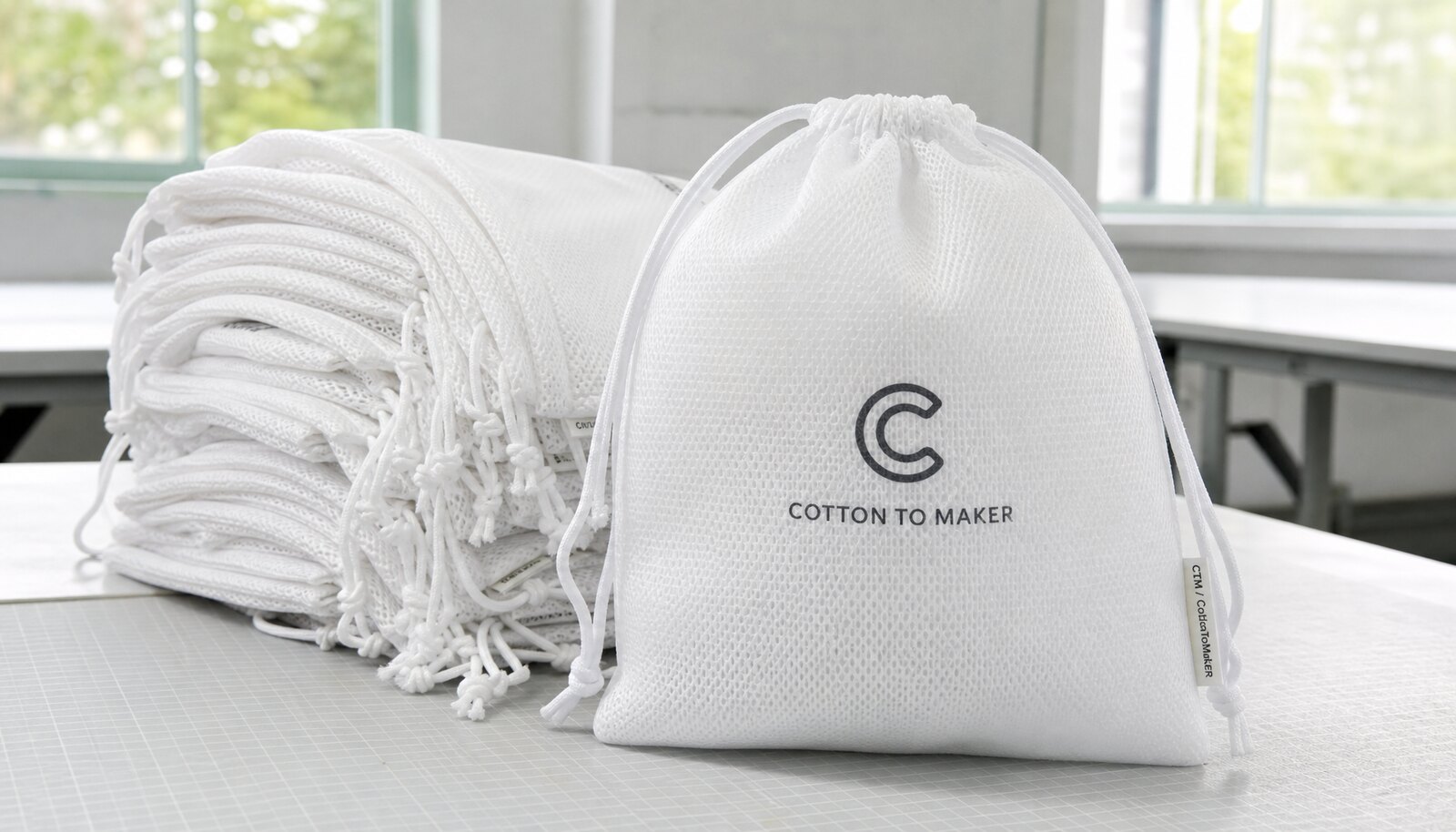
Why personalized mesh drawstring bags are not as simple as they look
At a glance, personalized mesh drawstring bags appear to be one of the easiest custom items to source. They are light, inexpensive-looking, and visually straightforward: mesh body, drawstring, logo, carton, done. Procurement teams know the real risk is not the idea of the product but the amount of variability hiding inside a very basic format. Mesh fabric behaves differently from woven cotton, nonwoven polypropylene, or coated polyester. The open structure affects print coverage, seam strength, dust exposure, and even the way the finished bag folds inside a carton.
The most common sourcing mistake is to treat the bag as a decoration item instead of a functional carry item. Once the bag is expected to hold sports gear, beach items, school supplies, or retail inserts, the quality conversation changes. The buyer then needs to know how strong the mesh is, how the cord exits the tunnel, how the print behaves on open fabric, and how much packaging labor is being absorbed into the quoted price. A quote that looks low can simply be using a lighter mesh, looser finishing, or less protective packing.
For B2B buyers, the commercial goal is repeatability. You do not just need a sample that looks right once. You need a production route that can repeat the same size, color, print quality, and closure performance across the order quantity, then again on reorders. That is why this guide focuses less on inspiration and more on the purchase details that affect landed cost, QC risk, and supplier accountability.
- Best-fit use cases: sports giveaways, gym retail, beach kits, school kits, laundry bags, travel organization, and promotional packaging.
- Primary procurement risks: weak tunnel seams, thin mesh, poor print legibility, cord fray, and carton damage during transit.
- Best buying mindset: compare finished function first, then compare unit price.
Start with the use case, not the logo
The intended use should drive the spec. A mesh drawstring bag for a light event giveaway does not need the same build as a retail bag expected to survive repeated opening, closing, and customer handling. If the bag is meant to hold a towel, sandals, or a set of training accessories, the bag size and structure must match the load. If the bag is used as packaging for a bundled product, presentation and print clarity may matter more than long-term abrasion resistance.
Different buyers also value different tradeoffs. A promotional buyer may prioritize low unit cost and quick lead time. A retail buyer may prioritize cleaner finishing, better print positioning, and consistent fold presentation. An importer serving a regional chain may care most about carton uniformity, barcode labels, and on-time replenishment. If you define the use case early, you reduce the chance that a supplier quotes a generic item that looks right on paper but is wrong for your channel.
A practical way to brief suppliers is to describe the product it must hold, the expected fill weight, and the handling environment. For example, a bag for wet swimwear has different needs from a bag for dry apparel inserts. A school-use item may need higher durability at the cord exit, while a short-run campaign item may be acceptable with a lighter mesh as long as the logo remains readable and the closure works smoothly.
- Define the load: empty bag, light giveaway fill, moderate everyday carry, or repeated retail use.
- Define the handling: one-time distribution, consumer retail use, warehouse kit packing, or frequent reuse.
- Define the expectation: low-cost promo, branded presentation, or inventory item with reorder potential.
Mesh construction and weight: how to compare specs without overgeneralizing GSM
GSM is useful, but it is not enough by itself. For personalized mesh drawstring bags, a supplier can quote a GSM number while still changing the openness of the mesh, the yarn thickness, the tunnel reinforcement, or the finishing density. That is why a simple “use 90–120 GSM” statement should be treated as a starting point, not a universal rule. The right range depends on the end use, load, presentation standard, and the supplier’s fabric system.
As a broad commercial reference, many buyers will see polyester mesh in the 90–120 GSM band for general-purpose custom bags. Lower weights can work for lightweight giveaways and low-fill programs, but they can feel flimsy, show contents more clearly, and distort under load. Mid-range builds often offer a better balance for retail promo or recurring use. Higher weights can improve body and make the bag look more premium, but they also increase material cost and may reduce airflow if the weave becomes too tight. Buyers should not assume heavier is automatically better; if the product is meant to be breathable, an overly dense mesh can defeat the point.
Supplier-side differentiation matters here. Some factories knit or source their own mesh, while others buy standard mesh from a textile partner and sew it into bags. A factory with tighter in-house control may be better able to hold consistency on repeat orders. A trading company may still be useful if you need mixed items, but then the buyer must ask how the mesh is sourced, who controls the fabric standard, and whether the quoted GSM refers to the same base material across samples. If the factory cannot explain that clearly, the item should be treated as a higher verification risk.
When comparing samples, look beyond the number on the spec sheet. Compare handfeel, translucency, edge stability, and how the bag sits when loaded. If you can see major differences in mesh openness or tunnel stiffness between samples that are both called the same GSM, the spec is incomplete and the quote is not directly comparable.
- Ask whether GSM refers to finished mesh, finished bag fabric, or base material before sewing.
- Compare at least four physical traits: openness, handfeel, color consistency, and load behavior.
- Treat unusually light quotes as a signal to check mesh quality, not just price.
Dimensions, capacity, and cord build should be written as one system
The bag size cannot be selected in isolation. A mesh drawstring bag that is too small will bulge awkwardly and place stress on the seams. A bag that is too large may look underfilled and lose shelf appeal. Procurement teams should start with the product to be carried, then add allowance for closure, movement, and presentation. If the bag is part of a retail set, it should also be sized to fit carton packing or kitting workflows without awkward folding.
Cord design is equally important. Buyers often focus on the body fabric and ignore the closure system, yet the cord determines user experience and complaint risk. Round polyester or PP cord tends to provide a practical balance of cost and consistency. The cord should glide through the tunnel smoothly and close evenly from both sides. Heat-sealed or otherwise secured ends help reduce fray in warehouse handling and transit. A double-drawstring configuration may cost more, but it often creates a more balanced closure and a cleaner retail feel than a weak single-cord setup.
Write the size, closure style, and reinforcement in the same line of the RFQ. Ask the supplier to confirm seam allowance, tunnel height, and how cord length is measured. Some suppliers quote cord length before knotting and trimming, others after finishing. That difference can change closure feel and make two quotes look similar when the actual product is not the same. For buyers who want consistency across sizes, this is one of the simplest places to remove hidden variation.
- Specify finished dimensions, not just cut dimensions.
- Confirm whether cord length is measured pre-knot or post-knot.
- Ask for tunnel reinforcement details at cord exit points and top seam.
Logo and decoration: what works on open mesh and what usually fails
Personalized mesh drawstring bags can carry branding well, but the artwork must respect the fabric. Open mesh is not a smooth printing surface. If the logo depends on very small text, delicate lines, or dense gradients, the result may be weak or uneven once it is printed on mesh openings. The safest route for most bulk orders is a simple one-color screen print with a clean shape and enough line thickness to survive the weave.
If the design is more detailed, a heat transfer or sewn label may produce a better-looking result, but the buyer should test the tradeoff. Heat transfers can crack, peel, or show wear if the bags are folded tightly, rubbed in cartons, or used repeatedly. Sewn labels look more premium, but they add labor, placement variation, and another point of inspection. Buyers should avoid overdesigning a low-cost mesh item just to fit an elaborate brand mark. In many programs, a simpler logo gives a better result on the finished product than a highly detailed mark that gets lost in the mesh.
The key commercial question is not “Can you print it?” but “Will it look consistent in production and after handling?” Ask the supplier for a strike-off or actual printed sample on the same mesh you will buy. Evaluate the logo at normal viewing distance and after the bag is folded, unpacked, and handled a few times. If the logo is too close to the tunnel or side seam, distortion risk increases. If the print area overlaps large mesh openings, edge crispness can suffer. These are common but preventable issues, and they should be considered before the PO is released.
- Use simple artwork shapes when possible; avoid tiny type unless it has been tested on the actual mesh.
- Ask for a printed sample on the production fabric, not a digital proof alone.
- Watch logo placement near seams, tunnels, and high-stretch areas.
MOQ, lead time, and source route: factory, trading company, or stock supplier
MOQ is not just a factory policy number. It is the result of fabric availability, print setup, color batching, and packing labor. If the supplier already holds stock mesh in a standard color and the artwork is simple, MOQ can be relatively low. If the buyer wants a custom-dyed mesh color, a special cord color, or more than one print location, the minimum rises because the supplier needs to absorb setup cost across fewer units. This is why a quote that appears cheap at low quantity may not scale well when the order becomes a repeat program.
Different supplier routes suit different buyers. A direct factory is usually the best option when you need stable spec control, repeat orders, or a defined QC process. The factory can better confirm who is weaving, printing, sewing, and packing the product. A trading company can be useful if your order includes multiple product types or packaging formats, but the buyer must push for transparent itemization. Otherwise, the actual mesh spec, cord type, or print process may be hidden behind a single lump quote. A stock supplier can be the fastest route for urgent replenishment or test-market runs, but you may give up some control over exact color, labeling, and packaging.
For procurement teams, the right question is not which route is universally best. It is which route best matches the order profile. If you are testing a new SKU in a single market, a stock-based route may be sufficient. If you are supplying a national retailer with repeat replenishment, the extra time spent locking the factory route and the sample standard is often worth it. When comparing quotes, ask each supplier to identify what part of the order is stock, what part is custom, and where the MOQ pressure really comes from.
- Lower MOQ often comes from stock mesh, simple logo, and bulk packing.
- Custom color, multi-location branding, and retail presentation usually increase MOQ.
- Ask who owns the fabric, print, and packing steps if the quote is coming through an intermediary.
How to compare supplier quotes line by line without missing hidden costs
A good supplier quote should let you see the cost structure, not just the final unit price. For personalized mesh drawstring bags, the unit price can hide several important drivers: mesh quality, cord specification, print setup, sample fees, packing format, carton size, and shipping basis. If one supplier prices bulk loose packing while another prices individual polybags and carton labels, the lower quote may create more work and expense after arrival. The cheapest offer on paper is not always the lowest landed cost.
A buyer-friendly quote should also state whether the supplier is charging setup separately for each artwork version, color, or size. That detail matters in multi-SKU programs. A supplier may quote the same unit price for two sizes but charge different setup or screen costs, which changes the economics if your order is split across variants. The same applies to freight: mesh bags are lightweight, so the total shipment cost is often driven by carton volume more than gross weight. Ask for carton dimensions and packed quantity early so your logistics team can estimate actual import cost.
When you compare quotes, use the same basis across all suppliers. Match the same finished size, same mesh weight basis, same logo method, same packing plan, and same Incoterm. If a supplier will not itemize the offer, request a revised quote before proceeding. A non-itemized offer may still be valid commercially, but it is not a strong basis for procurement comparison.
- Request itemized pricing for unit cost, setup, sample, packing, and shipment term.
- Compare freight by carton size and volume, not only by weight.
- Reject “apples to oranges” pricing by insisting on one standardized spec sheet.
Sample approval: what to inspect before you authorize bulk production
Sample approval should test function, not just appearance. A mesh drawstring bag may look acceptable on a table, but the real test is how it behaves when opened, filled, closed, handled, and repacked. Ask the supplier for a pre-production sample using the exact mesh, cord, print process, and finishing method intended for production. Blank samples are useful for size verification, but they do not confirm print performance, cord behavior, or final presentation.
Build a simple approval routine. Open and close the bag several times. Load it with the intended product weight. Check whether the top closes evenly and whether the cord slides without catching. Hold the bag at arm’s length and at display distance to evaluate logo clarity. Then inspect the stitching at the stress points: side seams, bottom joins, tunnel seams, and cord exits. If the sample passes visually but the closure feels stiff or the logo is fuzzy, do not assume bulk production will improve it.
For repeat programs, keep the approved sample and the signed spec sheet together. That reference package should include the bag size, mesh description, cord description, logo art file, print position, packing style, and acceptable defect examples. Without that record, future reorders tend to drift. A small change in mesh openness or cord thickness may seem harmless until the warehouse or retail team notices the product no longer matches the original approval.
- Test opening, closing, loading, and re-packing before approval.
- Use the pre-production sample as the reference for all future reorders.
- Document the approved spec in writing, not only by email or photo.
Packaging, cartonization, and warehouse receiving should be planned as part of the product spec
Packing has a direct effect on receipt quality and labor cost. Mesh drawstring bags can tangle, crease, or pick up dust if they are packed carelessly. If the product is retail-facing, individual polybags may be appropriate. If the bags are for B2B distribution or kitting, bulk carton packing is often better because it lowers labor and plastic use. Either way, the packing method should be specified before production starts, not after the first sample is approved.
Ask the supplier how the bags will be folded, how many go into each inner pack, and whether cords are secured to prevent tangling. If you need mixed-size or mixed-color cartons, tell the supplier exactly how the labels should be separated so warehouse receiving is clean. Carton marks should ideally include SKU, size, color, quantity, carton number, and purchase order number. If the bags are going to multiple distribution points, consistent carton labeling is one of the easiest ways to avoid receiving errors and inventory confusion.
Suppliers differ in how they treat packing labor. Some factories are comfortable with retail-style folding and labeling. Others are set up for bulk shipment only and may price retail packing as an add-on. Trading companies often quote whatever their upstream source can do, but buyers should not assume that the outer carton spec guarantees the same internal packing method. Ask for a photo of the packed sample carton or a written packing description before release.
- Bulk cartons reduce cost and are usually better for B2B distribution.
- Individual polybags improve retail appearance but add labor and material cost.
- Carton marks should match the PO exactly, including SKU, color, and count.
Quality control that procurement teams can actually use
QC for personalized mesh drawstring bags should be measurable. A vague instruction such as “good quality” is not enough to protect a purchase order. The inspection standard should define which defects are major, which are minor, and which are acceptable within the agreed AQL or internal standard. For this product type, the most common issues are weak seams, loose threads, cord friction, print blur, misaligned logos, and stain or odor problems from poor handling or packing.
A practical QC plan starts with physical checks and simple functional tests. Measure the finished size, not only the cut pattern, because sewing and folding can change the final dimension. Open and close each sample several times to check cord glide and tunnel friction. Look closely at the cord exit points and side seams under good light. Then inspect print placement against the approved art position. If the bag is intended to be reused or sold in retail, add a quick load test at the intended fill weight. If the bag distorts or the top won’t close cleanly under normal fill, it should not pass quietly into bulk shipment.
It is also wise to define defect examples before the inspection. Major defects might include broken seams, missing cords, unreadable logos, wrong size, or strong odor. Minor defects might include a small number of loose threads or slight folding marks if they do not affect function or shelf presentation. The important part is that supplier, buyer, and inspector all work from the same standard. For repeated orders, keep photos of approved and rejected examples so future inspections are consistent rather than subjective.
- Use a written major/minor defect list before inspection starts.
- Test seam integrity, cord glide, print alignment, odor, and stain control.
- Keep an approved reference sample and photo standard for reorders.
Specification comparison for buyers
| Buying decision | Recommended spec or route | Why it works | Tradeoff or supplier-side question |
|---|---|---|---|
| Mesh weight and structure | Polyester mesh around 90–120 GSM for general use; confirm whether GSM is finished fabric or base material before sewing | Balances airflow, cost, printability, and everyday strength for retail, promo, and event use | Ask whether the quote includes the same weave openness, edge binding, and tunnel reinforcement across samples |
| Bag size and load intent | Set size from the product it must hold, then add allowance for closure and handling | Prevents under-sized bags that bulge or over-sized bags that look weak on shelf | Ask what maximum fill weight the factory uses when recommending dimensions |
| Cord and closure build | Round polyester or PP cord with reinforced tunnel and heat-sealed or bound ends | Improves closure action and reduces fray in transit and warehouse handling | Ask whether the cord is single or double, and whether the cord length is measured after knotting |
| Print method | 1-color screen print for simple logos; heat transfer or label patch only if detail requires it | Keeps branding visible without forcing fragile detail into an open mesh surface | Ask for print durability evidence on the actual mesh, not on a substitute fabric |
| Supplier route | Direct factory for repeat programs; trading company for mixed-category consolidation; stockholder for fast low-MOQ replenishment | Matches control level to order size, speed, and spec complexity | Ask who actually owns fabric, printing, and packing if the quote comes through a middleman |
| MOQ strategy | Stock mesh + simple print for lower MOQ; custom color or multi-location branding only when volumes justify it | Reduces setup cost and lead time while preserving acceptable presentation | Ask how MOQ changes by color, artwork version, and packing format |
| Packing format | Bulk carton pack for B2B distribution; individual polybag only if retail presentation or resale requires it | Avoids unnecessary labor while keeping cartons clean and countable | Ask for inner pack count, folding method, and carton label format before approval |
| QC method | Written AQL plus functional tests for seams, cords, print alignment, and odor/stain control | Turns a vague quality expectation into a measurable acceptance standard | Ask which defects are considered major versus minor and what rework is allowed |
| Landed-cost view | Compare unit price, setup, packing, freight volume, and warehouse handling together | Prevents false savings from lighter quotes with hidden repack or freight costs | Ask for carton dimensions and packed quantity so freight can be calculated correctly |
Buyer checklist before sampling
- Define the end use first: retail packaging, sports promo, beach kit, school kit, laundry, travel, or event giveaway. The intended load and handling pattern should drive the bag spec, not the other way around.
- Write the spec before you request pricing: finished size, mesh type, target GSM range, cord type, closure style, logo size, print position, and packing format.
- Ask suppliers to confirm whether they are quoting stock mesh or custom-dyed mesh. That single point often changes MOQ, lead time, and color tolerance.
- Request a production sample or pre-production sample made with the actual mesh, cord, and print method you plan to buy. A blank sample is not enough for release.
- State the artwork file format and approval process up front. If small text or thin lines are included, ask the factory to flag any elements that are likely to fill in on mesh.
- Compare quotes only when they use the same basis: same size, same fabric weight basis, same print method, same packing, same Incoterm, and the same quantity tier.
- Ask for carton dimensions, packed quantity per carton, and how the bags are folded. Mesh bags are light, so freight often depends more on volume than weight.
- Request a clear defect list: loose threads, skipped stitches, cord friction, tunnel damage, print misregistration, odor, stains, and wrong count should all be defined before production.
- If the order is for multiple markets or retailers, confirm whether carton labels, barcodes, and inner pack marks need to follow a specific format.
- For repeat orders, save the approved sample against a signed spec sheet so the next purchase order can reference the same standard without re-negotiation.
Factory quote questions to send
- What is the exact mesh composition, and is the GSM based on the finished bag fabric or on the base mesh before cutting and sewing?
- Is the quoted mesh a stock item or a custom-made/custom-dyed item, and how does MOQ change if we need a different color?
- What is the exact finished size, seam allowance, tunnel height, and cord length included in the quote?
- How many print colors are included, which print method is being used, and what setup or screen charges apply?
- Can you quote the same bag with bulk packing and with individual polybag packing so we can compare real landed cost?
- What is the MOQ by color, by artwork version, and by size? Can a mixed-size order share the same print setup if the print position is unchanged?
- What sample stages are available: blank sample, printed sample, and pre-production sample? Which one is closest to final bulk quality?
- Which QC checks do you perform on stitching, cord function, print alignment, stains, and odor before shipment?
- What defect level do you accept for loose threads, skipped stitches, print blur, and dimensional variation? Do you work to an AQL or an internal standard?
- What are the critical path dates from artwork approval to shipment, and which steps can delay the schedule if we change the spec late?
Quality-control points to confirm
- Confirm finished dimensions after sewing, not just cut size. Mesh can stretch or draw in during assembly, so the approved sample should define allowable finished-size tolerance.
- Check mesh weight against the approved sample or a written tolerance band. If the supplier substitutes a lighter or more open mesh, it should be treated as a spec change, not a cosmetic difference.
- Inspect seam quality at the side seams, bottom corners, tunnel seam, and cord exit points. Look for skipped stitches, loose ends, needle holes near stress areas, and seam puckering.
- Run a pull-and-close test on the cord. The bag should close smoothly from both sides without snagging, binding, or uneven gathering at the top.
- Load test the bag with the intended product weight and a small handling margin. A bag that looks fine empty can distort, open, or seam-fail once filled.
- Check print legibility on the actual mesh under normal viewing distance. If the logo relies on thin lines or tiny text, test whether mesh openings make the edges break up or fill in.
- Measure print placement from the agreed reference point, such as top edge or centerline, so logo location stays consistent across lots and sizes.
- Inspect for stains, oil marks, dye transfer, and odor before packing. Mesh products often travel in bulk cartons, and contamination can become visible only when the bags are unpacked.
- Verify cord ends are heat-sealed, knotted, or otherwise secured as specified. Frayed ends are a common sign of rushed finishing and can cause customer complaints.
- Check carton count, SKU labels, and lot coding against the purchase order so the warehouse does not receive mixed quantities or the wrong color in the wrong carton.