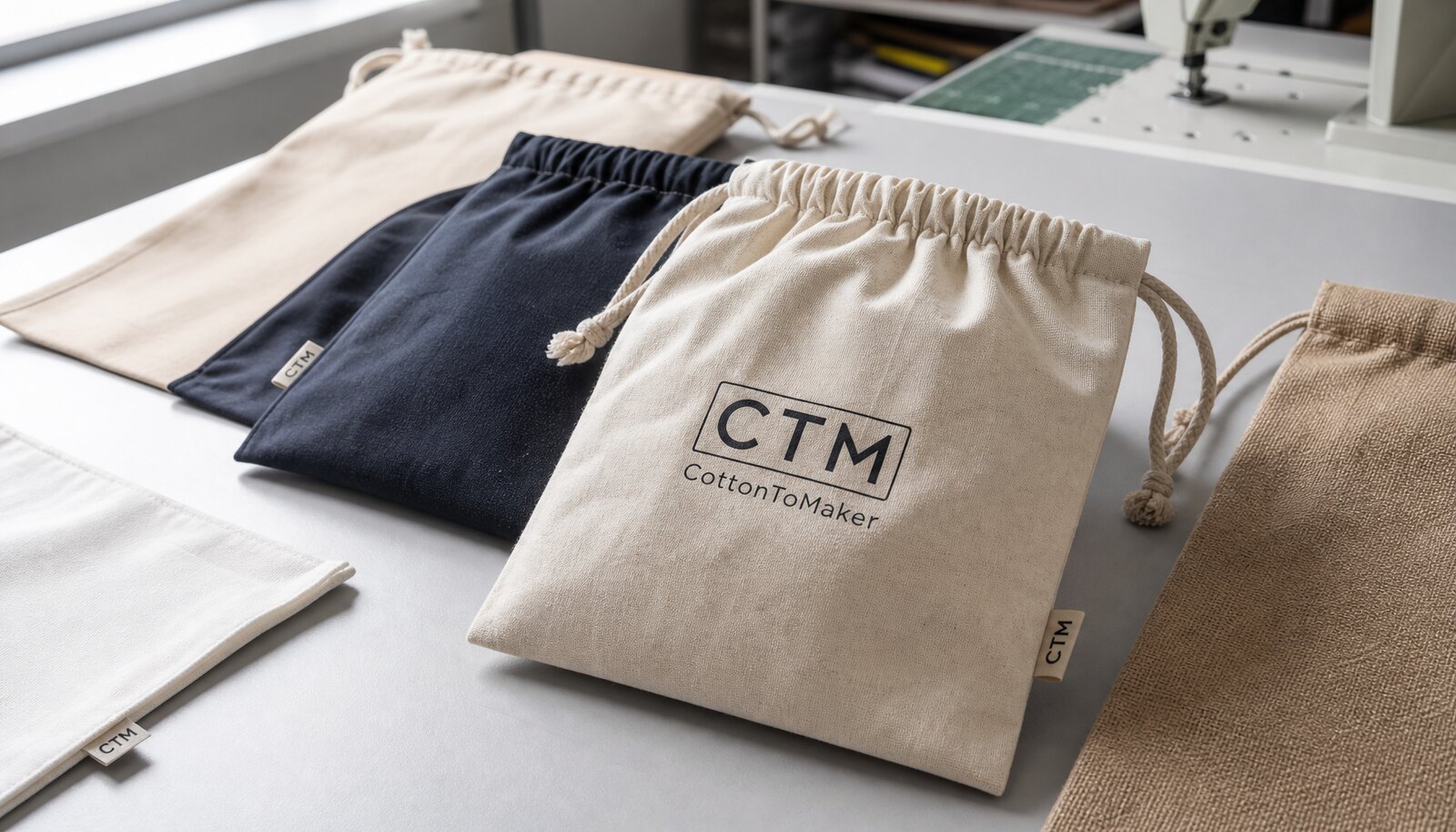
Why this pouch needs a tighter spec than it looks like it does
A personalized drawstring pouch is easy to describe and surprisingly easy to misbuy. If the RFQ only says "cotton pouch with logo," suppliers will fill in the missing details themselves: fabric weight, cord type, seam allowance, print size, packing style, and even how much variation is acceptable between pieces. That is how buyers end up comparing quotes that do not actually describe the same product.
For procurement teams, the pouch should be treated as both a textile item and a branded packaging component. It needs enough structure to function, enough print quality to represent the brand, and enough consistency to pass receiving without extra sorting. The buying goal is not just a low unit price; it is a repeatable spec that can be reordered without re-litigating every detail.
The first commercial decision is use case. A pouch for jewelry or cosmetics has a different quality bar from a pouch used as a mailer insert or a trade-show giveaway. If the item will touch retail packaging, the printed face, seam finish, and folding consistency matter more than they would for bulk internal use. If the pouch will be resold, the buyer should think about the customer opening experience, fabric feel, and long-term durability, not just the logo size.
- Start with the end use: retail insert, gift packaging, giveaway, storage pouch, or resale item.
- Write the product spec from the buyer's perspective, not the factory's default product page.
- Separate body construction, decoration, and packing so each can be quoted and checked independently.
Fabric choice changes cost, print result, and perceived value
Fabric is the biggest driver of look and feel. Cotton remains the default for many branded pouch programs because it is familiar, printable, and easy to source in a range of weights. In the 140-160 gsm range, the pouch is economical and suitable for light promotional use. At 180-200 gsm, it starts to feel more substantial and less transparent. Once the program moves toward 250-350 gsm canvas, the pouch reads as more premium and durable, but unit cost, carton weight, and sewing difficulty all move up.
The mistake many buyers make is comparing quotes by size only. A 15 x 20 cm pouch in 140 gsm cotton is not interchangeable with the same size in 300 gsm canvas. The heavier fabric requires more material, often a stronger cord, and usually tighter sewing control to avoid puckering at the channel or bottom seam. That extra control can show up in labor and lead time even if the supplier tries to keep the quote simple.
Regional sourcing also matters here. Cotton is widely available in Asia, but the real question is whether the supplier is buying greige fabric, dyed fabric, or mill-finished stock. If the pouch needs a specific natural shade, a brand-matched color, or consistent reorders over several seasons, ask where the fabric comes from and whether the shade is tied to a lab dip or only to a verbal description. Buyers ordering into Europe or North America should also ask whether the fabric or dye process is documented against the retailer's restricted-substance expectations, especially if the pouch will ship with consumer goods rather than sit as a plain insert.
- Use 140-160 gsm cotton for low-cost inserts or event giveaways with modest handling.
- Use 180-200 gsm cotton when the pouch must hold shape better and feel more deliberate in hand.
- Use 250-350 gsm canvas when durability, resale value, or brand presentation matters more than lowest price.
- Ask whether the quoted fabric is stock greige, dyed-to-order, or already finished, because this changes both lead time and re-order consistency.
- If color consistency matters, request a reference swatch or lab dip approval before production.
Decoration method should follow the artwork, not the other way around
This is where personalized drawstring pouch sourcing often gets oversimplified. Screen printing is usually the lowest-friction option when the logo is simple, the color count is low, and the volume is large enough to justify setup. It produces a clear brand mark, but it is unforgiving with fine lines, tiny type, and artwork that depends on delicate gradients. If the logo is too detailed, the print can blur, fill in, or look lighter than the brand standard on textured fabric.
If the buyer needs names, serials, event titles, or other variable content, the issue is not just decoration but data handling. Ask the supplier how the variable information will be passed, proofed, and sorted. A weak process here creates mixed names, missed characters, and carton rework at the packing table. For one-off personalization, a digital print workflow or a transfer-based method may make more sense than forcing a silk-screen workflow to handle every variation.
Woven labels, sewn patches, and embroidery can all work, but each one has a different risk profile. Labels and patches add a premium cue and can avoid ink issues on textured fabric. Embroidery works best on thicker materials where the stitch field has enough body. On small pouches, though, embroidery can distort the panel or create a stiff patch that changes how the drawstring gathers. For a buyer, the right question is not "which method is best?" but "which method best protects my artwork, unit cost, and defect rate at the quantity I need?"
- Use screen print for simple logos, repeat volumes, and stable artwork.
- Use digital or transfer methods when the artwork needs names, multiple colors, or fine detail.
- Use woven labels or sewn patches when the brand wants a premium tactile cue without heavy ink coverage.
- Use embroidery only after checking panel size, stitch density, and how the finished pouch closes with the extra bulk.
- Ask for a print proof that shows actual size, not only a digital mockup.
Read MOQ like a cost model, not a number on a quote
MOQ on a personalized drawstring pouch usually reflects three things: material usage, setup time, and labor efficiency. The factory may be willing to make a low quantity, but the setup cost can be spread across fewer pieces, which makes the price look high. Another supplier may advertise a lower unit price, but only if the order reaches a threshold where cutting, printing, and packing are efficient. Buyers should ask for both the MOQ and the price break, because the real commercial decision often sits between the two.
It also matters whether MOQ is tied to size, color, fabric, or artwork. A factory might quote one MOQ for one print design, but a different MOQ if the buyer asks for two logo locations or a second pouch size. If the program uses multiple colors or multiple names, ask whether those are separate SKUs or just print variations. That answer changes not only price, but also inventory risk and carton planning.
For B2B procurement, the practical approach is to limit complexity until the volume justifies it. One size, one fabric, one artwork, one packaging method is easy to quote and easier to reorder. If the buyer needs options, ask the supplier where the cost curve changes: at what point does a second color, a second size, or individual packaging become efficient. That is more useful than accepting a generic MOQ that cannot be traced back to any real cost driver.
- Ask whether MOQ is per size, per fabric color, per logo version, or per total order.
- Request quotes at two or three volume points so the price break is visible.
- Check whether a second print color or second logo placement changes tooling, setup, or only the unit price.
- Treat very low MOQ quotes carefully if they rely on high setup fees, expensive packaging, or restrictive artwork rules.
Supplier route matters because control sits in different places
A direct factory, a trading company, a local decorator, and a stocked importer can all source a personalized drawstring pouch, but each route puts control in a different place. Direct factories usually have the best grip on sewing, fabric selection, and production schedule, which matters if the buyer wants custom dimensions or a repeat program. Trading companies can be useful when the order is part of a broader packaging bundle or when the buyer wants one contact for multiple items. Local decorators are convenient for very small runs or last-minute event needs, but the fabric and construction options are narrower. Stocked importers can move fast, but customization is limited and the final product may not line up with a brand's exact spec.
The buyer should compare routes on more than price. Ask who actually makes the pouch body, who handles the decoration, and who packages the finished goods. If those steps are split across multiple vendors, the risk is not only margin opacity; it is also accountability when defects appear. A direct factory may quote slightly more transparently on unit cost, while an intermediary may bundle freight or packing into the number. Either can be workable, but the buyer must know which costs are fixed, which are optional, and which are hidden inside the quote.
For import programs, regional practicalities matter too. A supplier in one textile hub may be better set up for print volume, while another may be more comfortable with premium finishing or faster sample turnaround. Buyers sourcing into the EU or the US should also ask about standard compliance documents if the pouch will touch consumer goods or be sold through retail channels, especially if there is concern about fabric dye, odor, or restricted substances. The point is not to demand a certificate for every order; it is to understand whether the supplier can support the level of documentation your customer or channel requires.
- Direct factory: best for custom construction, repeat orders, and tighter control of sewing and printing.
- Trading company: useful when one supplier coordinates several packaging items or export documents.
- Local decorator: good for small runs, but expect fewer fabric choices and less seam-level control.
- Stocked importer: fastest route, but least flexible on exact size, artwork, and packing format.
- Ask the supplier to state whether decoration, sewing, and packing are all done at the same site or split across locations.
Comparison table: what looks similar on paper is not similar in landed cost
Procurement teams often compare pouches only by size and MOQ, but that misses the commercial differences that show up later. Decoration method affects setup, reject rate, and the chance of rework. Packing changes carton count and labor. QC documentation changes how quickly a buyer can release the order. Lead time is not just sewing time; it includes artwork approval, sample approval, material availability, and shipping window. The same basic pouch can be cheap to buy and expensive to land if those details are not aligned.
A better comparison is to test the sourcing route against the decoration method and QC burden together. That makes it easier to see whether the quote is truly apples-to-apples. A supplier that offers a lower factory price but charges for every revision, every sample, and every special pack may end up more expensive than a slightly higher quote that includes clearer approval steps and fewer handoffs.
Comparison table: supplier route, decoration, QC, and lead-time tradeoffs
Use this table as a sourcing filter, not a final award decision. The goal is to identify where each route carries hidden cost or execution risk.
If two suppliers look close on unit price, ask which one gives you the cleaner sample path, the sharper QC standard, and the most stable repeat lead time. That often matters more than a small difference in the ex-works number.
- Write decisions in measurable language, not only descriptive wording.
- Ask for sample photos plus one physical approval sample for important orders.
- Keep quotation, sample approval, and inspection notes tied to the same spec version.
Use samples to remove ambiguity before bulk approval
A sample only helps if you know what it proves. A blank sample verifies size, fabric hand feel, and basic sewing. A decorated sample verifies print color, logo placement, and how the artwork behaves on the actual textile. A pre-production sample is the one that matters most for bulk approval because it should use the final fabric, final cord, final decoration method, and final pack format. If any of those elements differ, the sample should not be treated as production reference.
The inspection should be mechanical, not just visual. Measure the finished pouch after sewing and pressing. Open and close the drawcord several times. Look at the print under bright light from different angles. Check whether the pouch sits flat, whether the top channel pulls evenly, and whether the seam allowances are consistent from piece to piece. For retail-facing orders, compare the sample against the item it will accompany. The question is not only whether the pouch is well made, but whether it looks right beside the product it is meant to support.
For personalized orders, there is one more control point: data accuracy. If names, dates, or codes are involved, require one approved variable sample before bulk run and make sure the supplier uses the same file version at production. That simple step saves more trouble than most buyers expect, because personalization errors usually do not show up until the cartons are already packed.
- Approve a blank sample for construction and a decorated pre-production sample for final release.
- Measure the pouch after sewing and pressing, not only while it is laid flat on the table.
- If names or codes are part of the order, approve one variable sample before the full run.
- Keep the approved reference sample labeled and sealed so the factory uses the same benchmark.
Packing choices affect damage, labor, and warehouse cost
Packing is often treated as a secondary issue, but for a personalized drawstring pouch it influences both appearance and landed cost. Bulk packing is usually the cheapest route and works well when the buyer will relabel, kit, or re-pack the goods later. Individual polybags add labor and material cost, but they help protect printed surfaces and improve retail readiness. If the pouch is going directly into consumer hands, that extra protection may be worth the cost. If it is going to a fulfillment center that will rework the goods anyway, it may be pure waste.
The commercial tradeoff is not just the cost of the bag. Bigger packs increase carton volume, change freight efficiency, and sometimes force a different carton count. That matters when the buyer is quoting air freight, paying for warehouse receiving, or trying to hit a shelf-ready condition on arrival. The supplier should tell you whether interleaf paper, bundle ties, size stickers, or barcode labels are included. Otherwise the buyer may discover after shipment that the "simple" packing choice created extra handling on the receiving side.
A procurement buyer should also ask for packing photos or a short video before release, especially on first orders. That makes it easier to catch orientation mistakes, mixed SKUs, wrong carton marks, or underfilled bundles before the shipment leaves the factory. Those issues are inexpensive to fix at source and expensive to fix after arrival.
- Use bulk packing when warehouse rework, relabeling, or kitting is planned.
- Use individual polybags when retail presentation or surface protection is important.
- Ask for carton dimensions and gross weight before freight booking.
- Confirm whether interleaf, bundle ties, barcode labels, or insert cards are included in the quote.
- Request packing photos or a short video on the first order before shipment release.
Lead time depends on artwork, material, and production booking
A useful lead-time quote has stages, not just one number. Artwork approval, sample approval, fabric availability, print setup, sewing capacity, packing, and shipping all take time. A supplier that says "20 days" without telling you what happens before the clock starts is not giving you a working schedule. For a personalized drawstring pouch, the front end is often where delays happen: artwork changes, color confirmation, or fabric availability can push the schedule more than the sewing itself.
This is why the buyer should ask which steps are reusable on a reorder. If the supplier can reuse screens, prints, or sewing patterns, the repeat order can move faster. If the pouch requires a custom fabric shade or variable personalization, the repeat lead time may still be manageable, but only if the supplier has documented the process carefully. Buyers should also ask what causes production to slip: material backorder, lab dip delays, artwork revision, packing changes, or cartoning bottlenecks. The more specific the answer, the more useful the quote.
For programs tied to a launch date, keep a buffer for approval time. A factory can only start once the buyer signs off on the exact spec. If the product ships into a retail or event deadline, build the calendar around the sample approval date, not only around the quoted sewing time. That is the practical way to avoid promising a launch that the factory schedule cannot actually support.
- Split lead time into artwork, sample, production, and shipping stages.
- Ask whether screens, patterns, or print files can be reused on reorders.
- Confirm whether fabric is stock, dyed-to-order, or made to order.
- Set the approval deadline before the production slot, not after it.
- Keep a schedule buffer for revision rounds and carton checks.
Specification comparison for buyers
| Spec decision | Recommended option | When it fits | Buyer risk to check |
|---|---|---|---|
| Sourcing route | Direct factory in the product category | Best for repeat programs, custom sizes, and controlled print quality | Confirm whether the factory actually makes the pouch body and decoration in-house or subcontracts either step |
| Sourcing route | Trading company or sourcing agent with factory backing | Useful when you need several product lines, mixed packaging, or coordinated shipping | Watch for unclear factory identity, hidden margin, and weak control of artwork revisions |
| Sourcing route | Local decorator or promotional supplier | Fits small runs, rush events, and name-by-name personalization | Expect limited fabric options, higher unit cost at scale, and less control over seam construction |
| Fabric choice | Cotton 140-160 gsm | Best for light inserts, campaign giveaways, and price-sensitive packaging | Thin cloth can print well but may feel limp; confirm opacity, shrink, and stitch integrity |
| Fabric choice | Cotton 180-200 gsm | Good middle ground for branded retail packaging and reusable promotional pouches | Check whether the supplier is quoting before or after finishing, because gsm definitions vary |
| Fabric choice | Canvas 250-350 gsm | Fits premium, reusable, or higher perceived-value programs | Heavier fabric increases cost, carton weight, and the chance of puckering if sewing control is weak |
| Decoration method | 1-2 color screen print | Best for simple logos, strong contrast, and repeat volume | Small text, tight line work, and gradients can fill in on textured fabric |
| Decoration method | Woven label or sewn patch | Good when the logo should look durable and premium without ink coverage issues | Adds labor and component cost; check edge fraying, placement, and attachment durability |
| Decoration method | Variable name print or digital personalization | Useful when each pouch needs a different name, code, or event line | Ask whether personalization changes lead time, setup, and reject sorting at packing |
Buyer checklist before sampling
- Define the finished size in centimeters, not only the intended use case or product it should carry.
- State the fabric type, weave, and gsm target, and note whether a tolerance band is acceptable.
- Choose one primary decoration method and specify the maximum logo area in millimeters.
- Confirm cord material, diameter, color, and end finish, including knots, heat-cut tips, or metal aglets.
- Specify whether the order must be retail-ready, gift-ready, or bulk-packed for later kitting.
- Request a blank sample first if shape and hand feel matter, then a decorated pre-production sample for final approval.
- Ask for carton count, inner pack count, gross weight, and carton dimensions before approval.
- Set a clear inspection standard for print position, seam quality, stains, loose threads, and cord function.
- Ask for a photo or video of the final packed cartons so you can verify labels, marks, and bundle arrangement.
- Request quote at two quantities so the supplier's setup cost, unit break, and price step are visible.
Factory quote questions to send
- Is your quote based on finished size, cut size, or approximate size, and what tolerance do you use for each dimension?
- What fabric, weave, and gsm are included in the price, and is the gsm measured before or after finishing?
- What decoration method is included, how many colors are priced, and what exact print area is allowed on the pouch front and back?
- If the artwork is personalized by name, code, or variable text, what is the per-piece cost and what file format do you need?
- What is the MOQ by size, by fabric color, and by artwork, and does a second logo or a second decoration location change the MOQ?
- What parts are made in-house, including cutting, sewing, printing, and packing, and which steps are outsourced?
- What sample stage is included in the quote: blank sample, decorated sample, or pre-production sample, and what is charged separately?
- What is the packing method, carton count, inner pack count, and outer carton mark detail, and are polybags included or extra?
- What lead time applies after artwork approval, after sample approval, and after deposit, and what events usually extend it?
- What inspection or test evidence can you share for fabric shade, seam strength, color fastness, or cord durability if available?
Quality-control points to confirm
- Measure finished length and width against the approved spec after the pouch is fully sewn and pressed, then confirm the buyer's tolerance is met on each inspection lot.
- Inspect print placement on a sample basis and verify the logo stays within the agreed location tolerance; require sharp edges, no blotting, and no missing fill on solid areas.
- Check print density under normal light and, for dark artwork on light fabric, look for strike-through, patchiness, or uneven ink coverage that makes the logo look weak.
- Test the drawcord by opening and closing the pouch several times to confirm smooth pull, even gather, secure cord ends, and no fraying at the exit points.
- Check side seams, bottom seam, and cord channel for skipped stitches, seam puckering, loose thread tails, or weak back-tack at stress points.
- Review fabric for stains, holes, slubs, oil marks, shade variation, weave distortion, and edge damage before packing; any visible defect inside the front panel should be treated more strictly than a flaw near a seam allowance.
- Confirm label or patch attachment by lightly tugging at the edges; sewn-on branding should not lift, curl, or show broken stitches after handling.
- Verify carton labeling, SKU count, inner pack count, and gross weight against the commercial invoice and packing list before shipment release.
- Use an agreed AQL or defect limit by defect class: for example, no critical issues such as wrong size, wrong artwork, or broken cord; and only limited minor defects such as loose thread or slight shade variation.
- If the program is retail-facing, open random cartons to check that print orientation, folding direction, and bundle condition are consistent, because carton-level damage often shows up only after the first master carton is opened.