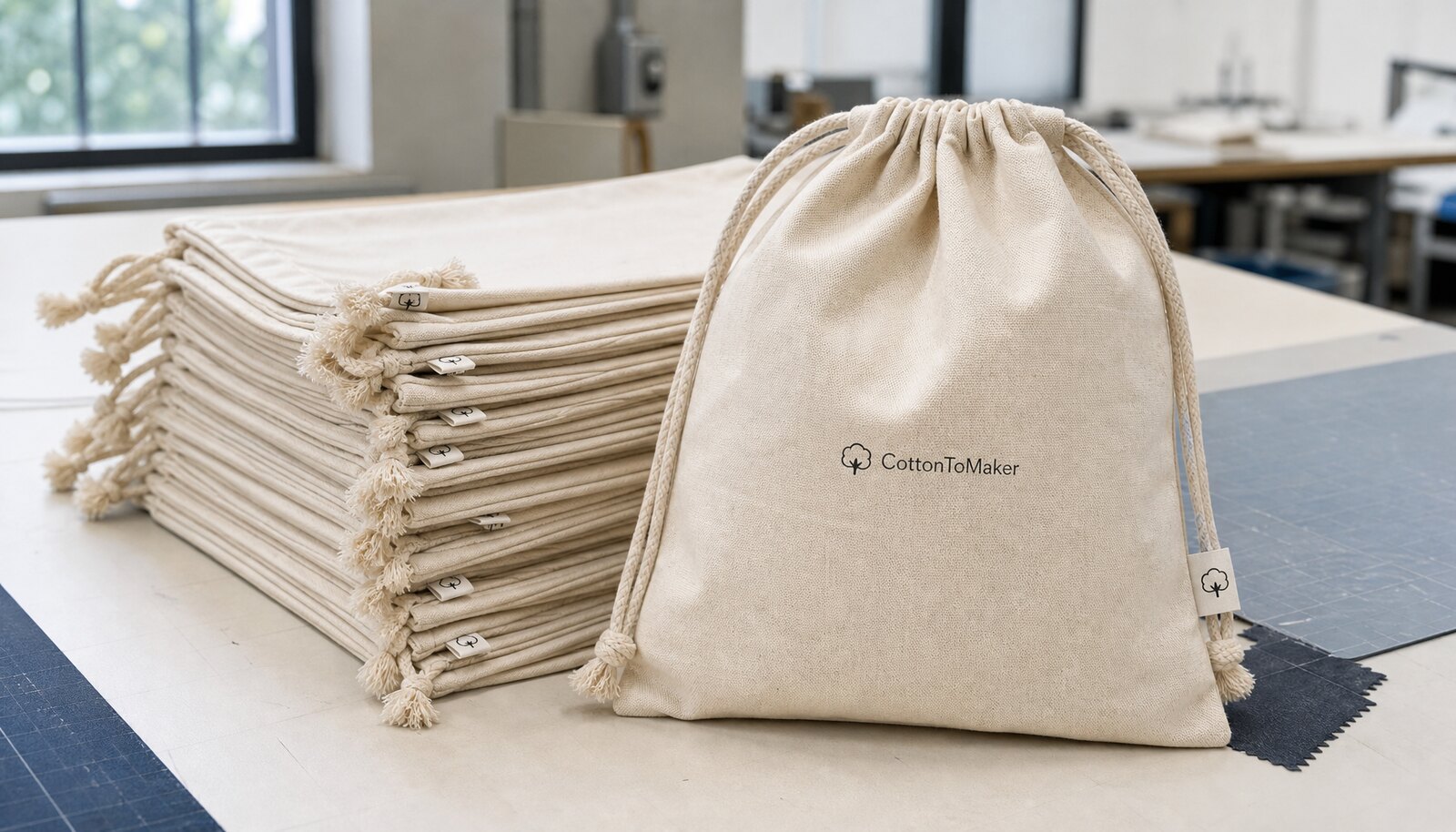
Start with the use case, not the bag photo
Personalized drawstring bags no minimum sounds simple, but procurement should treat it as a controlled sewn-product buy. The same photo can hide different fabric weights, cord quality, seam construction, and decoration methods. That is why a low-MOQ order should start with the use case: retail insert, event giveaway, sample kit, gift packaging, or product carry bag. Each one has a different tolerance for appearance, strength, and freight cost.
If the bag is only holding lightweight inserts, a basic cotton or poly-cotton build may be enough. If the bag needs to feel premium on shelf or survive heavier contents, the spec has to change. That usually means tighter weave, better opacity, cleaner finishing, and stronger seams. The cheapest quote is not the right benchmark if the bag fails in the channel or looks weak next to the rest of the kit.
The procurement mistake is to ask for a logo bag before deciding what kind of bag it is. When the use case is clear, the supplier can quote a real product instead of a loose promise. That makes the first order a useful pilot instead of a pricing exercise with too many hidden assumptions.
- Define the bag's job before requesting prices.
- Use low MOQ for pilots, not for vague buying.
- Treat the first run as a supplier qualification step as much as a purchase.
Lock the construction before you compare suppliers
Construction drives cost more than most buyers expect. For light promotional use, cotton around 140-160 GSM is usually enough. For a more substantial retail feel, 180-200 GSM cotton or 6 oz canvas is a stronger starting point. If the bag will carry heavier contents, the seam and channel design matter as much as fabric weight. A low price is useless if the bag tears at the drawstring channel or stretches out of shape after packing.
Ask the supplier whether the quote is based on finished size or cut size. That distinction affects internal volume and can change how the bag fits cartons or kit trays. Also confirm whether the dimensions include the channel and seam allowances or only the usable body. Buyers who miss that detail often end up comparing two bags that are not actually the same size.
The closure should match the load. A standard sewn channel with a cord is fine for most low-MOQ programs, but if the bag is expected to be opened and closed frequently or carry dense contents, ask about channel reinforcement, bar-tack placement, and seam allowance. Those details should be visible in the quote, not hidden in a generic product description.
- For light promotional use: cotton 140-160 GSM, standard channel, simple cord.
- For premium presentation: cotton 180-200 GSM or 6 oz canvas, better opacity, cleaner finish.
- For heavier contents: reinforced channel, stronger seam allowance, and clear load expectations.
Specify fabric and trim in procurement language
The weakest low-MOQ quotes usually come from vague specs. State the fabric weight in GSM or ounces, the weave, the finish, and the shrinkage expectation. For cotton, a practical default is pre-shrunk fabric or a documented shrinkage limit under 3% after test wash or steam exposure. If the bag is not meant to be washed, ask the supplier to state how much dimensional change is expected after pressing or heat exposure. That affects logo placement and packaging.
Trim details matter just as much. Specify cord material, cord diameter, end finish, and whether the channel edge is hemmed or reinforced. Thin cords and weak channels can make the whole bag feel cheap even when the fabric is acceptable. If you want a more premium look, a woven label or sewn patch may be more reliable than ink on a coarse weave, especially on very small runs where screen setup is harder to justify.
It is also worth defining what counts as a defect before sample approval. Wrong logo, missing cord, torn seam, and size outside tolerance should be critical defects. Smudged print, uneven stitching, and visible stains usually fall into major defects. Clear defect classes reduce debate later, especially when the supplier is working with low quantity and a shorter sampling cycle.
- Ask for fabric weight, weave, finish, and shrinkage in the RFQ.
- Specify cord diameter, channel construction, and seam allowance.
- Define critical defects before the sample is approved.
Choose the decoration method for the quantity you actually need
Decoration choice determines both cost and repeatability. For simple one-color branding, screen print is still the most predictable method for many buyers. It tends to hold up well and gives a repeatable look on reorder. The tradeoff is setup. Even at low MOQ, the supplier may charge for screens, plates, or color matching, and that should be shown explicitly. A low piece count does not eliminate setup work; it just spreads it over fewer units.
Digital print, DTG, and heat transfer can be practical when the art has multiple colors or the order is too small to justify screens. The buyer should still ask how the ink or transfer behaves on the chosen fabric. On coarse cotton or canvas, some methods soften the image or change the hand feel. Ask for a rub test, a close-up of the edge, and a photo of the actual finish under normal light, not only a front-on sales image.
Woven labels and sewn patches are useful when the brand wants a cleaner premium look or when print registration would be fragile at low volume. They are not always the cheapest path, but they often reduce the risk of visible misprint or color drift. The right question is not which method is cheapest on paper. It is which method gives the best approved sample and the most stable reorder.
- Screen print: best for simple logos and future repeat orders.
- Digital or heat transfer: useful for multi-color art, but verify feel and rub resistance.
- Woven label or patch: better when print registration is hard to control at low quantity.
Use the sourcing route as a cost and control decision
The route you choose changes not just price but control. Direct factories usually give the clearest path to the actual sewing and decoration operation, which is valuable when you care about repeatability. Trading companies can help when you need several products in one shipment or want less vendor management, but they often add a margin layer and may not own the production details. Marketplace sellers are easy to approach, but they usually provide the least traceability if the bag changes later.
Region matters, but it should not become a shortcut assumption. Buyers often compare suppliers across China, India, Vietnam, Pakistan, and domestic or nearshore options based on lead time, freight path, and fabric availability. Some regions are better aligned with cotton and canvas supply. Others are stronger on rush reorders or simpler logistics. What matters is whether the supplier can prove the actual manufacturing site and reproduce the approved sample without improvising.
For programs that may scale, ask one extra reorder question: what stays the same next time? The answer should cover fabric source, print method, seam spec, and any packaging changes. If the supplier cannot explain reorder consistency, the first order is only a sample purchase.
- Direct factory: best for control and repeatability.
- Trading company: useful for multi-item sourcing, but verify the real factory and fee structure.
- Marketplace reseller: fastest for samples, weakest for traceability.
- Nearshore or domestic: good for rush work, but usually with fewer fabric options and higher unit cost.
Comparison table: compare the full cost stack, not the quote headline
A useful comparison table should help a buyer see why two offers with similar unit prices are not equivalent. Setup fees, sample charges, packing labor, freight basis, and reorder stability can change the real cost more than the quoted per-piece price. At low quantity, fixed charges dominate. At higher quantity, repeatability and lead time matter more because they reduce the chance of rework or a second sample cycle.
A simple illustration makes this visible. If a supplier quotes a low unit price but adds a setup fee, sample charge, and loose packing, the all-in cost at 300 pieces can be materially higher than the headline suggests. Another supplier may look more expensive per unit but be cheaper overall because the packing is efficient, the print method is stable, and the freight carton is smaller. Procurement should compare the total landed cost, not the advertised product price.
The practical use of this table is to force equivalent bids. If one supplier is quoting a decorated blank-stock bag and another is quoting a sewn-from-scratch bag, the comparison is invalid. The table only works when the RFQ is the same across all bidders.
- Compare unit price, setup, sample, packing, freight, and rework risk together.
- Use the same spec version across all bids.
- Judge the route by total landed cost at your real order size.
Write the RFQ so the quote is actually comparable
A strong RFQ keeps the supplier from filling gaps with assumptions. Start with finished size, tolerance, fabric weight, decoration method, logo placement, cord type, packing format, and quantity breaks. Attach the vector artwork and note whether the logo can touch a seam or must stay inside a print box. If color matters, give Pantone references or a written color target. If the bag must fit a kit tray or carton, include the dimensions that matter to the packout, not just the outer bag size.
Then force cost transparency. Ask for separate lines for sample charge, print setup, packing labor, carton labeling, and any sub-MOQ surcharge. If the supplier hides those items inside a single unit price, the quote is hard to compare and hard to defend internally. This is where many low-MOQ programs get padded. The first quote looks clean, then the real invoice shows how much of the price was one-time setup.
Version control matters. Put a revision number on the RFQ and ask every supplier to quote against that exact version. If the supplier proposes a change, record it. That makes later quality disputes much easier to resolve because you can show exactly what was approved.
- Use one spec sheet, one artwork file, and one revision number.
- Require separate lines for sample, setup, packing, and freight basis.
- Quote against finished dimensions, not a loose description like standard size.
Approve the sample with measurable criteria
The sample is where small-order risk gets exposed cheaply. Approve a physical pre-production sample, not just a photo. Sewn goods can look different under camera lighting, and a bag that looks acceptable online may feel weak in hand. Measure the sample, verify the print position, check the cord symmetry, and confirm the bag opens and closes smoothly. If the bag is part of a retail set or subscription kit, test it with the actual fill weight or a close equivalent.
Set the inspection standard before production starts. A practical framework is zero tolerance for critical defects, a controlled threshold for major defects, and a looser limit for minor defects that do not affect function or brand presentation. Common critical defects include wrong size outside tolerance, missing cord, torn seam, and wrong logo. Common major defects include print misregistration, visible stains, and loose stitch sections. Common minor defects include small thread tails or fold marks that do not affect use.
If you use AQL, many buyers start around 2.5 for major defects and 4.0 for minor defects, with critical defects at zero. That is a practical default, not a universal rule. The right standard depends on the product risk and customer expectations, but it should be written before bulk material is cut.
- Approve a physical sample that matches final fabric, print, and packing.
- Measure size, cord symmetry, and fit with actual contents.
- Define critical, major, and minor defects before bulk approval.
Treat packing and labeling as part of the product spec
Packing affects both freight cost and receiving quality. Bulk packing is usually best for internal distribution or non-retail use because it lowers labor and carton volume. Individual polybags are better when the bags must arrive retail-ready or when contamination control matters, but they increase labor and freight density. If you need inner packs by color or size, barcode labels, hangtags, or carton marks, include that in the RFQ. Otherwise, the quote will not reflect the real warehouse work.
Carton data is not optional. Ask the supplier to state carton dimensions, gross weight, inner pack count, and bags per carton. That helps you estimate freight before goods move and makes receiving easier. It also prevents disputes when the warehouse gets cartons that do not match the planned pallet pattern. If the buyer has a labeling standard, approve it alongside the artwork proof, not after production.
If the bags are entering a regulated market or a formal retail channel, check whether testing, origin labeling, or document requirements apply to the fabric, print chemistry, or packaging. The exact rules depend on the market and buyer, but the procurement principle is simple: a sewn pouch is still a finished product and should be treated like one.
- State whether the bags are bulk packed or retail packed.
- Request carton dimensions and gross weight for freight planning.
- Approve carton marks and labels before bulk production.
Use landed cost to decide whether low MOQ is worth it
The right way to compare landed cost is to model the actual order quantity. A quote with a low unit price can become expensive once sample, setup, and freight are included. At 300 pieces, those fixed costs can dominate the total. At 1,000 pieces, they are spread more thinly and the per-piece rate may improve. That is why the unit price alone is a poor decision metric for low-MOQ programs.
A procurement-grade comparison sheet should include unit price, one-time setup, sample charge, packing labor, carton cost, freight basis, duty or brokerage if applicable, and a line for rework risk. Rework risk matters because a weak print or loose seam can create inspection, sorting, or replacement cost after delivery. If the bag is simple and the process is stable, the lowest landed cost may also be the safest choice. If the process is fragile, the cheapest quote often becomes the most expensive order.
That is the real value of a low-MOQ buy: not a cheap bag, but a controlled way to prove the product and the supplier before the order scales. If the supplier can quote cleanly, sample accurately, and hold quality across the run, the pilot has done its job.
- Compare landed cost at the exact quantity you plan to buy.
- Include setup, packing, freight, and likely rework in the model.
- Use the break point to decide when a reorder becomes materially cheaper.
Specification comparison for buyers
| Sourcing route | Typical fixed charges | Illustrative 300-piece all-in profile | Best fit | Buyer risk to check |
|---|---|---|---|---|
| Direct factory | Sample charge plus screen, plate, or setup fees if the art is custom | Lowest repeat cost if the spec is stable; fixed costs can still outweigh savings on the first run | Repeat programs, branded kits, pilots that may scale | Confirm factory identity, request sewing and print photos, and get the sample approved before bulk |
| Trading company | Sample plus coordination margin, sometimes hidden handling or consolidation fees | Convenient for mixed baskets, but total cost can rise once service fees and freight are added | Small launches, mixed SKUs, buyers wanting one contact | Ask who actually makes the bag and whether the same workshop will be used on reorder |
| Marketplace reseller | Fast quote, limited visibility into setup and process cost | Looks cheap on the listing page; true cost depends on print method, packing, and shipping basis | One-off events, urgent giveaways, quick sampling | Require finished measurements, print method, carton data, and defect standard before comparing offers |
| Domestic print shop | Low freight complexity, often higher unit cost, minimal coordination overhead | Good if the bag is decorated from stock; less competitive if sewn-from-scratch construction is required | Rush work, local distribution, rapid art changes | Confirm whether they are decorating blank bags or manufacturing the bag body |
| Illustrative cost model | Sample $20-80, setup $40-150, packing $0.03-0.15/unit, freight varies by lane | At 300 pcs, fixed charges can add $0.20-0.90 per bag before duty or local delivery | Use this as a bid-comparison lens, not a quote target | Compare unit price, setup, packing, freight basis, and rework risk on the same sheet |
| Material | 6-10 oz cotton canvas, 210D polyester, rPET, or blended cotton with shrinkage and colorfastness expectations set before sampling | Before price comparison | Different cloth weights, backing, or certification claims make quotes hard to compare | |
| Construction | cord diameter, eyelet or reinforced channel, bottom corner reinforcement, seam allowance, bar-tack position, and load target | Before sampling | Weak stress points create returns and failed inspections | |
| Decoration | screen print, transfer, embroidery, woven label, or drawstring tag tested against folding and abrasion | Before artwork approval | The wrong method can crack, bleed, pucker, or fail on the chosen fabric |
Buyer checklist before sampling
- Define finished size, usable depth, cord length, and whether the quote is based on finished size or cut size.
- Specify fabric type, GSM or ounce weight, weave, color, and shrinkage target. For cotton, ask for pre-shrunk material or a documented shrinkage limit under 3% after test wash or steam exposure.
- Set seam and stitch targets: reinforced side seams, 8-10 stitches per inch on main seams, and a consistent seam allowance across the lot.
- Send vector artwork, Pantone references if color matters, logo placement dimensions, and a print tolerance in millimeters.
- State the defect classes up front: wrong size, wrong logo, torn seam, missing cord, stain, or misprint should be treated as critical or major defects, not acceptable variation.
- Request a physical pre-production sample that matches fabric, print method, cord, packing, and label format.
- Ask for tiered pricing at 50, 100, 300, 500, and 1,000 pieces so the setup cost is visible.
- Confirm carton count, carton dimensions, inner pack count, and whether master carton marks match your receiving system.
- Ask the supplier to separate unit price, sample cost, print setup, packing labor, and freight basis in the quote.
- Keep one spec version, one artwork file, and one approval record so quote changes are traceable.
Factory quote questions to send
- Is the quoted price based on finished size or cut size, and what tolerance do you allow on width, height, and gusset if applicable?
- What is the fabric weight, weave, and finish, and can you state the expected shrinkage limit after finishing or test wash?
- Which decoration method is included, how many colors are covered, and what is the setup fee per color or per screen?
- What is the stitch construction on side seams and the bottom seam, and what stitches per inch do you target in production?
- What is your true low MOQ for this exact fabric and print method, and what surcharge applies below standard production quantity?
- Can you provide a pre-production sample, a blank fabric swatch, and photos of the sewing and print line used for this order?
- What is your accepted defect standard for size variance, seam failure, print misregistration, and visible stains or oil marks?
- How do you pack the bags per inner pack and per carton, and can you quote the carton dimensions and gross weight?
- Which costs are one-time and which are recurring on repeat orders, including sample charges, setup, color changes, and packing inserts?
- If I reorder later, what will change in price, lead time, or material availability, and how do you control art revision history?
Quality-control points to confirm
- Measure at least 10 pieces per size lot and compare against the approved sample; for many small pouches, a practical target is within +/- 0.5 cm on smaller dimensions and within +/- 1.0 cm on larger bags, unless the construction method justifies a different tolerance.
- Check fabric weight against the approved swatch; lighter-than-sample fabric is one of the most common low-cost substitutions.
- Inspect seam quality for skipped stitches, loose ends, uneven seam allowance, and seam pull-out; if the bag is intended for heavier contents, test it with the actual fill weight or a realistic equivalent.
- Confirm stitch density is stable across the run; 8-10 stitches per inch on the main seam is a practical buyer default for many cotton drawstring bags.
- Verify the drawcord moves smoothly through the channel, exits evenly on both sides, and does not snag on the seam or eyelet area.
- Check print alignment, edge sharpness, and color density against the approved proof; for logo placement, a practical acceptance target is no visible drift at normal viewing distance and no obvious off-center print.
- Perform a simple rub test on the print and inspect for smearing, cracking, or transfer onto a white cloth after light manual rubbing.
- Review one random packed unit from each carton for needle damage, oil marks, loose threads over 2 cm, or contamination before release.
- If you use AQL, many buyers start with zero tolerance for critical defects, around 2.5 for major defects, and 4.0 for minor defects, but the exact threshold should match the product risk and customer requirement.
- Check carton count, label accuracy, and inner pack count against the packing list; quantity disputes are easier to prevent than to recover after receipt.