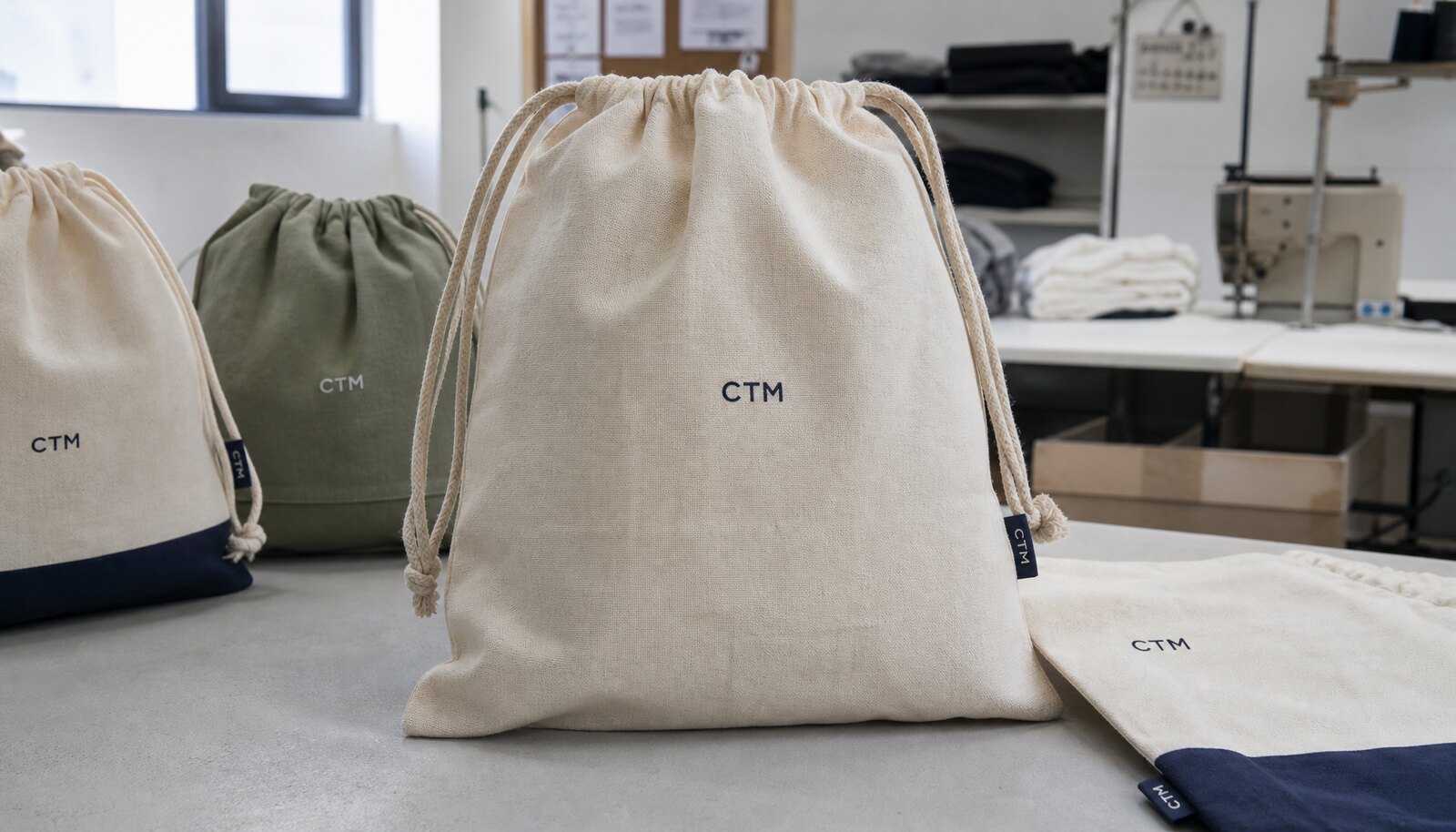
Start With The Use Case, Not The Logo
When procurement teams buy personalized drawstring bags bulk, the mistake is usually to start with decoration instead of function. A logo is only one variable. The real buying question is what the bag must do: present a gift, protect a product, package an order, separate items in transit, or support repeated consumer use. That use case determines the size, fabric density, closure strength, and whether the bag needs to look premium or simply perform reliably.
A pouch for jewelry or cosmetics can be light and soft. A bag for shoes, electronics, or hard-edged accessories needs more structure, stronger seams, and better abrasion resistance. If the bag is going into a retail channel, consistency matters almost as much as cost. If it is only for internal packaging, unit price may matter more. Write the RFQ around the job the bag must do, not around the artwork alone. That gives suppliers a basis for a real quote instead of a generic blank bag estimate.
- State the product it will carry and the maximum filled weight if known.
- Define whether the bag is for retail presentation, shipping protection, or internal packaging.
- Confirm whether the bag must survive repeated open-and-close cycles or only one-time distribution.
- Note any constraints on appearance, such as premium finish, soft hand-feel, or low transparency.
Lock The Size And Construction Before You Price Anything
Size is the easiest spec to understate and the most expensive to change later. A supplier can usually adjust a pattern, but every size change affects cutting yield, seam allowance, cord-channel length, carton pack-out, and freight volume. Compare quotes only when everyone is using the same finished size. If one vendor is quoting cut size and another is quoting finished size, the numbers are not comparable.
Construction matters just as much. A flat pouch is cheaper and packs more tightly. A gusseted or boxed-bottom pouch carries more volume and gives a better shelf shape, but it uses more fabric and more sewing time. The right answer is rarely the biggest possible pouch. It is the smallest structure that still fits the product cleanly and closes without strain. For heavier contents, ask for seam reinforcement at the bottom corners and at the cord channel, because that is where failures usually appear first.
- Specify finished size, not only pattern size, and state the tolerance in writing.
- Decide whether the bag needs a gusset, boxed base, or a flat construction.
- Ask for the cut-to-finish ratio so you can understand material waste and price pressure.
- Confirm cord length, hem depth, and whether the top opening needs reinforcement.
Fabric, GSM, And Finish Decide Feel, Strength, And Cost
For custom drawstring bags, fabric choice is the biggest quality lever after size. Cotton muslin in the 120 to 140 GSM range is common for lightweight promotional pouches and inner packaging. A tighter 150 to 180 GSM cotton or light canvas gives more body, hides contents better, and handles stress more reliably. If the bag carries sharp-edged products or anything with real weight, a thin fabric can show seam stress, distortion, or early wear.
Do not compare quotes on the phrase cotton bag alone. Ask for fabric composition, weave, GSM, finish, and whether the cloth is pre-shrunk, bio-washed, or greige stock. Those details change size stability and surface appearance. The same nominal GSM can behave differently depending on weave density and finishing. If the bags are retail-facing, ask for a shade standard or approved swatch. If the bags will be stored for months, confirm whether the material has any odor, linting, or dust pickup risk before packaging.
- Use 120 to 140 GSM cotton muslin for lighter promotional use.
- Use 150 to 180 GSM cotton or light canvas when the bag needs more body or better opacity.
- Ask whether the cloth is pre-shrunk, bio-washed, or greige stock.
- If the contents are heavy, request reinforced seams and a stronger cord channel.
Match The Decoration Method To The Artwork
Decoration should follow the artwork, not habit. Screen printing is usually the most economical choice for simple logos, solid shapes, and repeat orders. It gives strong opacity and a clean look, but each additional color adds setup and labor. If the artwork includes gradients, fine line work, or a dense multi-color mark, digital print or heat transfer may be more reliable because it avoids registration problems and heavy ink buildup.
For premium presentation, embroidery or a woven label can be a better fit than ink on the front panel. That choice is especially useful when the fabric is textured or the brand wants a restrained look. The tradeoff is that embroidery can distort thin fabric, and woven labels need placement discipline so they do not look like afterthoughts. Ask the supplier to confirm the minimum line thickness, minimum text size, safe distance from seams, and any restrictions on solid fills. If they cannot answer those points, the decoration is not fully engineered yet.
- Use screen print for bold, simple artwork with a controlled color count.
- Use digital print or heat transfer for fine detail, gradients, or short-run flexibility.
- Use embroidery or woven labels when the bag needs a more premium finish.
- Confirm whether small text, thin lines, or gradients need artwork simplification before production.
Read The Quote As A Cost Model, Not A Unit Price
MOQ is not just a gatekeeper number. It usually reflects the supplier's cost structure for fabric booking, print setup, sewing line changeover, and packing labor. A low MOQ can look attractive but still carry a high unit price, limited fabric options, or a simplified decoration method. For buyers planning repeat orders, tiered quotes are more useful than a single number. Ask for 1,000, 3,000, and 5,000 piece pricing so you can see how setup costs dilute as volume increases.
Treat the quote as a list of cost buckets, not as a single line. Screen fees, embroidery digitizing, sample charges, carton labels, hang tags, and special packing can materially change landed cost. A 3,000 piece run quoted at $0.52 ex-factory can easily land at roughly $0.72 to $1.00 per piece once freight, duty, and domestic delivery are added, depending on route and market. That is why a lower factory quote is not automatically the cheaper buy. Ask every supplier to use the same quote structure so the comparison is defensible.
- Ask for tiered pricing at 1,000, 3,000, and 5,000 pcs.
- Separate product cost from setup, sample, packing, and logistics cost.
- Treat low MOQ offers carefully if they limit fabric options or print methods.
- Compare ex-factory, FOB, and delivered pricing on the same basis.
Compare Supplier Routes Before You Compare Numbers
A direct factory is usually the right fit when you want control over fabric, sewing, print, and sample approval, and you can wait long enough to do it properly. A trading company can be useful when you need broader category sourcing or one commercial contact across multiple bag types. Local stock-and-print vendors win on speed, but they usually give up consistency and material control. There is no universal winner. The right route depends on how much variation you can tolerate and how much sourcing control you need.
The important question is not who is quoting, but who is actually making the bags. Ask who owns the pattern, who books the fabric, who runs the print, and who signs off the final inspection. If a reseller cannot clearly explain those roles, the quote may be thin on accountability. For higher-value or time-sensitive orders, ask for factory photos, equipment details, and recent sample images that match the exact spec you need. The goal is not to audit every vendor exhaustively. It is to make sure the commercial layer and the production layer are aligned.
- Direct factory: better control and usually better value at scale.
- Trading company: easier communication, but verify the real production owner.
- Stock-and-print route: fast, but accept less control over consistency.
- Ask who owns pattern approval, material booking, and final QC responsibility.
Treat Sampling As A Production Test
A sample is not just a visual approval. It is the only practical way to test how the fabric behaves, whether the cord slides cleanly, how the print sits on the cloth, and whether the bag closes evenly. Ask for a pre-production sample made from the exact fabric, cord, print method, and label type you plan to buy. A hand-cut mockup on substitute material may look close but still fail in production, which makes it a poor approval reference.
Review the sample like a factory inspector. Measure it, inspect the seam lines, check the cord tunnel finish, and compare the logo placement to your approved artwork. If the sample shrinks, puckers, or feels too stiff, record that before signoff. The approved sample should become your golden reference for incoming inspection and dispute resolution. Keep one sealed and untouched. Keep one working sample that can be used to compare production goods without damaging the reference copy.
- Require the exact fabric and exact decoration method in the pre-production sample.
- Measure size, cord length, and print position rather than approving by eye alone.
- Keep a sealed golden sample and note any deviations you are willing to accept.
- Use the sample to confirm packing format, not just the bag itself.
Build A QC Standard With Pass Or Fail Rules
QC coverage should be specific enough that a warehouse inspector, a factory line lead, and a buyer can all use the same rules. A practical default is AQL 2.5 for major defects, 4.0 for minor defects, and zero tolerance for critical defects, unless your category or customer requires something stricter. But AQL alone is not enough. Define what counts as a major defect, what counts as a minor defect, and what is outright rejectable before the order starts.
For personalized drawstring bags bulk, the most common defect classes are size drift, seam failure, logo shift, weak cord channels, and packing mistakes. Set a pass/fail standard for each of them. Example acceptance criteria: finished size within plus or minus 3 mm for small bags or plus or minus 5 mm for larger bags; print placement within plus or minus 2 mm to 3 mm; no open seam longer than 3 mm; no skipped-stitch run longer than 10 mm; no more than 2 loose threads longer than 10 mm per bag; no visible cracking after 20 fold cycles. If the supplier cannot work to that level of detail, the inspection standard is not mature enough.
- Use AQL 2.5 major, 4.0 minor, and 0 critical as a default starting point.
- Define pass/fail criteria for size, seam, print, and packing before production starts.
- Reject bags with visible stains, holes, oil marks, or needle damage in the main viewing area.
- Test print durability with fold and rub handling, not only visual inspection.
Packing, Cartons, And Shipping Terms Need To Be Written Down
Packing changes the cost structure as much as the bag does. Some programs need each bag individually polybagged to protect the surface or support retail shelving. Others should be bulk packed to reduce labor and material. The right answer depends on where the bags will be received, how they will be stored, and whether your team will repack them later. If the order includes color or size assortment, write the ratio into the PO. Do not leave it as a verbal note.
Carton labels, master carton marks, barcodes, and net or gross weight should all be specified before production. That matters for warehouse receiving, freight estimation, and claim handling. If you need FOB, then the forwarder, pallet rules, and export documents should be clear. If you need DDP or delivered pricing, ask exactly what is included: duties, local delivery, remote area charges, and who handles damage or shortage claims. One sentence of ambiguity can become a shipment dispute later.
- Define individual polybagging, bulk pack, or retail-ready packing before production.
- Specify inner pack count, carton quantity, and carton marking format.
- Write any assortment ratio into the PO instead of relying on verbal instructions.
- Confirm whether freight, duties, and local delivery are included if the quote is delivered pricing.
Ask For The Documents That Actually Protect The Order
Retail buyers and procurement teams often need more than a clean sample. Ask for the documents that support the order if the bags are sold, resold, or distributed through a controlled channel. Depending on your market, that can include fiber content confirmation, country of origin wording, carton labels, test reports for colorfastness or print rub resistance, and any material declarations your compliance team requires. Do not ask for tests you do not need, but do not assume the supplier has already prepared the right paperwork.
A strong supplier should be able to show that the quote, the sample, the production record, and the packing plan all match. If those four items disagree, the order is already at risk. This is especially important for branded programs where replacement cost is not only the bag price but also the campaign delay and the labor spent reworking inventory. Ask for one named contact who owns the order end to end, because accountability is easier to enforce when the responsibility is visible.
- Ask which compliance documents are available before the PO is issued.
- Confirm fiber content, country of origin wording, and any label requirements.
- If print durability matters, ask for rub or colorfastness evidence tied to the exact decoration method.
- Make sure one owner is responsible for the order from sample to shipment.
Specification comparison for buyers
| Spec or supplier route | Typical unit price | MOQ range | Best fit | Buyer risk to check |
|---|---|---|---|---|
| Stock blank bags plus local print | $0.45-$1.50 landed, depending on local labor and shipping | 100-500 pcs | Fast campaigns, event kits, and urgent replacements | Blank lots can vary in shade, cord length, and seam quality; confirm the blank inventory is from one dye lot |
| Direct factory, 120-140 GSM cotton, one-color screen print | $0.30-$0.85 ex-factory | 1,000-3,000 pcs | Standard promo programs and repeat orders | Check screen count, setup fees, and whether the quote assumes one artwork location only |
| Direct factory, 150-180 GSM cotton or light canvas, two-color print | $0.45-$1.20 ex-factory | 2,000-5,000 pcs | Retail-ready pouches and heavier contents | Ask for print registration tolerance, fabric shrinkage allowance, and whether the bag needs a stronger hem |
| Embroidery or woven label route | $0.70-$2.50 ex-factory | 500-2,000 pcs | Premium gifting, accessory packaging, and low-ink branding | Thin fabrics can pucker under embroidery; confirm backing, stitch density, and logo simplification |
| Trading company managing an audited factory | $0.40-$1.40 ex-factory | 1,000-3,000 pcs | Multi-category sourcing and buyers who want one commercial contact | Verify who owns the pattern, raw material booking, and final QC if there is a defect |
| FOB direct from factory with buyer freight | Same unit price as factory quote; freight and duty added separately | 1,000+ pcs | Teams that already control freight and customs | Make sure carton size, gross weight, and export paperwork are written into the PO |
| DDP or delivered pricing from a sourcing partner | $0.55-$1.80 landed, often easier to budget | 500-2,000 pcs | Buyers who want one invoice and simpler internal approval | Check what DDP includes: duties, remote area fees, local delivery, and claim responsibility |
| Third-party inspection before shipment | Usually $250-$600 per inspection, depending on location and scope | Best used on larger or first-time orders | Risk-sensitive launches and multi-site distribution | Define AQL, defect classes, and rework authority before production starts |
Buyer checklist before sampling
- Define the bag's job first: retail presentation, product protection, internal packaging, or repeated consumer use.
- Lock finished size, seam allowance, gusset depth, cord type, and closure style before asking for price.
- State the maximum filled weight or the heaviest item the bag must carry.
- Request quotes at 1,000, 3,000, and 5,000 pcs so setup costs and scale effects are visible.
- Ask for a pre-production sample using the exact fabric, print method, and cord construction you plan to order.
- Send vector artwork and define the maximum number of print colors, placement, and any required safe margin from seams.
- Ask for packing details in writing: individual polybag, bulk pack, inner pack count, and master carton count.
- Confirm tolerance rules for size, print position, shade variation, and stitching before production starts.
- Ask which work is done in-house and which steps are outsourced, including printing, embroidery, and final packing.
- Keep one sealed golden sample, one working sample, and one approved quote version so the factory can be measured against something concrete.
Factory quote questions to send
- What exact fabric composition, weave, GSM, and finish are you quoting, and can you show a matching swatch or spec sheet?
- Is the unit price based on one color, multiple colors, embroidery, or woven label work?
- What is the MOQ for the exact size, fabric, and decoration method I am requesting?
- Please quote 1,000, 3,000, and 5,000 pcs and explain what changes between those tiers.
- Does the quote include screen fees, digitizing, artwork setup, sample fees, or plate charges?
- What tolerance do you allow for finished size, cord length, seam placement, and logo location?
- What print or embroidery limits apply to line thickness, small text, and color count?
- How are the bags packed: bulk in cartons, individual polybags, or retail-ready with barcodes or hang tags?
- What is your standard timeline for sampling, production, internal QC, and shipment booking?
- Which inspection standard do you use before packing, and can you share a sample report or defect classification sheet?
Quality-control points to confirm
- Measure finished width, height, and gusset against the approved spec. Use a practical tolerance of plus or minus 3 mm for small pouches and plus or minus 5 mm for larger bags unless the product requires tighter control.
- Check seam quality at the bottom corners, top hem, and cord channel. Pass criteria: no open seam longer than 3 mm, no skipped-stitch run longer than 10 mm, and no more than 2 loose threads longer than 10 mm per bag.
- Verify cord function on both sides. The bag should close evenly, cords should not bind or twist, and both sides should be within 5 mm of each other in finished length.
- Inspect print placement and registration. A practical pass standard is placement within plus or minus 2 mm for small logos and plus or minus 3 mm for larger art, with no visible color bleed beyond the art edge and no missing ink or broken lines larger than 1 mm.
- Check print durability with fold and rub handling. Reject if the print cracks visibly after 20 fold cycles or transfers onto a clean white cloth with normal hand rubbing.
- Confirm fabric weight and appearance against the approved swatch. Reject obvious shade mismatch between panels, visible weave defects, stains larger than 3 mm, holes, oil marks, or needle damage in the main viewing area.
- Review packing accuracy. Carton count and inner pack count should be 100 percent correct, unless assortments were approved in writing. No mixed SKU cartons unless the PO says so.
- Set an inspection baseline with AQL before production. For most bulk pouch orders, buyers use AQL 2.5 for major defects, 4.0 for minor defects, and 0 for critical defects, but the threshold should be written into the PO and sample approval record.