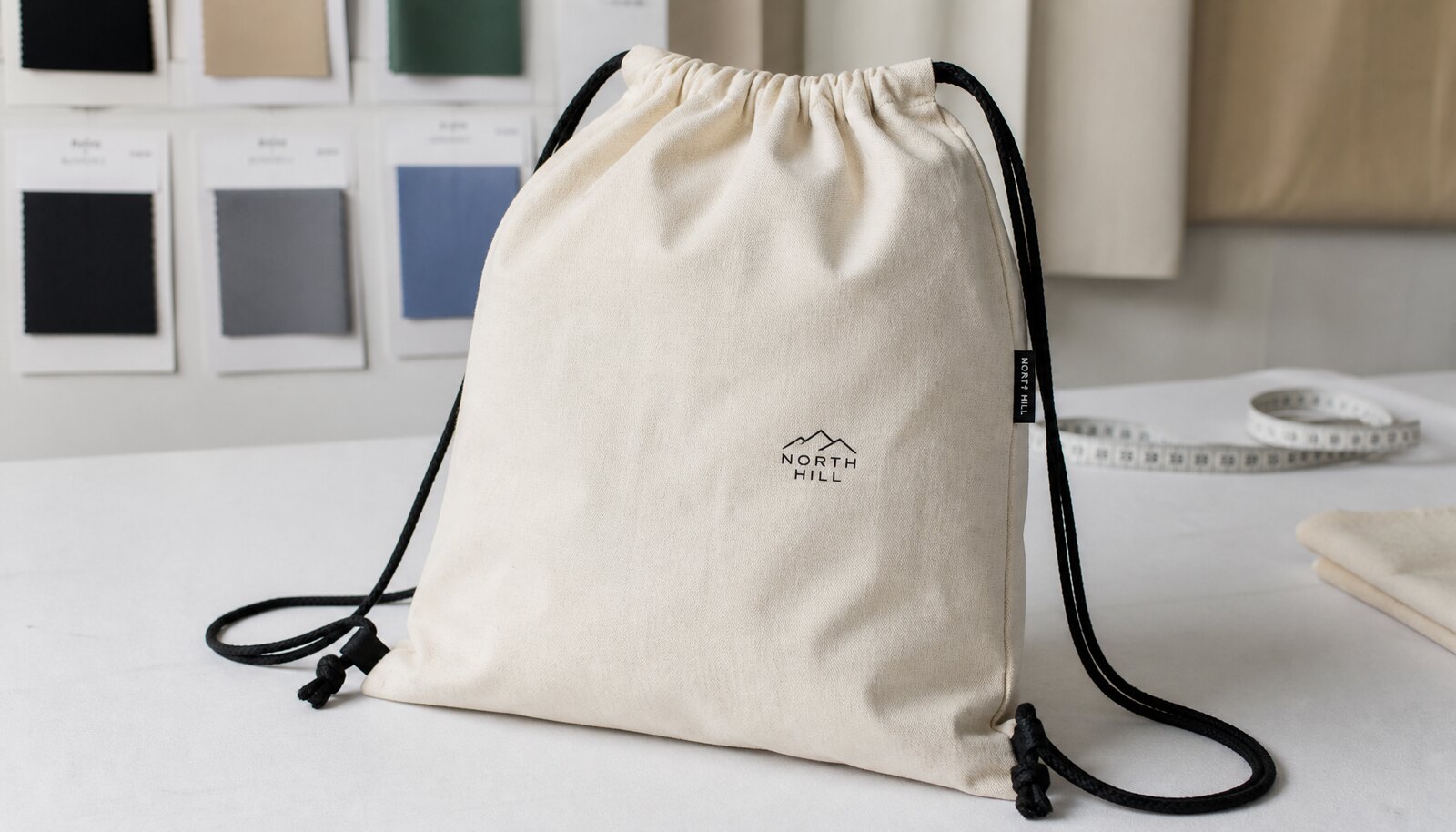
Start With the Use Case, Not the Logo
When buyers search for personalized drawstring backpacks bulk, they often start with the artwork and only later define the product. That order creates avoidable confusion. A logo can be printed on a wide range of bags, but not every construction can handle the same load, repeat use, or presentation standard. A school giveaway bag, a campus retail item, and an event pack may all be drawstring backpacks, yet they differ in fabric weight, seam reinforcement, decoration method, and packing format. If the use case is unclear, supplier quotes will appear comparable even when the products are not.
The better approach is to define the commercial purpose first. Is the goal to hit a giveaway budget, support a retail margin, or create a branded item that should feel substantial in hand? Once that is settled, the rest of the sourcing decision becomes more grounded: what fabric is acceptable, how much decoration is worth paying for, what finishing level matters, and how much variation the buyer can tolerate. A clear brief usually saves more time than a perfect logo file.
This also helps suppliers quote accurately. The category name alone can mean a lightweight promo pouch, a lined cotton canvas bag, a water-resistant polyester bag, or a more structured retail item with reinforcement. In an RFQ, describe the finished article, not just the category. Include dimensions, material, closure style, cord details, print requirements, and packing standard before asking for price. If the brief is vague, the supplier will fill in the blanks, and those assumptions are often the source of change orders.
For buyers managing several programs, it helps to group orders by channel. One specification can cover a promotional giveaway, another can cover retail merch, and a third can cover event use. You may still buy from the same factory, but the acceptance criteria should not be identical. A low-cost bag can be a good buy for a one-day event and a poor buy for resale. Precision at the start makes quote comparison meaningful later.
- Define the channel: promo, retail, sports, campus, or gift-with-purchase.
- Describe the bag as a finished product, not as a blank item for decoration.
- Match the spec to expected load and lifespan.
Choose Fabric for Function, Feel, and Freight
Fabric is the biggest driver of price and perceived quality. For cost-sensitive programs, 210D polyester is common because it is light, easy to sew, and inexpensive to ship. It works well for simple promotional use and can be made more functional with a coating. For a more premium look, cotton canvas is often the better fit, especially in the 140 to 240 gsm range. The right range depends on the use case. A 140 gsm canvas may suit light retail and gifting, while 200–240 gsm usually feels more substantial when the bag is part of a merchandise program.
GSM alone does not tell the whole story. A loose weave at 180 gsm may feel weaker than a tighter 160 gsm cloth. Coating, prewashing, calendering, and dye consistency also shape the final result. Ask for fabric construction, not only fabric weight. For polyester, clarify denier, weave, and any PU or PVC coating. For cotton, clarify whether the fabric is preshrunk, washed, or heat-set. If a factory cannot explain these basics clearly, treat that as a risk signal, especially for a repeat program.
There is also a freight tradeoff. Heavier canvas improves hand feel and branding presence, but it adds carton weight and shipping cost. That matters in bulk orders. Fabric choice also affects decoration. Screen print usually works well on polyester and cotton, but very textured cloth can reduce image crispness. Embroidery can add value on heavier canvas, but it can distort lighter fabrics or create puckering if stitch density is too aggressive. Compare the whole order economics, not just the fabric price per unit.
A practical rule is to match the material to the fill weight and product promise. If the bag will carry brochures or light giveaways, the build can stay light. If it will hold shoes, sports items, or folded apparel, reinforce the lower corners, check seam density, and consider a sturdier fabric or higher stitch count. Ask the supplier how many stitches per inch they use on main seams and whether bar-tacks are added at load points. That kind of operational detail is more useful than a vague promise of “good quality fabric.”
- 210D polyester fits low-cost, lightweight promo programs.
- Cotton canvas in the 140–180 gsm range suits entry premium and light retail.
- Cotton canvas in the 200–240 gsm range is better for heavier fill and stronger shelf presence.
- Ask for fabric construction, coating, prewash status, and color consistency, not just GSM.
Lock Down the Build Details That Often Get Assumed
A drawstring backpack looks simple, but several small build choices affect function and cost. Cord diameter matters because very thin cord can feel cheap and may dig into the hand, while a slightly thicker cord improves usability and perceived value. Cord end finish matters too. Heat-cut ends are economical, but if they are not sealed properly, fraying can appear quickly. Some buyers prefer plastic tips or knotted ends, but that changes both appearance and packing behavior. The same logic applies to any stopper: a basic plastic toggle can work well, but only if it stays fixed under repeated use.
Reinforcement is another area where generic quotes hide risk. The bag should not rely on a single seam at the cord channel. Ask whether the factory uses bar-tacks, double-needle seams, or reinforcement stitching at stress points. In many bulk orders, the first failure is not the main panel; it is the cord exit point or the lower corner where the load concentrates. If the order is heavier or expected to be reused often, ask for the exact stitch pattern or seam type at those stress points. A factory that can answer that clearly usually has better process discipline.
Finished dimensions should be stated in a way the factory can measure. Avoid writing only “standard size.” State the width, height, cord length, and any gusset or depth requirement. If the bag needs to fit a specific item, such as shoes, a notebook, or a lunch container, use that as the reference. The supplier should quote a tolerance range. For a simple promotional bag, a few millimeters may be acceptable. For retail or display programs, the buyer may need a tighter window.
It also helps to state what is not acceptable. For example: no broken stitch lines, no visible oil stains, no shade mismatch between front and back panels, no crooked label placement, and no cord ends that unravel in handling. That kind of negative specification prevents later arguments. Factories work better when the buyer tells them what reject examples look like, not only what the ideal bag should be.
- Ask for cord diameter, material, end finish, and stopper style.
- Require the factory to state reinforcement method at the cord channel and lower corners.
- Specify finished size, cord length, and any gusset or lining requirement.
- Add a short list of reject conditions, not just a description of the perfect sample.
Read the Quote for What It Includes, and What It Hides
A unit price by itself is rarely enough for custom drawstring backpacks because it can hide setup charges, packing assumptions, and decoration complexity. A quote should show the base bag price, print or embroidery cost, any label or hangtag cost, packing cost, carton cost, and any domestic handling charge before export. If the factory only gives one all-in number, the buyer cannot see where the savings or risks are coming from. That becomes a problem when comparing suppliers with different process routes or different assumptions about what is included.
The cleanest comparison is to make every bidder quote against the same sheet. Give the same size, same fabric, same print method, same packing style, and same carton requirement to each supplier. Then ask them to identify any deviation from the base spec. One supplier may quote lower because they assume stock fabric, while another includes pre-shipment inspection or higher-quality cord. Those are not equivalent offers. If the numbers are close, the better-supported quote often wins because it creates fewer hidden costs later.
Ask for quantity tiers if the order may scale. A quote should show where pricing changes at 1,000, 3,000, 5,000, or 10,000 pieces if that matters to the program. That helps procurement decide whether to consolidate volume and reveals how much the supplier depends on setup amortization. A large jump between tiers may suggest a heavy setup burden, while a flatter curve may indicate efficient production or stocked components. Both can be fine, but the logic should be visible.
If a supplier cannot explain the price drivers, they may not fully control the process. For drawstring backpacks, the main drivers are fabric grade, cutting efficiency, stitch complexity, decoration method, and packing labor. Ask which of those are fixed and which can change after sample approval. That gives you a clearer view of landed cost and of the risk of revision charges. A good quote is not the cheapest one; it is the one that makes the production path understandable.
- Compare quotes only after standardizing spec, size, print, and packing.
- Ask for separate lines for bag, decoration, packaging, carton, and handling.
- Request tier pricing if volume might move up or down.
- Treat unusually low unit prices as a prompt to check what is missing.
Choose Decoration for Durability, Not Just Appearance
The decoration method should be chosen for durability, simplicity, and economics, not just visual appeal. Screen printing is usually the most efficient option for one to three solid colors on larger runs. It is repeatable and easy to inspect, which makes it a good fit for many promotional and retail programs. For simple logos on polyester or cotton canvas, screen print often gives the best balance of cost and appearance. The buyer should still ask for the ink type, curing method, and whether the factory tests rub resistance on the actual fabric. A sharp print on day one is not a success if it cracks or transfers after handling.
Heat transfer or transfer film can be a strong option when the artwork is detailed, when personalization is needed, or when the run is short. It may allow names, numbers, or variable artwork without expensive screen setup. The tradeoff is durability and feel. Some transfers sit well on the fabric; others can feel stiff or show edge lift after repeated folding. If the supplier recommends transfer film, ask to see a sample after abrasion, folding, and light washing or rub testing where relevant. Do not approve the process on a flat proof alone.
Embroidery can elevate thicker canvas bags because it adds texture and a more retail-like feel. It is less suitable for very light fabrics where needle holes and thread density can distort the panel. If embroidery is under consideration, ask how many stitches the logo will use, what backing material they use, and how they prevent puckering. A useful quote should include digitization cost, thread count, and placement details so you can compare it with screen print on a true cost basis rather than on a vague premium impression.
A practical procurement question is lifespan. If the bag is meant to be used often, the decoration must stay legible after folding, carrying, and friction. If it is a short-term event giveaway, the buyer can accept a lower-cost print standard. Even then, there should be a minimum bar: no bleeding, no gross misregistration, and no peeling at delivery. When writing the RFQ, include both the decoration method and the use expectation so the supplier understands how much durability is needed.
- Use screen print for simple logos and larger quantities.
- Use transfer methods for short runs, fine detail, or variable names.
- Use embroidery only on fabrics heavy enough to support the stitch density.
- Ask for rub, fold, or handling resistance evidence on the actual fabric.
Use Samples to Prove Repeatability
Sample management is where many bulk programs either gain control or lose it. A decorative sample can show the artwork and overall shape, but it does not prove that the factory can repeat the build at scale. For custom drawstring backpacks in bulk, insist on a pre-production sample that uses the actual fabric, actual cord, actual print method, and actual packing format. If the sample room makes a prettier version with different cloth or different stitching, that can be helpful as a sales reference, but it is not a reliable production control sample.
The safest approach is to keep two reference points. First, maintain the approved sealed sample as the contractual reference. Second, keep a working sample at the factory for line control. This helps when questions arise about label placement, cord length, or stitch appearance. If the order is repeated later, the old approved sample is often more useful than the original artwork file because it shows what was actually accepted. Buyers who reorder should make sure the sample is traceable to the PO number, revision date, and component list.
Traceability matters because small substitutions can create major drift. A different cord supplier can change hand feel and length recovery. A different label vendor can alter color and stitch-edge quality. A slightly different screen mesh can shift print density. A good supplier should document what components were used in the approved sample and whether the same components will be used for bulk. If the factory says a substitution is equivalent, ask for written proof or a second sample. That is normal procurement discipline, not overcaution.
During sample review, inspect the bag as a user would: open and close it several times, pull the cords, check the shape when filled, and inspect the print from normal viewing distance. A sample that only passes a tabletop visual check is not enough. Many issues show up only after handling. The cord may cut into the bag channel, the bottom corners may twist when loaded, or the print may wrinkle once the fabric is tensioned. The sample stage is where these issues should surface, not after thousands of units have been cut.
- Approve a pre-production sample made from the same components as bulk production.
- Keep a sealed reference sample and a working line sample.
- Record PO number, revision date, and component list for traceability.
- Handle the sample like a user would: pull, fill, fold, and inspect under normal light.
Set QC Criteria Buyers Can Enforce
Quality control should be specific enough that both sides know what a pass looks like. That means measurable checks on size, stitching, print, cord performance, and packing count. A vague instruction such as “good quality” is not actionable. By contrast, a buyer can define a tolerance window for width and height, a placement window for the logo, and a list of defects that trigger rework or rejection. This is especially important when the order is large enough that minor defects will appear in every lot. The goal is not to demand perfection; it is to make acceptance objective.
A practical QC plan usually has three levels. First is an incoming material check, where the factory confirms fabric weight, shade, cord type, and label consistency. Second is an in-process check, where stitching, print registration, and seam quality are monitored before the full batch is completed. Third is the pre-shipment inspection, where buyers or third-party inspectors sample the finished cartons. The third stage is too late to fix a major design error, but it is still useful for catching count errors, carton damage, and obvious workmanship issues. If the order is time-sensitive, ask the supplier for inspection photos and measurement records before shipment.
Common failure modes are predictable. Loose threads are usually cosmetic but can signal weak trimming discipline. Skipped stitches or broken seams are more serious because they can cause early failure in use. Print defects include color shift, bleeding, ghosting, poor cure, and incorrect placement. Cotton products add another layer of risk because shrinkage can alter final dimensions after finishing or washing. Polyester products can show coating issues or poor edge finish if the factory has rushed cutting. Buyers should ask how the supplier classifies defects as minor, major, or critical and what happens when defect rates begin to rise during production.
A simple acceptance framework is usually enough. A minor defect might be a small loose thread that does not affect use; a major defect could be an off-center logo, a visible stain, or a crooked label; a critical defect would be a seam failure, wrong size beyond tolerance, or incorrect artwork. The thresholds should be tied to the buyer’s own tolerance, not a generic industry statement. If the bag is for a retail shelf, the standard is tighter. If it is for a one-day event giveaway, a little more variation may be acceptable, but there should still be a clear line between acceptable and rejectable.
- Write measurable tolerances for size, print placement, and cord length.
- Use incoming, in-process, and pre-shipment checks instead of relying on one final inspection.
- Classify defects as minor, major, or critical before mass production.
- Ask for photos, measurements, and defect counts, not just a verbal “passed” status.
Verify the Supplier, Not Just the Quote
A strong price is only useful if the supplier can actually repeat the order. For bulk personalized drawstring backpacks, procurement should verify more than the sample. Ask whether the seller is a factory, a trading company, or a decorator working from imported blanks. Then verify that answer. If they claim to be a factory, request a factory profile, machine list, production floor photos, and a description of which processes are done in-house. A real OEM should be able to show sewing machines, cutting tables, printing setup, and packing space. If they cannot, assume there is more outsourcing in the chain than disclosed.
Useful due-diligence documents include business registration, export history if available, quality certifications if relevant to your program, and a named production contact who understands the spec. For higher-risk orders, ask for an audit summary or a third-party factory assessment. You do not always need a full audit report, but you do need enough proof to know whether the supplier has the capacity they claim. Machine list matters because it shows whether the factory has the equipment needed for the job. For example, a bag that requires consistent bar-tacking or clean embroidery should be produced by a line that actually has that equipment in place, not borrowed elsewhere at the last minute.
Traceability is just as important as capacity. Ask which component suppliers they use for cord, labels, and fabric, and whether those vendors are stable across reorders. If the factory changes its label subcontractor or print vendor without notice, repeat orders can drift even when the primary supplier looks the same on paper. The buyer should also ask who signs off on a material substitution, who approves a print proof, and who owns the final pre-shipment signoff. That chain of responsibility should be clear before production begins.
It is also worth checking communication discipline. A supplier who answers quickly on price but cannot answer a tolerance question or a defect-classification question may not have the right internal controls. Ask a few operational questions early: how many stitches per inch they normally use, how they prevent shade variation, and what they do when a carton count is short. The quality of the answers often predicts the quality of the order better than the tone of the sales email.
- Ask for factory proof: registration, machine list, floor photos, and process ownership.
- Verify whether sewing, printing, and packing are in-house or outsourced.
- Request component traceability for fabric, cord, labels, and print consumables.
- Check who approves substitutions and who signs the final shipment release.
Build Packing, Shipping, and Lead Time Into the PO
Packing affects receiving, freight cost, and the first impression at destination. For wholesale or distribution programs, flat packing in bulk cartons is usually the most efficient. For retail or gift programs, individual polybags or branded inserts may be required. Specify whether the bags must be folded a certain way to protect the print, whether a desiccant is needed, and how many units belong in each carton. If those details are left open, the factory may choose what is easiest on its floor rather than what is best for your warehouse or sales channel.
Carton information belongs in the quote, not as a last-minute logistics note. Ask for carton dimensions, gross weight, carton count per batch, and outer carton marks. This is especially important if the bags will ship by air or if the receiving warehouse has pallet or shelf constraints. Carton compression can wrinkle printed panels, crush thicker embroidery, and distort cords. If the design is sensitive, ask for an inner layer or lower packing density. Also confirm whether master cartons are single-SKU only or mixed, because mixed cartons complicate inventory control.
Lead time is usually driven by material booking, decoration setup, sewing, and packing. The final ship date only matters if the milestones are believable. Ask the supplier for a schedule that shows sample approval, fabric arrival, production start, inspection, packing, and dispatch. If the order has a launch date, set a cutoff for artwork and packaging changes. Late changes often create new screens, new labels, or new packing instructions, which can add days or weeks. Buyers who need reliable delivery should treat change control as part of sourcing, not as an afterthought.
A realistic plan includes some buffer for rework and transit risk. Not every order needs a large cushion, but a bulk buyer should know where the weak points are. Complex artwork, custom packaging, or a new supplier relationship deserves more time than a simple repeat order with stocked fabric. The right shipment plan leaves enough time for correction if the first inspection finds a real problem.
- Specify packing style, carton count, carton size, and gross weight in the order.
- Protect printed or embroidered panels by stating the fold method and carton density.
- Ask for a milestone schedule, not only a promised final ship date.
- Use a change cutoff for artwork, labels, and packaging.
Use the RFQ to Force Apples-to-Apples Comparison
An RFQ works best when it removes ambiguity. Every supplier should receive the same spec sheet, the same artwork file, the same packing instruction, and the same acceptance standard. If one supplier quotes polyester while another quotes cotton, or one includes labels while another excludes them, the pricing will not be comparable. A disciplined RFQ reduces sales interpretation and improves the quality of the quote conversation. It also makes it easier for internal stakeholders to see why one option is better than another.
The RFQ should include the finished product description, fabric target, cord specification, decoration details, tolerance limits, packing requirements, inspection method, and required documents. It should also state what the quote must include and what must be shown separately. For example, ask for separate pricing on sample cost, setup, blank bag, print, labels, packing, and freight terms. That lets procurement model landed cost more accurately. If you expect future reorder volume, say so. Some suppliers will quote differently if they know the program is likely to repeat.
Ask suppliers to confirm deviations in writing. If they propose a substitution, they should explain the reason, the material difference, and the commercial effect. That keeps the negotiation focused on facts instead of vague assurances. Over time, a buyer can build preferred specs for common use cases: one for low-cost promo, one for mid-range event merch, and one for retail. Once those templates exist, sourcing becomes faster and more controlled without feeling repetitive.
The deeper lesson is that a strong RFQ is not just a request for price. It is the mechanism that defines the product. If you want custom drawstring backpacks in bulk that arrive on time and match the sample, the RFQ has to do the work of a build sheet, a quality brief, and a packing instruction combined. That may sound detailed, but it is exactly what reduces rework later.
- Send every bidder the same spec, artwork, packing, and acceptance criteria.
- Ask quotes to separate sample, setup, bag cost, decoration, packing, and freight terms.
- Require written confirmation of any substitution or deviation.
- Keep reusable RFQ templates for promo, event, and retail use cases.
Specification comparison for buyers
| Sourcing option | Best fit | Indicative cost level | Pros | Cons / risk |
|---|---|---|---|---|
| Direct OEM factory | Repeat programs, custom construction, tighter cost control | Low to medium ex-factory | Better control over fabric, seams, print, and repeatability | Requires stronger vetting and clearer specs; quality can vary by production line |
| Trading company with disclosed factory | Multi-SKU programs or buyers needing one contact | Medium | Convenient coordination and broader sourcing support | Less transparency if the factory changes; responsibility can blur |
| Local decorator using imported blanks | Fast domestic delivery and short promotional deadlines | Medium to high | Quick turnaround and easier communication | Limited fabric and build choices; fewer OEM controls |
| 210D polyester blank bag | Low-cost giveaways and lightweight promo packs | Low | Lightweight, economical, easy to ship | Can feel thin; coating and seam quality matter |
| 210D–300D polyester with PU/PVC coating | Events, sports, and improved moisture resistance | Low to medium | More surface stability and better protection from light moisture | Coating may feel stiff or crack if overdone |
| Cotton canvas 140–180 gsm | Entry premium, gift-with-purchase, campus merch | Medium | Natural hand feel and stronger perceived value | Can shrink, wrinkle, or vary in shade if control is weak |
| Cotton canvas 200–240 gsm | Retail, brand merch, heavier fill weight | Medium to high | More body, stronger shelf presence, better hand feel | Higher unit cost and freight weight; stitch consistency matters |
| Screen print 1–3 spot colors | Large runs with simple logos | Low | Efficient at scale and usually repeatable | Setup costs apply; not ideal for gradients or many colors |
| Heat transfer / transfer film | Short runs, variable names, fine detail | Medium | Useful for personalization and smaller runs | Durability depends on film quality and application discipline |
Buyer checklist before sampling
- Confirm the end use first: giveaway, campus retail, sports kit, event pack, or resale item; the channel should drive fabric and decoration choices.
- Lock the bag specification in measurable terms: finished size, fabric type, GSM, coating, cord diameter, stopper type, and any lining or reinforcement.
- Write the logo requirements clearly: print method, print size, placement window, Pantone target or visual match, and number of colors.
- Ask for a pre-production sample made with the same fabric, cord, print method, and packing style that the bulk order will use.
- Require tolerance limits for dimensions, print placement, seam alignment, and cord length before cutting starts.
- Request carton data in the quote: units per carton, carton dimensions, gross weight, barcode requirements, and outer mark text.
- Ask the supplier to separate blank bag cost, decoration cost, packaging cost, and any setup charges so you can compare quotes line by line.
- Clarify what is in-house and what is outsourced: sewing, screen making, embroidery, label application, packing, and final inspection.
- State the acceptance standard for defects: loose threads, crooked print, stain, shade variation, broken stitches, and count errors.
- Set a change cutoff date for artwork, labels, and packing so late revisions do not create avoidable delays or extra charges.
Factory quote questions to send
- What is the exact fabric construction, yarn or denier detail, and GSM, and what tolerance do you allow in incoming material inspection?
- Is the price quoted for blank bags only, or does it include printing, embroidery, labels, individual packing, and master carton packing?
- What is the MOQ by color, by size, and by print version, and how does the unit price change if I split the order into multiple versions?
- What cord specification is included: diameter, material, finish, end style, and whether the cord is pre-cut or cut in-house?
- What reinforcement is used at stress points, and how many stitches or bar-tacks are applied at the cord channel and lower corners?
- Can you provide a pre-production sample, and will it be made on the same line and with the same components as bulk production?
- What are your size tolerances for finished width, height, and cord length, and how do you measure them on the line?
- How do you control print placement and color consistency, and what is the acceptable variation from the approved sample?
- What are the carton pack details, and can you confirm carton dimensions, gross weight, and packing marks before production starts?
- Which process steps are in-house, which are outsourced, and which supplier do you use for labels, cord, or printing consumables?
Quality-control points to confirm
- Finished width, height, and cord length are measured against the approved sample and stay within the written tolerance, such as +/- 5 mm for small promo bags or a tighter window for retail specs.
- Fabric matches the approved spec for construction, weight, coating, and shade. Watch for lot-to-lot color drift, loose weave, coating streaks, and excessive stretch in the panel fabric.
- Stitching is even and secure at stress points. Check for skipped stitches, broken seams, needle holes, loose ends longer than the agreed limit, and weak bar-tacks where the cord channel meets the body.
- Cord slides smoothly and both sides are equal in use. Confirm that cord diameter and finish match the sample, that stoppers hold position if included, and that the cord does not fray during a simple pull test.
- Print placement stays within the agreed window, with no obvious skew, misregistration, ghosting, bleed, or color shift. For screen print, verify cure quality with a rub test and inspect for tackiness after folding.
- Embroidery, if used, should not pucker the fabric, distort the panel, or expose stabilizer. Check stitch density, thread trim, and backing cleanliness on the reverse side.
- Labels, hangtags, barcodes, warnings, and country-of-origin markings match the PO and artwork file. Verify orientation, spelling, barcode readability, and placement consistency.
- Packing count is exact in each inner pack and carton. Check for overcounts, short counts, mixed assortments, or missing inserts before balance payment is released.
- Cartons are strong enough for stacking and export handling. Look for crushed corners, tape failure, wet cartons, and compression marks caused by overpacked contents.
- Use AQL sampling or a defined visual standard for a pilot run, in-process checks, and pre-shipment inspection. Common reject reasons should be documented before mass production starts.