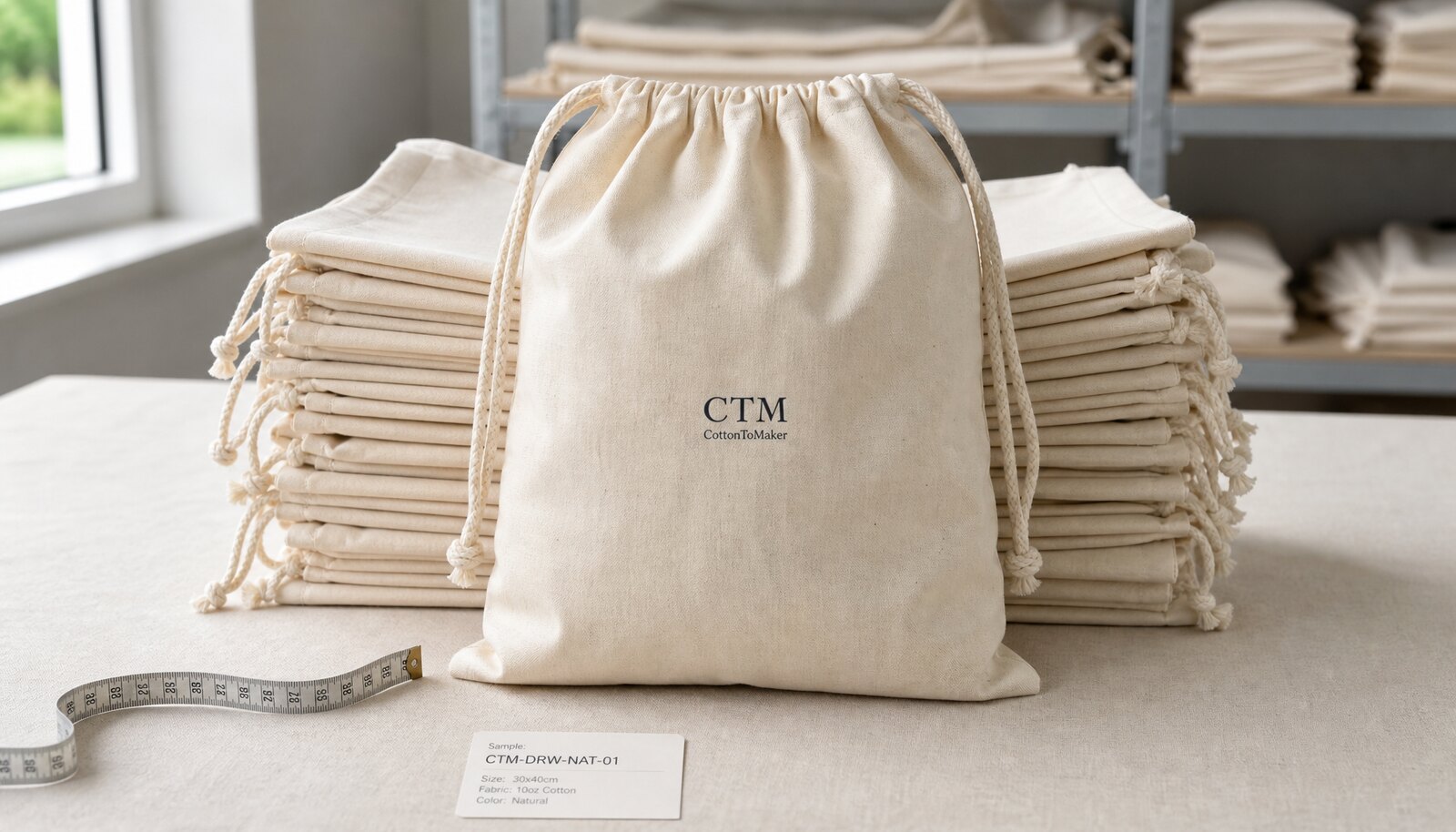
What buyers are actually buying when they source personalized cotton drawstring bags
For procurement teams and brand buyers, personalized cotton drawstring bags are not just a low-cost pouch. You are buying a combination of fabric feel, print clarity, load performance, and packing efficiency. The same bag can look acceptable in a sample photo but fail in warehouse receiving if the cotton is too thin, the cord channel is tight, or the logo print shifts after folding. That is why sourcing this item should be treated like a packaging purchase, not a commodity buy.
The first sourcing decision is not the logo. It is the use case. A bag for a cosmetic set, a jewelry kit, a retail accessory, a seasonal gift, or a promotional mailer will need different GSM, different sewing tolerance, and different packing rules. If you define the function first, you can compare supplier quotes on the same base and avoid paying for features that do not affect shelf performance. This also helps you avoid over-specifying a pouch that will be hidden inside a larger box, where appearance matters less than cost and packing density.
A useful buyer mindset is to separate visible quality from functional quality. Visible quality includes surface smoothness, color consistency, print sharpness, and folding neatness. Functional quality includes seam strength, cord movement, carton count, and whether the bag can survive repeated opening or insertion by a fulfillment team. In many procurement programs, the bag is touched at least three times: during sewing, during packing, and during receiving. A defect that seems small in sample review can multiply across every touchpoint.
You also need to know where the bag sits in the customer experience. If it is used as outer retail packaging, the print and fold become part of the product presentation. If it is an inner pouch for product protection, the surface can be simpler but the bag must be consistent and easy to pack. If it is a giveaway item, then cost control, low MOQ, and fast replenishment matter more than premium hand feel. The best quote comparison starts with that decision, because it determines which specs are worth paying for and which are just nice to have.
In practice, the buyer’s job is to make the bag spec objective enough that two suppliers can quote the same thing. If one factory is quoting a 120 GSM bag with bulk packing and another is quoting a 160 GSM bag with retail inserts, the numbers are not comparable. A strong RFQ should make the bag size, fabric, cord, print, packing, and inspection expectations visible before the first price is exchanged. That is how procurement teams reduce surprises later.
- Retail gift bag: prioritize print appearance, folding consistency, and shelf-ready presentation.
- E-commerce insert: prioritize packing density, carton strength, and receiving speed.
- Promotional giveaway: prioritize low MOQ, stable unit cost, and simple decoration.
- Premium brand pouch: prioritize fabric consistency, label placement, and finish detail.
- Wholesale replenishment: prioritize repeatability, clear tolerances, and reorder stability.
Cotton fabric choices and why GSM changes the whole quote
Most factory quotes for cotton drawstring bags are built around fabric weight. A 120 GSM bag may look fine for light giveaways, while a 140 GSM or 150 GSM version feels more structured and presents a logo better. Once you move to 170-180 GSM, you gain a more premium hand feel, but you also increase material cost, sewing resistance, and carton weight. That changes both the unit price and the freight math. Buyers should assume GSM is not a cosmetic preference; it is one of the main cost and performance drivers in the order.
Natural cotton is the most common base because it accepts printing well and fits eco-focused branding. Combed cotton gives a cleaner surface, which helps when your artwork has thin lines or small text. Unbleached natural cotton is less processed, but buyers should expect slight shade variation, visible fiber slubs, and small surface marks that are normal for the material rather than defects. If your brand requires a very even visual base, ask the supplier whether they use bleached stock, combed yarn, or a tighter weave that reduces slub visibility.
Fabric width matters too. Two bags with the same GSM can quote differently if one uses a wider cloth width and one uses a narrower width that creates more cutting waste. That waste is hidden inside the price, not the spec sheet. You should ask whether the quote assumes stock width, custom cutting, or fabric wastage allowance. The same is true for color. Natural cotton is usually cheapest, but dyed colors can trigger separate dye batch minimums, shade variation risk, and longer lead time for matching.
For procurement comparison, it helps to link fabric choice to use case rather than brand language. A 120-130 GSM bag is usually enough for lightweight accessories, small samples, and promotional packs. A 140-150 GSM bag is the safest middle ground for most retail and general brand use. A 160-180 GSM bag is more suitable when the pouch is part of a premium presentation or when the contents have sharper edges that could show through thin fabric. If the buyer expects repeated reuse, the heavier option often reduces complaints about transparency and deformation, even if the unit price is higher.
The right question is not “what is the best cotton?” It is “what cotton gives us the acceptable appearance, print result, and packing cost for this program?” That is the question that makes quotes comparable.
- 120-130 GSM: suitable for light accessories, samples, and promo kits.
- 140-150 GSM: balanced choice for retail and general brand use.
- 160-180 GSM: better for premium presentation and stronger perceived value.
- Combed cotton: better print surface, usually higher cost than standard cotton.
- Dyed cotton: higher visual control, but often more lead time and shade risk.
Print methods: what works for logos, what causes reject samples
For personalized cotton drawstring bags, the cheapest-looking quote is often the one that hides print setup limitations. Screen printing is usually the best commercial option for one to two solid colors and higher volume. It gives good opacity and stable repeatability if the factory uses the correct mesh, ink, and curing process. When artwork has gradients, small fonts, or multiple colors in a short run, digital or heat transfer may be the practical route, but the price and durability need closer review.
A buyer should judge the print on the actual sewn bag, not on a loose fabric swatch. The same artwork can shift once the bag is folded, stitched, and tensioned by the drawcord channel. If the print is too close to the seam, the logo may distort after sewing. If the ink is not fully cured, you may see sticking, smearing, or premature cracking during packing. A proper sample should therefore be reviewed after sewing, after pressing, and after the bag has been opened and closed several times.
Decoration limits should be written into the quote request. Ask for the maximum print area, the safe distance from seams, the minimum line thickness that the method can hold, and whether the factory can maintain small text without fill-in. If the buyer has a logo with fine strokes or reverse-out type, the decoration method is not just an aesthetic choice; it determines reject rate and rework cost. In some cases, a woven label or a single-color print gives better repeatability than a more complex direct print.
It is also worth asking how the decoration affects cost by spec change. Moving from one to two colors may add setup and ink cost. Adding a second print location may create a second screen or second labor pass. Switching from screen print to transfer may reduce setup at very low volume but increase unit cost. Embroidery can lift the perceived value, but it also adds stitch time, thread inventory, and the chance of puckering on lighter cotton. The buyer should compare those tradeoffs before asking for “one more option” that later complicates the order.
For sourcing teams, the practical rule is simple: choose the least complex decoration method that still meets brand standards. That usually gives the best balance of lead time, price, and defect control.
- Screen print: best for simple logos, stable repeats, and better unit economics.
- Heat transfer: useful for short runs or detailed artwork, but verify rub resistance.
- Digital print: suitable for small orders or multi-color graphics, usually higher cost.
- Embroidery or woven label: better for premium branding, but increases labor and MOQ.
- Ask for maximum print size, safe seam distance, and minimum line thickness in writing.
How factories build MOQ, and how to use it in supplier comparison
MOQ on cotton drawstring bags is usually driven by fabric availability, print setup, and sewing line efficiency. If the supplier already has the right natural cotton cloth in stock and you keep to one logo color, one size, and one cord color, the MOQ can stay relatively low. Add custom fabric weight, a special dyed cord, or multiple label placements, and the factory may need to reserve material or interrupt production flow, which pushes MOQ up. In other words, MOQ is often a production planning problem, not just a sales policy.
When comparing suppliers, do not read MOQ as a single number. Read the entire MOQ logic. One factory may offer 3,000 pieces at a higher unit price with standard materials, while another may quote 5,000 pieces but includes a more controlled print process and better packing. For a buyer, the real question is which route gives the lowest risk at the required service level, not which line shows the smallest number. If the lower-MOQ supplier has weak process control, the savings can disappear in inspection rework or late delivery.
There are also hidden MOQ triggers that procurement teams should ask about early. Some suppliers set MOQ by fabric color, not by PO total. Some set it by print artwork, which means each logo variant needs a separate minimum. Others apply a minimum for woven labels, hangtags, or custom inner packing even when the bag itself is standard. If you do not ask the right question, you may think you are comparing like for like when the factories are actually quoting different production structures.
A good comparison worksheet should separate true MOQ from sample fee, plate fee, packing fee, and any extra charge for minor spec changes. For example, a standard bag might have a low MOQ, but changing the cord to a custom color can trigger a separate material minimum. Adding a folded insert or retail sticker may look small on paper but can increase labor more than expected. The buyer should therefore ask the supplier to identify the exact reason for every MOQ restriction. That explanation is often more useful than the number itself.
The most procurement-friendly approach is to request the standard version and the upgraded version side by side. If the standard route is too basic, you can see exactly which change drives cost or MOQ upward. That gives you leverage in negotiations and helps you avoid over-ordering features that do not improve the end use.
- Lowest MOQ usually comes from standard fabric + one print color + one-size run.
- Custom cord, custom label, or dyed fabric often raises MOQ faster than print changes.
- Ask whether the MOQ is per color, per artwork, per size, or per total purchase order.
- Separate true MOQ from sample fee, plate fee, setup fee, and packing fee.
- Request the supplier’s reason for each minimum so you can compare routes accurately.
Supplier routes: direct factory, trading company, or mixed-sourcing path
The sourcing route matters because personalized cotton drawstring bags can look simple but still hide process variation. A direct factory is usually the best option if you need repeatability, clear control over fabric GSM, and better visibility on sewing and print changes. A trading company can be useful if you are consolidating multiple product types in one shipment or need help with multilingual coordination, but the quote may include hidden handling layers. For a B2B buyer, the issue is not who is easiest to email; it is who can consistently reproduce the approved sample.
For retail buyers and distributors, the right route depends on how often you reorder. If you expect repeat business, a direct factory relationship usually gives better control of shade, size, and print consistency. If the order is one-time and mixed with other packaging items, a trading route may save time. The key is to make the quote transparent enough that you can compare landed cost and not just unit price. Ask for the production address, who owns the printing step, and whether any process is subcontracted.
Mixed-sourcing can be practical when the bag is one component in a larger packaging program. For example, if you are sourcing a drawstring bag together with a box, tissue paper, and a hangtag, one trading partner can sometimes coordinate the whole bundle and reduce your internal workload. But the tradeoff is less direct control over quality disputes. If a problem shows up, you need to know whether it came from the actual sewing factory, the print subcontractor, or the pack-out team. That is why the buying team should always ask who performs each process step.
The quote should also clarify whether the supplier is acting as an exporter, a consolidator, or just a sales office. That affects how quickly issues can be corrected, whether spare stock can be held, and how rework is managed if a lot fails inspection. A direct factory may be better for repeat SKUs; a trading route may be better for program management. Neither is automatically superior, but the buyer should know what layer they are paying for.
If you need consistent reorders, the strongest move is often to qualify one direct factory and one backup route. That gives you pricing leverage without losing the production control that these bags require.
- Direct factory: better for repeat quality control and process visibility.
- Trading company: useful for mixed baskets and simplified communication.
- Mixed-sourcing path: good when you need bundled packaging items with one shipment.
- Ask who owns the sewing, printing, packing, and export documentation steps.
- Always request the actual manufacturing address or production base name.
Sample approval: the stage where most avoidable defects get missed
A proper sample for personalized cotton drawstring bags should be made from the same fabric, the same cord, the same sewing method, and the final print method. A blank size sample is not enough if the artwork placement matters. The sample must show how the logo sits relative to the seam, how the bag folds, and whether the drawcord slides smoothly after stitching. If the supplier only sends a digitally printed mock-up or a sewn blank, you have not yet approved the real product.
The sample review should be practical. Lay the bag flat, measure width and height, then load it with the intended product weight. Check whether the channel twists, whether the seam distorts, and whether the print stays centered after tension. If the bag is for retail, you also need to know whether it can be folded consistently for carton packing without crushing the logo area. Ask for one sample folded the way the carton will be packed, not just a clean photo on a table.
Buyers should also treat sample approval as a specification lock, not a courtesy step. Once the sample is approved, the PO should reference the sample date, sample code, size, print color, cord type, and packing format. That gives procurement a concrete basis for rejecting a shipment that drifts materially from the approved version. If the supplier wants to swap fabric, change the cord, or shift print position after sample approval, that should trigger a reapproval cycle.
For tighter programs, ask the factory to provide a pre-production sample and, when relevant, a production reference sample. The pre-production sample proves the setup before mass sewing starts; the production reference sample helps the inspection team judge the bulk lot later. This is especially useful for buyers who are not on site during production. It reduces the chance that verbal promises replace the actual approved standard.
The sample review should also include a short conversation about what went wrong, if anything. Was the logo too close to the seam? Did the fabric show more slub than expected? Did the drawcord feel too stiff? Those details are often more useful than a generic “approved” stamp because they tell the factory what must be controlled in bulk.
- Measure size before and after loading to see if the bag distorts.
- Rub the print lightly to detect weak curing or transfer risk.
- Open and close the drawstring several times to test channel friction.
- Approve artwork placement on a sewn sample, not only on artwork proof.
- Reference the approved sample code and date in the PO.
QC thresholds that matter in production and receiving
For bulk orders, quality control should focus on a few measurable points instead of vague visual approval. Size tolerance, stitch consistency, print clarity, and cord function are the most useful checks. A bag that is 5 to 10 mm off size may still be acceptable depending on the spec, but a crooked seam or a shifted logo can make the product look cheap in retail packaging. Buyers should write acceptance limits into the PO or spec sheet before production starts. If the supplier knows the standard in advance, dispute handling becomes much simpler.
QC coverage should also include stitch count and seam behavior. Ask the factory what stitch density it uses on the main seams and whether the channel seam is reinforced. You do not need a laboratory report to make this useful. A buyer can ask for a simple control range: no skipped stitches, no open seam ends, no thread knot buildup, and no more than an agreed amount of puckering at corners. If the bag is intended for repeated use, ask the supplier to explain how the cord channel was tested for wear.
Print testing should not stop at visual review. A practical receiving check can include dry rub, light wet rub if the bag might encounter moisture, and tape pull testing on a sample from each lot or carton set. If the print is on natural cotton, small fiber texture is normal, but the ink should still stay aligned with the approved sample. If the logo is supposed to be sharp, ask the supplier to define what “acceptable” means in terms of blur, registration, or coverage. This is far more useful than the word “good” in a QC email.
Receiving teams should also inspect packing consistency. If the factory promised 50 pieces per inner polybag and the cartons arrive mixed at 48 and 52, inventory counting becomes messy. If the carton markings do not match the PO, warehouse delays can eat up any savings from a lower unit price. This is especially important for distributors and ecommerce buyers who need fast put-away. For larger programs, use AQL-style acceptance language so there is a clear rule for major and minor defects and a defined response for each level.
The strongest QC setup is the one that is simple enough for the supplier to follow and detailed enough for your team to enforce. A one-page control sheet with measurable points usually performs better than a long narrative that nobody can apply consistently.
- Size tolerance: define an acceptable range before production.
- Stitching: no skipped stitches, seam breaks, or excessive puckering.
- Print placement: logo centered within the approved visual window.
- Cord function: smooth pull, secure ends, no slipping after handling.
- Receiving checks: carton condition, quantity count, and packing label match.
Packing, carton count, and export handling
Packing is a cost driver that buyers often ignore until the shipment arrives. Personalized cotton drawstring bags can be bulk packed, individually polybagged, folded with a cardboard insert, or labeled for retail. Every added step increases labor and can change the carton size. For export buyers, a compact and consistent carton count usually matters more than a perfectly dressed retail fold if the bags will be repacked downstream. That is why packing should be chosen based on the next handling step, not just on appearance in the factory photo.
If the bags are going direct to stores or subscription fulfillment, retail-ready packing may be worth the extra cost. If the bags are going into a larger branded box or being stuffed with another product, bulk packing is usually cleaner from a cost perspective. The right choice depends on who opens the carton next, not on what looks neat in a sample room. Buyers should ask the factory to quote the difference between bulk, inner-bag, and retail-pack versions so the cost impact is visible before approval.
Carton count and carton strength matter as much as the inner pack. Ask for the exact quantity per carton, the carton dimensions, and the gross weight. A lower carton count may make handling easier but increase freight cost. A very dense carton may reduce freight but can risk compression marks, crushed corners, or creased print areas. If your bag is printed close to the fold line, ask the supplier how they prevent set creases during inner packing.
For warehouse operations, receiving labels should be clear and consistent. Carton marks should show SKU, quantity, carton number, and any orientation or storage instructions. If the bags include inserts, barcode labels, or hangtags, make sure those costs are separately identified. Many quote disputes happen because the bag price was clear but the packaging extras were not. A B2B buyer should insist on line-by-line visibility so the landing cost is predictable.
The final packing decision should match the handling plan. Bulk if you want cost efficiency. Individual if you want cleaner receiving. Retail-ready if the bags are part of the customer-facing presentation. But always make the supplier quote the difference, because packing changes are one of the easiest places for hidden cost to appear.
- Bulk pack: lower cost, better for warehouse handling.
- Individual polybag: cleaner receiving, higher labor and material cost.
- Retail fold: good for shelf presentation, but can crease printed areas.
- Carton count should be fixed and marked clearly for receiving teams.
- Ask separately for insert, label, and barcode costs if they apply.
Lead time, quote data, and the landed-cost comparison buyers should use
A useful quote for personalized cotton drawstring bags should separate material, print, sewing, packing, and carton handling. If the supplier only gives one unit price, you cannot see where the cost is hiding. In a normal standard-spec order, lead time often sits around 14 to 25 days after sample approval, but that range can stretch when fabric is sourced fresh, when multiple print colors are involved, or when the packing instructions are unusually detailed. Buyers should ask for a timeline that shows the sample stage, production start, and final dispatch date instead of a single broad estimate.
For landed-cost comparison, compare not only ex-factory price but also carton volume, gross weight, and the print setup fee. A slightly higher unit price may still win if the cartons are denser or the supplier packs more consistently. Likewise, a lower unit price can become expensive if the factory changes carton count, adds repacking labor, or forces extra handling at destination. In many sourcing programs, freight and receiving labor are just as important as the bag itself.
Quote structure should also show what happens when the spec changes. If you move from one to two print colors, what is the additional cost? If you add a woven label, what is the setup fee and what is the MOQ impact? If you request packaging inserts or a custom hangtag, does the quote include the material and application labor or only the item cost? These details are not minor. They are where many surprise increases show up after the buyer thinks the order is already agreed.
Buyers should also ask about overrun and underrun tolerance before the PO is issued. A factory may be comfortable producing a small excess or shortfall, but that needs to be explicit so the receiving team knows what to expect. The same applies to sample cost. Some suppliers will credit the sample cost once the bulk order is placed; others will not. Neither is wrong, but it should be visible in the comparison sheet. If you do not ask, the cheapest quote may simply be the least complete quote.
A good landed-cost comparison should include: unit price, setup cost, sample cost, pack-out cost, carton spec, freightable dimensions, and the lead time start point. If one supplier is quoting more detail than another, ask both to re-quote on the same template before making a decision.
- Quote should separate unit price, setup fee, sample fee, and packing extras.
- Lead time should state whether it starts from PO, deposit, or sample approval.
- Carton size and gross weight should be included for freight planning.
- Compare suppliers on the same spec sheet, not on different email descriptions.
- Ask for overrun/underrun tolerance and sample cost policy in writing.
A buyer workflow that reduces mistakes before PO release
The cleanest way to buy personalized cotton drawstring bags is to lock the specification in three steps: define the bag, approve the sample, then release the PO against the approved sample. This sounds basic, but many problems come from mixing these steps. Buyers approve artwork before fabric, approve fabric before packing, or compare supplier quotes before the final dimensions are fixed. That is how small differences turn into chargebacks and delayed receipts. A disciplined workflow saves more money than squeezing a few cents from the unit price.
A practical workflow is to request two quotes from each supplier: one based on the standard spec and one based on the upgraded spec you may use if the first price is too tight. This makes it easier to compare what each factory can actually control. It also exposes whether the supplier is quoting a real production setup or just a low entry price that will change later. If the standard version and the upgraded version are close in cost, you may choose the better spec. If the gap is large, you know exactly which feature is driving it.
Before PO release, the buyer should also run a risk review. Which dimension is critical? Which tolerance matters most? Is the logo a brand-critical element or just a functional mark? Will the receiving team reject cartons if labels are off, or is the bag intended for a less controlled channel? This sounds simple, but it helps procurement decide where to spend control effort. Not every spec deserves the same level of inspection, but every spec should be written down.
The PO itself should reference the approved sample, the agreed tolerances, the packing method, and any replacement or credit rule for defects. If the factory agrees to a rework policy, include who pays for rework and how replacement quantity is handled. If the program is seasonal, ask the supplier to identify the single longest-lead component, because that is often what delays the full order. Buyers who understand the critical path tend to avoid rushing the wrong step.
A good final check is to compare the approved sample against the first production lot, not just against the artwork proof. The sewn product is the real standard. If the bulk lot differs materially, you need a written basis for action. That is what keeps the order commercial instead of conversational.
- Step 1: freeze size, fabric GSM, print method, and packing format.
- Step 2: approve a sewn sample with final artwork and final cord.
- Step 3: release PO with tolerances, carton count, and lead-time start point.
- Step 4: compare the approved sample against the first production lot.
- Step 5: keep rework or replacement rules in the PO if quality slips.
Specification comparison for buyers
| Spec decision | Recommended option | When it fits | Buyer risk to check | Testing or cost impact |
|---|---|---|---|---|
| Cotton fabric weight | 120-140 GSM for standard retail bags; 150-180 GSM for premium feel | Brand launches, gift sets, and reusable retail packaging | Too thin causes wrinkling, poor print appearance, and easier seam distortion; too heavy increases cost and slows sewing | Heavier GSM raises fabric cost, carton weight, and may increase stitch resistance during production |
| Cotton type | Unbleached natural cotton for lower cost; combed cotton for cleaner surface | Natural-look brands, eco positioning, or printing with simple logos | Natural fiber slubs are normal, but excessive neps, specks, or shade variation can make print look uneven | Combed cotton usually costs more but improves print clarity for fine text and thin lines |
| Print method | 1-2 color screen print for volume; heat transfer or digital for small artwork runs | Simple logos, repeated brand marks, and short-run tests | Ink cracking, poor cure, or color shift if pre-treatment and drying are weak | More colors, gradients, or small fonts can raise setup cost and reduce print speed |
| Drawcord construction | Single cord with reinforced channel for light-duty use; double cord for better opening stability | Promotional packs, retail pouches, and sample kits | Loose channel stitching can cause tearing after repeated loading or rough opening | Reinforced channels add labor but reduce returns from seam failure |
| MOQ route | Standard fabric and one print location to hit the lowest MOQ | Buyers comparing suppliers across short-list factories | Custom fabric, multiple print positions, or special cord colors raise minimums quickly | Every deviation from stock material can add reserved inventory cost and longer lead time |
| Sample stage | Pre-production sample with real fabric, real print, and final cord color | Any order with brand color control or regulated packaging requirements | A blank size sample is not enough; print placement and shrinkage can change after sewing | Sample fees may be credited later or may be non-refundable; confirm this before approval |
| Packing method | Bulk polybag with carton count label; retail-ready folding only if needed | Distributor supply, e-commerce fulfillment, or warehouse receiving | Overfolding can crease print areas; underpacking increases contamination and transit damage | Retail inserts, barcode labels, and inner bags each add direct packaging cost |
| Lead time route | 14-25 days for standard specs after sample approval; longer for custom fabric or labeling | Repeat orders and stable seasonal demand | Quotation lead time may exclude fabric sourcing, carton printing, or shipment booking | Ask when the clock starts: PO date, deposit date, or sample sign-off date |
| Supplier type | Direct factory for controlled specs; trading route only when consolidating mixed items | Brands needing repeatability and cost control | Middleman quotes can hide print setup, internal packing, and rework charges | Direct communication usually improves specification control and lowers ambiguity in quotes |
Buyer checklist before sampling
- Confirm final bag size, gusset if any, cord length, and usable loading weight in the spec sheet.
- Specify fabric type, GSM/oz weight, color tolerance, and shrinkage expectation after sewing or washing if relevant.
- Send vector artwork and define logo size, print position, Pantone references, and acceptable color delta if your brand requires it.
- Ask for sample photos plus one physical pre-production sample before bulk approval; approve the sewn and printed sample, not a mockup only.
- Agree carton packing, barcode or hangtag needs, carton count, and shipment marks before production starts.
- Record inspection checkpoints for stitch quality, size tolerance, print adhesion, stains, cord function, and quantity count.
- Ask the supplier to confirm overrun/underrun tolerance, rework policy, and how defects are replaced or credited.
- Request a packing list that shows inner pack count, carton dimensions, gross weight, and any insert or label costs.
Factory quote questions to send
- What cotton GSM is included in the quote, and does it change with bag size or fabric width?
- Is the price based on one-side print, one color, and one logo position only, or does it include both sides?
- What is the MOQ if we keep the fabric standard but change cord color, add a woven label, or request a custom hangtag?
- Will you send a pre-production sample with final artwork, final dimensions, final cord, and final packing format before bulk approval?
- What is included in the unit price: bag sewing, print setup, inner packing, carton labels, insert cards, and export carton?
- What is the sample cost, and is it refundable or deductible after order placement?
- Do you allow overrun or underrun tolerance, and what range do you guarantee in writing?
- How many days are needed after sample approval, and what steps can extend lead time or add cost?
- What percentage tolerance do you allow for size, stitch placement, print registration, and carton count?
- Can you share carton loading quantities, carton dimensions, and gross weight for freight comparison?
Quality-control points to confirm
- Fabric weight should match the agreed GSM within the supplier’s stated tolerance and feel consistent across the lot; random roll-to-roll variation should be checked, not assumed.
- Bag opening should stay even after sewing; channel width must allow cord movement without tightness, twisting, or localized puckering.
- Seam quality should be checked with a stated standard such as no skipped stitches, no broken thread ends, and no open seam at the bottom corners or gusset transition.
- Print edges should be sharp, with no cracking, pinholes, or major color shift from the approved sample; rub or tape tests should be performed on printed areas.
- Print adhesion can be checked with basic rub testing, fold testing, and light tape pull testing on a sample batch before shipment release.
- Cord ends must be secured so they do not fray or slip after basic pull testing; the channel should not cut into the cord after repeated opening and closing.
- Bag size should remain within agreed tolerance after final pressing and folding; measure width, height, and any gusset before and after loading if the bag has one.
- Carton labels, quantity per carton, inner packing format, and any retail inserts should match the PO exactly; carton count should be verified at receiving.
- Receiving checks should include carton condition, moisture damage, odors, compressed corners, and random opening count to confirm inner pack accuracy.
- Where possible, use AQL-style acceptance language in the PO or inspection instruction, with clear major/minor defect definitions and disposition rules.