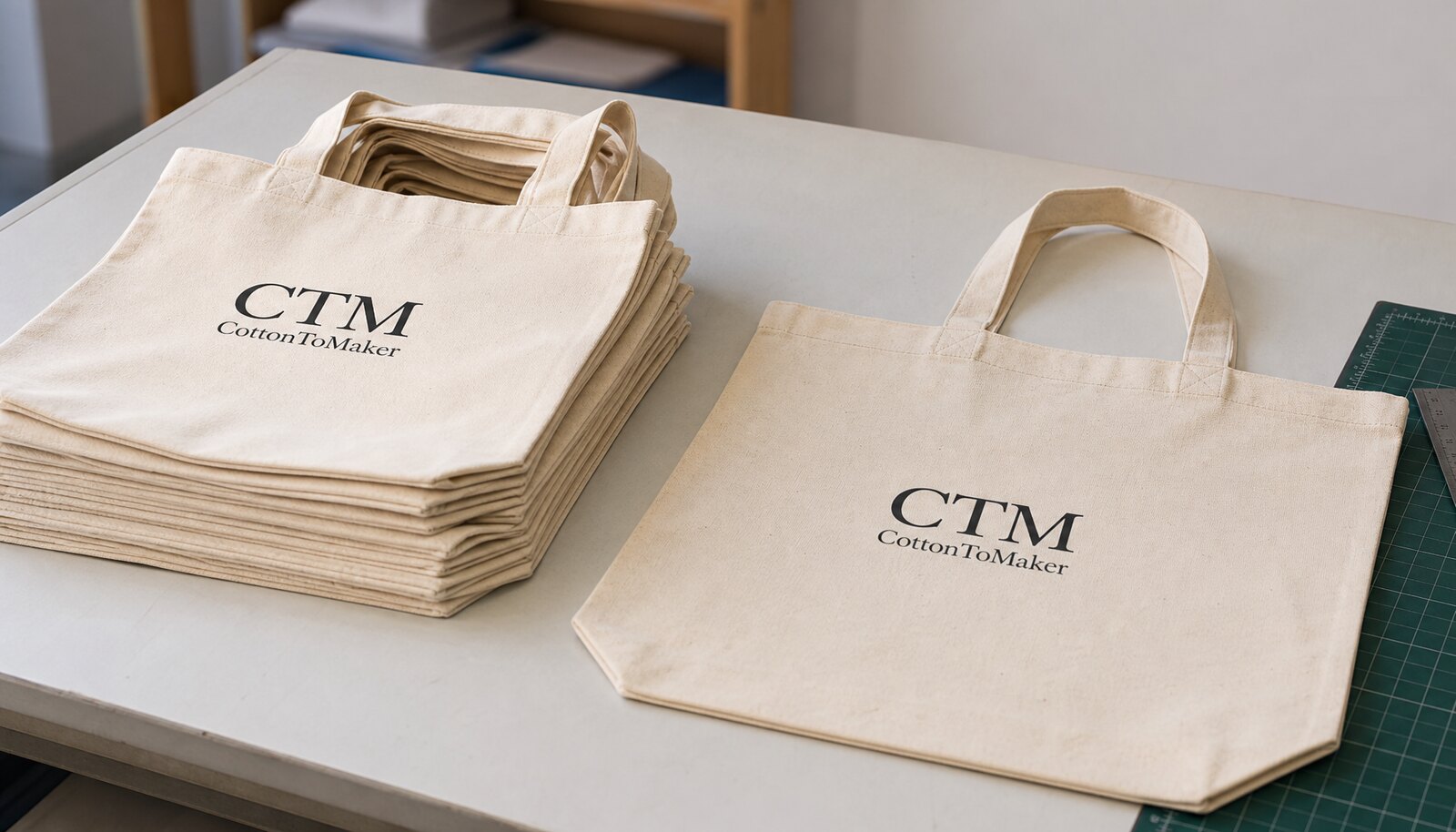
Why personalized cotton bags fail in sourcing, not in design
Most personalized cotton bags look straightforward at artwork approval, then turn into a sourcing problem during production. Buyers usually focus on the logo and forget the structure: fabric weight, how the print sits on the weave, handle reinforcement, and whether the bag can survive freight, retail handling, and customer reuse. If the brief is vague, suppliers fill in the gaps with their default spec, and that default is often lighter than what the brand intended.
For procurement teams, the goal is not just to buy a cotton bag with a logo. It is to control the full spec so the quote from one supplier can be compared fairly with another. That means locking size, GSM, print method, packing, and sample standard before you ask for pricing. The better the RFQ, the less room there is for hidden cost in setup fees, rework, or downgraded materials.
- The logo is only one line in the spec; the construction drives the real customer experience.
- A low unit price can hide a weak fabric, small handles, or extra print charges.
- The most common sourcing failure is not print quality alone; it is inconsistent bag body and finishing.
Start with the use case: retail carry, promo giveaway, or packaging insert
The right personalized cotton bag spec depends on how the buyer will use it. A trade show giveaway can tolerate a lighter fabric and a simpler single-color print, while a retail reusable bag needs better shape retention, stronger seams, and a cleaner finish. If the bag will be resold, the buyer should care about drape, edge finishing, and how the logo looks after normal folding and handling.
This is where many RFQs are too broad. A buyer writes 'custom cotton tote' and receives quotes for very different products: a thin promotional sack, a midweight reusable tote, and a canvas-style retail bag. Those quotes cannot be compared unless the intended use is stated. If the purpose is cross-border retail, the brief should describe expected load, carry duration, and whether the bag will be sold folded, flat-packed, or pre-tagged.
- Promo giveaway: lighter fabric, lower-cost print, simpler packing.
- Retail resale: stronger seams, consistent color, better print finish, cleaner folding.
- Packaging insert or gift-with-purchase: compact size, neat appearance, and controlled unit cost.
Fabric weight and construction choices that change the quote
For personalized cotton bags, fabric weight is the first cost driver buyers should lock. A common commercial range is 140–180 GSM for retail-grade totes, with lighter weights below that mainly suited to giveaways. Heavier fabric improves body, print opacity, and perceived value, but it also increases raw material cost and may require a better sewing setup to keep the bag flat and aligned. If the supplier quotes only 'cotton' without GSM, the quote is not complete.
Construction matters just as much as GSM. A flat tote with no gusset is usually cheaper and easier to produce, but a gusseted style gives more usable volume and often looks more like a retail bag. Reinforced handles, cross-stitching, and stronger seam allowance add labor but protect the product from premature failure. Buyers should decide whether the order is price-sensitive or performance-sensitive before comparing samples.
- 140–160 GSM: common for promo and light retail use; can feel soft but may show the outline of dark prints.
- 160–180 GSM: better balance for general retail and reusable shopping bags.
- Above 180 GSM: stronger hand feel and better structure; usually higher cost and longer sewing time.
- Gusseted bags carry better but can increase sewing complexity and measurement variance.
Print method selection: where artwork, volume, and lead time intersect
Print method is one of the easiest places to overpay or under-specify. Screen printing remains the most practical choice for many personalized cotton bags when the design is one to two colors and the order volume justifies setup. It usually gives strong opacity and controlled unit cost at scale. Heat transfer and digital methods are useful when artwork has more colors, gradients, or smaller quantities, but they can raise the risk of print feel, adhesion issues, or higher setup cost per piece.
The buyer should not judge print by appearance only on a showroom sample. Ask how the print will behave on the actual fabric lot and whether curing, wash resistance, and rub resistance are part of the factory's standard control. If the bag will be folded tightly or shipped long distances before retail display, a print that cracks after packing will create avoidable claims. Keep the artwork simple when the order needs to move fast and stay price-competitive.
- Screen print: best for flat logos, simple typography, and repeat production.
- Heat transfer: useful for short runs and more detailed graphics, but confirm durability.
- Digital print: flexible for complex artwork, though unit cost can be less favorable at volume.
- Embroidery on cotton bags is possible, but it adds weight, needle marks, and cost; it suits premium positioning more than basic reusable bags.
MOQ logic and how to compare quotes without getting misled
MOQ should be read as a cost formula, not just a number. In personalized cotton bags, the unit price often depends on fabric consumption, print setup, sewing time, and packing labor. A factory may offer a low MOQ but charge heavy setup fees, while another supplier may require a larger run but give a much cleaner per-unit structure. If the artwork has multiple colors or multiple print positions, compare the full total rather than only the unit price.
The cleanest RFQ separates the order into the bag body, printing, packing, and any optional labels or inserts. That lets buyers see where the supplier is adding cost and whether the quote is scalable for a repeat program. For importers managing several markets, it can also make sense to split MOQ by size or by print version, as long as the factory has a clear plan for fabric cutting and label control. Otherwise, mixed production creates confusion in packing and carton counts.
- Compare quotes by total landed structure, not just ex-factory unit price.
- Separate one-time setup charges from recurring per-piece charges.
- Ask whether MOQ is by design, color, size, or print side.
- If the supplier offers a very low MOQ, review whether fabric choice or packing quality is being downgraded.
Supplier route comparison: factory direct, trading company, or stock program
The best sourcing route depends on lead time, complexity, and internal control. Factory direct sourcing is usually the best route for repeat personalized cotton bags because it gives clearer visibility into fabric, stitching, and print process. It also helps when the buyer wants to lock the exact construction for future replenishment. The downside is that lead time and communication can be less flexible if the factory is full or if the buyer's artwork keeps changing.
Trading companies can be useful for mixed product programs, but their quotes must be scrutinized because the actual factory spec may sit behind the wording. Stock programs or partially finished blank bags are helpful for urgent launches, yet the buyer must verify how much customization is truly available. The decision is not just about convenience; it is about who controls the standard and who owns the quality failure if the bag arrives wrong.
Sample approval: what a serious buyer should look at before mass production
The sample is where many projects are either saved or quietly set up for trouble. A sales sample that uses different fabric, a different print process, or a looser stitch standard does not prove the mass production outcome. For personalized cotton bags, the approval sample should be as close as possible to final production materials. If the factory cannot use the same fabric lot, the buyer should at least demand an explanation of the difference and a matching standard for the final run.
Approving the sample should be a measured decision, not a visual thumbs-up. Body dimensions, handle length, logo position, print opacity, and stitch quality should all be compared against the approved reference. If the sample feels too soft or the logo sits slightly off-center, do not assume mass production will improve it. That small defect often becomes more obvious once the run starts.
- Measure the bag flat and filled, if the intended use requires shape retention.
- Place the logo reference next to the sample and confirm the print position in millimeters, not impressions.
- Check inside seams, thread tails, and corner reinforcement before approving.
- If the sample is not representative, pause approval instead of pushing the order into production.
Packing and carton planning affect freight cost more than many buyers expect
Packing is often treated as a back-office detail, but it directly changes freight density, damage risk, and handling labor. Personalized cotton bags that are folded too loosely waste carton space, while overly compressed packing can crease the print or leave permanent fold marks. If the order is for retail resale, the buyer may also need consistent folding direction, individual polybags, barcode labels, and carton marks that match the warehouse receiving process.
A practical packing spec should state how many pieces per inner pack, whether each piece is in a polybag, and what the master carton target should be. Buyers who import regularly should also ask for carton dimensions and gross weight before production starts, because these figures affect sea freight and warehouse planning. A slightly larger carton can change the shipment economics when the order is volume-heavy and low-value.
- Bulk-packed totes are usually more freight-efficient than individual retail bags.
- Retail-ready packing adds labor and should be costed separately.
- Carton dimensions matter when air freight or palletized warehouse storage is involved.
- Barcode labeling and carton marks should be part of the approved packing sheet, not an afterthought.
Lead time and schedule risk: where custom cotton tote programs slip
Normal production for personalized cotton bags is often around 25–40 days after sample approval, but that range is only useful if the buyer understands what resets the clock. Artwork changes, material changes, or a different print process can all push the schedule back. The most common delays are not sewing problems; they are unresolved artwork, late deposit release, and missing packaging details that stop the factory from starting prep work.
To protect launch timing, buyers should freeze the artwork file and approval date before the factory buys fabric or starts printing plates. If the order is seasonal or tied to a store opening, build in buffer time for rework or re-approval. A one-week slip in sample signoff can become a two-week delay once production slots are full and export booking windows are missed.
- Freeze design files before asking for final pricing.
- Reserve time for sample correction, not just bulk production.
- Confirm whether the lead time starts at deposit receipt, artwork approval, or sample signoff.
- If the order is time-critical, ask the supplier what can be pre-booked before final approval.
What a useful landed-cost comparison should include
A buyer-friendly landed-cost comparison for personalized cotton bags should include more than ex-factory price. The total should show fabric weight, print setup, packing, carton dimensions, domestic factory handling, and any export documents or labeling charges. If two quotes look close on paper but one uses a heavier fabric or better print method, the better value may actually be the slightly higher quote. The reverse is also true: some low prices only work because the supplier has stripped out packing or downgraded the fabric.
When comparing suppliers, request the same assumptions from each source. One quote might include polybag packing and export cartons, while another only quotes loose bulk packing. That difference can wipe out the apparent savings. For importers, the goal is to compare apples to apples before freight, duties, and destination handling are added. Once those are included, the cheapest factory quote often stops being the cheapest supply option.
- Compare the same bag size, same GSM, same print method, and same packing standard.
- Ask for carton size and carton count before final approval.
- Separate one-time setup fees from recurring unit charges.
- Review whether the quote includes inspection, labels, and export packing.
Specification comparison for buyers
| Spec decision | Recommended option | When it fits | Buyer risk to check |
|---|---|---|---|
| Fabric weight | 140–180 GSM cotton twill or canvas for retail-grade use | Brand launches, resale, and repeat customer use where the bag must hold shape and print cleanly | Too-light fabric can distort after printing; confirm finished fabric width, shrinkage allowance, and actual GSM tolerance |
| Print method | 1–2 color screen print for volume; heat transfer or digital print for small artwork runs | Simple logos, large branding, or variable-color artwork with controlled cost | Poor ink curing causes cracking or smell; require wash/rub expectation and print position tolerance |
| Bag construction | Single-panel or gusseted tote with reinforced handle stitching and cross-stitch at stress points | Retail, grocery, and trade show use where load strength matters | Weak handle attachment is a common failure; request stitch count, bartack locations, and seam allowance |
| Handle length | 55–65 cm total loop for shoulder carry; shorter handles only for hand carry | Retail shoppers, event giveaways, and ecommerce inserts with mixed-use needs | Short handles reduce usability; verify finished drop length on a physical sample, not only a drawing |
| MOQ approach | Start with a higher unit MOQ only if print setup and fabric consumption are locked; otherwise split by color or size | When you need one artwork across multiple regions or SKUs | Low MOQ can hide high setup fees; compare tool, plate, and print-prep charges separately |
| Supplier route | Factory direct for repeat SKUs; trading or stocking route for urgent launch fills | Long-term programs versus short lead-time replenishment | Trading quotes may obscure the real factory spec; require exact mill, construction, and QC responsibility in writing |
| Packing method | Bulk-packed in polybags, then carton-packed with carton mark and size label | Wholesale replenishment and import shipments where freight efficiency matters | Retail-ready folding or barcode labeling adds labor; confirm whether packing is per piece, per dozen, or master carton only |
| Sample approval | Pre-production sample matched to final fabric lot and print file | Any order where color, artwork placement, or handle strength is critical | A sales sample made from different fabric can mislead approval; require production-equivalent material for signoff |
| Lead time planning | 25–40 days after sample approval for normal production, plus transit time | Standard custom orders without special washing or complex packaging | Artwork changes and shade matching extend schedule; keep a frozen approval date and material reservation date |
Buyer checklist before sampling
- Final bag size with tolerance, including body width, height, and gusset if any
- Fabric type and GSM target, plus whether the quote is based on greige, dyed, or finished fabric
- Artwork file format, color count, print size, print position, and required Pantone references
- Handle length, handle width, reinforcement method, and expected load use case
- Sample approval standard for fabric shade, print clarity, stitch quality, and overall construction
- Packing requirement by piece, bundle, inner carton, and master carton, including carton marks
- Target MOQ, split SKU logic, and whether mixed sizes or colors are allowed
- Required shipment timing, destination, and whether the quote includes export carton and documentation
Factory quote questions to send
- What exact fabric GSM, weave, and finished fabric width are included in your quote?
- Is the quoted print method screen print, heat transfer, digital print, or embroidery, and what is the setup cost per color?
- Does the MOQ apply per design, per size, per color, or per print side?
- What sample type will you send before production, and will it use the same fabric and print process as mass production?
- What is the handle reinforcement structure and stitch specification at the stress points?
- Are packing, carton marks, barcode labels, and polybags included in the unit price or charged separately?
- What production lead time starts from: artwork approval, deposit, or pre-production sample approval?
- What defect tolerance do you use for print misalignment, stains, uneven stitching, and measurement variance?
Quality-control points to confirm
- Measure body size, gusset width, and handle drop against agreed tolerance on both pilot sample and production run
- Verify GSM or fabric hand feel against the approved sample; reject obvious underweight substitutions
- Inspect print registration, ink opacity, edge sharpness, curing, and color consistency across the lot
- Test handle seams, bartacks, and top stitching for pull strength and symmetry
- Check seam allowance, internal loose threads, and needle damage at corners and stress points
- Confirm folding method, count per polybag or carton, carton label accuracy, and shipping marks
- Review odor, moisture, dust, and staining before export packing
- Compare production sample against approved sample for logo placement and overall appearance before release