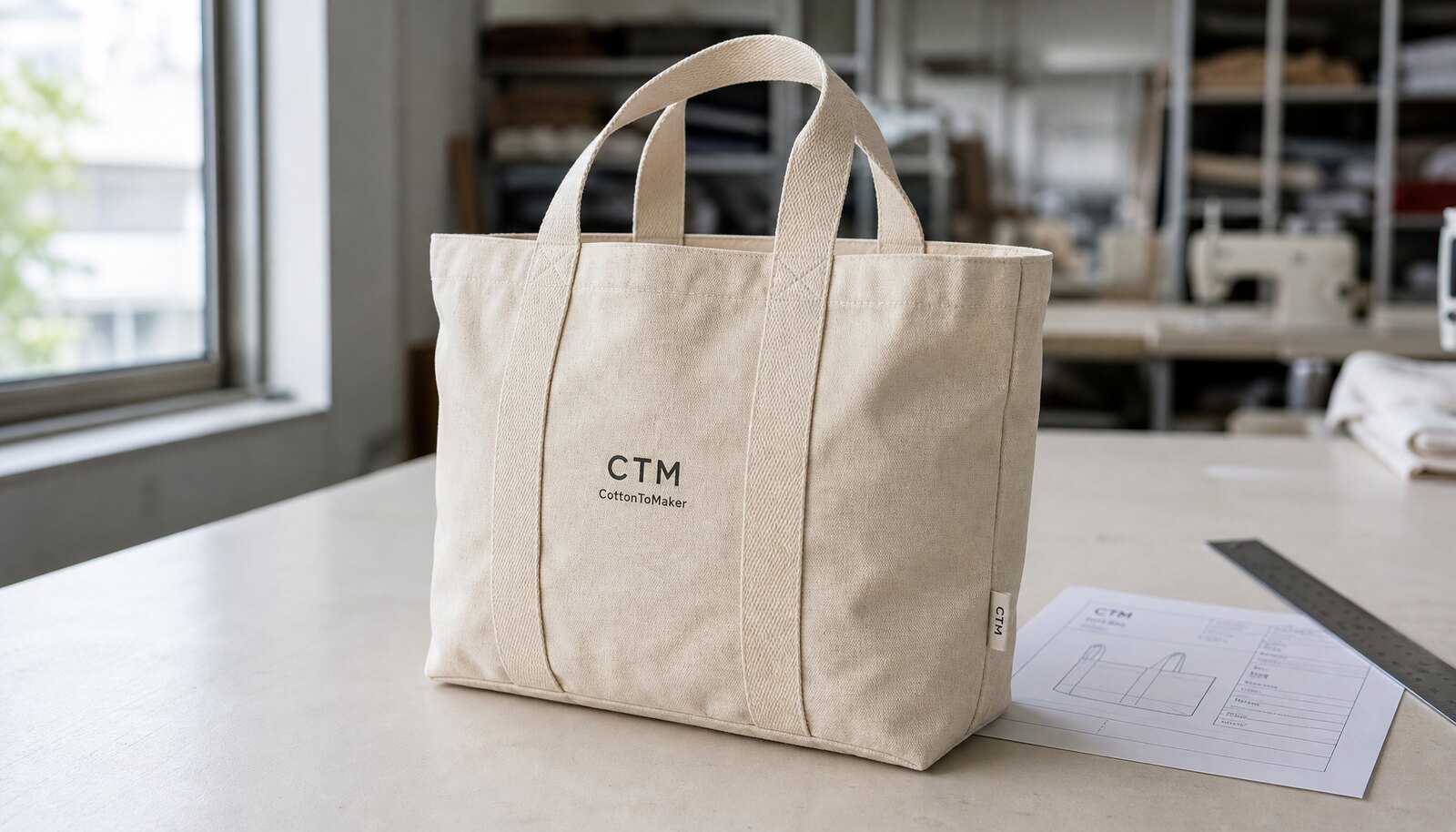
Why this tote needs a tighter buying spec
Personalized canvas tote bags look like a simple buy, but procurement problems usually start when the body, decoration, and packing are treated as separate conversations. If the RFQ leaves one of those gaps open, suppliers will fill it with their own assumptions, and the sample can look acceptable while the bulk order arrives with different fabric weight, handle feel, or logo placement.
For a B2B buyer, the real job is not to buy a blank bag and add a logo. It is to buy a repeatable finished product with a defined canvas specification, a defined decoration method, a defined packing format, and a defined reorder path. The tighter the spec, the easier it is to compare suppliers on the same basis instead of comparing their interpretation of your request.
- Treat the tote as a finished product, not as a commodity blank with decoration added later.
- Separate the bag-body spec from the decoration spec so suppliers cannot hide scope in a vague line item.
- Define what must stay stable across reorders: size, logo position, handle construction, and pack format.
- If the tote will be sold, not given away, write the spec around shelf appearance and repeatability rather than only unit cost.
Choose the tote architecture before you price decoration
The first buying decision should be the tote architecture, because that decision drives cost, print area, and how the bag performs in use. Open-top promo totes are easy to pack and price, but they are not the right answer if the customer needs structure or security. Gusseted totes carry better and feel more useful, while lined or pocketed totes move the product into a more premium retail space with more labor and more risk of spec drift.
Handle design matters just as much as fabric weight. Wide handles, longer handle drop, reinforced stitching, top hems, and bar-tack placement all change the carrying experience. If the logo sits too close to a seam or fold line, the print can be distorted even if the artwork file is perfect. Ask the factory to quote from a construction drawing or annotated spec sheet, not from a general description of a canvas tote.
- Use open-top construction for low-cost promotions and campaigns where speed and packability matter more than structure.
- Use a gusseted body when the tote must stand up better, carry more, or present more cleanly at retail.
- Use lining or pockets only when the user need or brand position justifies the added labor and quality-control burden.
- Confirm whether the handles are sewn into the seam, bar-tacked, or reinforced with a top hem, because the answer changes durability.
- Define whether dimensions are measured before sewing, after sewing, or after pressing so the supplier cannot quote a looser standard than you intended.
Match decoration to artwork, volume, and wear life
Decoration method should be chosen for the artwork and the expected life of the bag, not for the lowest quote line. Screen printing is usually the most efficient option for flat graphics, simple logos, and repeat programs because it scales well and gives a predictable look when the factory controls ink coverage and registration. Embroidery or sewn labels work better when the brand wants a more premium feel or when the logo is small and needs texture instead of large solid fills.
Transfer methods can be useful for complex artwork, gradients, or low-volume orders, but they should be evaluated against the real use case. If the tote will be washed, folded repeatedly, or exposed to heat, the buyer should ask how the decoration will age. The cheapest process on the quote is not the cheapest process if it fails after the first few uses or if the decoration cannot be repeated cleanly on the next order.
- Use screen print for simple logos, campaign graphics, and repeat replenishment orders.
- Use embroidery for small premium marks, but check for puckering on lighter canvas.
- Use woven labels or sewn patches when the logo should be durable and understated.
- Use transfer decoration only when artwork complexity or low quantity makes screens uneconomical.
- If the tote is likely to be washed, ask for a durability check on the decoration method before approving bulk production.
Use the comparison table to narrow product choice
The comparison table is meant to help buyers choose the product, not the supplier route. A lightweight promo tote, a gusseted daily carry tote, and a lined retail tote all answer different procurement problems. If the team chooses the wrong product format, no amount of quote negotiation will fix the mismatch between use case and finished bag.
When two options look close, compare them on actual performance variables: load carrying, structure, shelf appearance, print durability, and reorder stability. A heavier tote is not always the better choice if the program is a short-lived giveaway. Likewise, a low-cost open-top bag is not suitable if the brand needs the tote to look premium in-store or survive repeated use.
- Compare product formats on intended load, not just on unit cost.
- Use the same artwork file and same logo position when comparing different constructions.
- Check whether the bag needs to stand up, fold flat, or carry one heavy item versus many lighter items.
- If the bag is retail-facing, give shelf appearance the same weight as functional durability.
Write the RFQ so quotes can be normalized
A useful RFQ for personalized canvas tote bags reads like a production instruction, not a brand brief. Start with finished dimensions, gusset depth, handle length, canvas weight, fiber content, weave style, fabric color, print position, number of colors, and the exact decoration method. If the tote has lining, a pocket, a zipper, or a woven label, force those items into the RFQ so they are not added later as hidden cost.
Quote normalization is the other half of the job. Buyers often receive one all-in number that mixes the blank bag, decoration setup, packaging, sample work, and freight assumptions. That creates noisy comparisons because suppliers can price different scopes while appearing to quote the same tote. Ask for line-item pricing, ask for the incoterm, and ask for any assumptions that would change the price if your spec is adjusted.
- Attach the artwork in vector format and call out Pantone references if color consistency matters.
- State whether the quote should include one side or two sides, and whether repeat logos count as extra print hits.
- Request a price ladder at your likely buying levels, such as 500, 1,000, and 3,000 pieces.
- Ask the supplier to separate blank bag cost, decoration, setup, packaging, testing, and freight assumptions.
- Include the launch date and ask the factory to confirm the realistic ship date after sample approval.
Qualify the supplier, not just the sample
A good sample does not prove that the factory can hold the spec in mass production. Procurement teams should ask how the supplier is organized: which steps are in-house, which steps are subcontracted, how in-line checks are run, and how defects are isolated before packing. A supplier that can explain its process map clearly usually has a better chance of reproducing the sample than one that only presents a showroom piece.
The factory audit signals that matter are practical ones. Look for visible lot traceability, a sample library, calibrated measuring tools, work instructions at the line, and a quarantine area for rejected goods. Ask whether the factory can show recent CAPA examples, how it handles rework, and whether it stores screens, plates, or artwork files for reorders. If the supplier cannot explain who owns decoration or where the bag body comes from, the quote is not yet procurement-ready.
- Ask for a factory profile, process map, and photos of cutting, sewing, decoration, inspection, and quarantine areas.
- Verify who actually performs printing, embroidery, or patch application, and whether any step is subcontracted.
- Ask for evidence of lot traceability, sample retention, and defect logging.
- Check whether the supplier can keep screens, plates, or artwork files for repeat orders.
- If you are comparing regions, ask the supplier to explain real lead time, not only nominal lead time.
Compare sourcing regions by tradeoff, not by habit
Regional sourcing should be compared by tradeoff, not by assumption. Some factories are strong on integrated sewing and decoration, while others are better at basic cut-and-sew volume or low-MOQ domestic finishing. The right answer depends on your product complexity, order frequency, freight strategy, and how much control you want over repeatability.
China is often evaluated when buyers need integrated decoration, wider trim options, or faster sample iteration. Vietnam is often evaluated for standard export programs where process discipline and stable basics matter. India and Pakistan can be relevant when cotton canvas, local textile inputs, or woven finishing are important to the program. Domestic decoration on imported blanks can work well for rush launches and small quantities, but the buyer still needs to verify blank continuity and reorder consistency.
- Compare regions on sample speed, decoration capability, MOQ flexibility, and freight exposure.
- Check whether the supplier has real control over the fabric, or only over the finishing step.
- Ask what changes when the program moves from first order to reorder.
- Do not treat domestic finishing as automatically simpler; it still needs the same quality controls on blank consistency and logo placement.
- If sustainability or origin claims matter, require documentation before making any marketing statement.
Lock sample approval and color control before bulk release
The preproduction sample is the control point for personalized canvas tote bags. It should be made from production-intent fabric, production-intent decoration, and the same finishing route the factory plans to use in bulk. If the supplier sends a prettier sample from a different cloth or hand-finishes the logo only for approval, the buyer loses the only reliable benchmark for the production run.
Sample approval should be tied to measurable references. Keep one signed master sample at the buyer side and one at the factory side, and record the acceptable range for dimensions, logo placement, handle drop, seam finish, and packing format. If brand color is critical, ask for a fabric swatch or strike-off approval under a controlled light source before the order is released.
- Approve the sample only if it uses bulk-intent fabric, bulk-intent decoration, and bulk-intent packing.
- Record the approved dimensions, logo location, and construction details on the sample approval sheet.
- If color matters, retain a reference swatch or printed strike-off and define how color will be judged on reorder.
- Check how the tote folds, because a bag that looks good open can crease badly in transit or on shelf.
- If the factory proposes a substitution after approval, require a written change notice and a fresh approval if the change affects appearance or performance.
Set QC thresholds that reflect the end use
Quality control should be set to the use case, not to a vague factory standard. A promotional tote may tolerate a slightly looser aesthetic if the logo remains readable and the handles are secure. A retail tote usually needs tighter control on stitch line, logo placement, fold appearance, and carton presentation because the customer will inspect the item before purchase and will compare it to the approved sample.
The most useful QC plan combines defect definitions with simple test methods. Buyers should not rely on a pass-fail summary only. Require measurements, pull-test results, colorfastness checks, and carton-level inspection notes so the decision is based on evidence. If the supplier knows the rejection criteria before production starts, it is easier to stop problems before they become a full shipment issue.
- Use AQL 2.5 major and 4.0 minor as a common starting point for promo totes, and tighten the major-defect threshold for retail programs.
- Run a handle pull test at a buyer-defined load, commonly 2x to 3x intended working load for 30 to 60 seconds, and reject seam opening or bar-tack failure.
- Check printed bags with dry rub and wet rub on white cloth, and if the tote will be washed, add a wash-cycle check for bleed, shrinkage, and cracking.
- Measure finished dimensions after pressing and packing, not just on the cut pattern.
- Inspect stitching for skipped stitches, loose tails, raw edges, and seam pucker at high-stress points.
- Require lot traceability and a written corrective action if defect patterns appear in the pilot lot or pre-shipment inspection.
Do not let packing and labeling break the program
Packing changes how personalized canvas tote bags arrive, and it can change how the product is perceived on shelf. A tote folded too tightly can hold a permanent crease, and a printed face folded across the logo can crack or mark during transit. If the tote is retail-facing, the buyer should decide early whether it ships flat, tissue-wrapped, in an individual polybag, or in a retail-ready inner pack.
Labels and carton marks belong in the quote, not in a side note. Barcode placement, barcode quality, inner-pack count, carton quantity, country-of-origin marking, and pallet rules all matter if the bags are going through a distributor or retail warehouse. The packaging spec is part of the product specification because it affects damage risk, labor cost, and whether the goods can enter the buyer's distribution system without rework.
- Avoid folding the tote so the logo sits on the main crease line.
- Define whether the inner pack is bulk, individual polybag, tissue wrap, or a retail-ready insert pack.
- Specify carton marks with style, quantity, country of origin, and buyer reference if needed.
- If moisture is a risk on the route, require packing that protects the canvas from damp storage and transit.
- For warehouse programs, make sure the carton size and pack count match the receiving system before production starts.
Specification comparison for buyers
| Product choice | Recommended spec | Best fit | Buyer risk to check |
|---|---|---|---|
| Lightweight promo tote | 8 oz to 10 oz open-top canvas, unlined, one-color screen print, flat fold | Giveaways, event packs, and mailers where cost and packability matter more than structure | Check limpness, show-through, and whether handles hold under basic load |
| Standard daily carry tote | 10 oz to 12 oz canvas, gusseted bottom, sewn handles, one- or two-color logo | Corporate gifts, campus stores, and retail basics that need a balanced price-performance mix | Check shrinkage, print placement near seams, and whether the bag stands up cleanly |
| Heavy retail tote | 12 oz to 16 oz canvas, reinforced seams, wider handles, optional pocket | Sellable merchandise and premium gifting where durability and shelf appeal matter | Check seam strength, carton scuffing, and dimensional stability after packing |
| Lined or pocketed tote | 12 oz+ canvas with lining, interior pocket, and cleaner finishing | Higher-margin retail programs that need a more polished product story | Check hidden labor, pocket alignment, and spec drift across reorders |
| Zipper-top tote | 12 oz+ canvas with zipper closure and reinforced top edge | Travel, security, and commuter use where closure and containment matter | Check zipper quality, alignment, and the lead-time impact of extra components |
| Long-handle shoulder tote | Midweight or heavy canvas with longer handle drop and reinforced attachment | Shoulder carry, events, and shopping programs | Check handle drop against real user needs and bar-tack security at the attachment points |
Buyer checklist before sampling
- Confirm finished size, gusset depth, handle length, and whether the dimensions are measured before or after sewing and pressing.
- Lock the fabric composition, canvas GSM, weave style, and finish, then state the acceptable GSM tolerance.
- Decide the product format first: open-top, gusseted, lined, zipper-top, pocketed, or reinforced retail tote.
- Specify logo size, print position, number of colors, and the exact decoration method the supplier must quote.
- State whether the artwork must match a Pantone target, a visual reference, or both, and whether the color must be repeatable on reorders.
- Define the target MOQ, reorder quantity, and whether the first order must match a future replenishment program.
- Require a production-intent sample made from bulk-intent fabric and the same decoration method planned for mass production.
- Define packaging: flat fold, tissue, inner polybag, hangtag, barcode, carton count, and carton mark format.
- Request line-item pricing for blank bag, decoration, setup fee, sample fee, packaging, testing, and freight assumptions.
- Set the delivery window with buffer for artwork approval, sample corrections, and peak-season factory congestion.
Factory quote questions to send
- What exact fabric weight, weave, fiber content, and finish are you pricing for this tote?
- Is the quote for open-top, gusseted, lined, zipper-top, or pocketed construction?
- What finished size and dimensional tolerance are included in the price?
- Is the logo price based on one color, multiple colors, one side only, or both sides?
- Which fees are separate: screen setup, plate charge, digitizing, sampling, packaging, testing, carton marks, or label changes?
- What is the MOQ by size and decoration method, and does the MOQ change if we add lining, a pocket, or a zipper?
- Will you produce and ship a preproduction sample that matches bulk materials, not a showroom sample?
- What carton pack, inner pack, and barcode option are included in the quoted price?
- What inspection standard and AQL do you use before shipment, and what happens if the sample-approved spec is missed?
- Can you quote EXW, FOB, and if available a landed-cost estimate with freight assumptions shown separately?
Quality-control points to confirm
- Set the inspection plan before the PO. A common starting point is AQL 2.5 for major defects and 4.0 for minor defects on promo programs, with tighter major-defect limits for retail programs.
- Check finished dimensions on a representative sample after pressing and packing. Use the same tolerance on every order, such as plus or minus 0.5 in on overall dimensions or a buyer-defined metric tolerance.
- Verify canvas weight by measuring cut swatches from the production lot. Accept only the agreed GSM band, often plus or minus 5 percent unless the program calls for tighter control.
- Run a handle pull test on finished bags at a buyer-defined load, commonly 2x to 3x the intended working load for 30 to 60 seconds. Reject any seam opening, bar-tack failure, or permanent deformation outside the agreed limit.
- Inspect stitching, seam allowance, and bar-tacks for skipped stitches, loose thread tails, raw edge exposure, and seam pucker at stress points.
- Measure logo placement against the approved artwork file. Require registration and placement to stay within the agreed tolerance, and reject drift toward seams, folds, or edges.
- Check decoration quality for even ink coverage, no pinholes, no smear, no cracking, and no thread gaps on embroidery or woven labels.
- Run dry rub and wet rub checks on white cloth for printed bags, and if the tote will be washed, run at least one wash-cycle test for color bleed, shrinkage, and print cracking.
- Inspect pack quality for fold marks across the logo, crushed corners, moisture damage, and count accuracy at the inner-pack and carton level.
- Require lot traceability, sample retention, and a written corrective-action note if any defect trend appears in the pilot lot or pre-shipment inspection.