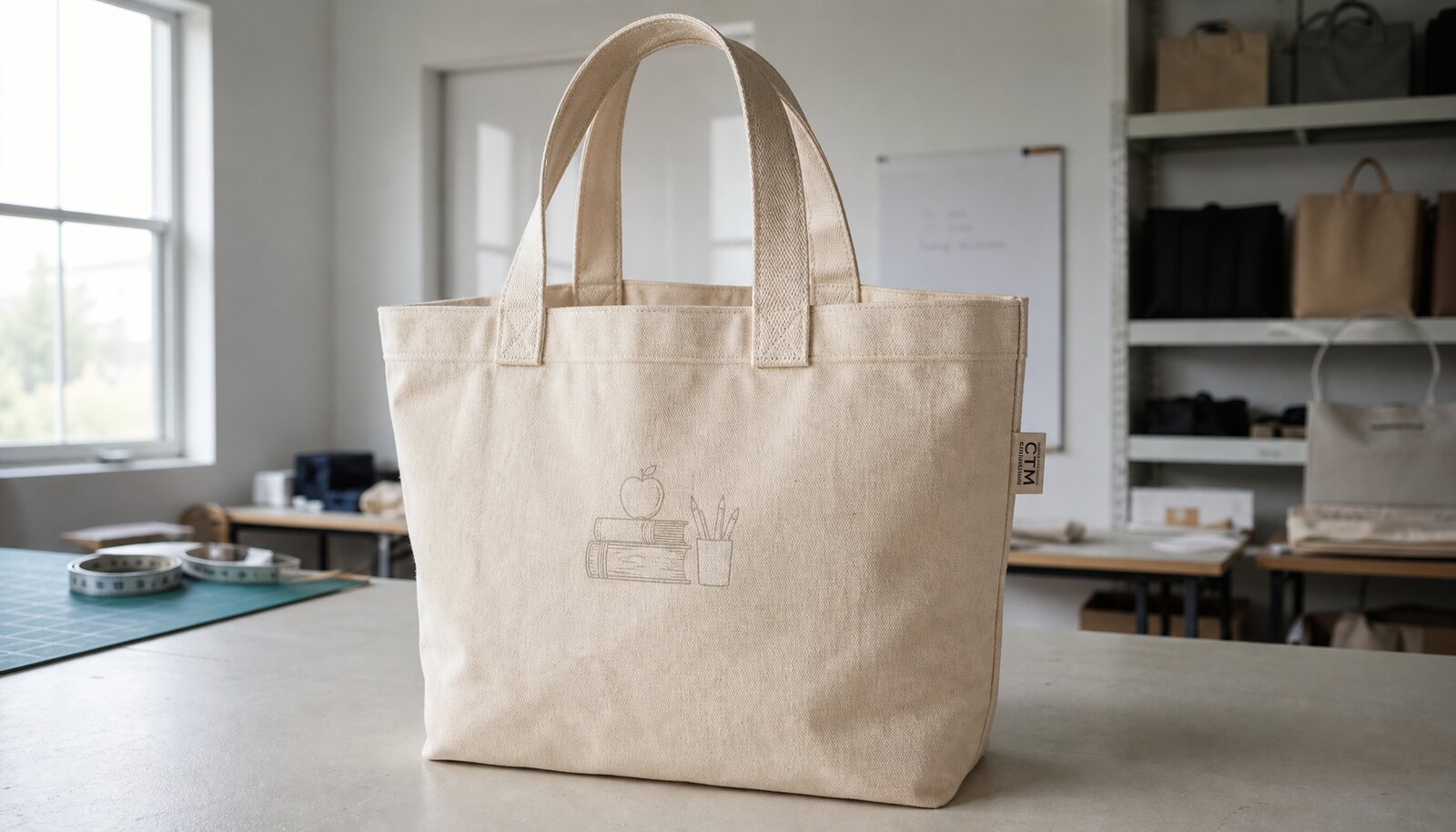
What Buyers Are Really Purchasing in a Teacher Tote Program
Personalized canvas tote bags for teachers are rarely just a bag purchase. In practice, the buyer is sourcing a small branded product that has to do three jobs at once: carry classroom items, feel thoughtful at first glance, and arrive with enough consistency that the school, company, PTA, or reseller behind it does not spend time fixing avoidable defects. That is why the buying decision should start with the use case, not the artwork. A tote intended for teacher appreciation week has different requirements from a tote sold through a school store or bundled with stationery as a retail gift.
The use case sets the build. A one-time appreciation gift can tolerate slightly less structure if the presentation is good and the price is controlled. A retail SKU or resale item needs a cleaner finish, more predictable dimensions, and decoration that can survive repeated handling. A direct-to-recipient gift program needs better personalization control and packing accuracy than a bulk event handout. The tote itself may look similar across these programs, but the sourcing brief should not be similar.
Procurement teams should also decide what the tote is expected to carry. That detail matters more than many quote requests admit. Books and folders demand a stronger bottom seam and handle attachment. A tote that only carries a notepad and a gift card can be lighter and cheaper. If the buyer never states the real load, the supplier may still quote quickly, but the finished product can miss the functional target by a wide margin.
For repeatable sourcing, the first sample should become a control reference. Not a concept sample. A control reference. That means the fabric, handles, seam pattern, decoration method, and pack format should match the bulk run as closely as possible. If the first approved sample cannot be repeated, it is not helping procurement; it is just creating false confidence.
A good brief also reduces downstream argument. Instead of asking the supplier to “make it nice,” specify what nice means: natural or bleached canvas, a clean print field, handle reinforcement, a gift-ready fold, or a premium label. The more concrete the brief, the easier it is to compare offers, approve samples, and defend the order decision later if there are questions from finance or end users.
- Define the tote by use case first: gift, retail, event handout, or utility carry.
- Write specs around practical contents such as books, folders, planners, or a laptop sleeve.
- Treat the first sample as a production control standard, not just a visual approval piece.
Fabric First: Weight Matters, But Weave, Finish, and Shade Matter Too
Canvas weight is usually the first number buyers ask for, and it is useful, but it should never be the only fabric metric in the quote. For most teacher-tote programs, 10 oz to 12 oz canvas, roughly 340 to 406 gsm, is the most balanced range. It generally provides enough body for a neat print surface and enough structure to feel useful without becoming unnecessarily heavy to make, fold, or ship. That range is not a law of nature; it is simply a practical middle ground for bulk buying.
Lightweight 8 oz canvas can work when the tote is mostly promotional and the buyer wants to keep price and freight low. The commercial risk is that a light bag can slump, show contents, and lose its shape quickly once books or supplies are added. If the handles are also narrow or lightly anchored, the bag can feel thin even when the print looks good. In other words, the printed face may pass approval while the body fails in actual use.
Heavier 12 oz to 14 oz canvas brings a more retail-style handfeel and can support embroidery or woven labels well. It also helps the bag stand upright for a more giftable presentation. But that extra body has costs. Sewing can slow down because thick seams are harder to handle. Packing cube rises. Freight gets more expensive. If the buyer only asks whether heavier is “better,” the answer is incomplete. Better for what? Shelf display, yes. Lowest landed cost, not always.
Weave structure is also part of the product decision. A tighter plain weave generally gives crisper print edges and a more controlled visual surface. A looser weave can look more casual or artisanal, but it often creates more variation in how ink sits on the cloth. For natural canvas, seed fibers, flecks, and small shade changes are common and can be acceptable if the buyer approves them in advance. For a cleaner gift look, lightly bleached canvas may work better, but the bleach process needs to be controlled. Over-bleaching can leave the fabric weaker, flatter in handfeel, or inconsistent between lots.
Shade is another area where buyers should ask for hard references instead of relying on a mockup. Canvas is not a color standard unless the supplier makes it one. Ask for daylight photos, swatches, or an approved master sample under conditions close to production. If the supplier is quoting dyed canvas, ask how they control lot variation and whether the dye process has been tested for repeatability. If the canvas is bleached, ask what method is used and whether the finish is stable enough to support the intended print contrast. Shade drift is one of the easiest ways for a bulk program to look inconsistent even when the sewing is fine.
- Use 10 oz to 12 oz canvas for the most balanced price, structure, and utility.
- Use 8 oz only if the tote is a lightweight giveaway and carry expectations are modest.
- Specify fabric finish, shade, and weave behavior so the supplier does not substitute a look-alike cloth.
- Ask whether the canvas is stock-held or woven to order, because that changes lead time and audit trail.
Construction Details That Separate a Giftable Tote from a Cheap One
The body fabric gets attention, but the construction details are often what determine whether a tote feels trustworthy. Start with the handles. Buyers should not just ask for handle length; they should ask for handle width, attachment position, reinforcement method, and whether the handle drop is comfortable when the bag is full. A handle that looks proportional in a flat sample can feel short, twisty, or awkward once the tote is loaded.
Handle anchoring is a common failure point. Ask the supplier how the handles are attached: stitched into the top hem, reinforced with bartacks, box-X, or another pattern. The actual attachment pattern matters more than decorative stitching. If the tote is expected to carry books or a laptop sleeve, the supplier should be able to show a reinforcement standard that is repeatable in production. Buyers do not need to design the stitch path themselves, but they do need to know which standard they are buying.
Top hem quality is another visible checkpoint. A wavy or uneven hem makes the bag look poorly controlled even if the print is perfect. Ask for hem width, folding method, and seam allowance control. For a gift product, the top edge is often at eye level when the tote is handed over or photographed, so even a small defect here affects perceived quality disproportionately.
Bottom and side seams should be reviewed as load-bearing areas rather than just assembly lines. A good tote should have clean seam finishing, no visible popping at the corners, and no loose internal thread clusters that can snag items. If the design includes a gusset, make sure the gusset width is measured after sewing, not only on paper. Totes can lose internal space if the gusset collapses during construction. For buyers, that means the printed artwork may be fine while the usable bag volume is smaller than expected.
Small design features also need a value check. Inner lining can make the product feel more finished, but it adds cost and can complicate sewing. A pocket may be useful for markers, notes, or a phone, but it creates more pattern alignment and stitch risk. A snap closure or zipper improves functionality, yet it changes lead time, component sourcing, and defect potential. Procurement should approve these features only if they support the actual use case; otherwise, they create complexity without commercial payoff.
- Specify handle width, handle drop, and reinforcement pattern before you compare quotes.
- Review hem straightness and seam consistency as quality markers, not just cosmetic details.
- Treat pockets, linings, closures, and gussets as cost-and-risk features, not free upgrades.
Decoration Method Changes the Quote More Than Most Buyers Expect
Decoration is where many tote quotes stop being directly comparable. Two suppliers can quote the same-looking teacher tote and be using very different methods, each with different setup cost, failure modes, and production speed. For simple wording, school names, or one- to two-color line art, screen print is often the most commercial option for larger runs. It handles volume well and usually gives a cleaner unit cost once the setup is spread across enough pieces. The buyer should still ask for screen count, color count, and whether each location is priced separately, because those details can swing the quote.
DTF and heat transfer become attractive when the order needs many names, short runs, or multicolor detail. That is especially relevant for teacher gifting, where personalization often means each tote may carry a different name or title. The upside is flexibility. The downside is process sensitivity. Buyers should ask what temperature, dwell time, and pressure range the factory uses, and how they confirm the transfer has properly bonded. A transfer that is acceptable in the sample room can still fail if the factory changes settings during bulk production.
Embroidery and woven labels serve a different commercial purpose. They create a more premium impression and can make a teacher tote feel less like a promo item and more like a retail product. But they are not automatically safer. Dense embroidery can pucker canvas if stabilizer and stitch density are not matched. Tiny lettering may fill in or distort. Woven labels are cleaner for fine text, but placement and stitch security still matter. If the buyer wants a premium look, the supplier should show previous work or a stitched sample under similar fabric conditions, not only a digital render.
The important procurement move is to separate decoration cost from decoration risk. Ask the supplier to quote the same tote with the decoration method identified as a line item, not buried inside a lump sum. That makes it easier to compare screen print against DTF, or embroidery against a woven label, on the basis of both price and expected defect rate. For bulk buying, the cheapest decoration method is not always the best value if it increases rework, rejects, or late delivery.
- Ask the supplier to quote decoration as a separate line item, not only as a bundled price.
- Screen print usually suits larger runs and simpler artwork; DTF and heat transfer suit variable names and fine detail.
- Embroidery and woven labels can improve perceived value, but they need tighter control over placement and fabric distortion.
What to Ask About Fabric Sourcing, Shade Control, and Documentation
The fabric line on a tote quote is often too vague to support a real procurement decision. Buyers should ask where the canvas comes from, whether it is stock-held or sourced to order, and how the supplier controls lot consistency. If the supplier cannot explain the fabric source clearly, they may still be able to produce a bag, but the buyer will have less visibility into repeat order stability and less leverage if the cloth changes unexpectedly.
For stock canvas, the useful questions are about width, GSM verification, shrinkage expectation, and whether the material is held in sufficient quantity for the order. For sourced-to-order fabric, ask which mill is producing it, what the fabric MOQ is, and whether the supplier can provide mill references, purchase records, or equivalent traceability. You do not need an expensive audit package for every tote order, but you do need enough documentation to know whether the quote is based on real inventory or a hopeful assumption.
Bleached and dyed canvas deserve separate treatment. Bleaching can improve brightness and print contrast, but it may also increase sensitivity to shade drift and handfeel variation. Ask what process is used and whether the supplier has examples from previous lots. For dyed canvas, ask about colorfastness expectations and whether the base fabric has been tested against the intended decoration method. A dark canvas with a white logo looks simple on a render and can still fail visually if the base fabric sheen is high or the white print is too translucent.
A procurement-friendly supplier should be able to provide basic supporting artifacts without being pushed into a full lab program. Useful documents include fabric photos under daylight, a swatch or fabric reference, a production-equivalent sample, shade approval references, and a simple fabric specification note listing weight, width, and finish. If the supplier is truly mature, they should not object to these requests. They may not have every test report a multinational factory would have, but they should have enough records to support repeatability.
Keep the paper trail clean. Save the approved swatch, approved sample, and approved artwork files together. On a reorder, those references matter more than memory. The goal is not paperwork for its own sake. The goal is to make sure the next run matches the first run without renegotiating the product from scratch.
- Ask for fabric source, mill or stock status, width, and shrinkage expectation.
- Request dye or bleach process details when color consistency matters.
- Keep swatches and approved fabric references so future reorders can match the first run.
MOQ, Pricing, and Lead Time: Build a Quote Comparison That Actually Works
Unit price alone is a weak way to compare tote suppliers. A better method is to normalize each quote around the real variables that change the final cost: canvas weight, bag size, decoration method, personalization complexity, packing format, sample or tooling charges, and freight cube. This is especially important for personalized canvas tote bags for teachers because the artwork may be variable while the base product looks identical across offers. A supplier with a low quote may simply be charging more for setup, packing, or variable-data handling later.
MOQ deserves more nuance than “low is good.” A low MOQ can be useful when names vary or the order is test-market sized, but a very low MOQ can also hide a higher piece price, higher setup cost, or less efficient fabric use. Buyers should ask for MOQ at three levels: MOQ per design, MOQ per personalization file, and MOQ per carton configuration. Those are not the same. A supplier may accept a small overall order but require a minimum quantity per name or per print color, which affects how the final order should be structured.
Lead time is another area where buyers should be careful about unsupported assumptions. A quote that says “7 to 10 days” may only refer to sewing after sample approval and may exclude artwork proofing, screen setup, fabric procurement, or freight booking. If the supplier is quoting variable names, sorting and proofing can also add real time. Ask which steps are included in the calendar and which are not. If the supplier promises an unusually fast timeline, ask what is already in stock, what is already approved, and what exactly has to be done before bulk can begin.
The most useful budget practice is to compare landed cost per delivered unit, not factory price per piece. Freight cube can matter as much as sewing cost because canvas is bulky. Packing that looks efficient on paper can still create expensive cube if the bag is overfolded, padded, or packed with inserts. Conversely, a bag that ships flat and clean may save enough on freight to justify a slightly higher make cost. That is why carton dimensions and estimated weight should be part of every serious quote request.
When comparing vendors, also note who owns each risk. A factory quote may be better when you need tighter control and fewer handoffs. A trader may be better when you need a simpler buying process and are comfortable with an added layer. A domestic decorator may be better if the date is immovable and the order is small enough that speed matters more than unit cost. The correct decision is usually the one that fits the program’s real constraint, not the one that wins on a single line item.
Practical buyers often ask for a quote matrix rather than a single number. That matrix can list the fabric spec, bag size, decoration method, minimum order, sample charge, tooling cost, pack method, carton size, estimated cube, and lead time assumptions. Once those variables are visible, the commercial differences between suppliers become much easier to judge.
- Compare landed cost, not just ex-factory price.
- Ask MOQ at the design, personalization-file, and carton levels.
- Treat lead time as a chain of approvals, setup, and shipping steps rather than a single production window.
Supplier Comparison: Factory, Trader, or Local Decorator?
The right supplier route depends on the buyer’s operating model. A direct factory is usually best when consistency, control, and repeatability matter more than convenience. A factory that handles sewing and decoration in-house can reduce handoff errors and give procurement a clearer view into handle construction, stitching, and packing. The tradeoff is that the buyer needs a better spec and more disciplined approvals. A direct factory is rarely the place for vague instructions.
Trading companies and sourcing agents can be useful when the buyer is managing a broader basket of products or wants one point of contact. They can simplify coordination, consolidate communication, and sometimes help with flexible minimums. But there is usually less transparency on where each step happens. If sewing, printing, and packing are split across different sites, root-cause analysis becomes slower when something goes wrong. Buyers should ask who actually owns fabric, decoration, and final inspection, because that affects accountability.
Local decorators or domestic converters are worth considering when lead time is the main constraint or the order is relatively small. Their unit price is often higher, but the value can show up in faster proofing, easier sample coordination, and lower friction if a correction is needed. For a teacher appreciation deadline or school event that cannot move, paying more for certainty may be the commercially rational decision.
The decision should not be framed as “factory equals cheapest.” Sometimes the factory is cheapest only on paper because the buyer is carrying more coordination work, longer proof cycles, or more freight risk. Sometimes the local decorator is better value because the total administrative burden is lower. A practical procurement team should compare suppliers based on the whole process: how they quote, how they sample, how they inspect, and how they handle corrections.
If you are comparing a factory quote with a trader quote, make sure both are quoting the same production reality. Ask whether the factory owns the sewing line, whether decoration is subcontracted, whether the sample is production-equivalent, and whether packing is done on-site. Without that clarity, a lower quote may just be a less complete quote.
- Direct factory sourcing usually gives the best visibility into sewing and packing.
- Trading companies can simplify communication but may add margin and reduce traceability.
- Local decorators can be the right choice when schedule certainty matters more than unit price.
Sampling Should Prove the Production Method, Not Just the Artwork
A sample only helps if it answers production questions. A mockup can show the logo placement, but it cannot prove that the bag will sew correctly at scale or that the decoration will survive handling. For personalized canvas tote bags for teachers, the approval sample should use the final fabric, the final handle structure, the final decoration method, and the final packing format. If any of those are substituted, the sample becomes a concept piece, not a production reference.
The sample review should be measured. Check width, height, gusset depth, handle drop, and handle symmetry against the approved spec. Inspect top hem straightness, side seam finish, bottom corner reinforcement, and any pocket placement. If the tote includes variable names, request at least one sample with a real name or title. That is where spacing, line breaks, centering, and missing-character issues reveal themselves before the bulk run starts.
For gift-ready or retail-ready orders, ask for a packed sample as well as an empty one. A bag may look fine when open, then arrive heavily creased or poorly folded when packed. Ask to see the carton sample, carton markings, and inner pack method. That gives you a better sense of whether the bag can move through freight without looking tired at delivery.
When the order includes repeated names or school identifiers, ask the supplier to confirm the file-mapping process in writing. Who checks spellings? Who approves the print proof? Who matches each name to a packing slot? If the answers are vague, the risk is not only a bad name spelling; it is a full sorting error that can affect an entire carton or delivery batch.
The sample phase should end with a documented approval, not a casual “looks okay.” Save the approved sample photo, measurement sheet, artwork file, and any packing reference together. That record becomes the standard for the bulk run and the benchmark for future reorders.
- Approve the production sample only after measuring dimensions and checking structure.
- Use one real-name sample when the order includes variable personalization.
- Review packed-unit and carton samples if the bags will ship gift-ready or retail-ready.
Quality Control Needs Pass/Fail Rules, Not Generic Inspections
A tote bag order usually fails in small, visible ways rather than dramatic factory disasters. That is why the QC plan should name the likely failure modes before production starts. Typical issues include crooked print placement, handle asymmetry, loose threads, seam opening, shade variation, puckered embroidery, transfer ghosting, and packing damage. If the order is personalized, wrong spelling is the most serious defect because it destroys the core value of the product. For that reason, the buyer should not rely on “normal tolerance” language alone.
Use a defect taxonomy with critical, major, and minor categories. Critical defects include wrong name, wrong school, wrong artwork version, or a structural failure that makes the tote unusable. Major defects include size out of spec beyond the agreed tolerance, print shift outside the visual target, open seam ends, visible staining, or weak handle attachment. Minor defects might include small loose threads or slight wrinkling if they remain within the agreed standard. The exact pass/fail thresholds should be written in the spec, not decided at inspection time.
Set measurement tolerances that fit the product. For a simple sewn tote, ±1 cm on overall size is often a reasonable starting point, but the buyer should confirm whether the bag is plain or structured, whether the gusset affects usable volume, and whether the artwork placement needs tighter control. Handle symmetry usually needs tighter attention than total bag width because the eye catches handle mismatch very quickly. Print placement also deserves a centerline and top-edge tolerance so the artwork does not drift in a way that looks cheap even if the bag is technically usable.
A practical QC plan should include a use-based load check. Put in books, folders, or another load that mirrors how teachers will actually use the tote, and watch for seam opening, handle stretch, or bottom deformation. A simple rub test after curing is also useful for screen print, DTF, and heat transfer. The buyer does not need a laboratory theater; it just needs a repeatable method that reflects real handling. If the print cracks, lifts, or transfers to another surface after a basic rub, the issue should be flagged before shipment.
Inspection records should be visual as well as numeric. Ask for photo examples of acceptable and rejectable conditions so the supplier and inspector are looking at the same standard. This matters because tote defects are often subjective at the margin. A controlled photo set reduces argument and speeds correction. If the order goes to multiple locations, that consistency becomes even more important because one bad carton can create an outsized complaint even when the majority of the order is fine.
- Classify defects as critical, major, and minor before inspection starts.
- Create photo examples of rejectable issues to reduce subjectivity.
- Run a use-based load test that matches books, files, or other teacher carry items.
Packing, Cartonization, and Distribution Can Change the Final Buyer Experience
Packaging is not a finishing touch on tote bags; it is part of the product experience and part of the freight bill. Canvas folds, creases, and sometimes picks up pressure marks if it is packed too tightly. If the order is intended as a gift, the buyer should test how the bag opens after packing. A bag that looks good in the factory but arrives with hard crease lines or crushed corners can undercut the presentation even when the sewing and print were fine.
Cartonization deserves real attention because canvas is bulky relative to its weight. Small changes in fold method or inner pack count can move the freight cube enough to change the total landed cost. That is why buyers should request carton dimensions, carton weight, and estimated cube during quoting. If the order is large or international, ask for more than one packing option. A flat, efficient pack may save freight, while a softer fold or tissue insert may improve presentation. The right choice depends on whether the program values cost, unboxing quality, or both.
Variable personalization adds another layer. If each tote has a different teacher name or school identifier, the supplier must sort units carefully and pack them in the right sequence. The PO should state whether bags are packed individually by name, grouped by campus, or mixed by carton. If that instruction is missing, even a well-made tote can become a distribution headache. The production team may do the sewing correctly and still create a costly downstream sorting job.
Retail and school-store programs may need stronger packing controls than simple gift orders. Barcode labels, size stickers, carton marks, and inner pack counts can all matter. Ask whether those labels are applied in-house or outsourced. If the labeling step is subcontracted, it introduces another point of failure. If gift inserts or hangtags are included, they should be approved and carton-tested before production so they do not interfere with folding or add unnecessary labor.
For any program that must look polished on arrival, it is worth asking for a sample carton to be opened after vibration or transit simulation. That reveals whether the tote shifts too much, whether the insert card bends, and whether the folded bag holds its shape. It is a small step that can save a lot of complaint handling later.
- Test the fold and pack method so the bag does not arrive heavily creased.
- Request carton dimensions and cube at quote stage, not after production starts.
- Write the packing sequence clearly if names, schools, or campuses are being sorted separately.
Specification comparison for buyers
| Decision area | Best-fit option for most programs | Where it works best | Commercial tradeoff or risk |
|---|---|---|---|
| Canvas weight | 10 to 12 oz, about 340 to 406 gsm | Balanced everyday teacher totes, appreciation gifts, and moderate retail resale | Too light can collapse and telegraph contents; too heavy raises freight, stiffens the bag, and can slow sewing |
| Fabric finish | Natural or lightly bleached cotton canvas with a stable weave | When buyers want a warm, giftable look and predictable print contrast | Aggressive bleaching can weaken handfeel or create shade variation if mill control is weak |
| Decoration route | 1 to 2 color screen print | Large runs with simple teacher wording, school names, or clean line art | Setup takes longer than digital methods, but unit cost improves as volume rises |
| Personalization route | DTF or heat transfer for names and multicolor art | Short runs, variable names, or artwork with fine detail | Needs wash/rub testing and careful application control to avoid edge lift or cracking |
| Premium branding | Small embroidery or woven label | Higher perceived value, retail packs, or minimalist branding | Can pucker the fabric or add cost if stitch density, backing, or placement are not controlled |
| Fabric sourcing | Stock greige canvas with controlled dye/bleach finish, or sourced mill fabric with documented GSM and width | When buyers need predictable cost and faster lead times | Custom-woven fabric can improve consistency but adds time, MOQ, and audit complexity |
| Supplier route | Direct factory with in-house sewing and decoration | Bulk orders that need tighter control over quality and packing | Buyer must be more precise on specs, approvals, and defect criteria |
| Supplier route | Trading company or sourcing agent | Multi-category buys or buyers needing simpler communication and fewer vendor contacts | Can add markup and make root-cause tracking slower if sewing and decoration sit in different plants |
| Supplier route | Local decorator or domestic converter | Short lead times, small programs, or event-based fulfillment | Higher unit price is common, but freight risk and rework cost can be lower |
Buyer checklist before sampling
- Write the tote specification around use, not only artwork: intended contents, carry frequency, and gift presentation all affect the build.
- Confirm bag dimensions, gusset depth, handle width, handle drop, top hem, and seam allowance in a measured tech pack.
- State canvas weight in oz and gsm, plus whether the fabric is natural, bleached, dyed, enzyme-washed, or garment-washed.
- Identify the exact decoration method, print colors, personalization format, and whether names vary by unit.
- Ask for fabric sourcing details: stock canvas or mill-made fabric, weave type, width, finish, and any bleach or dye process.
- Require a production sample made from final fabric and final decoration method, not a blank mockup.
- Set acceptable tolerances for size, print placement, stitch quality, and carton count before bulk production begins.
- Define packing format, barcode requirements, carton marks, inner pack count, and whether gift inserts or hangtags are included.
- Request a landed-cost quote that includes product price, tooling, sample, domestic freight, international freight, duties, and destination charges where applicable.
- Lock the approval process for variable-data files so spelling, capitalization, and order list mapping are checked before print starts.
Factory quote questions to send
- What canvas weight, weave structure, width, and finish are you quoting, and is the fabric stock-held or sourced to order?
- Is the canvas natural, bleached, dyed, or washed, and what documentation do you have for shade consistency across batches?
- What is the exact decoration method, setup fee, and per-color, per-location, or per-name charge?
- If names vary by tote, how do you handle file setup, proofing, and sorting during packing?
- What MOQ applies per design, per colorway, per personalization file, and per carton configuration?
- What are the confirmed bag dimensions, handle dimensions, gusset depth, seam allowance, and reinforcement stitch pattern?
- What stitch count, bartack method, or handle anchoring standard do you use on the sample and the bulk run?
- What packing method is included, and how many pieces per inner pack and master carton?
- Can you quote carton dimensions, carton weight, and estimated cube so we can compare freight efficiency?
- What are the sample charges, tooling charges, and any color matching or screen fees?
Quality-control points to confirm
- Measure bag width, height, and gusset against the approved sample and keep the finished tolerance within the agreed range, commonly ±1 cm for a simple sewn tote; larger or structured totes should use tighter or project-specific tolerances.
- Check handle length, handle symmetry, and handle anchor position on both sides; a small mismatch is visible immediately and often affects carrying comfort.
- Inspect top hem straightness, seam allowance consistency, side seam finish, and bottom corner reinforcement.
- Use a defect taxonomy in the inspection plan: critical, major, and minor. For example, wrong name spelling is critical; print shift outside the visual target is major; a loose thread under a set limit may be minor.
- Watch for photo-worthy rejection examples: tilted artwork, open side seams, puckered embroidery, ghosting on heat transfer, cracked print edges, stain marks, or bleach spots on natural canvas.
- Agree on print alignment tolerance relative to the centerline and top edge, especially when artwork sits near a pocket seam or above a gusset fold.
- Run a simple load test that reflects actual use, such as books, folders, or a laptop sleeve, and observe handle stretch or seam opening.
- Perform a rub test for screen print, DTF, and heat transfer on a sample tote after curing, then inspect for cracking, tackiness, or ink transfer.
- Check the interior for frayed thread ends, skipped stitches, needle holes, or loose reinforcement at the handle base.
- Verify all variable-data names, initials, titles, and school names before final production approval; a spelling error is a hard reject in gift programs.