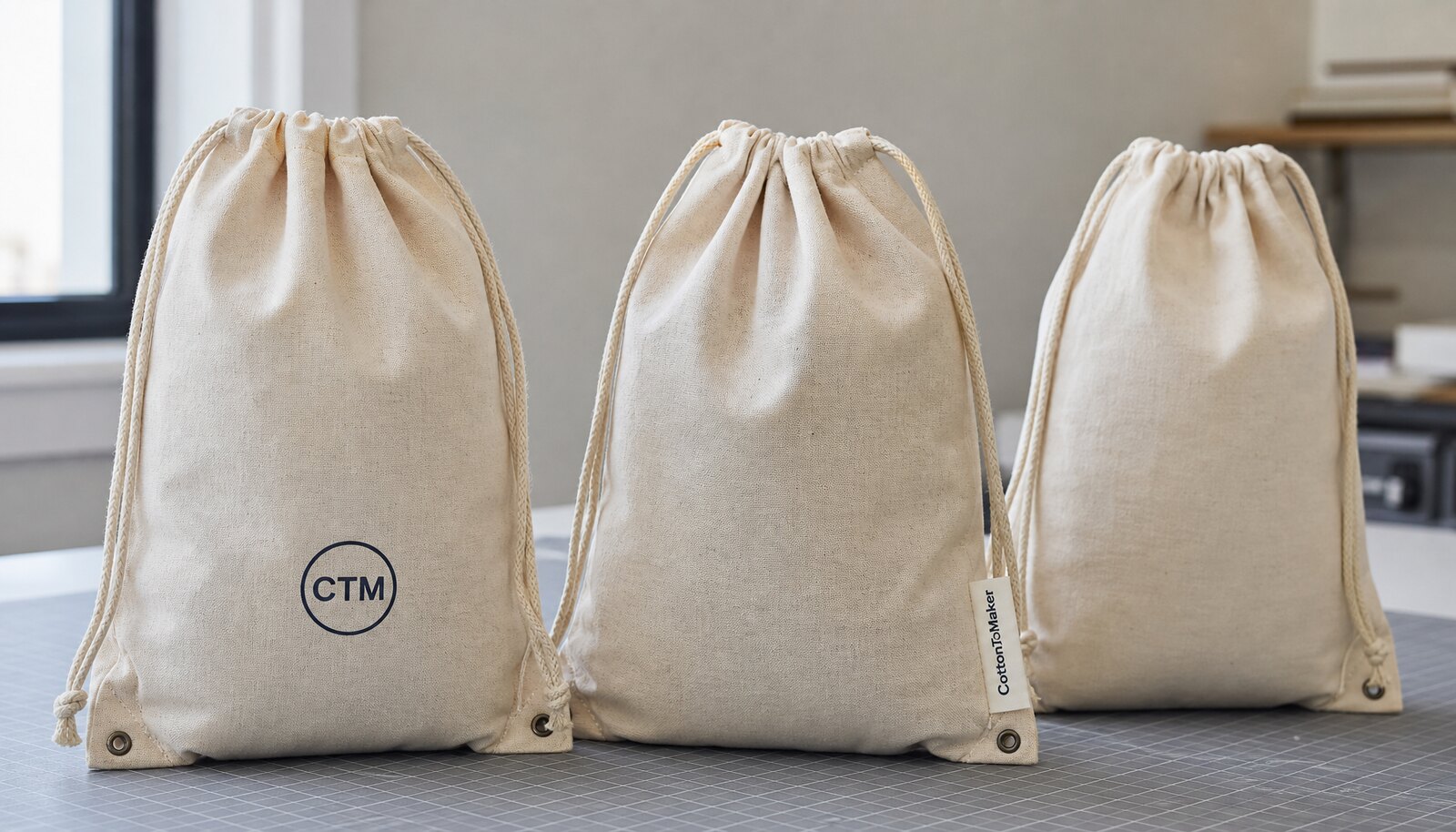
What procurement teams need to decide before asking for quotes
Personalized canvas drawstring bags look simple, but quote quality depends on how many decisions you lock before you contact suppliers. If the RFQ only says 'canvas bag with logo,' the factory has to choose fabric weight, cord type, seam finish, print process, and packing. Those defaults differ by factory, which means your price comparison becomes unreliable before it starts. The result is not just a spread in unit price; it is a spread in spec scope.
For procurement teams, the first task is to define the commercial use case. Is the bag part of a retail collection, an event giveaway, a subscription kit, or a distributor pack? A retail bag usually needs cleaner presentation, tighter dimensional control, and more consistent packing. A giveaway bag may tolerate looser sewing and simpler finishing if the main priority is cost. That distinction should shape every later decision, including fabric weight and carton count.
It also helps to separate the visible spec from the hidden production spec. The visible spec includes bag size, artwork, and color. The production spec includes seam allowance, channel construction, reinforcement, fabric finish, and cord-end treatment. The production spec is where the factory manages yield and risk. If you leave it open, you will pay for it later in samples, delays, or rework.
A useful rule: do not send a quote request until you can answer at least six questions yourself — what size, what canvas weight, what print method, what cord material, what packing format, and what volume. Those six items change cost enough that they should be treated as sourcing variables, not design afterthoughts.
- Define the end use: retail, promotion, kits, or distributor supply.
- Decide whether presentation or cost is the primary buying driver.
- Lock the six core variables: size, fabric weight, print method, cord type, packing, and volume.
Canvas weight, fabric finish, and how they change performance
Canvas weight is one of the most important decisions because it affects hand feel, drape, print behavior, and freight. For personalized canvas drawstring bags, 8 oz canvas, roughly 280–300 gsm, is a workable choice when the bag is for lightweight items, samples, travel kits, or promotional programs. It keeps the unit cost down and is usually easy to source. If the bag needs to sit neatly on a shelf, carry denser items, or support repeat handling in a retail setting, 10 oz or roughly 340–380 gsm is the more stable choice.
The tradeoff is not just cost. Lighter canvas often wrinkles more in packing and can telegraph print imperfections more clearly. Heavier canvas gives a more substantial look, but the sewing operation may need to be adjusted. The top channel can need a bit more room, the side seams may need stronger stitch density, and the carton weight rises. If your shipment is freight-sensitive, that additional weight can matter across a full order, not just per piece.
Fabric finish matters just as much as fabric weight. Greige canvas can be cheaper, but it brings more risk around shade variation, shrinkage, and surface consistency. If the bag will be washed, humid-stored, or held for repeat replenishment, pre-shrunk or otherwise finished cloth is easier to control. Ask suppliers to identify whether the canvas has been washed, dyed, or mechanically finished, and whether shrinkage testing was done before the sample was approved.
When comparing suppliers, ask for the finished fabric spec, not only the raw fabric weight. Two bags can both be described as 10 oz canvas and still feel different if one is loosely woven, heavily coated, or not pre-shrunk. That is why procurement teams should request a fabric description that includes gsm, weave style, finish, and expected shrinkage range.
- 8 oz / 280–300 gsm: better for low-cost gifting, light inserts, and programs that prioritize lower freight.
- 10 oz / 340–380 gsm: better for retail positioning, stronger shape retention, and repeated handling.
- Ask whether the fabric is greige, dyed, washed, coated, or pre-shrunk before comparing prices.
Choosing the right size and construction without creating carton or artwork problems
Bag size affects more than capacity. It changes the usable print area, the visual balance of the artwork, the folded pack size, and the shipping carton count. A small pouch in the 20 x 25 cm range can work for jewelry, cosmetics, sample sets, and gift inserts. Medium formats around 30 x 40 cm are common for apparel, shoes, and multi-item kits. Larger sizes can be useful, but they also increase fabric use and may push your cartons into a less efficient freight profile.
Do not define size only as width and height. Ask for flat size, finished opening, seam allowance, and the actual printable area. A 30 x 40 cm bag with a generous top channel may have less printable space than expected once the drawcord area and seam margins are removed. If your logo must sit a certain distance from the top edge, that should be written into the spec rather than assumed from the artwork file.
Construction details matter because canvas is more sensitive than many buyers expect. A basic single-layer pouch can be enough for promotional work, but retail buyers usually want stronger seams, better symmetry, and a cleaner top channel. Bar-tacks at the cord exits are a useful detail to specify because they prevent pullout at the point of highest stress. If the cord is thick or the contents are heavy, the factory may also need to widen the channel or adjust stitch spacing.
Ask the supplier to provide a dimensional drawing before sampling. The drawing should show the front panel, seam allowances, channel depth, print area, and cord exit positions. That avoids a common issue where a logo looks well placed on the artwork proof but shifts upward once sewn.
- Specify flat size, finished opening, seam allowance, and printable area.
- Check whether the top channel reduces the usable logo space.
- Require bar-tacks or equivalent reinforcement at cord exits for heavier use cases.
Print method selection: the artwork should drive the process
Screen print remains the main choice for personalized canvas drawstring bags when the logo is simple and the order is large enough to amortize setup. It gives strong color, predictable repeatability, and a straightforward cost structure. For procurement, the advantage is that screen print usually behaves well in replenishment programs if the ink, mesh, and curing process are controlled. It is also the easiest method to quote cleanly because the variables are visible: number of colors, number of print positions, and print size.
Heat transfer is often considered when the artwork is more detailed, the run is shorter, or the design includes smaller type and fine edges. The print can look sharp at first, but it introduces a different set of risks. The transfer can crack if the bag is repeatedly folded or packed tightly, and edge lift can appear if the adhesion process is inconsistent. That does not make transfer a poor choice; it means buyers should use it intentionally, usually for short runs or complex artwork that screen print cannot reproduce cleanly.
Embroidery can create a premium look, but it is not automatically the best option for canvas pouches. On a lightweight bag, dense embroidery can distort the fabric, especially if the logo is large or detailed. If you want embroidery, ask the supplier to confirm the stitch count, backing method, and whether the panel can handle the load without puckering. In some cases, a woven label gives a cleaner premium effect than embroidery at lower risk.
Whatever method you choose, the quote should state print area, color count, pantone target, file type, and allowable placement tolerance. Artwork that crosses a seam line or sits too close to the top channel is a common source of disputes because the sewing process changes where the art finally lands. Buyers should also ask the factory whether any file cleanup is required, such as converting fonts to outlines, separating spot colors, or simplifying thin lines for production.
- Use screen print for simple logos, repeat orders, and lower unit cost at scale.
- Use transfer for detailed art or smaller runs when sharp edges matter more than long-term durability.
- Use embroidery only when fabric weight, panel size, and stitch density can support it without distortion.
How to compare quotes on the same basis and avoid hidden extras
The biggest quote trap is comparing different scopes as if they were equivalent. A low headline price may not include setup, packing materials, cartonization, or even the exact cord type you expect. For personalized canvas drawstring bags, the landed cost can move materially once those details are added. If one supplier quotes bulk packed bags with stock cord and another quotes retail folding with insert cards, the two offers are not comparable even if the unit price looks close.
Normalize every quote before you review price. Use the same bag size, the same canvas gsm, the same number of print colors, the same print positions, the same cord type, and the same packing standard. Then ask each supplier to show what is included and excluded line by line. This is where procurement teams catch unclear pricing on sample-like orders. Some suppliers include screen setup but exclude print tooling changes. Others include standard outer cartons but exclude insert cards or barcode labels.
A useful way to structure the comparison is to ask for a quote breakdown in five parts: fabric cost, sewing cost, printing or decoration cost, packing cost, and freight or shipment prep. Not every supplier will present it that way, but you can ask them to respond in that format. If they cannot, then at least require a written list of inclusions and exclusions. This makes it easier to identify where a cheaper offer depends on assumptions that may not survive the PO stage.
Also check the tolerance on overrun and underrun. If the supplier prices 1,000 pcs but only ships 950 or 1,040, the unit economics change. If your buying system is strict on invoice quantity or if you need exact distributor counts, that tolerance matters. A quote should state whether the supplier expects a standard production tolerance and whether it is already reflected in the price.
- Normalize quotes to one spec before comparing prices.
- Ask for inclusions and exclusions in writing, line by line.
- Check overrun/underrun tolerance, because it affects invoice quantity and downstream inventory planning.
Supplier selection: direct factory, trading company, or a managed mix
The right supplier route depends on how stable your program is and how much control you need over construction. Direct factory buying is usually the better choice when you have repeat demand, a fixed spec, and a need to control seams, print placement, and fabric finish. It gives the sourcing team a clearer line of sight into production, and it often reduces margin layers. The tradeoff is that you need to manage the technical communication more carefully because the factory will expect a tighter spec and faster decisions.
Trading companies can make sense when your order is part of a broader bag or packaging program and you need consolidation across multiple styles or even multiple factories. They can simplify communication and help if you do not have internal capacity to manage several production streams. The downside is that the quote may include extra margin layers, and the actual factory may be less visible to you. That matters when you need to verify who controls print quality, QC, and packing discipline.
A managed mix can be useful for larger buyers. For example, a trading partner may handle coordination while the actual bag is made in a factory you have already approved. That can work if roles are clear in writing: who owns the artwork, who approves the sample, who inspects bulk, and who is responsible if the print or packing is wrong. The buyer should know the chain of accountability before placing the order, not after a problem appears.
The decision trigger is simple. If you need the lowest total cost for a stable repeat spec, start with the factory. If you need coordination across mixed SKUs, special shipment consolidation, or less internal workload, a trading partner can be practical. In both cases, ask who the actual manufacturer is, where the sewing and printing happen, and whether any part of the job is subcontracted.
- Use direct factory sourcing when the spec is stable and repeat orders are likely.
- Use a trading company when you need mixed-SKU coordination or consolidation.
- Always ask who makes, prints, inspects, and packs the bags in practice, not just on paper.
Sample approval: what to inspect before bulk production starts
Sample approval should test production reality, not just appearance. A blank sample can help confirm size and seam shape, but it does not tell you whether the print will sit cleanly or whether the fabric will behave after ink is cured. A printed sample is more useful, but only if it uses the same canvas lot, the same ink or transfer material, and the same cord construction planned for bulk. Otherwise, it is a marketing sample, not a production reference.
When reviewing a pre-production sample, check the canvas hand feel, the thickness consistency, and the way the bag folds. Examine the top channel and cord exit area closely because this is where many failures begin. The cord should move smoothly, cinch evenly, and reopen without snagging. If the product has a woven label, the label should lie flat and not twist when the bag is filled. If artwork is large, confirm that the logo remains visually centered after the bag is pulled closed, not only when it is lying flat.
For procurement teams, the sample approval note should be written like a mini acceptance record. Record the fabric gsm if it is known, the measured dimensions, the decoration method, the print area, and any exceptions that were accepted. If you approve a deviation, say so in writing. That protects both sides by making sure the bulk run follows the approved version, not an informal memory of the sample.
A simple sample checklist can catch expensive errors early: measure width and height, inspect seam symmetry, rub the print by hand, test the cord pull, inspect label placement, and compare carton pack if retail packing is included. If any one of those points fails, pause and request a corrected sample before mass production begins.
- Approve the same build you intend to buy, not a simplified sample.
- Record sample measurements and exceptions in writing.
- Test the bag in hand: fill, cinch, open, rub, and inspect again.
Quality control standards buyers can actually use
QC for canvas pouches works best when it includes measurable thresholds, not just general instructions to inspect for defects. Many buyers rely on visual approval alone and then discover that the bulk run has size drift, weak seams, or print rub-off. For personalized canvas drawstring bags, the inspection plan should cover material, construction, decoration, function, and packing. That is the only way to compare a factory's sample to the bulk run with any confidence.
A practical approach is to define acceptance around a standard AQL plan and then pair it with product-specific checks. For many B2B buyers, AQL 2.5 for major defects and 4.0 for minor defects is a common starting point, but the right level depends on channel risk and order value. Higher-risk retail programs may need tighter acceptance, while lower-value promotional orders can sometimes accept a more standard approach. The important point is that the supplier knows the acceptance rule before production starts.
For measurement control, ask the factory to check canvas weight or at least the incoming fabric certificate if weight testing is not done in-house. Ask for size checks on both flat dimensions and finished opening. On decoration, the supplier should inspect print opacity, registration, edge quality, and adhesion. A hand rub test is useful for printed bags because it can reveal loose ink before the order leaves the factory. If the logo is embroidered, check for thread breakage, puckering, and backing exposure.
Function testing matters too. A drawstring bag is supposed to open, close, and hold its shape without the cord cutting into the channel. Pull each cord end enough times to simulate normal use. If the bag is intended for repeated handling, ask for a simple pull test or at least a documented inspection of bar-tacks and seam recovery. On packing, confirm carton count, inner pack count, and outer carton marks so the receiving team can reconcile shipment quantity quickly.
Carton performance should not be ignored. Bags are light, but they are often shipped in high counts, which means cartons can become bulky and subject to compression. Ask the supplier what carton size and stacking assumption they used. If the route includes long-distance export handling, a basic carton drop expectation is useful, especially for retail-packed orders where insert cards and barcode labels must arrive undamaged.
- Use an AQL plan, then add product-specific checks for size, print, function, and packing.
- Inspect print adhesion with a hand rub test and check for registration drift.
- Confirm carton count, carton size, and stacking assumption before shipment.
Landed cost, lead time, and the real drivers of schedule risk
Landed cost is where many procurement decisions become clearer. The ex-factory price is only one piece of the total. For personalized canvas drawstring bags, the final cost can move because of setup fees, label application, insert cards, carton changes, freight weight, and rework risk. A supplier that looks inexpensive at first may become the costly choice once packing and shipment details are added. The reverse is also true: a slightly higher unit price can win if the supplier uses better cartonization or lower-rework construction.
Lead time has a similar pattern. A bag made from stock canvas with one-color screen print is generally simpler to schedule than one that needs custom dyeing, woven labels, or retail packing. The most common delay points are not sewing itself but material booking, artwork approval, and waiting for the right cord or label component. If your RFQ says 'urgent' but does not specify whether artwork is ready, the supplier can only guess at the schedule.
Procurement teams should ask for a stage-by-stage timeline. The supplier should tell you how long they need for material procurement, sample confirmation, production, packing, and final inspection. If they quote a short lead time, ask where the bottleneck sits. A factory that can explain the bottleneck clearly is easier to manage than one that only repeats a total number of days.
There is also a useful commercial trigger for reordering. If you expect repeat demand, ask at what quantity the supplier can reserve material or hold a color standard for a second run. Replenishment is easier when the factory keeps a reference sample, agreed artwork file, and a confirmed fabric spec. That is especially helpful if your brand uses the same personalized canvas drawstring bags across multiple campaigns.
- Compare landed cost, not just ex-factory price.
- Ask for a timeline by stage: booking, approval, cutting, printing, sewing, packing, and inspection.
- Confirm whether the factory can support repeat replenishment with the same material and artwork standard.
Artwork file prep, color control, and small factory-side details buyers often miss
Artwork can slow a bag order down more than the physical production. For canvas, the print supplier needs clean files, simplified color separation, and clear guidance on line thickness and font size. If the logo contains very thin strokes or tiny type, those details may break up on textured fabric. Buyers should ask the supplier what file format they prefer, whether fonts need to be outlined, and whether pantone matching is realistic on the chosen ink system.
Color control should be handled with practical expectations. Canvas is a natural substrate and does not behave like coated paper. Even with good process control, the same Pantone can look slightly different on a rough textile than on a flat proof. That is why sample approval matters. If your program requires repeatability, keep a physical reference sample and, when possible, note the approved ink code or color recipe. If the supplier only says 'close enough,' ask for a printed strike-off before bulk.
Factory-side details also matter on the bag itself. Cord-end finishing is a small detail that can change perceived quality. Some buyers prefer a neat knot inside the channel, while others want heat-sealed ends or metal tips for a more finished look. Each option has a cost implication and a different failure profile. Metal tips can look premium but may add lead time and sourcing complexity. Heat-sealed synthetic cord ends can be clean but may not suit a natural look. Cotton rope may need knotting or stitching to prevent fray, which changes the build sequence.
Shrinkage is another detail that deserves explicit discussion. If the canvas is not pre-shrunk, the bag can change size after finishing, washing, or even humid storage, especially if the fabric has been heavily pressed or finished. Buyers should ask how the supplier manages shrinkage between cutting and packing. If the bag size is tightly controlled for shelf fit, this is not a minor issue; it can determine whether the product meets the display spec at receipt.
- Ask for file format requirements, line thickness guidance, and whether fonts must be outlined.
- Approve a physical color reference for repeat orders whenever possible.
- Specify cord-end finishing and ask how the supplier controls shrinkage before cutting.
Specification comparison for buyers
| Procurement decision | Practical buyer spec | Typical price effect | Tradeoff or risk to check |
|---|---|---|---|
| Canvas weight | 8 oz / 280–300 gsm for light use; 10 oz / 340–380 gsm for shelf-ready or heavier-fill programs | 8 oz is usually the lower-cost starting point; 10 oz commonly adds material and sewing cost and may increase freight by weight | Too-light canvas can wrinkle, feel flimsy, and show print distortion; too-heavy canvas may require stronger stitching and raises landed cost |
| Construction finish | Single layer canvas with top channel; double-needle or reinforced side seams; bar-tacks at cord exits | Reinforcement usually adds a small unit-cost increase but can reduce failure risk in handling and returns | Ask whether bar-tacks are included by default; some quotes price basic seams only |
| Print method | 1-color screen print for simple logos; heat transfer for small-run detail; embroidery only when fabric and panel size can support it | Screen print often has the best unit economics at volume; transfers can be costlier per piece on larger runs; embroidery typically costs more and takes longer | Fine text can fill in on rough canvas; transfers may crack if over-folded; embroidery can pucker on lighter cloth |
| Bag size | Common flat sizes from about 20 x 25 cm to 35 x 45 cm, defined with seam allowance and usable print area | Smaller formats usually reduce fabric use and freight; oversized bags can raise both | A bigger bag may look more premium, but it can also push up carton volume and change artwork placement |
| Cord material | Cotton rope for a natural look; polyester cord for consistency and lower lint; flat tape only if the design needs it | Cotton rope may cost more and can vary more lot to lot; polyester is often more stable and easier to source | Cord thickness, twist, and finish affect cinch feel and visual quality; loose cord can slip or fray |
| Fabric finish | Pre-shrunk or finished canvas when dimensional stability matters; greige only if you accept some variation | Pre-shrunk cloth can add cost, but it reduces risk of size drift after washing or humidity exposure | Ask whether shrinkage was tested before approval; greige fabric may change after dyeing, printing, or storage |
| MOQ and pricing tier | Request pricing at MOQ, mid-volume, and target annual volume; separate stock-material and custom-material pricing | MOQ pricing is often the highest per unit; volume breaks can materially change landed cost | Some factories quote low MOQ using a sample-like process that is not scalable |
| Packing format | Bulk pack, inner polybag only, or retail-ready fold with insert card and barcode sticker | Bulk is usually cheapest; retail-ready packing adds labor, materials, and carton volume | Packing is often excluded from headline price; confirm every packing component before comparing quotes |
| Supplier route | Direct factory for repeat programs and tighter build control; trading company for mixed SKUs or consolidated shipments | Direct can reduce margin layers; trading can simplify coordination but may increase markup | Compare who actually makes the bag, who prints it, and who packs it before relying on the quote |
Buyer checklist before sampling
- Lock bag size, canvas gsm, and seam allowance before requesting prices.
- State whether the fabric should be greige, dyed, or pre-shrunk, and ask the supplier to disclose expected shrinkage.
- Specify print method, print size in cm, Pantone references, and artwork placement on one side or both sides.
- Define cord type, cord diameter, cord finish, and whether cord ends need heat-seal, knotting, or metal tips.
- Confirm seam construction, top channel width, bar-tack count, and reinforcement at cord exits.
- Set packing format clearly: bulk, inner polybag, retail fold, insert card, barcode label, or hangtag.
- Request blank sample, decorated sample, and pre-production sample made from the same material lot if possible.
- Ask for landed-cost details, not just ex-factory price, including setup, packing labor, cartonization, and freight impact.
- Compare quote assumptions for overrun/underrun allowance, lead time, carton size, and shipment readiness.
- Ask for the supplier's QC plan and acceptance criteria before you release the PO.
Factory quote questions to send
- What exact canvas gsm did you quote, and is the cloth greige, dyed, washed, or pre-shrunk?
- Does the unit price include one print position, screen setup, standard packing, and carton marks?
- What are the MOQ and price breaks for stock canvas versus custom color, woven label, or special packing?
- What is the usable print area in cm, and how far should artwork stay from seams and the drawcord channel?
- What stitch construction do you use at the cord exits, and how many bar-tacks are included per bag?
- What cord material, diameter, and end-finishing method are included in the quote?
- What carton size, pcs per carton, gross weight, and estimated carton count did you use for pricing?
- How do you control shrinkage, color consistency, and print opacity on repeat orders?
- What sample types can you provide, and which one should be approved before mass production?
- What is the lead time by stage: material booking, sample approval, cutting, printing, sewing, packing, and final inspection?
Quality-control points to confirm
- Canvas weight should match the agreed spec within a defined tolerance; if you need tighter control, require the supplier to state the tolerance in writing rather than relying on 'standard' factory practice.
- Bag dimensions should be checked on both flat size and finished usable opening, with a practical tolerance set by size and sewing method; small cosmetic pouches can allow slightly wider variation than retail-display bags.
- Shrinkage should be tested if the canvas is washed, dyed, or finished; ask for pre-shrink and post-shrink measurement if the bag must keep its size after storage or cleaning.
- Stitching should be straight and secure with no skipped stitches, loose thread chains, broken seam starts, or raw-edge exposure in stress zones.
- Top channel width should be consistent so the cord cinches evenly; the cord should move smoothly without catching, slipping, or abrading the fabric.
- Bar-tacks or reinforcements at cord exits should be visible and symmetrical; weak or uneven reinforcement is a common cause of early pullout.
- Print quality should be checked for registration, opacity, edge sharpness, pinholes, ghosting, and rub-off; artwork should stay clear of seams and turn lines.
- If embroidery is used, inspect for puckering, thread breakage, backing exposure, and distorted logo shape on a filled bag rather than only on a flat sample.
- Label placement should be centered and secure; woven or side labels should not curl, fray, or lift after hand rubbing.
- Packing should match the agreed method: correct fold direction, correct insert card, correct barcode, correct carton count, and legible outer carton marks.