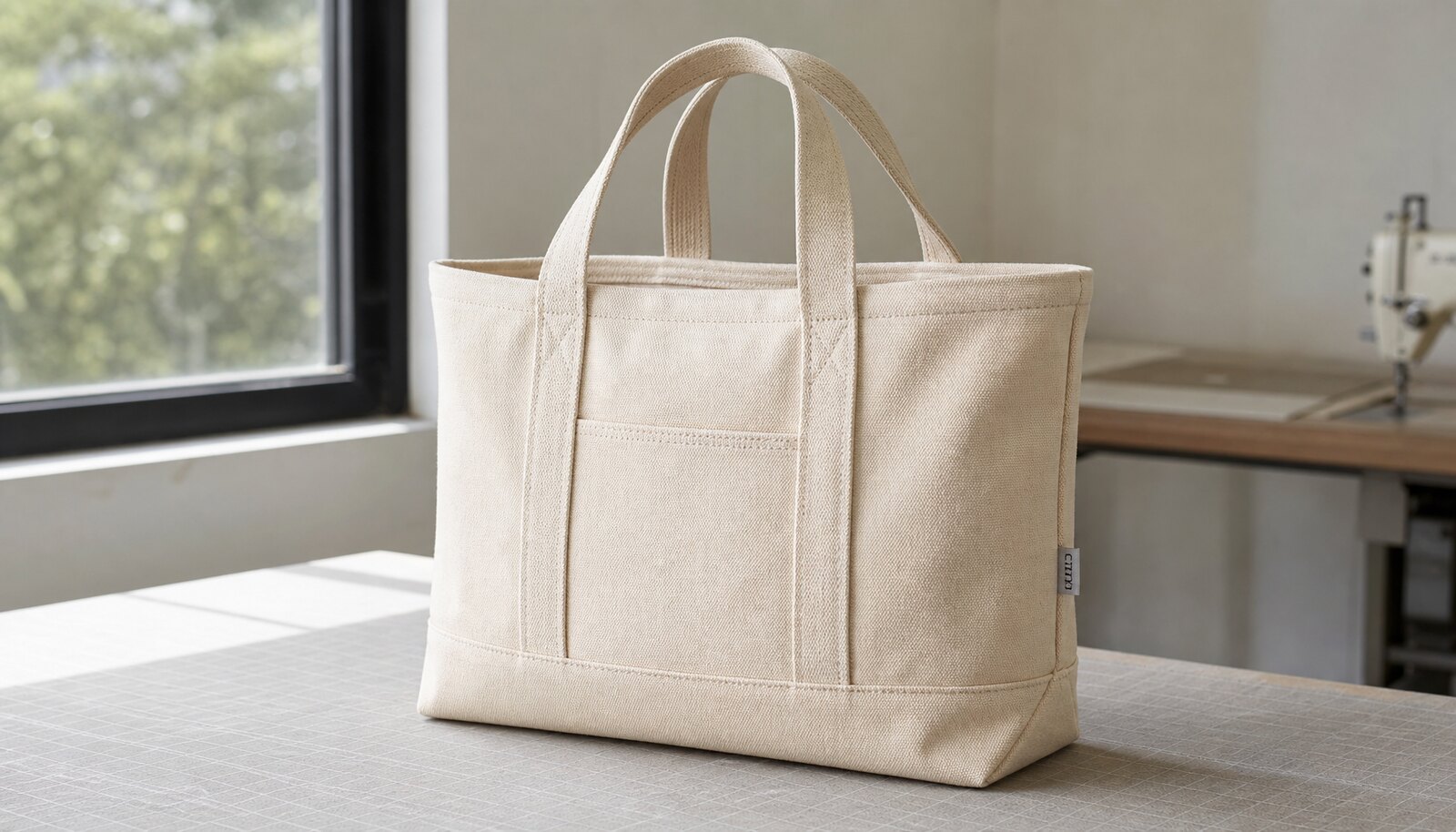
What Buyers Actually Mean by Personalized Canvas Boat Tote Bags
Personalized canvas boat tote bags are usually bought as a finished commercial product, not as a loose style idea. For procurement teams, "personalized" can mean printed branding, a woven side label, an appliqué patch, embroidery, custom body color, or a modified bag structure that supports a specific retail or promotional program. The sourcing problem is that different suppliers may hear the same request and price very different constructions.
A true boat tote is more than a generic tote with a logo added later. The shape normally implies a more structured body, a flatter base, and side walls that help the bag stand better than a soft promotional carry bag. That means the buyer needs to define the bag as a finished unit: shape, fabric, reinforcement, decoration, and packing. If those pieces are left open, quote comparisons become misleading because suppliers fill the gaps with their own assumptions.
The easiest way to avoid that confusion is to write the product definition in production terms. Instead of asking for "custom canvas totes," specify a boat tote with open top or zip top, finished dimensions, targeted carry use, decoration method, and the level of retail presentation expected. Once the product is defined that way, suppliers can quote the same item rather than three different interpretations of it.
- Define the bag as a finished product, not just a logo item.
- Use one core product term: boat tote, not a generic tote category.
- Separate decoration, structure, and packing so suppliers do not make assumptions.
Start With the Use Case, Not the Artwork
The correct specification depends on what the bag must carry, how long it should last, and how the buyer will judge quality. A resort retail tote carrying towels and sunscreen, for example, needs different handle reinforcement and bottom support than a conference giveaway that only holds brochures and a notebook. The same artwork may work on both, but the construction should not be identical.
This is where procurement teams either save money or create a quality claim. If the bag is under-specified for the actual load, handles stretch, seams distort, and the bag stops feeling premium very quickly. If it is over-specified for a lightweight promo program, unit price rises unnecessarily, the tote becomes bulky, and shipping and storage cost climb as well. The best spec is the one matched to the user scenario, not the one that simply looks strongest on paper.
For personalized canvas boat tote bags, it helps to think in operating scenarios. A retail buyer may need repeat quality across replenishment lots and a cleaner finish for shelf display. An event buyer may care more about price stability, short lead time, and easy packing. A travel or coastal program may care about wipeability, a secure closure, and the ability to hold slightly awkward items without tipping. Those are different buying problems, and they should produce different specifications.
- Retail and gifting programs usually justify cleaner finishing and stronger presentation.
- Promo and event programs can use simpler construction if the load is light and the use is short-term.
- If the tote will carry heavier items, write the load expectation into the brief so the supplier can size the reinforcement correctly.
Fabric Weight, Weave, and Finish: Where the Bag Feels Cheap or Durable
For many personalized canvas boat tote bags, the practical canvas range is often around 12 to 14 oz, because it gives enough body for a boat tote silhouette without pushing the item into an overly stiff, slow-to-sew product. That said, there is no universal best weight. A lighter program may perform well below that range if the tote is only carrying soft goods, while a premium retail bag or a carry-all for heavier merchandise may justify more weight. The useful rule is not "buy the heaviest canvas," but "buy the weight that matches the carry load, hand feel, and price target."
Fabric weight alone is not enough to evaluate quality. Buyers should also ask about weave density, finish, and expected shrink behavior. Natural cotton canvas can have more visual variation than dyed or coated versions, and that variation affects both appearance and print clarity. A fabric that feels substantial in a sample room may also change shape after folding, decoration, or carton packing. For that reason, the sample should be judged in a realistic condition, not just held once in hand.
If a boat tote needs to stand upright for retail display, the buyer should specify a base board, bottom reinforcement, or a firmer bottom panel. If the bag is meant to collapse flat for efficient packing, then too much structure may be a disadvantage. The source spec should make that choice explicit so the factory does not guess the intended posture of the bag.
- Request fabric in measurable terms: oz or GSM, not only a descriptive phrase like heavy canvas.
- Confirm whether the canvas is bleached, natural, dyed, garment washed, or coated.
- If standing structure matters, specify base reinforcement or bottom board requirements.
Decoration Method Drives Price, Yield, and Risk
Decoration is usually the first place a tote quote becomes hard to compare. A one- or two-color screen print is often the most efficient approach for large runs with bold branding because the setup is straightforward and repeat production is predictable. But embroidered logos, woven patches, and sewn-on labels can create a more premium look. They also add setup time, labor, and more opportunities for inconsistency if the spec is not tight.
Artwork itself affects production yield. Thin type, very small text, gradients, halftones, and intricate lines can break up on coarse canvas because the weave interrupts the image. On personalized canvas boat tote bags, simple branding usually performs better than highly detailed art packed into a small print area. That does not mean the design must be plain. It means the design should be scaled for the substrate. A logo that looks clean on a digital mockup may still print poorly if the line weights are too fine for canvas.
For procurement, the most useful rule is to approve decoration on a real sample or strike-off that reflects the actual method. PDF approval proves layout only. It does not prove opacity, stitch density, registration, thread color accuracy, or how the logo sits relative to the bag seam. If the logo is brand-critical, those details should be measured and signed off before bulk production begins.
- Use screen print for bold logos, large type, and repeatable high-volume runs.
- Use embroidery or patchwork when premium perception matters more than cost and speed.
- Set an explicit print placement tolerance from the seam or top edge so the artwork does not drift.
Sourcing Routes: Which Supplier Type Fits Which Program
The supplier route affects more than price. A direct cut-and-sew factory, a trading company, a blank-bag decorator, and a local converter all solve different procurement problems. A direct factory usually gives the best control over fabric, trim, construction, and packing because the buyer is closer to the process that actually makes the bag. A trading company can be useful when you need one point of contact across multiple products, but the buyer still needs to know where production really happens and who owns quality responsibility.
Blank-bag decorators and converters can work well when the order is short-run, seasonal, or tied to a campaign with a fixed timeline. Their advantage is speed and reduced product-development complexity. Their limit is flexibility. Once the buyer wants a custom gusset, a different handle build, or a private-label finish that affects the sewing order, the blank route may stop being efficient. That is why the sourcing route should be chosen after the use case is defined, not before.
For private-label or retail replenishment programs, the strongest route is often OEM-style direct manufacturing, especially when the buyer wants repeatability across seasons. In that case, the factory should be able to show sewing capacity, decoration capability, and a controlled packing process. For smaller or urgent jobs, a simpler supply route may be acceptable if the buyer explicitly accepts a narrower customization range.
- Direct factory: best for custom size, reinforcement, and repeat replenishment.
- Trading company: useful for multi-item coordination, but verify the actual production site.
- Blank decorator or converter: useful for short-run programs with limited structural changes.
Comparison of Sourcing Routes and What to Verify Before You Choose
The purpose of this comparison is not to chase the lowest line item. It is to match the sourcing route to the product risk. Two suppliers can both offer personalized canvas boat tote bags and still be quoting very different goods. One may be offering a true custom cut-and-sew bag with controlled packing; the other may be quoting a stock blank with added decoration and simpler finishing. Those should not be compared as if they were identical.
When buyers compare suppliers only by unit price, the hidden variables are usually fabric origin, handle reinforcement, label ownership, sample quality, and packing scope. A clear sourcing comparison looks at who makes the bag, who decorates it, who packs it, and who owns the quality records. If those details are not known, the quote is incomplete even if the price seems attractive.
- Compare like-for-like: same fabric, same decoration method, same packing, same inspection expectation.
- Ask who controls sewing, decoration, and cartonization; do not assume the same facility does all three.
- If the price is much lower than the others, identify which element was excluded before treating it as a better offer.
MOQ, Sampling, and Lead Time: What Is Realistic to Expect
MOQ for personalized canvas boat tote bags is usually shaped by three things: fabric color, decoration complexity, and packing complexity. A natural canvas tote with a simple one-color print is generally easier to launch in a lower quantity than a dyed body, zipper closure, lining, woven label, and multi-step retail packing. The reason is practical: every additional material or finishing step raises the amount of coordination and reserved inventory the supplier must manage.
Lead time follows the same logic. A quote that looks fast may only be fast because it assumes stocked fabric, a simple print, and standard packing. If the order needs custom-dyed canvas, a new handle color, or branded packaging, the schedule can stretch quickly. Buyers should treat lead time as a function of material availability and process complexity, not as a fixed promise that applies to every version of the bag.
Sampling should mirror mass production as closely as possible. That means the sample should use the actual canvas, actual print or embroidery method, the final handle length, and the intended packing style. A beautiful sample made from substitute materials can be misleading because it hides how the real order will behave. The sample is not just for art approval; it is for verifying construction, feel, dimensions, and packing efficiency.
- Expect MOQ to increase with custom color, lining, zipper, and multi-step decoration.
- Treat sample approval as a process check, not only an artwork check.
- Build time for material booking, sample revisions, and final inspection into the schedule from the start.
How to Write a Quote Request That Produces Comparable Pricing
A good RFQ for personalized canvas boat tote bags should make it difficult for suppliers to guess. The buyer should specify the finished dimensions, canvas weight range, handle length, handle construction, decoration method, and packing method. If those items are missing, the supplier will quote their usual version of the bag, which may not match the buyer’s expectations at all.
To keep quotes comparable, separate the price into line items. Ask for the blank bag, decoration, setup charges, sample charges, packaging, labels, and any special carton work as separate components. That way, buyers can see whether one supplier is pricing a lower-grade blank with a high decoration charge, or a better-built bag with more transparent cost structure. This is especially important when the order is split between different supplier types.
The best RFQs also include basic quality language. Instead of saying "good quality," tell the supplier what quality means: clean stitching, no obvious fraying, print centered within tolerance, equal handle length, and approved packing format. The point is not to over-engineer the request. The point is to remove ambiguity so the buyer can compare proposals on the same basis.
- Use finished dimensions, not approximate size words like large or medium.
- Separate base bag, decoration, packing, and setup charges in the quote.
- Add quality expectations in plain language so the supplier knows what failure looks like.
Handle Construction, Base Shape, and Functionality Checks
On personalized canvas boat tote bags, handle build is one of the most important functional details because it is where the bag is actually stressed in use. Buyers should specify the handle material, width, attachment length, and reinforcement method. Webbing handles, self-fabric handles, and mixed constructions each behave differently in hand and under load. If the handle is too narrow or too short, the bag may look acceptable but carry poorly. If the attachment is weak, the bag may fail even when the body fabric is fine.
The base and side structure also matter. A boat tote with a flat base and moderate gusset will usually sit better and be easier to pack than a soft tote with no structure. But a deeper gusset can raise material usage and labor, so the buyer needs to decide how much utility is really required. For retail display, a bag that keeps its shape often looks more premium. For low-cost giveaway programs, a softer build may be acceptable if the load is light.
One useful procurement habit is to ask the factory to show where the bag will carry stress under repeated use. That may sound simple, but it forces the supplier to think about bartacks, seam ends, and bottom corners in a practical way. If the factory cannot explain those load points clearly, it is usually a sign that the process is not well controlled.
- Specify handle width, handle drop, attachment length, and reinforcement details.
- Confirm whether the bag must stand upright or only lie flat in cartons.
- Ask how the bag is reinforced at the bottom corners, because that is a common failure point.
Packaging, Labeling, and Retail Readiness
Packing is part of the commercial product, not an afterthought. For retail or distributor programs, buyers should define whether each tote is folded flat, tissue-wrapped, polybagged, tagged, barcoded, or packed with a carton insert. A boat tote that looks neat in the sample room can become bulky and unattractive if folding is inconsistent. If the brand sells through retail shelves, fold direction and presentation consistency matter almost as much as the bag itself.
Labeling should also be resolved early. A woven side label, a printed care label, a hangtag, or a barcode sticker may each be part of the program. If the buyer wants a branded side label such as a CTM or CottonToMaker label, the placement and stitch method should be approved on the sample. Otherwise, the factory may place it in a technically acceptable but visually awkward position. For commercial orders, that kind of mismatch creates avoidable rework.
Carton specs matter for freight and warehouse handling. Buyers should ask for carton count, carton dimensions, gross weight, and whether the supplier will standardize fold orientation across the batch. If the bags are going into a retail network, the outer carton mark format and any SKU coding should be quoted with the order, not added later as an informal request.
- Specify fold method and pack count before bulk production starts.
- Approve label placement on the physical sample, not only by email.
- Include barcode, carton mark, and retail-ready presentation requirements in the RFQ if they matter downstream.
Specification comparison for buyers
| Sourcing route / decision | Best fit | Procurement upside | Key risk to verify |
|---|---|---|---|
| Direct cut-and-sew factory | Custom size, custom reinforcement, repeat replenishment, private label programs | Best control over fabric weight, dimensions, handle build, and packing sequence | Confirm actual sewing line capacity, print capability, and whether the quoted factory also controls finishing and cartonization |
| Trading company / sourcing agent | Multi-item programs, consolidated buying, buyers needing one contact across several factories | Can simplify communication and help bundle decoration, packing, and freight coordination | Verify the real production site, line ownership, and whether the quote is a pass-through or includes hidden markups |
| Blank-bag decorator / converter | Fast turns, smaller runs, simpler artwork, event merch, or seasonal promotions | Often faster setup and lower complexity when shape changes are minimal | Check blank bag origin, consistency by lot, and whether decoration quality matches the intended retail level |
| Import blank route plus local decoration | Domestic branding, urgent replenishment, or small-batch promotional fulfillment | Shorter turnaround after blanks arrive and easier local oversight of decoration | Watch for decoration mismatch, blank inventory variation, and duplicate handling costs across two suppliers |
| OEM private-label factory | Retail programs, brand-controlled specs, and multi-season programs | Better for long-term consistency, barcoding, custom labels, and repeat color control | Require documentation on materials, trims, approved sample retention, and change-control discipline |
| Material | 8-12 oz cotton canvas, 120-220 gsm cotton, recycled cotton, or blended fabric selected by use case and target price | Before price comparison | Different cloth weights, backing, or certification claims make quotes hard to compare |
| Construction | bag size, gusset, handle drop, seam allowance, stitch density, reinforcement patch, and loading expectation | Before sampling | Weak stress points create returns and failed inspections |
| Decoration | screen print, heat transfer, embroidery, woven label, or hangtag matched to fabric texture and brand durability needs | Before artwork approval | The wrong method can crack, bleed, pucker, or fail on the chosen fabric |
Buyer checklist before sampling
- Define the end use first: retail, resort, beach, corporate gift, event merch, or resale program, because the intended load changes the structure you should buy.
- Write a finished-bag specification: dimensions, gusset depth, handle drop, closure type, label type, and whether the bag must stand upright.
- State the canvas in measurable terms: oz or GSM, weave density if known, finish type, and whether the fabric is natural, bleached, dyed, or washed.
- Specify decoration details: method, artwork file format, print size, placement tolerance, color count, and whether small text or gradients are allowed.
- Require a pre-production sample made with actual fabric, actual trim, and the final decoration method—not a paper approval or digital mockup alone.
- Ask the supplier to quote the base bag, decoration, packing, labels, and one-time setup separately so you can compare like for like.
- Define packing requirements: fold method, polybag or no polybag, barcode label, carton count, outer carton markings, and any retail-ready presentation rules.
- Set inspection expectations before production: AQL level, defect severity definitions, and whether third-party inspection is required.
- Ask for evidence of production capability: sewing line photos, in-house decoration or subcontracted decoration, quality records, and export documentation experience.
- Confirm delivery logic in writing: sample timing, bulk lead time, partial shipment policy, and what events trigger a schedule slip.
Factory quote questions to send
- What is included in the quoted price: blank bag only, bag plus print, bag plus embroidery, or fully packed retail-ready units?
- What exact canvas weight, weave, and finishing are included, and is there any tolerance on the fabric supplied?
- Which supplier route is this quote based on: direct factory, trading company, blank decorator, or local converter?
- What are the MOQ rules by size, color, decoration method, and packaging style?
- What are the setup charges for printing plates, screens, embroidery digitizing, woven labels, hangtags, or carton printing?
- What is the sample cost, what materials will be used in the sample, and is the cost refundable after order confirmation?
- What is the quoted handle construction, including material type, width, stitch count, bartack count, and reinforcement points?
- What inspection standard does the factory accept, and can the order be inspected by a third party before shipment?
- What are the carton pack count, carton dimensions, gross weight target, and whether the quote includes polybags, desiccant, or inserts?
- What is the confirmed production lead time after sample approval, and which steps are the usual bottlenecks?
Quality-control points to confirm
- Fabric weight should match the approved spec within the supplier’s stated tolerance, and the lot should not show obvious shade or weave inconsistency across cartons.
- Finished dimensions should stay within a pre-agreed tolerance, commonly tighter on width and handle drop than on overall height, because those dimensions affect retail presentation and usability.
- Handle stitching should include equal-length attachment points, consistent bartacks, and no skipped stitches, frayed ends, or exposed thread tails.
- For load-bearing programs, require a simple load test on a defined sample count, such as repeated lift-and-hold cycles using a realistic weight that matches the use case.
- Print placement should be checked against a measured reference from the seam or top edge, with no visible skew, poor opacity, ink bleed, ghosting, or off-center logos.
- If embroidery is used, inspect thread density, backing cleanliness, puckering, stitch trimming, and whether the logo remains legible at normal viewing distance.
- Bottom and side seams should be inspected for seam allowance consistency, corner reinforcement, and any sign of seam pop, raw-edge fray, or broken needle damage.
- Closure hardware, if any, should be checked for zipper gauge, puller type, tape alignment, and smooth operation across a practical open-close cycle.
- Packaging should match the approved pack-out exactly, including fold direction, insertion method, labels, barcodes, and carton marks.
- Inspection should classify hard rejects clearly: broken seam, weak bartack, significant print shift, wrong size, wrong fabric, or missing label should not be treated as minor defects.