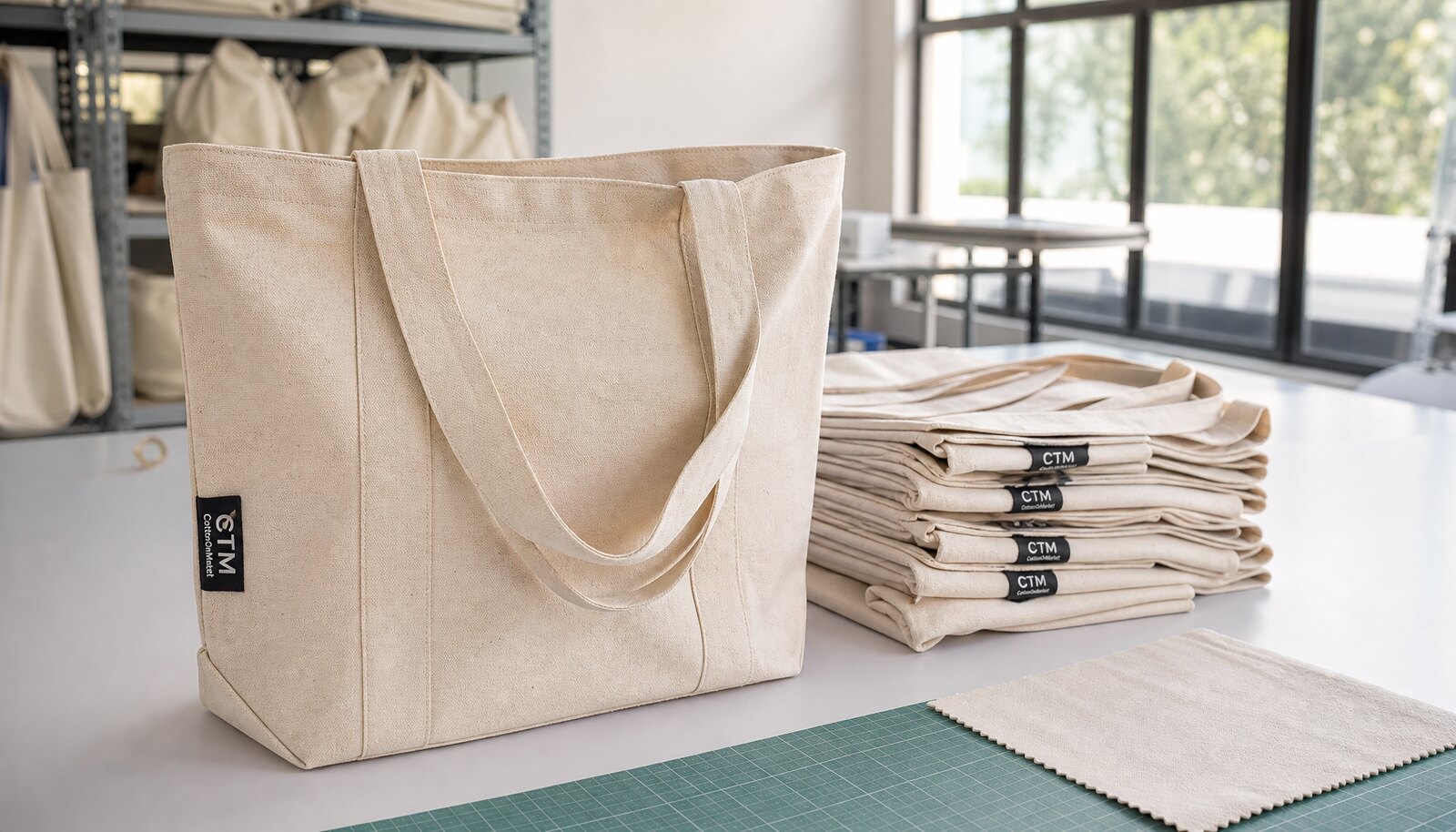
Write the spec the way the factory will price it
The fastest way to get unusable quotes for personalized canvas bags is to describe the product in marketing language. Buyers need a production spec, not a concept. The factory has to know the exact size, fabric weight, handle construction, decoration area, packing format, and destination before it can price anything accurately. If the brief only says "custom tote with logo," every supplier will fill in its own assumptions, and the prices will not be comparable.
A good starting spec has one purpose: force every bidder to quote the same bag. State the end use first, because that changes the build. A promo handout can use lighter cloth, bulk packing, and a simpler print. A retail tote or gift bag needs better edge finishing, stronger handles, and more disciplined packing. Then define the personalization itself: print, woven label, embroidered patch, hang tag, or a combination. The more precise the brief, the less time you spend clearing up avoidable quote noise.
- Start with use case: promo, retail, gift, e-commerce, event kit, or internal distribution.
- Specify the exact bag body, not just the logo: size, gusset, handle drop, and reinforcement.
- State whether branding goes on one side, both sides, the gusset, or a label only.
- Attach final artwork early and note if it must stay within a safe print area.
- Call out any non-negotiables such as natural canvas color, black ink only, or no polybag.
Choose canvas weight and construction by use case, not habit
Canvas weight is one of the few spec choices that changes price, feel, and failure rate at the same time. As a practical buying guide, 8 oz canvas, roughly 240 to 270 GSM, works for light promotional use and mail-out kits. 10 oz, around 340 GSM, is the most common middle ground for branded everyday totes because it balances cost, structure, and print appearance. 12 oz and above, often 400 GSM or more, makes more sense when the bag needs a firmer hand feel, better shelf presence, or a heavier load profile.
Weight alone does not decide performance. Handle width, seam construction, top hem style, gusset depth, and reinforcement at the join point matter just as much. A heavier cloth with weak handle stitching still fails under load. A lighter cloth with clean reinforcement can be acceptable for many programs if the load is modest. For buyers, the useful question is not "what canvas does the supplier like?" It is "what build matches the actual use case and the acceptable failure risk?"
- 8 oz / 240-270 GSM: light promotional use, lower price, softer structure.
- 10 oz / about 340 GSM: balanced choice for most branded carry programs.
- 12 oz / 400+ GSM: better shape retention, premium feel, and stronger visual weight.
- Ask for handle width, handle drop, seam style, and reinforcement in the same line as fabric weight.
- If the bag will carry heavy items, require a stronger handle join and a load test, not just thicker cloth.
Match the decoration method to the artwork and volume
The print method should follow the artwork and order profile, not the other way around. Screen print is usually the most predictable choice for bold logos, one to three colors, and repeat volumes. It gives solid coverage on cotton canvas, but it needs registration discipline and clear approval of the print base. If the cloth is natural, bleached, dyed, or recycled, the ink can sit differently on each surface, so the supplier should not quote decoration before confirming the substrate.
Other methods solve different problems. Heat transfer can handle more complex artwork or shorter runs, but the finish may feel less premium and the wear profile can be weaker. Embroidery or a sewn patch gives a premium look, but it can distort on lighter cloth and adds setup time. Woven labels or stitched badges are useful when the brand wants a clean identity mark rather than a large graphic. The right method depends on the logo, expected handling, and acceptable decoration cost per unit.
- Screen print fits simple logos, larger repeat runs, and tighter unit-cost targets.
- Heat transfer fits short runs or multi-color artwork, but validate hand feel and abrasion resistance.
- Embroidery and patches fit premium positioning and thicker canvas with modest logo sizes.
- Require a production test if the artwork has fine lines, small text, or tight registration.
- If the bag is washed or heavily handled, ask for wash and rub resistance before approval.
Build the quote around the real cost stack
A quote for personalized canvas bags should not arrive as a single number with no breakdown. Buyers need to separate material, sewing, decoration setup, labels, packing, and freight basis. Otherwise, the lowest number can hide the most expensive omission. One supplier may include screens, polybags, and carton marks; another may quote only the sewn bag body. Those are not comparable offers, even if the line item looks similar.
The main cost drivers are predictable. Heavier cloth consumes more cotton and usually lowers yield. Larger bag sizes, wider handles, and deeper gussets increase fabric use. Every added print color raises setup work and control risk. Retail packing, barcode labels, and destination labeling also add labor. The cleanest RFQ forces suppliers to quote the same finished dimensions, decoration method, packing format, and incoterm so the total landed cost can be compared without guesswork.
- Request separate pricing for bag body, print setup, labels, packing, and freight basis.
- Compare only like-for-like quotes: same size, same weight, same print area, same pack format.
- Confirm whether the quote includes inland freight, export documentation, and destination delivery.
- Treat unusually low pricing as a spec risk until the supplier explains what is excluded.
- If the order will repeat, ask for breakpoints by MOQ tier so you can plan volume pricing.
Set MOQ, sample stages, and change control before you award the order
MOQ is usually driven by production economics, not by sewing capacity alone. Fabric lots, screen setup, label minimums, and packing efficiency all affect the floor. A factory may accept a low MOQ on the bag body but still require a higher threshold for each decoration version. If the program needs several colors or logos, standardize the body where possible and vary only the branding element. That is usually the easiest way to keep volume manageable without diluting the identity.
Sampling should be treated as a control gate, not a courtesy. A useful path is reference sample, then pre-production sample with final fabric and final artwork, then bulk production against that approved standard. The sample must prove more than appearance. It should show the actual print density, handle join, stitching finish, label position, and packed presentation. If the sample is too soft, too stiff, or slightly off-color, do not assume the bulk run will improve itself. Lock the sample into the PO.
- Ask whether MOQ is per design, per color, per size, or per total order.
- Use one common bag body if you need multiple artwork versions.
- Approve a pre-production sample with final fabric, final decoration, and final packing.
- Keep one signed sample as the production reference and cite it in the PO.
- Any post-approval change should trigger a documented impact review on cost and lead time.
Check region, material source, and compliance before the quote gets too far
For buyers who need a defensible supply chain, region matters less than traceability. Do not assume that "organic," "recycled," or "cotton from X country" is automatically supported by the factory. Ask where the cotton was grown, where the yarn was spun, where the fabric was woven, and where the bags were sewn and decorated. Those are different steps, and they may affect customs origin, claim language, and supporting paperwork. If your sales team plans to make a material claim, the supplier should be able to document it.
Compliance expectations also vary by market. For the EU and UK, buyers commonly ask for restricted-substance confirmation and declarations tied to the fabric, print, and labels. For U.S. programs, ask whether the item could raise Prop 65 issues depending on inks, dyes, or accessories. If the bags are for children, the compliance bar is different again and may require CPSIA-related controls. For organic or recycled claims, request the right certificate or transaction evidence rather than relying on a marketing statement. This is where many sourcing briefs become weak: they name a trend, but they do not specify the proof.
- Ask for the material chain: fiber origin, yarn, fabric, sewing, decoration, and packing location.
- Do not use organic or recycled claims unless the supplier can support them with documentation.
- For EU-bound orders, confirm restricted substances and label language early.
- For U.S.-bound orders, check whether inks, dyes, or trims could create a Prop 65 issue.
- If the order is for children, food contact, or a regulated retail channel, raise the compliance bar before sampling.
Define QC with test methods and acceptance thresholds
Quality control works only when it is measurable. Words like "good finish" or "nice print" do not help a factory during production or a warehouse during receiving. Buyers should set tolerances for finished dimensions, shade, print position, and stitch finish before bulk starts. For many programs, a finished size tolerance of plus or minus 1 cm is workable for promo bags, while retail-facing programs often need tighter control. The key is not the exact number; the key is that the number exists and is shared by both sides.
Functional testing should focus on where canvas bags fail. That means handle joins, top hems, side seams, and the print layer under rubbing or handling. Agree the test method, weight, and pass/fail rule in advance. If the bag is likely to be washed, include wash testing. If it will only be carried, then a load and drop test is more relevant. A good QC plan lets you reject a weak bulk lot before it becomes an inventory problem.
- Use a measured dimensional tolerance, not visual judgment alone.
- Check stitch density, seam alignment, and handle reinforcement on the first cartons from each lot.
- Use dry rub and, if relevant, wet rub testing for the printed area.
- Require a load test with a defined weight and duration before bulk approval.
- Set an AQL or inspection standard for carton count, packing accuracy, and cosmetic defects.
Specify packing and labeling for the channel, not just the factory
Packing can make or break the economics of a tote program. Bulk packing is cheaper, but retail and e-commerce channels usually need more structure: individual polybag or paper wrap, barcode label, SKU sticker, hang tag, and carton marks that match warehouse intake. If the supplier only understands factory packing, the buyer ends up paying for repacking later. That is avoidable if the RFQ names the selling channel from the start.
Canvas bags are light but bulky, so the carton plan matters. The wrong pack count can drive up freight, distort the bags, or make warehouse receiving inefficient. Ask for carton dimensions, gross weight, and packs per carton before booking freight. If the bags will be shelf-ready, also require the label data format and location. Those details are low-cost to define and high-cost to fix after the goods are sealed.
- Specify whether the goods ship bulk, individually wrapped, or retail-ready.
- Include barcode, SKU, and carton-mark requirements in the packing brief.
- Ask for carton dimensions and gross weight before freight planning starts.
- If the order goes to e-commerce, require packaging that survives parcel handling.
- If there are multiple SKUs, confirm how the factory segregates and labels each one.
Compare sourcing routes by landed cost, not ex-factory price
The cheapest factory quote is often not the cheapest landed cost. A direct factory may show a higher unit price than a local print shop, but the total can still be lower once setup, rejects, freight, duty, and rework are included. The correct comparison method is simple: force every supplier to quote the same spec, the same incoterm, and the same packing plan. Only then does the price mean anything.
Different sourcing routes solve different problems. A direct factory is usually the cleanest option for repeat volumes and stable construction. A trading company can help when you need several SKUs or coordination across different factories. A local decorator on stock blanks works for rush jobs, but the bag structure is already fixed. For branded retail, the chosen route must support the product story all the way through packing, not stop at a logo application.
- Compare on landed cost, not unit price alone.
- Hold the incoterm constant before reviewing the quote.
- Include packaging, freight, duty, and expected reject rate in the comparison.
- Use the sourcing route that matches the program: speed, volume, retail finish, or customization depth.
- If you will repeat the order, ask each supplier for price breaks at realistic volume tiers.
Send a complete RFQ package and ask for proof, not promises
A complete RFQ reduces back-and-forth and makes supplier behavior easier to read. The factory should receive the finished dimensions, fabric weight, artwork files, logo placement drawing, print method preference, packing requirements, target quantity, destination, and incoterm. If there is a reference sample or retail spec sheet, attach it. A clean RFQ also says what is not allowed, such as glitter ink, oversized seams, mixed dye lots, or unapproved label text. That prevents the supplier from quoting a cheaper but wrong version.
Before award, ask the supplier to show proof that the quote is real. That can be recent production photos, a sample-room photo, in-house print setup evidence, machine list, or a line card of similar work. You do not need a polished sales deck. You need evidence that the factory can make the construction you want, pack it as required, and repeat it at the volume you need. That is the difference between a quote and a purchase-ready source.
- Attach a dimensioned sketch or spec sheet, not only a logo file.
- Provide final artwork in the correct format and note the exact print size.
- State the destination, incoterm, target quantity, and any retail packaging rules.
- Request similar-production proof before you commit the order.
- Document the approved sample, test standard, and packing plan in the PO so there is no ambiguity later.
Specification comparison for buyers
| Spec decision | Recommended option | When it fits | Buyer risk to check |
|---|---|---|---|
| Direct canvas bag factory | Best for repeat programs, stable specs, and coordinated sewing plus decoration under one PO | You want one source to own fabric, sewing, print, labeling, and packing | Confirm whether screens, labels, cartons, and inland moves are included or charged separately |
| Trading company or sourcing agent | Useful when you need mixed styles, multiple factories, or one commercial contact | You are short on local sourcing time or need cross-factory coordination | Watch margin stacking, weak visibility into the actual factory, and subcontracting without approval |
| Local print shop on imported blanks | Good for rush promos and short delivery windows where the bag body can stay standard | You can accept a stock blank and only need branded decoration | Check whether the blank weight, seam construction, and handle reinforcement are fit for reuse or retail |
| Stock blank plus custom label | Practical for fast programs where branding can sit on a woven label, patch, or hang tag | Artwork changes often or setup cost must stay low | Make sure the blank color, handle drop, and label attachment are stable across lots |
| Small workshop or low-MOQ maker | Suitable for prototypes, market tests, and very small design-led runs | You are validating a new product before volume commitment | Expect wider dimensional variation, less disciplined packing, and limited formal testing |
| Integrated retail supplier | Good when barcode labels, shelf-ready packing, and store intake matter | You are supplying retail, gifting, or e-commerce fulfillment | Verify carton strength, pack accuracy, and whether retail labels are printed or applied |
| Dual-source setup | Useful for risk control when one supplier cannot cover peak demand | You need continuity or regional redundancy | Align artwork files, shade standards, and tolerances so two factories do not drift apart |
| Eco-positioned specialist supplier | Fit for recycled or organic positioning where documentation is part of the sale | Material story is part of the brand and sales brief | Expect more paperwork, tighter sourcing rules, and longer approvals |
Buyer checklist before sampling
- Finished bag size with tolerance, including gusset depth, handle drop, and usable print area
- Target canvas weight in oz or GSM by use case, plus whether the cloth is natural, bleached, dyed, recycled, or organic
- Handle construction, handle width, reinforcement method, and stitch count at the stress point
- Decoration method, number of colors, artwork placement, and approved file format with Pantone or reference color callouts
- Packing format, unit packaging, master carton count, carton size, gross weight, and carton-mark requirements
- MOQ by size, color, and decoration method, not only by bag body
- Sample stages required before bulk approval, plus who signs off each stage
- Target incoterm, destination port or warehouse, inland freight responsibility, and any duties or taxes excluded from the quote
- Required tolerances for size, shade, print position, stitch quality, and carton count
- Any retail, customs, or compliance labels that must appear on the product, carton, or inner pack
Factory quote questions to send
- What exact finished size, fabric weight, weave, and handle construction is your price based on?
- Is the unit price for one-side or two-side decoration, and how many colors, screens, or setup steps are included?
- Which items are included in the quote: screens, plates, embroidery setup, woven labels, hang tags, polybags, barcode stickers, and carton marks?
- Is MOQ calculated by bag body, color, print design, size, or total order value?
- What sample stages do you provide, and which sample becomes the production reference?
- What is the bulk lead time after approval, and what events usually extend it?
- Which incoterm is quoted, and what freight, duty, inland delivery, or destination charges are excluded?
- What carton pack count, carton dimensions, gross weight, and outer label format are included in the quoted pack plan?
- What tolerance do you hold for size, shade, print registration, stitch finish, and carton count?
- Which tests or inspection standards do you use for fabric weight, seam strength, print durability, and packing accuracy?
Quality-control points to confirm
- Finished dimensions stay within the agreed tolerance for width, height, and gusset depth; use a tighter range for retail-facing programs than for promos
- Fabric weight matches the approved spec within the agreed tolerance, verified by mill certificate and spot cut-and-weigh checks on incoming cloth
- Seams are straight, secure, and free from skipped stitches, broken thread, or loose tails at the top hem, side seams, and handle attachments
- Handle attachment points are symmetrical and reinforced; the handle drop matches the approved sample on both sides
- Logo placement, size, and color match the approved artwork and reference sample, including safe margin from seams and edges
- Print coverage is even, with no pinholes, cracking, bleeding, blistering, or obvious misregistration after the agreed rub or tape test
- Color shade across cartons stays within the approved standard, especially for natural canvas, dyed bodies, and recycled-content lots
- No stains, holes, oil marks, puckering, or damaged edges are present on visible panels, handles, or folded areas
- Packing count, barcode, SKU label, and carton marks match the purchase order exactly, with no mixed SKUs unless preapproved
- Load and carry performance passes the agreed test weight and cycle count without seam failure, handle stretch, or distortion