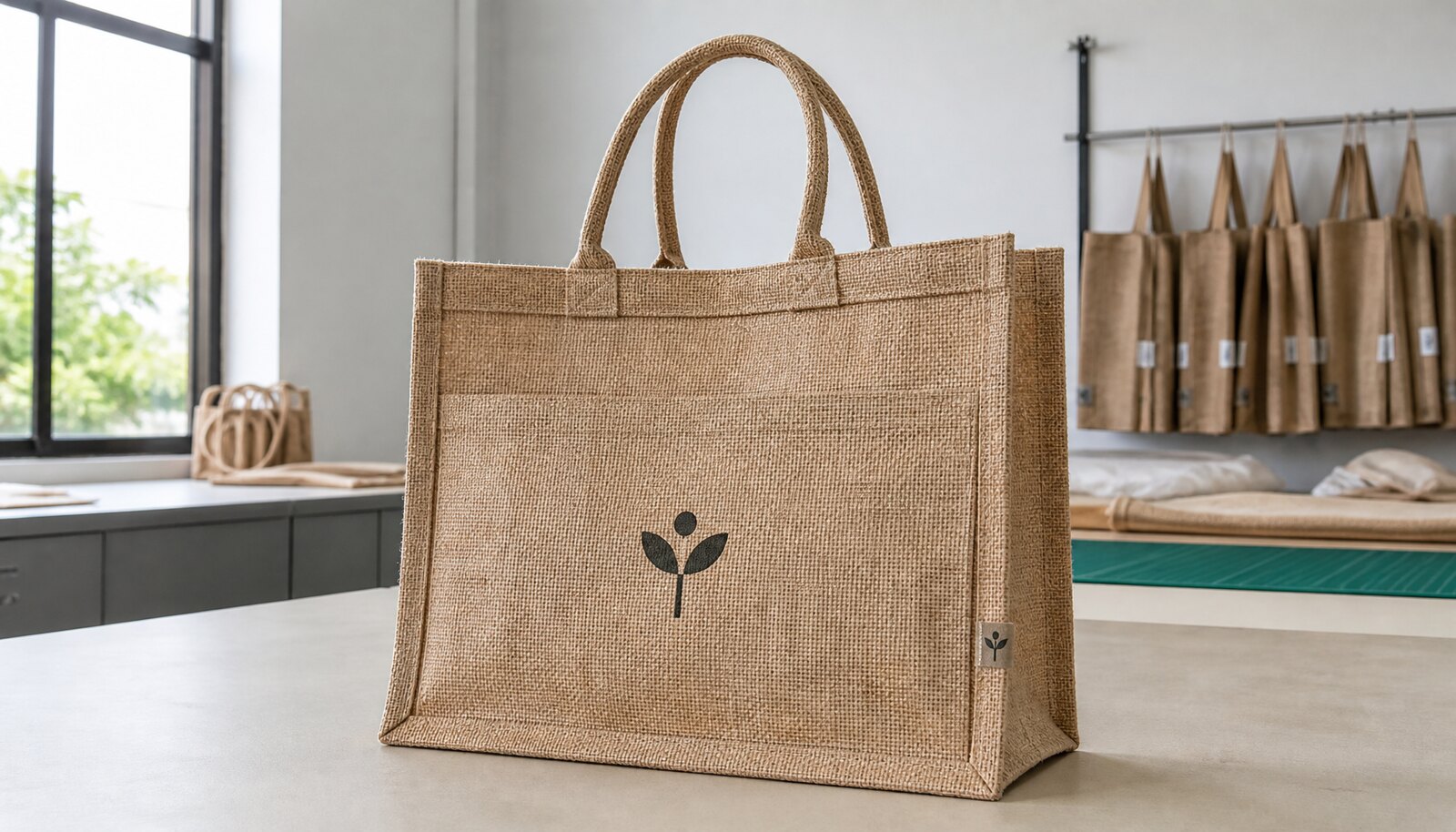
Why personalized burlap tote sourcing goes wrong
Most problems with a personalized burlap tote order start before production begins. Buyers usually approve a pretty sample, then discover the fabric is heavier, rougher, or more uneven than expected; the logo looks good on a flat mock-up but breaks up on coarse weave; or the bag arrives packed so tightly that the shape is permanently crushed. A tote made from burlap is less forgiving than cotton canvas because the yarn structure is more open, the surface is less uniform, and the print result depends heavily on the actual weave quality.
For procurement teams, the real issue is not whether the bag looks rustic. It is whether the spec can be repeated across the same lot and the next reorder. That means you need a clear answer on GSM, finishing, stitching, and print method before you compare quotes. If a supplier cannot explain those inputs in plain terms, their low price is usually hiding fabric downgrade, loose QC, or a print process that will not survive handling.
- Avoid approving burlap from a photo alone; request fabric close-ups and a physical sample.
- Treat logo legibility as a material issue, not only an artwork issue.
- Ask whether the quoted bag is true burlap/jute, a burlap-look blend, or a laminated variant.
Choose the right burlap grade before you talk price
The first commercial decision is the fabric itself. For a personalized burlap tote, the usual practical range is around 250–400 GSM, depending on the use case. Lower GSM lowers cost and freight weight, but it also makes the bag softer, more wrinkled, and more likely to show gaps in the weave. Higher GSM improves body and retail presentation, but it can make folding harder and may hide small print details if the surface is uneven. If the bag must hold boxed items or be sold in retail stores, a mid-to-heavier grade is usually safer than a very light burlap.
Also decide whether the buyer wants the rough natural handfeel or a more controlled retail finish. Some burlap bags are made from a coarse jute face with minimal finishing, while others include a cleaner weave, inner lining, or edge binding. Those are not cosmetic extras; they change the sewing time, the stitching path, the weight per carton, and the failure rate at stress points. A supplier quote without fabric details is not comparable to another quote that specifies fabric grade and finishing.
- 250–300 GSM: lower cost, promo use, lighter contents, more visual irregularity.
- 320–400 GSM: better body, stronger retail appearance, better for repeated customer handling.
- Ask if the burlap is bleached, dyed, or natural color only; shade consistency matters for repeat orders.
Print method changes both unit cost and logo quality
The most common print choice for a personalized burlap tote is one- or two-color screen printing. It stays economical, works well for bold logos, and is the easiest method for larger batches. The limit is detail. Fine lines, small serif text, and soft gradients are risky on burlap because the weave opens the print and makes edges look broken. If your brand mark includes thin strokes, the factory should show a proof on the actual fabric or a very close substrate before mass production starts.
For smaller runs or more complex artwork, a transfer method or a sewn patch may be better. That gives you cleaner detail, but it adds process steps and can create durability issues if the patch edge lifts or the transfer cracks. Embroidery works on thicker burlap styles, but it also pushes the price up and can distort lightweight bags. Buyers should compare print methods by logo type, not by habit. If the logo is simple, screen print is usually the best value. If the design is intricate, simplify the art or switch to a patch-based execution with clear durability criteria.
- Screen print works best for bold, flat artwork with limited text.
- Transfer print is useful for short runs or more detailed logos, but needs rub testing.
- Embroidery should be reserved for heavier construction where needle distortion will not warp the bag.
How MOQ logic really works on burlap tote quotes
MOQ on personalized burlap tote orders is not just a production preference; it is the point where setup cost becomes absorbable. Screen-print setup, fabric cutting, sewing line changeover, and packaging all create fixed cost. If the order is too small, the factory either increases unit price sharply or cuts corners on inspection and materials. That is why the same tote can be quoted very differently at 1,000 pieces versus 5,000 pieces, even if the design looks identical.
A clean RFQ should ask the supplier to separate MOQ by process. For example, a simple one-color print might be viable at a lower quantity than a multi-color or lined version. If a supplier offers one blanket MOQ for every configuration, that is usually a sign they are not controlling actual process cost. Compare the quote against a version with and without lining, then compare simple print versus detailed print. You will quickly see where the factory’s real constraint is.
- Lower MOQ usually means higher setup allocation per bag.
- Adding lining, inside pockets, or custom labels often raises MOQ more than the print itself.
- Ask for tiered pricing at 1,000 / 3,000 / 5,000 units to expose the break point.
Supplier comparison: factory direct, trading company, or local converter
For importers and brand buyers, the sourcing route changes more than the unit price. A direct factory normally gives better control over burlap GSM, stitching details, and packing specs, especially if the order is repeatable. A trading company can be useful when you need multiple bag categories in one shipment or want a single contact to manage revisions, but you must verify who is actually making the bag and who owns QC signoff. A local converter may be best for urgent or low-volume retail replenishment, yet the fabric options and printing economics are often limited.
When comparing quotes, do not only compare the bag price. Compare how each supplier handles samples, artwork proofing, tolerance control, carton packing, and claim resolution. A slightly higher factory quote can be the lower landed cost if it reduces defects, avoids rework, and prevents freight waste caused by overpacked or poorly folded bags.
- Direct factory: strongest on repeat quality, more efficient on custom specs.
- Trading company: easier coordination, but requires tighter proof of manufacturing control.
- Local converter: useful for speed, but often less flexible on fabric and packing economics.
Comparison table: sourcing routes and what each one hides
Use the table below to compare sourcing routes before you issue a final RFQ. The goal is not to pick the cheapest line item; it is to identify which route can actually hold the spec you need across print, fabric, and packing. The same personalized burlap tote can look very different depending on whether the supplier is controlling the fabric mill, the print shop, or only the final assembly.
In practice, the biggest hidden risk is not the tote itself. It is weak process ownership. If the supplier cannot explain who approves the art, who inspects the sewing, and who signs off on the carton count, you can expect avoidable variation between samples and mass production.
Sample approval: what the pre-production sample should prove
A sample is not just a color reference. It should prove that the tote can be made at the agreed size, with the agreed fabric, and with the agreed print method. For a personalized burlap tote, the sample should show the actual burlap texture, handle reinforcement, seam bulk, print placement, and the way the bag folds or stands. If the bag includes lining or a pocket, the sample should also show whether the inside finish causes the exterior shape to twist or bulge.
The best approval process is to compare the sample against written acceptance criteria, not memory. Measure size with the bag loaded and unloaded. Check the print under normal room light, not only under close inspection. If there is a logo placed near a seam or corner, ensure it remains legible after the bag is packed and unpacked several times. Small errors that seem cosmetic at sample stage often become expensive rejection points in bulk production.
- Approve size, stitch quality, logo position, and fabric feel separately.
- Insist on a pre-production sample made from the same materials, not a showroom substitute.
- If the logo is small, define a minimum line thickness and minimum text height.
QC thresholds that protect the order in mass production
In mass production, QC needs specific tolerance limits. For burlap totes, the most common issues are size drift, crooked handles, uneven seam allowance, and print misalignment on a coarse surface. Because burlap is naturally irregular, the acceptance criteria should allow normal fabric variation but reject obvious functional defects. For example, a small change in weave pattern may be acceptable; a handle that is visibly off-center or a print that lands too close to a seam is not.
Agree with the supplier on what is a major defect versus a minor defect before production starts. That protects both sides from disputes later. A practical rule is to reject bags with broken stitching at load points, severe print blur, wrong size beyond the agreed tolerance, or visible contamination from dust, oil, or dye transfer. If the order is retail-facing, you should also set a limit for loose threads and fiber shedding because shelf presentation matters as much as strength.
- Major defect: broken handle stitching, wrong size beyond tolerance, failed print area, contamination.
- Minor defect: small loose thread, slight weave variation, minor color drift within agreed range.
- Use a final random inspection that samples from multiple cartons, not only the top carton.
Packing, carton design, and moisture protection
Burlap is more sensitive to packing abuse than many buyers expect. If the tote is folded too tightly, it can hold hard creases that affect retail presentation. If it is packed too loosely, carton count efficiency drops and freight cost rises. The right packing method depends on whether the bag is for retail shelf display, promotional distribution, or warehouse-to-store replenishment. For export orders, suppliers should state units per carton, carton dimensions, net and gross weight, and whether the bags are wrapped in an inner polybag or paper sheet.
Moisture protection matters because burlap can absorb ambient humidity and pick up odor in storage. That does not mean every order needs expensive packaging, but it does mean the packing spec should match route and climate. If the shipment goes by sea or sits in a humid warehouse, a basic moisture barrier or lined carton liner can reduce musty odor and surface spotting. Buyers should also specify carton labels clearly so receiving teams can count and identify the bags without opening every carton.
- For retail presentation, avoid hard compression folds that leave permanent lines.
- For export, define carton count, carton strength, and whether desiccant or liner is required.
- If barcodes or SKU labels are needed, specify placement and scan standard before packing starts.
Lead time and landed-cost comparison for procurement teams
Lead time on a personalized burlap tote order usually depends on three gates: material availability, sample approval, and packing completion. If the burlap fabric is stock-supported, printing and sewing can move quickly after sample approval. If the buyer changes artwork late, adds lining after sample signoff, or requests a new packaging format, the schedule extends. The safest way to manage timing is to separate the order into a pre-production phase and a production phase, with clear approval deadlines for each.
For landed-cost comparison, do not stop at ex-factory price. Add print setup, special packing, carton optimization, inland freight, export paperwork, and the cost of rejects or rework. A quote that is two or three percent cheaper on paper can become more expensive if it ships in oversized cartons, needs repacking, or arrives with a high defect rate. Procurement teams should compare not just unit price, but usable units delivered in saleable condition.
- Typical schedule structure: sample approval first, then material reservation, then bulk production, then carton finalization.
- Late artwork edits often have a bigger schedule impact than sewing complexity.
- Ask suppliers to quote both ex-factory and carton-ready packing data for landed-cost modeling.
Specification comparison for buyers
| Spec decision | Recommended option | When it fits | Buyer risk to check |
|---|---|---|---|
| Source route | Direct factory with tote-bag line | You need custom size, custom print, and repeat orders with stable specs | Factory must show actual burlap tote samples, not generic jute bag photos |
| Source route | Trading company with managed QA | You need multiple bag types in one shipment or lower internal sourcing workload | Confirm who owns pattern approval, color control, and final inspection responsibility |
| Fabric weight | 250–300 GSM burlap | Light promotional use, lower freight cost, short-life retail packs | Too thin can skew, show gaps, and wrinkle heavily after packing |
| Fabric weight | 320–400 GSM burlap | Retail resale, gift packaging, and stronger hand feel | Higher GSM may increase cost and reduce print sharpness if weave is coarse |
| Lining | No lining or spot lining | Budget promos, dry contents, and simple logo runs | Check fiber shedding and whether the bag leaves lint on packed goods |
| Lining | Cotton or poly-cotton lining | Retail tote programs, heavier items, or premium positioning | Confirm added shrinkage risk and seam bulk at side seams and corners |
| Print method | One- to two-color screen print | Most logo programs with clear artwork and controlled unit cost | Fine text may fill in on rough burlap; test minimum stroke width first |
| Print method | Heat transfer or digital transfer on patch | Short runs, multicolor artwork, or complex gradients | Patch edge lifting and wash/rub durability need to be approved in advance |
| Packing route | Bulk packed with insert sheet and carton count label | Importers and distributors optimizing freight and warehouse handling | Need carton compression rules, polybag requirement, and moisture protection agreed before production |
Buyer checklist before sampling
- Confirm final tote size, gusset, handle length, and whether the bag must stand upright when empty.
- State burlap GSM or fabric feel target, plus whether the weave should be coarse natural or tighter retail grade.
- Specify print artwork, number of colors, print position, and minimum legibility for small text or logos.
- Decide if you need lining, inside pocket, lamination, or reinforced base, because each changes cost and lead time.
- Set acceptable sample tolerances for size, color shade, handle stitching, and print placement before mass production.
- Define packing method, carton quantity, moisture protection, barcode label needs, and palletization if required.
- Request a pre-production sample and, for larger orders, a production-representative sample from actual line materials.
Factory quote questions to send
- What burlap GSM, weave count, and yarn type will you use for this tote, and can you send a close-up fabric photo?
- Is the quote based on screen print, transfer print, embroidery, woven label, or stitched patch, and what is the setup charge per color or per artwork?
- What is the MOQ at this spec, and does MOQ change if I increase print colors, add lining, or request custom packaging?
- Please state sample cost, sample lead time, and whether the sample charge is refundable after mass order confirmation.
- What are your standard size tolerances, handle stitch pattern, and acceptable print misalignment in millimeters?
- How will the bags be packed for export cartons, and what is the carton size, gross weight, and packing quantity per carton?
- What is the estimated production lead time after sample approval, and what factors can extend it?
- Can you provide a quote split by fabric, printing, sewing, packing, and freight-ready carton data for landed-cost comparison?
Quality-control points to confirm
- Fabric weight matches the agreed GSM range and the burlap does not have excessive loose fibers, broken weave, or weak thin spots.
- Bag dimensions stay within a practical tolerance, with handle length and gusset depth matching the approved sample.
- Reinforcement stitching at handle joins, stress points, and side seams is even, secure, and free of skipped stitches.
- Print position is centered or placed within the approved tolerance, with no major blur, pinholes, or color banding.
- If lining is used, the lining is flat, not twisted, and does not shrink more than the approved threshold after pre-treatment if applicable.
- Packing count, carton labels, and inner protection match the purchase order and do not compress the bag into permanent creases.