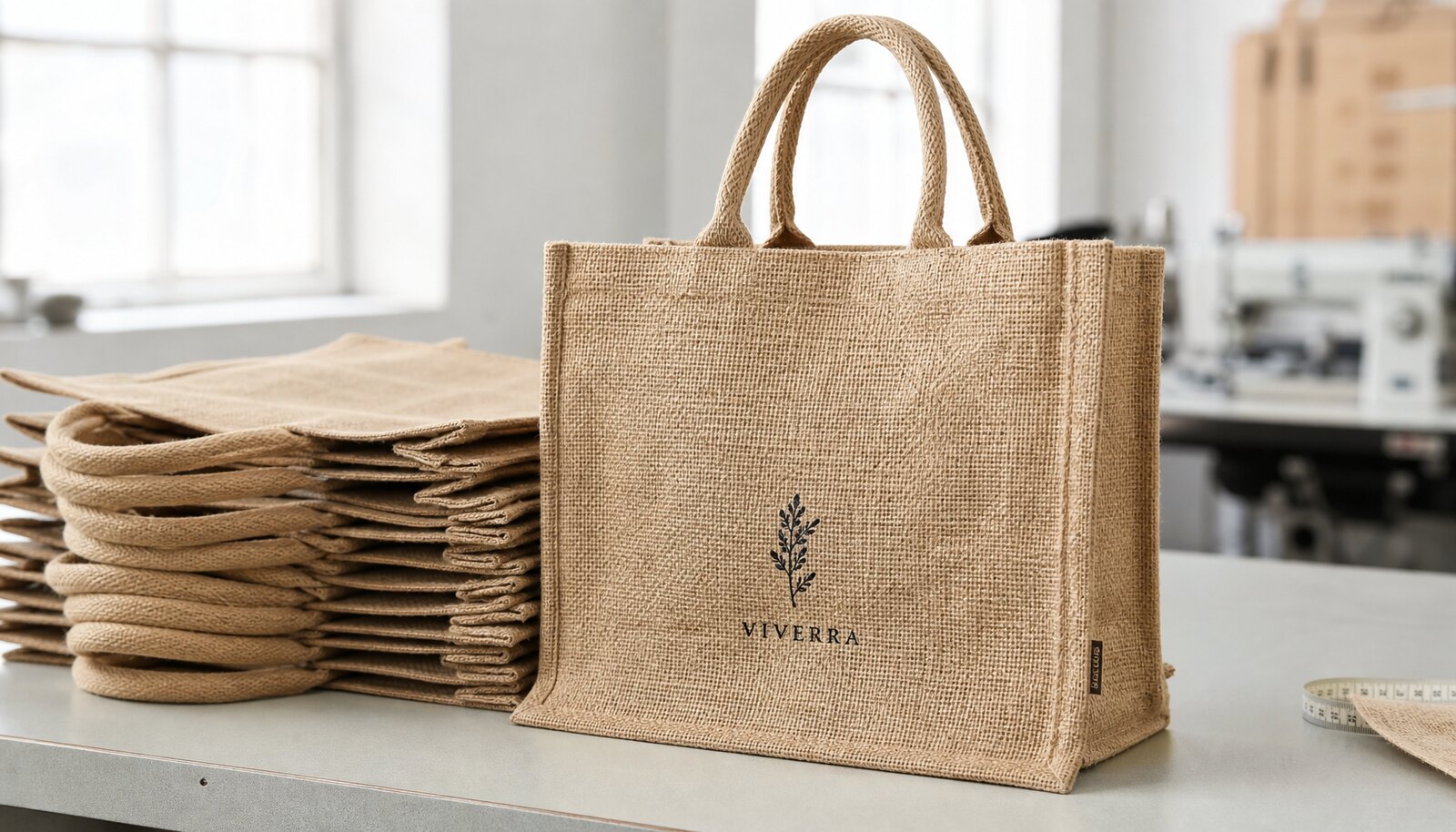
What Buyers Need to Define Before They Request Quotes
Personalized burlap tote bags look simple, but they are easy to mis-buy. Procurement teams are not just buying a natural-looking bag; they are buying a repeatable product that has to hold its shape, carry the right load, present a clean logo, and arrive in the right retail or wholesale pack format. If the request is vague, the supplier will fill in the blanks with its own default build, and the result is usually a quote that is difficult to compare and a bulk order that is easy to dispute.
The first step is to write the use case, not the decoration. A trade-show giveaway has a very different spec from a private label retail tote or a wholesale gift bag. Define the channel, the expected carry weight, whether the bag must stand upright, whether it needs to look rustic or polished, and whether the final packing needs to be retail-ready. Those answers drive the fabric choice, the handle build, the print method, and even the carton configuration. Without them, you are comparing loose ideas instead of sourcing a product.
- State the channel clearly: promotional, wholesale, private label, e-commerce, or in-store retail.
- Define the target carry use in plain terms, such as brochures, produce, bottles, or gift sets.
- Decide whether the bag should feel rustic, structured, or premium before asking for price.
- Treat the decoration method as part of the spec, not as a late-stage branding detail.
Material Choice Sets the Ceiling for Quality
For personalized burlap tote bags, the fabric decision controls the rest of the order. A raw burlap face gives you a lower-cost rustic look, but it sheds more, prints less cleanly, and can pick up wrinkles and odor if storage is poor. A tighter jute weave or laminated build gives the supplier a more stable print surface and usually improves shape retention and retail presentation. If the bag is meant for resale, the cleaner material usually reduces complaints more than it raises unit cost.
The right starting point is not simply "burlap." Ask for the exact fiber or fabric construction, target GSM, weave tightness, and any finish treatment. For lightweight promotional use, a lower GSM may be acceptable if the bag only carries flat items. For private label or wholesale retail programs, a heavier build is usually safer because it supports more consistent stitching, cleaner print edges, and a better handfeel. If the order involves bottles, boxed goods, or e-commerce packing, define the base seam and handle reinforcement at the same time.
- Use a lighter build for handouts, inserts, and event bags where load is modest.
- Use a heavier build when the bag must keep shape or support retail resale value.
- Ask whether the fabric is untreated, laminated, lined, or otherwise finished.
- Request the same material on all visible panels and handle components unless you intentionally approve mixed materials.
Construction Details Matter More Than the Product Photos
A good product photo does not prove a good tote. Buyers need to know how the bag is assembled: seam type, stitch density, handle attachment, gusset shape, edge finishing, and whether the factory reinforces stress points. Those details are what determine whether the bag survives use or only survives the photo shoot. On jute and burlap, the rough surface hides some flaws until the bag is flexed, loaded, or packed in volume.
As a practical sourcing baseline, ask the factory to state the stitch density in a measurable way and to show the reinforcement method at the handle ends. A box-X or bar-tack at the load point is generally easier to defend in QC than a plain seam with no reinforcement. Also ask how the bag is cut. Clean trimming and consistent edge finishing reduce stray fibers, improve packing, and make the logo area look less irregular. If the bag will be sold through a retail chain, the buyer should also check whether the bag can stand flat enough on shelf and whether the gusset opens evenly across the batch.
- Request stitch density and reinforcement details in the quote, not only in the sample approval.
- Ask for close-up photos of the handle end, side seam, and bottom seam before bulk approval.
- Confirm whether the bag is flat, gusseted, boxed, or softly structured.
- Check whether the bag shape stays consistent when empty and when lightly loaded.
Decoration Choices Change Price, MOQ, and Risk
The branding method is not only a cosmetic decision. It affects the quote structure, the MOQ, the setup time, and the defect risk. Screen print is usually the most practical choice for simple one- or two-color artwork at volume. It works best when the logo has bold lines, larger type, and flat color blocks. Heat transfer can help with short runs or frequent artwork changes, but the buyer should test it on the actual fabric because rough burlap can expose cracking, poor adhesion, or edge lift. Woven labels, sewn patches, and embroidery create a more premium private label feel, but they add labor and can make the bag less cost-efficient at lower volumes.
The cleanest sourcing decision is to match artwork complexity to the fabric. If the logo includes fine detail, legal text, or gradients, the buyer should separate the brand system into two layers: a simplified mark on the bag and the full identity on the hangtag, care label, or retail packaging. That avoids over-specifying the print area and lowers the chance that a factory will either quote too high or produce a blurry result. For wholesale programs, the logo should be legible at shelf distance and still look clean after folding, transit, and unpacking.
- Use screen print for standard retail, event, and wholesale runs with simple artwork.
- Use transfer only after testing adhesion, flex durability, and edge quality on the actual burlap.
- Use woven or sewn branding when the tote is part of a premium private label set.
- Keep small text, gradients, and thin lines off the main print unless the supplier proves they can hold them.
Build the RFQ So the Quotes Can Actually Be Compared
A strong RFQ for personalized burlap tote bags should read like a product brief, not a conversation starter. The supplier should be able to answer it without guessing. At minimum, the request should include the bag dimensions, handle length, fabric spec, decoration method, color reference, packing format, carton target, delivery term, and inspection standard. That is what keeps one supplier from quoting a raw promotional bag while another quotes a retail-ready private label tote with extra labor hidden inside the price.
Quotes also need cost separation. If a supplier only gives a single unit price, the buyer cannot see whether the figure includes sample charges, print setup, packaging, carton costs, barcode application, or inland freight. For wholesale and FOB comparisons, ask the factory to separate product price from any non-recurring charges and to state exactly what the quoted term includes. That way, the comparison can be normalized across suppliers and regions. Otherwise the lowest quote may only be the quote that omitted the most cost items.
- Ask for the same quote format from every supplier so line items can be compared directly.
- Separate recurring unit cost from one-time setup fees.
- Require the supplier to name the trade term: EXW, FOB, or another agreed term.
- If the program has multiple variants, ask for pricing by size, print color, and pack format.
MOQ, Price Breaks, and the Real Cost of Customization
MOQ is rarely a simple number. For personalized burlap tote bags, the minimum can change with size, print colors, label type, and packing labor. A factory may offer a lower MOQ on a standard size with one-color print and bulk packing, but require a much larger quantity when the order includes multiple artwork versions, sewn labels, retail hangtags, or individual polybags. Procurement teams should treat MOQ as a pricing rule, not just a production rule.
The more useful question is: which spec choices push the order into a different cost tier? Once that is clear, the buyer can decide where to simplify. Sometimes the best commercial decision is to keep the bag spec fixed and vary only the printed insert or hangtag. Other times, the right move is to standardize the base bag and ask for seasonal artwork changes on a consistent panel size. That approach lowers setup friction, supports reorder continuity, and gives private label teams a cleaner path to scale. It also makes landed cost easier to forecast because the supplier is not repricing the entire build with every artwork update.
- Ask the supplier to show price breaks at multiple volume points, not only at one MOQ.
- Clarify whether MOQ is tied to one size, one color, or one artwork.
- Check whether packaging changes create a hidden MOQ increase.
- Standardize the base tote if the brand expects frequent design refreshes.
Sourcing Route and Trade Terms Shape Both Risk and Control
Direct factory sourcing is usually the strongest option when the buyer needs repeatable wholesale or private label output. It gives better visibility into the actual fabric, sewing line, and print process. A trader or sourcing agent can be useful when the order includes several product types, language variants, or destination-specific packaging, but the buyer should still ask for the underlying factory details. Otherwise the quote becomes a chain of assumptions instead of a specification.
Trade terms matter as much as the sourcing route. An EXW quote may look cheaper at first glance, but it leaves more cost and handling on the buyer's side. An FOB quote often gives a clearer starting point for export comparison because the supplier covers the goods to the port and can usually explain packing and outbound handling more consistently. The key is not to chase the lowest term label. It is to compare like with like and make sure every supplier is quoting the same handoff point, the same carton pack, and the same production scope. That is where procurement teams avoid false savings.
- Use direct factory sourcing when you need tighter QC and reorder consistency.
- Use an agent only if the added coordination value is real and documented.
- Compare EXW to EXW, or FOB to FOB, not a mix of terms.
- Ask who owns the printing, sewing, and packing steps before you approve the order.
Sample Approval Should Prove the Bulk Order, Not Just the Artwork
Sampling for burlap totes should be treated as a process gate. A front-facing mockup or a neat studio photo does not prove that the bulk run will match. Buyers need to review the actual fabric hand, the print on the actual weave, the stitch reinforcement, and the final pack style. If any one of those changes after the sample is approved, the approval should be reopened. Otherwise the bulk order can drift away from the agreed product while still technically matching an outdated sample photo.
A good sample workflow starts with the material swatch, then the sewn sample, then the printed or branded sample, and finally the packed sample. At each step, the buyer should measure the bag, inspect the print placement, and verify the packaging layout. If the order is intended for private label retail, the sample should also show how the brand will appear after folding, stacking, or hanging. This reduces the gap between approval and shelf reality. It also creates a paper trail that is useful if the bulk lot needs correction or chargeback negotiation later.
- Approve the fabric swatch before the factory cuts bulk material.
- Measure the sample against a marked spec sheet with explicit dimensions and placement points.
- Request a revised pre-production sample if the fabric, artwork, or packing changes.
- Keep sample photos, approved swatches, and dated signoff in one buyer file.
QC Controls for Jute and Burlap Programs
QC for burlap and jute should focus on the defects that actually create claims. The obvious ones are size drift, print bleed, weak seams, and mixed shades. The less obvious ones are odor, mildew, loose fiber shedding, and carton deformation after handling. A natural fiber bag does not need to be cosmetically perfect, but it does need a clear acceptance standard so the buyer can defend a reject or accept decision. That standard should be written before production, not improvised after inspection.
For color-related programs, ask the supplier how they will control shade variation across panels, handles, and reorders. If dyed components are involved, define an expectation for colorfastness appropriate to the use case and ask how the factory tests it. For transit risk, require a packing check that includes carton compression, internal movement, and a buyer-defined drop test or handling test based on the shipping mode. If the goods are going through e-commerce or mixed-mode freight, packed-carton durability matters almost as much as the bag itself. Buyers should also look for mold or damp smell after storage simulation because natural fibers can absorb warehouse conditions if cartons are not well sealed.
- Check odor, mildew, and moisture condition when cartons are opened, not only at the factory.
- Require shade control for handles, panels, and any dyed trim or labels.
- Set a clear print registration limit and reject unreadable small text if it was part of the approved artwork.
- Test the packed carton for crush resistance and handling damage before release.
- Inspect a random sample from multiple cartons so one good carton does not hide a bad batch.
Packing, Retail Packaging, and Carton Specs
Packing is part of the commercial spec. For wholesale and promotional orders, bulk packing may be the best fit because it reduces labor and keeps landed cost lower. For private label and retail, the buyer may need individual polybags, barcode stickers, hangtags, tissue, or inserts. Those details should be written into the RFQ because they change both labor and carton density. If the buyer leaves them open, the supplier will usually default to the lowest-effort pack, which can create receiving problems later.
Carton design matters because jute and burlap totes are bulky relative to their value. A few centimeters of oversize can increase freight cost and pallet inefficiency very quickly. Buyers should request the packed carton dimensions, gross weight, and unit count before approving the PO. For export programs, ask whether the factory uses a 5-ply carton or another agreed standard and whether the carton can handle the intended shipping mode. If the bags are being sold retail, it also helps to define how the product should look when the carton is opened: flat, folded, tissue-wrapped, or ready to hang. That is the difference between a carton that merely ships and a carton that supports the brand at receiving.
- State whether each bag needs a polybag, tissue, hangtag, barcode label, or insert.
- Confirm the units per carton and whether mixed sizes or colors are packed together.
- Ask for carton dimensions, gross weight, and pallet count before you compare freight.
- Use buyer warehouse marking rules in the RFQ so the supplier prints the correct shipping marks.
Specification comparison for buyers
| Spec decision | Recommended starting point | When it fits | Buyer risk to check |
|---|---|---|---|
| Sourcing route | Direct factory with in-house sewing and printing | Best for repeat wholesale, private label, and tighter control over bulk matching | Confirm who actually cuts, prints, and packs; trader quotes can hide extra handling and weaken accountability |
| Fabric weight | 260-320 gsm jute or burlap for retail-use totes | Suitable when the bag needs shape, print clarity, and a more finished handfeel | Ask for measured GSM on the approved swatch and allow no more than +/-5% unless you approve a wider band |
| Bag size tolerance | Plus or minus 0.5 cm on height and width; plus or minus 0.25 cm on handle drop for small to mid-size bags | Useful when the bag must fit retail shelves, gift sets, or standardized inserts | Loose tolerances can cause carton inefficiency, uneven shelf presentation, and pack-out issues |
| Stitch construction | 6-8 stitches per inch on load seams, with box-X or bar-tack reinforcement at handle ends | Good for bags that need everyday carry strength or light retail resale | Check that stitch density is consistent across sample and bulk, not only on the front-facing panel |
| Print method | 1-2 color screen print for volume runs; heat transfer for short runs or many variants | Screen print fits standard logo programs; transfer is better when artwork changes often | Set a print registration limit up front, such as within 1-2 mm for simple logos, because rough weave can blur edges |
| Artwork complexity | Bold lines, larger type, and flat colors | Works well on coarse burlap where the weave interrupts fine detail | Avoid hairline strokes, gradients, and small legal text on the main print zone unless the supplier proves legibility on sample |
| Retail packaging | Flat-packed with tissue, barcode sticker, and hangtag when retail-ready; bulk packed for promotional use | Choose based on whether the channel is e-commerce, wholesale, or event giveaway | Confirm carton count, inner pack count, and whether each bag needs a polybag or dust protection |
| Carton spec | 5-ply export carton, clear shipping marks, and gross weight kept within the buyer's warehouse limit | Useful when cartons move through distribution centers or are export-shipped by sea or air | Request carton dimensions, gross weight, and pallet count before PO approval so freight math is not guessed |
| Odor and fiber control | No strong chemical odor, visible mildew, or excessive loose fiber at pack-out | Important for retail, private label, and indoor promotional use | Check odor after unpacking and after short storage because natural fibers can hold smell if storage is poor |
Buyer checklist before sampling
- Confirm exact bag size, gusset, handle length, and target load weight before requesting quotes.
- State the material as jute, burlap, or laminated burlap with a target GSM and finish, not just "natural tote".
- Attach vector artwork, Pantone targets, and a placement drawing with print size in millimeters.
- Define the required sample stage: fabric swatch, sewn pre-production sample, printed sample, or photo approval only.
- Specify packing method, carton count, shipping mark style, and whether barcode labels, hangtags, or retail inserts are needed.
- Ask for a quote that separates bag body, decoration setup, packaging, carton cost, inland transport, and export terms.
- State acceptable tolerance for size, print alignment, color variation, stitch density, and handle placement.
- Request bulk photos or a short video of the first production lot before shipment if the order is time-sensitive.
- Ask whether the price is quoted EXW, FOB, or another term, and compare the same term across suppliers.
- Require confirmation on odor, mildew, loose fiber, and packed-carton condition before final payment if the order is retail-facing.
Factory quote questions to send
- What exact fabric weight, weave style, and finish will you use, and can you share a swatch photo or close-up with measured GSM?
- Is the logo printed, woven, sewn, or applied as a label in your quoted price, and what setup fee applies to each method?
- What is your MOQ by size and by print color, and how does the price change at different quantity breaks?
- Can you separate unit price from sample charge, plate fee, packaging fee, carton cost, and any inland handling cost?
- What size tolerance, stitch density, and print registration limit do you accept during production and final inspection?
- How many days do you need for sampling, bulk production, and final inspection after artwork approval?
- What packing configuration is included by default, and what is the cost impact of polybags, inserts, barcode labels, or hangtags?
- Do you quote EXW, FOB, or another trade term, and what is included at that term?
- If artwork changes after sampling, what additional cost or lead-time penalty should we expect?
- What checks do you use for odor, mildew, loose fiber, and carton compression before shipment?
Quality-control points to confirm
- Check fabric GSM and weave consistency against the approved swatch, especially on body panels, gussets, and handle tape.
- Measure bag width, height, gusset depth, and handle drop on a random carton sample and compare with the approved spec sheet.
- Inspect print registration, ink opacity, and edge bleed on the rough fabric surface under normal light and at a short viewing distance.
- Require a colorfastness check suitable for the intended use if the bag has dyed components, printed panels, or colored handles.
- Verify that stitch density, bar-tacks, and box-X reinforcement are present at every load point, not only on selected samples.
- Test handle and side-seam strength with a load close to the intended use case, then inspect for seam slippage or distortion.
- Check for loose fibers, oil marks, mildew smell, discoloration, glue residue, and broken threads before carton sealing.
- Inspect packed cartons for compression damage, corner crush, and internal shifting after a transit-style handling check.
- Confirm carton labeling, inner pack count, barcode placement, and shipping marks match the buyer's warehouse requirements.
- Reject mixed shades, mixed handle materials, or mixed print placement within the same order unless those variants were approved in advance.