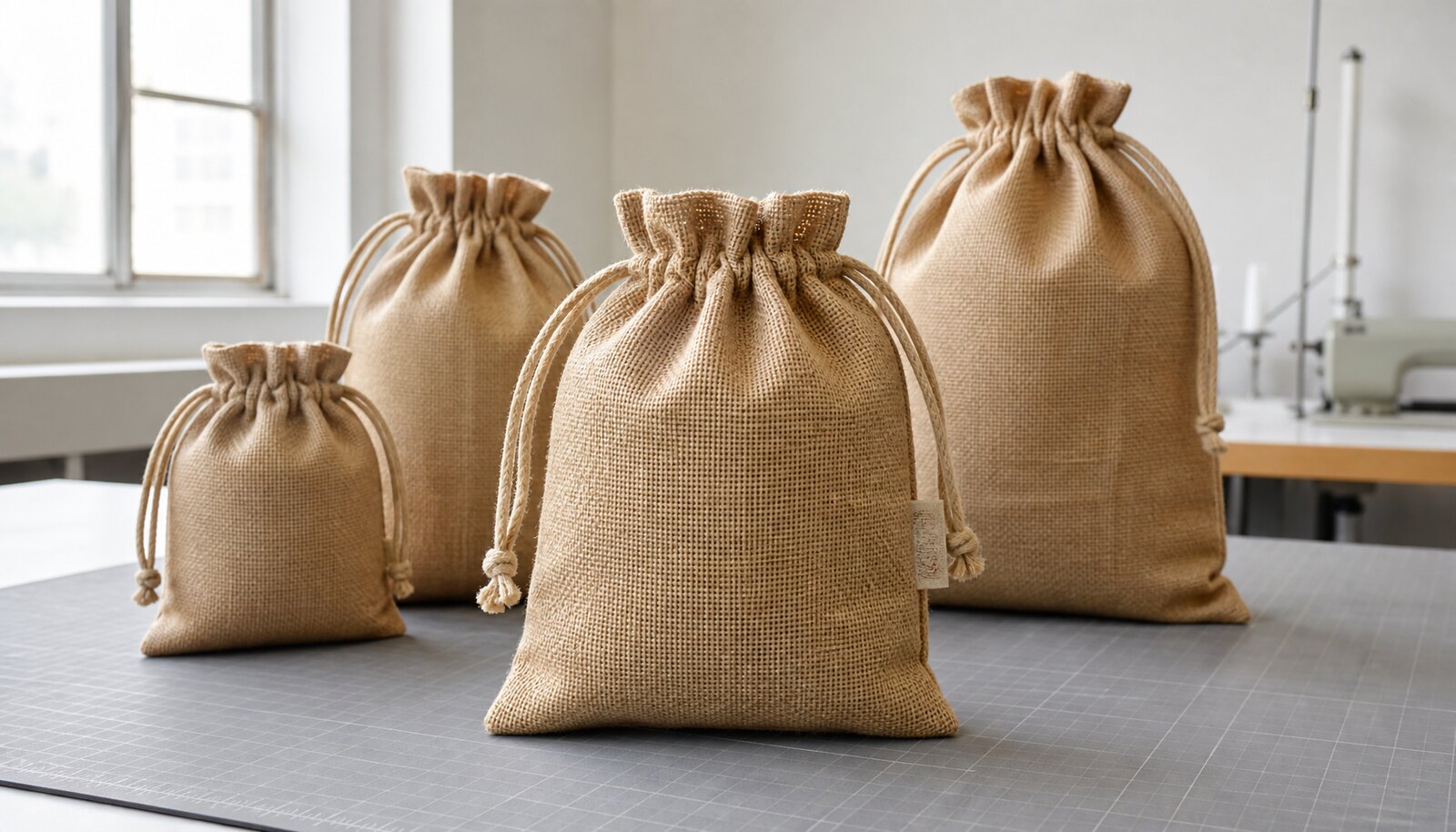
What buyers should define before requesting quotes
Personalized burlap gift bags look simple, but the price and production result change fast when the spec is vague. A buyer should start with the end use: is the bag meant for a single bottle, a cosmetic set, a seasonal retail gift, or an event giveaway that must look rustic but still present well on shelf? Once that use case is fixed, the factory can size the bag correctly and choose whether the bag needs lining, a drawstring, a flat bottom, or a reinforced opening. Without that context, suppliers will quote different constructions and the lowest number will usually be the least useful one.
For RFQs, the most useful spec sheet is not long, but it is exact. State the finished size, fabric type, target GSM, decoration method, closure style, and packaging format. Add one reference image for look and one for function if possible. If you only send a logo and the phrase personalized burlap gift bags, you invite variation in weave, print size, and bag structure. Buyers who want clean comparisons should force every supplier to answer the same question set and quote the same production basis.
- Define the product by use case first, not by color or print alone.
- Write one finished size and one tolerance range for all quotes.
- Separate the bag itself from optional retail packaging so the quote is easier to compare.
Burlap, jute, and lining choices that change the result
In sourcing language, burlap usually means a jute-based fabric, but not every burlap bag feels the same. The open weave gives the rustic look buyers want, yet the same weave can shed fibers, show print bleeding, or collapse if the fabric is too light. For most reusable gift bags, a practical range is about 240-300 GSM. Lighter fabric can work for soft items and short-term events, while heavier fabric gives more body and better shelf appearance. If the bag must hold a harder product or survive repeated use, the factory may need a tighter weave or a jute-cotton blend rather than plain loose burlap.
Lining is the other decision that changes both quality and cost. An unlined bag is fine when the contents are dry, bulky, and not easily scratched. Once you pack candles, glass jars, cosmetics, or jewelry, a lining becomes a problem-solver, not an upgrade. Cotton or poly-cotton lining improves hand feel, reduces shedding, and helps the bag hold shape. It also changes the sewing process, which affects MOQ and lead time. Buyers often compare only outer fabric cost and miss the fact that lining can reduce returns, improve perceived value, and make print look cleaner from the outside.
- Use 240-300 GSM as a practical starting range for most gift bag programs.
- Choose lining when the contents are delicate, premium, or sensitive to fiber shedding.
- Ask for a fabric swatch and a sewn sample, because the woven texture changes print clarity.
Print method and branding limits on rough burlap
Burlap is not a smooth print surface. The weave can swallow thin lines, make small text fuzzy, and create uneven ink coverage if the method is wrong. For simple logos, one- or two-color screen print is usually the most reliable factory route. It is cost-effective, repeatable, and easier to control on a textured surface. If the brand wants a more durable or premium presentation, a woven label, stitched patch, or sewn side label can be more consistent than trying to print fine detail directly onto the weave. Buyers should not assume digital decoration is automatically better just because the artwork is complex; on burlap, the substrate often limits the finish more than the printer does.
The quote should state the exact artwork size, number of colors, and whether the supplier will use a white underbase. That matters because burlap is dark and irregular, so a light logo may need extra ink layers or a different process to stay legible. Also define the accepted variation in registration and edge crispness. For retail packaging, a logo that looks acceptable at arm's length is not the same as one that holds up in product photography. If the bag is intended for repeat promotions, ask the factory which method has the lowest reprint risk after washing, abrasion, or warehouse handling.
- Use screen print for simple branding and predictable repeat production.
- Use a woven or stitched label when fine detail or long wear matters more than a flat print.
- State minimum line thickness and logo clear space so the factory can reject artwork that will fail on burlap.
Size, structure, and closure choices for different gift sets
A bag that looks right in a catalog may fail in packing because the internal volume is wrong. Personalization does not solve structure. Buyers should choose size based on the packed product, not on the gift itself. A flat cosmetic set needs a different gusset depth than a bottle or jar set. If the bag is too shallow, it bulges at the seam and the logo distorts. If it is too large, the item shifts and the bag looks underfilled. A well-written RFQ should include the product dimensions the bag must hold, plus the acceptable level of slack or fill.
Closure style also changes function. A drawstring is the standard choice for a rustic gift bag, but the channel must be reinforced or it will tear once the customer pulls it open and closed several times. Tie loops are useful for decorative gifting, while an open-top pouch may work better for display packs or inserts. If the bag is meant to move through retail and then through the end customer's home, the closure should be tested as part of the sample approval, not treated as a visual detail. Many buyer complaints start with the opening rather than the print.
- Size the bag around the actual contents, not around a guessed gift category.
- Require the factory to show seam and gusset measurements on the sample sheet.
- Test the closure with a loaded sample, because empty-bag fit means very little.
Sourcing routes and MOQ logic buyers should compare
For personalized burlap gift bags, the sourcing route matters as much as the spec. A direct factory is usually the best option when you need control over fabric, stitching, and repeat ordering. It is also the right route when the bag is part of a larger packaging program and the buyer can manage sample approval on a normal production timeline. Trading companies can help when the order is fragmented across categories or when the team wants a single point of contact, but the buyer should understand that margin and process control are both layered into the quote. Domestic decorators or assemblers are useful for urgent launches, low volumes, or market tests, but the same bag often costs more because the material and labor base is different.
MOQ should not be treated as a single number. It is usually driven by fabric roll usage, print setup, cutting efficiency, and packing labor. A simple stock-size bag with one-color print may have a lower MOQ than a custom-size bag with lining, but a buyer can sometimes reduce risk by keeping the size standard and changing only the logo or insert. The useful question is not what is the lowest MOQ, but what spec change pushes the order into a new cost tier. Ask the supplier to explain the breakpoints by artwork, size, and packaging so you can plan the first run and the reorder path.
- Use a direct factory when custom control and repeatability matter most.
- Use a trading company only if the coordination value is real enough to justify the markup.
- Treat MOQ as a cost threshold, not a marketing answer.
How to read a factory quote line by line
A clean factory quote should let you compare apples to apples. Start by identifying the commercial term. Ex-works, FOB, and DDP are not interchangeable, and buyers sometimes compare quotes that already include very different cost buckets. Next, isolate the spec items that change the unit price: GSM, lining, print color count, size, closure, and packaging. A quote that looks cheaper may simply exclude the inner bag, label, or carton mark. If the supplier cannot tell you what is included, the number is not ready for procurement.
The next layer is process risk. Ask whether the quote includes a pre-production sample, whether the bulk fabric will match the sample fabric, and whether the print method is the same as the hand sample. Also watch for terms like similar, approximate, or final price after approval. Those phrases are not wrong, but they signal that the buyer has not fixed the spec tightly enough. For a practical comparison, you need the factory to quote the same tech pack, the same packaging, and the same loading basis. Only then can you evaluate landed cost rather than a placeholder unit price.
- Separate the commercial term from the product price before comparing suppliers.
- Make sure the sample method and the bulk method are the same.
- Reject quotes that rely on vague exclusions for packaging, labels, or carton packing.
Sample approval and QC thresholds that prevent avoidable rejects
The sample is not just a sales sample. For burlap, it is the control standard for weave, print clarity, seam behavior, and bag shape. Buyers should approve the pre-production sample only after measuring the finished dimensions and checking the bag under load. The important thing is not whether the sample looks rustic; it is whether the logo sits where it should, the stitching is straight, and the bag closes properly when filled. If the sample is approved with loose tolerances, the bulk run will inherit those same weaknesses.
Practical QC thresholds help the inspector make a decision quickly. For many programs, a size tolerance around plus or minus 0.5 to 1 cm is workable, depending on bag size. Stitch density should be consistent and the seam should not open when the bag is filled to normal use level. Print should not rub off under ordinary handling, and the logo should remain legible at the viewing distance you expect in retail. If the order is for a brand launch, the buyer should treat odor, loose threads, and fiber shedding as real quality issues, not cosmetic noise.
- Approve one physical sample as the production benchmark, not a sales sample only.
- Measure loaded performance, not just empty-bag appearance.
- Set written acceptance criteria for print placement, stitch quality, and odor.
Packing, labeling, and retail readiness
Packing can make a good bag look careless by the time it reaches the shelf. Burlap bags should be packed so the weave is not crushed and the drawstring does not snag. For bulk shipments, the factory should state the inner pack count and master carton count, plus whether the bags are folded flat or lightly nested. If the product is intended for retail, ask for individual polybags, barcode stickers, or hangtags only if they are truly needed, because every added layer affects labor, carton volume, and handling time. A buyer trying to save money on the bag itself can lose that saving in packing errors later.
Labeling also needs to support warehouse and retail operations. Carton marks should include the SKU, size, color, quantity, and gross and net weights so the receiving team can count quickly. If the brand uses multiple sizes or colors, ask the factory to separate them by carton rather than mixing variants unless mixed packing is part of the plan. Mixed cartons look efficient on paper but often create receiving errors. For imported retail programs, a small packaging decision can affect pallet build, container utilization, and damage risk more than the bag price itself.
- Choose folding and carton counts that preserve the bag shape.
- Do not add retail pack items unless they are part of the selling plan.
- Keep SKU labels and carton marks consistent with the buyer's warehouse system.
Lead time, freight, and landed-cost comparison
Lead time for personalized burlap gift bags usually has two parts: sample time and bulk time. A straightforward sample may take about one to two weeks depending on artwork and material readiness, while bulk production often takes several weeks after sample approval and deposit. The real schedule risk is not only sewing time; it is fabric confirmation, print setup, and packing approval. Buyers who compress the front end often create a late-stage bottleneck that forces air freight or a rushed shipment, which destroys the original unit-cost advantage. Plan the order around approval gates, not just around a promised production window.
Freight matters because burlap is light but bulky. That means volume can matter as much as weight, especially if the bags are lined, boxed, or packed with retail inserts. A quote that looks acceptable at ex-works can change once carton size, master pack count, and pallet pattern are added. To compare landed cost properly, ask for the carton dimensions, carton weight, and estimated loading plan. A slightly higher unit price can still win if the packaging is tighter and the freight footprint is smaller. This is where procurement teams save money: not by chasing the cheapest bag, but by comparing the whole shipment profile.
- Build schedule around sample approval, not around the first promised ship date.
- Check carton dimensions early because burlap bags can be volume-heavy.
- Compare total landed cost, including packing and freight impact, before choosing a supplier.
Specification comparison for buyers
| Spec decision | Recommended option | When it fits | Buyer risk to check |
|---|---|---|---|
| Fabric weight | 240-300 GSM burlap or jute blend for most gift bags | Retail gifts, event sets, and reusable packaging that needs shape | Too light looks flimsy; too heavy can fray more and raise freight cost |
| Lining | Cotton or poly-cotton lining when contents are delicate | Candles, cosmetics, jewelry, or premium gift kits | Unlined burlap can shed fibers and scratch packed items |
| Print method | 1-2 color screen print for simple logos; woven or stitched label for longer wear | Medium-volume orders with stable artwork | Fine text can fill in on rough burlap weave; white ink may need underbase |
| Artwork placement | Centered artwork with clear margin from seams and drawstring channel | Standard retail or promotional bags | Logo distortion happens when print area is too close to seams or folds |
| Closure type | Drawstring with reinforced channel or stitched tie loops | Reusable gift packaging and easy open-close use | Weak channel stitching can tear at the pull points |
| Direct factory | Best for custom size, fabric, and repeat orders with stable forecast | Annual programs and buyers who can approve samples on schedule | Spec gaps create quote disputes; require a written tech pack |
| Trading company | Useful for mixed product sourcing or buyers without in-house QC in Asia | Small teams managing several packaging SKUs | Markup can hide the true factory cost and reduce process control |
| Domestic decorator or assembler | Good for urgent regional launches or very low MOQ tests | Short runs, local fulfillment, or first-market trials | Unit cost is usually higher and burlap options may be limited |
Buyer checklist before sampling
- Lock the finished size, seam allowance, and acceptable tolerance before asking for prices.
- Specify fabric type, target GSM, and whether the bag is unlined, lined, or reinforced.
- Send vector artwork, one-color and multi-color versions, and exact Pantone references if color matters.
- State the closure style, cord length, and whether the opening must stay fully closed after loading.
- Define the pack format: bulk, individual polybag, barcode sticker, insert card, or retail hangtag.
- Ask for the MOQ by size, artwork, and color so you can see where the real cost break is.
- Request sample photos and a pre-production sample before bulk cutting begins.
- Confirm the quote term, lead time, carton pack count, and what is excluded from the unit price.
Factory quote questions to send
- What exact fabric is being quoted, including GSM, weave density, and whether the burlap is laminated or plain?
- Is the price based on ex-works, FOB, or DDP, and which charges are excluded from the unit price?
- What is the MOQ per size, per artwork, and per color, and can the MOQ be split across variants?
- Which print method will you use, and what are the limits on line thickness, small text, and color count?
- Will you make a pre-production sample from the same material and print method as bulk production?
- What stitching standard, seam allowance, and pull-strength target do you use for this bag style?
- How will the bags be packed per inner pack and per carton, and can carton marks or barcodes be added?
- What is the production lead time after sample approval and deposit, and what usually causes delay?
- Can you show previous size measurements, QC records, or inspection photos for a similar bag?
- If the quote is revised later, what changes trigger the revision: artwork, fabric, packaging, or carton loading?
Quality-control points to confirm
- Measure finished size, handle length, and drawstring opening against the approved spec sheet.
- Check fabric GSM, weave consistency, and fiber shedding across the whole batch, not just the first sample.
- Inspect seam strength at corners, channel ends, and any stress points where the cord or handle is anchored.
- Verify logo placement, registration, ink coverage, and color contrast on the rough burlap surface.
- Perform a basic pull test on drawstrings, tie loops, or handles to see if the channel tears or stretches.
- Open random bags and confirm there is no strong odor, staining, oil mark, or loose thread contamination.
- Count inner packs and master cartons, then check labels, carton marks, and barcode accuracy.
- Review one sealed carton for crushing risk, because burlap bags lose retail appearance if packed too tightly.