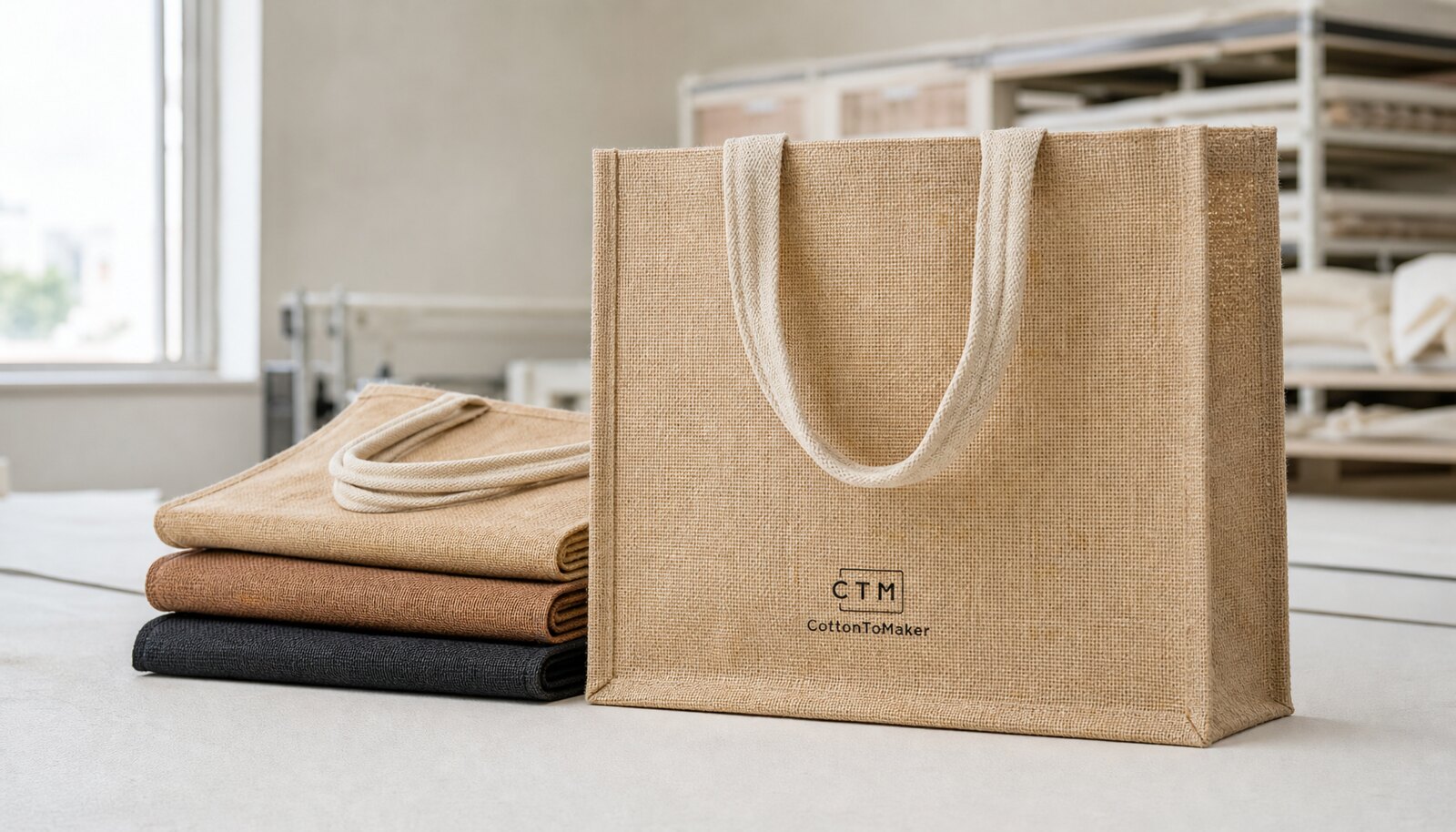
Why the spec matters more than the phrase on the RFQ
Personalized burlap bags often appear simple from the outside: a natural-fiber body, a branded mark, and a handle. That simplicity is exactly why sourcing errors happen. Burlap, or jute-based fabric in many supply chains, is visually forgiving in a way that can hide weak specs during quoting. The bag may look acceptable in a quick photo, but once it enters production, open weave, fiber variation, and sewing behavior can change the result more than many buyers expect.
For procurement teams, the buying question is not whether the bag looks rustic or on-brand. The real question is whether the product can be specified tightly enough to compare suppliers on equal terms. If the RFQ only says “personalized burlap bag with logo,” every supplier fills in the blanks differently. One may assume a light promotional bag with simple print and loose tolerance. Another may quote a structured retail bag with reinforced handles and cleaner packing. Those are not comparable products, even if the outside description sounds the same.
A useful spec treats the bag like a working component of your supply chain. It should define where the bag will be used, how much it must carry, how long it needs to last, and what level of cosmetic variation is acceptable. That matters if the bags are part of retail packaging, event merchandising, gift sets, or resale. In those settings, the bag is not just a container; it is part of the customer-facing product experience.
The practical takeaway is simple: the more commercial value the bag carries, the more the RFQ should read like a product specification and less like a request for a generic promotional item. That improves quote accuracy, reduces sample revisions, and gives procurement a better base for landed-cost comparison.
It also creates a fairer supplier review. If you ask one factory to quote a rustic giveaway item and another to quote a shelf-ready branded accessory, the price gap tells you very little. If you ask both to quote the same construction, same packing, and same inspection standard, the result is far more useful for sourcing.
Think of the spec as a risk filter. It removes ambiguity before the factory starts spending time on your order and before your team starts comparing numbers that do not mean the same thing.
- Use finished dimensions, not raw cut size, in the RFQ.
- State whether the bag is for retail sale, gifting, events, product resale, or protective packaging.
- Define the first-use scenario: carry weight, shelf display, shipping presentation, or repeated reuse.
Choose construction first, then ask for price
Fabric weight is usually the first construction decision that changes both appearance and cost. For personalized burlap bags, a practical buyer range is often around 260–320 GSM, with heavier builds used when the bag must stand up better, carry more weight, or feel more substantial in hand. Treat that as a sourcing starting point, not a universal standard. Ask how the supplier measures GSM and whether the number refers to base fabric only or finished material after any backing or lamination.
Construction details matter just as much as the GSM number. An unlined open-top bag with self-fabric handles is a very different product from a cotton-lined, zipper-top retail bag with a branded patch and reinforced base. If you do not separate those options in the RFQ, the supplier may quote the cheapest build possible and still be technically correct. That can look attractive on paper while creating issues in use, especially if the bag will be handled frequently or sold at retail.
The buyer should also think about hand feel and shape retention. Burlap can look intentionally rustic, but a product that wrinkles too easily, slumps on shelf, or sheds loose fibers can undermine the brand presentation. A slightly heavier fabric, better seam control, or a simple lining can improve perceived quality. The tradeoff is cost, sewing time, and sometimes freight weight. Procurement teams should decide early whether the goal is lowest acceptable cost or a more retail-ready appearance.
Handle structure deserves the same attention. Self-fabric handles can be cost-effective and visually consistent, but cotton webbing handles may perform better if the bag is expected to hold heavier items or survive repeated use. Reinforcement at the handle joint is often the difference between a passing sample and a problematic bulk run. In other words, the best construction is not the most expensive one; it is the one matched to load, use case, and target margin.
If the bag will be used in a gift set or by a retailer with a stricter visual standard, ask the supplier what change in construction gives the biggest improvement for the smallest cost increase. That question often reveals whether the factory understands commercial tradeoffs or only sells by thickness and size.
A quick material check should also include the feel of the weave, edge fraying, and any coating or backing used to stabilize the fabric. Those details can affect print clarity, folding behavior, and whether the bag presents as casual or premium once it reaches the shelf.
- 260–280 GSM: often suitable for light retail gifting and seasonal promotions.
- 280–320 GSM: a common balance point for structure, cost, and print stability.
- 320 GSM and above: useful for premium retail or heavier contents, but check sewing efficiency and freight weight.
- Ask whether the finished bag includes backing, lamination, or lining that changes the feel and the quote.
Printing on burlap: how to keep brand marks readable
Printing on a coarse natural weave is very different from printing on smooth cotton or coated polyester. The open structure of burlap can break thin strokes, soften small text, and create uneven ink coverage if the artwork is too detailed. That is why the most reliable personalized burlap bags typically use bold logos, short brand marks, simple iconography, or limited text. When the design is forced beyond what the fabric can clearly support, the print may look acceptable in a digital proof but fail in actual production.
For most buyer programs, one- or two-color screen print remains the most practical option because it is economical, repeatable, and relatively durable when the artwork is simple. If the design requires tiny text, gradients, or photographic detail, weigh the risk of lost legibility against the marketing value of the artwork. In some cases, a woven label, sewn patch, or transfer print is the better commercial choice, even if it changes the look of the bag. A premium retail program often benefits more from clear brand recognition than from forcing every visual detail into a rough substrate.
The best procurement practice is to tie print expectations to the actual fabric lot. A smooth demo panel can produce misleadingly sharp results, while the production fabric may be looser, darker, or more textured. Ask for a sample made on the same material and the same print setup that will be used in mass production. If the supplier changes ink density, print placement, or the weave type after approval, the product can drift quickly. That is why sample sign-off should include both visual acceptance and process acceptance.
Durability is another point buyers should not gloss over. A burlap bag may not be washed often, but it will be folded, stacked, shipped, and handled. Print durability should therefore be judged not only on initial appearance but also on rub resistance and handling wear. The factory does not need to provide a laboratory claim to make this useful; it does need an internal method and a repeatable standard that can be explained before shipment.
If your artwork has a very thin line or a small text lockup, ask the supplier to recommend the minimum safe line weight and character height for that fabric. That is often more useful than a blanket promise that “the logo will be clear.”
Buyers should also confirm print location with a drawing or marked photo. It prevents small but costly drifts such as a logo printed too low, too close to a seam, or scaled down during production.
- Screen print: best for solid logos, short slogans, and repeat orders.
- Transfer print: useful for more detailed artwork, but confirm abrasion resistance before approval.
- Woven label or sewn patch: better for premium branding and lower visual risk on coarse fabric.
- Ask for a print location drawing so the supplier cannot shift the logo higher, lower, or smaller than approved.
How to compare supplier quotes without comparing the wrong thing
A quote for personalized burlap bags is only useful if every supplier is quoting the same product. That sounds obvious, but in practice it is where many procurement teams get misled. The most common issue is hidden spec drift: one supplier quotes a bag without lining, another includes lining; one includes one-sided print only, another assumes double-sided branding; one gives an ex-factory price, another adds cartons or local transport. If the quote structure is not normalized, the lowest price may not represent the best value.
A strong comparison separates the quote into its component parts: raw material, cutting and sewing labor, printing, trimming, lining or closure cost, packing, tooling, and shipping basis. This matters because it reveals what changes with volume and what does not. For example, a higher setup cost may be acceptable if the unit price improves substantially at 5,000 or 10,000 pieces. But if the setup charge is high and the unit price barely moves, the supplier may be charging for complexity without offering production efficiency.
Buyers should also ask whether the supplier is quoting directly from the factory or through a trading company. Trading intermediaries can be useful when a program needs multiple product categories or consolidated buying, but they can also obscure who actually makes the bag and who owns the quality responsibility. If the bag is a key brand item, it is worth knowing whether sewing, printing, packing, and inspection are all handled in one place or split among subcontractors. The more handoffs involved, the more difficult it becomes to isolate a defect later.
Another practical comparison point is pricing by future reorder, not only by the first order. Many buyers focus on the launch quantity and forget that the real commercial value often appears on the second and third buy. Ask the supplier whether screens, patterns, and carton specs can be reused and whether a reorder avoids new setup charges. For branded programs, a supplier that can repeat the same build cleanly is often more valuable than a slightly cheaper source that cannot hold consistency.
You should also test the quote against landed-cost realities. A lower factory price can lose once you add stronger cartons, inner protection, inspection fees, rework allowance, or a higher freight cube. If the product is bulky, packing efficiency can change the final cost more than the bag price itself. Buyers who model the total shipment cost usually make better decisions than buyers who stop at the unit quote.
When quotes differ by more than expected, ask the supplier to explain the delta line by line. Good suppliers can usually show where the cost sits. Weak quoting behavior often becomes obvious at that stage.
- Compare like-for-like: same GSM, same size, same print count, same handle, same pack.
- Separate one-time charges from recurring unit cost.
- Ask for price tiers at your likely reorder volume, not only at the initial trial order.
- Confirm the quotation basis: EXW, FOB, or another Incoterm, so freight assumptions do not distort the comparison.
Factory, trading company, or hybrid sourcing: what changes in real buying
The best sourcing route for personalized burlap bags depends on program complexity, order frequency, and how much control the buyer needs over production details. A direct factory usually offers stronger control over sewing, print, and packing because the buyer can trace responsibility more cleanly. That is often the better fit for repeat orders, branded retail programs, and private-label packaging where consistency matters as much as cost. A trading company can still be useful if the buyer needs multi-category consolidation, smaller operational workload, or access to several product types under one commercial contact.
The important nuance is that sourcing route affects not just price but accountability. A trading company may quote a complete package, but the actual sewing, printing, and packing may be split across different workshops. That can be workable if the spec is simple and the supplier manages quality well. It is less ideal when the bag has custom lining, mixed trims, special closures, or tightly controlled branding. The more complex the build, the more useful it is to know exactly where the product is made and who signs off on the final lot.
For procurement teams, the decision should be based on a few concrete questions: Who owns the fabric? Who prints the logo? Who checks dimensions? Who reworks defects? Who is responsible if the bags are off-size or the print is faint? If the answer is unclear, the route may be too indirect for a high-control retail program. If the answer is clear and documented, a trading route may still be viable, especially when the buying team prioritizes convenience or consolidation over direct plant access.
A mixed approach can also work. Some buyers source the bag body directly from a factory while using a local or regional service provider for final labeling, barcode application, or retail packing. That can make sense when a destination market has specific label rules or when the buyer wants the supplier to manage only the core bag production. The key is to avoid fragmentation without ownership. The more separated the steps are, the more important it is to define responsibility in writing before production begins.
Region can matter too. Jute supply is concentrated in South Asia, and factories in that ecosystem may offer stronger familiarity with raw jute behavior, weaving options, and standard finishing methods. That does not automatically make one region better, but it does mean the buyer should ask how the supplier sources fiber, whether they keep stable lot records, and how they handle seasonality or material substitutions. Those are practical verification steps, not marketing claims.
The best route is the one that matches order value, repeatability needs, and your tolerance for coordination effort. For a single low-complexity promotion, convenience may outweigh direct control. For a recurring retail SKU, direct accountability usually matters more.
- Direct factory: best when cost control, repeatability, and production accountability matter most.
- Trading company: useful when you need consolidation, broader catalog support, or a single commercial contact.
- Mixed sourcing: workable if the buyer has clear ownership of artwork, labels, and final pack standards.
- Ask who actually manufactures, who inspects, and who is responsible for rework if the first run misses the approved sample.
MOQ, sample strategy, and why the smallest order is not always the safest pilot
MOQ on personalized burlap bags is usually driven by setup labor, print preparation, cutting efficiency, and packing flow. Buyers sometimes assume that a lower minimum order quantity is automatically safer for a first buy, but that is not always true. A very small order can hide production behavior. The factory may switch operators, simplify packing, or use a less representative material batch to make the order work economically. That can make the first shipment look acceptable while the reorder exposes consistency problems.
From a procurement point of view, the goal is not to buy the smallest possible quantity. The goal is to buy enough pieces to validate production stability, packaging, and market response without overcommitting stock. For simple single-color bags, 500 to 1,000 pieces per design may be enough for a pilot if the supplier is stable and the use case is low risk. For a bag with lining, special closure, or premium print placement, the pilot should be large enough to prove the full production flow, not just the sample room version of it.
A good sample plan has more than one decision point. First, request a pre-production sample that uses the intended fabric, print method, handle, and packing style. Second, compare that sample to the approved artwork file and measurement sheet. Third, if the order is large enough, ask for a production reference sample or photo before the line is released. This is especially useful when the supplier is managing multiple variants or when the bag is part of a launch with fixed timing.
Buyers should also make the order size match the commercial reality of the product. If the bag will be used in a seasonal event or one-time promotion, a lower MOQ may be reasonable even if the unit price is not ideal. If the bag will be sold as a retail SKU or repeated across multiple locations, it is often better to specify a slightly more efficient order size so the factory can run the job properly. In burlap sourcing, the cheapest first order is not always the best procurement decision; the order that proves repeatability is often the better one.
Ask the supplier what cost element is sensitive to order size. Sometimes the answer is print setup; sometimes it is cutting waste; sometimes it is packing labor. That answer tells you where the real economics sit and helps you decide whether to increase quantity or simplify the construction.
A strong pilot order should also reflect the reorder path. If the sample order uses one finish, but the scale order requires another, the pilot may not teach you much. Build the pilot so it is representative of the commercial version, not just the cheapest possible version.
- Lower MOQ often means higher unit price and less leverage on packing efficiency.
- Complex construction raises MOQ faster than simple print changes.
- Reorder cost improves when screens, cutting patterns, and carton specs can be reused.
- Ask whether the sample cost is refundable against the first bulk order, and under what conditions.
What to inspect in samples before you approve mass production
The sample is the buyer’s best chance to prevent avoidable production loss. It should be treated as a control document, not a showroom prop. For personalized burlap bags, the sample needs to prove that the fabric, print, stitching, and packing all work together. A bag can look attractive in a close-up photo yet still fail in mass production if the seams are too weak, the print is too fine, or the fold pattern damages the branding. That is why sample approval should be structured around the product’s end use, not just aesthetics.
Start with the visible basics: confirm the exact dimensions, the logo placement, the number of colors, and the print intensity on the real material. Then move into build checks. Measure handle drop on both sides, inspect the bottom seam and side seams, and look for loose threads or skipped stitches. If the bag has a lining or closure, open and close it several times and check whether the interior finish interferes with the function. If the bag is meant for retail, place it on a shelf or display surface to see whether it stands, slumps, or wrinkles in a way that changes the perception of value.
Then check the packaging path. The way a burlap bag is folded can affect crease marks, print damage, and warehouse receiving quality. A sample that arrives in perfect shape but cannot be packed efficiently is not ready for bulk. Ask for the same folding method, carton count, and protective insert method that will be used in shipment. If the supplier cannot show that, the sample approval is incomplete.
For high-value programs, it helps to create a short acceptance record. Record the sample version, date, measurements, material note, print note, and who approved it. That way if the factory later claims the bulk order was made to a different revision, you have a clean reference. This is simple paperwork, but it saves time when procurement, QA, and logistics all need to review the same order history.
If the artwork has small text, request an enlarged production proof and a note on the smallest readable character size. This is especially useful on coarse weave, where an image can look crisp on screen and soften once ink meets the fabric. It is better to reject a weak design early than to discover too late that the logo reads as a blotch from arm’s length.
If the sample is close but not perfect, do not approve it casually. Ask the supplier to revise one issue at a time and resubmit. That makes the final bulk approval more defensible and reduces the chance that several minor adjustments create a bigger production error.
Keep one signed sample on file with a photo set and measurement sheet. That record becomes the standard if there is disagreement later over color tone, placement, or fold method.
- Confirm print alignment, ink coverage, and readability at normal viewing distance.
- Measure dimensions after the sample has been folded and unpacked once.
- Load-test the handles with an actual product weight, not just hand pressure.
- Keep a sample approval sheet with version number, date, and sign-off name.
QC that a B2B buyer can actually use
A useful QC plan for personalized burlap bags should define what is acceptable, what is not, and when each check happens. Industrial procurement works better when quality terms are tied to measurable criteria. Start by separating defects into three levels. Critical defects are the failures that make the bag unusable or commercially unacceptable: wrong artwork, wrong size beyond tolerance, broken handles, open seams, or strong chemical odor. Major defects reduce the bag’s selling value or functional reliability: distorted print, serious stain, visible hole, severe seam puckering, or obvious shade mismatch. Minor defects are cosmetic issues that do not usually stop use but still affect appearance: loose threads, slight weave variation, or small trim irregularity.
The buyer should define acceptance thresholds before the line starts. Exact AQL settings will depend on the order value and the market, but the key point is to decide the threshold in advance rather than after a dispute. For branded retail programs, many buyers prefer zero critical defects and a tight major defect limit, because even a small number of failures can damage shelf presentation or trigger chargebacks. For lower-risk promotional programs, the thresholds may be a bit more flexible, but they should still be written into the spec and purchase order.
Testing does not need to be overcomplicated, but it should be practical. Check fabric weight against the approved range; compare the print against the master sample; inspect handle attachment and seam reinforcement with a pull test using actual expected contents; and confirm the bag dimensions after pressing and packing. If the supplier has in-house inspection records, ask for them. If the order is commercial or time-sensitive, it can be worth arranging an in-line check after the first production run and a final random inspection before carton sealing. That cadence catches early drift and prevents an entire lot from being packed incorrectly.
The other QC point procurement teams sometimes miss is traceability. If the shipment has multiple colorways or size variants, carton marking, inner pack labeling, and carton count should all be tied to the correct version. A perfectly sewn bag in the wrong carton is still a fulfillment failure. For that reason, commercial buyers should ask for packaging photos, carton labels, and a pre-shipment count sheet in addition to the product photos. The more the order is customized, the more valuable this documentation becomes.
If you buy through a trading company, ask whether they inspect at the factory or only at their own warehouse. The answer affects how much rework time remains before export booking. A buyer who knows where the inspection happens is usually better protected than one who only sees a final pass/fail note.
QC should not be a separate afterthought. It should connect directly to your PO, sample approval, and packing instructions so the factory knows what will be judged and how.
- Critical defects: wrong artwork, broken handle, open seam, wrong size beyond tolerance, strong chemical odor.
- Major defects: severe stain, distorted print, obvious shade mismatch, or seam puckering that affects presentation.
- Minor defects: loose threads, small trim irregularity, slight weave variation.
- Inspection cadence: pre-production sample sign-off, in-line check for larger runs, and final random inspection before shipment.
- Ask for measurement sheets, carton counts, and shipment photos that show the actual packed version, not only loose units.
Packing, carton efficiency, and how to avoid paying for wasted cube
Packing is often underestimated because it looks like a logistics detail, but for personalized burlap bags it affects both cost and presentation. Burlap bags are bulky relative to their value, which means packing efficiency can materially change freight cube. If the supplier folds too generously, uses oversized cartons, or adds unnecessary inner packaging, the product may arrive in good condition but at a higher landed cost than planned. On the other hand, packing too tightly can leave crease marks, flatten the bag shape, or damage printed areas.
The right packing format depends on the sales channel. For wholesale or distribution, bulk polybagging in export cartons is usually the most efficient approach. For retail or e-commerce, you may need a cleaner presentation, barcode labels, and possibly a retail-ready inner pack. The buyer should decide early whether the bag will be opened by a warehouse operator, a store associate, or the end consumer. That determines how much protection is needed and how much packing labor the supplier should include in the quote.
Carton design should be reviewed with the same seriousness as the bag itself. Ask for carton dimensions, net and gross weight, pieces per carton, and the planned folding method. If the bag has a printed face, request proof that the print will not rub against rough carton surfaces or hard corners. Divider sheets, tissue, and clear polybags all serve a purpose, but they also add labor and sometimes freight volume. A good supplier should be able to explain why a specific protection method is necessary, not just add it automatically.
For importers, carton efficiency can be the difference between a clean margin and a squeezed one. If the bag is bulky, even a small change in folding pattern can affect how many units fit per carton and per pallet. That is why packing should not be approved as an afterthought. Buyers who treat packing as part of product engineering usually avoid more surprise costs than buyers who only discuss packing after the sample has already been approved.
A simple way to evaluate this is to ask for the carton packing photo before bulk, with the fold pattern visible and the final carton count listed. That image often reveals whether the supplier is packing for protection, for speed, or for freight efficiency. The best option is usually a controlled balance of all three.
If your warehouse uses barcode scans or case labels, build that requirement into the quote. Otherwise the supplier may pack correctly but still miss receiving requirements at destination.
- Define whether bags ship flat-folded or lightly stuffed for presentation.
- Request carton markings that match warehouse receiving needs and barcode rules.
- Check whether packing changes the finished look of the bag after opening.
- Ask for a packing spec sheet with carton size, carton count, and protection method.
Lead time, schedule risk, and the real causes of delay
Lead time for personalized burlap bags is not determined by sewing alone. It is shaped by material availability, print setup, sample approval speed, trimming requirements, packing complexity, and the supplier’s actual production load. A simple repeat order can move relatively quickly if the fabric, screens, patterns, and carton specs are already approved. A new program with custom dimensions, lining, and multi-step packing will naturally take longer because every production variable has to be locked before the line can move confidently.
The biggest schedule risk is late change management. If the buyer changes logo placement, art color, handle style, closure type, or carton marking after sample approval, the supplier may need new setup and fresh sign-off. That can push the order into a different production window and affect freight booking. The best way to reduce this risk is to freeze the spec before bulk and keep a single version-controlled approval record.
Buyers should also ask a practical question during the quote stage: what usually slows this product down at your factory? The answer tells you a lot. If the supplier says raw material sourcing is the bottleneck, the order may depend on fiber availability. If they say print approval is the bottleneck, then artwork discipline matters more than production capacity. If they say packing is the bottleneck, then retail-ready requirements may need extra time. These answers are more useful than a generic timeline because they tell procurement where to monitor the path.
When the launch date is fixed, build a small buffer around approvals and freight. Burlap bags are not usually the kind of order that benefits from last-minute optimism. A clear approval sequence, with sample sign-off and packing sign-off both completed before bulk, is the best way to keep the shipment date realistic. The buyer who protects the critical path usually gets a better production outcome than the buyer who keeps revising the order after the line is already set.
For repeat programs, ask what can be pre-booked. In some cases the supplier can reserve fabric, screens, or carton materials once the design is confirmed. That can shorten the active production window, but only if the approval file is stable. The cost of speed is usually discipline, not magic.
The most reliable delivery plans are built from the supplier’s actual constraints, not from the buyer’s ideal timeline.
- Simple repeat orders can move faster than new custom programs.
- Artwork changes after sample approval usually cost time and sometimes money.
- Ask the supplier where the biggest delays normally occur so you can control the right bottleneck.
- Align freight booking with production finish date, not only with PO issue date.
Specification comparison for buyers
| Decision point | Practical option | When it fits | Acceptance check | Cost impact to watch |
|---|---|---|---|---|
| Fabric weight / GSM | About 260–280 GSM for light promotional use; 280–320 GSM for retail, gifting, or repeat carry; heavier only when the bag must hold shape or carry denser contents | Simple campaigns, resale items, or reusable bags that need more body than a giveaway tote | Confirm the supplier’s GSM method, whether it is base fabric only or finished material, and request a physical swatch from the same lot | Heavier fabric usually increases material cost, sewing time, and freight weight; it can also improve shape retention and reduce complaints |
| Inner structure | Unlined for low-cost, short-life programs; lining or light backing when presentation, cleanup, or fiber control matters | Retail SKUs, gift packaging, premium event bags, and products that sit near apparel or delicate goods | Check whether the lining is stitched or glued, and inspect for odor, delamination, and added bulk after folding | Lining improves perceived quality but adds labor, more sewing steps, and often a larger carton cube |
| Print method | 1–2 color screen print for bold logos; transfer or patchwork branding when detail matters more than lowest cost | Simple marks, short slogans, and logos that need consistent visibility on coarse weave | Approve on the actual burlap lot, not a smooth substitute; verify line sharpness at normal viewing distance | Complex decoration raises setup and reject risk, especially on fine text or small graphics |
| Handle construction | Self-fabric handles for basic use; cotton webbing or reinforced handles for heavier carry or repeat use | Retail shopping bags, gift sets, and reusable carry bags where handle performance matters | Ask for handle width, stitch count, reinforcement pattern, and pull-test method | Better reinforcement raises labor cost but lowers failure and return risk |
| Closure style | Open top for shopping; drawstring, zipper, or flap for gifting, storage, or private-label resale | When contents need privacy, dust protection, or a more premium unboxing feel | Check whether the closure is included in the unit price and whether it changes finished dimensions | Closures add sewing steps, packing complexity, and sometimes more dimensional variation |
| Supplier route | Direct factory for repeat, high-control orders; trading company for consolidation or mixed-category buying | Direct control over print, seams, packing, and accountability is important | Confirm who cuts, prints, sews, packs, and inspects; ask for the actual production site | Trading quotes may be easier to manage but can hide subcontracting and weaken defect ownership |
| MOQ logic | 500–1,000 pcs per design for simpler programs; higher thresholds for lining, special trim, or complex print | Pilot buys, launch orders, or lower-risk promotional runs | Confirm MOQ by size, print method, closure, and pack style; not just one headline number | Smaller orders usually carry a higher unit price and less efficient packing |
| Packing format | Bulk packed in polybags and export cartons; retail-ready pack only when warehouse or shelf needs require it | Wholesale distribution, fulfillment, or shelf-facing retail | Ask for carton size, piece count, gross weight, and print protection method | Packing can swing freight cube, damage risk, and warehouse handling time |
| Sample strategy | One pre-production sample made with final material, final artwork, and final pack method | Any order where the bag is customer-facing or volume is meaningful | Compare the sample to a version-controlled approval sheet and photo record | Rushed samples that use substitute material can hide real production risk |
Buyer checklist before sampling
- Finished dimensions in centimeters or inches, with tolerance limits for width, height, gusset, and handle drop
- Fabric specification with GSM, weave type, color reference, and whether the burlap is natural, dyed, backed, or laminated
- Artwork file with Pantone references, print size, logo placement, and whether branding is single-side or double-side
- Construction notes for closure, lining, seam type, handle width, and reinforcement points
- Target MOQ, target unit price, and any carton, retail pack, barcode, or pallet requirements
- Sample approval standard for print sharpness, stitch quality, odor, color variation, dimensions, and handle pull strength
- Shipping terms, destination port, and whether the quote includes cartons, inner polybags, labels, and palletizing
- Inspection scope: in-line check, final random check, or third-party pre-shipment inspection, plus the defect threshold
- Who in the supply chain is responsible for cutting, printing, sewing, packing, and final sign-off
Factory quote questions to send
- What is your standard burlap or jute GSM for this bag size, and what changes if we move up or down by 20 GSM?
- Is the quote based on direct factory production, and which steps are in-house versus outsourced?
- How many print colors are included, and what is the setup charge for extra colors or a second print position?
- What are the exact finished dimensions and allowed tolerances after sewing and packing?
- What handle material, handle width, and reinforcement method are included in the quoted price?
- What is the MOQ by size, print method, lining, and packaging style?
- How many pre-production samples can you provide, and which parts are chargeable or refundable?
- What is the standard lead time after sample approval, and what usually changes it?
- Can you share sample photos or a short video of the actual production materials before bulk approval?
- How will the bags be packed for export, and what carton details can you provide before PO?
Quality-control points to confirm
- Check fabric GSM on approved swatches and bulk panels, not only on one showroom sample; if the material falls outside the agreed range, separate the lot for review.
- Print edges should remain readable on the burlap weave without heavy ink bleed, broken letters, or uneven saturation; compare each lot against the approved master sample.
- Stitching at handles, side seams, and bottom seams should be straight and even, with reinforcement at stress points; loose thread ends should be trimmed before packing.
- Bag dimensions should remain within the agreed tolerance after pressing and packing; measure width, height, gusset, and handle drop on a defined sample count from each lot.
- Odor, loose fibers, stains, and oil marks should be limited before packing; natural jute smell is normal, but chemical odor, mold smell, and visible contamination are not.
- Carton packing should protect print faces and handles from creasing, compression, and dirt during transit; check carton count, carton strength, and stackability.
- If the order is commercial retail, inspect mixed-size variation, label accuracy, and pack count accuracy as separate checkpoints; a correct bag in the wrong carton is still a shipment failure.
- For industrial procurement, use defect severity levels: critical defects include wrong size, wrong artwork, broken handles, or strong chemical odor; major defects include distorted print, open seam, severe stain, or missing closure; minor defects include loose threads, slight weave variation, or small trim irregularity.
- Define acceptance thresholds before production starts. A practical buyer standard is zero critical defects, a tight major defect cap, and a minor defect allowance tied to order value and channel sensitivity.
- Inspection cadence should include a pre-production sample sign-off, an in-line sewing and print check if volume justifies it, and a final random inspection before carton sealing; do not rely on only one end-stage review.