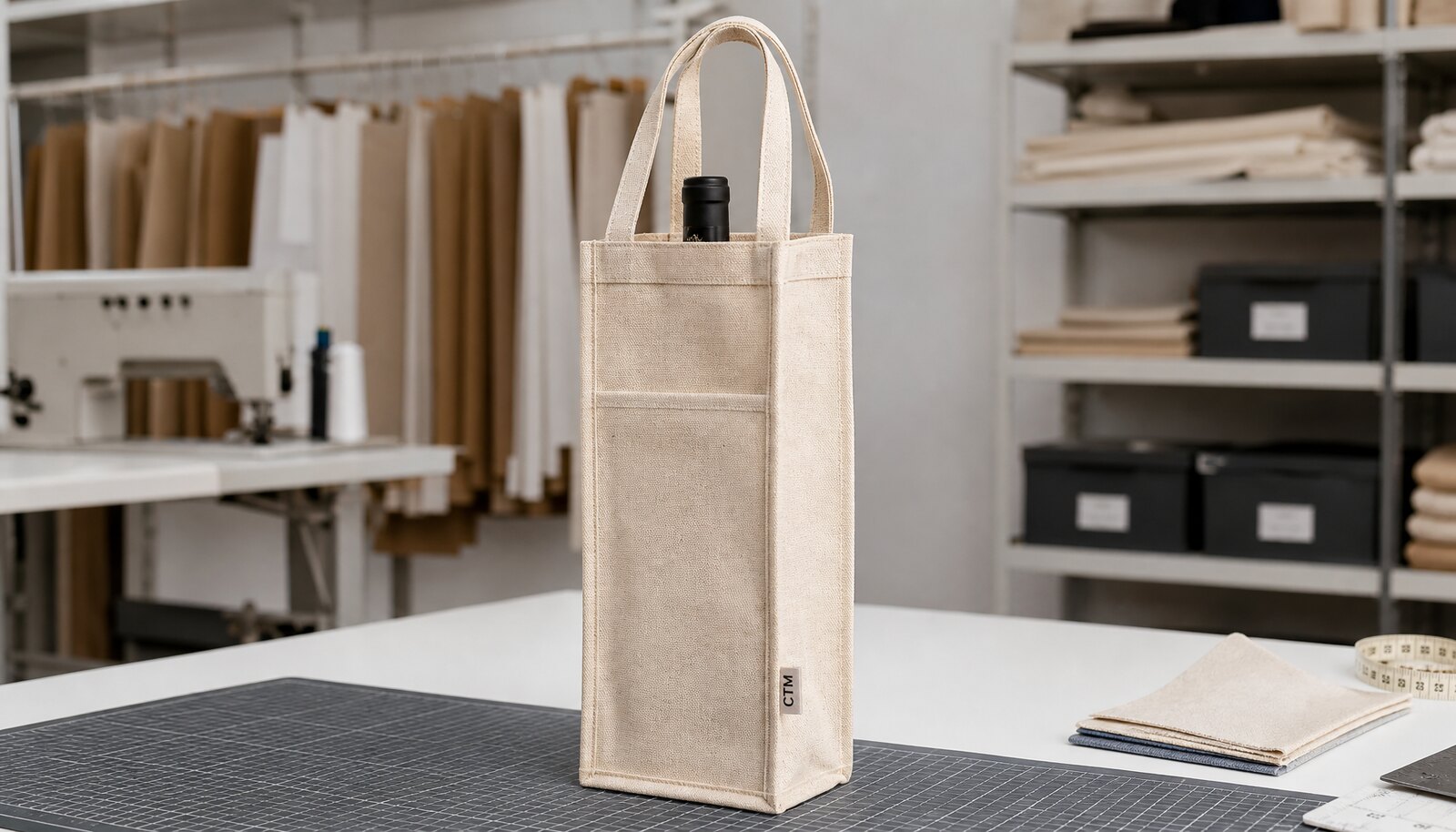
Start With the Use Case, Not the Artwork
A personalised wine bottle bag looks simple, but the buying risk is usually in the brief, not the decoration. If the supplier only receives a logo file and a bottle photo, you will get quotes that are impossible to compare because each factory will make different assumptions about size, fabric, handle length, lining, and packing. The correct starting point is the actual use case: retail gift packaging, winery tasting-room sales, corporate gifting, distributor promo stock, or subscription inserts. Those channels do not need the same construction, and they definitely do not need the same commercial spec.
For a procurement buyer, the first question is what the bag must do in the chain of use. Is it mainly a presentation sleeve that protects the bottle until handover, or is it expected to survive repeated handling at the shop counter, in a cellar door, or on a mail-order fulfillment line? A gift shop bag can be optimized for appearance and display. A wholesale program may need a stronger seam, a better carton pack, and a more consistent print area because the product will be stacked, handled, and reordered.
The most common mistake is treating the product as a generic pouch. Wine bottles vary more than many buyers expect, especially if you sell Bordeaux, Burgundy, sparkling wine, imported bottles with thicker glass, or regional bottles with wider shoulders. The bag has to fit the bottle comfortably, protect the label, and still look clean on shelf. If the bag is too tight, the seam will distort. If it is too loose, the product reads as cheap even when the fabric is decent. That is why bottle dimensions should be part of the RFQ, not an afterthought.
Before you request price, define the commercial intent in one sentence. Example: ‘Single-bottle personalised wine bottle bag for 750 ml retail gifting, 12 oz canvas, one-color front print, bulk pack, repeat order expected within six months.’ That sentence forces the supplier to quote the right structure instead of a vague best guess. It also makes it easier for your internal team to compare quotes later because the product brief is tied to the channel, not just to the decoration.
If you buy for multiple channels, resist the temptation to ask one supplier for a universal version unless the spec is intentionally standardized. One version can still be used across retail and corporate gifting, but only if you decide which requirement wins when there is a tradeoff. For example, a drawstring closure may improve gift presentation but complicate bottle insertion, while a taller bag may look premium but increase carton size and freight cost. Make those tradeoffs explicit at the start instead of discovering them at approval time.
- For a standard 750 ml bottle, confirm body diameter, shoulder width, neck height, and total height with the label included.
- If the bag is for retail display, prioritize shape retention and clean branding over the lowest fabric cost.
- If the bag is for shipping or gifting, define whether the bottle must stand upright inside the bag or only during carrying.
- Write the intended channel directly into the RFQ so the supplier can recommend the right construction.
- If your brand uses multiple bottle shapes, nominate one primary reference bottle for sampling and quote control.
Choose the Right Bag Structure for the Bottle
For most buyers, a single-bottle personalised wine bottle bag in cotton canvas is the safest commercial choice. A 10 oz canvas can work for light promo use, but 12 oz to 14 oz usually gives a better feel, stronger seam behavior, and more reliable print clarity. In gsm terms, that is often roughly 280 to 420 gsm depending on weave density, yarn count, and finishing. The exact number matters less than whether the cloth is stiff enough to hold shape, opaque enough to hide the bottle outline, and stable enough to sew without warping.
Do not treat gsm as a slogan. Two fabrics labeled 340 gsm can behave very differently if one is loosely woven and one is tightly woven. Ask suppliers to quote the same material description every time: fiber content, weave, finishing, and whether the cloth is pre-shrunk. For a buyer comparing quotes, a ‘premium canvas’ description is not enough. You need a repeatable spec that the factory can source again on reorder without subtle shading or hand-feel differences.
The structure matters as much as the fabric. A flat single-panel bag is cheaper, but a boxed bottom or gusset gives a more stable base and better retail presentation. A narrow bottom seam is acceptable for a budget pack, but it will not hold the bottle upright as cleanly, especially if the bottle is tall or the base is wider than standard. For premium buyers, a small bottom gusset and reinforced side seams are usually worth the added labor because they reduce distortion and improve perceived value. The design also affects carton utilization: a flat bag may ship more efficiently, while a gusseted bag can occupy more space but deliver a better shelf impression.
Handle design deserves the same level of scrutiny. Short reinforced handles, cut-out carry loops, or long shoulder handles each create different load paths. A handle that feels fine with an empty sample may fail when filled with a heavier bottle and lifted repeatedly. Ask the factory what reinforcement they use at the handle ends, whether they apply bar-tacks or double stitching, and how they control symmetry. If handle height is not standardized, the bag may sit differently from one carton to the next, which looks unprofessional in retail.
Natural-fiber options such as jute, hessian, or burlap can also work, but buyers should treat them as a different product family. They have a more rustic visual language, can shed fibers, and are less forgiving on print detail. They may be right for winery merchandise or seasonal gift packs, but they are usually not the best choice when the brand needs a crisp, modern, or luxury-facing finish. If you want a softer hand or better print accuracy, cotton canvas is still the easiest route for most procurement teams.
If the bag will be used in e-commerce, ask whether the structure will be folded and re-packed by a warehouse. Some constructions hold their shape beautifully on a shelf but become awkward in fulfillment if the opening is narrow or the fabric springs back after folding. In that case, a slightly lighter but more collapsible canvas can lower packing time and reduce warehouse complaints without changing the outward look very much.
- 10 oz canvas around 280 gsm: acceptable for short-run promotions, lower shelf expectations, and price-sensitive orders.
- 12 oz canvas around 340 gsm: the default choice for balanced cost, strength, and print performance.
- 14 oz canvas or heavier: useful when the bag must feel premium, stand better, or support repeated handling.
- If the bag uses jute or hessian, accept a coarser look and check for fiber shedding before approving shelf-facing retail use.
- Ask for a sewn physical sample in the exact fabric shade, because printed photos often hide weave openness and opacity.
Branding Method Drives Both Cost and Appearance
The logo method should be chosen after the bag construction, not before it. Screen print is usually the best answer for simple logos and repeat orders because it is stable, readable, and cost-efficient at scale. If the artwork has one to two solid colors, a clean screen print on canvas normally gives the best quote-to-result ratio. For a more premium look, buyers often move to woven side labels, embroidery, debossed PU patches, or sewn textile badges, but these choices change labor time, MOQ logic, and approval steps.
Do not let decorative ambition create a sourcing problem. Fine gradients, photographic art, or thin serif text can break down on textured canvas and produce disputes about what was actually approved. If the brand mark must be exact, keep the art simple and test it at production size. A woven label or side seam label is often a better solution than trying to force a detailed print onto coarse fabric. Likewise, if the logo sits too close to the seam or fold line, the visual result can look misaligned even when the factory is technically within tolerance.
Screen printing still needs careful control. Buyers should ask for mesh count, ink type, curing method, and whether the print will be hand-pulled or machine-applied. Those details affect opacity, edge sharpness, rub resistance, and consistency across the run. A one-color print on dark canvas can look excellent if the ink coverage is strong, but it can also appear washed out if the ink system is weak or under-cured. If the logo includes small type, confirm the minimum line thickness the supplier can hold on that fabric. A print that looks fine in digital artwork may disappear on cloth if the line weight is too thin.
Embroidery can look premium, but it is not free quality. Stitched logos on canvas may pucker the fabric, especially around dense fills or small text. If you want embroidery, ask for stitch density, backing material, and whether the logo will be direct embroidery or applied as a patch. For buyers who need a giftable look without risk of thread distortion, a woven label or sewn PU patch can be a better middle ground. It is often cleaner for typography and can be easier to repeat across orders.
Another procurement point is color control. If your brand uses a specific Pantone, clarify whether the print must match the Pantone on canvas, on label stock, or only approximately. Textiles are not paper, and the substrate changes the visual result. Suppliers should tell you whether they can hit a practical tolerance or whether a near-match is more realistic. Good sourcing teams do not force impossible color promises; they decide early what level of match is commercially acceptable for the channel.
- Screen print works best for flat logos, limited colors, and stable repeat production.
- Embroidery adds perceived value but can distort fine text on lighter canvas.
- Woven labels are useful when the buyer wants a premium brand cue without large print coverage.
- PU patches and debossing work well when the bag needs a more giftable or retail-forward look.
- Ask for a rub-resistance check on printed logos if the bag will be handled often or packed tightly.
Read Quote Differences Like a Factory Buyer
Quoted prices for a personalised wine bottle bag can differ sharply even when the product looks similar on paper. The main drivers are fabric weight, print setup, labor content, packaging, and whether the supplier is making every component in-house. A low quote often means a lighter fabric, simpler stitch count, smaller print area, fewer reinforcement points, or bulk-only packing. None of those are bad by themselves, but they must be visible in the quote so you can compare apples to apples.
The best way to compare quotes is to break the product into decision layers. First, compare the base bag: fabric, size, and construction. Second, compare branding: print, embroidery, or label. Third, compare packing: fold method, polybag, insert card, barcode, and carton marks. Fourth, compare service scope: sample cost, revision policy, photo report, and lead time. If the supplier only gives a single line price, they are asking you to absorb all the risk of hidden assumptions.
Buyers should push suppliers to describe the quote in the same language used in the RFQ. For example, ‘12 oz canvas, single bottle, one-color front print, unlined, bulk pack of 100 per master carton’ is useful because each part is measurable. By contrast, ‘premium wine bag with logo’ is not useful because every supplier will interpret ‘premium’ differently. This is where many procurement teams lose time: they compare a polished quote from one supplier against a more transparent quote from another and mistake formatting for value.
A useful sourcing example is to ask for three versions of the same product: a budget version, a target version, and a premium version. The budget version might be 10 oz canvas, one-color print, and bulk pack. The target version might be 12 oz canvas, one-color print, and barcode-labeled retail packing. The premium version might add a gusset, woven label, and reinforced handle. This is not about forcing a cheaper price; it is about learning where the cost actually moves. Once you know which details move the price, you can trim the right feature instead of cutting blindly.
When you review the quote, check whether the supplier has separated printing setup from unit decoration cost. If a quote includes a large setup fee, you need to know whether that fee is one-time or repeated on reorders. If the factory is quoting a low piece price but a high sample cost, the economics may still make sense for a large rollout but not for a small test run. Procurement buyers should also ask whether the quoted price assumes current raw material availability or whether it is valid only for a short time window.
A simple rule: if you cannot explain the price difference in one sentence, the quote is not yet ready for approval. That sentence should mention what is different in fabric, construction, branding, or packing. If the answer is just ‘supplier A is cheaper,’ the comparison is incomplete.
- Ask for the fabric spec in oz or gsm, not only in generic terms like heavy canvas or premium cotton.
- Separate print setup, print unit cost, and packaging cost so you can see what changes with quantity.
- Confirm whether the supplier's quote includes label sewing, barcode stickers, folding, and carton marking.
- Watch for hidden costs on artwork cleanup, extra colors, or changes after sample approval.
- Request a quoted price ladder at 500, 1,000, 3,000, and 5,000 units to see where the unit cost actually drops.
Build MOQ Around Production Reality, Not a Guess
MOQ is not only a supplier limitation. It is the point where the bag becomes commercially efficient. A simple one-color personalised wine bottle bag in 12 oz canvas can usually support a lower MOQ than a multi-color embroidered version because the setup burden is lighter and the sewing process is more repeatable. Once you add lining, rigid inserts, woven labels, multiple print placements, or specialty closures, the MOQ has to rise or the unit price becomes unworkable.
A practical buyer should separate launch MOQ from reorder MOQ. The first order may need extra units to cover sample approvals, print strike-offs, and packing tests. Reorders should be sized around carton efficiency and forecast stability. If your supplier cannot explain where the MOQ comes from, it usually means they are guessing from labor convenience rather than from a real production plan. Good factories can usually tell you whether the bottleneck is cutting, printing, sewing, finishing, or packing. That matters because the bottleneck determines whether a lower MOQ is realistic or just theoretically available at a higher cost.
As a guide, simple products can often be quoted at lower quantities because the line can move quickly and the supplier can combine work across different orders. More complex versions need enough volume to justify setup and reduce rework. If the bag includes embroidery or an additional sewn label, the supplier should tell you how many pieces are needed to amortize setup and whether the MOQ is calculated by design, by color, or by total run. Buyers should not accept ‘MOQ is flexible’ as an answer unless the cost impact of flexibility is shown clearly.
If you are launching a seasonal line, consider whether the MOQ should be tied to display or distribution logic rather than to a random production number. For example, a 2,000-piece MOQ may be acceptable if you can sell through in one retail cycle, but too risky if the bag is only a secondary add-on item. On the other hand, a lower MOQ may look attractive but can be expensive enough that margin disappears once freight, warehousing, and spoilage are included. Procurement should evaluate MOQ as part of the landed cost model, not as a stand-alone sourcing win.
A strong supplier will often suggest a compromise, such as standardizing the fabric and body size while customizing only the print or label. That approach can reduce cost and keep MOQ manageable. If the bag is intended to be reordered, standardize as much as possible on the base construction. Use branding to create the variation, not the bag body itself. That keeps future procurement simpler and lowers the risk of a different fit on the next production cycle.
- Simple canvas bag with one print color: often the best route for low to medium MOQ.
- Multi-location branding, embroidery, or specialty labels: expect higher MOQ and longer approval time.
- If the order is for multiple colors, ask whether MOQ is by design, by color, or by total order across the run.
- Separate launch MOQ from reorder MOQ so you do not overpay for a test run.
- Ask the factory which production step limits MOQ: cutting, printing, sewing, or packing.
Approve Samples Against a Production Standard, Not Taste Alone
The sample stage should prove that the bag can be produced consistently, not just that one hand-finished piece looks good. A useful sample must show the final fabric weight, seam finish, print placement, and packing method. If the sample is made with temporary stitching, special hand trimming, or a different ink process from mass production, the buyer has not really approved the product. That is why you should ask whether the sample is a sales sample, a pre-production sample, or a production standard sample.
Inspection on the sample should be specific. Measure the finished dimensions, check the bottle fit, pull on the handles, inspect the print edges, and look at the internal stitch joins. If the bag is meant for retail, place it under store lighting and see whether the print reads correctly from one meter away. If the logo is distorted, too small, or too close to the seam, fix that before bulk approval. Once bulk starts, those issues turn into inventory risk. A good sample review also checks fold behavior, because a bag that folds awkwardly can drive complaints in warehousing and store replenishment.
The best sample approval workflow is simple: first, approve the construction sample; second, approve the artwork strike-off or lab dip if color is involved; third, approve the pre-production sample from the same production line that will make the bulk order. Many problems happen because these steps are compressed into one approval. The result is a sample that looks acceptable but does not fully reflect the final bulk process. If the factory refuses to identify the sample stage, that is a warning sign, not a convenience.
For repeat business, keep a signed reference sample or a reference photo set in the order file. Include the final size, the logo position, the approved print color, the carton count, and the fold direction. Future orders should be matched against that reference, not against memory. Buyers often save more money by avoiding one inconsistent reorder than by squeezing a few cents out of the initial quote.
If your team does not have a formal QA process, create a simple approval sheet. It should list the bottle model, dimensions, fabric spec, brand color, print size, packaging spec, and whether the bag has passed the required insertion and handle test. This keeps internal stakeholders aligned and prevents a marketing manager, a merchandiser, and a warehouse lead from approving different versions of the same product.
- Confirm sample type before approval so the factory cannot rely on a hand-made prototype.
- Check bottle insertion, label visibility, and stand stability with the actual bottle you sell.
- Approve a signed reference sample or photo set that shows print position, fabric shade, and label placement.
- Keep the approved artwork file and the approved physical sample linked to the PO.
- Do not approve bulk until the factory confirms the same process route used for the sample.
Packing Should Match the Sales Channel and the Warehouse
Packing is often under-specified in buyer briefs, yet it affects both cost and shelf performance. A bag for distributor stock can usually be bulk packed with carton labels and simple inner bundles. A retail-ready bag may need a polybag, tissue, barcode sticker, and a hangtag or insert card. Those small changes affect labor, carton count, and how the product survives transit. If the bag arrives creased, dust-marked, or badly folded, the retail value drops even if the sewing is correct.
Set the packing format before the production order is released. Decide whether each bag should be folded flat or stuffed for shape, whether the barcode belongs on the polybag or the carton, and whether the carton should show colorway, item code, or only a PO reference. If the bag is part of a wine gift set, the outer pack must leave enough room for the bottle and any inserts. That is where many projects fail: the bag itself is fine, but the final gift configuration does not fit the carton plan.
For buyers with warehouse teams, ask how the product should be received and scanned. If the barcode is too small, printed on a curved surface, or hidden under a fold, the warehouse will push back even if the product itself is acceptable. That becomes an operational issue, not a design one. If the program is for retail display, ask for a sample carton and a packed unit photo before bulk packing begins. A single approved photo can prevent mis-folding across the entire run.
Moisture control matters for natural fibers like jute and for long sea freight lanes. Even cotton canvas can pick up a storage smell if cartons are packed too tightly or stored in humid conditions. Ask whether the factory uses desiccants, inner polybags, or carton liners when the shipment is headed for a long transit. Those are small cost items compared with a rejected shipment or a retail complaint about odor.
A useful packaging check is to think in layers: product layer, inner pack layer, master carton layer, and pallet layer if relevant. Each layer should have its own decision. If you do not specify these layers, the supplier will choose defaults that may be fine for their warehouse but not for yours. Retail buyers, in particular, should insist that packing instructions be included in the sample approval photos and the final inspection report.
- Bulk pack is cheaper, but only suitable if your channel can handle extra handling before retail display.
- Retail insert cards and hangtags need an agreed placement so they do not cover the logo or interfere with folding.
- Moisture control matters for natural fibers like jute and for long sea freight lanes.
- If you need barcode scanning in the warehouse, test the exact label size and surface before mass packing.
- Request one packed-unit photo and one master-carton photo before final shipment approval.
Lead Time Risk Comes From Artwork, Trims, and Peak Season
Lead time for a personalised wine bottle bag is usually straightforward when the spec is simple, but it expands quickly when artwork, labels, and packaging are handled by different vendors. A plain canvas bag with one screen print and bulk packing is much easier to schedule than a bag with woven labels, insert cards, and retail barcodes. The more process handoffs there are, the more likely the schedule will slip between sample approval and bulk launch. That is why buyers should ask what the critical path is, not just what the promised delivery date is.
The most useful lead-time question is not ‘How many days?’ but ‘What has to be frozen before production starts?’ Buyers should lock the fabric, artwork, label placement, packing spec, and carton mark before the PO is released. If the supplier still needs design decisions after that point, the date on the quote is not a real schedule. Reorders are faster only when the factory has retained the original artwork, trims, and sewing instructions without changes. If any one of those elements has changed, treat the reorder like a new order for planning purposes.
Lead time also depends on seasonality and order queue. If the factory is in peak period, a quote that looks normal may still be slow because the line is fully booked. Ask whether the supplier’s date is based on material availability, line capacity, or just a theoretical turnaround. A competent supplier should tell you if a faster schedule requires a rush fee, simplified packaging, or a reduced QC window. That is useful information, not a red flag, as long as it is disclosed before approval.
There is also a sourcing tradeoff between speed and control. A local decorator may appear faster if you need a small test run quickly, but the product may involve more manual steps and less repeatability. A direct factory may need more time for sampling and production setup but can be stronger on repeat orders and consistent packing. Buyers should choose the route based on whether the urgent need is the initial launch or the long-term replenishment program. Those two situations do not always favor the same supplier type.
The safest way to protect lead time is to freeze the spec early and keep changes small. Once the bag has been sampled, changing the fabric shade, logo size, or packing format often adds more delay than buyers expect. If marketing requests a revision late in the cycle, the better answer may be to launch the first version cleanly and schedule the revised version as a second production wave.
- Ask the factory what must be finalized before cutting starts and what can still change after sample approval.
- Treat new labels, new carton artwork, and new packaging inserts as schedule risks, not minor details.
- Avoid changing fabric, logo size, or packing after a sample has already been approved.
- Build in extra time if the order lands near holiday seasons or winery sales peaks.
- Ask whether the quoted lead time includes sample rounds or only bulk production after final approval.
Compare Sourcing Routes Before You Compare Prices
For this product, the best sourcing route depends on how tightly you need to control the spec. A direct factory is usually the strongest choice when you want the bag, print, label, and packing managed together. A trading company can help if you need mixed products in one shipment, but you have to be more careful about who is actually making each component. A local decorator may work for fast low-MOQ campaigns, yet the unit cost often rises once you include labor, relabeling, and repeat setup time. For procurement buyers, the question is not which route sounds easiest; it is which route gives the least risk at the required quality level.
A direct factory is best when repeatability matters. You can ask for a fixed construction, a named material source, and a clear production flow. The drawback is that you may need to manage more detailed communication, especially if the factory expects technical instructions rather than broad direction. A trading company is useful when you are sourcing several items together or when you need a single commercial contact across different factories. The tradeoff is less visibility into who controls QC and whether the same plant will actually make your reorder. A local decorator can be useful for ultra-fast launches, but the buyer should verify whether they will apply print only or coordinate the full bag assembly elsewhere.
Red flags differ by route. With a factory, watch for vague answers about who owns printing and labels, because outsourcing can create hidden variation. With a trader, ask for the real factory name, location, and production responsibility for each component. With a local decorator, ask how they manage fabric consistency, seam quality, and carton packing if those steps are outsourced. In all cases, request samples that reflect the actual route you will use for bulk. A sample made in one place and a bulk run made in another is a recipe for inconsistency.
A practical verification step is to ask for process photos rather than only product photos. You want to see cutting, printing, stitching, label application, and carton packing if those steps matter to your spec. It is also reasonable to ask for a simple supplier capability sheet: monthly capacity, main products, sample lead time, QC process, and whether they can handle custom artwork. Buyers do not need a long presentation; they need evidence that the supplier can repeat the same result without improvisation.
Use the table as a procurement filter, not a marketing chart. The right route is the one that matches your channel, MOQ, repeat-order expectation, and tolerance for variation. If your business needs the same bag every reorder, direct factory control is usually worth more than a slightly lower initial quote. If you are testing a gift program, a simpler build and a smaller MOQ may matter more than premium construction. The route choice should follow the business case, not the first salesperson who replies fastest.
- Direct factory: best for stable specs, repeat orders, and better control over sewing and packing.
- Trading company: useful when you need multiple items consolidated, but confirm who owns each process step.
- Local decorator: useful for speed, but compare the full landed cost, not only the per-unit decoration price.
- Request process photos or a capability sheet to verify actual manufacturing control.
- If the supplier outsources printing or labels, require written process ownership and approval points.
Use a Clear RFQ and Supplier Qualification Framework
A strong RFQ does more than request a price. It narrows the supplier’s interpretation so each quote is usable. For a personalised wine bottle bag, your RFQ should contain the bottle model, target fabric weight, finished size, branding method, print position, packing format, and forecasted quantity bands. If any of those fields are missing, the supplier will fill the gap with assumptions, and those assumptions become hidden cost later. Buyers often blame the supplier for inconsistency when the brief was the real problem.
A good RFQ for this product should also separate must-have requirements from preference items. For example, ‘must have one-color front print and barcode on inner polybag’ is a requirement, while ‘prefer matte finish’ is a preference. That distinction matters because suppliers can price the essentials accurately and then offer alternates without muddying the core comparison. If you are inviting multiple suppliers, send the same template and ask them to state exceptions line by line. That creates a more reliable comparison than a free-form email thread.
Supplier qualification should be capability-based. Ask whether they can sew the bag in-house, whether they manage print in-house, whether they can hold your approved fabric shade on reorder, and whether they can provide a pre-shipment photo report. If the supplier cannot answer these questions cleanly, they are not ready for a controlled procurement program. For buyers purchasing at scale, the qualification stage is where most risk is removed. Price only matters after capability is confirmed.
A useful qualification question is how the supplier handles a defect if it appears after approval. Ask what happens if the print shifts, if the seam allowance is inconsistent, or if the carton count is wrong. You do not need a dramatic warranty statement; you need a practical correction process. That can include replacement pieces, rework, credit, or shipment hold depending on the issue. The point is to understand who absorbs the cost when the result does not match the approved standard.
If you are buying for a chain, distributor, or multi-site rollout, ask for one more thing: a repeat-order control plan. That should include how they store artwork, how long they hold label stock, how they reference the approved sample, and whether they can quote future orders against the same spec without a full resample. This is the difference between a one-time vendor and a repeatable supply partner.
- Use one RFQ template for all suppliers so quotes are easier to compare.
- Separate must-have requirements from preferences to reduce quote ambiguity.
- Ask each supplier to state whether sewing, printing, and packing are in-house or outsourced.
- Request a repeat-order control plan if the bag will be reordered or rolled out across multiple stores.
- Require suppliers to identify exception items line by line instead of sending only a generic quotation.
Specification comparison for buyers
| Spec decision | Recommended option | When it fits | Buyer risk to check |
|---|---|---|---|
| Fabric weight | 12 oz cotton canvas around 340 gsm | Retail gifting, wine clubs, corporate gifts, and general-purpose premium carry | Too light and the bag collapses; too heavy can raise cost, reduce sewing speed, and make folding bulkier |
| Fabric weight alternative | 10 oz canvas around 280 gsm | Price-sensitive promotions or high-volume giveaways where hand feel matters less than unit cost | Lower opacity and weaker body; ask for an actual sewn sample because some 10 oz fabrics look thin once printed |
| Bottle capacity | Single-bottle format with a snug 750 ml fit | Most winery, retail, and corporate gift programs | Check body diameter, shoulder width, and whether the label must remain visible in the bag |
| Bottle capacity alternative | Single-bottle with gusseted or boxed base | Premium presentation and repeat retail handling | Base geometry adds sewing cost and can change carton size and freight efficiency |
| Branding method | 1–2 color screen print or woven side label | Medium MOQs, clean brand marks, and reorder programs | Thin serif text, gradients, or very small logos can print poorly on textured canvas |
| Branding method alternative | Embroidery or sewn PU patch | Giftable, premium-looking programs with less artwork complexity | Adds labor, can distort small text, and may require higher MOQ or longer sample approval |
| Closure | Open top with optional drawstring or top flap | Gifting and retail sets where presentation matters | Closure can interfere with bottle insertion and affect finished height and carton dimensions |
| Lining | Unlined canvas for low cost or thin PP nonwoven insert for shape | Budget ranges, short-run promo jobs, or light internal protection | Unlined bags can show bottle shape; lining changes cost, hand feel, and production time |
| Handle style | Short reinforced handles or cut-out carry loop with bar-tack reinforcement | Point-of-sale retail and event giveaways | Weak reinforcement can fail at the seam when bottles are heavier or cartons are tightly packed |
Buyer checklist before sampling
- Confirm bottle type: standard 750 ml Bordeaux, Burgundy, champagne-style, or a non-standard local bottle diameter.
- Record the actual bottle dimensions: body diameter, shoulder width, neck height, total height, and whether the label must stay visible.
- Lock the finished size, including seam allowance, handle height, gusset depth, and whether the bag must stand upright or fold flat.
- Specify fabric weight in oz or gsm, weave type, lining requirement, and whether you want a structured base insert.
- Choose the branding method, logo placement, number of print colors, and the approved Pantone or artwork file format.
- Define packing: bulk pack, polybag, tissue insert, hangtag, barcode sticker, folding direction, and carton count.
- Set the acceptance standard for print registration, stitch quality, odor, stains, measurement tolerance, and seam reinforcement.
- State your target MOQ, reorder expectation, and whether the supplier must hold repeating artwork, labels, and carton artwork.
- Ask the supplier to confirm whether the sample is a sales sample, a pre-production sample, or the actual production standard.
- Request pre-shipment photos and a short inspection report before final payment or shipment release.
Factory quote questions to send
- What is the exact finished size, fabric weight, seam construction, reinforcement method, and base style in your quoted version?
- Which branding process are you pricing, how many colors or locations are included, and what setup charges apply?
- Is the logo price based on one artwork position only, and what is the added cost for a second print or extra label?
- What is your MOQ by design, by color, and by print method, and where does the unit price change if I reduce quantity?
- Can you confirm sample lead time, bulk lead time, and the point at which artwork approval freezes the production schedule?
- Who makes the fabric, who prints the logo, who sews the bag, and who applies the final label or barcode?
- What packing unit is included in the quote, and what is the cost impact of retail insert cards, barcodes, or master carton marks?
- Which QC checkpoints do you inspect before shipment, and do you provide a pre-shipment report with measurements and photos?
- What is your re-order process, and can you repeat the same fabric shade, print position, and packing spec on future orders?
- What are the payment terms for sampling, bulk, and any custom tooling or label setup?
Quality-control points to confirm
- Finished size must stay within an agreed tolerance, typically about plus or minus 5 mm for width and height on simple canvas construction; check both flat dimensions and the effective internal opening.
- Bottle fit must allow easy insertion of the agreed bottle model without stretching side seams, distorting the base, or exposing raw stitch edges; test with a filled bottle, not an empty one.
- Print placement must stay centered or within the agreed offset, with clean edges and no visible ghosting, smudge, banding, or under-cure gloss differences.
- Color match must stay within the approved strike-off or lab dip reference for both logo color and fabric shade; if exact brand color matters, approve under daylight-equivalent lighting.
- Stitching must show even SPI, secure bar-tacks at handle joins and stress points, no skipped stitches on side seams, and no seam puckering that suggests thread tension problems.
- No needle damage, loose threads, oil marks, glue marks, or fiber contamination should appear on visible product surfaces; trim loose threads after sewing and recheck under strong light.
- Odor check should pass for storage and retail presentation, especially if coatings, linings, inks, or synthetic labels are used; smell the product straight from the sealed carton if possible.
- Carton count, barcode, inner pack configuration, and master carton marks must match the purchase order before final shipment release; count by carton, not only by total pieces.
- Pre-shipment inspection should use a defined AQL level or an equivalent buyer standard; if no AQL is agreed, ask the supplier what lot size they treat as critical, major, and minor defects.
- Request photo evidence of measurement points, print areas, seam stress points, carton labels, and packed master cartons before balance payment or release.