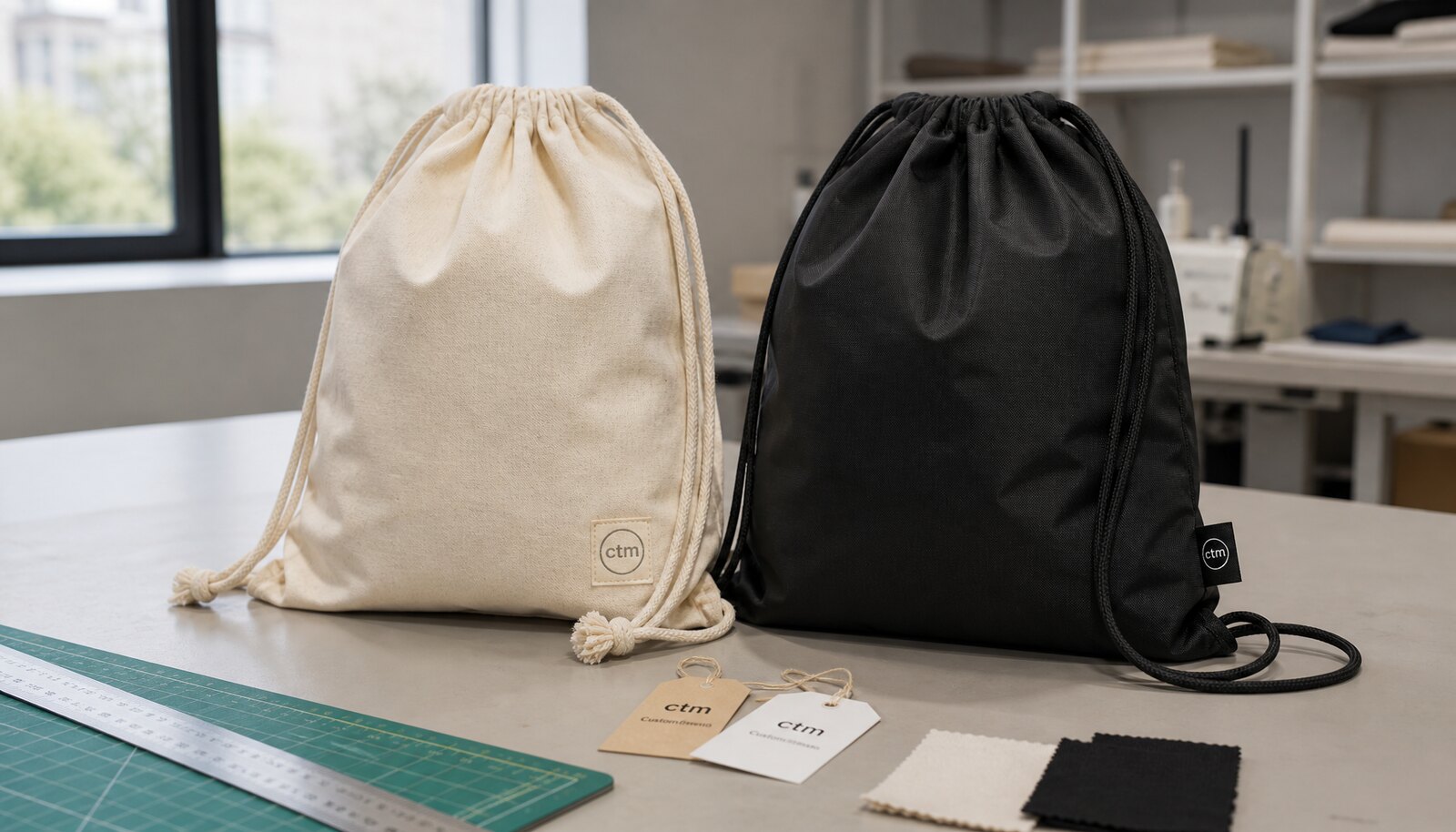
Why quotes for a personalised string bag are easy to misread
A personalised string bag looks simple, but the quote is built from several decisions that are easy to hide behind one line item. Fabric weight, print method, cord type, finishing, packing, and supplier route all affect price and delivery. That is why two offers can look similar on paper and still produce very different results at receipt. One supplier may be quoting a light promo bag, while another is quoting a heavier retail bag with tighter finishing and more packing labor.
The main procurement mistake is treating the order as decoration only. If the buyer sends a logo and a size, the factory will fill in the gaps with the cheapest acceptable interpretation unless the brief is precise. That can mean thinner cloth, looser seam standards, a less durable print method, or bulk packing when the commercial team expected shelf-ready units. The result is usually not a dramatic failure. It is a quiet mismatch that shows up later in margin pressure, quality complaints, or rework.
The better approach is to define the bag as a product with a use case. A drawstring pouch for retail resale is not the same thing as a giveaway bag for a trade event. If you separate those cases early, you can compare quotes on the same basis and avoid paying for features you do not need, or losing quality because the spec was left open.
- Start from end use, not from logo artwork.
- Treat every omitted detail as a cost or quality risk.
- Compare quotes only after the spec and packing basis are standardised.
Build the base spec around the job the bag must do
For procurement, the first decision is not the logo method. It is what the bag must do after it arrives. A retail bag that is handled repeatedly needs different fabric, stitching, and presentation from a short-run event pouch. If the use case is resale, you should care about hand feel, visual consistency, and repeatability across lots. If the use case is protection or internal carrying, function can matter more than presentation.
Fabric weight is one of the most important cost and performance drivers, but it should not be treated as a universal rule. Cotton is common because it prints cleanly and feels familiar to buyers, but the right weight depends on use and budget. Light cloth can be fine for event giveaways or low-load use. Heavier cloth is often more appropriate for resale, repeated handling, or product carry. The useful question is not "what gsm do people usually buy?" It is "what fabric weight supports the use case without adding unnecessary cost?"
Construction should be written with the same care. Decide whether the bag uses a single cord or double cord, whether the channel is stitched or folded, whether corners are reinforced, and whether the load-bearing points need bar tacks. If the bag will carry real product weight, those details matter more than the logo position. A neat print on a weak seam is still a poor procurement outcome. The cord material, stitch density, and edge finishing should be defined before the supplier starts quoting, not after the first sample fails.
- Specify fabric in gsm or oz, not only by material name.
- State cord type, attachment style, and reinforcement method.
- Write the use case before you write the print brief.
Use supplier route as a buying decision, not a sourcing label
Supplier route changes the buying outcome as much as the product spec does. A direct factory relationship gives you the best chance of repeat consistency, lot traceability, and controlled changes. That is usually the right route when the bag is part of a stable retail line or a recurring brand program. The tradeoff is that you need clearer RFQs and more disciplined sample approval, because there is less hand-holding and less insulation from production issues.
A trading company can be useful when the project is broad, the style list is mixed, or you need one contact to compare several factory options quickly. The risk is transparency. If the trading desk does not name the actual production site, you may be comparing offers that came from different sub-suppliers with different standards. That is not automatically bad, but it means the quote needs stronger verification on who owns QC, who buys the fabric, and who is responsible if the sample does not match production.
Local decorators on imported blanks are often the fastest option for small campaigns, seasonal promotions, or urgent launches. The downside is that the blank bag spec may be fixed and the print process may be optimised for speed rather than long-term durability. Domestic converters or wholesalers can offer easier communication and shorter shipping, but the buyer should still ask whether the blank stock is stable enough for reorders. If the product will be reordered, continuity matters as much as the first shipment price.
- Choose direct factory when reorders and spec control matter.
- Use trading routes only when the production source is clear and accountable.
- Use decorated blanks only when the base bag quality already fits the channel.
Ask for a quote in comparable units, not just a unit price
A useful RFQ removes guesswork. Send the finished size, fabric spec, cord spec, artwork file, print position, and packing instruction together. If the supplier only receives a logo and a rough size, the quote will often include assumptions that are not visible until later. A good buyer brief also states whether the order is for resale, internal distribution, or promo use, because the expected finish and packing usually change with the channel.
The most useful quote structure breaks cost into buckets: fabric, cutting and sewing, print setup, label application, packing, and freight basis. If the supplier sends a lump sum only, ask for the missing breakdown before you compare it with another offer. Hidden labor often sits in packing or setup, not in the cloth itself. A low quote can become expensive once you add individual polybags, count labels, or special carton marks.
It also helps to ask for the quote in the same currency and on the same delivery term. A unit price at factory gate is not comparable to a landed quote that includes cartons and export handling. If you want a real buyer answer, tell suppliers to list assumptions beside the price. That includes whether the quote is based on stock fabric, custom dye, a standard cord, or a special label.
- Send the spec sheet, drawing, artwork, and packing instruction together.
- Ask for line-item pricing where possible.
- Require the supplier to write down the assumptions behind the price.
Check capability and compliance before you release a PO
A supplier quote is not proof of capability. Before PO release, ask the supplier to show who actually makes the bag and where it is made. At minimum, you need business identity, the production address, and the person responsible for quality on the order. If the order is important or the first order with that supplier, request production photos or a short factory video focused on the relevant line, not generic marketing images.
For compliance, ask only for what applies to your market, but ask early. Depending on where the bag is sold and how it is used, you may need composition statements, test reports, substance declarations, origin paperwork, or labeling information. Do not ask for every certificate by default. Ask for the documents that matter for the destination market and the product category. If the supplier cannot explain what applies, that is a signal to slow down and verify before money moves.
Also verify how the supplier manages sub-suppliers. Fabric, cord, labels, and packing materials may come from different vendors. A factory that cannot identify the source of the cord or the fabric lot is a traceability risk if there is a quality issue later. For higher-value programs, ask how lot numbers are recorded and how rejected material is separated from accepted stock. That is a practical control, not paperwork for its own sake.
- Confirm who actually makes the bag, not only who sent the email.
- Ask for the documents that apply to your destination market.
- Check lot traceability for fabric, cord, labels, and finished goods.
Sample approval should test function, not only appearance
A sample is useful only if it proves the same things the bulk order must prove. Place the sample flat and measure the finished size. Check seam straightness, the depth of the cord channel, the position of the print, and the label placement. Then test the bag with the intended load or a realistic dummy load. If the bag is sold as a carry item, it should survive handling without seam strain or obvious distortion. If it is a gift or retail bag, check whether it folds cleanly and presents well on shelf.
The most common sample problem is a good-looking print on a weak structure. The artwork may be clean, but the cord channel twists, the side seam puckers, or the print sits too close to the edge to survive trimming and sewing variation. That is why the sample needs to be reviewed against the drawing and not against memory. Use a measurement sheet or annotated artwork so the approval includes exact placement, not only a visual yes.
If the order has multiple variants, do not approve only one representative sample unless the differences are trivial. Size changes, color changes, label changes, or print placement changes should be checked separately. For the first order, ask for pre-production photos showing the actual fabric roll, the cord, the labels, and the first sewn units. That is a better control point than approving a render or a factory stock image.
- Measure the sample, do not just look at it.
- Test the bag with a realistic load.
- Approve each meaningful variant separately.
MOQ and lead time usually come from the same production constraints
Minimum order quantity is rarely arbitrary. It is usually tied to fabric roll usage, print setup, sewing efficiency, and packing labor. A factory can lower MOQ if you accept stock fabric, a standard size, fewer print colors, or bulk packing. If you want custom dye, special cords, or retail-ready pack-out, the MOQ usually rises because the factory cannot spread setup cost across many units. The buyer should ask which variable is driving the MOQ rather than simply negotiating the number downward.
Lead time has the same pattern. Suppliers often quote an attractive production window but forget to separate sampling time, art approval, and export prep. If the project has a fixed launch date, build the timeline from sample approval backward, not from the production start date forward. In practice, art revisions and sample shipping are common causes of delay. If the factory says the fabric is in stock, ask them to confirm whether that stock is reserved for your order or merely available in theory.
Price pressure usually comes from one of three tradeoffs: lighter fabric, simpler print, or less packing labor. There is nothing wrong with any of those if they fit the use case. The problem is when the tradeoff is hidden. Buyers should ask the factory to explain what is being simplified to hit the target price. That gives procurement a fair view of whether the savings are real or whether the quote depends on quality being lower than expected.
- Loosen one spec at a time if you need a lower MOQ.
- Separate sample time from mass-production time.
- Ask what the factory is simplifying to reach the quoted price.
Set QC rules that match the risk, not a generic template
QC for a personalised string bag should start with a written acceptance plan. If your category and customer requirements do not specify a tighter scheme, a practical starting point is General Inspection Level II with AQL 2.5 for major defects and AQL 4.0 for minor defects, with zero tolerance for critical defects. Tighten or relax only when the product risk and order history justify it. The point is not to memorise a standard. It is to stop arguing after production by defining the pass or fail logic in advance.
For visual defects, agree on thresholds. Major print defects should include visible smudge, cracking, poor coverage, misalignment beyond the approved limit, or color shift that is obvious against the approved sample. Major seam defects should include skipped stitches, open seams, weak bar tacks, or channel failure. Minor defects can cover small loose threads, minor packing dents, or slight cosmetic variation that does not affect function. The key is to assign each issue a severity level before the factory ships.
Testing should match the actual risk. For print, use a rub test on production samples and check for ink transfer or cracking. For seams and cord attachment, use a simple pull or load test on sampled bags against the intended use case. For packing, check count accuracy, carton marks, and whether bags are folded and protected the way the buyer approved. If your bag is sold in retail or marketplace channels, one mixed carton or one bad label can be enough to create a receiving problem even if the product itself is acceptable.
- Use AQL as a starting point, not as a universal rule.
- Set zero tolerance for critical defects.
- Define print, seam, and packing defects before inspection starts.
Packing, labeling, and delivery terms can decide whether the shipment is usable
Packing is often treated as a finishing detail, but for a personalised string bag it can affect receiving speed, cosmetic quality, and the ability to go straight into sale or distribution. Bulk packing is efficient and usually the best choice for B2B shipments when the buyer has warehouse handling in place. Individual polybags are better when the item must reach retail shelves, e-commerce customers, or premium gift sets in clean condition. The right answer depends on the downstream handoff, not on tradition.
Labeling should be defined with the same precision as print. State whether the bag needs a woven label, care label, barcode, carton mark, or master carton label. If the bag will move through a retail or marketplace channel, confirm that the supplier can print and place labels consistently across lots. Mixed cartons, missing labels, and unlabeled inner packs are common reasons a good bag becomes a receiving headache. A buyer should also decide whether a hang tag is part of the product or only a shipping insert.
For delivery, do not stop at the freight term. Ask how the supplier packs cartons, whether cartons are palletised, whether there are restrictions on mixed SKUs, and who is responsible if cartons arrive crushed or short. If the shipment will be distributed into multiple locations, ask for carton labelling that supports warehouse scanning and downstream sorting. That is usually cheaper to solve before the PO than after goods are already in transit.
- Choose bulk packing for warehouse-led B2B programs.
- Choose retail-ready packing only when presentation or protection justifies the extra cost.
- Tell the supplier which market, warehouse, and document set apply before production starts.
Specification comparison for buyers
| Supplier route | Best procurement fit | What you gain | Main buyer check |
|---|---|---|---|
| Direct factory | Repeat programs, retail lines, and orders where consistency matters | Best control over fabric, cord, print, packing, and reorders | Confirm factory identity, line capability, and which sub-suppliers provide the fabric, cord, and labels |
| Trading company | Fast quoting across mixed SKUs or multiple factory options | One contact, broader quote coverage, and easier coordination | Verify the actual production site, ownership of QC, and whether the price includes handling or markups |
| Local decorator on stock blanks | Small campaigns, urgent events, and short-run personalization | Shortest turnaround and low setup friction | Check blank origin, blank spec, print durability, and whether stock continuity is realistic |
| Domestic converter or wholesaler | Short logistics chains and smaller or recurring domestic buys | Simpler communication and easier reorder management | Compare landed cost against the exact blank spec, not against a similar-looking sample |
| Material | 6-10 oz cotton canvas, 210D polyester, rPET, or blended cotton with shrinkage and colorfastness expectations set before sampling | Before price comparison | Different cloth weights, backing, or certification claims make quotes hard to compare |
| Construction | cord diameter, eyelet or reinforced channel, bottom corner reinforcement, seam allowance, bar-tack position, and load target | Before sampling | Weak stress points create returns and failed inspections |
| Decoration | screen print, transfer, embroidery, woven label, or drawstring tag tested against folding and abrasion | Before artwork approval | The wrong method can crack, bleed, pucker, or fail on the chosen fabric |
| MOQ | Base MOQ plus change drivers | During quote review | Custom colors, trims, and packing can change minimums |
Buyer checklist before sampling
- Define the use case first: resale, promo giveaway, gift packaging, e-commerce accessory, or product carry bag. The use case should decide size, fabric weight, closure style, and packing.
- Write the base spec before requesting prices: finished size, fabric weight in gsm or oz, weave or knit type, cord diameter, print size, and label placement.
- State the artwork rules clearly: number of colors, print position, Pantone targets if needed, centered or offset placement, and any acceptable registration tolerance.
- Ask each supplier to quote the same Incoterm, the same packing format, and the same sample policy so you can compare true landed cost.
- Request proof of material route: fabric composition declaration, cord material, and label composition if the bag may enter retail channels.
- Confirm tolerance bands before sample approval for size, print registration, seam consistency, shade variation, and carton count.
- Ask for pre-production photos and a physical approved sample if the order is custom, reorders are expected, or the order value justifies the control step.
- Check carton count, inner pack count, carton marks, and whether mixed sizes or colors are allowed in one outer carton.
- Request the factory's QC approach in writing: inspection level, defect definitions, and whether checks are inline, final, or third-party.
- Separate lead time into sample lead time, production lead time, and export or domestic dispatch time. Do not let them blur together in the quote.
Factory quote questions to send
- Are you quoting as a direct factory, trading company, or converter, and which facility will actually produce the personalised string bag?
- What is the exact fabric specification, including composition, weight, weave, finish, and any shrinkage allowance you are using for pricing?
- Which print method are you quoting, how many colors are included, and what setup charge applies per color or artwork file?
- What is the MOQ for this exact spec, and which changes would increase it: size, fabric weight, cord style, label, or packing?
- Can you quote the same bag in bulk pack and individual polybag pack, with carton count and carton dimensions for each option?
- What size tolerance are you pricing to, and how do you handle print shift, color variation, seam alignment, and cord length variance?
- What compliance documents can you provide for my market, such as composition statements, test reports, or substance declarations where applicable?
- Can you share business registration details, factory address, production photos, and the contact person responsible for this order?
- What is your sample approval process, and do you require signed artwork, a signed measurement sheet, or an approved swatch before bulk production?
- How do you control lot traceability for fabric, print, and packing if I need to separate batches after arrival?
Quality-control points to confirm
- If your category and customer requirements do not specify a tighter scheme, a practical starting point is General Inspection Level II with AQL 2.5 for major defects and AQL 4.0 for minor defects, with zero tolerance for critical defects. Tighten or relax only when the product risk and order history justify it.
- Critical defects should include wrong size outside the agreed tolerance, mixed color or mixed size cartons, missing cord where a cord is required, broken or open seam at a load-bearing point, and any sharp or unsafe object in the bag or carton.
- Major print defects should include visibly off-center artwork, smudging, cracking, poor coverage, color shift outside the approved sample, or registration error beyond the written limit. For small logos, buyers often set a tighter visual threshold than for large graphics.
- Major seam defects should include skipped stitches, seam gaps, loose bar tacks, or channel failure. Agree on a numeric rule in the spec, such as no open seam and no skip longer than 5 mm in a load-bearing area, if that fits the intended use.
- Measure finished size on sampled units and compare against the approved spec. A common starting point is plus/minus 0.5 cm on smaller bags and plus/minus 1.0 cm on larger bags, but the final tolerance should match fill weight, presentation needs, and whether the bag must close cleanly after loading.
- Check cord performance by pulling the cord through the channel, confirming equal left-right length, and verifying that the cord does not fray or bind. If the bag is expected to carry weight, ask for a simple load test on sampled units against the intended use.
- Inspect packing against the agreed plan: correct count per inner pack, correct outer carton count, no mixed lots, no damaged bags from over-compression, and correct carton marks and SKU labels.
- For print durability, use a rub test on the approved sample and on production samples. If the bag will be handled often, also inspect for ink transfer, flaking, or cracking after repeated folding and handling.