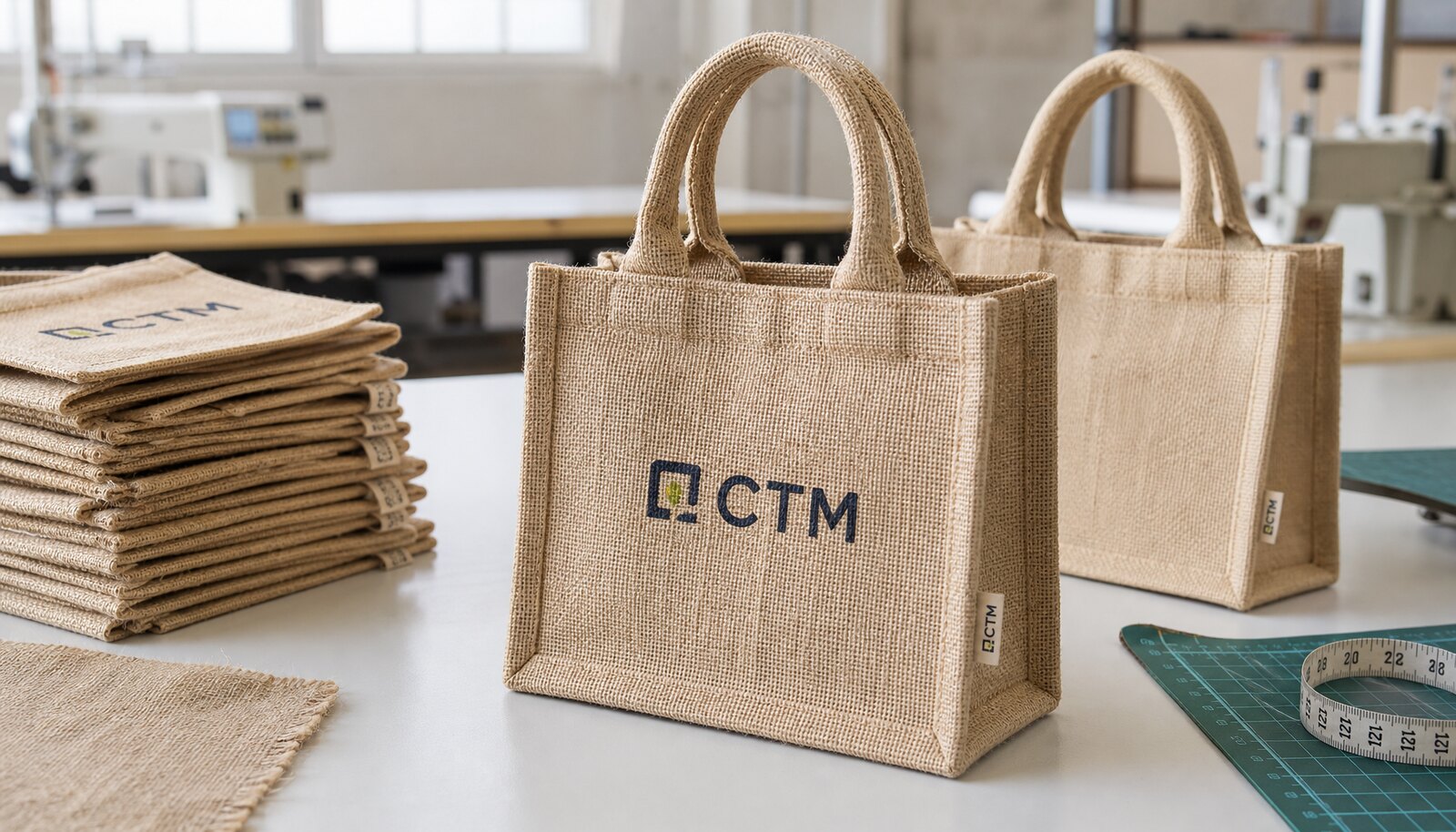
Why personalised small jute bags need a stricter brief than they look
Personalised small jute bags look simple on screen, but they are one of those products where a vague brief creates expensive surprises. The bag is compact, the print area is limited, and the surface is naturally uneven. That combination makes the final result highly sensitive to small changes in GSM, weave density, gusset depth, handle length, and print method. If the brief is loose, suppliers fill the gaps with their own assumptions, and the quotes stop being comparable.
For procurement teams, the real question is not whether the bag is attractive. It is whether the finished article will hold the intended product, present the brand clearly, and repeat consistently across the full run and reorder. A compact jute bag used for cosmetics, bakery items, event gifting, or bundled merchandise can look like a standard commodity until you place a branded insert into it. Then the tolerances start to matter. Small differences in opening width, handle placement, or seam squareness become obvious immediately.
The article should therefore be treated like a small packaging component, not a generic tote. That means the RFQ needs to define the use case, the carry load, the branding method, and the packing format before the first supplier is asked to quote. If those items are not fixed, the buyer ends up comparing a cheap quote for one product against a premium quote for a different one.
- Set the use case first: promotional giveaway, retail packaging, boutique gift bag, or product bundle.
- Define the carry load in practical terms, not just by size; a small bag can still be overfilled by the end user.
- Keep the artwork realistic for a textured substrate; fine type and thin reversal lines rarely reproduce cleanly.
- Ask for a physical sample before bulk sewing starts, not only a digital proof.
How to specify the bag so suppliers are pricing the same thing
The most useful buyer lever is the specification block. For compact jute bags, start with finished dimensions, gusset depth, handle drop, and whether the bag needs to stand upright. A common range for small retail formats is around 15-25 cm wide and 15-25 cm high, but the exact size should be driven by the product insert and shelf presentation rather than a generic catalog size. If the product is a rigid item, a gusset and a slightly heavier fabric are usually worth the cost. If it is a soft giveaway pack, a simpler construction may be enough.
Fabric choice is the next major cost and appearance decision. Plain jute in the 120-150 GSM range is usually suitable for lightweight promotional use and low-cost bundling. Heavier plain or laminated jute in the 180-250 GSM range gives better body, cleaner edges, and less visual distortion after printing. Laminated jute can make the surface more predictable for logo application, but it also shifts the look away from raw natural fiber. Buyers should decide whether they want a natural, rustic appearance or a more controlled retail finish, because those are not the same product.
Construction details should not be left to the factory's default pattern. Short handles look neat on a small bag, but if the handle drop is too short the bag becomes awkward to use. A soft bag can work well for gift packaging, but if the item needs to stand on shelf, ask for a firmer base or a heavier GSM. If you need lining or reinforcement, call that out explicitly; those features are useful in some programs, but they can add cost quickly and should not be added casually.
- Use exact dimensions in millimeters or centimeters, not only the phrase 'small bag'.
- State whether the bag must stand, fold flat, or stay soft.
- Tie the handle drop to the intended product and how the end user will carry it.
- Specify whether the body is plain jute, laminated jute, dyed jute, or lined jute.
Print method choices on textured jute
Screen printing remains the default for personalised small jute bags because it is usually the best balance of cost, durability, and repeatability. It works well when the artwork is bold, the logo is simple, and the color count is limited. On a textured surface, simple art tends to look better than a complicated design that loses definition in the weave. Buyers should be cautious about very small reversed text, thin stroke widths, and fine gradients. These may look acceptable in a PDF and still fail on jute.
Heat transfer and digital approaches have a place, but they should be chosen for a concrete reason rather than because they sound modern. They are often used when the artwork is more detailed, when the order is small, or when the print sits on a smoother panel or laminated surface. The key risk is durability. A transfer that cracks at the fold or lifts at the edge may still pass a quick visual check, but it is not a good retail result. If the bag is going into a store program, ask the supplier to show you the exact substrate used for the sample, not a different test material.
A good rule for procurement is to select the simplest print method that achieves the brand objective. If the logo can be read clearly at a glance, the quote is usually healthier and the production risk is lower. If the design needs several colors, extra care is needed on registration, drying time, and surface consistency, so the buyer should ask for an extra review step before bulk approval.
- Use one-color screen print when cost control and durability matter most.
- Use a second color only when it materially improves brand legibility.
- Avoid tiny QR codes unless the supplier can prove that the code scans reliably on the actual bag surface.
- Request print samples on the same fabric and in the same position as the production bag.
Supplier routes and landed-cost comparison that buyers actually need
A useful quote comparison has to go beyond spec choices and compare how the product reaches you. Direct factory sourcing is usually strongest for repeat programs with stable artwork. It gives the buyer better visibility into fabric choice, sewing quality, and packing, and it often produces the lowest ex-works price once the order is large enough to spread setup costs. The tradeoff is that the buyer has to manage a cleaner approval process and wait for the factory's production slot.
Trading companies and consolidators are useful when the purchase includes mixed SKUs, a small trial order, or several style changes at once. They can be easier to coordinate, but the landed-cost picture can be less transparent. The price may include multiple layers of margin, and the factory used for sewing or printing may change between orders. For personalised small jute bags, that matters because a shift in factory can change handle placement, weave appearance, and carton consistency even if the headline spec is the same.
Regional importers or local decorators can be sensible when speed matters more than absolute unit cost. They are often better for short replenishment runs, local compliance demands, or programs where buyers need fast communication and domestic delivery. The real comparison is not 'cheap versus expensive'; it is 'which route gives the lowest landed cost for the required service level.' If you are flying in a launch order, freight and carton cube can overtake the bag price very quickly, so the quote must include size, gross weight, and packing density.
- Direct factory: strongest for repeat business and tighter control over construction.
- Trading route: useful for mixed SKUs, smaller trials, or when the buyer needs a broader sourcing umbrella.
- Local conversion route: useful for urgent delivery or low-MOQ replenishment, but often not the lowest unit price.
- Compare landed cost, not just ex-works price; carton cube and freight can change the answer.
What to ask for in the quote so the comparison is fair
Many procurement problems start because the quote format is incomplete. A useful quote for personalised small jute bags should separate the cost drivers, not collapse them into a single unit price. Ask the supplier to state the finished size, fabric GSM, print side, number of colors, pack format, and Incoterm. Then ask for the price at several volume points, not just one. A quote at 500 pieces, 1,000 pieces, 3,000 pieces, and 5,000 pieces will show you whether the unit price is genuinely scalable or whether most of the cost sits in setup.
Setup charges are especially important. Screen charges, artwork preparation, blank sample costs, and any packaging labels can distort the first order. A low MOQ can look attractive until the buyer sees that every future change requires a new screen, a new label run, or a separate packing step. It is better to know upfront whether repeat orders will be materially cheaper than the first production lot. That difference matters when the bag becomes part of a seasonal or replenishable program.
The best supplier quotes are also explicit about what is not included. If cartons, barcode labels, moisture protection, or inland delivery are additional, that should be stated clearly. When those items are left implicit, the landed cost is easy to underestimate and the order may look better on paper than it does in the warehouse.
- Ask for a price ladder at 500, 1,000, 3,000, and 5,000 pieces.
- Separate setup fees from recurring production cost.
- Require carton dimensions, carton gross weight, and pieces per carton.
- Ask whether packing, labels, and documents are included or billed separately.
Lead time benchmarks by region, fabric type, and order volume
Lead time for personalised small jute bags should be treated as a planning range, not a promise. The biggest variable is whether the fabric and accessories are already in stock when the artwork is approved. As a practical benchmark, origin factories in India or Bangladesh can often turn around simple plain-jute orders of roughly 1,000 to 5,000 pieces in about 7 to 14 working days after sample approval when material is available. That range usually assumes one-color screen print, bulk packing, and no special labels.
Once the order moves into heavier fabric, laminated construction, two-color branding, or retail packing, the schedule usually stretches. For the same origin-factory route, 12 to 20 working days is a more realistic planning window for laminated jute, lined bags, or more involved pack-outs. Larger orders in the 5,000 to 20,000 piece range, or orders with multiple artwork variants, can move into the 15 to 30 working day range because setup, line balancing, and packing control take longer. If the factory must source a special lamination, dye lot, or trim, add time rather than assuming it will be absorbed.
Trading or consolidated routes usually add coordination time even when the fabric itself is available. A buyer may save effort on communication, but the order often passes through more steps before it reaches the freight stage. For urgent launch programs, buyers should also add time for sample revision, artwork proofing, and freight booking. The safest schedule is the one that already assumes one revision cycle, especially if the bag is new, the artwork is dense, or the packing format is changing at the same time.
- Plain jute, in-stock material, simple print: plan around 7-14 working days after approval.
- Laminated jute, lined construction, or two-color print: plan around 12-20 working days.
- Larger repeat orders or mixed artwork: plan around 15-30 working days.
- Add extra time when the supplier must source special trim, labels, or a specific fabric finish.
Sample approval that prevents expensive bulk surprises
A useful sample process should verify more than the logo. Start with the basics: does the bag open correctly, does it stand or fold the way it should, and does it actually fit the intended product? Then move to construction details such as seam straightness, handle symmetry, top hem finish, and gusset alignment. On compact bags, millimeters are visible, so a slightly crooked top line or a twisted handle can turn into a shelf problem even if the bag technically meets the size spec.
Artwork approval should be based on a physical sample whenever possible. Textures and weave density can make a logo look slightly darker, softer, or more broken-up than the digital artwork suggests. That is not a defect by itself; it is a substrate effect that the buyer needs to accept or correct before bulk starts. If the design includes a side label, woven tag, or barcode label, inspect the attachment method as well as the position. Poorly fixed labels are a common source of rejectable finishes on small bags.
The master sample is the control point. Mark it clearly, record photos of every critical face and edge, and note the acceptable range for minor variation. If the bag is for a repeat program, store the approved sample with the PO record so reorders do not drift. That one discipline saves more time than most buyers expect, because it reduces the chance that a new production run gets approved against memory instead of evidence.
- Approve the bag both empty and filled with the actual product weight.
- Check handle symmetry and opening shape, not only the logo.
- Keep one signed master sample with photo documentation for reorders.
- Record the acceptable variation for print position and finish before the bulk run starts.
QC checkpoints that matter on small jute bags
Quality control for personalised small jute bags should focus on visible defects, function, and pack integrity. A practical inspection plan checks finished size, handle reinforcement, seam neatness, print alignment, yarn quality in the logo zone, and carton count. If the product is going into retail, any visible thread tails, glue marks, broken yarns, or print smudges in the front panel are worth treating as defects rather than cosmetic noise. Small bags have limited surface area, so the front panel has to do most of the work.
The packing stage deserves as much attention as the sewing stage. Jute can crease, and printed surfaces can mark each other if the curing time is too short or the bags are compressed too hard. For that reason, the buyer should specify the fold method, whether individual polybags are required, and whether the cartons need moisture protection. If the route goes through humid storage or long ocean transit, those details are not optional. They are part of the product quality.
For first-time production, third-party inspection can be helpful if the supplier is not already on a strong approved-vendor list. The point is not to create bureaucracy. The point is to catch the defects that are most expensive to fix after shipping: wrong size, wrong print position, weak handle attachment, short pack count, and carton damage. If those are controlled, the product is usually serviceable even when the natural fiber shows some normal variation.
- Set size, print, and stitch tolerances in the PO or spec sheet.
- Inspect the handle root and seam finish with special care.
- Treat packaging quality as part of product quality, not as a separate admin task.
- Use AQL or a comparable inspection standard for first shipments and new suppliers.
Packing, labeling, and freight choices that affect the final cost
Packing is one of the most underestimated parts of the cost stack. Bulk-packed bags are usually the lowest-cost option and often the best choice for wholesale distribution, event kits, and B2B resale. But retail programs, marketplace fulfillment, and warehouse-driven launches usually need extra labeling or individual packing. Every additional step adds labor and materials, so the quote should show exactly which pack format is included. If the supplier says 'standard packing' without defining it, ask for a description that you can attach to the PO.
Carton efficiency matters because jute is bulky relative to its value. A quote that looks competitive per piece can become less attractive if the cartons are oversized or the packing is loose. Ask for carton dimensions, gross weight, and pieces per carton so your freight team can estimate the cube. This is especially important on airfreight launches, where volume weight can matter more than the product price. Even on ocean shipments, poor packing density can increase the landed cost enough to erase the apparent saving from a lower ex-works quote.
Labeling should be decided before approval, not after the sample arrives. Barcode labels, size stickers, retail hangtags, and carton marks all need a fixed layout. If the bag is going into a retail environment, a neat fold and clean front panel are part of the presentation. If it is going to a warehouse, the carton code and label location must support inbound handling. Define the destination first, then the pack-out.
- Use bulk pack for trade, gifting, and general B2B distribution.
- Use individual polybag or label pack when the bags go directly to retail or fulfillment.
- Ask for carton dimensions and gross weight to estimate freight correctly.
- Add moisture protection if the route, season, or destination storage is risky.
How to write the PO so the supplier cannot guess the spec
The purchase order should read like a controlled manufacturing document, not a sales note. Include finished size, fabric GSM, construction, print method, number of colors, handle type, pack format, and approved artwork reference. If you agreed a tolerance on size or print position, put it in writing. If the bag has a special fold or retail label, add a photo or sketch. The goal is to remove room for interpretation, because interpretation is where variation enters the batch.
For personalised small jute bags, change control matters more than buyers often expect. A last-minute switch from plain jute to laminated jute, or from bulk pack to retail pack, changes the production flow and can reset the lead time. The same is true for artwork changes. If the artwork changes after approval, the supplier should re-quote the print setup rather than absorbing it quietly, because that almost always gets recovered elsewhere. A disciplined PO protects both sides by making cost and responsibility visible.
The final check is commercial, not just visual. Confirm Incoterms, payment terms, and whether any extra charges are likely to appear for documentation, inland delivery, or rework. If you have a target landed cost, give the supplier enough detail to price to it. The best quotes are not the cheapest on the first page; they are the ones that survive the freight, packing, and receiving stages without surprise costs.
- Attach the approved artwork and the signed master sample reference to the PO.
- State tolerances, pack format, and carton requirements in writing.
- Confirm whether the supplier is quoting ex-works, FOB, or delivered terms.
- Requote any late change to material, print, or packaging before release.
Specification comparison for buyers
| Procurement scenario | What it usually looks like | Where landed cost is strongest | What to challenge in the quote |
|---|---|---|---|
| Origin factory, simple spec | Direct factory order in India or Bangladesh, in-stock plain jute, one-color screen print, bulk pack | Best ex-works pricing once artwork is stable and volume is repeatable | Confirm whether the quote includes screens, sampling, packing, and whether carton dimensions are realistic for freight |
| Origin factory, premium retail spec | Heavier jute, laminated or lined construction, two-sided print, barcode or insert labeling | Strong when the bag is part of a branded retail program and shelf consistency matters | Ask for the price delta for GSM, lining, extra color, and retail packing instead of assuming they are bundled |
| Trading company or consolidator | One supplier managing multiple factories or mixed bag styles, often for smaller trials or mixed SKUs | Useful when coordination speed matters more than absolute unit price | Check whether lead time includes factory production or only export handling, and whether the same factory is used for every order |
| Regional importer or local decorator | Blanks or semi-finished bags brought in, then printed or packed closer to the destination market | Best when you need low MOQ, faster replenishment, or easier local communication | Challenge the hidden layers: blank cost, print cost, repacking cost, and margin stacked across separate steps |
| Urgent launch airfreight scenario | Small first order shipped by air to hit a campaign date | Good only when launch timing is more important than unit cost | Request carton weight and cube, because bulky jute can make air freight the main cost driver |
| Material | laminated or unlaminated jute, cotton-jute blend, inner coating, odor control, yarn thickness, and color shade variation | Before price comparison | Different cloth weights, backing, or certification claims make quotes hard to compare |
| Construction | handle stitching, side gusset, lamination edge control, inner seam cover, and fiber shedding tolerance | Before sampling | Weak stress points create returns and failed inspections |
| Decoration | screen print, transfer patch, cotton label, or embroidery selected for rough fiber texture and ink holdout | Before artwork approval | The wrong method can crack, bleed, pucker, or fail on the chosen fabric |
Buyer checklist before sampling
- Define the finished size, gusset depth, handle drop, and whether the bag must stand upright or stay soft.
- Specify fabric type and GSM: plain jute, laminated jute, dyed jute, or jute with lining or reinforcement.
- State the use case so the supplier can price the right build: giveaway, gift pack, retail bag, or product bundle.
- Lock the print method, number of colors, print side, and the maximum printable area before asking for quotes.
- Set MOQ expectations by artwork and by color, and ask whether mixed designs can share the same fabric batch.
- Confirm packing format, carton size, label requirements, and whether inner polybags are needed for retail presentation.
- Approve a physical pre-production sample and keep the signed master sample with photos of all critical angles.
- Ask for a quote that splits fabric, printing, sewing, packing, sampling, and freight basis so you can compare landed cost, not just unit price.
Factory quote questions to send
- What is the exact finished size, gusset depth, handle length, fabric GSM, and construction included in your quote?
- Is the price based on plain jute, laminated jute, dyed jute, or lined construction, and what changes if that spec moves up or down?
- Is the print price for one side or both sides, how many colors are included, and what is the add-on for a second color or second print area?
- What is your MOQ per design and per color, and how does the unit price change at 500, 1,000, 3,000, and 5,000 pieces?
- Are stitching, printing, and packing done in-house, or are any steps subcontracted to another facility?
- What sample stages do you offer: existing sample, blank sample, printed strike-off, or printed pre-production sample?
- What tolerances do you accept for finished size, handle length, print placement, and carton count?
- What is the standard lead time after sample approval for plain jute, laminated jute, and any lined or special-pack version?
- Which packing method is quoted: bulk pack, individual polybag, barcode label, insert card, or retail-ready packing?
- What Incoterms are included, which port or dispatch point is used, and what extra charges may appear for cartons, documents, inland delivery, or rework after approval?
Quality-control points to confirm
- Agree the finished-size tolerance before production starts; for compact bags, a tolerance around plus or minus 5 mm is usually more useful than a vague 'industry standard' note.
- Check handle symmetry, handle drop, and stitch reinforcement at the handle root, because this is one of the most visible failure points on small bags.
- Inspect print position against the signed master sample from front, back, and top edge views, especially when artwork sits near a seam or gusset.
- Reject visible broken yarns, holes, or heavy slubs in the logo area if the bag is being sold at retail or used for gift presentation.
- If the bag is laminated, fold a sample several times and check whether the coating cracks or lifts at the crease line.
- Use actual product weight in sample testing so you can see whether the bag distorts, sags, or opens awkwardly in use.
- Count cartons and sample-pack quantities, rather than relying on weight alone, because small bags are often vulnerable to short-packing.
- For first shipments, align the inspection plan to AQL 2.5 for major defects and 4.0 for minor defects, or the equivalent standard your team already uses.
- Require cure or drying time before packing so the print does not block, smear, or transfer inside the carton.