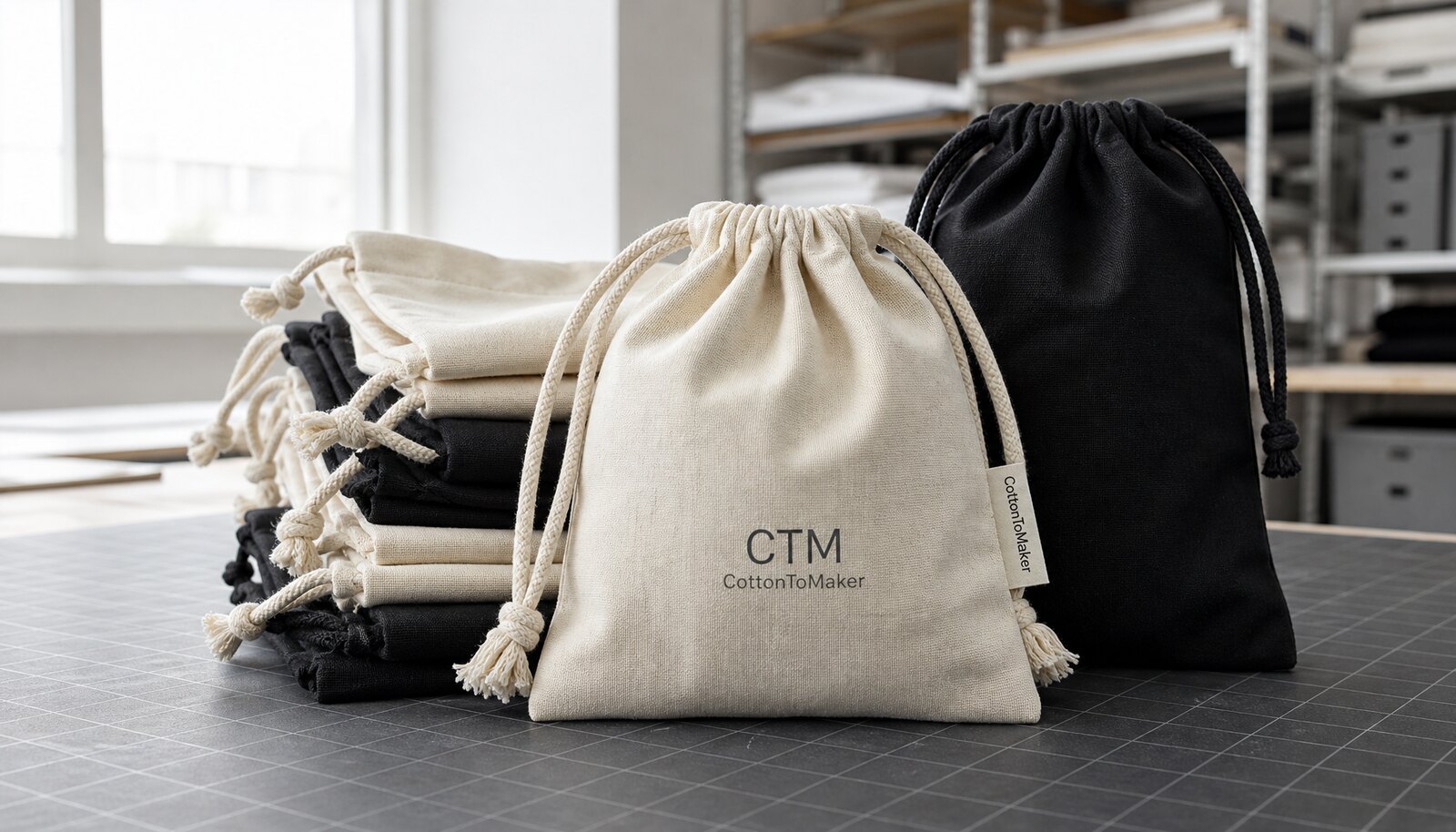
What buyers really mean by a personalised mini drawstring bag
In procurement terms, a personalised mini drawstring bag is not just a small pouch with a logo. It is a compact packaging or retail accessory used for jewelry, cosmetics, tea sachets, sample kits, gift inserts, event tokens, or small promotional items. The buying problem is simple but unforgiving: because the format is so small, every defect becomes visible faster. A print shift of a few millimeters, a loose cord channel, or a weak seam is much easier to spot on a mini pouch than on a larger bag.
That is why the first sourcing question should not be the logo file. It should be the end use. A pouch for a luxury sample set needs cleaner finishing, better fabric consistency, and tighter packing control than a giveaway pouch for a trade show. If the bag will be resold, it needs to hold up under shelf handling and repeated opening, not just survive one unboxing moment.
- State the end use first: retail insert, gift packaging, sample pouch, event giveaway, or storage pouch.
- Clarify whether the bag is visible to end customers or only used inside a supply chain.
- Separate decorative requirements from functional requirements before you request pricing.
Size, fabric, and construction: the decisions that shape the quote
For a personalised mini drawstring bag, the size spec should be written in full: finished width, finished height, usable internal space, and whether the design is flat or has a small base. Buyers often compare supplier prices without noticing that one factory quoted a 9 x 12 cm pouch while another quoted 10 x 14 cm. On a tiny product, that difference changes fabric consumption, print placement, and carton loading enough to distort the quote.
Fabric weight matters just as much. A basic 80-100 gsm cotton is usually fine for lightweight samples or low-cost gifting, but it can look limp when printed or when the contents are dark. If the bag must feel more structured or carry a slightly heavier item, 100-120 gsm cotton is a better default, and 120-140 gsm cotton canvas gives a firmer handfeel. If the brief is more decorative than functional, muslin or a light cotton blend can work, but the buyer should confirm that the fabric will not become semi-transparent when filled.
- Ask the factory to quote both finished size and usable internal size, not only the outside dimension.
- Confirm whether GSM is measured before or after finishing, because mills and factories do not always describe it the same way.
- If the contents are small and premium, ask for a tighter weave or a more opaque fabric to avoid show-through.
- For a mini format, check the hem and cord tunnel depth. A weak top finish will show quickly and can distort closure performance.
Print and branding: choose for artwork, not for habit
Mini bags force a practical choice on branding. If the logo is simple and the order is repeatable, one-color screen printing is often the cleanest and most cost-effective route. A 2-color screen print can still work if the artwork is bold and the registration tolerances are realistic, but the smaller the pouch, the less room there is for detail. When the artwork is complex, short-run, or needs photo-like effect, heat transfer or digital print becomes relevant, although the unit cost usually rises.
If the brand wants a cleaner or more premium look, a woven label or sewn side label may be better than trying to force a large print onto a very small surface. That choice reduces the risk of print blur and makes the front face more versatile. The wrong decision is to pick a method because it sounds premium rather than because it fits the artwork, the quantity, and the manufacturing line. On a mini pouch, the process must fit the size.
- Keep the logo away from seams and the cord channel by an agreed minimum margin; on very small pouches, placement errors are more visible than ink variation.
- Avoid hairline text and ultra-thin strokes. If the logo contains fine detail, simplify it before production.
- Ask the supplier for a physical print strike-off, not just a digital proof, when the artwork is important.
- If exact brand color matters, give a Pantone target and compare the result against the approved sample under normal light.
Price and MOQ benchmarks buyers can actually use
Most pricing friction comes from uncertainty about what is included. For a basic personalised mini drawstring bag made from standard cotton with a simple one-color print, a typical factory quote at 500-1,000 pieces often sits around USD 0.18-0.45 each ex-works. If the bag uses heavier canvas, a woven label, or retail-ready packing, the price often moves into the USD 0.35-0.95 range. Highly customized programs, very small runs, or special finishing can go above USD 1.00 per piece. These are practical benchmark bands, not fixed market prices, but they are useful for spotting quotes that are unrealistically low or padded without explanation.
MOQ follows the amount of setup work more than the bag size. A standard printed cotton mini bag can often be launched at 500-1,000 pcs per color and artwork if the supplier is using stock fabric and a straightforward print process. Once you ask for custom-dyed fabric, specialty cord, special labels, or retail packaging, the MOQ can jump to 3,000 pcs or more. The buyer should ask whether MOQ applies per color, per artwork, or per SKU, because those are not interchangeable.
- Treat a very low quote as a signal to check what is missing, especially print, packing, or sample charges.
- Ask the supplier to separate MOQ by color, artwork, and packaging so the commercial constraint is visible.
- If the order is a market test, accept a higher unit price only if the supplier can still hold the quality standard and the lead time you need.
Supplier route and selection criteria
The best supplier route depends on order pattern, not just headline price. A direct factory is usually the right choice for repeat SKUs, stable branding, and tighter process control. A trading company can make sense when you need mixed products in one shipment or when procurement wants one coordination point, but the buyer should verify where the goods are actually made and who owns final QC. A local converter can be useful for urgent samples and very low MOQs, although the unit price is often higher and the material choices may be narrower.
When comparing suppliers, look for proof of process maturity. A serious supplier should be able to restate the spec in writing, send a physical sample quickly, explain the print method they recommend, and show how they handle inspection and packing. If the supplier cannot explain the difference between finished size and usable size, or cannot separate bag cost from setup cost, the quote is not yet procurement-ready.
- Prefer suppliers who can show recent work on similar mini pouches rather than only larger bags.
- Ask who owns the sewing line, who approves the sample, and where final inspection happens.
- Ask for a clear response time. A reliable quoting process should not take a week just to clarify a basic spec.
- If the supplier is a trader, ask for the factory name, production location, and whether the order can be traced through batch records.
Quote breakdown and carton planning
A quote for a personalised mini drawstring bag should be detailed enough for landed-cost planning. Ask for the bag unit price, print setup fee, unit print charge, sample fee, label or packaging cost, carton cost, and the freight assumption or incoterm. If the quote is bundled, you cannot tell whether the supplier is competitive or simply hiding charges in the total. In procurement, a clear unit price is only useful if the surrounding assumptions are visible.
Carton planning matters more than many buyers expect because mini bags are light but voluminous. For most mini pouch programs, a sensible starting point is 50-100 pieces per inner pack and 200-500 pieces per master carton, depending on size and material. Keep gross weight under 15-18 kg where practical so cartons remain manageable for warehouse handling and reduce damage risk. If a carton is oversized or underfilled, ask whether the pack count can be improved before you approve production.
- Request carton dimensions, pieces per carton, gross weight, and estimated CBM before you approve the order.
- Ask whether the carton pack is optimized for sea freight, air freight, or warehouse distribution.
- If the goods will go to a distribution center, specify carton marks, SKU labels, and barcode format at the quote stage.
- Check whether outer cartons, inner polybags, palletization, and moisture protection are included or charged separately.
Quality control thresholds for a tiny pouch
QC on mini drawstring bags should focus on what the end customer will actually see and use. First, check dimensions against the approved sample. On a small pouch, a small size drift can move the print into a seam or make the opening feel off-center. Second, inspect print clarity at normal viewing distance. If the logo only looks acceptable from far away, it is probably too soft for retail packaging.
Functional checks matter too. The drawcord should run smoothly through the channel without catching, and the top hem should not twist or fray after repeated opening. The stitching around the channel and the side seams should be clean, with no loose threads or skipped stitches that make the product look unfinished. For branded or retail use, standard inspection planning is usually AQL 2.5 for major defects and AQL 4.0 for minor defects, with zero tolerance for critical issues such as wrong artwork, contamination, or holes.
- Define major defects before production, including off-size, print shift, missing cord, and open seam.
- Define minor defects too, such as slight thread tails or small tone variation that still meets your approval standard.
- Inspect a sample from each carton lot, not just the top carton, because small goods can vary by batch.
- Keep the golden sample accessible during final inspection so the inspector has a physical reference instead of a memory.
Packing, labeling, and warehouse handling
Packing is not a cosmetic detail. It controls receiving speed, freight efficiency, and the chance of mix-ups downstream. Bulk packing is usually the right option when the pouch is being inserted into another product set or sent to a warehouse that will repack it. Individual polybags are only worth the extra cost if the pouch is a retail unit or the buyer needs a cleaner presentation on arrival. For high-volume programs, the wrong packing format can add real cost without adding value.
Labeling should match how the receiving team works. If cartons contain mixed colors or mixed sizes, the carton marks must be explicit. If the shipment will go to a distribution center, add SKU, color, size, quantity, carton number, and purchase order number to the marks. If the route is long or humid, ask for a moisture barrier or desiccant plan. A light cotton pouch can look clean at pack-out and still arrive with odor or dampness issues if storage and transit are not controlled.
- Choose bulk pack for warehouse efficiency unless retail presentation requires individual packing.
- Use clear carton marks, and do not assume the receiver will identify SKUs from appearance alone.
- If the shipment is sea freight or moving through humid storage, ask about moisture protection.
- Do not mix many variants in one carton unless the receiving site has already agreed to that method.
Lead time, sample control, and schedule risk
A realistic schedule for a personalised mini drawstring bag starts with the sample, not the bulk run. A physical pre-production sample commonly takes about 7-12 days, depending on fabric availability, print setup, and the clarity of the brief. Once the sample is approved, simple bulk production may take about 20-35 days. If the order needs custom dyeing, special cord, custom labels, or more elaborate packing, the schedule can extend to 35-50 days or more. Those are practical planning ranges, not promises, but they are better than assuming a bag this small must be fast by default.
The biggest delay is often approval churn. If artwork changes after the supplier has already sampled the wrong placement, the process slips even if sewing itself is straightforward. Build a buffer into the schedule for sample correction, and freeze the artwork before bulk production is booked. For seasonal or event-driven orders, hold at least one extra week of contingency so freight variability does not turn a late sample into a missed launch.
- Plan the sample stage as a gate, not as a formality.
- Do not approve bulk until the fabric, print, cord, and pack format all match the physical sample.
- If the order is linked to a launch date, hold time in the calendar for final inspection and transit risk.
- Keep the production schedule tied to one spec version so late revisions do not create ambiguity.
The quickest way to get a clean RFQ
If you want a useful quote instead of a rough guess, send the supplier a spec sheet that reads like a production instruction. Include the finished size, usable internal size, fabric type and GSM, print method, artwork file, print area, cord type, packing method, carton target, inspection level, and the incoterm you want quoted. When procurement gives that level of clarity, the factory can price the order more accurately and is less likely to add unexpected charges later.
A good decision rule is simple: if a supplier cannot quote the bag back to you in the same terms you used, the brief is still incomplete or the supplier is not operating at the level you need. For a personalised mini drawstring bag, this matters because the item looks simple while actually containing many small manufacturing decisions. The better you define those decisions upfront, the easier it is to get a clean quote, approve a reliable sample, and ship without avoidable rework.
- Send one file with size, material, print, packing, carton, and inspection requirements.
- Ask the supplier to confirm each spec item in writing before sampling starts.
- Use the same spec version for quote comparison, sample approval, and final inspection.
- Reject quotes that do not distinguish between product cost, setup cost, and packing cost.
Specification comparison for buyers
| Spec decision | Recommended option | When it fits | Buyer risk to check |
|---|---|---|---|
| Fabric for mini size | 80-100 gsm cotton for low-cost gift use; 100-120 gsm cotton for most branded retail or insert programs; 120-140 gsm cotton canvas if the pouch must feel structured or carry slightly heavier items | Use lighter fabric for sachets, samples, or event giveaways; move up in GSM when you need better body, cleaner print edges, or less seam distortion | Very light fabric can look thin after printing and may become semi-transparent on dark contents; very heavy fabric can make the mini bag stiff and awkward to close |
| Bag size range | 8 x 10 cm to 12 x 15 cm for a true mini pouch, with finished size and usable internal size stated separately | Fits jewelry, tea sachets, cards, mini candles, cosmetics samples, tokens, and gift inserts | Quotes that list only one dimension or only finished size hide seam allowance and can reduce the usable cavity more than expected |
| Print route | 1-color screen print for simple logos, 2-color screen print if the artwork still reads cleanly, heat transfer or digital print only when the art is detailed or the order is short-run | Best when the logo is small and legibility matters more than photo realism | Tiny artwork can blur if it sits too close to seams or the cord channel, and multi-color methods can cost more than the bag itself on small runs |
| Supplier route | Direct factory for repeat SKUs, trading company for mixed-line consolidation, local converter for urgent sampling or very low MOQ tests | Use the route that matches your reorder pattern, compliance needs, and target lead time | A low quote from a middleman can hide setup, packing, or rework costs until the order is already approved |
| MOQ logic | 500-1,000 pcs per color and artwork for basic printed cotton; 3,000+ pcs if you want custom fabric dye, custom cord, special label work, or retail presentation pack | Good for launches, seasonal tests, store kits, and gift campaigns | MOQ often rises because of fabric sourcing, label setup, or packaging constraints rather than sewing capacity alone |
| Typical price benchmark | Basic custom printed mini cotton bag: about USD 0.18-0.45 each at 500-1,000 pcs; premium canvas, woven label, or retail pack: about USD 0.35-0.95; highly customized or short-run programs can sit above USD 1.00 | Useful for early budget checks and quote sanity tests | If a quote falls far below these bands, check whether print, sample, cartons, or packing are excluded; if it sits far above, ask what premium process is actually included |
| Packing method | Bulk packed in inner polybags or master cartons for warehouse efficiency; unit polybag only when retail presentation requires it | Best for lower freight cost and simpler receiving | Loose packing can create contamination, mixed-size errors, and avoidable carton volume; retail polybags add cost and waste |
| Carton benchmark | Target 50-100 pcs per inner pack and keep master cartons around 200-500 pcs for mini pouches, with gross weight under 15-18 kg where practical | Works well for export handling, warehouse picking, and lower damage risk | Oversized cartons raise freight cost and make receiving slower; if a carton exceeds 18 kg gross, ask whether the pack count can be improved |
| Sample approval level | Pre-production sample using actual bulk fabric, actual print method, actual cord, and final packing; one signed golden sample retained for comparison | Needed for branded retail, distributor orders, and any program where consistency matters | Artwork approved on screen is not enough; physical sample approval should confirm tone, print density, placement, shrinkage, and finishing |
Buyer checklist before sampling
- Finished size stated in cm and inches, with usable internal size and seam allowance called out
- Fabric composition and GSM confirmed, including whether the material is cotton, canvas, muslin, or a blend
- Print method matched to artwork complexity, and print area dimensions shown on the artwork proof
- Drawcord type, cord diameter, top hem construction, and reinforcement at the channel specified
- MOQ, sample fee, lead time, and packing method separated clearly in the quote
- Carton pack count, carton size, gross weight, and CBM estimated for freight planning
- Artwork file format, Pantone target, and print placement approved before bulk production starts
- Inspection level agreed in writing, including AQL target and zero-critical rule
- Golden sample signed off and kept as the reference for production and final inspection
- Incoterm and freight assumption stated so the quote is not compared against a different cost basis
Factory quote questions to send
- What is the exact finished size, usable internal size, and seam allowance for this personalised mini drawstring bag?
- What fabric GSM do you recommend for this size, and how will it affect body, print sharpness, and cost?
- Which print method do you propose for my logo, and what are the setup fee, unit print cost, and color limits?
- What is your MOQ per color and per artwork, and does it change if I use custom cord, label, or packaging?
- Can you provide a pre-production sample using actual bulk fabric, actual print method, actual cord, and final packing?
- What packing configuration do you offer, and how many pieces go into each inner pack and master carton?
- What carton size, gross weight, and pieces per carton do you estimate for my order?
- What is your standard production lead time after sample approval, and which steps usually cause delay?
- Please quote separately for bag, print, sample, packing, carton, and freight assumptions, and state the incoterm.
- What AQL level do you normally accept for final inspection, and can you define major, minor, and critical defects?
Quality-control points to confirm
- Measure finished size against the agreed tolerance. For small pouches, plus or minus 0.5 cm is a common starting point, but tighten it if artwork placement is critical.
- Verify fabric weight by supplier declaration and random spot check. Confirm the material is not too see-through for the intended contents.
- Inspect print placement, edge sharpness, and cure quality. The logo should still look clean at normal retail viewing distance, not only from far away.
- Check that all artwork is clear of seams and the cord channel by an agreed margin, so the print does not disappear into construction lines.
- Pull-test the drawcord and examine the top hem stitching. The closure should open and close repeatedly without fraying or seam damage.
- Check for loose threads, skipped stitches, oil marks, stains, and fabric slubs that are outside the approved sample standard.
- Confirm color consistency across cartons, especially on natural cotton, where lot variation can be visible even on a small pouch.
- Inspect label placement and flatness if the bag uses a woven or sewn label. Puckering is common on small formats and should be rejected if visible at normal viewing distance.
- Use an agreed AQL plan, typically AQL 2.5 major and AQL 4.0 minor for standard soft goods, with zero tolerance for critical defects such as wrong artwork or contamination.
- Retain one signed golden sample and compare pilot units and bulk units against it during final inspection.