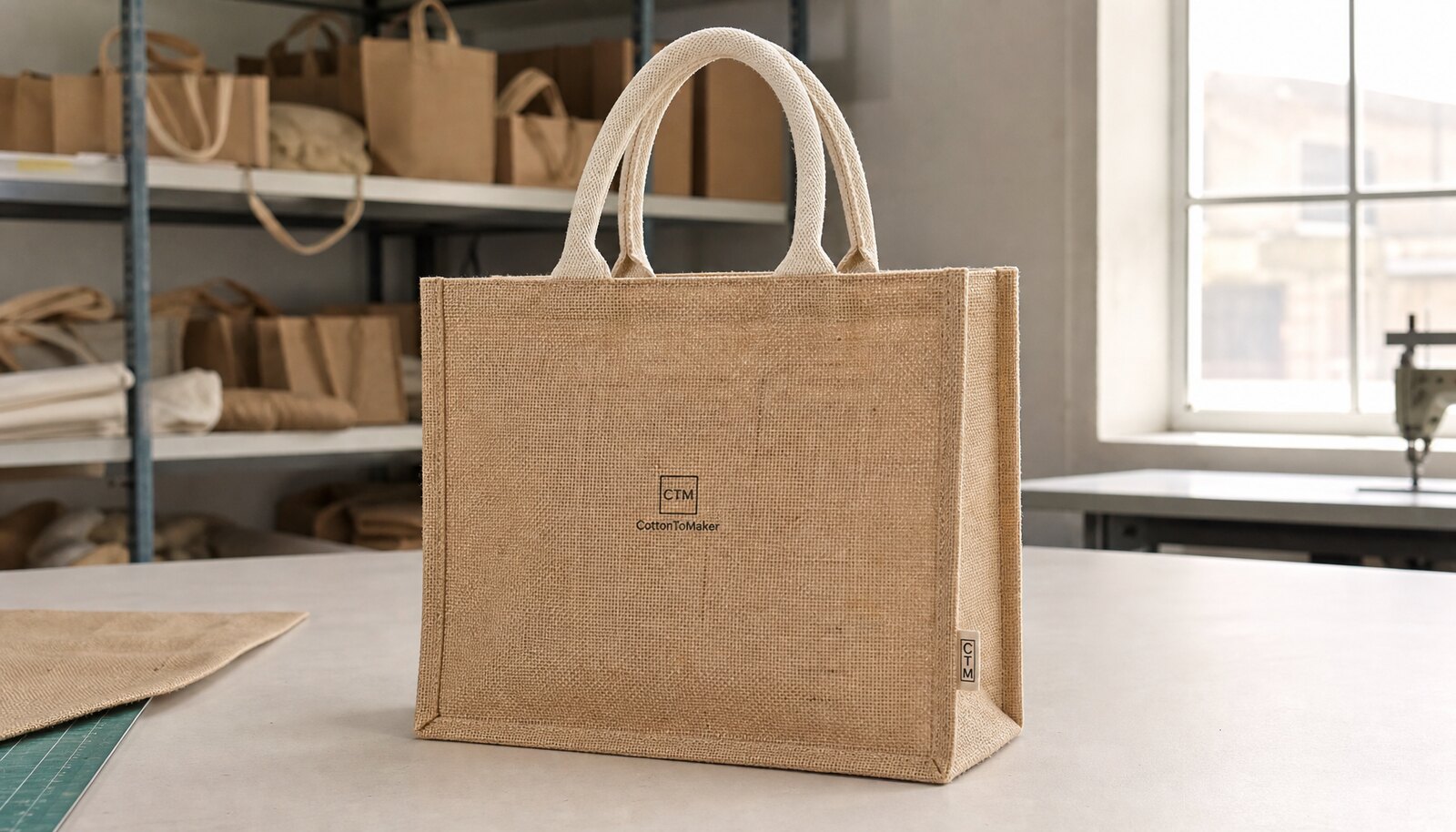
Start With the Retail Job, Not the Logo
Personalised jute shopping bags should be treated as a functional carry product, not just a printed promotion item. The first decision is what the bag must do in the hands of the end user. A supermarket replacement bag, a premium retail tote, a trade-show giveaway, and a seasonal gift carrier all need different combinations of fabric weight, structure, handle length, and branding area. If the bag fails under load or looks sloppy on shelf, the logo does not rescue it.
For procurement teams, the buyer brief should begin with the use case and the load profile. Ask what the bag will carry, how often it will be reused, whether it must stand upright, and whether it will be seen folded, stacked, or hanging in a retail display. A bag for light event handouts may be acceptable at 260-280 gsm. A genuine shopping bag generally needs more body, a stronger base, and a handle build that survives repeated carry. When the use case is unclear, the quote will also be unclear, which is where most sourcing mistakes start.
- Define the load profile: light promo carry, everyday shopping, or heavier retail reuse.
- Set the finished dimensions before art work starts, because print area and carton volume depend on them.
- Decide whether the bag must stand upright on shelf or simply carry goods without deformation.
- Confirm whether the buyer wants a natural, rustic appearance or a cleaner retail finish with backing or lining.
Choose the Jute Construction Before You Compare Prices
The bag price depends heavily on the underlying jute build, so decoration should never be priced before the structure is fixed. Jute shopping bags are commonly made from plain woven jute, but some programs use herringbone weave for a tighter visual pattern or a more premium look. The weave itself affects appearance, print legibility, and how evenly the bag feels from panel to panel. A looser weave can look more rustic but may let print sink into the texture. A tighter weave usually gives better shape control and a cleaner brand face.
Backing and liner choices matter just as much as the outer weave. An unbacked bag keeps the natural hand feel and can be easier to position as an eco product, but it creases more readily and offers less print stability. Laminated or internally backed constructions improve stiffness, reduce dust pickup, and help the bag keep a more upright profile. Cotton lining gives a retail-ready interior and can improve perceived quality, but it adds sewing complexity and cost. For some buyers, a lightweight internal lamination is the best compromise because it holds the bag shape without making it feel like a plastic carrier. The right choice depends on the end market, not on a generic 'premium' label.
Gusset depth is another structural decision that affects both utility and cost. A 10-12 cm gusset is common for flat retail carry and lightweight shopping. A 15-18 cm gusset increases usable capacity for groceries and boxed products, but it also raises material consumption and carton volume. Bottom construction deserves equal attention. A reinforced bottom seam, sometimes paired with an extra base panel or stitching fold, reduces the risk of seam opening when the bag is filled unevenly. Buyers sourcing for supermarkets or bottle carriers should ask for a practical filled-load example rather than relying on empty-bag photographs.
- Ask whether the supplier is quoting plain woven, herringbone, backed, or laminated jute, because the build changes both appearance and performance.
- Use 260-280 gsm only when the carry requirement is light and occasional.
- Use 300-320 gsm for most commercial shopping programs that need a sturdier feel and better shelf presentation.
- Use 340 gsm or more when the bag must feel substantial, stay upright, or carry heavier goods over repeated use.
- Check the bottom seam design and whether the bag has a reinforced base fold or extra stitching path.
Specify Handles and Stitching as Load-Bearing Parts
Handles are not a styling detail; they are the part most likely to fail in real use. Cotton webbing is often the best procurement choice for personalised jute shopping bags because it is comfortable in the hand, easy to source in consistent widths, and strong enough for repeat carry. Jute tape handles keep the overall look more natural, but they can feel harsher on the hand and may not age as well under repeated loading. Self-fabric handles can look neat and integrated, but they may stretch or distort if the base material is not sufficiently robust. Rope handles are sometimes used for premium gift programs, yet they are usually less practical for broad supermarket or retail use because they do not distribute weight as evenly across the hand.
The handle width and the attachment method should be written into the spec sheet in clear terms. For most shopping bags, a webbing width in the 25-38 mm range is a practical benchmark because it balances comfort and stitch area. Narrow handles can look neat in sample photos but become uncomfortable when the bag is full. More importantly, the attachment detail determines whether the handle is likely to peel, tear, or twist under load. Ask for X-box stitching or bar-tack reinforcement at the load point, and require the supplier to show the actual stitch pattern on the sample. If the order is for heavier carry or bottle pack use, ask whether the factory can add an extra stitch path, a folded reinforcement patch, or a longer handle anchor. These details often separate a bag that survives daily use from one that only survives the unboxing photo.
A procurement buyer should also ask about stitch density and visible finish. Too few stitches can leave the seam open to stress; too many in the wrong place can pucker the material and make the bag look overworked. The best answer is not a vague promise of 'strong stitching' but a photo or sample showing the exact stitch type, thread color, and reinforcement width.
- Use cotton webbing when comfort and repeated carry matter.
- Use jute tape only if the natural look is more important than hand comfort.
- Require X-box or bar-tack reinforcement at the handle root for retail or grocery programs.
- Ask for a sample showing stitch density, thread color, and reinforcement width.
- Do not accept a handle spec that only names the material without the width and attachment detail.
Match Print Method and Artwork to the Jute Surface
Jute is a textured surface, so the printing method needs to be chosen for the actual fabric rather than for a generic artwork file. For most personalised jute shopping bags, 1-2 color screen print remains the most reliable option because it produces bold, legible branding at a sensible cost. It is especially well suited to logos, simple claims, and short text. The challenge is that the rough weave can interrupt fine lines, very small type, and smooth tonal shading. Buyers should assume the design will need to be adapted to the material, not the other way around.
The print area should be stated in millimeters, not described loosely as 'large front logo' or 'centered branding'. A rough fabric can make a print appear slightly smaller than it looked on screen, and if the artwork is close to a seam or gusset fold, the visible result may be distorted. As a rule, keep delicate elements away from seam lines and avoid thin reverse text unless the supplier has already proved that the method works on the chosen build. If the bag needs barcodes, care instructions, or compliance text, a woven side label or stitched label is usually cleaner than crowding the main print panel. For multi-color artwork, request a strike-off or sample print because the registration on textured jute can shift enough to affect the look of the whole bag.
Some buyers ask whether heat transfer, embroidery, or woven labels are better than screen print. The honest answer is that each has a place. Embroidery can give a premium finish but may not suit large solid logos on thin jute. Heat transfer can be useful for certain short-run applications, but the wear behavior and surface texture should be tested carefully. Woven labels are excellent for secondary branding or product information. The sourcing decision should be based on durability, artwork complexity, and acceptable unit cost rather than on decoration trends.
- Use screen print for bold logos and larger repeat runs.
- Avoid hairline details, tiny serif type, and delicate gradients on rough jute.
- State print size and position in millimeters and approve a physical strike-off when possible.
- Move care instructions or legal text to a woven label if the main logo area is already crowded.
- Ask the supplier how much print area is actually usable once seams and gussets are factored in.
Write the Spec Sheet Like a Manufacturing Document
A strong spec sheet reduces quote noise and prevents the supplier from filling in missing details with its own assumptions. For personalised jute shopping bags, the specification should identify the finished dimensions, gusset depth, handle drop, fabric weight, weave type, backing or lining choice, print method, print size, thread color, and packing format. If any of these fields are left open, the supplier may quote a cheaper version than the one the buyer actually needs. That can lead to scope creep later, when the sample looks fine but the bulk bag is built to a different standard.
Tolerances should also be written into the document. If the buyer needs retail consistency, the allowable variation in length, height, gusset, and print position should be stated. The tolerance does not need to be over-engineered, but it should exist. Without a tolerance, the supplier may treat variation as normal even when the bags look mismatched in a retail stack. Size variation, especially on a natural fiber product, is normal to some degree; the procurement task is to decide how much variation is acceptable for the end use. That is different from accepting whatever the factory can produce.
The most useful buyer documents are simple but complete. One page can carry the core dimensions, a line drawing or reference image, the logo placement, the ink reference, the handle detail, and a short note about packing. Another page can cover acceptance criteria and defect examples. If the bag is going to multiple markets or channels, the buyer should define whether the spec must work for all regions or only for one program. That avoids the common mistake of letting local preferences overwrite the actual commercial requirement.
- Write the finished size, gusset, handle drop, and print placement into the spec.
- State weave type, gsm, backing, and lining options instead of relying on adjectives.
- Include acceptable tolerances for size and print position.
- Attach a simple line drawing or annotated image so the factory is quoting the same geometry you intend to buy.
- Use one approved spec sheet for every supplier, including the trading company if you use one.
Use MOQ Logic to Keep the Quote Comparable
MOQ should reflect setup reality, not just the supplier's preferred order size. Jute bags involve cutting, stitching, printing screens, thread preparation, carton planning, and sometimes separate handling for liners or labels. That means a very small run can be disproportionately expensive even if the bag itself is simple. Procurement buyers get better pricing clarity when they hold the spec constant and ask for tiered prices at realistic volumes, such as 1,000, 3,000, and 5,000 pieces. This shows where the cost curve starts to flatten without disguising one spec as another.
The most common mistake is to add too many variables at once. Multiple artwork versions, mixed handle colors, and different base bag colors all create separate setups. A supplier may still quote the order, but the number will no longer be useful for comparing alternatives. If the buyer is testing market response, keep the first order narrow: one size, one body color, one logo version, one packing style. If a variant is essential, ask the supplier to price it separately so the real cost of customization is visible. That makes the quote more honest and helps the buyer decide whether the variant is worth the complexity.
For procurement teams, MOQ is also a risk-management tool. A lower MOQ may be preferable for a new brand or a seasonal launch, but the buyer should check whether the low MOQ comes with higher setup fees, less consistent material allocation, or weaker scheduling priority. A slightly higher order can sometimes deliver better unit economics if it allows the factory to run the batch more efficiently. The point is to compare the total economics, not to chase the lowest-looking minimum.
- Ask for price tiers on the exact same spec.
- Keep the first order to one size, one body color, and one artwork version where possible.
- Treat each additional print color or label version as a separate setup.
- Check whether a low MOQ is offset by extra fees or reduced production priority.
- Compare the cost curve, not only the first price point.
Approve Samples for Materials, Not Only for Artwork
A sample has limited value unless it proves the actual materials and construction method. For personalised jute shopping bags, the approval sample should use the intended fabric weight, handle material, reinforcement method, print process, and packing style. A beautiful logo on a lighter fabric or a different handle does not protect the buyer from bulk variation. Procurement teams should ask whether the sample is a hand sample, a pre-production sample, or a sealed reference sample, because those stages are not interchangeable.
The sample review should be practical. Measure the bag against the approved dimensions, check the handle drop, inspect the seam finish, and confirm the print position relative to the center and edges. Fold the bag, fill it, and test whether it opens and closes the way the buyer expects. If the bag is sold in a branded retail environment, the inside finish matters too: loose threads, exposed adhesives, or uneven lining work can degrade the perceived quality even when the outside looks acceptable. Keep one sealed golden sample signed off by both sides, and label it clearly with date, artwork version, and fabric spec.
The goal is not perfection; it is controlled repetition. If the sample is approved against the right materials and dimensions, the factory has a reference for the bulk order. If the buyer approves a sample only because the logo looks correct, the bulk shipment can still fail on handle strength, seam neatness, or fabric consistency. That is why approval should be a procurement step, not just a design step.
- Approve the exact fabric, handle, and reinforcement method.
- Confirm whether the sample is hand-built, pre-production, or a sealed reference.
- Measure the physical sample against the spec sheet, not against memory.
- Test opening, folding, and filled carry behavior before sign-off.
- Store one sealed golden sample for later lot comparison.
Build a QC Plan That Finds Real Defects Before Shipment
Quality control for jute bags should go beyond a quick appearance check. The most useful QC plan starts with a sample size rule, then layers in defect definitions and practical tests. AQL is a good base, but procurement buyers should also define what counts as a major defect and what counts as a minor one. For example, a seam opening, a weak handle attachment, or a crooked print that affects brand presentation should be treated more seriously than a small loose thread or a tiny natural weave variation. Without those definitions, the factory and the buyer may disagree about what is acceptable.
The inspection itself should be specific. Check finished dimensions, gusset depth, handle length, and print placement on a random lot sample. Compare the actual bag to the sealed approved sample, not to a verbal description. Inspect the handle root closely, because that is where stress failure usually begins. Look at the bottom seam corners and side gussets for skipped stitches, uneven sewing, or puckering. Examine the print for registration drift, weak ink deposit, over-smudging, and rubbing. If the bag contains laminate or adhesive, check for odor, delamination, or visible bubbling. Those are the details that affect the buyer after goods are delivered, not just in the factory.
A practical pre-shipment inspection should also include load and packing checks. Use representative bags and place them under the kind of filled weight the end user will actually carry. If the bag distorts immediately or the handle pulls at the attachment point, the program should not ship as-is. Then check carton labels, carton count, moisture protection, and whether the carton dimensions match the booking. Many shipment problems start as packing problems, and packing problems are easier to correct before the goods leave the factory than after they arrive.
- Define major and minor defects before inspection starts.
- Treat seam opening, weak handles, and print misregistration as major issues for retail programs.
- Inspect against the sealed sample, not only against the spec sheet.
- Run a practical filled-load test on representative bags.
- Verify carton count, carton labels, and moisture protection during pre-shipment review.
Compare Factory, Trading Company, and Local Decoration by Risk, Not by Label
When buyers compare sourcing routes, the useful question is not 'which type of supplier is cheapest' but 'which route gives the lowest total risk for this order'. A direct factory that handles cutting, stitching, printing, and packing in-house often gives the best process visibility. The buyer can ask who owns the final inspection, where the print screens are stored, and whether the same line runs all stages. That matters because a bag can be quoted at one specification and produced through several subcontracted steps that are harder to control.
Trading companies can add value if they consolidate factories well, manage multiple product types, or coordinate shipments across a broader program. The risk is that the buyer may not know where each step is done, which factory actually owns the quality decision, or whether the quote includes a margin on top of multiple process layers. That does not make trading companies bad suppliers, but it does mean the buyer should request traceability: factory name, process flow, QC responsibility, and sample ownership. If those details are vague, the quote should be treated cautiously.
Local decoration after import is a different business model. It can be useful when a buyer wants to hold blank stock and add branding later, or when artwork changes often and late-stage flexibility matters more than factory integration. The tradeoff is extra handling and a second quality step. For some procurement teams, that is acceptable because it protects against forecast error. For others, especially where unit economics are tight, it simply adds cost and complexity. The correct route is the one that fits the channel, the lead time, and the tolerance for variation. Buyers should ask for landed cost on the same basis across each route so they can compare total value rather than headline unit price.
- Direct factory: best when you need tighter process control and repeatable bulk quality.
- Trading company: useful only when it adds real coordination, not just an extra margin layer.
- Local decoration: good for late-stage branding changes, but check the extra handling cost and risk.
- Ask who owns QC, where the work is actually done, and how sample approval is controlled.
- Compare routes on landed cost and defect risk, not just FOB price.
Pack, Ship, and Receive the Bags Without Damage or Surprise Cost
Packing decisions affect product condition, freight cost, and warehouse efficiency. Jute can absorb and release moisture, so it does not like sloppy packing or humid transit conditions. Buyers should define whether the bags are bulk packed, individually wrapped, interleaved with paper, or bundled in a way that keeps the shape flatter in the carton. Bulk packing is usually the most efficient for freight, but it may leave more surface marks and handling variation. Individual wrapping improves presentation and dust control, but it adds labor and volume. There is no universal best option; the correct choice depends on the retail channel and the destination market.
Carton planning is equally important. The quote should state carton dimensions, pieces per carton, gross weight, and whether moisture protection is included. This matters because carton volume can change the freight bill materially, even when the unit price looks attractive. For sea freight and humid lanes, a moisture barrier or other protective packing step may be worth the extra handling. Buyers should also ask how cartons will be labeled for receiving: item code, color, quantity, and carton number. A well-packed order is easier to count, easier to inspect, and easier to warehouse. A poorly packed order creates avoidable labor at the destination and can hide damage until the cartons are opened.
If the bags are going to retail distribution centers, ask the supplier to align carton pack counts with the receiving process. Small, inconsistent pack counts create unnecessary handling. Overfilled cartons can crush handles or distort the bag body, while underfilled cartons waste volume and increase freight cost. The packing format should be part of the commercial comparison, not something discussed after the price is already accepted.
- Specify bulk pack, wrap style, and carton count before approval.
- Ask for carton dimensions and gross weight in the quote.
- Check whether moisture protection is included for sea freight or humid routes.
- Align pack count with the receiving process to reduce handling.
- Avoid overfilled cartons that deform handles or bag panels.
Specification comparison for buyers
| Spec decision | Common buyer options | How to choose | Buyer risk to check |
|---|---|---|---|
| Fabric / weave build | Plain woven jute, herringbone weave, jute with cotton or laminated backing | Plain weave is the most common and cost-efficient; herringbone gives a neater premium appearance; backed or laminated builds hold shape better and print more cleanly | Ask whether the supplier is mixing yarn lots or loom settings, because that can create visible shade and texture variation across panels |
| Fabric weight | 260-280 gsm, 300-320 gsm, 340 gsm+ | Use 260-280 gsm for light promo carry; 300-320 gsm for everyday shopping; 340 gsm+ for heavier loads or a more premium hand feel | A high gsm number alone does not guarantee strength if the weave is loose or the handle attachment is weak |
| Liner / backing | No liner, PP or laminate backing, cotton lining, inner lamination only | No liner keeps the bag more natural and flexible; backing improves stiffness and print flatness; cotton lining is useful when the bag must look more retail-ready inside | Check whether the liner is sewn in or laminated, since that affects odor, recyclability expectations, and repairability |
| Handle material | Jute tape, cotton webbing, self-fabric handles, rope handles | Cotton webbing is usually the best balance of comfort and durability; jute tape is lower cost and more natural-looking; self-fabric is cleaner visually but may stretch more | Thin handles can dig into the hand and early tearing often begins at the attachment point rather than the handle itself |
| Handle reinforcement | Single stitch, double stitch, X-box, bar-tack, rivet plus stitch | For shopping use, ask for X-box or bar-tack at the load point; add reinforcement if the bag will carry bottles or boxed goods | Single-line stitching is the first failure point under repeated loading and should not be accepted for retail carry programs |
| Print method | 1-2 color screen print, heat transfer, woven label, embroidered patch | Screen print is best for bold logos and larger runs; woven labels or patches are better for small branding elements; heat transfer is more sensitive to surface texture and wear | Fine typography, gradients, and close registration often degrade on rough jute, especially on uncoated surfaces |
| Sourcing route | Direct factory, trading company, or local decoration after import | Use direct factory when you need fewer handoffs and tighter process control; use trading companies when they add real consolidation and QC value; use local decoration only when late-stage branding changes are likely | A low unit price can hide extra handling, duplicate setup fees, or uncontrolled subcontracting |
| Packing and freight | Bulk packed, individual polybag, paper wrap, carton with moisture protection | Bulk packing is efficient; polybag or paper wrap is better for presentation and dust control; moisture protection matters on long or humid routes | Carton volume, not just unit price, often drives landed cost and warehouse receiving effort |
| QC standard | AQL sampling, full bag measurement, load test, print inspection, carton check | Use AQL as the base, then add practical checks for size, stitching, print placement, and load performance | Inspection that only looks at appearance can miss weak seams, handle pull failure, and print rubbing |
Buyer checklist before sampling
- Lock the finished size, gusset depth, and handle drop before asking for pricing.
- Specify the fabric build in gsm and weave type; do not use vague terms like 'premium jute'.
- Decide whether the bag needs lamination, a separate liner, or an uncoated natural interior.
- Send vector artwork and state the print method, number of colors, print area, and color references.
- Ask for pricing at the same spec across tiers such as 1k, 3k, and 5k pieces.
- Request a pre-production sample or signed sealed sample before bulk starts.
- Confirm carton count, carton dimensions, gross weight, and moisture protection for the route.
- Define acceptance tolerances for size, shade, print position, seam quality, and handle reinforcement.
Factory quote questions to send
- What exact weave type, gsm, and backing structure are you quoting for this bag?
- Is the bag made from plain woven jute, herringbone, or another weave, and do you mix yarn lots during production?
- What are the handle options, the handle width, and how is the attachment reinforced at the load point?
- How many print colors are included in the base price, and do you charge separate screen/setup fees?
- What is the print area in millimeters, and what artwork detail is too fine for your process?
- What is the MOQ per artwork, per color, and per size, and where do price breaks begin?
- Can you quote the same bag with and without lamination or lining so we can compare landed cost?
- What sample stage is included, and can we approve a physical pre-production sample against a sealed reference?
- What carton pack count, carton dimensions, and gross weight should we expect for export shipping?
- Which defects are treated as major versus minor in your QC plan, and what AQL are you proposing?
Quality-control points to confirm
- Measure finished length, height, gusset depth, and handle drop against the approved spec sheet on a random sample from each lot.
- Check whether the actual fabric weight and weave density match the approved sample, and look for panel-to-panel variation.
- Inspect the seam path at the handle root, including X-box, bar-tack, or double-stitch areas where load stress concentrates.
- Check the bottom seam and side gusset corners for skipped stitches, broken yarns, puckering, or seam opening under tension.
- Verify print registration, edge sharpness, ink density, and coverage on the full logo area, not only the center of the design.
- Rub-test the print lightly and look for smearing, cracking, or transfer to adjacent surfaces before shipment.
- Look for stains, oil marks, loose threads, odor from lamination or adhesive, and visible yarn slubs that affect retail presentation.
- Confirm carton labeling, pack count, and moisture protection, then check that cartons are not crushed or overpacked.
- Perform a practical load test using the buyer's expected filled weight, and reject samples that deform too easily or split at the handle.
- Keep one sealed golden sample signed off by both sides so bulk production can be compared against a fixed reference.