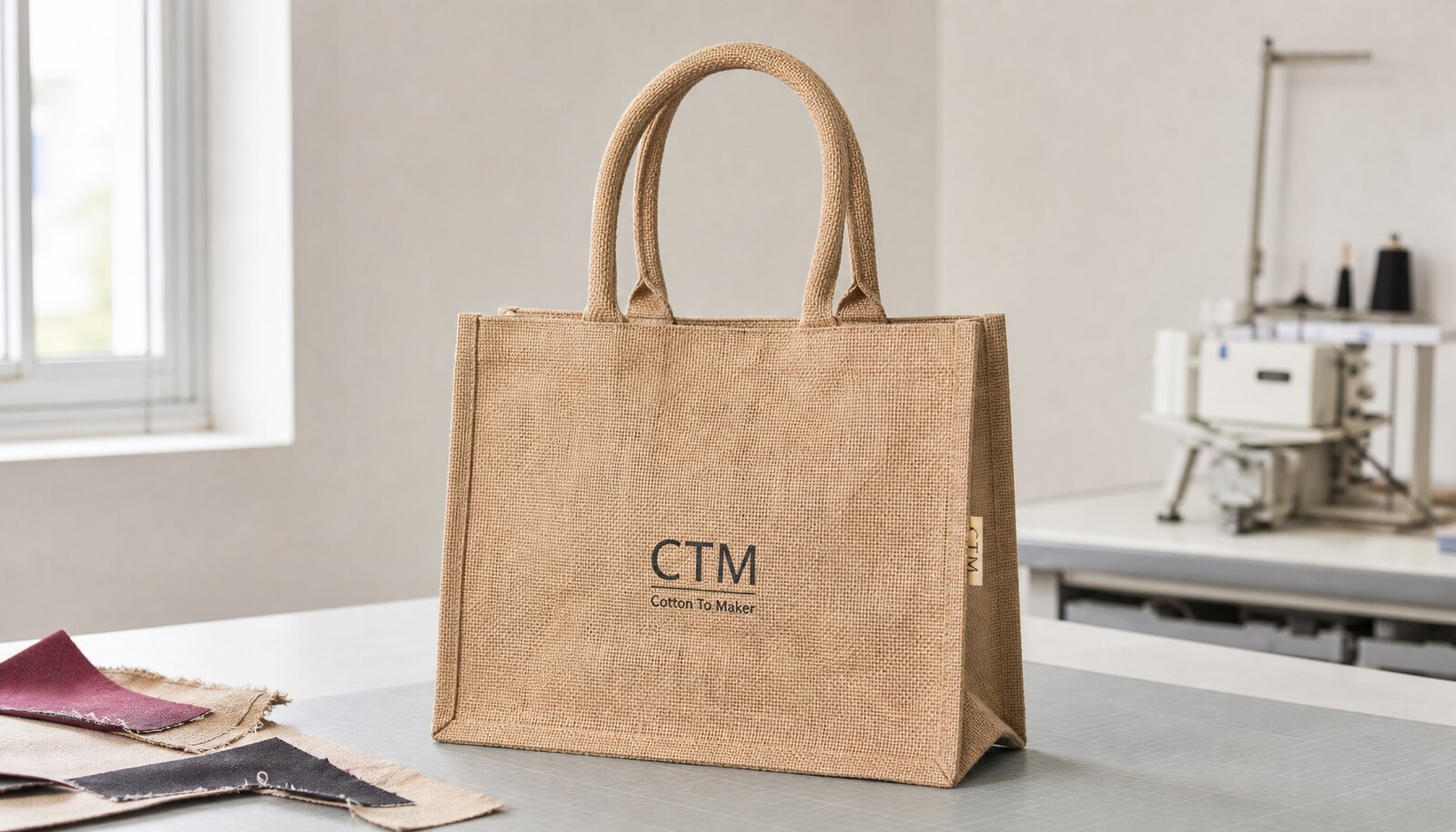
Start With the Job the Bag Has to Do
Personalised jute bags are not one product. A promo giveaway, a retail carry bag, a grocery tote, and a gift bag all ask different things from the same material. If the brief starts with artwork first and use case later, the supplier has to guess the build. That is how buyers end up comparing quotes for bags that look similar on paper but behave very differently in use.
The first part of the RFQ should define the commercial job. State whether the bag is meant to be handed out flat, displayed on shelf, reused many times, or used for heavier carry. Add the expected load, the channel, and whether the bag needs to stand upright. Those details decide the fabric weight, the reinforcement, the print method, and even the packing method. If the buying job is clear, the supplier can price the same product each time instead of pricing a moving target.
- Define the end use before asking for price.
- State the expected carry weight and reuse level.
- Say whether shelf presentation matters as much as unit cost.
- Fix the launch date and volume so the supplier can judge capacity.
Choose the Bag Build, Not Just the Fabric
For personalised jute bags, GSM is only the starting point. A 300 to 350 gsm unlaminated body is usually enough for light retail and event use, but it will feel softer and show the weave more clearly. If the bag needs a more structured shape, a stronger retail look, or heavier carry, 400 to 450 gsm is a better base. Above that, the buyer should ask whether the extra weight is needed for the job or only to make the bag look more substantial in a sample room.
Construction details matter just as much as fabric weight. A gusset increases usable volume and gives the bag a better profile when filled. A lining or light lamination can improve shape retention and make print look cleaner, but it can also create stiffness, cracking, or odor if the process is poor. Handle choice matters too. Self-fabric handles are cheaper, while cotton webbing or rope handles usually feel better and last longer. If the bag will carry bottles or irregular goods, ask for top-edge reinforcement and bartacks at the handle root rather than relying on the body fabric alone.
- 300 to 350 gsm fits light carry and promotional use.
- 400 to 450 gsm fits a more structured retail bag or heavier load.
- Lamination improves surface stability but adds cost and failure risk if poorly applied.
- Gussets, linings, and handle reinforcement should be quoted as separate build choices.
Match the Branding Method to the Surface
Jute texture does not forgive fine artwork. Thin text, small reverse details, gradients, and tight linework can disappear into the weave or print unevenly across the fabric. For most personalised jute orders, one or two spot colors in screen print are the cleanest and easiest to control. The artwork must be simplified for the medium, not copied from a smooth packaging surface and pushed onto rough fabric without adjustment.
If the brand needs a more premium finish, a woven label, sewn patch, or neat side label may be better than forcing complex art into the print area. Heat transfer can work on smoother or laminated surfaces, but buyers should test it for adhesion and wear, not just appearance. Approval should be based on a real strike-off at actual size, with Pantone references, placement dimensions, and a minimum line and text size that still reads clearly on textured jute. For artwork approval, daylight or a controlled white light setup is better than judging color on a phone screen.
- Use screen print for simple logos and cost control.
- Avoid tiny type and hairline strokes unless the artwork is redesigned for jute.
- Use a woven label or patch when the brand wants a cleaner premium mark.
- Require a physical strike-off at actual size before bulk approval.
Quote the Whole Build, Not a Single Unit Price
A useful quote for personalised jute bags should separate the cost items that actually move the number. The bag body, handle type, reinforcement, print setup, lining or lamination, packing, carton spec, and inspection costs should not be buried inside one rounded unit price. If they are, there is no way to tell whether the offer is genuinely efficient or simply missing a step that will reappear later as a charge or a defect.
MOQ should be tied to the build. One size, one color, one print setup, and one handle style is the easiest order to price. Add a second size, a second print color, a special patch, or a different handle material and the setup load rises immediately. Buyers should ask for option pricing rather than forcing one quote to cover several possible builds. A clean comparison sheet can show the base bag, the upgraded bag, and the premium version side by side, which makes landed-cost tradeoffs much easier to see.
- Ask the supplier to list body, decoration, packing, and setup separately.
- Compare MOQ by style and decoration method, not only by total volume.
- Request options for a base spec and two upgrade levels.
- Include freight cube and carton count when comparing landed cost.
Choose the Supplier Route With the Fewest Blind Spots
The supplier type matters less than process ownership, but it still changes risk. A direct factory is usually the best fit when the order needs tighter control over cutting, printing, sewing, packing, and final QC. A trading company can be useful when the buyer needs a mixed program or a smaller order that would otherwise be hard for one factory to prioritize. A local decorator can work well for regional demand, but the buyer still needs to know who actually owns the fabric, the print line, and the final sign-off.
The danger is handoff drift. If one party quotes, another prints, and a third packs, there is a high chance that a small change will not be tracked properly. The buyer should ask who signs the sample, who approves the bulk start, and who is responsible if the color, size, or packing changes mid-order. If the supplier cannot answer those questions cleanly, the quote is not ready for procurement. The lowest price is not useful if no one can explain how the bag is actually being made.
- Use a direct factory when repeatability and traceability matter most.
- Use a trader only when the coordination value is real and visible.
- Ask who owns each production step before comparing price.
- Do not approve a quote until the final QC owner is named.
Approve the Sample as if It Were the Bulk Lot
A sample is only useful if it mirrors production reality. A beauty sample made from stock fabric can look excellent and still hide the problems that will appear in bulk. The pre-production sample should use the intended fabric weight, the intended handle material, the intended print method, and the intended finishing line. If the sample is made differently, it should be treated as a concept sample only, not as the production standard.
The approval should be measurable. Check dimensions, gusset depth, handle drop, print position, color density, seam finish, and the way the bag sits when filled. On jute, the edge finish and loose fiber control matter as much as the logo. If the bag is meant to carry weight, lift it by the handles and check whether the top edge distorts or the stitching opens. When possible, keep one signed and dated sample as the reference piece for inspection and for any future repeat order.
- Approve production fabric, not substitute stock fabric.
- Measure the bag instead of judging it only by eye.
- Check handle drop and print placement before signing off.
- Keep one signed reference sample with the order file.
Write QC Rules the Factory Can Actually Follow
Factory QC for personalised jute should go beyond dimensions and seam appearance. Buyers need acceptance rules for the defects that matter commercially. Start by classifying critical, major, and minor defects. A wrong size, a wrong logo, a failed handle, wet cartons, or signs of mildew should be treated as critical. Loose threads, inconsistent stitch density, or visible shade variation should be treated as major if they affect the way the bag will be received by the customer. Small cosmetic issues only belong in the minor bucket if the buyer is comfortable passing them under the agreed standard.
Handle stress is one of the most important checks and one of the most often under-specified. The test does not need to be complicated, but it should be realistic and agreed in advance. A filled bag should be lifted, held, and inspected for tearing, stitch pop, or elongation at the handle root. Color should be compared against the approved physical master under stable light, not against an old phone photo. Artwork should also be checked for registration, coverage, and edge sharpness on the actual fabric texture. If the logo moves, blurs, or loses readability, that is not a small issue for a branded bag.
- Write critical, major, and minor defect rules before inspection starts.
- Set a handle stress check that reflects the intended carry load.
- Compare color against the signed master under consistent light.
- Reject poor print registration, mildew, wet packing, and wrong labels.
Get Packing Right Before the Bags Leave the Factory
Packing can quietly destroy an otherwise good order. Jute is sensitive to moisture, creasing, and rough handling, so the fold method and carton spec need to be locked early. Flat packing is usually the most efficient route for export, but the fold should protect the front print and avoid a permanent crease through the logo. If the bag is structured or has a premium finish, the packing method should be chosen to preserve appearance, not only to reduce carton count.
Carton details belong in the product spec because they affect freight, warehouse handling, and receiving time. Ask for inner pack count, carton dimensions, carton markings, barcode placement, and whether a moisture barrier or liner is included. In humid routes or sea freight programs, a simple moisture control layer can prevent claims later. Overpacking is also a risk. If the carton is too tight, the bag arrives crushed; if it is too loose, the shipment wastes cube and raises freight cost.
- Define the fold method before mass production starts.
- Specify carton count, carton size, and barcode rules.
- Use moisture protection when transit or storage conditions justify it.
- Do not let packing create permanent creases across the front print.
Plan Lead Time Around the Slowest Decision, Not the Fastest Promise
Lead time for personalised jute bags is a chain of decisions, not a single number. Artwork approval, material booking, sample sign-off, cutting, printing, sewing, packing, inspection, and export handover all sit on the critical path. If the order includes multiple print colors, a lining, or a custom label, the chain gets longer because more steps have to align before bulk can move. Buyers who ask only for the ship date often miss the real risk, which is whether the factory has enough control to hold the same spec through the whole run.
The safer way to plan is to build the schedule stage by stage and keep one buffer for approval delay. That matters even more in peak season, when raw materials and production slots are tighter. For repeat orders, retain the approved sample, the artwork file, and the print settings so the second order does not become a new qualification exercise. A good reorder is not just faster; it is also cheaper because the supplier is not re-learning the same spec from scratch.
- Ask for timing by stage, not only one final lead-time number.
- Add buffer for artwork sign-off and sample revision.
- Lock materials early if the order is tied to a fixed launch date.
- Keep the approved sample and artwork file for repeat orders.
Use One RFQ to Force Apples-to-Apples Quotes
The easiest way to get a clean quote is to send one page that contains the bag spec, the artwork file, the packing instruction, and the target ship window. Buyers should not send a logo alone and expect the factory to guess the rest. The clean RFQ has one size, one material spec, one decoration method, one packing method, and one approval path. If there are variations, they should be listed as separate options instead of blended into one vague request.
The most common procurement mistakes are predictable. Buyers ask for the lowest unit price before they define the bag; they compare quotes that include different packing assumptions; they approve a sample made from the wrong fabric; or they leave acceptance rules undefined and then argue over defects after inspection. None of those problems are complicated, but all of them create cost. If you want a useful personalised jute quote, make the factory prove it has understood the spec before it prices the bag.
- Send one locked spec sheet instead of scattered revisions.
- Keep size, fabric, print method, and packing consistent across all quotes.
- List any acceptable options separately rather than mixing them into one request.
- Use the approved sample and QC rules as part of the RFQ, not as an afterthought.
Specification comparison for buyers
| Build choice | What it changes | Best fit | Procurement tradeoff / landed-cost impact |
|---|---|---|---|
| Flat, unlined tote at 300 to 350 gsm | Lowest material content, simplest cutting and sewing, softest body profile | Event handouts, light retail, short-life campaigns, low-carry giveaways | Lowest unit price, but the bag can sag when loaded, crease easily in packing, and look less premium on shelf |
| Gusseted tote at 300 to 350 gsm | Adds depth and usable volume without changing the base fabric weight | Shopping bags, gift packs, general retail use, compact reusable formats | Slight cut-and-sew uplift, but better capacity can avoid upsizing the whole bag, which often keeps freight and material cost down |
| Structured body at 400 to 450 gsm | Improves stiffness, panel stability, and appearance after filling | Retail programs, heavier carry, display-ready bags, premium branded tote orders | Higher fabric cost and more piece weight; uneconomic when the bag is mostly promotional and will not be reused |
| Laminated or lined body | Improves surface stability, print presentation, and moisture resistance | Premium retail, gifting, humid transit, or orders that need a cleaner outer face | Adds material and labor cost; poor lamination can crack, smell, or delaminate, creating claims that outweigh the visual benefit |
| Boxed base or base insert | Helps the bag stand upright and keeps the load from collapsing into the corners | Shelf display, bottle carry, food retail, premium gifting | Adds parts and labor; becomes uneconomic if the bag is mostly flat-packed and the end user never needs self-standing shape |
| Self-fabric handles | Keeps the build simple and keeps color and texture consistent across the whole bag | Price-sensitive promotional orders and lighter carry | Lowest handle cost, but the fold area can wear faster and the grip is less comfortable for repeated use |
| Cotton webbing handles | Improves comfort, grip, and durability at the lift point | Reusable retail bags, grocery carry, and premium branded programs | Usually costs more than self-fabric handles, but often reduces handle wear and complaint risk on heavier fills |
| Rope handles | Creates a more gift-like or premium look and a softer hand feel | Boutique gifting, seasonal retail, and higher-value branded sets | More expensive than basic webbing or self-fabric handles; uneconomic if the order price must stay near promotional tote levels |
| Reinforced top edge and bartacks | Strengthens the highest-stress area where the bag is lifted and dropped | Any tote expected to carry bottles, groceries, or repeated use | Small cost increase compared with the downside of handle tear-out, but it should be specified explicitly rather than assumed |
Buyer checklist before sampling
- Lock the final bag size, gusset depth, handle drop, body weight range, and reinforcement points before requesting pricing.
- State the use case clearly: promo handout, retail tote, grocery carry, gifting, or a reusable shelf item with a premium finish.
- Send vector artwork with Pantone references, minimum line thickness, minimum text size, and the exact print position on the bag.
- Confirm whether the body is unlaminated, laminated, lined, or reinforced at the handles and base, and ask the supplier to price each option separately.
- Request MOQ by size, print method, handle type, and decoration complexity rather than asking for one blanket MOQ number.
- Ask for a pre-production sample made from the intended production fabric and finishing process, not a random stock body.
- Define packing in detail: fold method, piece count per inner pack, carton quantity, carton markings, barcode rules, and moisture protection.
- Ask for lead time by stage: artwork approval, material booking, sample approval, production, inspection, and export handover.
- Require the quote to separate unit price, setup or screen charges, packing, and any special finishing costs so landed cost can be compared properly.
- Set a written defect rule before inspection, including size tolerances, print tolerance, and what counts as a critical failure.
Factory quote questions to send
- What exact jute GSM, weave density, and surface finish are you quoting, and is that the same fabric you will use for bulk production?
- Is the quoted price based on one-color screen print, multi-color print, woven label, patch, heat transfer, embroidery-style branding, or no branding at all?
- What is the MOQ for each size, and does the MOQ change if I add a second print color, a different handle material, a base insert, or a lining?
- Please list every one-time charge separately: screens, plates, artwork prep, label tooling, sample charges, and any color matching fees.
- What are the recurring per-bag costs for the body, handles, reinforcement, printing, packing, and carton work?
- Are samples made from the same fabric, handles, ink system, and sewing line you will use in bulk production?
- What handle construction will you use, how many attachment points are included, and how is the load point reinforced?
- What are the exact carton dimensions, pack quantity, carton markings, barcode placement, and moisture protection included in the quoted price?
- What is your production schedule from artwork approval to ex-factory date, and which steps are most likely to delay the order?
- Who owns cutting, printing, sewing, packing, and final QC if any part of the order is subcontracted?
Quality-control points to confirm
- Measure body width, height, gusset depth, and handle drop against the approved spec, and set the tolerance before production starts. A practical starting point is +/-1 cm for body dimensions on small and medium bags, and +/-1.5 cm for larger formats.
- Check jute weight, weave consistency, and surface appearance across the lot so the shipment does not alternate between loose, soft panels and overly stiff panels.
- Inspect handle attachment, bartack placement, seam density, and top-edge reinforcement at the exact stress point where the bag will be lifted most often.
- Set stitch quality rules in advance. For load-bearing seams, agree a target stitch density, no skipped stitches, no broken stitches, and no visible seam opening after normal handling.
- Run a handle stress check on filled samples using the intended carry load or a realistic test load agreed before production. Reject bags that show stitch pop, seam creep, tearing, or visible elongation at the attachment point.
- Set a print placement tolerance and use it consistently. A practical starting point is +/-5 mm for logo position and no visible misregistration that affects readability or brand alignment.
- Review print registration, ink coverage, and edge sharpness on the actual production fabric, not just on a paper proof. Thin lettering, reversed text, and fine lines should be rejected if they blur into the weave.
- Set color tolerance against the approved master sample and check under consistent light. If the shade drift makes the logo or body look materially different from the approved reference, treat it as a major defect.
- Agree defect classification before inspection: wrong size, wrong artwork, failed handles, wet cartons, or mold should be critical defects with zero tolerance; major defects should be capped by the agreed AQL or sample rate; minor defects should only pass if they do not affect function or presentation.
- Reject cartons or bags with mildew smell, damp packing, stains, broken yarns, oil marks, or loose fibers that cannot be removed without affecting appearance.