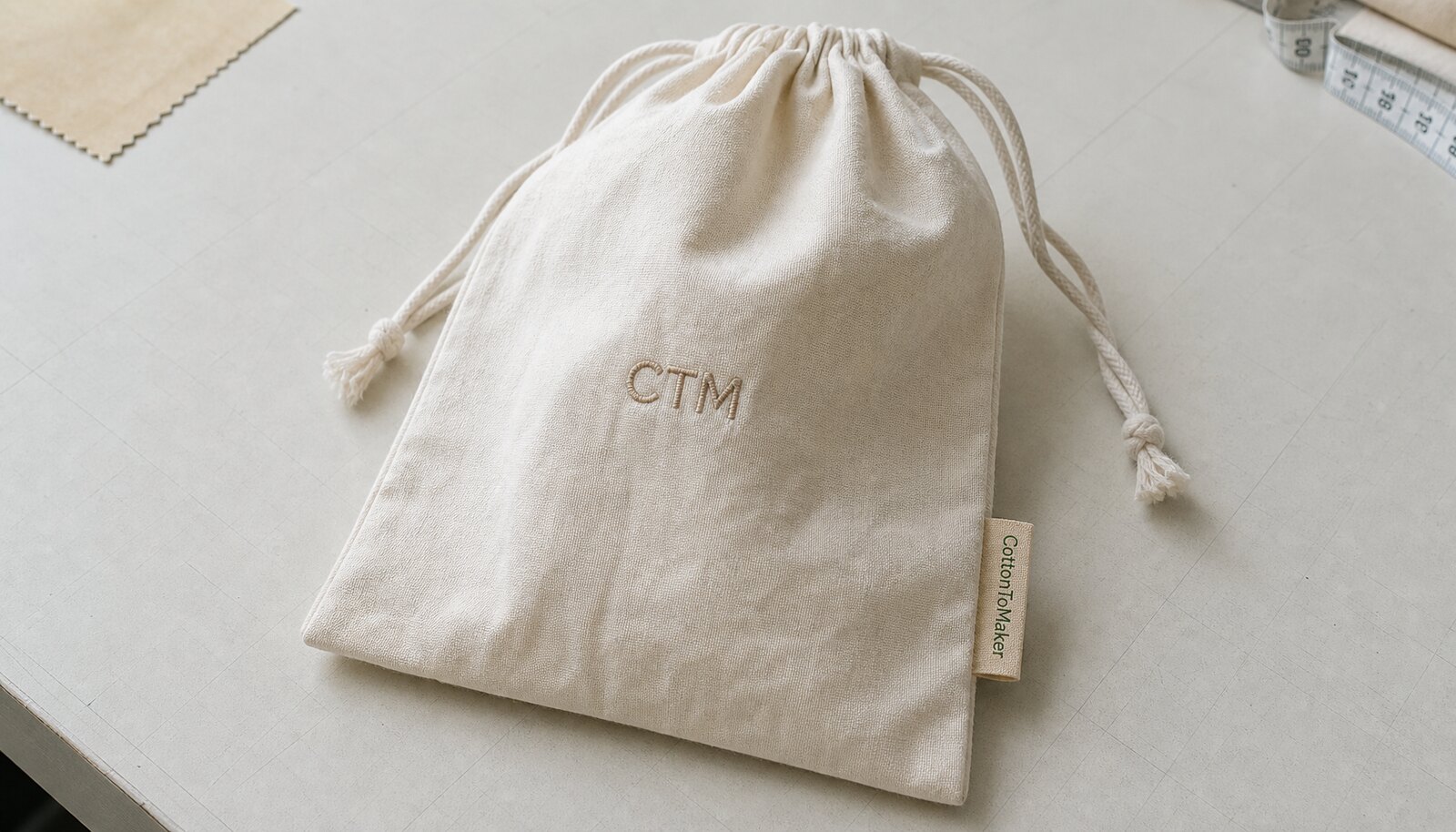
Start With the Use Case, Not the Decoration
A personalised embroidered drawstring bag looks simple, but sourcing mistakes usually start when the buyer begins with artwork instead of use case. The right spec depends on whether the bag is for retail gift packaging, premium event merch, beauty kits, garment inserts, or a reusable carry bag. Embroidery adds texture and perceived value, but it also adds stiffness, stitch tension, and weight. If the bag will be shipped flat and opened later by the end user, you can accept a softer body and a simpler logo. If it must sit on a shelf, survive postal handling, or be reused many times, the body fabric and closure quality matter as much as the decoration.
For RFQs, write the end use in one sentence and let the supplier build the spec around that. A brief like retail gift bag for apparel, must hold 1 kg, logo visible from 1 m, packed 50 pcs per carton gives the factory something real to price. A vague line like embroidered drawstring bag forces the supplier to fill the gaps with assumptions, and that is where quote comparison breaks down. The buying problem is not finding a supplier who can embroider a logo. It is getting the same logo, on the same bag body, with the same finish, at the same landed cost.
- State the carry weight, retail channel, and whether the bag is meant to be reused.
- Give the maximum logo width and the number of embroidery locations.
- Define the packing format early if the cartons must fit a distribution system.
Choose the Base Bag That Can Hold Embroidery Cleanly
The base fabric controls puckering more than most buyers expect. Lightweight cotton is fine for simple giveaway pouches, but once the artwork gets dense, the needle forces can distort the fabric. For most personalised embroidered drawstring bag programs, 180-240 gsm cotton or cotton canvas is the practical middle ground. Around 120-160 gsm works for low-cost promotions, while 300-340 gsm canvas gives a more premium hand and better structure, but it also increases sewing time and freight weight. If the bag will carry cosmetics, small apparel, or heavier gift sets, use a tighter weave or add a lining so stitch pull does not show through the inside.
Polyester or poly-cotton can reduce shrinkage and keep dimensions steadier in transit, but the look is less natural. That matters if the embroidery is meant to feel premium or handmade. Ask for the actual fabric weight in gsm, not just cotton or canvas. A 200 gsm plain weave from one mill can behave very differently from another supplier's 200 gsm because yarn count, finish, and shrink control vary. For repeat orders, ask the factory to hold the same fabric lot or at least the same shrinkage range so the second shipment does not feel smaller or stiffer than the first.
- 120-160 gsm: low-cost, lightweight, and more prone to embroidery distortion.
- 180-240 gsm: the most balanced choice for stitched logos and retail use.
- 300-340 gsm: premium structure, but higher sewing and freight cost.
How to Specify the Embroidery So Quotes Match
Embroidery cost is driven by stitch count, color changes, placement, and backing support, not by logo size alone. A small text logo with dense satin stitching can cost more than a larger outline mark. For a clean buyer comparison, send the exact vector file, the finished logo width in millimeters, the number of thread colors, and whether the artwork includes gradients or tiny detail. A factory should convert that into a stitch count estimate and tell you where the artwork will be simplified. If a supplier quotes without mentioning stitch count or machine setup, the number is incomplete and difficult to compare.
For a drawstring pouch, keep the first embroidery location away from the cord channel and side seams. Center front is usually safest, and a 70-100 mm logo width works for many retail programs. Very small text under 4 mm letter height is a weak idea on woven fabric because letters close up once the stitches tighten. If the artwork is sensitive, request a stitched sample on the same fabric, not just an embroidered patch. The sample must show underlay, edge definition, and how the reverse side looks. Buyers who approve flat artwork only often discover too late that the stitch density is too tight or the fabric tunnels.
- Provide vector art, PMS references, finished logo size, and placement.
- Limit detail to what the fabric and stitch count can actually hold.
- Approve a stitched sample on production fabric before bulk cutting.
Supplier Routes: Factory, Trader, or Bag Converter
The best supplier route depends on how much control you need. A direct bag factory with in-house embroidery usually gives the cleanest control over fabric, lining, cord, and logo alignment. A trading company can be useful if you need several product types on one purchase order, but you should expect less transparency on the embroidery line and more risk of subcontracting. A bag converter that buys blank pouches and adds embroidery can be practical for small or urgent jobs, yet its fabric options are usually narrower and its margin structure less visible.
For buyers comparing quotes, route matters because the same unit price can hide different responsibilities. If the logo is embroidered by a subcontractor, the supplier may treat stitch defects as acceptable variation unless the quality standard is written down. If the factory does the entire build, you can control one approval path from fabric swatch to pre-production sample to carton pack. In a repeat program, that usually lowers risk more than it lowers the headline price. If you are buying for multiple regions or channels, the strongest route is the one that can hold repeat color and dimensions, not the one that says yes first.
- Direct factory: best for repeat quality and sample-to-bulk consistency.
- Trader: useful for mixed-category sourcing, weaker on process visibility.
- Bag converter: practical for low MOQ or fast turns, but narrower spec control.
MOQ, Samples, and Approval Stages
MOQ should be tied to fabric color, embroidery setup, and packing format. If the body fabric is stock natural cotton, the MOQ can be lower because the factory avoids a dye-lot commitment. If you need custom dyed fabric, special cord color, or multiple logo placements, the MOQ moves up because each variable creates setup and waste. For embroidered orders, ask whether the minimum is driven by bag sewing, embroidery thread setup, or carton packing. That tells you where the real cost sits. A low MOQ that ignores setup cost often becomes an expensive reorder later because the factory padded the unit price to protect its margin.
The sample path should be more than one sample. At minimum, use a reference sample or photo approval for the bag construction, then a stitched logo sample on production fabric, then a pre-production sample if the order is large or the artwork is difficult. On first orders, buyers should pay attention to edge stability, logo centering, and how the cords sit after the bag is closed and pulled several times. A sample that looks fine flat can fail once the bag is filled and cinched, so the approval should include a filled test if the product will be used that way.
- Separate MOQ for bag body, embroidery setup, and packaging if the supplier can break them out.
- Approve a stitched sample before cutting bulk fabric.
- For premium programs, require a pre-production sample after all materials are in house.
What Actually Moves Unit Price and Landed Cost
Buyers often compare embroidered drawstring quotes as if they were identical, but the cost drivers are layered. Fabric weight, fabric finish, thread color count, stitch count, cord type, eyelets or metal tips, inner labeling, and packing all move the number. A 240 gsm cotton bag with one simple logo is not the same as a 340 gsm canvas bag with two embroidered sides, cotton tape cords, and individual polybags. Ask the supplier to separate the quote into body, embroidery, packing, and freight assumptions where possible. That makes it easier to compare a direct factory offer with a trading company offer and see where the margin sits.
Landed cost needs more than a unit price. Add carton size, gross weight, carton count, internal pack count, and the destination method. A heavier cotton canvas pouch can inflate ocean freight and final warehouse handling even if the factory price looks slightly better. For retail buyers, the hidden cost is often not production but repacking, barcoding, and non-compliant carton dimensions. If the program is for e-commerce, you may save more by simplifying packaging than by shaving a few cents off the bag body. Always compare the cost of the full order, not just the sewing line.
- More stitches, more thread colors, and more logo positions all increase cost.
- Higher gsm usually raises sewing time and freight.
- Packaging choices can change landed cost as much as the sewing spec.
QC Thresholds for Logo, Stitch, and Construction
Set acceptance criteria before the first bulk run. For embroidery, specify logo position tolerance, thread color match, stitch coverage, and reverse-side appearance. A practical standard is logo placement within 5 mm of the approved sample for retail-grade work, with no loose threads, skipped stitches, or visible puckering around corners. On the bag body, seams should be even, cord channels should run clean, and the opening should cinch smoothly without twisting. If the bag is meant for display, the front panel should not wrinkle badly when empty because the first impression will be judged in that state.
The body fabric should also be inspected for weave defects, dirt marks, and shade variation across the same carton. Cotton goods commonly vary slightly, but the variation should stay within a defined acceptable range. For a repeat program, one of the best controls is a golden sample sealed for reference and a photo record of the approved stitched sample. Bulk inspection should compare against both. Do not rely on artwork files alone; production quality lives in the stitch and the seam, not the PDF. If the factory cannot explain its own inspection points, the risk is already visible.
- Placement tolerance: keep the logo centered and within a small written tolerance.
- No loose threads, skipped stitches, or visible tunnel distortion.
- Use a sealed golden sample and compare every bulk lot against it.
Packing, Barcodes, and Retail Readiness
A drawstring pouch is often treated as a simple accessory, but packing can make or break the finished program. If the bag goes to retail, each pack may need an individual polybag, barcode label, country of origin marking, and carton label that matches the buyer's routing guide. If it goes into a promotional kit, bulk inner packing can be more efficient, but the bags still need to be counted and protected from dust and moisture. Ask the factory to confirm whether the bag is folded, flattened, or stuffed with paper during packing because that affects shape and carton utilization.
Embroidered items can show crease marks if they are packed too tightly or stacked while warm from finishing. That risk is worse on heavier canvas and on bags with raised stitch work. If the bag will be shelf-ready, insist on a packing method that keeps the front panel presentable on arrival. For distribution-heavy programs, carton count consistency matters more than decorative finishing because warehouse receiving errors cost more than a slightly nicer fold. The right packing choice depends on whether the customer will ever see the outer carton before the bag is sold.
- Match barcode, carton marks, and inner pack count to the buyer's routing guide.
- Prevent crush marks on raised embroidery with a smarter fold and carton density.
- Decide whether the product ships retail-ready or bulk-ready before production starts.
Lead Time Risks and Production Scheduling
Lead time for personalised embroidered drawstring bags is usually governed by three things: fabric availability, embroidery queue time, and finishing or packing capacity. A factory can own the fabric but still miss the ship date if the embroidery line is saturated or if thread colors need to be ordered. If your artwork uses many colors or the order includes multiple SKUs, expect setup time to stretch. The safe approach is to place a sample approval deadline in the RFQ and ask the supplier to schedule production only after final approval. Otherwise, the factory may start cutting before you have signed off the stitched sample.
For seasonal programs, build in slack for corrective work. Small corrections like logo shift or thread shade changes are common and should be handled before bulk cutting. If the order is time-sensitive, request a production schedule by milestone: material receipt, sample approval, cutting, embroidery, sewing, packing, final inspection, and ex-factory readiness. That gives procurement a way to see where the delay is actually happening. The most common schedule mistake is assuming that embroidery is a minor add-on; in reality, it is often the bottleneck, especially when the supplier is running many small logo jobs at the same time.
- Tie the start date to sample approval, not just purchase order issue date.
- Ask for milestone dates for cutting, embroidery, sewing, packing, and inspection.
- Build buffer time if the order has multiple logo colors or custom packaging.
RFQ Format That Gets Comparable Quotes
The strongest RFQ is short but specific. State the bag size, fabric gsm, weave or canvas type, cord material, embroidery size, number of colors, placement, packing method, destination country, and target order volume. Add the required sample stage and whether the quote should include freight, duty support, or only ex-works pricing. If you need supplier comparison, make sure each bidder answers the same assumptions. A quote that includes a woven side label, individual polybag, and carton marks is not comparable to one that excludes all three, even when the unit number looks lower.
Give the factory enough information to price the real job, not a vague idea. Then compare responses by risk, not just by number. The best quote is the one that explains its assumptions clearly, shows a matching sample path, and can repeat the same logo quality on the second order. For personalised embroidered drawstring bag programs, repeatability matters more than headline savings because the next purchase order usually has the same brand rules and a tighter timeline. Procurement wins when the RFQ is detailed enough to force a real manufacturing answer.
- Require a quote breakdown for body, embroidery, packing, and freight assumptions.
- Demand a sample path and a production lead time by milestone.
- Compare apples to apples: same size, same gsm, same pack count, same logo spec.
Specification comparison for buyers
| Spec decision | Recommended option | When it fits | Buyer risk to check |
|---|---|---|---|
| Supplier route | Direct drawstring bag factory with in-house embroidery | Best for repeat programs, tighter sample control, and fewer handoffs | Confirm the embroidery is not subcontracted and the same line will handle bulk |
| Base fabric | 180-240 gsm cotton or cotton canvas | Balanced choice for most personalised embroidered drawstring bag orders | Too-light fabric can pucker around dense stitches and distort after filling |
| Premium body | 300-340 gsm canvas or heavier cotton canvas | Fits retail gifting, higher perceived value, and structured pouches | Heavier fabric raises sewing time, freight weight, and carton cost |
| Embroidery style | Direct satin stitch with proper underlay | Works well for simple logos, text, and clean brand marks | Fine detail, gradients, and tiny lettering can blur or collapse in production |
| Logo placement | Center front, away from side seams and cord channel | Safer for most retail and promotional layouts | Poor placement can warp when the bag is cinched or when seam tension pulls the panel |
| Sample route | Stitched sample on production fabric before bulk | Needed for first orders, complex logos, or new suppliers | Flat artwork approval alone does not prove stitch quality or fabric behavior |
| Packing route | Flat-folded, counted inner packs, carton labels matched to routing guide | Best for retail and distribution programs | Tight folding can crush embroidery and inner pack counts can drift if not controlled |
| MOQ logic | MOQ tied to fabric color, embroidery setup, and pack format | Useful when comparing stock natural fabric against custom dyed or multi-SKU runs | A low MOQ that ignores setup cost usually hides weak quote assumptions |
Buyer checklist before sampling
- State the final use case, target retail channel, and expected carry weight.
- Lock the bag size, fabric gsm, weave type, and cord material before asking for quotes.
- Specify logo width, placement, number of thread colors, and any small-text limits.
- Request a stitched sample on the same fabric, not only a digital artwork proof.
- Ask for a quote split by body, embroidery, packing, and freight assumptions.
- Confirm whether the supplier is a direct factory, trader, or bag converter.
- Define inner pack count, carton size, barcode placement, and carton mark format.
- Set logo placement tolerance, stitch quality, and seam standards in writing.
- Keep a sealed golden sample and reference photos for repeat orders.
- Ask for milestone dates covering material receipt, sample approval, sewing, packing, and inspection.
Factory quote questions to send
- What is the exact fabric composition, weave, and gsm you are quoting?
- How many embroidery stitches and thread colors are included in the quoted design?
- Is the quote based on a stitched sample on production fabric or only on artwork?
- What is the MOQ for the bag body, embroidery setup, and packing format?
- What logo placement tolerance and bag size tolerance do you apply in bulk?
- Which parts of the job are made in house and which parts are subcontracted?
- What sample stages are included, and how many revisions are covered?
- What are the carton count, inner pack count, and carton dimensions in the quote?
- What lead time do you need after final sample approval, and what milestones will you track?
- Can you provide production photos or past examples of the same fabric weight and embroidery type?
Quality-control points to confirm
- Measure bag width and height against the approved sample and keep the tolerance tight enough for retail display.
- Keep embroidery placement centered and within about 5 mm of the approved sample for standard programs.
- Reject loose threads, skipped stitches, needle breaks, and visible backing show-through on the face side.
- Inspect logo edges for puckering, tunneling, or distortion around dense fills and sharp turns.
- Check that the cord runs smoothly, closes evenly, and does not cut into the seam or eyelet area.
- Confirm fabric weight, hand feel, and color shade match the approved swatch or golden sample.
- Inspect seam allowance, top hem, and bar tacks for even density and no opening under pull.
- Verify inner pack count, carton count, barcode label, and shipping marks before release.
- Keep the product free from lint, oil marks, dust, or embroidery debris before final packing.
- Compare the first carton and the last carton against the sealed reference sample during bulk inspection.