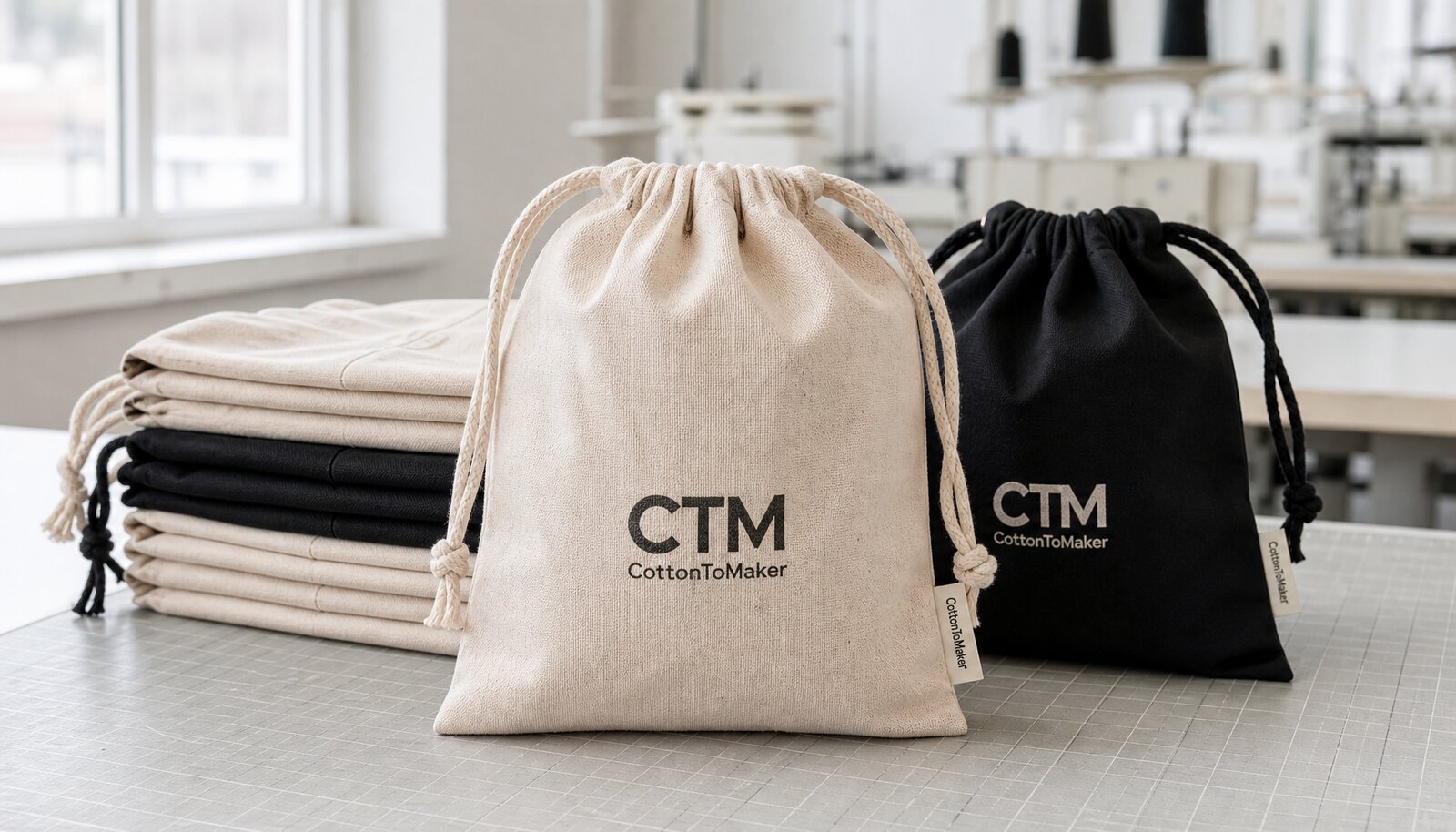
What a personalised drawstring pouch is actually doing in your supply chain
A personalised drawstring pouch is often treated as a simple accessory, but the procurement role can be very different from one program to the next. In one case, it is only transit packaging for another product. In another, it is part of the customer-facing presentation and affects perceived value, unpacking experience, and even return behavior. That difference changes the buying spec. If the pouch is invisible to the end customer, cost and packing speed may dominate. If it is visible, you need tighter control over fabric, print, closure, and finish.
The most common sourcing error is to buy on appearance alone. A sample that looks neat on a desk can behave differently when a buyer packs it with actual product, compresses it in cartons, or receives it after a long freight leg. The cord channel may twist, the logo may sit awkwardly once drawn closed, or the surface may show more marks than expected. Procurement needs a use-case first, then a product spec. Ask what the pouch must carry, how it will be handled, and what the receiving team will inspect.
It helps to classify the program before you request quotes. Jewelry and sample kits usually need consistent appearance and accurate sizing. Cosmetics and toiletry programs need opacity, clean seams, and a fabric feel that matches the brand position. Hospitality and promotional orders often care more about cost, pace, and easy warehouse handling. Once that is clear, you can stop over-specifying unimportant details and tighten the ones that will actually affect receiving, customer perception, or reorders.
- If the pouch is customer-facing, prioritize visible-face quality and logo consistency.
- If the pouch carries product weight, prioritize seam strength and channel construction.
- If the pouch is a packing item, prioritize flat pack, carton efficiency, and fast receiving.
Fabric options: GSM is only one part of the decision
Cotton remains the default choice for many personalised drawstring pouch programs because it is familiar, widely available, and easy to brand. But 'cotton pouch' is not enough for a purchase order. A 120 gsm cotton pouch and a 180 gsm cotton pouch can feel like completely different products. One may drape softly and pack compactly; the other may stand up better on shelf, hide contents more effectively, and tolerate heavier items. The right choice depends on whether you need presentation, strength, opacity, or all three.
For softer or more natural presentation, buyers often look at muslin. It can work well for gifting, herbal products, and delicate retail packaging, especially when the brand wants a relaxed handmade look. The trade-off is structure. Muslin can show contents more easily and may need closer attention to stitch density and seam behavior. Canvas and heavier twill bring more body and abrasion resistance, which can be useful for reuse or heavier contents, but they also increase sewing resistance, freight weight, and sometimes the risk of uneven folding in packing.
Polyester and poly-cotton make sense in some programs, but not because they are automatically cheaper. The real questions are shape stability, print behavior, hand feel, and whether the customer will accept a more synthetic texture. If you are moving away from cotton, state why: moisture resistance, color consistency, easier care, or a more technical look. That makes the quote review more useful, because the supplier can answer against a performance need rather than a loose material name.
A useful RFQ should therefore specify material, weave or construction, GSM, finish, and the reason the fabric was chosen. If you want a natural look, say whether the cloth should be raw, bleached, dyed, brushed, or pre-washed. That saves time later and reduces the risk that a buyer and supplier both say 'cotton' while talking about very different cloths.
- 100-120 gsm cotton: lower-cost tier, but check transparency and drape.
- 120-140 gsm cotton: a common baseline for branded retail and general packaging.
- 160-180 gsm cotton or canvas: more structure and opacity, but higher cost and freight weight.
- Muslin: good for soft presentation, but confirm opacity and seam behavior.
- Poly-cotton/polyester: useful when stability matters, but re-check print and finishing on the actual substrate.
Print and decoration: match the method to the artwork and fabric, not the catalog
For personalised drawstring pouches, print method is usually where quotes drift apart most. Screen printing is often the most efficient route for one- or two-color logos, bold marks, and repeat programs. It has setup work, but once the artwork is fixed it can be a strong option for volume. Digital printing is more appropriate when the design has multiple colors, gradients, or a short run that does not justify screen setup. Embroidery can work on thicker fabrics and can suit a premium look, but it adds cost, thickness, and sometimes distortion on lighter cloth.
A supplier should be able to explain more than 'print available.' Ask what ink system they use, how it is cured or fixed, and what kind of rub resistance they expect on that fabric. If the pouch is cotton, different fabric lots can absorb ink differently. If the pouch is dyed, shade variation can change how the logo appears. This is why a strike-off or pre-production sample matters. A PDF proof can confirm layout, but it does not show opacity, hand feel, or whether the ink will hold up under normal handling.
The print area also needs precision. A logo placed too close to a seam can warp after sewing or when the pouch is pulled closed. Large prints can expose fabric distortion if cutting is uneven. The useful buyer question is not just whether the supplier can print it, but whether they can keep the same result across the full order on the final pouch fabric. Ask for the print placement sheet, the number of colors included, and whether the artwork is approved on one side or both sides.
In RFQs, it helps to include Pantone targets where color matters, but avoid pretending every print needs lab-grade matching. For many branded pouches, visual match under normal light is enough. For high-sensitivity brand work, define the reference sample and what counts as acceptable variation. That keeps the discussion practical and enforceable.
- Screen print: best for simple logos, repeat orders, and efficient unit cost at volume.
- Digital print: best for short runs, detailed artwork, or multiple colors.
- Embroidery: suitable only when the fabric body and budget support the extra process.
- Always approve a strike-off or pre-production sample on the final pouch fabric.
- Specify whether the logo must appear on one side only or on both sides.
Size, construction, and seam detail: where small gaps become disputes
Finished size is one of the most under-specified items in pouch RFQs. Buyers often write a nominal size and assume everyone is talking about the same measurement, but factories may interpret that as cut size, sewn size, or flat size. That is how disputes start. Specify finished dimensions after sewing and pressing, and state the tolerance you can accept. For many general pouch programs, plus or minus 5 mm to 10 mm is a workable band, but the correct number depends on the bag size, the fabric, and how visible the pouch is in the customer journey. If the pouch must fit a specific inner product, define the fit requirement rather than only a dimension.
Construction details matter just as much as dimensions. Ask for seam type, seam allowance, and where the drawstring channel is formed. A pouch can look neat on first inspection yet still fail if the seam allowance is too small, the bottom seam opens under load, or the channel twists during repeated use. You should also ask the supplier to state stitch density in a measurable way. If they cannot tell you their target stitches per inch or stitches per 3 cm, they may not be controlling sewing tightly enough for a repeat order.
If the design includes a gusset, do not rely on a flat drawing alone. A gusset changes usable volume, fold pattern, carton efficiency, and the way the pouch sits when filled. It can also change how the print reads once the pouch is closed or loaded. For higher-visibility packaging, ask for both a dimension drawing and a filled-state reference image. That gives the supplier and your receiving team the same visual target.
Use the construction spec to reduce ambiguity: finished size, seam allowance, stitch density, gusset depth if relevant, and any reinforcement points. That is enough detail for a good factory to quote honestly and for your QC team to inspect consistently.
- Specify finished size after sewing and pressing.
- Set tolerance bands for width, height, and depth where relevant.
- Ask for stitch density, seam allowance, and seam type in the quote.
- If the pouch has a gusset, include a drawing and a packed-state reference.
- Define the fit around the real product, not just the bag dimension.
Supplier comparison: what to verify before you trust the quote
The best quote comparison starts by normalizing the inputs. Every supplier should be pricing the same finished size, fabric GSM, print method, number of colors, packing standard, and shipping basis. If one includes a label and another does not, or one uses bulk pack while another quotes individual polybags, the low number is not a real comparison. Ask for a line-by-line breakdown: fabric, sewing, print, labels, packing, sample fee, and freight basis if applicable.
The route to market also matters. A direct factory with in-house sewing, printing, and packing generally gives better process visibility and fewer handoffs. That matters when the pouch must match a brand standard or be reordered with the same result. A trader can still be useful for stock items or when you need to bundle multiple products, but for a repeat pouch program you should verify who actually owns the line. Ask for factory photos, a short production video, the number of sewing machines, and whether printing happens on site or is outsourced.
When a quote comes in much lower than the others, do not assume the supplier has found a hidden efficiency. More often, something was left out or understated: GSM, print setup, label cost, carton spec, or proper sample cycles. Ask the supplier to restate the offer using your RFQ line items. If they can do that clearly, you are looking at a real quote. If they cannot, the low number may not survive the first production correction.
Auditability matters as much as price. You need to know whether the supplier can prove capability, not just promise it. That means asking for production references in the form of photos of the factory floor, current machine inventory, QC checkpoints, and examples of carton marks or inspection reports they use internally. You do not need a long questionnaire, but you do need enough evidence to see whether the seller is actually set up for the pouch you want.
- Compare only after normalizing GSM, size, print, packing, and incoterms.
- Ask for a cost breakout so you can see where the quote is actually coming from.
- Verify whether the supplier is the factory or a trading layer.
- Treat unusually low pricing as a prompt to re-check fabric weight, print coverage, and packing assumptions.
- Request carton count and gross weight before you finalize landed cost.
MOQ, SKU planning, and how to avoid fragmented production
MOQ for personalised drawstring pouches is rarely a single number. Factories usually think in terms of fabric lots, print setup, line efficiency, and packing labor. That means your total order quantity can look healthy while each variant is too small to run cleanly. A program with three sizes, two colors, and two artwork versions is not one order to a manufacturer; it is six production combinations. The quote, lead time, and QC workload all move accordingly.
For procurement teams, SKU discipline matters. Decide early whether every size is needed, whether every color is truly necessary, and whether the artwork can be standardized. A common mistake is to overload the first order with too many variants. That fragments the run, raises per-unit cost, and creates slow-moving inventory in colors or sizes that do not support the rollout. A simpler first order often gives you cleaner data for the reorder, and a better base for negotiating later once the supplier has proven the spec.
It also helps to separate commercial minimum from production minimum. The commercial minimum is what you want to buy. The production minimum is what the factory can run efficiently without waste or rework. If those differ, you need to know whether the supplier is absorbing the difference, charging it back, or changing the spec quietly to protect margin. Ask for MOQ by size, by color, and by artwork version. That is more useful than a single order total.
This is also where custom elements matter. Special dyeing, custom cord color, branded labels, or unusual pack formats can all raise the practical MOQ. Rather than discovering that later, ask the supplier to identify which components are stock and which are custom. It makes the pricing structure much easier to audit.
- Keep the first order as close to one size, one fabric, one cord, and one artwork version as possible.
- If you need multiple SKUs, ask for MOQ by variant, not just total order count.
- Expect higher MOQ if you request custom dyeing, custom cord color, or special labels.
- Use the first order to prove the spec; use the reorder to expand variants if the pouch performs well.
Sample approval: what to check before production is allowed to run
A digital mockup is not a sample. It is a layout file. For personalised drawstring pouches, the approval sample should be made from the final fabric, final cord, final print process, and final packing method if packing is part of the customer experience. The reason is simple: cloth behaves differently once it is cut and sewn. The pouch may pull, wrinkle, or sit differently than the proof suggested. Your sample needs to answer practical questions: does the logo sit correctly, does the bag open and close smoothly, does the seam lie flat, and does it still look acceptable once it contains the actual product it was designed to hold?
Use the sample stage to close the expensive gaps. Measure the finished pouch. Check the visible face under normal light. Pull the cord repeatedly to make sure the channel does not distort. If the pouch will be reused, test the closure through a few cycles, not just once. If print durability matters, do a basic dry rub check and, when relevant, a light wet rub check on the sample before approving the full order. None of that is complex, but it is far cheaper than discovering a problem after cartons are sealed.
A sealed gold sample should be kept by both sides: one with the supplier and one with the buying team or warehouse. If there is later disagreement about shade, print position, stitching, or fold method, the gold sample shortens the discussion. It also gives the factory a clearer line reference if they need to train new operators or verify a reorder. The point is not bureaucracy. It is to reduce subjective interpretation in a product that is visually simple but operationally easy to drift.
If you want to tighten this stage further, ask the supplier to send photos of the first sewn units, the print strike-off, and the packed cartons before mass packing begins. That gives you a chance to catch errors while the order is still adjustable.
- Approve a physical sample on final fabric and final print process.
- Measure finished dimensions and compare against your tolerance band.
- Check print position, color, and edge clarity under normal viewing light.
- Test cord pull, channel recovery, and visible-face appearance after packing.
- Keep a sealed gold sample for reference on both buyer and supplier sides.
Packing, carton planning, and warehousing: the hidden cost center buyers overlook
Packing often looks minor until the shipment lands. For personalised drawstring pouches, bulk pack is usually the lowest-cost and simplest option, especially when the pouch will be reworked, kitted, or relabeled in your own warehouse. If the pouch is retail-facing, e-commerce ready, or part of a hygiene-sensitive program, then individual polybags, size stickers, and controlled folding may be required. The critical decision is to define that before production starts, not after the factory has already packed the goods in the easiest way for their line.
Carton planning affects both freight and receiving. Because pouches compress well, buyers sometimes ignore carton dimensions. In practice, folding method and inner pack quantity can change carton count enough to move landed cost and warehouse labor. Ask for carton dimensions, gross weight, units per carton, and carton marks at the quote stage. If your warehouse scans case-level labels or expects barcode placement in a certain position, make sure the supplier’s label format matches the inbound process.
A common issue is overpacking or underfilling cartons. Overpacked cartons can crease pouches and create complaints at receiving. Underfilled cartons waste cube and raise freight cost. A controlled pack plan solves both. If shelf appearance matters, ask the supplier to define fold direction and face orientation. If the pouch is premium or customer-facing, a small request like that can save a lot of manual adjustment later.
Do not forget that packing is part of the product spec when the buyer sees it. If a pouch arrives folded differently from the approved sample, the discrepancy may be minor on paper but significant in a retail or gifting program. The best packing spec is short, measurable, and easy for the factory to follow without interpretation.
- Bulk pack for the lowest cost and easiest warehouse rework.
- Individual polybag for retail, hygiene, or e-commerce presentation.
- Ask for carton dimensions, gross weight, and units per carton before quote comparison.
- Define barcode, case label, and carton mark rules early.
- If shelf appearance matters, specify folding orientation and face direction.
QC thresholds that are specific enough to enforce at receiving
Quality control for personalised drawstring pouches should be written as measurable thresholds. Phrases like 'good stitching' or 'nice print' are too vague for a large or urgent shipment. Your QC sheet should define acceptable size variation, stitching appearance, print quality, and packing accuracy. If the supplier knows the visible-face standard in advance, they can inspect against it before the cartons leave the factory. That is much easier than debating it after import.
A practical QC process starts with the first production run and ends with carton verification. Ask for photos of the first sewn units, the print strike-off, and the packed cartons. Then define a simple inspection routine. Check dimensions across units from different cartons, not just the top layer. Pull the drawcord a few times. Look closely for stains, holes, loose threads, open needle holes, or print blur. If the order is large enough, align the inspection with your own AQL standard; if not, still require a documented final inspection checklist from the supplier.
Write the standard in terms that can actually be enforced. For example: target stitch density, acceptable print placement tolerance, and dry rub performance for the ink system. You do not need a lab spec for every order, but you do need enough specificity to avoid subjective arguments. The more visible the pouch is to your customer, the tighter the visible-face criteria should be. For a packing-only pouch, the QC focus can be more functional. For a branded pouch, appearance and consistency matter more.
One useful boundary is to separate cosmetic defects from functional defects. A tiny thread tail may be acceptable in a low-cost bulk pack but not on a retail-facing pouch. A slightly soft print edge may pass in a promotional program but fail for a premium brand pack. Put those distinctions in writing before production starts so the factory knows what to inspect out before shipment.
- Specify size tolerances in millimeters for finished width, height, and depth.
- Set a visible-face defect rule for stains, holes, loose threads, and print blur.
- Ask for stitch density or stitches per inch / per 3 cm on the sewing spec.
- Require a basic dry rub check for print and a wet rub check if the use case warrants it.
- Verify carton count, inner pack count, and size labeling against the packing list.
Lead time planning: where pouch orders slip and how to protect your launch
Lead time for personalised drawstring pouches is a chain of smaller steps: sample approval, material booking, cutting, sewing, printing, packing, and final inspection. The factory may quote a short production window, but the actual schedule depends on how fast the artwork is approved, whether the fabric is in stock, and whether labels or custom cord colors need to be sourced. Buyers often approve the commercial order before they have frozen art or packaging details, and then the schedule starts to slip in ways that are hard to recover.
A useful procurement habit is to separate the critical path from the supplier promise. If the pouch is tied to a seasonal launch, your main risk may be artwork sign-off or carton label approval rather than sewing capacity. If the order needs custom dyeing, the risk is material booking and shade approval. If the order includes multiple SKUs, the risk is packing and carton consolidation. Once you know the slowest step, you can protect it with earlier approvals or a simpler first order.
Freight timing matters too. Pouches are lightweight, so teams sometimes focus only on production time and ignore shipping mode. A low-cost sea shipment may be fine for replenishment, but not if your launch date is fixed. Ask the supplier to state whether lead time starts from sample approval, PO receipt, or deposit receipt. Different factories start the clock at different moments, and that difference can alter your planning by days or weeks.
When comparing lead times, ask for an itemized schedule rather than a single number. You want to know how many days are needed for sample making, how long the line needs after approval, and whether any stages are concurrent. That gives you a more realistic view of whether the pouch can fit your launch window without emergency freight.
- Separate sample lead time from bulk production lead time.
- Confirm what event starts the production clock: approval, PO, or deposit.
- Build extra time for custom dye, labels, and retail packing.
- Treat artwork, carton labels, and barcodes as schedule items, not admin tasks.
- Plan freight mode alongside production timing, not after it.
Specification comparison for buyers
| Spec decision | Recommended option | When it fits | Buyer risk to check | Cost / lead-time impact |
|---|---|---|---|---|
| Supplier route | Direct factory with sewing, printing, and packing control | Best for repeat programs, private label, and orders where pouch appearance matters | Confirm whether the supplier owns or controls cutting, sewing, printing, and packing; request factory photos, machine list, and a recent production video | Usually lower unit cost at scale; fewer handoffs can improve schedule control |
| Fabric choice | Cotton 120-140 gsm for standard retail; 160-180 gsm for premium or heavier contents | Best for cosmetic sets, jewelry, gifting, and branded product packaging | Ask for GSM proof, weave/structure detail, shrinkage behavior, and a cut-and-sew sample on the actual fabric | Heavier cloth raises material cost and freight weight; lighter cloth can reduce cost but may show contents |
| Alternative fabric | Muslin for soft natural presentation; canvas or heavier twill for body and abrasion resistance; polyester or poly-cotton for shape stability or moisture resistance | Useful when the pouch must match a brand aesthetic or carry a specific load profile | Check hand feel, opacity, print sharpness, and whether the closure channel still works with the chosen fabric thickness | Polyester can require different print and curing controls; canvas can increase sewing time and carton weight |
| Print method | Screen print for simple logos and volume; digital print for short runs or complex artwork; embroidery only if hand-feel and budget support it | When logo clarity is more important than photo realism | Ask for ink type, curing method, rub resistance, artwork placement sheet, and whether the print is one side or both sides | Screen print adds setup but is efficient at volume; digital can be quicker for low quantities but often costs more per piece; embroidery adds time and thickness |
| Closure style | Single drawcord with stitched channel; add cord lock only if the use case truly needs it | Best for gifts, sample kits, cosmetics, and simple branded packaging | Check cord diameter, channel width, pull smoothness, and whether the knot or stopper can slip back through the channel | Cord locks and end tips increase component cost and assembly time; thicker cords may slow packing |
| MOQ logic | One SKU per size, fabric, color, and artwork version | Best when you want clean production planning and predictable unit cost | Separate total order quantity from MOQ per variant; ask for minimums by size, color, and print version | Complexity increases setup fees, sample cycles, and line changeover time |
| Packing method | Bulk pack for warehouse handling; individual polybag only when retail, hygiene, or e-commerce requires it | Best for distribution centers, kitting operations, and rework-friendly receiving | Verify carton count, inner pack quantity, barcode placement, fold method, and whether the pouch should be folded a specific way | Retail-ready packing increases labor and materials; bulk pack usually shortens handling time and lowers cost |
| QC standard | Written size tolerances, visible-face defect limits, print rub tests, seam strength checks, and closure pull checks | Best for importers and brands that need repeatable receiving standards | Insist on measurable acceptance criteria, not only 'good quality' language | Better QC adds a little pre-shipment effort but reduces returns, relabeling, and disputes |
Buyer checklist before sampling
- Confirm finished pouch dimensions, not cut size, and specify tolerance for width, height, and depth if gusseted.
- Define fabric by material, weave/structure, and GSM. If you need a natural look, say whether the fabric should be raw, bleached, dyed, brushed, or pre-washed.
- State the print process, number of colors, print area in millimeters, Pantone targets, and whether the print appears on one side or both sides.
- Specify cord material, cord diameter, end finish, and whether knots, metal tips, or cord locks are required.
- If the pouch carries weight, define the load assumption so the supplier can check seam strength and channel behavior.
- Set MOQ by SKU and by artwork version, not only by total order quantity.
- Confirm whether labels, hangtags, barcode stickers, and retail inserts are included or charged separately.
- Ask for a pre-production sample made with final fabric, final cord, and final print process.
- Request a sealed gold sample and keep one copy on your side for line comparison.
- Ask for carton dimensions, units per carton, gross weight, and pack method before you approve the PO.
Factory quote questions to send
- What exact fabric is included in the price, including material, weave/structure, and GSM?
- Is the quoted size the finished size after sewing, or a flat/cut size before stitching?
- What shrinkage allowance have you assumed for the fabric after cutting, printing, or washing?
- Which print method are you quoting, how many colors are included, and what setup fee applies per color or per side?
- Can you quote the same pouch with screen print and digital print so we can compare cost and lead time on the same artwork?
- What is the MOQ per size, per color, and per artwork version?
- Are woven labels, side labels, care labels, hangtags, or barcode stickers included in the price?
- What cord material and cord diameter are included, and can you provide a photo or sample of the exact cord?
- What packing standard is included: bulk pack, individual polybag, or retail-ready packing with carton marks?
- What is the sample lead time, and is the sample cost refundable against a bulk order?
Quality-control points to confirm
- Finished width and height within the agreed tolerance band; if gusseted, check depth as well.
- Fabric GSM within the approved range and consistent across the order lot.
- Visible seams straight, secure, and free from skipped stitches, broken threads, or open needle holes.
- Stitch density acceptable and consistent on side seams, bottom seam, and drawstring channel; require the supplier to state their target stitches per inch or stitches per 3 cm.
- Cord channel width and stitching allow smooth pull action without tearing or bunching.
- Drawcord pulls evenly, does not snag, and does not slip back out after repeated open/close cycles.
- Print placement centered within tolerance and aligned to the approved artwork placement sheet.
- Print color close to the approved sample under normal viewing light; if Pantone matching is needed, define the acceptable delta or visual reference standard.
- Print adhesion passes a simple dry rub check and, if relevant, a wet rub check suitable for the ink system and fabric.
- No obvious pinholes, fabric slubs, oil marks, holes, or contamination on the visible face beyond the agreed allowance.