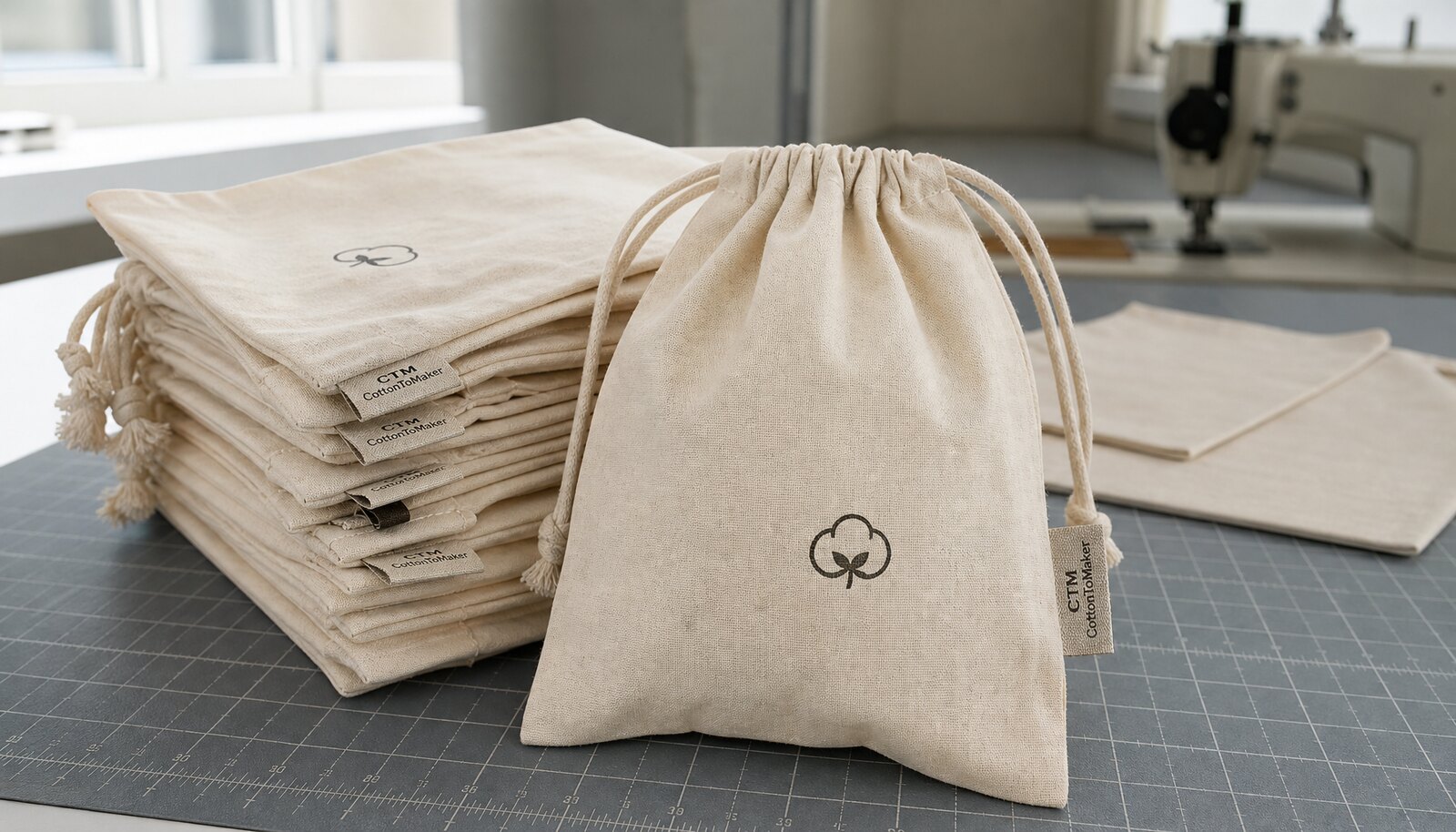
What a personalised drawstring bag is actually bought for in B2B supply
A personalised drawstring bag is usually not bought as a standalone accessory. In procurement terms, it acts as a carrier, insert, or presentation layer for something else: cosmetics, apparel, jewellery, wellness items, hospitality gifts, conference packs, sample kits, or e-commerce bundles. That means the bag must do more than carry a logo. It needs to fit the product, survive handling, support the presentation standard, and still land at a unit cost that works for the channel.
The first mistake many buyers make is starting with the decoration instead of the use case. A retail insert needs neat appearance, predictable folding, and consistent print placement. A giveaway bag needs speed, low friction, and low total cost. A premium gift pouch may justify thicker fabric, a better closure, or a more refined branding method because the pouch is part of the perceived value of the pack. The spec should follow the job, not the catalog photo.
It helps to write the buying brief in plain operational terms before requesting quotes. What goes in the bag? How often will it be handled? Will the customer see it alone, or only inside another pack? Is it intended to be reused, or is it expected to do one short job and then disappear? Those answers are more useful than a general request for 'good quality' because they guide fabric, GSM, print method, and packing choice.
For procurement teams, the bag becomes a packaging component with its own cost and failure modes. If the product inside is fragile, the pouch must protect it. If the bag is displayed at shelf or in-box, print quality and hand feel matter more. If the bag is part of a campaign with strict launch timing, lead time and sample discipline matter more than an extra cent saved on unit price. The right spec is the one that matches the route to market.
Before quoting, ask three questions: what is the intended contents weight, what is the visible use stage, and how many handling cycles must the bag survive? Those answers determine whether the build should lean toward light promotional economics, mid-range retail presentation, or a more durable premium pouch.
- Retail insert: prioritise print sharpness, fold consistency, and shelf presentation.
- Gift or event pack: prioritise stable MOQ, fast replenishment, and efficient packing.
- Warehouse or e-commerce use: prioritise seam strength, abrasion resistance, and carton efficiency.
Fabric choice: the material decision that drives cost, feel, and reject risk
Fabric is the largest driver of perceived quality and one of the easiest places to create hidden cost. Cotton remains a common choice because it feels natural and prints well, but cotton is not a single spec. Plain weave, canvas, recycled cotton, and blended cloth can all behave differently in sewing, finishing, and print output. If the bag must carry heavier items or survive repeated handling, polyester or a cotton-poly blend may give better abrasion resistance and more stable shape, though the hand feel changes.
GSM is useful, but it does not tell the whole story. Two fabrics with the same GSM can perform differently if the weave is looser, the yarn is uneven, or the finishing is inconsistent. A 90-120 gsm bag works for light promotional use and low-load inserts, but buyers should expect a softer body and lower opacity. The 120-180 gsm range is often the best balance for most branded retail and gift programmes because it supports print, looks more substantial, and still keeps freight reasonable. When the bag needs more structure, better shelf presence, or heavier contents, 180-240 gsm may be justified.
The buyer-side tradeoff is simple: lighter cloth lowers raw material cost and freight weight, but it can look thin, wrinkle more easily, and show distortion after print. Heavier cloth improves structure and presentation, but it raises fabric cost, sewing effort, and carton weight. If the product is going to sit in a retail environment, ask for swatches, photos of the same weave in the chosen colour, and if possible, a filled sample. A flat swatch rarely shows how the pouch behaves once it is actually used.
Pay attention to whether the GSM is measured before or after finishing, because that changes comparisons between suppliers. Also ask whether the fabric is stock-supported or made to order. A low unit price on a custom-dyed bag can disappear once dye lot approvals, minimums, and lead time extensions are added. For repeat programmes, consistency often matters more than squeezing out the lowest quote on the first run.
- 90-120 gsm: light promotional use and minimal product load.
- 120-180 gsm: balanced choice for most branded retail and gifting.
- 180-240 gsm: premium feel, more body, and higher material cost.
- Ask whether GSM is measured before finishing or after finishing.
Closure variants: single drawstring, double drawstring, cord-lock, or ribbon tie
Closure style affects both user experience and production complexity. A single drawstring is usually the simplest and most cost-efficient option. It is suitable when the bag needs to open quickly, close quickly, and carry a light to moderate load. Double drawstrings improve cinch symmetry and closure control, which is useful when the pouch is larger, the contents are heavier, or the buyer wants a more balanced visual finish. Cord-lock closures add convenience and a more engineered feel, but they introduce an extra component that must be sourced and assembled. Ribbon ties can work for decorative gift presentation, but they are less efficient if the bag will be opened and closed repeatedly.
Buyers should specify the closure in operational terms. If the cord must be soft enough for handling but thick enough not to cut into the hand, say so. If the channel width must accommodate a specific cord diameter, include that in the technical brief. If metal tips, plastic tips, knots, or stops are required, note that clearly because those details affect look, cost, and lead time. A bag that feels premium in the hand may still fail procurement expectations if the cord slips, twists, or frays during normal use.
One common sourcing mistake is to choose a premium-looking closure and leave the rest of the build at promotional grade. That creates a mismatch: the cord may look good, but the body fabric, seam finish, and print accuracy may not support the same position in the market. The closure should match the intended price point and use cycle so the finished item feels coherent rather than improvised.
- Single drawstring: simplest, fastest, and lowest labour.
- Double drawstring: better closure symmetry and load balance.
- Cord-lock: convenient but adds a component and inspection point.
- Ribbon tie: decorative, but less efficient for repeat open-close use.
Decoration methods: choose for artwork detail, price stability, and reorder risk
Decoration should be chosen after the buyer knows the artwork complexity, branding objective, and reorder pattern. Screen printing remains the most common method for a personalised drawstring bag because it handles bold logos, gives clean colour fill, and keeps unit pricing stable on simple graphics. It is usually the best fit for promotional programmes, branded retail basics, and repeat replenishment where the logo is simple and the print area is predictable.
Heat transfer can be useful when the design includes fine detail, multiple colours, gradients, or small text. The tradeoff is that adhesion, edge lift, and rub resistance need to be tested carefully on the actual fabric. A transfer may look sharp at approval stage and still fail if the press temperature, pressure, or surface prep is not controlled. Embroidery gives a textured, premium look, but it is less forgiving on thin fabrics and can distort small lettering or very tight shapes. Woven labels work well when the buyer wants understated branding, care information, or a more repeatable result without large ink coverage.
From a procurement perspective, the key issue is repeatability. A decoration method that performs well on one sample may not be the safest choice for 10,000 units if the logo has tight registration or if the reject risk is high. Ask the supplier to confirm minimum line thickness, minimum text size, maximum print area, and the expected visual result on the actual fabric colour. If the supplier cannot show the artwork on a close fabric match, the proof is not strong enough for a bulk release.
- Screen print: efficient for simple logos and larger runs.
- Heat transfer: useful for detail, but adhesion and rub resistance must be tested.
- Embroidery: premium look, but may distort on thin cloth and increases setup time.
- Woven label: good for subtle branding, repeat programs, and small text support.
- Avoid tiny text unless the supplier proves readable output on the actual fabric.
How to compare quotes without comparing the wrong bag
A quote only becomes useful when every supplier is pricing the same commercial basis. That means the buyer must freeze the bag dimensions, fabric, GSM, closure type, decoration method, logo size, colour count, packing format, and delivery term before price comparison. If those items are not standardised, the cheapest quote may simply be for a lighter cloth, a smaller print area, simpler packing, or a lower-cost closure that the buyer did not intend to approve. The goal is not to find the lowest number first; it is to find the same product on comparable terms.
The quote should separate unit price from the items that can change landed cost. Those items include artwork conversion, digitising, screen or plate charges, sample cost, packaging labour, carton materials, and any extra handling for mixed sizes or mixed colours. For a launch order, setup can matter more than the per-piece price. For a reorder, repeatability matters more because the buyer wants the second lot to match the first. A supplier who itemises those costs clearly is usually easier to manage than one who sends a single line price and no assumptions.
It also helps to ask for price breaks by quantity, but only after the buyer knows whether the extra units are actually needed. Not every step-down in unit cost is worth the storage, cash-flow, or forecast risk. Compare cost per sellable unit, not only the cost per ordered unit. If the lower quote depends on a larger MOQ, it may be more expensive in practice once warehousing, obsolescence, or repacking is included.
When evaluating suppliers, ask what has been simplified to make the lower price possible. That question is more useful than asking why the quote is high. A direct answer about stock fabric, simpler packing, or standard print size often tells you more about commercial risk than a generic assurance of 'best price'.
- Request the same spec sheet from every supplier before quoting.
- Ask for separate lines for product, setup, sample, and packing.
- Compare landed cost per sellable unit, not just piece price.
- Check whether the quote assumes stock fabric or custom-dyed fabric.
- If a quote seems unusually low, ask which simplification made it possible.
MOQ, price breaks, and the sourcing pitfalls that hide inside them
MOQ is one of the clearest examples of why bag sourcing is a commercial process, not just a product search. Factories set minimums based on cutting efficiency, print setup, sewing line batching, and the amount of changeover work required. A simple one-colour bag may allow a lower MOQ than a multi-colour or multi-position version because the decoration line stays efficient. If the buyer asks for mixed sizes, mixed colours, or multiple logo versions, the factory usually charges for the extra handling, even if the bag looks similar on paper.
The most common mistake is to treat a low MOQ quote as if it were the baseline. Lower quantities often mean higher setup amortisation, fewer material options, and less flexibility on packing. That does not make the quote wrong; it means the buyer should know what is being traded away. On the other side, a large MOQ can lower unit cost but create inventory risk if the campaign changes, artwork is revised, or demand slows. Procurement teams should therefore set a target MOQ based on forecast accuracy and shelf-life of the artwork, not on the lowest possible number.
A practical approach is to ask the factory where the price break begins, what changes at that threshold, and which element is driving it. If the supplier can explain why 2,000 units are materially more efficient than 1,000, the pricing is usually more credible. If the answer is vague, push for the reason in labor, fabric utilisation, print setup, or packing efficiency. For custom programmes, that explanation matters because it tells you whether the quote is scalable or only attractive at one quantity.
- Lower MOQ usually means higher setup cost per bag.
- Mixed colours create more sorting and cutting labour.
- Multiple logo colours can mean separate screens, more setup, and more reject points.
- Large MOQ improves unit price only if the forecast can absorb the stock.
Sample approval: what a buyer should inspect before bulk cutting starts
The sample is not just a sign-off item; it is the reference for the whole order. For a personalised drawstring bag, the sample should confirm finished dimensions, fabric shade, hand feel, closure behaviour, print placement, logo size, seam finish, and packing format. It should also show how the bag looks once filled, because a pouch that sits well when empty can behave very differently when actual product weight is inside it. If the bag is intended for retail display, the folded appearance matters as much as the open shape.
Approval should be documented against a checklist, not accepted by email alone. If the logo must sit a certain distance from a seam, record that distance. If the buyer wants a specific folding method, capture that too. If the bag is for a premium client, inspect it under the same lighting conditions the end user will likely experience. For programmes with multiple stakeholders, keep one signed physical reference sample and one photo set showing front, back, seam detail, and packed carton example. That gives everyone a shared baseline if there is later a dispute about appearance.
A useful sourcing habit is to request a first-off production sample from the line before the bulk run is packed. This is especially helpful if the order uses a new fabric lot, new artwork, or new packing method. The first-off piece shows whether the approved sample is actually being reproduced on the line, not just in the sample room. It is a small check that can prevent expensive rework later.
- Measure finished dimensions after sewing, not just cut sizes.
- Pull the drawstring repeatedly to check snagging and channel twist.
- Inspect print under normal light for registration and colour consistency.
- Approve folding and packing if the bag is visible on receipt or shelf.
- Keep a signed reference sample for dispute resolution if needed.
Quality control thresholds: define what counts as pass, rework, and reject
QC becomes much more useful when it includes thresholds instead of general wishes. For a personalised drawstring bag, the buyer should define acceptable variation on size, colour, print position, and workmanship. The standard should distinguish between minor cosmetic issues and defects that affect function or resale. A loose thread may be a rework item if it is easy to trim, while a broken seam at the corner should be treated as a reject because it affects load-bearing performance.
A practical QC checklist should cover the failure modes that actually appear in production: skipped stitching, loose thread tails, seam puckering, broken or uneven drawstrings, misregistered print, colour drift, stains, oil marks, holes, snags, and incorrect carton count. It should also define how defects are counted. For example, is one stain on one bag enough to reject the carton, or is the lot judged by defect rate? That rule should be agreed before production starts. The less ambiguity there is in the acceptance rule, the easier it is to handle rework or rejection without delay.
Sampling should also be structured. For large runs, it is normal to inspect a sample from first-off production and then random cartons across the balance lot. Buyers can use their own inspection standard or a buyer-approved AQL-based approach, but the decision should be explicit in the PO or quality annex. If the order is for a market with strict receiving controls, the supplier should know whether the buyer wants only visual checks, functional checks, or both. The inspection plan should match the risk level of the order, not just the size of the order.
- Set acceptance criteria for size, colour, print, and stitching before production starts.
- Define which defects are critical, major, and minor.
- Inspect first-off pieces from the line, then random cartons from the balance lot.
- Verify carton count and SKU separation even when product quality is acceptable.
- Ask for defect photos if the factory classifies and sorts rejects internally.
Packing, carton loading, and freight: the hidden cost layer in bag sourcing
Packing has a bigger effect on total cost than many buyers expect. Individual polybags improve presentation, protect against dust, and suit shelf-ready retail, but they add labour, materials, and carton volume. Bulk packing is more efficient for wholesale, distributor, and warehouse programmes, especially when the receiving team will unpack and repack the bags anyway. The right choice depends on the channel, not on a blanket assumption that more packaging always means better quality.
Carton efficiency matters because freight is paid by volume as well as by weight. A supplier can offer a competitive unit price and still create a poor landed cost if the carton format wastes space. That is why buyers should request carton dimensions, net weight, gross weight, and bag count per carton before freight is booked. Those details let the procurement team compare product price and shipping efficiency together. They also make it easier to spot whether a low quote is being offset by oversized cartons or excessive packing labour.
For retail programmes, ask whether the supplier can keep a consistent fold count and count-per-carton. For warehouse supply, ask whether the bags are packed by size and colour or mixed in one carton. Mixing can be acceptable, but only if the receiving operation is set up for it. Otherwise, the apparent convenience at factory level turns into extra labour at destination. Freight reconciliation should also include the actual packed weight and dimensions, because variance there can affect forwarder charges and receiving acceptance.
- Retail channel: individual polybag or belly-band may be justified.
- Wholesale or distribution: bulk packing is usually more cost-efficient.
- Always request carton dimensions before confirming freight.
- Check whether cartons are labelled by SKU, colour, and quantity.
- Match packing to the downstream receiving process, not just the factory's convenience.
Lead time planning: where delays really happen in a drawstring pouch programme
Production for a personalised drawstring bag is usually manageable once the material, artwork, and packing are locked. The sewing itself is rarely the only scheduling variable. Delays more often come from late artwork changes, shade approval delays, custom fabric sourcing, or a packaging requirement that was added after sampling. If the bag is tied to a launch date or event date, the buyer should treat approvals as hard gates because every extra revision compresses the time left for production and freight.
A workable schedule separates sample approval from bulk release. First, approve artwork, size, material, and packing. Second, approve the physical sample. Third, release bulk production with the deposit and final sign-off. If the buyer changes print position after sample approval, the supplier may need to remake screens, adjust layout, or scrap already prepared materials. Those changes can extend lead time more than the sewing itself would. In practice, the largest schedule risk often sits in the decision process, not the needlework.
Buyers can reduce timing risk by choosing stocked materials, limiting the number of decoration colours, and keeping packing simple. Rush orders can be done in some cases, but they work best when the spec is already straightforward and the buyer is ready to approve quickly. Complexity and speed rarely coexist comfortably in custom bag sourcing. If timing is critical, the quote should state which elements are fixed and which are still open, so there are no surprises once production starts.
- Standard run: artwork and sample approval first, then bulk production.
- Rush orders work best with stocked fabric and simple decoration.
- Custom fabric, complex logos, and retail packing each increase schedule risk.
- Late approvals usually cost more time than the sewing stage itself.
Specification comparison for buyers
| Spec decision | Buyer-side options to compare | Best fit use case | Commercial tradeoff to watch |
|---|---|---|---|
| Fabric base | Cotton, cotton canvas, recycled cotton, polyester, jute, non-woven | Retail inserts, gift packs, wellness kits, event bundles, travel pouches | Cotton usually feels more premium and prints cleanly, but can wrinkle; polyester is more abrasion-resistant and stable in transit, but may feel less natural; jute gives a rustic look, yet can shed fibres and usually supports less refined print detail |
| Fabric weight / GSM | Lightweight 90-120 gsm, balanced 120-180 gsm, premium 180-240 gsm | Low-load giveaways, standard branded retail, premium packaging, heavier content bundles | Lower GSM reduces raw material cost and freight weight, but it can look thin and distort under print; higher GSM improves body and shelf presence, but raises material cost and carton weight |
| Closure style | Single drawstring, double drawstring, cord-lock, ribbon tie | Fast-open gift packs, repeat-use retail, child-safe presentation, decorative packs | Single drawstring is simpler and cheaper; double drawstrings improve symmetry and load balance; cord-locks add convenience but also add components, assembly steps, and inspection points |
| Decoration method | Screen print, heat transfer, woven label, embroidery, deboss/emboss patch | Bold logos, fine-detail artwork, premium branding, multilingual care info | Screen print is efficient for simple one- or two-colour graphics; embroidery adds texture but can distort small text; heat transfer handles detail but needs adhesion and rub testing; woven labels suit understated branding and reorder stability |
| Bag construction | Flat bag, boxed/gusseted bag, reinforced corners, lined bag | Flat inserts, bulk storage, heavier gift sets, premium retail packaging | Gussets increase usable volume but add cutting and sewing cost; lining improves hand feel and presentation but adds labour, inspections, and lead time |
| Print placement | Centre front, lower front, full panel, corner mark, woven side label | Shelf display, brand kits, pack-in-box presentation, subtle brand builds | A large print gives visibility but can warp near seams; small placement is neat and lower cost, but may underperform if the bag is displayed on its own |
| Colour strategy | Natural, stock black/white, dyed custom colour, mixed-colour pack | Launch kits, coordinated retail sets, event programmes, subscription boxes | Custom colours can trigger dye-lot variation, higher MOQ, and more approval time; mixed packs improve merchandising but complicate cutting, packing, and count control |
| Packing format | Bulk packed, folded with size labels, individual polybag, retail belly-band or hangtag | Wholesale replenishment, marketplace fulfilment, shelf-ready retail, premium gifting | Retail-ready packing improves presentation but adds labour and carton volume; bulk pack is cheaper and faster but may need repacking downstream |
| Order structure | Single SKU, mixed sizes, mixed colours, mixed decoration versions | Stable replenishment, promotional campaigns, multi-brand programmes | Every added variation increases setup, sorting, and reject risk; compare true landed cost per sellable unit, not just the piece price |
Buyer checklist before sampling
- Define the end use first: retail insert, gift pack, event giveaway, travel pouch, or product carrier.
- Lock final bag dimensions, usable internal size, and whether you need a gusset, lining, or reinforced corners.
- Specify fabric type, construction, target GSM, colour, and acceptable shade variation between lots.
- Confirm drawstring material, cord diameter, closure style, cord length, and whether metal tips, knots, or stops are required.
- Send vector artwork and state logo size, print position, colour count, Pantone references, and any minimum line thickness for the artwork.
- Ask for a physical pre-production sample, not only photos, before bulk approval.
- Agree packing format, carton count, outer marks, barcode needs, and any retail labels or belly bands.
- Set QC thresholds in writing for stitching, print quality, measurement tolerance, defects, carton count, and packing accuracy.
- Request carton dimensions and gross weight before freight booking, and confirm whether quoted weights are net, gross, or estimated.
- Write down what happens if a sample or bulk lot misses the agreed acceptance criteria: rework, replacement, credit, or rejection.
Factory quote questions to send
- Which fabric are you pricing for this personalised drawstring bag, and what is the exact GSM, weave, and finish?
- What is the finished bag size, and what dimensional tolerance are you quoting for cut size and sewn size?
- Which closure is included in the price: single drawstring, double drawstring, cord-lock, or ribbon tie?
- What decoration method is included, how many colours are priced, and what setup, digitising, screen, or plate charges apply?
- What is your MOQ by size, colour, and print version, and how does the unit price change at the next quantity tier?
- Can you separate product price, sample cost, tooling/setup cost, packing cost, and any carton or freight handling charges in the quotation?
- What is your sample lead time, bulk production lead time, and which events will reset the schedule if artwork or packing changes?
- How are the bags packed per carton, and what are the carton dimensions, gross weight, and carton count variance allowance?
- What inspection standard do you use before shipment, and can you share your internal defect categories for critical, major, and minor issues?
- What test method do you use for seam strength, print rub resistance, colour fastness, or closure function on this fabric and decoration method?
Quality-control points to confirm
- Fabric weight should stay within the agreed tolerance, and the supplier should state whether the tolerance is measured before or after finishing. Ask for a practical window in writing rather than a vague 'same as sample' promise.
- Finished size should be measured after sewing and trimming, not from cut panels. Use a defined tolerance by dimension, for example +/- 0.5 cm on small bags or a buyer-approved equivalent for larger formats.
- Stitching at the drawstring channel, side seams, and lower corners should be straight, secure, and free of skipped stitches, broken thread, loose loops, seam puckering, and needle damage.
- Drawstring function should be checked by repeated opening and closing. The cord must run smoothly, stay evenly cut, and not snag, twist, fray, or jam in the channel.
- Print quality should be checked for registration, coverage, smudge, ghosting, cracking, edge lift, and colour consistency. Fine text should remain readable at normal viewing distance, not just in close-up photos.
- Colour consistency should be checked against the approved sample under neutral light. The buyer should define what level of shade difference is acceptable between cartons, rolls, or production lots.
- Accept/reject criteria should cover stain, oil mark, hole, hole repair, seam distortion, loose thread, untrimmed excess thread, and obvious fabric defects. Ask the factory to classify defect severity before bulk packing begins.
- Carton inspection should verify carton count, outer marks, SKU separation, and barcode readability. A clean product with wrong carton counts still creates warehouse disruption.
- Sampling should include one physical pre-production sample, and for new programmes it is useful to request a first-off production reference from the line before the full run is packed.
- Use a defined sample-size logic rather than a casual visual check. For major orders, many buyers inspect first-off pieces from the line, then random cartons across the balance lot, with the lot accepted only if critical defects stay within the agreed limit.