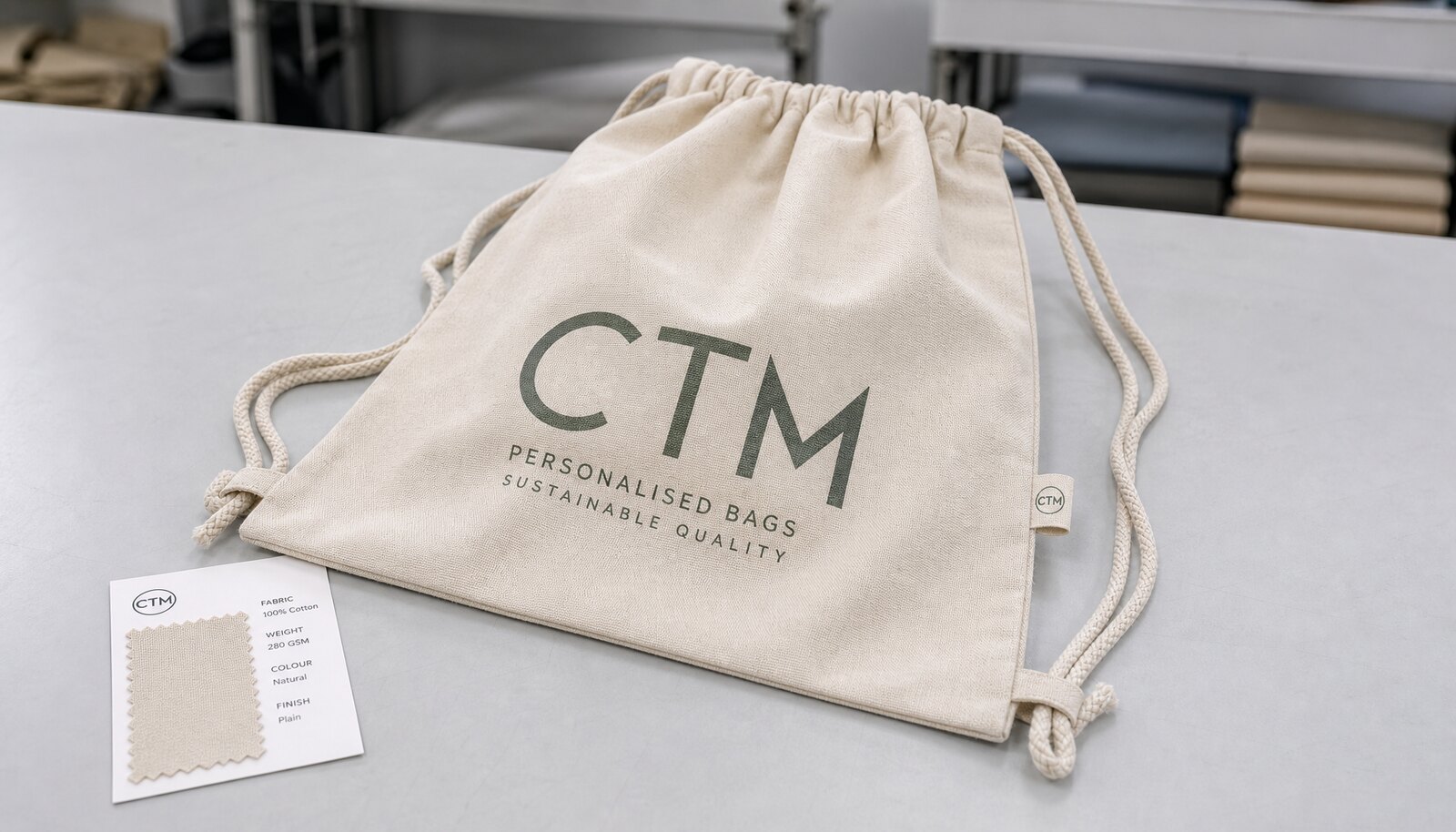
Why a personalised drawstring backpack is a specification problem, not just a logo job
A personalised drawstring backpack looks simple, but most procurement problems start with the same mistake: the buyer treats it as a basic print item and leaves the bag structure underspecified. The result is usually a product that looks fine in a photo but fails in use because the fabric is too light, the cords cut into the top edge, or the print sits on a surface that cannot hold detail cleanly. For a buyer, the goal is not only to get the logo on the bag. It is to define a bag that can survive the intended use, pack efficiently, and land at the right cost.
The most useful way to brief a factory is to start from the end use. A sports giveaway bag, a school promo pack, and a retail accessory are not the same product even if they share the same shape. Different use cases change the fabric weight, cord thickness, reinforcement level, and print method. If the RFQ does not reflect that, supplier quotes will look comparable on paper but will not be comparable in production.
- Giveaway use: optimize for low unit cost, fast print setup, and carton efficiency.
- Retail use: prioritize handle feel, stitching quality, print durability, and clean packing.
- Heavy-load use: specify stronger fabric, better cord, and reinforced stress points.
Fabric choices that change both cost and buyer complaints
For a personalised drawstring backpack, the fabric choice is the biggest cost and quality lever. Polyester options such as 210D are commonly used for promotional orders because they are light, economical, and easy to print. They work well when the bag is mainly for events, campaigns, or short-term reuse. Cotton options in the 140-180 gsm range feel more substantial and are often preferred when the buyer wants a more natural look or plans to sell the bag in retail channels.
There is no universal best fabric. A 210D polyester bag can be the right choice when price pressure is high and the buyer wants a compact bag that folds small. A 160 gsm cotton bag can be the right choice when the brand wants a more premium handfeel and better shelf appeal. What matters is that the quote states the fabric clearly enough to compare suppliers on the same basis. If one supplier quotes 210D and another quotes 190T or a light cotton blend, the unit price difference can be misleading.
- 210D polyester: lower cost, smoother print surface, better for promo volume.
- 140-180 gsm cotton: stronger brand feel, more natural appearance, higher perceived value.
- Lightweight nonwoven or blended options: only use if the target use is short-life and budget driven.
Size, cord, and reinforcement: where bag failure usually starts
Most buyers think size is only a marketing question, but it affects both production yield and usage failure. A bag that is too wide for its fabric weight can look loose and collapse under load. A bag that is too small can create customer complaints because it does not fit shoes, apparel, or event items as expected. For a standard personalised drawstring backpack, many buyers start around 34-40 cm width and 42-48 cm height, then adjust based on the content they expect the bag to carry.
Cord construction matters more than many RFQs show. A soft cord may feel nice in hand, but if the bag will carry heavier items, the cord should be paired with reinforced eyelets or stitched tunnel openings and bar-tack stress points. Ask the factory how the cord is anchored, what diameter is used, and whether the top corners are reinforced. A quote that ignores those details may look cheap but often produces higher defect rates during packing or use.
- Top opening should draw smoothly without jamming or uneven closure.
- Cord length must be equal on both sides after trimming and knotting.
- Stress areas should be reinforced before bulk approval if the bag is expected to hold weight.
Print method selection: the cheapest quote is not always the right one
The logo method should be selected based on artwork complexity, quantity, and durability target. Screen print is usually the most practical choice for one or two spot colors on larger runs because setup is efficient and the result is predictable when the artwork is simple. Heat transfer or DTF can be useful when the design has more colors, gradients, or fine detail, but the buyer should confirm the finish expected on the chosen fabric. Embroidery is less common on this product style unless the brand wants a more premium look and accepts higher cost and longer production time.
The biggest quote trap is selecting a method before looking at the artwork scale and bag surface. Fine text, thin lines, and low-contrast logos may print poorly on textured cotton or on a bag with strong grain. Large solid blocks can crack if the fabric folds sharply or if the print layer is too heavy. A practical RFQ should state the logo size, number of colors, placement, and whether exact Pantone matching is required or whether the factory may use the closest workable match.
- Screen print: best for simple logos and volume orders.
- DTF or heat transfer: useful for complex art, but confirm wash and rub performance.
- Embroidery: premium feel, but slower and costlier; usually not the first choice for promo bags.
Comparison of sourcing routes for a personalised drawstring backpack
Procurement teams often compare only factories against factories, but the sourcing route matters just as much. A direct factory can usually offer better control over fabric, print, and packing, while a trading route may help with smaller orders or mixed product consolidation. The right choice depends on how much control the buyer needs over sampling and change management. If the bag is a repeat private-label item, direct factory sourcing usually gives better consistency. If the buyer wants a small test order across multiple products, a sourcing agent or trading supplier may reduce coordination effort, though the margin structure may be less transparent.
The table below compares the practical route choices buyers usually face. The useful question is not which route is cheapest in theory, but which one gives the best landed cost and lowest risk for the order type.
- Use direct factory when repeatability, QC control, and custom packing matter most.
- Use a trading route when the order is small, mixed, or needs coordination across categories.
- Compare routes on landed structure, not just ex-works unit price.
Sample approval: what to lock before the order goes into bulk
A sample should be treated as the production reference, not as a loose suggestion. For a personalised drawstring backpack, the best sample approval is a pre-production sample that includes the final fabric, print method, cord, stitching, and packing format. Approving only the bag body is risky because many defects show up only after print curing, cord insertion, and final packing. If the buyer signs off too early, the factory may treat later corrections as chargeable changes.
When reviewing the sample, buyers should focus on measurable items. Look at print alignment, logo size, seam symmetry, cord tension, and how the bag closes when loaded. If the artwork includes small text, test legibility at normal viewing distance rather than in close-up only. If the bag will be sold retail, check the sample in its packed form as well, because some bags look correct unpacked but compress badly in cartons or retail polybags.
- Approve fabric color, logo placement, and cord finish on the same sample.
- Record any deviations from the approved artwork before production release.
- Keep one signed sample on both buyer and factory sides for dispute reference.
Packing and carton details that affect your real landed cost
Packing is one of the easiest places for quotes to become misleading. A supplier may quote a bag price that looks competitive but leave out retail polybags, barcode labels, carton marks, or inner pack counts. For distribution or retail, those details are not optional. They affect labor, carton utilization, warehouse handling, and store readiness. If your team needs shelf-ready packing, put the pack format in the RFQ rather than trying to add it later as a service request.
For a personalised drawstring backpack, bulk polybag packing is common, but the buyer should still define whether each bag gets a single polybag, warning label, hangtag, or barcode sticker. Carton quantity also matters because it affects freight density and warehouse handling. Ask the supplier to provide carton dimensions and gross weight so you can estimate cubic volume and compare sea freight or courier impact before you award the order.
- Define inner pack count and outer carton quantity.
- Require carton dimensions and gross weight in the quote.
- State whether retail barcode, country of origin, or warning labels are needed.
MOQ logic, lead time, and quote structure buyers should compare
MOQ is not just a number; it is a reflection of fabric availability, print setup, and packing labor. A simple one-color screen print on standard polyester can support a lower MOQ than a multicolor design on cotton with custom labels and special packing. Some factories will quote one MOQ for all versions, but that often hides the real logic. It can mean the supplier will only proceed profitably if you accept a higher unit count, or it can mean they are spreading setup charges across all quantities. Buyers should ask for MOQ by fabric, print method, and packing type so they can see where the cost breaks actually sit.
Lead time also needs structure. A quote that says only "30 days" is not enough for procurement planning. Separate sample time, material sourcing time, production time, and final inspection or packing time. If the bag uses a printed logo with color matching, the sample approval stage can add more time than the sewing itself. For seasonal orders, a 3-5 day delay in sample sign-off can push the order into a different freight window and change the landed cost materially.
- Ask for MOQ by variant, not just one overall MOQ.
- Separate sample lead time from bulk lead time.
- Confirm whether rush orders change print cost, fabric choice, or packing.
How to read a supplier quote without missing hidden cost
A clean quote for a personalised drawstring backpack should let you compare suppliers on the same basis: bag spec, print method, MOQ, sample, packing, and delivery term. If one supplier includes carton labels and another does not, the unit prices are not directly comparable. The same applies if one quote is ex-works and another includes domestic trucking or export packing. Procurement teams should normalize the quote into a landed structure before making a decision.
The best way to avoid a bad award is to break the quote into cost buckets. Fabric, sewing, printing, packing, sample, and freight each carry different risk. If the quote is unusually low in one bucket, there is usually a reason: thinner fabric, fewer reinforcement points, lower print durability, or reduced packing service. That is why buyers should ask for carton dimensions, carton count, and exact fabric description, not only the final unit price.
- Compare unit price only after you align fabric, print, and packing.
- Watch for missing sample charges, label charges, or carton mark fees.
- Normalize all offers into ex-works or delivered terms before ranking suppliers.
Practical QC thresholds for bulk release and receiving inspection
For bulk goods, quality control should be tied to the approved sample and a few simple acceptance points. Fabric should match the agreed weight and feel, with no obvious shade variation across cartons. Printing should stay clean at normal viewing distance, with no visible smudge, misregistration, or color break. If the logo uses fine text, inspect the smallest line thickness and ensure it is still legible on the bag surface. For drawstring function, the cord should glide without snagging and return evenly after pulling.
Receiving inspection should also cover packing accuracy. Count random cartons against the packing list, verify the inner pack quantity, and check that retail labels or barcode stickers are in the agreed position. For orders with multiple colors or SKUs, mix-ups usually happen at the packing stage, not the sewing stage. A buyer can avoid most disputes by requiring carton labels that clearly show style, color, quantity, and order reference.
- Inspect print, stitching, cord alignment, and packing in the same pass.
- Use the approved sample as the visual baseline for acceptance.
- Record defects by type so the factory can trace them to fabric, print, or packing.
Specification comparison for buyers
| Spec decision | Recommended option | When it fits | Buyer risk to check |
|---|---|---|---|
| Supplier route | Direct factory with sampling and export packing support | Best for private label, repeat orders, and controlled lead times | No verified sampling path, unclear QC responsibility, or quotes missing carton specs |
| Fabric choice | 210D polyester for low cost, 140-180 gsm cotton for a more premium feel | Poly for giveaways; cotton for retail, lifestyle, or eco-positioning | Thin fabric showing print bleed, poor abrasion resistance, or unstable bag shape |
| Print method | Screen print for 1-2 spot colors, heat transfer or DTF for more complex art | Simple logos, large runs, or small-batch multicolor designs | Artwork too detailed for the method, poor wash durability, or color shift |
| Cord construction | Polyester cord with reinforced eyelets and bar-tack stress points | Heavier loads, school use, or retail buyers needing better durability | Cord fray, loose knots, sharp eyelets, or seam failure at the top corners |
| Size format | Standard 34-40 cm width with 42-48 cm height, adjusted to intended contents | Sports, events, children’s kits, retail accessory use | Oversized bag creating weak bottom seams or undersized bag causing fit complaints |
| MOQ strategy | Use tiered MOQ by fabric and print complexity | Best for brands testing new designs or distributors consolidating SKUs | One MOQ quoted for all options, which often hides setup cost or forces excess stock |
| Packing route | Bulk polybag + export carton, with barcode label if retail requires it | Wholesale distribution, e-commerce replenishment, or mixed-SKU shipment | No carton count, no inner pack spec, and no retail barcode placement defined |
| Sample approval | Pre-production sample with print, cord, stitching, and packing approved together | Any order with custom artwork or retail-facing finish | Approving fabric only while missing print alignment, cord length, or carton labeling errors |
| Supplier comparison | Compare factory quote on landed structure: ex-works, packing, sample, and carton charges | Procurement teams running RFQs across multiple sources | Cheapest unit price with hidden costs that make the delivered cost higher |
Buyer checklist before sampling
- Define the bag use case first: giveaway, retail resale, school kit, event pack, or corporate merchandise.
- State the target fabric and GSM/denier range, not just the color and logo.
- Specify print area, ink count, color references, and whether artwork must match Pantone or a close visual match is acceptable.
- Confirm cord material, cord diameter, eyelet type, and whether stress points need reinforcement.
- Request sample photos and one pre-production sample before bulk release.
- Lock packing format, carton marks, barcode requirements, and any polybag warning or retail compliance needs.
Factory quote questions to send
- What exact fabric, GSM or denier, and lining if any are included in the quote?
- Which print method is included, how many colors, and what setup or plate charges apply?
- What is the MOQ by fabric and print complexity, and can different SKUs be combined?
- What are the sample charges, sample lead time, and whether freight is refundable on bulk order?
- What packing is included: polybag, inner pack, carton quantity, barcode label, and carton mark?
- What is the production lead time after sample approval, and what factors can extend it?
Quality-control points to confirm
- Fabric must match approved handfeel and weight range; no thin spots, streaking, or major weave variation.
- Print registration must stay within agreed tolerance; no cracking, smearing, or color bleeding on the approved sample basis.
- Cord length must be even on both sides, knots secure, and draw function smooth without jamming.
- Seams at corners, tunnel openings, and bottom edges must show no skipped stitches, loose threads, or seam pop under normal fill.
- Eyelets or reinforced openings must sit flat with no sharp edges that can cut the cord or snag fabric.
- Packing count must match carton labels and the approved packing list; retail barcodes must scan if required.