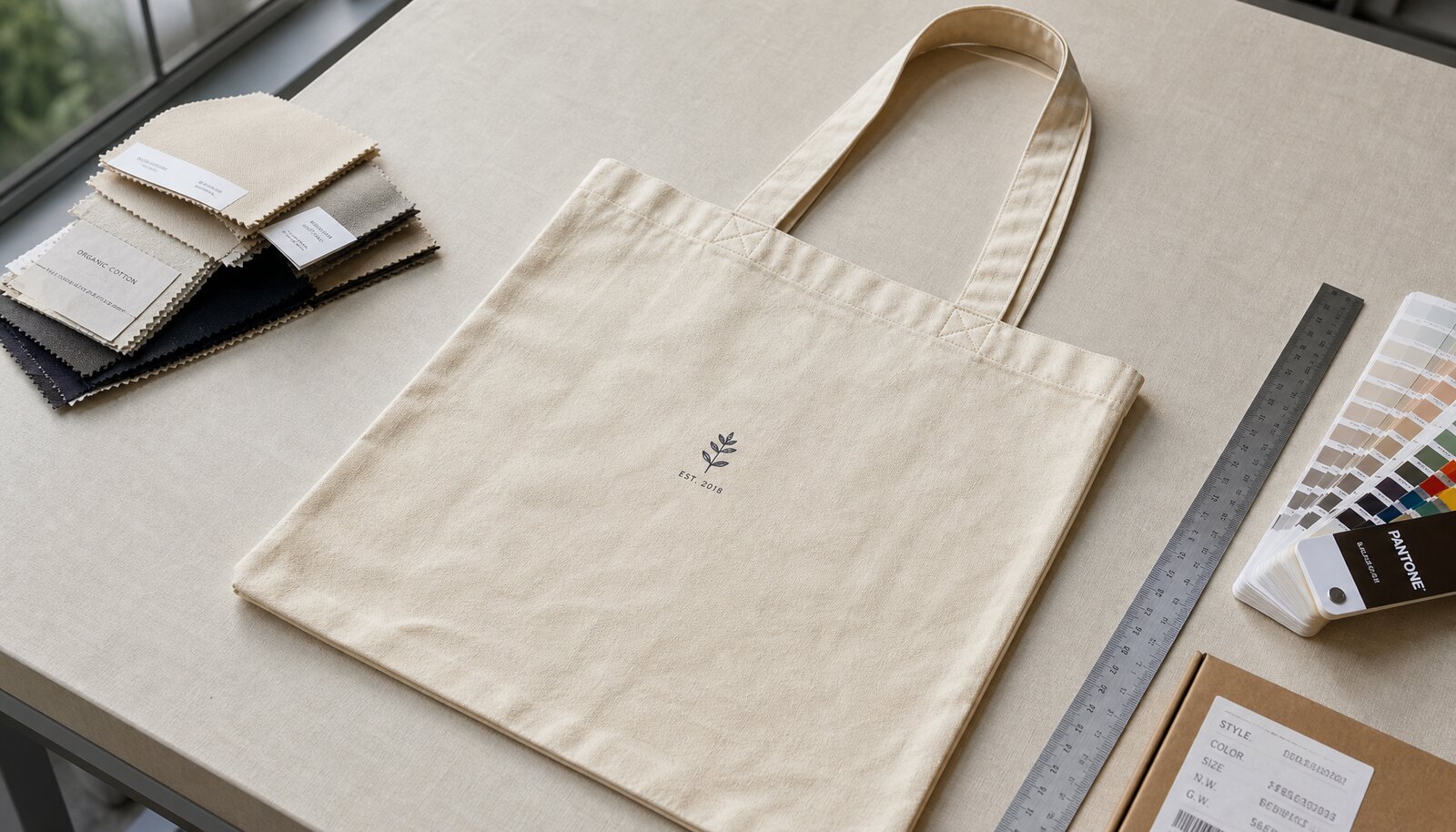
What buyers really mean by personalised cotton tote bags
For procurement teams, personalised cotton tote bags are not just a simple printed accessory. They are a low-complexity product with a high number of decision points hidden inside a small item: cloth weight, weave, stitching, print method, packing, and documentation. When buyers treat those choices casually, the quotes that come back may look comparable while actually representing different products altogether. That is where margin erosion, late rework, and avoidable claims usually begin.
A tote bag program can serve very different commercial goals. A trade-show handout may only need to hold brochures and a small sample pack. A bookstore retail tote may need better body, cleaner print edges, and a sturdier handle because shoppers will use it repeatedly. A fashion or lifestyle brand may care just as much about the tactile feel of the cloth and the way the bag folds as it does about the logo itself. Personalised cotton tote bags become a procurement item only when the buying team defines the commercial job the bag has to do.
The most useful way to start an RFQ is not with artwork alone, but with use case. Ask whether the tote is being sold, given away, bundled with another product, or used as store packaging. Then define the expected carry load in plain language. A bag that only needs to hold a catalog is a different build from one that may be used for groceries or books. Once the use case is clear, the supplier’s advice on GSM, handle length, and print method becomes far more meaningful.
Buyers also need to distinguish between the visual sample and the production reality. A showroom sample can be made carefully by hand, with extra time spent on alignment and finishing. Bulk production must still reproduce that result at scale. If your spec does not tell the factory what matters most, the production team will optimize for speed or cost, not for the commercial outcome your business needs.
- Start with end use, not artwork.
- Treat the tote as a functional product, not only a printed surface.
- Use one RFQ definition for all suppliers so the comparison is commercially valid.
Choose fabric weight based on use, not on a generic catalog number
The biggest spec mistake in personalised cotton tote bags is asking for “cotton” or even “canvas” without pinning down weight and weave. In practice, a light promotional cloth and a heavier retail cloth can both be described in loose marketing language, but they will not perform the same. A 140–160 GSM bag is often enough for giveaways, brochures, and light retail inserts. A 160–180 GSM bag usually feels more stable and holds print better for bookshops, gift stores, and branded merchandise programs. Once you move above that, the bag usually gains body and premium feel, but freight weight and price rise too.
GSM alone is not enough, because weave and finishing affect performance. A tightly woven 150 GSM fabric may feel sturdier than a looser 160 GSM cloth. Natural unbleached cotton can also present more visible fiber variation, which matters if your brand expects a clean and uniform surface. If the product will be resold in a retail environment, ask whether the cloth is pre-shrunk or finished in a way that reduces size change after handling. That detail matters when bags need to stack neatly, fit into retail packaging, or stay consistent across reorders.
For a procurement buyer, the best question is not “what GSM do you have?” but “what GSM and weave best support this use case, and what will it cost me across the full program?” A lighter cloth can lower unit price, but it can also create complaints if the contents show through or the print panel warps when the bag is packed. A heavier cloth may reduce those risks, but if the bag is intended as a free giveaway, the added cost may not be justified. The right answer depends on how the tote will be used, carried, stored, and distributed.
A simple rule for sourcing discussions: whenever the supplier recommends a fabric weight, ask what tradeoff they are solving. Are they protecting print quality, reducing sewing failure, lowering freight, or meeting a target price? That question often reveals whether the recommendation is based on real production experience or just a generic sales script.
- 140–150 GSM: workable for campaigns, event handouts, and lighter inserts.
- 160–180 GSM: better balance for retail resale, bookstores, and everyday carry.
- Ask whether the cloth is pre-shrunk, bleached, dyed, or left natural, because each choice affects appearance and repeatability.
Bag size, handle build, and construction details that affect real-world performance
Most buyers focus on width and height, but a tote’s commercial usefulness is often determined by the smaller build details. A standard size around 38 x 42 cm works for many programmes because it is familiar, easy to pack, and suits common retail use. But if the bag is intended for oversized books, premium apparel packaging, or thicker product kits, you may need a slightly different panel shape or gusset depth. Once the size changes, the artwork area, carton loading, and freight calculations all change too.
Handle construction matters as much as the bag body. A tote with decent cloth but weak handle attachment will fail in the field long before the fabric itself wears out. Buyers should specify handle length in a way that reflects how the bag is carried. Short handles work for hand-carry or packaging use. Longer handles support shoulder carry and are usually more versatile for consumer use. Ask the factory to confirm the finished length, not just cut length, because sewing and folding can change the final result.
The handle attachment method is another place where generic sourcing language causes problems. A turned handle, folded edge, double-stitched attachment, or bar-tack reinforcement all influence durability and appearance. For personalised cotton tote bags that will be resold, the buyer should ask to see the exact reinforcement method in the sample, not just the front print. Stitch density at the stress point is a practical indicator of how carefully the bag was made.
If the bag needs to stand upright, hold shape, or look premium on a shelf, say so in the RFQ. That requirement can influence fabric choice, seam structure, and whether a base insert or gusset is needed. Without that direction, the factory may prioritize foldability and shipping efficiency, which is fine for giveaways but not ideal for retail merchandising.
- State finished size, not just approximate measurements.
- Specify handle length by intended use: hand carry, shoulder carry, or store packaging.
- Ask for handle reinforcement details and stress-point stitching in the sample.
Print method should match artwork complexity, volume, and durability targets
Print selection is where many tote bag orders quietly become more expensive than planned. Screen printing is usually the best commercial option when the artwork is simple, the colors are limited, and the order will repeat. It gives strong color coverage on cotton and is widely understood by factories. For a one-color or two-color logo, screen print often provides the best balance of cost and durability. For larger runs, the setup cost is quickly spread across the order, which improves unit economics.
Heat transfer and digital methods can be the better fit when artwork is more detailed, the order is small, or the design uses gradients and fine lines that screen printing would struggle to reproduce cleanly. The tradeoff is that these methods can feel less permanent depending on the materials used and the print area. A sample that looks excellent in the room can still reveal issues after folding, friction, or light washing. Buyers should therefore judge print methods by the intended end use, not by a single flat sample photograph.
The real procurement question is not which method looks nicest once, but which method keeps the brand mark acceptable after the bag is handled in normal life. If the tote will be sold in a retail environment, ask for the approved sample to represent the final cure or transfer process. If the bag will be used in a campaign, ask whether the print remains clear after transit, stacking, and distribution. For heavier coverage designs, ask the supplier how they control ink thickness, alignment, and curing temperature so the result does not crack or feel stiff.
Print placement is also a measurable spec, not a design afterthought. A centered logo that sits too high or too low can make the bag look unprofessional even when the artwork itself is correct. Put a center line reference and top-edge distance into the spec, and approve the position on the physical sample using a ruler. That small step reduces argument later if production drifts by a few millimeters.
- Screen print: best for simple logos and repeat orders.
- Heat transfer / digital: better for short runs, fine detail, or gradient work.
- Define print position with dimensions, not just by eye.
MOQ, setup cost, and the economics of small versus repeat orders
MOQ is often presented as a simple number, but for personalised cotton tote bags it is really a combination of fabric economics, sewing efficiency, and print setup. A factory may offer a low unit price only because the order is large enough to absorb screen preparation, cutting waste, and packing labor. At smaller volumes, those fixed costs become visible. That is why a quote that looks cheap at 5,000 pieces can become much less attractive at 500 pieces.
For a test launch, the buyer may prefer a higher per-unit cost if it reduces exposure. One practical route is to use stock blank tote bags and print locally, especially when the design is still being refined or the campaign needs to move quickly. Another route is to place a small sewn-to-order batch with a simplified spec, then scale once the design and customer response are known. In both cases, the objective is to protect the business from overbuying a tote that has not yet proved itself.
Repeat programs are where direct factory production usually starts to make more sense. Once the spec is stable, the factory can hold the same cloth, same print method, and same carton plan across reorders. That makes replenishment easier for procurement and inventory teams. However, the buyer should still ask what has to be re-quoted on the next run. Fabric availability, screen wear, and dye lot variation can all change the economics. The most useful supplier is the one who can explain those triggers before the order is placed.
When you compare MOQ offers, ask the supplier to show the price at several quantities, not just one. A real buyer often needs to know the cost at pilot volume, launch volume, and re-order volume. That is much more informative than a single “best price” meant to win the first order. It also helps you judge whether the supplier is truly manufacturing for your spec or merely quoting a loose approximation of it.
- Ask for price breaks at 500, 1,000, 3,000, and 5,000 pcs.
- Separate setup, sample, and freight costs from recurring unit price.
- Use a test-run strategy when the design is unproven or the campaign window is short.
Supplier comparison: which sourcing route fits which buying scenario
A buying team often receives personalized tote bag quotes from very different supplier types, and those quotes can be hard to compare if the commercial route is not understood. A factory direct quote usually offers the best control over the product, but it also requires the buyer to manage more of the approval process. A trading company or sourcing agent can simplify coordination and consolidate multiple items into one shipment, but there is an extra layer between buyer and factory. A local printer can move quickly, especially for test runs, but may be limited by available stock bags, sewing quality, or batch consistency.
The right supplier route depends on the buying scenario. If your business is launching a branded retail range or supplying a retail chain, repeatability and traceability matter most, so factory direct sourcing often provides the strongest commercial outcome. If you are buying for a short campaign or need to bundle multiple promotional items into one program, a trading company may be worth the added cost because it reduces operational load. If the need is urgent and the quantity is small, a local printer may be the fastest path, but only if you accept tighter material constraints.
The main procurement risk is not choosing the “wrong” supplier type in the abstract. It is choosing a route that does not match your commercial priority. Buyers sometimes select the cheapest route for a retail-grade program and then discover that color consistency, stitch quality, or repeat order support is weaker than required. Others select a premium factory route for a short-lived event, then overpay for precision they never needed. Match the route to the business case, and the comparison becomes much clearer.
When comparing supplier routes, ask each one what they control directly and what they subcontract. A factory may control cutting, sewing, and packing but outsource printing. A trading company may coordinate everything but own none of the production assets. A local printer may handle decoration well but source the blanks from a third party. That matters because it tells you where defects can originate and which party will actually be responsible if the final tote does not match the approved sample.
- Factory direct: best for repeatability, spec control, and reorders.
- Trading company: useful for mixed-item sourcing and easier coordination.
- Local printer: good for small tests, but verify cloth and stitching before scaling.
How to structure a quote so the numbers are actually comparable
A usable quote for personalised cotton tote bags should read like a small commercial specification, not just a price line. Procurement teams need to see the fabric weight, bag dimensions, print method, number of colors, handle length, packing format, shipment term, and any one-time setup costs. Without that detail, two offers may look similar while actually covering different products. One supplier may quote a lighter cloth or a looser tolerance and still appear cheaper on paper.
The cleanest way to compare offers is to split them into fixed and variable costs. Fixed costs include screens, plates, artwork setup, sampling, and sometimes cutting adjustments. Variable costs include the blank bag, print application, sewing labor, packing, and export handling. Once those are separated, the buyer can see whether a small run is expensive because of setup or because the product spec itself is heavy and labor-intensive. That distinction matters for future reorders and internal budget planning.
A strong quote should also explain what is excluded. Is the price ex-works, FOB, or DDP? Does it include cartons, inner packing, and labelling? Are freight and destination charges separate? What happens if artwork changes after proof approval? Those answers are important because many tote bag purchase orders become more expensive only after the first estimate, when packaging or shipment assumptions are clarified. Buyers save time when they insist on the quote being complete enough to pass internal approval without a second round of clarification.
If your company has finance, compliance, or retail operations teams involved, ask the supplier to provide a simple commercial summary that can be forwarded internally: product definition, unit cost by volume, lead time, MOQ, sample charge, packing count, shipment term, and key exclusions. That keeps the buying process fast and also reduces the risk of sign-off delays later.
- Ask for a full cost breakdown, not only a single unit price.
- Make sure the quote clearly states shipment terms and exclusions.
- Use the same quote template for every supplier so the comparison is clean.
Sampling and approval: verify the real bag, not only the artwork
Sampling is where a lot of tote bag sourcing effort is wasted because the approval is too narrow. The buyer may approve a design file, a print proof, or a hand-finished sample that does not represent the actual bulk process. For personalised cotton tote bags, a meaningful sample has to answer three questions at once: does the fabric meet the target, does the decoration process reproduce the artwork correctly, and does the packed bag still look acceptable after handling?
The most useful sample is a pre-production sample made with the final cloth, final print method, and final packing format. That sample should be checked under neutral light and compared with the spec sheet, not with memory. Measure body size, handle length, seam alignment, and print position with simple tools. Look for loose threads, uneven top hems, skewed side seams, patchy print areas, and any sign that the bag body is warped after sewing. If the bag is going to retail, fold it as it will be packed and see whether the print area creases or scuffs against another bag.
Approval should be written and traceable. The supplier should know which sample version is final and what exactly was approved: artwork placement, cloth type, GSM, handle build, packing method, and carton labeling. If any of those elements change after approval, the production team should not assume it is still acceptable. That discipline prevents the common problem where the factory sees the sample as a reference and the buyer sees it as a binding standard. They are not the same unless the RFQ says so.
For small runs, buyers sometimes try to skip sampling to save time. That is risky if the artwork is critical, the bag is for resale, or the delivery window is tight and there is no chance to correct mistakes later. In those cases, a small sample cost is usually cheaper than replacing an entire run with wrong print placement or poor handle construction. Sampling is not a formality; it is a control point in the production chain.
- Approve a physical pre-production sample with final materials and packing.
- Measure the sample, do not just view it visually.
- Record the approved version in writing so production changes are traceable.
QC checks, tolerance limits, and the workflow from incoming fabric to shipment release
QC for personalised cotton tote bags needs to be practical. The most common quality failures are not exotic manufacturing issues; they are simple cost-cutting problems such as lighter-than-agreed fabric, weak handle reinforcement, poor sewing consistency, and prints that are under-cured or misaligned. Because the product is textile-based, some variation is normal, but the variation should be controlled and visible only within the boundaries of the approved sample.
A useful workflow starts before sewing. Incoming fabric inspection should confirm the cloth type, appearance, and approximate weight against the purchase spec. If the fabric is dyed or bleached, check for obvious shade difference between lots. During cutting and sewing, the factory should inspect body dimensions, seam allowance, top hem construction, and handle attachment. At the print stage, check registration, ink density, and curing quality. At final packing, confirm count accuracy, carton marks, dryness, and whether the folded bags press into the print surface. This sequence matters because it catches problems earlier and cheaper than a final carton-only check.
Tolerance planning should reflect sewn-goods reality rather than rigid industrial parts logic. For example, a bag body may be acceptable with a small size variance if the visual appearance and functionality remain intact. Print placement may have a slight tolerance if the artwork still looks centered and balanced. What is not acceptable is drift that makes the bag look obviously off, or defects that affect function, such as loose handles, split seams, broken threads, oil marks, or print that cracks when folded. Buyers should define defect severity with the supplier before production so everyone knows what is a minor issue and what triggers rework or rejection.
If your procurement process uses AQL, align the inspection level with the end use. A retail program may need tighter acceptance than a one-time event giveaway. Even without a formal AQL plan, the buyer should insist on a final inspection report, photographs of any defects found, and confirmation that the shipment matches the approved sample. That is especially important when the order is being exported, because replacement costs and delay costs can be substantial once the goods leave the factory.
- Inspect in stages: incoming fabric, in-line sewing, print, and final carton check.
- Define practical tolerances for size, position, and shade before production starts.
- Reject or rework bags with weak handles, open stitches, broken threads, or print curing issues.
Packing, freight, and landed-cost planning for import and wholesale programs
Packing decisions influence both product condition and total landed cost. Flat-packed cotton totes are usually the most efficient way to ship because they keep cartons compact and make warehouse handling easier. But “flat-packed” still needs detail. How many bags per carton? Is there inner poly, paper banding, or just bulk stacking? Is there moisture protection? Is the bag folded to protect the print area, or can the fold cause a visible crease? These choices matter because they affect carton weight, carton volume, and the risk of transit damage.
A good packing plan is matched to the channel. For wholesale distribution and retail replenishment, the carton should be easy to receive, count, and store. That means consistent carton quantities, clear carton labeling, and a packing list that matches the physical load. For direct-to-store or ecommerce programs, the buyer may need additional inner packaging, carton marking, or barcode requirements. If those instructions are not given early, the supplier may quote a format that is cheap to make but inconvenient to receive.
Lead time should be read as a process, not a single date. Sample approval, raw material booking, print setup, sewing, QC, packing, and dispatch all take time. For standard personalised cotton tote bags, a bulk lead time of roughly 20–35 days after approval is common when materials are available and the artwork is straightforward. Complex print coverage, fabric shortages, seasonal congestion, or repeated sample changes can lengthen that schedule. The buyer should therefore build margin into the plan and treat the production calendar as a working assumption, not a promise until the sample is signed off.
Landed cost is often where the real comparison is won or lost. A lower ex-works quote can become a higher final cost if the carton plan is inefficient or the freight rate rises because the product is bulky. Similarly, a slightly higher unit price may be cheaper overall if the supplier packs more efficiently, reduces damage, or ships from a better logistics point. Procurement should always compare the cost to receive usable bags in the destination warehouse, not just the factory gate price.
- Confirm carton count, carton size, gross weight, and moisture protection.
- Read lead time as a process: approval, production, QC, and dispatch.
- Compare landed cost to the destination warehouse, not only ex-factory price.
Specification comparison for buyers
| Supplier route | Best fit for | Commercial tradeoff | Main risk | Procurement implication |
|---|---|---|---|---|
| Factory direct | Repeat programs, branded retail, chain store replenishment | Best control over fabric, sewing, and packing once the spec is stable | Higher effort for RFQ, sampling, and inspection management | Use when repeatability and defect control matter more than speed |
| Trading company / sourcing agent | Multi-item buys, urgent coordination, buyers with limited factory access | Simpler coordination and consolidated documentation | Spec can drift if the factory is not tightly managed | Useful if you need one point of contact, but require detailed spec sign-off |
| Local print shop | Very small runs, event trials, local pickup | Fast turnaround and easy artwork changes | Fabric quality and sewing consistency may be weaker or inconsistent | Good for test launches, not ideal for long-term repeat programs |
| Blank stock + local branding | Fast campaigns, promotional packs, low initial inventory risk | Low setup cost and quick start | Bag style and cloth weight are constrained by stock availability | Best when time matters and exact custom sizing is not essential |
| Fully custom sewn-to-order | Retail resale, premium merch, structured distribution | Best brand control and spec precision | Longer lead time, higher MOQ, more QA responsibility | Use when the tote is part of the brand offer, not just a giveaway |
| Material | 8-12 oz cotton canvas, 120-220 gsm cotton, recycled cotton, or blended fabric selected by use case and target price | Before price comparison | Different cloth weights, backing, or certification claims make quotes hard to compare | |
| Construction | bag size, gusset, handle drop, seam allowance, stitch density, reinforcement patch, and loading expectation | Before sampling | Weak stress points create returns and failed inspections | |
| Decoration | screen print, heat transfer, embroidery, woven label, or hangtag matched to fabric texture and brand durability needs | Before artwork approval | The wrong method can crack, bleed, pucker, or fail on the chosen fabric |
Buyer checklist before sampling
- Define the end use before asking for price: retail resale, store packaging, event giveaway, membership gift, or corporate merch. Load expectation determines fabric weight and handle strength.
- Write the tote spec in measurable terms: finished size, target GSM, weave type, handle length, handle stitch pattern, gusset depth if needed, print location, and acceptable tolerances.
- Match the print method to the artwork: one-color logo, multi-color logo, fine text, gradients, or large coverage area all point to different production choices.
- Ask every supplier to quote the same terms: EXW, FOB, or DDP; same fabric; same size; same print colors; same packing count; same sample fee treatment.
- Request a pre-production sample with the final fabric, final decoration method, and final packing format, then approve it in writing before bulk starts.
- Compare landed cost, not just unit price. Include setup fees, sampling, cartonization, inland freight, sea/air freight, and destination charges if applicable.
- Confirm QC checkpoints in advance: incoming fabric inspection, in-line sewing checks, post-print checks, final carton audit, and AQL or sampling plan if your team uses one.
- Ask for a document pack suited to your market, such as composition note, country of origin, carton marks, test reports if required, and commercial invoice / packing list details.
- Check whether the supplier can hold shade consistency and repeat the same spec for reorders; this matters more than a one-time sample that looks perfect.
- Verify who owns the final approval: artwork, sample sign-off, bulk production release, and shipment release should each have a named signatory.
Factory quote questions to send
- What is the exact fabric composition, weave type, and finished GSM after washing or finishing?
- Is the price based on a stock blank bag, a sewn-to-order bag, or a fully custom spec with new cutting and stitching?
- Which print method are you recommending for this artwork, and why is it better than the alternatives for durability and cost?
- What is the MOQ for this exact size, fabric weight, handle construction, and print method combination?
- Please break the quote into blank bag cost, print setup, print unit cost, sewing labor, packing, and freight term.
- What are the price breaks at 500, 1,000, 3,000, and 5,000 pcs, and which cost elements change at each level?
- What is included in the sample fee, how many samples are supplied, and is the fee refundable against bulk?
- What are your practical tolerances for size, print placement, shade variation, and handle symmetry?
- How do you inspect handle strength and seam security during production?
- How are bags packed per carton, how many pieces per carton, and what are the carton dimensions and gross weight?
Quality-control points to confirm
- Fabric weight: confirm the finished GSM against the agreed spec. A common buyer tolerance is roughly ±5% to ±8% on sewn textile goods, but the real point is to reject cloth that is visibly lighter than the approved sample or feels too open in weave.
- Size: measure at least a small sample set from each lot. A practical sewn-bag tolerance is usually around ±1 to ±2 cm on body dimensions, provided the bag still matches the approved sample profile and the print area remains centered.
- Handle build: check handle length, symmetry, bar-tack density, and seam reinforcement. Pull-testing should reflect the intended use case; for event giveaways, a simple repeated load check is often enough, while retail bags need more consistent stress-point control.
- Stitch quality: inspect top hems, side seams, gussets if used, and any folded edges for skipped stitches, loose threads, needle damage, or uneven seam allowance.
- Print quality: verify registration, color density, edge sharpness, and curing. Watch for cracking, smudging, offset, ghosting, or patchy ink coverage, especially on natural cotton cloth.
- Shade and fabric consistency: compare against the approved reference under neutral light. Natural cotton can vary from lot to lot; define what variation is acceptable before production starts.
- Packing: confirm carton count, bag orientation, poly or paper banding if used, moisture protection, and whether the packed bags crease the print area.
- Labeling and traceability: cartons should show order reference, style code, color, quantity, carton number, and any destination marks required by your warehouse or importer.
- Final audit: check count accuracy, defect rate, and carton condition before dispatch. If your business uses AQL, align the inspection level and defect definitions with the supplier before bulk begins.