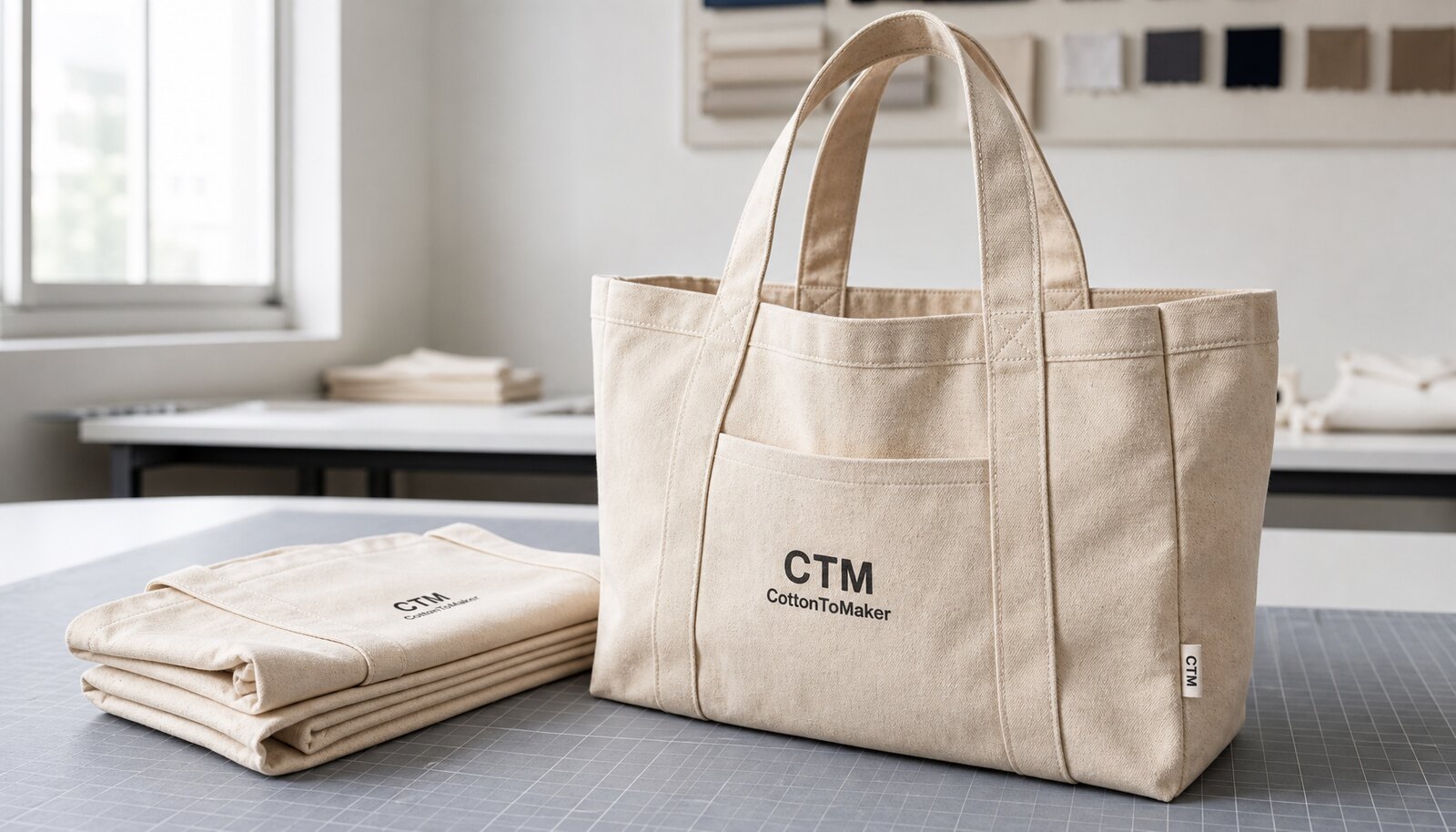
1. Why this tote is a real procurement item, not a casual promo purchase
A personalised canvas shopping bag can look straightforward at the catalog stage and still become a difficult bulk-buy once production starts. The visible product is only one part of the order. Procurement also has to control fabric weight, weave quality, seam structure, print durability, packing method, carton efficiency, and the evidence the supplier can provide when something goes wrong. If any of those are left vague, the factory will usually fill in the blanks with the cheapest workable interpretation.
That is why the quote must be treated as a sewn-product specification, not a one-line promotional item. A buyer who only asks for “canvas tote with logo” is likely to receive a quote that cannot be compared fairly across suppliers. The better approach is to lock the finished size, material weight, decoration method, and quality standard before pricing begins. Once those are fixed, unit price becomes meaningful instead of misleading.
In procurement terms, the biggest risk is not that the bag arrives completely unusable. The more common problem is that it arrives slightly wrong: the fabric is thinner than expected, handles sit unevenly, print colors drift, or cartons are packed in a way that wastes freight volume. Small mistakes on a sewn bag multiply across a bulk order because they affect customer perception, returns, and warehouse handling. Buyers should therefore compare not just the price, but also the factory’s ability to reproduce the same result run after run.
- Ask for a spec-driven quote rather than a generic promotional quote.
- Separate product quality, decoration quality, packing quality, and freight cost in your evaluation.
- Assume the supplier will quote to the lowest unspoken standard unless you define the bag clearly.
2. Fabric spec starts with weight, yarn count, and finish
Canvas weight is the foundation of the buying decision. For many retail and branded-use programs, 12 oz canvas is the practical default because it provides enough body for a clean print, decent shape retention, and everyday carry without driving the cost structure too high. If the tote is meant to feel more premium, carry heavier items, or stand up better on display, 14–16 oz canvas is often the safer choice. Very light canvas can reduce the quote, but it often looks soft, creases quickly, and can make the product feel closer to a giveaway than a retail tote.
Procurement teams should ask for more than an ounce figure. Request GSM, yarn count, weave description, and fabric finish. A supplier that says only “canvas” may be offering stock cloth, custom-woven cloth, washed cloth, or dyed cloth, each of which behaves differently in sewing and printing. Natural raw canvas can also vary in shade, so a quote should state whether the base cloth is natural, bleached, or dyed. This matters because the same logo can look bright and crisp on one base and dull or muddy on another.
If the tote is expected to be reused frequently, buyers should also ask about shrinkage allowance and colorfastness. Untreated cotton canvas can shrink after washing or steam exposure, and darker inks may rub off if the curing process is weak. For bulk programs, it is reasonable to require a small wash or rub test on the approved material before approval. That is not overengineering; it is basic control for a sewn item that will be handled, folded, and sometimes cleaned by end users.
- 12 oz works well for most standard retail and promotional applications.
- 14–16 oz is more suitable when structure, durability, or premium perception matters.
- Ask for fabric finish, shrinkage behavior, and color fastness evidence when the bag will see repeated use.
3. Construction details that separate a durable tote from a weak one
Many buyers focus on logo placement and ignore the sewing specification. That is a mistake because tote durability is built into the construction. For a standard canvas shopping bag, ask the supplier to state seam allowance, stitch density, thread type, reinforcement method, and the trimming standard for loose threads. If those details are missing, you may get a bag that looks acceptable on arrival but fails after repeated use or heavy loading.
As a practical sourcing baseline, side and bottom seams should not be vague. A seam allowance in the range of about 1.0–1.3 cm is common for a workable tote build, but the key is consistency and reinforcement, not just the number itself. Stitch density on main seams is often best kept around 8–10 stitches per inch for balance between strength and speed. Too few stitches can weaken the seam; too many can perforate the fabric and create a line of weakness, especially on heavier canvas.
Thread type matters too. Buyers should ask whether the factory uses polyester thread, cotton thread, or a blended thread, and whether the thread thickness matches the fabric. Polyester is often preferred for strength and abrasion resistance, particularly on a bag that will be carried frequently. If the order uses heavy canvas, handle anchoring should be strengthened with bartacks or an X-box pattern so the load is transferred away from a single stitch line. For higher volume or heavier-load programs, it is reasonable to request a pull-strength reference from the factory or at least an internal reinforcement standard.
- State seam allowance, stitch density, thread type, and reinforcement pattern in the RFQ.
- Do not accept a quote that omits handle-anchor construction details.
- Ask the supplier how loose threads, skipped stitches, and open seams are counted during inspection.
4. Decoration choices should be matched to artwork complexity, not habit
Decoration is often the most visible part of the tote, but it should not be chosen by habit. Screen printing is typically the most economical route for one to three solid colors at meaningful volume. It gives strong coverage on canvas and usually holds up well if the curing process is controlled. The tradeoff is detail. Very thin lines, tiny text, and gradients may not reproduce cleanly on the weave of canvas, especially if the fabric surface is coarse or the ink layer is too heavy.
DTF or heat transfer can solve some of those limitations when the artwork is complex, when the order is small, or when the buyer wants a faster sample route. The procurement tradeoff is that transfer-based decoration can feel less integrated with the fabric and may wear differently over time if heat, pressure, or curing is off. Buyers should ask whether the transfer has been tested for rub resistance and whether the factory can share a sample from a previous similar substrate.
Embroidery can be a good fit for a small premium mark, but it is rarely the right choice for large logo coverage on a shopping bag. It adds labor, needs careful thread selection, and can distort lighter fabric if the stitch density is too high. It also changes the hand-feel of the bag and may increase cost quickly. If embroidery is being quoted, ask for stitch count, backing type, and the maximum logo size before approving it for comparison against print options.
- Use screen print for simple logos and repeat orders.
- Use transfer methods when artwork complexity or short-run flexibility matters more than long-term print economics.
- Use embroidery only when the brand wants a premium tactile finish and the mark is small enough to stay clean.
5. Size, gusset, handle, and loading behavior should be specified together
A tote is not just width and height. The gusset, handle drop, and load path affect how the bag feels and how it performs in the field. A common retail size is around 38 x 42 cm, often with a 10–12 cm gusset, because that format works for shopping, events, and light household carry. If the bag will hold boxes, catalogs, or bulkier items, a deeper gusset can improve utility, but it also increases fabric usage, sewing time, and carton volume. That is why the buyer should not approve size in isolation from freight planning.
Handle specification deserves equal attention. Self-fabric handles are common on personalised canvas shopping bag programs because they match the body fabric and are economical to produce. However, the buyer should define handle width, handle length, and handle drop. A handle that is too narrow can dig into the hand, while one that is too long can make the tote hang awkwardly when full. If shoulder carry matters, the handle drop should be set with the intended load in mind. If the bag is designed for retail carry only, a shorter drop may be fine and can reduce material use.
If the bag must stand up or carry heavier contents, ask for base reinforcement and ensure the factory tells you how the bottom seam is built. Some buyers also specify panel alignment or center seam placement so the logo sits squarely on the front face. These details seem minor, but they affect display quality and customer perception. A tote that is structurally sound but visually crooked can still fail a retail program.
- Put finished size, gusset depth, handle length, and handle drop into the RFQ together.
- Ask whether the bag is expected to stand upright when empty or partially loaded.
- Define load expectations if the bag will carry books, groceries, bottles, or boxed items.
6. Quote comparison: look beyond the unit price and normalize the spec
Procurement teams often compare tote quotes line by line and still miss the real difference because the specs are not normalized. One supplier may quote a low unit price but omit screen fees, artwork setup, packing inserts, or export documentation. Another may include those costs but use a heavier canvas, stronger thread, and better carton packing. The unit price alone does not tell you which offer is better. What matters is whether the same visible product and the same commercial conditions are actually being offered.
The cleanest way to compare quotes is to build a single comparison sheet with the same size, same canvas weight, same print method, same print area, same packing count, and same delivery assumption. Then ask the supplier to separate one-time charges from recurring unit costs. This makes hidden costs visible and helps procurement understand which quote is truly lower after setup and packing are included. It also prevents the common mistake of selecting the cheapest sample and then discovering the bulk order has higher add-ons.
Buyers should also normalize by carton data. Two bags with identical unit pricing can produce very different freight cost if one supplier packs 50 pieces per carton and another packs 30 because of folding or carton-size limits. A good factory quote should include carton dimensions, gross weight, and whether the cartons are export-grade or standard warehouse cartons. Those details matter if the order is shipping internationally or going into a tightly managed distribution network.
- Compare only quotes built on the same bag spec and the same packing spec.
- Ask for separate pricing on setup, decoration, inner packing, and cartons.
- Use carton dimensions and gross weight to estimate freight before placing the PO.
7. MOQ is a production rule, not a marketing promise
MOQ on a personalised canvas shopping bag reflects actual production economics. If the factory is using stock canvas, a standard tote pattern, and a simple one-color logo, the MOQ can be relatively low. If the order requires custom woven fabric, special dyeing, washed finishing, multiple print screens, or embroidery, the MOQ should rise because the factory has more setup cost to absorb. That is why two suppliers may quote very different minimums even when the bag looks similar in a photo.
For first-time buyers, a lower MOQ can be useful for market testing, but the tradeoff is usually price, color flexibility, or schedule. Some factories can meet low MOQ only by inserting your order into a larger production run or by using existing stock cloth. That may be acceptable if the product is a test SKU, but procurement should confirm whether the same fabric lot can be reserved for repeat orders. If not, shade variation and hand-feel drift can create problems later when the product is reordered.
The real buying question is not simply whether the supplier can make 500 pieces. It is whether they can make 500 pieces under the same conditions that will be used for 5,000 pieces later. If the order is likely to repeat, a slightly higher MOQ with better fabric continuity and more stable production planning is often the smarter commercial choice.
- MOQ may apply by artwork, size, fabric color, or print color count.
- Low MOQ usually trades off against price, fabric reservation, or customization options.
- For repeat programs, ask whether the same fabric lot can be reserved for future reorders.
8. Factory vetting: verify the supplier before you rely on the quote
A strong tote quote is only useful if the supplier can actually make it consistently. Procurement teams should vet the factory or trading partner before approving bulk production. At minimum, ask who owns the sewing line, where the fabric comes from, and whether the quoted product is made in-house or outsourced. If the supplier is a trading company, ask which steps are factory-controlled and which are subcontracted, because that affects lead time, quality accountability, and document traceability.
Document verification matters. Buyers should ask for business license details, export registration if relevant, and any current audit or compliance documents the supplier can share without delay. Depending on the program, this may include ISO certification, BSCI or SEDEX audit summaries, OEKO-TEX-related fabric claims, or basic social compliance evidence. The point is not to collect certificates for their own sake; it is to verify that the supplier’s claims are supported by current documents, not by a sales pitch. Where a claim is important to your customer, ask for the actual certificate number, scope, validity date, and issuing body so you can confirm it independently.
Factory vetting should also include process questions. Ask whether the factory has a cutting table, screen-print area, in-line sewing checks, and a final inspection area. Ask how they measure size tolerance, how they handle shade variation, and whether retained samples are kept from the approved run. A supplier that can answer those questions clearly is usually more reliable than one that only talks about low price. If possible, request live photos or a short video walk-through of the production floor and finished goods area. That is often more revealing than a polished sales deck.
- Confirm whether the quote is from a factory or a trading company.
- Ask for current business, compliance, and audit documents, not expired certificates.
- Verify who controls sewing, printing, and packing, and whether any step is subcontracted.
9. Quality control needs defect thresholds, not just a general promise
QC is where bulk orders either stay under control or become expensive. For sewn totes, quality control should not be limited to “check before shipment.” The buyer should define defect categories, sampling levels, and acceptance thresholds before production starts. A common procurement approach is to use AQL-based inspection with different treatment for critical, major, and minor defects. If your organization uses a specific AQL, write that into the PO or quality agreement; if not, ask the supplier what standard they follow and insist on written thresholds.
A good QC plan for a personalised canvas shopping bag should include dimensional tolerance, stitching integrity, print quality, packing accuracy, and appearance criteria. Critical defects may include open seams, missing handles, major contamination, or incorrect artwork. Major defects might include obvious print misalignment, significant shade variation, loose reinforcement, or a missing label. Minor defects may include small thread tails or slight fold marks, but even these should be counted so the supplier knows what is and is not acceptable. What matters is that the factory and buyer use the same definition of acceptable quality.
Procurement teams should also ask for sample retention. Keep one sealed retained sample from the approved pre-production sample and another from the final approved bulk lot if possible. If a dispute arises, the retained sample becomes the reference for size, print shade, handle length, and folding method. That is especially valuable when the product is sold through retail channels where quality disputes can be expensive to resolve.
- Use AQL sampling and write the defect rules before production begins.
- Classify defects as critical, major, or minor with written examples.
- Keep retained samples from approval and from the final bulk run.
10. Testing, acceptance criteria, and the final RFQ checklist
If the tote will be used repeatedly or sold as a retail item, testing should be part of the buying conversation. Buyers commonly ask for shrinkage behavior after washing or steam exposure, print adhesion or rub resistance, and color consistency across lots. The exact test regime can vary by program, but the principle is the same: a bag should be checked under the conditions in which it will actually be used. If the customer will carry groceries, the handles and seams should be able to survive load. If the customer may wash the bag, the print and fabric need to tolerate that use case.
Acceptance criteria should be practical and written in advance. For example, size variation, print placement tolerance, loose thread limits, and carton damage limits should all be defined before the goods are made. If the supplier says a measurement or appearance issue is “normal,” ask them to quantify it. Procurement teams should not rely on vague assurances when dealing with repeated units across a bulk run. A clear acceptance plan prevents production arguments later and gives the factory a target it can actually hit.
Before closing the RFQ, make sure the request includes the commercial and technical details the factory needs to price accurately. That should include the bag dimensions, fabric weight, reinforcement method, decoration method, artwork files, carton spec, inspection standard, document requirements, and delivery terms. A well-written RFQ reduces back-and-forth, improves quote comparability, and lowers the chance of rework. For buyers managing multiple vendors, that is often the difference between a useful sourcing exercise and a pile of non-comparable offers.
- Ask for shrinkage, rub resistance, and colorfastness evidence when use conditions justify it.
- Write acceptance tolerances for dimensions, print placement, stitching, and packing before production.
- Use a single RFQ template across suppliers so quotes can be compared on equal terms.
Specification comparison for buyers
| Spec decision | Recommended procurement target | Why this choice works | Buyer risk to check |
|---|---|---|---|
| Fabric weight | 12 oz canvas as the default commercial spec; 14–16 oz for premium retail, heavier carry, or better structure | 12 oz balances price, print clarity, and everyday usability; heavier canvas improves shape retention and perceived value | Light fabric can look limp after printing; heavier fabric increases raw material cost, carton weight, and freight cube |
| Yarn and weave | Plain-woven cotton canvas with stable yarn count and minimal slub variation | Predictable print surface and more consistent cutting/sewing than mixed or loosely woven cloth | Ask for yarn count, weave density, and whether the fabric is stock, custom woven, bleached, dyed, or washed |
| Stitching construction | Side seams with 1.0–1.3 cm seam allowance, 8–10 stitches per inch on main seams, bartack or X-box reinforcement at handle anchors | This gives better seam durability without overcomplicating the bag or raising sewing time too much | Thin seam allowance, skipped stitches, or weak handle reinforcement is a common failure point in bulk use |
| Handle spec | Self-fabric handles with reinforced anchoring; handle width 2.5–4 cm depending on load | Comfortable in hand, easy to source, and more durable than very thin webbing on budget programs | Check handle drop, symmetry, edge finishing, and whether handle twist is allowed or prohibited |
| Decoration method | Screen print for one to three solid colors; DTF or heat transfer for complex artwork or shorter runs; embroidery only for small premium marks | Matches decoration to artwork complexity and order size instead of forcing one method for every brief | Fine text, gradients, and delicate outlines can break down on coarse canvas or crack in use |
| MOQ | 1,000–3,000 pcs for standard custom runs; lower only if using stock fabric, existing pattern, or shared setup | A realistic MOQ usually reflects setup, fabric availability, and production stability | Very low MOQ often means higher unit price, limited color control, or shared production batches |
| Packing | Flat fold with protective inner wrap if needed; export carton with fixed piece count and carton mark | Controls cube, protects print areas, and speeds receiving | Bad folding can crease the logo; overpacking can damage cartons and raise freight cost |
| Inspection route | Pre-production sample, first-article approval, in-line check, final random inspection to AQL | Gives procurement a defensible acceptance process for bulk orders | Buying from photo approval alone is too risky for sewn goods |
| Lead time | Sample in 5–10 days; bulk 20–35 days after final approval for standard stock fabric builds | This is a reasonable planning range for common tote programs | Custom dyeing, wash finishing, embroidery, or peak season can extend schedules materially |
Buyer checklist before sampling
- State finished width, height, gusset depth, handle length, and seam allowance in the RFQ so every supplier prices the same tote construction.
- Specify canvas weight in GSM or oz, plus whether the fabric is natural, bleached, dyed, pre-washed, or resin-finished.
- Define print area, number of colors, Pantone references where needed, and the acceptable registration tolerance for logo placement.
- Require a pre-production sample that matches final fabric, stitch construction, print method, and packing; do not approve a blank sample as final.
- Ask for production photos or video at cutting, printing, sewing, and packing stages if the order is time-sensitive or the supplier is new.
- Request carton dimensions, pieces per carton, gross weight, and pack method before PO release so freight and warehouse planning are accurate.
- Set defect thresholds in writing: allowable size variation, stain allowance, loose thread limits, print defects, and carton damage criteria.
- Keep a signed reference sample and one sealed retained sample from the approved production run for dispute resolution.
Factory quote questions to send
- What exact canvas weight, yarn count, and weave type are included in your quote, and is the fabric stock-held, custom woven, or dyed after weaving?
- What seam allowance and stitch density do you use on side seams, bottom seams, and handle anchoring, and how are handle stress points reinforced?
- Which print method is quoted, how many colors are included, and what is the cost for each extra color, larger print area, or second-side print?
- Is the MOQ per artwork, per size, per colorway, or per fabric color, and can quantities be combined if the total order meets your minimum?
- What are the sample charges, sample lead time, and what fees are refundable after bulk confirmation?
- Can you provide a carton spec sheet with pieces per carton, carton size, gross weight, and fold method?
- What QC standard do you use for sewn bags, and do you inspect against AQL 2.5/4.0 or an internal equivalent?
- Which documents can you share to verify factory claims: business license, export registration, ISO certificate, BSCI/SEDEX audit summary, OEKO-TEX or fabric test reports if relevant, and recent inspection records?
- Are any costs excluded from the quote, such as screen fees, plate fees, artwork cleanup, woven labels, hangtags, inner packing, export documents, or urgent lead-time surcharges?
- What testing can you provide for shrinkage, color fastness, seam strength, and print adhesion, and what were the latest results on similar fabric?
Quality-control points to confirm
- Finished dimensions should stay within the agreed tolerance band, typically ±0.5 cm to ±1.0 cm on common tote formats, unless the buyer writes a different spec.
- Canvas weight should match the approved reference or be within the agreed tolerance, with supporting mill test data or in-house weighing records.
- Seam allowance should be consistent along production runs; main seams should not wander enough to reduce strength or affect bag symmetry.
- Main stitching should show no skipped stitches, broken threads, open seams, or loose ends longer than the agreed trim standard.
- Handle anchors should be reinforced and symmetric, with no pulled stitches, twisted handles, or uneven strap length beyond the tolerance.
- Print should match the approved sample for placement, ink density, edge sharpness, and color tolerance, with no obvious bleed, cracking, or smearing.
- Shrinkage after wash or steam testing should fall within the agreed limit; if no limit is set, the buyer should define one before production.
- Color fastness and rub resistance should be checked where the bag will be handled often; buyers should ask for dry rub and wet rub results if the artwork is high contrast.
- AQL sampling should be documented by defect class, with clear pass/fail thresholds for critical, major, and minor defects.
- Carton count, labels, fold method, and bag orientation should match the approved packing standard exactly, with retained samples kept from final shipment.