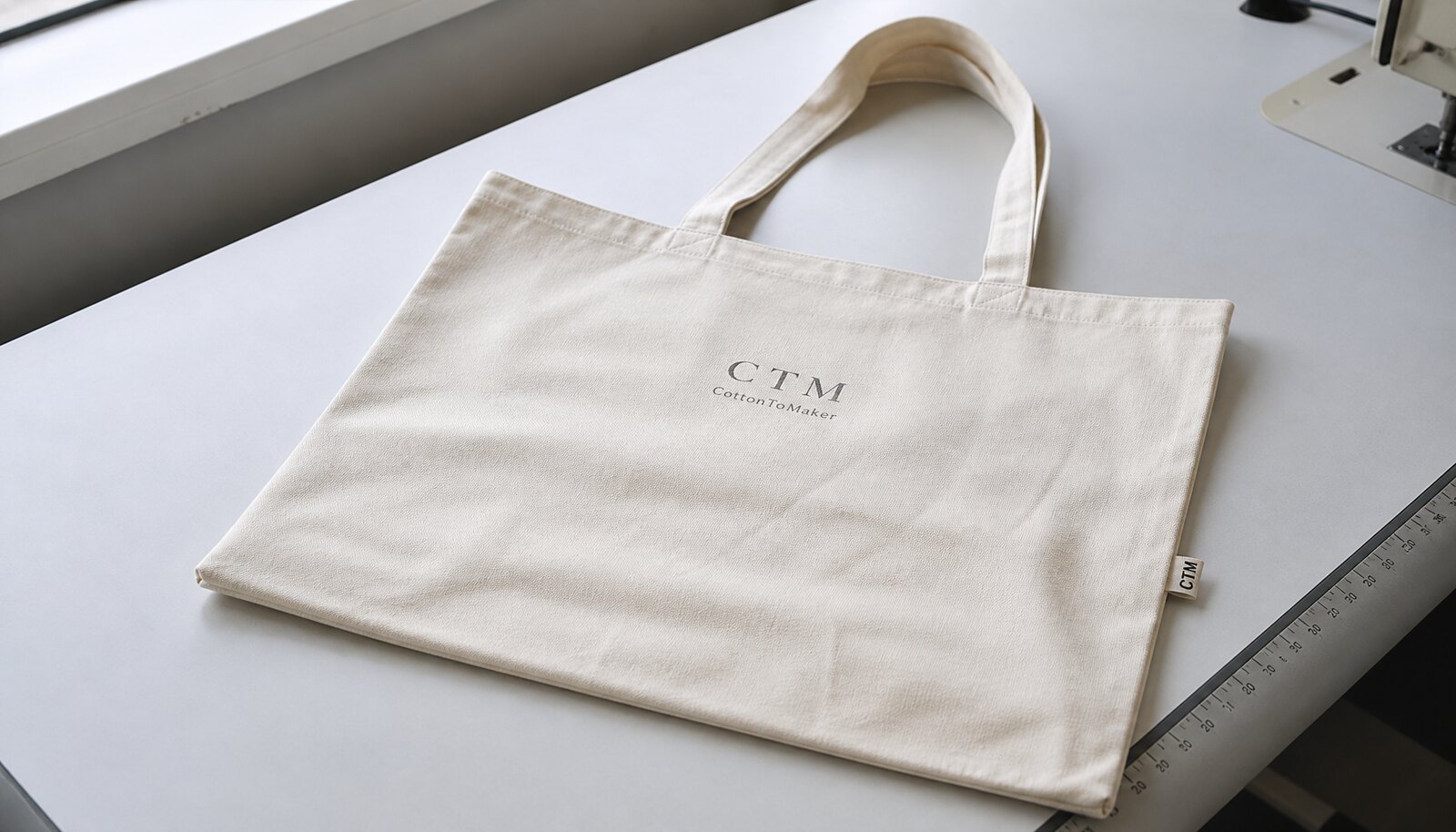
Why organic tote bag printing is a different RFQ from a standard cotton tote
Organic tote bag printing is not just a logo exercise. The cotton base, fabric finish, and print method all interact, so a quote that looks cheap at first can become expensive when the supplier adjusts for lighter fabric, extra curing, or a second print pass. For procurement teams, the real task is not finding the lowest unit price; it is making sure every supplier is quoting the same build.
The biggest sourcing mistake is sending a vague brief like “organic cotton tote with logo.” That usually produces mixed quotes: one supplier offers a thin fabric with a single-color screen print, another quotes a heavier canvas with better stitching, and a third includes retail folding and a carton pack that changes the landed cost. A usable RFQ should lock down the fabric, size, print coverage, and packing method before price comparison starts.
- State whether the tote is for retail sale, events, gift-with-purchase, or daily carry.
- Specify the target hand feel: lightweight soft cotton, structured canvas, or heavier natural canvas.
- Separate the bag spec from the decoration spec so the supplier cannot fill gaps with assumptions.
Fabric choices: GSM, weave, and how they affect print results
For organic tote bag printing, fabric weight is one of the first lines that should appear in the RFQ. A common working range is 170–270 GSM for cotton canvas, depending on whether the buyer wants a soft promotional tote or a more durable retail bag. Below that range, the bag can look too thin once printed; above it, sewing labor and freight volume climb quickly.
Weave and finishing matter almost as much as GSM. A tight canvas surface generally prints cleaner than a loose weave, especially for small text or line art. Unbleached or natural organic cotton may also show fiber flecks and shade variation, which is normal, but the buyer should accept that the fabric is not a bright white billboard. If the brand art depends on sharp contrast, the quote should specify print underbase, opacity target, and whether the base fabric will be scoured or left natural.
- 170–200 GSM: better for events, giveaways, and price-sensitive programs.
- 220–270 GSM: better for retail use, heavier carry, and sharper perceived value.
- Natural organic cotton may vary in shade from roll to roll; build that into your approval standard.
Print method selection: screen print, heat transfer, or embroidery
Most bulk organic tote bag printing programs still use screen printing because it gives consistent coverage, good wash resistance, and a predictable unit cost at scale. It is the right default for simple logos, one- or two-color art, and repeat orders. If the artwork uses large solid areas, screen print also tends to look more premium on natural cotton than a low-cost transfer that sits on top of the surface.
Heat transfer can work for small runs or multi-color artwork, but buyers should be careful with feel and crack resistance. Embroidery is usually less common on tote bags because it adds cost and can distort lightweight fabric, though it is useful for small premium marks on heavier canvas. A good supplier will tell you when the art is too fine for screen printing and propose a practical alternative instead of saying yes to everything.
- Screen print: best for simple logos, medium-to-large quantities, and controlled color repeatability.
- Heat transfer: useful for short runs, variable art, or photographic effects, but inspect for edge lift and stiffness.
- Embroidery: suitable for premium positioning, not ideal for very thin organic cotton or large filled areas.
MOQ logic: why the cheapest quote is often tied to one narrow setup
MOQ in tote production is usually driven by fabric cutting efficiency, printing setup, and sewing line planning. A factory may quote an attractive price if all bags share one size, one fabric color, and one print location. The same supplier may raise the MOQ sharply once the buyer asks for mixed sizes, multiple artwork versions, or individual retail packing. That is not arbitrary; it reflects the way the production line is scheduled.
For buyers, the important point is to match MOQ to commercial reality. If the order is a pilot for a new retail line, a lower MOQ may be worth a slightly higher unit cost. If the program is a recurring replenishment order, it is often better to combine the volume into one base spec and keep the decoration simple. The wrong MOQ strategy creates leftover stock, not savings.
- Ask whether MOQ is based on fabric color, size, artwork, or total order volume.
- Check if the price changes when you split shipments or mix pack styles.
- For launch programs, compare the cost of one larger SKU against two smaller SKUs before splitting demand.
Comparison table: supplier options and sourcing routes that really matter
When sourcing organic tote bag printing, compare supplier routes the way a production team would, not by headline price alone. Direct factories often give stronger control over stitching, print placement, and carton packing, while export traders can be useful when you need faster communication or mixed-product consolidation. The wrong route can look convenient at quote stage but create problems in sample control and final inspection.
Use the table below to compare which route fits your order size, artwork complexity, and internal QA capacity. It is common for procurement teams to use two routes at once: one direct factory quote for baseline pricing and one specialist trading partner quote for scheduling flexibility. That gives you a practical spread for negotiation and a clearer view of what the market will actually support.
What a solid quote should include, line by line
A usable quote for organic tote bag printing should separate the bag body, printing, packing, and any setup costs. If the supplier gives one all-in number without stating fabric GSM, print method, or pack standard, you cannot compare it properly against another quote. The biggest hidden gap is usually in the printing setup or in packing labor, especially when the buyer expects retail-ready folding or individual polybags.
A good quote also reveals whether the supplier understands production reality. If they specify the base fabric shade, print size, stitching reinforcement, carton quantity, and lead time from sample approval, they are likely quoting from an actual production plan. If they only repeat your wording, assume you still need to clarify the spec before the PO.
- Fabric: composition, weave, GSM, and whether the cloth is bleached or natural.
- Decoration: method, number of colors, print size, and placement.
- Packing: bulk/carton, folded retail pack, inner polybag, or barcode label.
- Commercials: unit price, setup cost, sample cost, tooling if any, and freight basis.
- Timeline: sample lead time, mass lead time, and whether time starts after approval.
Sample approval: what to inspect before mass production starts
The pre-production sample is the moment to catch expensive mistakes. A sample can look acceptable at a glance but still fail on print alignment, handle length, or stitch reinforcement. For organic tote bag printing, the sample should be reviewed under the same conditions you expect for the final product: correct artwork file, approved fabric shade, and actual packing method if the buyer is paying for retail-ready presentation.
Inspect the sample with the final use case in mind. A tote for bookstore retail needs a clean front panel, consistent gusset shape, and enough handle length for shoulder carry. A tote for event distribution may tolerate a simpler build, but the print still needs to survive folding and carton compression. Do not approve a sample based only on “looks good”; mark acceptance criteria in writing so the factory knows what must not change.
- Measure width, height, gusset, and handle length against the approved spec sheet.
- Check print centering, edge sharpness, and solid area coverage in natural light.
- Pull-test a sample handle and inspect bar-tacks and top hem stitches.
- Confirm the packing method and carton count with a packed sample if possible.
QC thresholds that prevent chargebacks, returns, and rework
Quality control for organic tote bag printing should be simple enough to enforce at the factory and strict enough to protect the buyer. Start with measurable limits: size tolerance, print placement tolerance, and acceptable fabric shade variation. Then define obvious defect rejects such as broken stitches, oil stains, print smears, and off-center logos. If the factory cannot work to these thresholds, the order is too loosely specified.
QC should also cover carton pack accuracy. Many tote shipments fail not because the bag itself is bad, but because the wrong quantity is packed per carton or the label is missing SKU information. That becomes a warehouse issue at destination, not a sewing issue at source, and it is avoidable with a clear packing instruction sheet.
- Measurement tolerance: define an acceptable range for each dimension, not a vague “same as sample.”
- Print defects: reject smudges, under-inked areas, double images, or visible color breaks.
- Construction defects: reject loose threads, broken stitches, skipped seams, and uneven handles.
- Packing defects: reject carton count mismatch, missing marks, or mixed SKUs in the same carton.
Packing, cartonization, and landed-cost comparison
Packing is where tote programs quietly gain or lose money. Bulk-packed bags take less labor and less carton volume, but they may not suit retail shelves. Individually folded bags with inserts or polybags improve presentation but increase labor, material cost, and freight. For importers, the best decision depends on whether the buyer is selling the tote as a product or using it as a distribution item.
Landed cost should be compared on more than the factory unit price. Two suppliers may quote the same bag at different costs, but one packs 200 pieces per carton while the other packs 100. The latter can raise freight cost, warehouse handling, and even pallet efficiency. Ask for carton dimensions, gross weight, and piece count before you decide the quote is cheaper.
- Bulk pack: lowest unit cost, best for distribution or relabeling downstream.
- Retail fold: higher labor but better for shelf presentation and e-commerce fulfilment.
- Carton data: use carton size and gross weight to estimate freight, not just bag price.
Lead time risk: where tote orders slip and how to protect the schedule
Lead time for organic tote bag printing usually depends on fabric availability, sample approval speed, and printing queue load. If the buyer changes artwork after sample approval, the schedule resets. If the fabric needs to be sourced in a specific organic shade or weight, the textile lead time may be longer than the sewing lead time. The fastest order is the one with a fully defined spec and a frozen file set before production booking.
Procurement teams should build in slack for approval delays and shipping variation. A realistic plan is to separate sample stage, mass production, and freight booking rather than treating the factory date as the final delivery date. For seasonal retail programs, this matters more than the unit price difference between suppliers because a late tote launch usually destroys the selling window.
- Freeze artwork before sample sign-off; artwork changes are one of the most common schedule delays.
- Build time for print plates, fabric sourcing, and pre-production confirmation into the plan.
- Request a production calendar showing sample, cutting, printing, sewing, inspection, and packing milestones.
Specification comparison for buyers
| Spec decision | Recommended option | When it fits | Buyer risk to check |
|---|---|---|---|
| Fabric base | Organic cotton canvas 5–8 oz / 170–270 GSM | Retail, events, bookstores, lifestyle brands, and general merch where print quality matters | Too light and the bag looks flimsy; too heavy and the quote, dye uptake, and sewing cost rise fast |
| Printing method | 1–2 color screen print for most bulk orders | Simple logos, large runs, and buyers who need repeatable color with moderate cost | Fine lines can fill in; dark bags may need underbase or an extra flash cure that changes hand feel |
| Artwork complexity | Flat vector art with limited spot colors | When the logo has bold shapes and a clear brand mark | Gradient art, tiny text, and thin strokes often fail at tote scale or require a more expensive print route |
| Bag construction | Flat tote or gusseted tote with reinforced handles | Retail carry bags, event packs, and everyday use where durability is visible | Handle pull strength and stitch quality can be hidden in quotes; request seam photos and load test expectations |
| Handle choice | Same fabric handles or webbing handles with 60 cm finished length | Most consumer use cases and shoulder carry | Short handles reduce usability; overly long handles can twist or create uneven print placement |
| MOQ route | Standard factory MOQ on one base fabric and one print setup | When the buyer wants the lowest unit cost and stable repeat orders | Mixing sizes, colors, and print locations too early can push the MOQ above what the buyer planned |
| Sampling path | Pre-production sample after artwork proof and fabric confirmation | When print placement, color, or bag proportions matter to the brand | Approved artwork alone does not prove the final fabric shade, stitch density, or print opacity |
| Packing method | Bulk packed with clear carton marks or individually folded if retail-ready | Bulk shipments to DCs versus shelf-ready programs | Packing changes labor cost and carton volume; confirm fold direction, insertion, and carton count before PO |
| Sourcing route | Direct factory or vetted export trader with tote-bag specialization | When the program needs controlled QC, recurring orders, and export documentation | Generalist suppliers may quote low but miss GSM, print tolerance, or carton labeling requirements |
Buyer checklist before sampling
- Confirm final bag size, gusset, handle drop, and usable loading weight.
- Specify fabric type, GSM/oz weight, color tolerance, and shrinkage expectations.
- Send vector artwork and define logo size, print position, and Pantone references.
- Ask for sample photos plus one physical pre-production sample before bulk approval.
- Agree carton packing, barcode or hangtag needs, and shipment marks before production.
- Record inspection checkpoints for stitching, print adhesion, stains, and quantity count.
Factory quote questions to send
- What exact fabric composition and GSM will you use, and what tolerance do you allow on fabric weight?
- Which printing method is included in the quote, how many colors, and what setup or plate costs apply?
- Is the quoted MOQ tied to one artwork, one size, one fabric color, or one production batch?
- What is the sample process, what will the sample cost include, and what changes are billed after approval?
- How are the handles, side seams, and top hems reinforced, and can you share stitch count or seam photos?
- What packing standard is included, how many pieces per carton, and what carton dimensions will you use?
- What lead time applies after sample approval, and what factors can extend it?
- What inspection standard do you follow for print placement, shade variation, and measurement tolerance?
Quality-control points to confirm
- Fabric GSM matches the approved range and is measured on the correct fabric before printing.
- Bag dimensions stay within agreed tolerance for width, height, gusset, and handle length.
- Print placement is centered and within the allowed offset from top hem, side seam, and bottom edge.
- Print opacity is even with no pinholes, smudging, ghosting, or color shift on the approved fabric shade.
- Handle attachment, bar-tack, and top-stitch areas pass a pull check without loose threads or seam distortion.
- Carton labeling, piece count, inner packing, and barcode or SKU marking match the order instructions.
- Finished bags are clean, odor-free, and free from oil marks, broken needles, and visible stain spots.