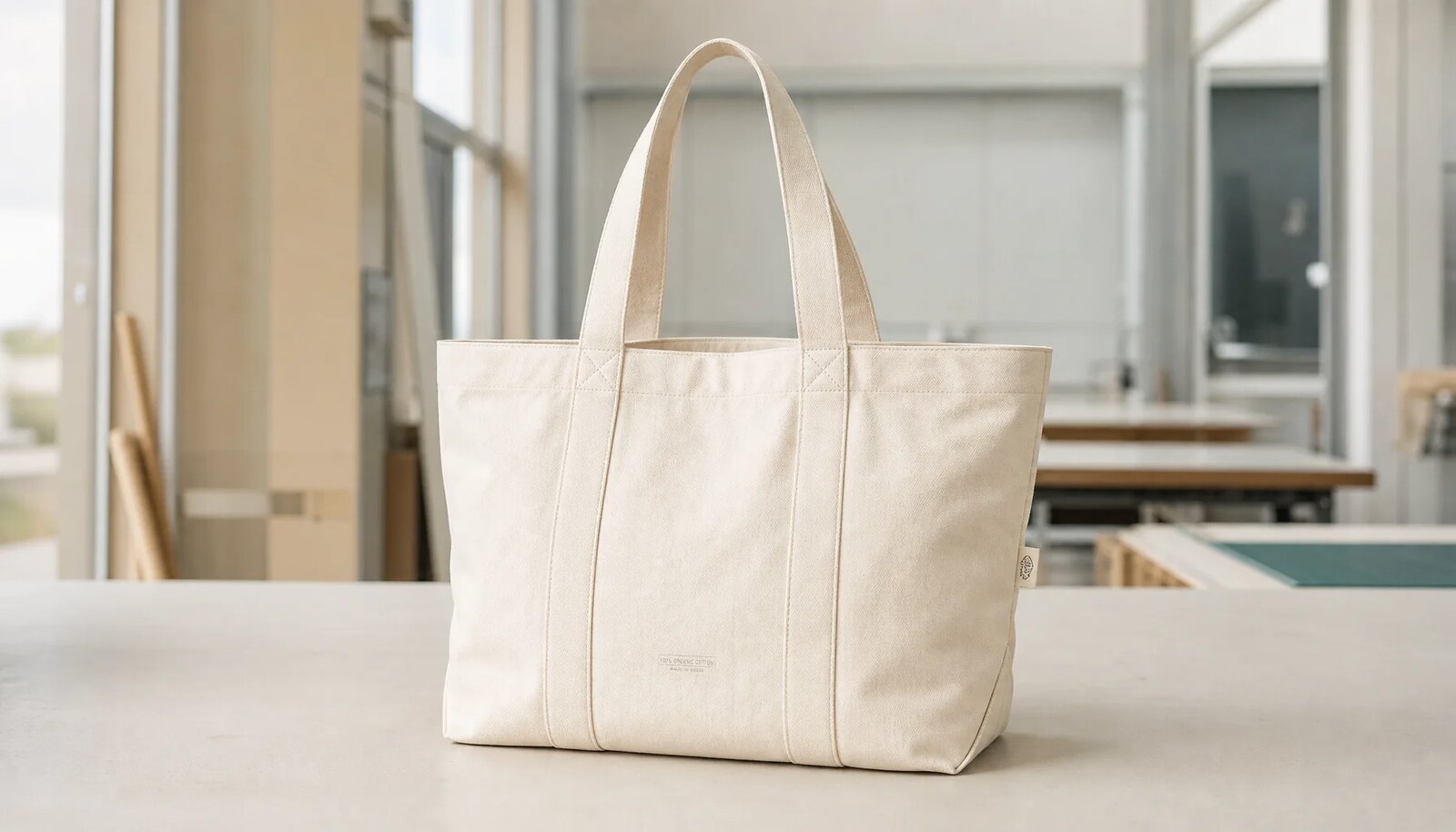
Buy for the brand moment, not only the bag
For an eco apparel brand, an organic cotton tote is rarely just packaging. It may be the first thing a customer touches at a pop-up, the item that carries a denim order home, or a paid accessory displayed beside tees and hoodies. That means procurement has to protect both function and brand trust. A bag that sags under two folded garments, carries an unsupported organic claim, or arrives with crooked logo placement can make the rest of the apparel range feel less considered.
Start by naming the commercial job before asking for price. A resale tote needs a cleaner face, stronger body, tighter measurement control, and retail-ready labeling. A gift-with-purchase bag can be simpler, but it still has to carry the expected load and support the brand's sustainability language. An ecommerce insert may need less presentation but more carton efficiency. The same organic cotton tote cannot be optimized for all of those outcomes at the same unit cost.
The phrase organic cotton totes wholesale buying checklist for eco apparel brands should translate into a working spec, not a slogan. Procurement, merchandising, marketing, and logistics should agree on the use case, customer promise, and receiving process before suppliers quote. When those decisions are left open, every quote looks plausible and none of them are truly comparable.
- Define the tote's role: resale, gift with purchase, retail shopping bag, ecommerce insert, event bag, or staff kit.
- List the expected contents by weight and size, such as one hoodie, two denim pieces, folded tees, books, or sample packs.
- Decide whether the customer will judge it as packaging, merchandise, or part of the apparel product experience.
- Write down any consumer-facing claims before sourcing so documentation and labeling can be checked early.
Turn the design idea into a measurable spec
A clean tote specification prevents most sourcing confusion. Suppliers need more than a mockup and a target quantity. They need finished dimensions, fabric weight, weave, handle details, gusset, decoration, label placement, packing, and delivery terms. Finished size matters because many disputes begin with different measurement points. State width and height with the bag laid flat, gusset depth if used, handle width, total handle length, and handle drop from the top edge of the bag to the top of the handle opening.
Fabric should be specified by composition, weave, GSM, color, and tolerance. Organic cotton canvas and twill can both work, but they do not behave exactly the same. Canvas often feels sturdier and familiar for totes. Twill can give a smoother diagonal surface that some brands prefer for printing or a softer fashion look. Natural undyed cotton may show seed flecks and shade variation; that can be acceptable for an eco brand, but only if the approval standard allows it.
Construction details are where a low quote often hides. Ask whether the tote has a side gusset, bottom gusset, French seams, overlocked seams, folded top hem, inside binding, and reinforced handle stitching. A basic promotional tote may use simpler stitching. A tote sold alongside apparel should usually have neater seams and consistent handle placement because customers will compare it with the quality of the garments nearby.
- Include finished width, height, gusset depth, handle width, handle length, and handle drop in centimeters.
- State GSM and tolerance, for example target fabric weight plus an agreed acceptable range.
- Specify seam type, top hem, handle reinforcement, stitch color, label placement, and print placement.
- Attach artwork as vector files and include print dimensions, Pantone or physical color reference, and placement from edges.
Choose GSM, weave, and construction by use case
Fabric weight is one of the clearest cost and quality levers. Very light organic cotton, around 140 to 160 gsm, can work for event handouts, low-load promotions, or simple inserts. It usually has less structure and may feel too limp for paid merchandise. Many eco apparel buyers use 180 to 240 gsm for retail-friendly totes because it gives better opacity, stronger hand feel, and a more stable print surface. Heavier weights above 240 gsm can suit premium resale bags, but they increase fabric cost, carton weight, and sewing effort.
GSM alone does not guarantee strength. A well-made 220 gsm tote with good reinforcement may outperform a heavier bag with poor handle stitching. Handle attachment should match the expected load. For everyday apparel carry, bar-tacks, box stitches, or cross stitches at handle joins are worth specifying. Gussets also change the customer experience. A flat tote is cheaper and stacks neatly, but a side or bottom gusset helps folded apparel sit better and makes the bag feel more retail-ready.
Shrinkage should be discussed before sample approval. If the fabric is untreated, washed, heat-pressed, or later laundered by consumers, the finished measurements may change. If the tote is not intended to be washed, do not imply washability in consumer copy without testing. If the tote is marketed as washable, ask for shrinkage results and approve the post-wash dimensions and appearance. That protects the brand from a common gap between sustainability language and product reality.
- Use 140-160 gsm only when light-duty use and lower cost matter more than structure.
- Use 180-240 gsm for most apparel retail, gifting, and repeat-carry programs.
- Use 240 gsm and above when the tote is a premium accessory or must carry heavier goods.
- Pair heavier fabric with verified seam strength, not just a higher GSM number.
Verify organic claims before artwork is approved
Organic-specific procurement deserves more attention than a single line saying organic cotton. The buyer should know which standard supports the claim, which company holds the certificate, and which steps are included in scope. GOTS and OCS are common references in textile sourcing, but they are not interchangeable in what they cover. A scope certificate shows that a company is certified for certain processes or product categories. A transaction certificate, when applicable, links a specific shipment or lot to certified material flow. Both are more useful than a logo pasted into a sales deck.
Chain-of-custody limits matter. A fabric mill may be certified, but the sewing unit, printer, or packer may not be covered. Depending on the claim you want to make, that may restrict the wording you can use on the product, hangtag, website, or invoice. Ask early whether the supplier can support a product-level claim, a material-content claim, or only a general sourcing statement. If the answer is vague, keep consumer-facing language conservative until documents are reviewed.
Labeling is a brand-risk issue, not just a compliance task. Unsupported wording such as certified organic tote, GOTS bag, or 100% organic can create problems if the certificate does not cover the final product or if transaction documents are missing. Procurement should work with compliance or legal teams on final wording, especially when selling through retailers or marketplaces with their own claim rules. A safer sourcing process keeps certification documents, artwork, hangtags, and PO language aligned.
- Request current GOTS or OCS scope certificates from the relevant supplier before confirming the claim.
- Ask whether a transaction certificate can be issued for the order and what details it will include.
- Confirm which steps are inside scope: spinning, weaving, dyeing, printing, cutting, sewing, labeling, and packing.
- Do not approve hangtags or product pages with certification logos or strong organic claims until documentation supports them.
- Keep lot numbers, invoices, packing lists, certificates, and final artwork together for audit and reorder reference.
Compare supplier routes with evidence, not impressions
Supplier evaluation should go beyond friendly communication and a polished quote sheet. For wholesale organic cotton totes, the buyer needs to know whether the supplier controls the production steps that affect quality and claims. A direct factory can be strong for repeat orders because it may control cutting, sewing, and finishing under one system. A trading company can be useful when the order includes multiple trims, mixed products, or export coordination. A stock vendor may be fastest for a short campaign. Each route can be valid, but each one carries a different visibility level.
Ask who owns fabric sourcing, printing, sewing, packing, inspection, and export paperwork. If the tote body is made in one place, printed in another, and packed somewhere else, the quality plan needs to reflect those handoffs. Subcontracting is not automatically a problem, but invisible subcontracting is. It can affect lead time, certification scope, defect responsibility, and the ability to repeat the same bag on reorder.
A practical supplier review includes capability, documentation, communication, and correction behavior. Ask for photos of similar tote construction, available equipment, sample room process, printing methods, carton packing, and inspection records. Avoid relying on broad statements such as we can do everything. The better question is what they have already produced under similar fabric weight, decoration, packing, and documentation requirements. Keep the answer tied to verifiable materials, not anecdotes.
- Confirm the legal supplier, production factory, printing facility, and export party if they are different.
- Ask which steps are in-house and which are subcontracted, then connect each step to QC responsibility.
- Review certificate scope against the actual order route, especially if the organic claim will appear on consumer-facing materials.
- Request a sample history or production photos for similar GSM, handle construction, and print method.
- Evaluate how clearly the supplier explains limits, because clear limits are often more useful than broad promises.
Normalize quotes so price comparisons are real
Two tote quotes can differ by 20 percent for reasons that have nothing to do with supplier efficiency. One supplier may quote 180 gsm while another quotes 240 gsm. One may include woven labels, carton marks, and export packing; another may price only a plain printed bag. One may quote FOB, another EXW, and another delivered to a domestic warehouse. Procurement should normalize the quote before making any price judgment.
A useful quote template separates material, cutting and sewing, decoration, trim, packing, cartons, testing, documentation, inland transport, export fees, freight, duty, and inspection. Not every supplier will price every item separately, but asking for the split exposes assumptions. If a supplier cannot provide line-level pricing, at least require a written inclusion and exclusion list. This is especially important for organic cotton totes because documentation fees, certified material availability, and claim-related controls can change the real cost.
Use a simple quote normalization example. Supplier A quotes a lower unit price for a natural tote but excludes hangtags, barcode labels, transaction certificate handling, and individual packing. Supplier B quotes higher but includes those items and a carton plan that fits your warehouse. Supplier A may still be the right choice, but only after the excluded items are added back. The winning quote should be the best landed and controllable cost, not the smallest number in the first email.
- Put all quotes on the same Incoterm, currency, delivery location, order quantity, and payment assumption.
- Compare the same finished size, GSM, weave, decoration size, color count, label package, and packing method.
- Ask suppliers to mark inclusions and exclusions for testing, certificates, hangtags, barcodes, cartons, and freight.
- Calculate cost per usable approved unit, not only cost per produced unit, when defect risk or rework is likely.
- Keep a quote comparison file with the date, version, spec sheet, artwork, and supplier assumptions.
Control MOQ and variants before they control you
MOQ is rarely one number. It can be driven by fabric availability, dye lot size, cutting efficiency, print setup, label production, packaging materials, or carton printing. A natural organic cotton tote with one-color screen print may sit at one minimum. The same tote in three dyed colors with woven labels, hangtags, and barcode stickers may trigger several separate minimums. That does not mean the supplier is moving the goalposts; it means the production job changed.
Eco apparel brands often create unnecessary MOQ pressure by launching too many variants in the first order. A better first program might use one body size, one natural fabric, one handle style, and one label package, then vary only artwork if the supplier can manage it efficiently. If brand color is essential, consider whether the color can live in the print or label rather than dyed fabric. Dyed bodies add lab dips, color approval, colorfastness risk, and sometimes higher minimums.
Reorder planning also affects MOQ. If the tote will become a recurring retail item, a slightly higher first MOQ may be acceptable when the spec is stable and the supplier can repeat it. If the tote is for a one-time campaign, keep the construction simple and avoid trims that create leftover inventory. Procurement should ask for MOQ by variable, not only by finished SKU, because that reveals which choices are expensive to customize.
- Ask for MOQ by fabric, dye color, GSM, body size, print color count, label type, and packing format.
- Reduce first-order risk by keeping one base body and limiting decoration or packing variants.
- Check whether labels, hangtags, and barcode stickers have their own minimums and lead times.
- Ask what quantity breaks reduce cost meaningfully, and which ones only create extra inventory.
- Document reorder MOQ separately from first-order MOQ, especially when screens, labels, or patterns already exist.
Use samples and QC as production controls
Samples should lock the production standard, not just make the buyer feel comfortable. A prototype can confirm size, proportion, handle drop, and artwork placement. A strike-off can confirm print color, ink coverage, and registration. A pre-production sample should use the actual bulk fabric, bulk decoration method, real labels, and intended packing. For a new supplier or a new tote spec, the pre-production sample is the reference that inspection should use.
QC should be measurable. State inspection level and defect rules in the purchase order or quality manual. Many buyers use AQL-based final inspection for soft goods, with critical, major, and minor defect categories. The exact inspection level depends on order size, risk, destination, and buyer policy, so it should be agreed rather than assumed. Critical issues may include unsafe contamination, wrong claim label, mold, sharp metal, or incorrect product. Major defects may include wrong size beyond tolerance, weak handles, poor print adhesion, severe stains, or wrong packing. Minor defects may include small loose threads or slight appearance issues within an approved range.
Tote-specific QC should include dimensional measurement, GSM verification, seam inspection, handle pull or load testing, print checks, label checks, and carton checks. If the bag is dyed, test rubbing or crocking risk, especially because dark dye or print can transfer to light apparel. If it is marketed as washable, run shrinkage and appearance checks after washing. If the buyer sells through channels that require safety controls, needle detection or metal control should be discussed before production starts.
- Approve prototype, strike-off, and pre-production samples for different decisions rather than treating one sample as proof of everything.
- Set dimensional tolerances for width, height, gusset, handle length, handle drop, and print placement.
- Use AQL inspection language when your team requires it, and define critical, major, and minor defects clearly.
- Include handle pull, seam strength, shrinkage, crocking, print adhesion, needle detection where relevant, and carton moisture checks.
- Keep the sealed approval sample available for inspection and reorder comparison.
Plan packing, presentation, and landed cost together
Packing is where sustainability, retail presentation, and freight cost meet. Bulk packing can reduce materials and improve carton efficiency, but it may not suit retail or marketplace receiving. Individual polybags protect the bag from moisture and warehouse dirt, but they may conflict with a plastic-reduction message. Paper bands or tissue can look better to eco-minded customers, yet they need testing for abrasion, moisture, barcode scanning, and handling. There is no single correct answer; the right choice is the one that survives the supply chain and matches the claim.
For apparel brands, tote presentation affects the whole product story. A wrinkled tote pulled from an overstuffed carton may be acceptable for a warehouse giveaway but poor for boutique resale. If the tote is displayed in store, specify folding method, hangtag placement, barcode position, carton orientation, and whether steaming or repacking will be needed after receipt. If the tote ships with apparel, make sure inks, dyes, or rough trims do not rub onto garments in the parcel.
Landed cost should close the sourcing loop. Add together unit price, packing materials, cartons, testing, documentation, inland movement, export charges, freight, duty, inspection, and receiving labor. Include the cost of preventable failure: reprinting bad logos, replacing crushed cartons, relabeling unsupported claims, or air-shipping late orders. A tote can be low cost and still expensive if it creates work after arrival. Procurement's job is to make the bag easy to buy, easy to receive, and safe for the brand to present.
- Choose bulk pack, paper band, recycled polybag, individual bag, hangtag, or barcode format based on actual channel requirements.
- Test plastic-free or reduced-plastic packing for moisture, rubbing, scannability, and warehouse handling before using it at scale.
- Confirm carton dimensions, gross weight, carton strength, marks, bundle count, and pallet requirements before freight booking.
- Include testing, documentation, inspection, duty, freight, and receiving labor in landed cost.
- Store packing photos and carton specifications so repeat orders do not drift.
Specification comparison for buyers
| Buying choice | Best fit | Tradeoff to price | Procurement check |
|---|---|---|---|
| Direct custom production | Repeat apparel programs that need controlled fabric, size, print, trim, and packing | Longer setup than stock goods, but stronger control over spec and documentation | Confirm the named factory, in-house versus subcontracted steps, certification scope, and sample-to-bulk controls |
| Stock tote with custom print | Fast campaigns, low complexity launches, or event merchandise where exact GSM is less critical | Speed can be better, but fabric weight, handle drop, and organic claim paperwork may be fixed or limited | Ask whether the stock body is already certified, what documents support the claim, and whether the print facility is covered |
| Natural undyed organic cotton | Eco apparel retail bags, gift-with-purchase programs, and lower dye-impact positioning | Color variation between lots is normal; stains and seed flecks are more visible | Approve a shade range and defect standard, not a single perfect photo |
| Dyed organic cotton tote | Brand-color campaigns or retail collections that need a specific shade | Dyeing adds approval steps, possible higher MOQ, and colorfastness testing needs | Request lab dips, bulk shade tolerance, crocking results, and whether dyeing is inside certification scope |
| 180-240 gsm canvas or twill | Most retail and apparel carry uses where structure and perceived value matter | Higher material cost than light promo fabric, but better body and print surface | Check actual GSM tolerance, weave, shrinkage, opacity, and finished measurements |
| 240 gsm and above | Premium resale totes, heavier loads, and bags intended for repeated use | More fabric cost, heavier cartons, slower sewing on some lines | Verify needle size, seam strength, handle reinforcement, carton weight, and freight impact |
| Screen print | Simple logos, repeat programs, and one- to three-color artwork on flat panels | Setup charges and color matching matter; very fine detail may not hold on textured fabric | Approve ink type, print size, placement tolerance, curing method, and adhesion standard |
| Embroidery or woven label | Subtle premium branding where texture matters more than large front artwork | Embroidery can pucker lighter fabric; labels add trim MOQ and placement control | Review backing, stitch density, label material, attachment method, and sample wash behavior |
| Bulk pack | Wholesale replenishment, warehouse receiving, and lower-plastic packing goals | Less retail polish, but usually better carton efficiency | Define bundle count, carton count, moisture protection, carton marks, and warehouse labeling |
Buyer checklist before sampling
- Define the tote's commercial role: resale item, gift with purchase, ecommerce insert, employee kit, trade show bag, or retail shopping bag.
- Write the finished size in centimeters, including width, height, gusset depth, handle width, handle length, and handle drop.
- Specify fabric composition, weave, target GSM, GSM tolerance, color, dye status, and whether the fabric is pre-shrunk or untreated.
- Name the organic claim you intend to make and request supporting documents such as valid GOTS or OCS scope certificates and transaction certificates where applicable.
- Confirm whether cutting, sewing, printing, labeling, and packing are covered by the supplier's certification scope or whether any step breaks chain-of-custody.
- Choose print or trim based on artwork, use case, wash expectation, hand feel, and reorder plan instead of only first-order unit price.
- Ask for MOQ by fabric, dye color, body size, print setup, label style, hangtag, barcode, and packing format so hidden variant minimums are visible.
- Request a line-item quote that separates fabric, cut and sew, decoration, labels, hangtags, packing materials, cartons, testing, documents, inland freight, and export terms.
- Normalize all supplier offers to the same Incoterm, currency, delivery point, carton quantity, and inspection responsibility before comparing unit prices.
- Approve a prototype sample for size and construction, then a pre-production sample using bulk fabric, bulk decoration, labels, and packing.
Factory quote questions to send
- What exact fabric composition, weave, yarn type if known, and GSM are you quoting, and what tolerance will be accepted in bulk?
- Is the fabric certified organic under GOTS, OCS, or another standard, and can you provide a current scope certificate before order placement?
- For this order, can you provide transaction certificates or other lot-level documentation that supports the organic claim on the shipped goods?
- Which production steps are inside your certification scope: fabric sourcing, cutting, sewing, printing, embroidery, labeling, packing, and export?
- Are any processes subcontracted, and if yes, who controls quality, documentation, and chain-of-custody at that step?
- What finished size, gusset depth, handle width, handle length, handle drop, seam allowance, and reinforcement method are included in the price?
- What MOQ applies by body color, fabric GSM, print color count, label type, hangtag, barcode, and packing style?
- Which decoration method do you recommend for this artwork, and what are the setup charges, color limits, placement tolerance, and curing or finishing requirements?
- What sample stages are included: prototype, strike-off, lab dip, trim sample, pre-production sample, and sealed approval sample?
- What AQL level or inspection plan do you normally use for tote bags, and which defects are treated as critical, major, and minor?
Quality-control points to confirm
- Confirm the production lot is linked to the approved purchase order, sealed sample, artwork file, packing instruction, and organic documentation requirements.
- Check fabric GSM using agreed sampling from multiple cartons or rolls, with the tolerance stated in the PO rather than judged by hand feel alone.
- Measure finished width, height, gusset depth, handle width, handle length, and handle drop against the approved tolerance, commonly tighter for retail programs than giveaways.
- Inspect seam allowance, stitch density, skipped stitches, loose threads, broken stitches, seam twisting, and bar-tack or cross-stitch reinforcement at handle stress points.
- Perform handle pull or load testing to confirm the bag can carry the intended product weight without tearing, handle failure, or seam distortion.
- Check print placement, registration, color match, ink coverage, pinholes, smearing, cracking, curing, rub resistance, and adhesion after light abrasion or tape testing where appropriate.
- Review crocking and colorfastness risk for dyed fabrics, dark prints, or bags that may rub against apparel in ecommerce parcels or retail displays.
- Check wash or shrinkage behavior if the tote is marketed as washable or likely to be laundered by customers.
- Use needle detection or metal contamination controls where required by the buyer's safety program, marketplace rules, or destination market expectations.
- Verify labels, side tabs, care marks, hangtags, barcode labels, and claim wording are attached in the approved position and do not overstate the organic status.