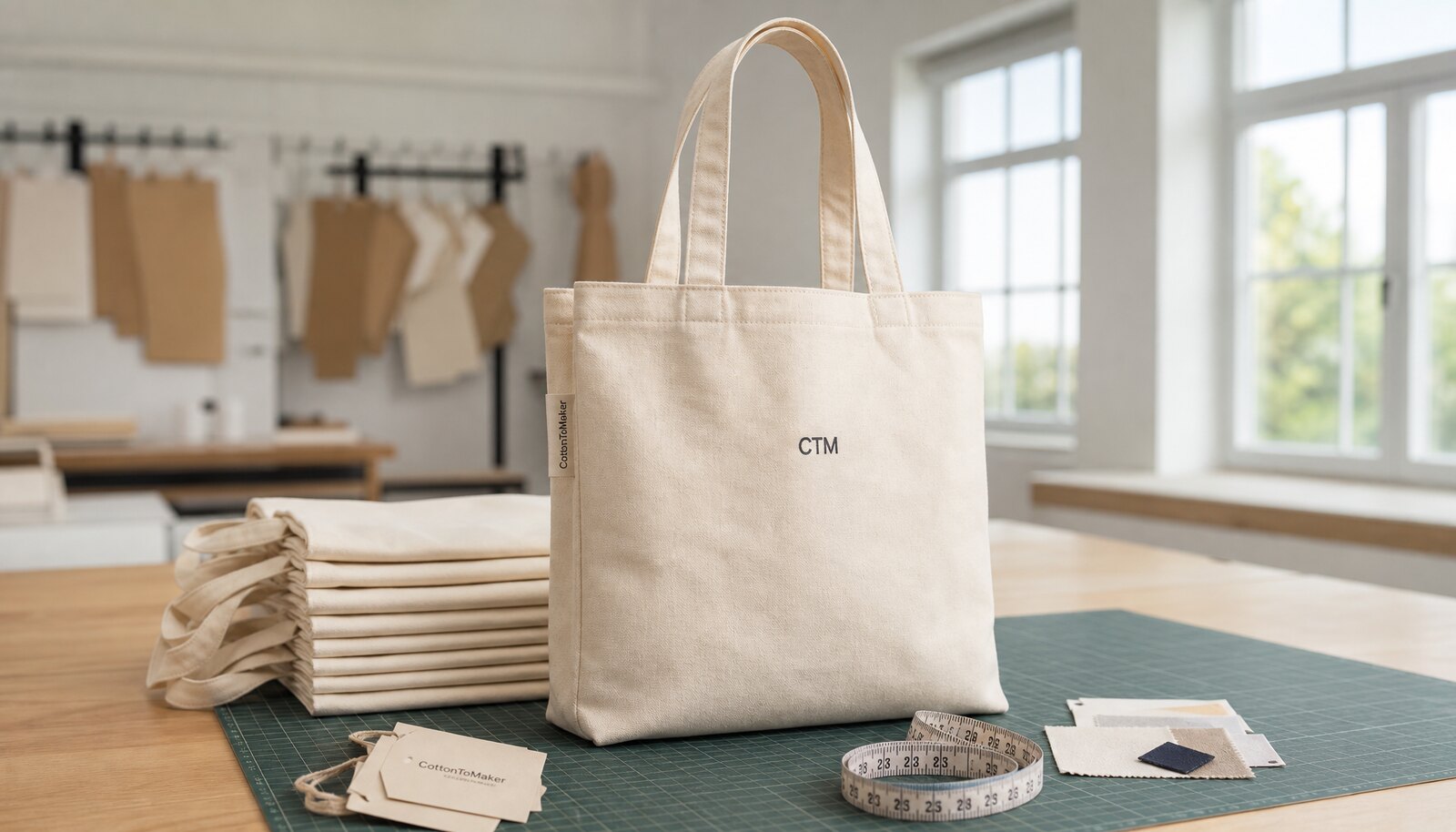
1. Start With The Gift Program, Not A Generic Tote
A strong organic cotton totes wholesale buying checklist for corporate gifting starts with the job the bag must do. “5,000 organic cotton totes with logo” sounds simple, but it leaves too many decisions open. A conference giveaway, executive client gift, employee onboarding kit, internal town hall bag, and lightweight mailer insert do not need the same fabric weight, handle drop, decoration method, packing format, or inspection standard.
The contents set the real performance requirement. A tote carrying a badge, pen, and one brochure can be lighter than a bag expected to hold a hardcover notebook, drinkware, apparel, boxed samples, and a welcome card. Put an estimated load in kilograms or pounds into the RFQ. Under about 1 kg, a lightweight construction may be acceptable. Around 2 to 3 kg, the buyer should look harder at fabric body, handle anchoring, seam strength, and practical load testing.
Presentation is a separate question from strength. For a premium client gift, the tote is part of the unboxing experience. It needs to arrive clean, folded consistently, and visually aligned. A slightly skewed logo may be acceptable for a high-volume event handout, but it can look careless in a sales kit or brand launch package. If the bag will be photographed, opened by executives, or used as a long-term branded item, say so. That single detail affects print placement tolerance, fabric shade control, folding, and final packing.
Distribution also belongs in the specification. Event teams often need cartons that can be counted quickly at a venue. Fulfillment centers may require fixed carton quantities, barcodes, SKU separation, or destination sorting. Regional office shipments may need carton labels by location. If these requirements appear after production, the supplier may have to reopen, recount, or relabel cartons. That costs money and time. Put the receiving model into the RFQ before pricing so each supplier quotes the real work.
- Write the gifting scenario into the RFQ: trade show giveaway, client appreciation gift, employee welcome kit, retail-style merchandise tote, or mailer insert.
- List actual contents and estimated load instead of using broad phrases such as “standard duty” or “good quality.”
- State whether the tote is mainly packaging, a reusable branded item, or part of the recipient’s premium gift experience.
- Tell the supplier how bags will be distributed: event handout, office shipment, fulfillment center, regional drop ship, or pre-packed kit.
- Match the spec to the program value. Do not buy heavy canvas for a one-day brochure bag, and do not under-spec a tote for a premium client gift.
2. Verify The Organic Cotton Claim Before You Price The Order
For procurement teams, “organic cotton” is more than a fabric description. It may become a claim used by marketing, ESG, compliance, sales, or a client’s procurement department. Decide what level of proof is needed before you ask factories to quote. Some programs only require cotton made with organic fiber. Others need a certified product claim under a standard such as GOTS or OCS. Those requirements are not interchangeable, and they can change supplier options, documentation, cost, and lead time.
A scope certificate shows that a company is certified for certain processes and product categories. It does not automatically prove that a specific tote order is certified. Depending on the claim and customer policy, an order-level transaction certificate may also be required. Ask early whether the supplier can provide the documents that support your intended wording. If only the fabric mill has certification and the sewing, printing, or trading company is outside the certified chain, the finished bag may not support the claim your brand team wants to make.
Decoration and packing can complicate the chain. A tote may be sewn from certified organic fabric, printed by an outside decorator, packed by a kitting facility, and exported by a trading company. Each party matters if the finished product claim depends on chain-of-custody documentation. Do not assume “organic fabric available” means “finished certified organic tote.” Ask who performs each step, which legal entity invoices the order, and which entity appears on certificates.
Keep sustainability language precise. Organic cotton refers to the fiber source and farming standard behind that claim. It does not automatically prove low water use, plastic-free packing, fair wages, carbon neutrality, or biodegradability. A clear RFQ might say: “100% organic cotton fabric, OCS or GOTS documentation required, natural ecru finish, no individual polybag unless needed for presentation.” That is much stronger than asking for an “eco-friendly tote,” which can mean almost anything.
- Ask for current scope certificates before PO release, not after production is finished.
- Confirm whether the finished tote, not only the fabric, can be supported by GOTS or OCS documentation if required.
- Ask whether a transaction certificate is available for the specific order and what lead time or fee applies.
- Identify all parties in the chain: fabric supplier, dyer, sewing factory, printer, packer, exporter, and trader.
- Use precise claim language in the RFQ and avoid unsupported words such as “sustainable,” “carbon neutral,” or “chemical-free” unless verified.
3. Specify Fabric In A Way Suppliers Can Actually Match
Fabric drives hand feel, cost, print result, carton bulk, and perceived value. Yet many tote quotations still use loose descriptions: canvas, cotton bag, eco tote, natural cotton. Those words are not enough for a B2B comparison. A usable fabric spec should name the fiber content, certification requirement, GSM, weave, finish, color, and whether GSM is measured before or after washing, dyeing, or finishing.
For lightweight campaigns, 120 to 140 GSM plain weave organic cotton can work well for brochures, event materials, or low-weight inserts. It keeps the unit price and freight weight down. The risk is that the bag may feel thin, wrinkle easily, show print through the fabric, or distort once loaded. If the order is client-facing, do not approve this range from a flat photo. Ask for a swatch or sample and load it with realistic contents.
For many corporate gifting programs, 150 to 180 GSM is the practical middle ground. It usually gives better body, a cleaner decoration surface, and a more substantial feel while still being manageable for volume orders. Premium gifts or retail-style reusable totes may justify 200 GSM and above. Heavier fabric, however, is not a free upgrade. It raises material cost, increases freight weight, takes more carton space, and may affect drying or curing time after printing. It also needs handles and seams that match the heavier body.
GSM alone does not tell the full story. A tightly woven 160 GSM fabric can feel firmer and print more cleanly than a loose 180 GSM fabric. Ask about weave density or fabric description, then approve a physical reference. For natural ecru cotton, agree on shade range and seed speck acceptance. For bleached or dyed cotton, build in lab dip approval, colorfastness review, and possible MOQ. A Pantone reference helps with brand direction, but cotton will not look exactly like ink on coated paper.
- Use 120 to 140 GSM for lightweight event bags, brochure totes, and budget-driven inserts after checking opacity and handle performance.
- Use 150 to 180 GSM as the default starting point for many corporate gifting totes carrying notebooks, apparel, or small products.
- Consider 200 GSM and above for premium reusable totes, but include upgraded handles, stronger seams, and freight impact in the quote.
- Ask whether GSM is before or after finishing and agree on an acceptable tolerance, commonly expressed as a percentage or approved swatch comparison.
- Approve natural ecru shade and seed speck tolerance before production so normal cotton character is not treated as a defect later.
4. Build The Bag Around Real Contents, Handles, And Stress Points
A tote’s durability comes from construction, not from a vague promise that it is “strong.” Procurement should specify finished width, height, gusset depth, handle drop, handle width, seam type, reinforcement method, and measurement tolerance. These are sewn products, so some variation is normal. For many programs, about ±1 cm on finished width and height is a realistic starting point. Handle drop may need its own tolerance. If the tote must fit into a gift box, catalog sleeve, or automated fulfillment fixture, identify those critical dimensions before the factory cuts fabric.
Shape should follow the contents. A flat tote works for documents, catalogs, and light apparel. A bottom or side gusset is better for boxed gifts, drinkware, skincare sets, product samples, or wider onboarding kits because it lets the bag open up and stand more naturally. Gussets add fabric, sewing time, and packing bulk, so they should be used for a reason. If in doubt, ask the supplier to photograph the sample filled with similar items, or test it yourself with the planned kit.
Handles deserve close attention. Short handles can look tidy for hand-carry gift bags but may not fit comfortably over the shoulder. Longer handles work better for commuting, conferences, and repeated use, but they can fold awkwardly in tight packing. Width affects comfort; narrow handles can dig into the hand when the bag is loaded. Specify whether handles are self-fabric, cotton webbing, or another material. If webbing is sourced separately, check color match and texture against the body fabric.
Do not write “reinforced handles” and leave the interpretation to the factory. Name the reinforcement: box-X stitch, cross-stitch, bartack, or another approved pattern at all four anchor points. Inspect the stitch density, thread tension, and clean finishing on the sample. Interior seams also affect both durability and presentation. Depending on budget and style, options may include overlocked, folded, bound, or French seams. A simple overlock can be acceptable for a budget event tote if it is secure and neatly trimmed. Premium gifts often justify a cleaner inside finish.
- Specify finished dimensions and tolerances, not only approximate size or cut panel dimensions.
- Use gussets for dimensional gift contents; use flat construction for documents or low-bulk event materials.
- Define handle drop and width based on how recipients will carry the bag: hand-carry, shoulder carry, or both.
- Require handle reinforcement at all four anchor points and inspect the same pattern on the pre-production sample.
- Test the sample with the intended load for distortion, seam stress, handle comfort, and practical usability.
5. Match Decoration Method To The Artwork, Fabric, And Fold
Logo decoration is often where a simple tote project becomes technical. Cotton is textured, absorbent, and flexible. Fine lines, tiny text, gradients, low-contrast colors, and large solid areas may not behave the way they do in a digital proof. Treat decoration as a production spec. The RFQ should include artwork size, print position, number of colors, brand color reference, front or back placement, and whether a physical strike-off is required.
Screen printing is often the most practical default for simple one- to three-color corporate logos at medium and higher quantities. It can give clean edges and good opacity when the printer controls mesh, ink deposit, curing, and registration. Each color and each location may require a setup or screen charge, so ask how those fees are handled. For natural ecru fabric, dark single-color logos are usually straightforward. Light ink on dyed cotton is more demanding and may need an underbase or extra opacity control.
Heat transfer, DTF, or digital print can be the better choice for gradients, full-color artwork, short runs, or versioned campaigns by region, event, or department. The tradeoff is usually hand feel and folding behavior. A transfer may look sharp but feel like a film on fabric. If the printed area will be folded, stacked, or packed under pressure, test for cracking, blocking, tackiness, and edge lift. Digital methods can also have color and durability limits depending on the fabric and process.
Placement needs a measurement point. Define whether the logo is centered on the panel or set a fixed distance from the top edge and side seam. Agree on a tolerance, often around ±5 mm to ±10 mm depending on the artwork, bag size, and production method. Small centered logos show drift quickly. Large graphics may hide it better. Ask the supplier for minimum line thickness and minimum readable text height on the selected fabric. A physical strike-off on the real fabric is far more useful than a PDF proof because it shows scale, texture, opacity, and color interaction.
- Use screen print for simple logos, solid colors, and repeatable medium-to-high-volume orders.
- Use transfer or digital methods for gradients, full-color artwork, short runs, or versioned campaigns, but approve hand feel and fold durability.
- Provide vector artwork when possible and specify logo size, print position, color references, and front/back requirements.
- Ask for minimum line weight and minimum text size that the factory can hold on the selected fabric.
- Approve a strike-off or pre-production sample on the actual tote fabric before mass printing.
6. Compare Suppliers By Control, Not Just Unit Price
Direct factories, trading companies, promotional distributors, domestic decorators, and importers can all quote organic cotton totes wholesale. The best route depends on order size, customization, lead time, documentation needs, and tolerance for risk. Instead of asking only “Who is cheapest?”, ask a more useful question: who controls fabric sourcing, cutting, sewing, printing, packing, inspection, and shipment handoff?
A direct factory can be a strong fit for custom sizes, repeat corporate gifting programs, and tighter QC. When sewing and decoration are coordinated under one production plan, it is easier to maintain fabric consistency, handle construction, print placement, and packing standards across reorders. Inspection access and defect responsibility are also clearer. Over time, the buyer can build a sample library and a detailed spec sheet that supports future campaigns.
A trading company or sourcing partner may be useful when the gift program includes multiple SKUs, complex kitting, or coordination across several product categories. The risk is hidden subcontracting. If one factory sews the tote, another prints it, and a third packs it, accountability can blur unless each step is documented. Ask who performs each process and who signs the final QC report.
Domestic decorators and local distributors can be the right choice for small rush orders using available blank stock. This can shorten transit time and simplify communication. The limitation is that stock options may be narrow, and the blank tote may change between batches. Verify the organic cotton claim, fabric weight, construction, and reorder availability. If brand consistency matters, ask whether the same blank SKU and manufacturer will be used later.
A low quote may simply be missing important work. Setup fees, certification documents, packing labels, inspection support, destination sorting, or stronger handles may not be included. Ask for a process map and line-item quote. If a supplier cannot explain where the fabric comes from, who prints the logo, how handles are reinforced, and how final inspection is done, the order carries risk even if the unit price looks attractive.
- Choose direct factory sourcing for custom sizes, repeat programs, tighter QC, and clearer production ownership.
- Use trading companies for mixed-SKU programs only when production partners and QC responsibility are transparent.
- Use domestic decoration for speed or small quantities, but confirm blank stock quality and organic documentation.
- Ask who owns each process step: fabric sourcing, cutting, sewing, printing, labeling, packing, inspection, and shipment handoff.
- Evaluate suppliers on documentation, sample discipline, inspection access, and communication accuracy—not only unit price.
7. Break Down MOQ, Setup Charges, And Hidden Price Drivers
MOQ is rarely just one number. In tote production, minimums can be driven by organic fabric purchasing, dyeing, cutting efficiency, sewing line setup, screen printing, transfer film, custom woven labels, hangtags, individual packing, or carton sorting. When a supplier says the MOQ is 1,000 units, ask what creates that threshold. You may be able to reduce quantity by choosing natural ecru stock fabric, simplifying decoration, using a standard label, or avoiding custom packing.
A useful quote separates the blank tote, decoration, setup, sampling, labels, inserts, folding, inner packing, carton marks, inspection support, and freight handoff. Without that breakdown, comparisons become misleading. One supplier may quote only a printed blank bag. Another may include individual packing and destination labels. A third may use a lower GSM or simpler handle reinforcement. Line-item pricing makes it easier to see whether a lower price is true efficiency or a downgraded spec.
Ask for price breaks at realistic volumes such as 1,000, 2,500, 5,000, and 10,000 units if those match your potential campaign sizes. Then ask what changes at each level. Does the order move from stock fabric to custom weaving or dyeing? Does screen print become more cost-effective than digital? Are setup charges spread across a longer run? Does carton quantity change? Price breaks are most useful when the production assumptions are visible.
Setup charges deserve their own line. Screen charges may apply by color and print position. Transfer or digital file preparation may apply by artwork version. Custom labels can have separate MOQs. Sample charges may or may not be refundable; if they are refundable, write down the condition. Corporate gifting often adds packing labor: hangtags, inserts, tissue, belly bands, folding standards, or individual bags. Confirm these items before PO release, not after bulk production is finished.
Be careful with price breaks that encourage overbuying. Extra totes create storage cost, inventory control work, and brand-version problems if a logo, campaign date, department name, or message changes. If demand is uncertain, ask whether the supplier can hold the approved sample and repeat the order later. Another option is ordering a base blank first and decorating closer to final demand, if timing and certification requirements allow it.
- Request line-item pricing for blank bag, print, setup, sample, label, hangtag, insert, packing, carton marks, and inspection support.
- Ask what drives MOQ: fabric, dyeing, cutting, printing, labels, packing, or supplier policy.
- Compare price breaks using the same finished spec and the same packing scope.
- Confirm whether setup charges are included, separate, refundable, or repeated on reorders.
- Do not purchase surplus units unless storage, future use, and brand version control are planned.
8. Make Sample Approval Feel Like The Final Recipient Experience
Sample approval is not a formality. For corporate gifting totes, it is one of the best ways to prevent expensive mistakes. The approved sample should represent the final experience as closely as possible: same organic cotton fabric, GSM, finish, handle construction, logo method, label placement, fold, and ideally the same packing approach. A mockup that shows approximate size and artwork location is useful for discussion, but it should not be the only production reference.
Different samples answer different questions. A fabric swatch confirms shade, GSM, weave, and hand feel. A development sample checks size, shape, gusset, handle drop, seam construction, and usability. A print strike-off shows how the ink or transfer performs on the selected fabric. A pre-production sample brings the full spec together before bulk production. For larger or high-visibility programs, keep one sealed sample with the supplier and one with the buyer or inspector.
Photos help, but they cannot do everything. A picture may hide thin fabric, stiff transfer film, poor seam trimming, odor, or an uncomfortable handle drop. If the timeline is tight, use close-up photos and video for preliminary review, then state clearly what still requires physical approval. Fabric hand feel, stitch quality, print texture, load performance, and fold behavior are much easier to judge in person.
Review the sample in a structured way. Measure the tote flat using the agreed method. Fill it with the intended gift contents and carry it by hand and shoulder if that is how recipients will use it. Inspect the handle anchors, inside seams, loose threads, label placement, and print edges. Fold the tote the way it will be packed and check whether the logo creases, cracks, blocks, or transfers. If the bag will go into a kit, test the kit assembly before approving mass production.
Internal alignment matters. Brand, events, sustainability, procurement, and fulfillment teams may all have opinions. Assign one approval owner and one deadline. Late changes to logo size, bag dimensions, print color, or packing can restart sampling and compress production. Record the final decisions in a spec sheet so the factory is not piecing together instructions from scattered email comments.
- Approve the right sample type: swatch, development sample, print strike-off, and final pre-production sample as needed.
- Keep a sealed approved sample as the production and inspection reference.
- Measure and test the sample with real gift contents before authorizing bulk production.
- Check fold, packing, label, hangtag, and carton mark requirements at sample stage when possible.
- Consolidate internal comments and issue one written approval or revision list to avoid conflicting instructions.
9. Lock Packing, Carton Marks, And Receiving Rules Early
Packing is part of the product in corporate gifting. A tote can pass visual inspection and still create problems if cartons are mislabeled, mixed by artwork version, too heavy, wrinkled, damp, or hard to count. Event teams and fulfillment centers work against fixed dates and receiving windows. Poor packing can wipe out the savings from a cheaper quote.
Start with the fold. Decide whether bags will be flat folded, half folded, rolled, bundled, or individually packed. Bulk bundles of 25, 50, or 100 units can work well for event handout and fulfillment operations. Individual polybags, paper bands, tissue, or belly bands can improve presentation for premium gifts, but they add labor, cost, waste, and carton volume. If plastic reduction is part of the brief, say exactly what is acceptable and how the bags should be protected from dust or moisture.
Carton quantity should balance freight efficiency and handling. Oversized cartons may reduce carton count, but they can become too heavy or crush lower layers. Small cartons are easier to move but increase label count and freight complexity. Before shipment planning, ask for master carton dimensions, gross weight, net weight, quantity per carton, and total carton count. For imported orders, carton size affects volumetric weight and landed cost.
Treat carton marks as a specification, not a warehouse afterthought. Many B2B programs need PO number, SKU, item description, artwork version, quantity per carton, carton number sequence, destination, gross weight, net weight, and country of origin where applicable. Fulfillment centers may require barcode labels or ASN-compatible references. If the campaign ships to multiple offices, regions, or events, cartons should be separated and clearly marked by destination.
Packing photos are a simple control point. Before shipment, request photos of the folded tote, inner bundle, open carton, closed carton, carton label, and pallet condition if palletized. Photos do not replace inspection, but they can catch obvious errors before goods leave the factory. If the tote is part of a kitted gift, include instructions for insert orientation, label visibility, and the presentation standard recipients should see when they open the package.
- Specify fold method, bundle quantity, individual packing requirements, and master carton quantity in the RFQ.
- Ask for carton dimensions, gross weight, net weight, quantity per carton, and total carton count before shipment planning.
- Require carton labels that match buyer receiving instructions, including PO, SKU, artwork version, destination, and carton sequence.
- Separate cartons by artwork, region, destination, or kit version when the program requires clean receiving.
- Request packing photos before shipment to verify fold, bundle, carton label, and carton condition.
10. Build QC Around Measurable Tolerances And Shipment Evidence
Quality control should follow the approved sample and written specification. “Good quality” is not enough. Organic cotton totes are textile products, so small natural variations can be normal. The QC job is to separate acceptable variation from defects that affect brand presentation, usability, documentation, or receiving accuracy. That requires measurable tolerances and clear defect categories.
Inspection should cover organic cotton documentation, fabric, finished size, handle construction, seam quality, print quality, label placement, cleanliness, odor, folding, packing, and carton count. Fabric defects may include holes, stains, oil marks, severe shade differences, contamination, or obvious weaving faults. Construction defects include open seams, skipped stitches, broken thread, loose handles, raw edges beyond the approved construction, or excessive puckering. Decoration defects include wrong artwork, wrong color, poor opacity, smudging, cracking, transfer edge lift, pinholes in solid areas, and visibly off-center placement.
Agree on tolerances before production starts. Many tote programs can use about ±1 cm for width and height and about ±5 mm to ±10 mm for print placement, but the right tolerance depends on design, construction, and factory capability. A small centered logo may make even a modest placement shift obvious. A tote that must fit into a rigid gift box may need tighter dimensions. Put the tolerances on the spec sheet and use the same measurement method during inspection.
Handle strength needs a practical check. There is no single universal tote test for every corporate gift program, so define the method with the supplier. A sensible approach is to load the sample and random production units with the intended gift weight plus an agreed safety margin, then lift, hold, or carry for a defined period. The goal is to catch tearing, seam failure, or excessive distortion before shipment. Document the method so the factory, buyer, and inspector use the same standard.
For larger orders, in-line checks can be as valuable as final inspection. A first sewing check may catch wrong handle placement or poor stitch pattern. A first print check may catch color, opacity, or placement issues before the full run is decorated. Final inspection should compare packed goods with the PO, approved sample, artwork guide, packing list, and carton labels. If a third-party inspector is used, provide the sealed sample, spec sheet, defect classification list, and packing instructions. Inspectors cannot enforce requirements they never receive.
- Inspect against a sealed approved sample, written spec sheet, artwork guide, and packing instructions.
- Define size, print placement, shade, and carton count tolerances before production begins.
- Classify defects as critical, major, or minor so the supplier knows what must be corrected before shipment.
- Include practical handle load testing using the intended gift contents or an agreed representative load.
- Make packing and carton label accuracy part of QC because receiving errors can disrupt the gifting schedule.
Specification comparison for buyers
| Spec decision | Recommended option | When it fits | Buyer risk to check |
|---|---|---|---|
| Organic claim | GOTS or OCS-certified organic cotton with valid scope certificate and transaction certificate where required | Best when the corporate brief, ESG team, retailer, or end client requires a documented organic cotton claim rather than a general eco message | Confirm whether certification covers fiber, fabric, dyeing, printing, sewing, and trading. Do not assume a bag is certified because the yarn or fabric supplier is certified |
| Fabric weight | 120 to 140 GSM plain weave organic cotton | Budget event giveaways, lightweight mailer inserts, conference bags for brochures, or short-use campaigns carrying under about 1 kg | Check opacity, seam slippage, print show-through, and handle distortion. Light fabric may meet price targets but feel too thin for premium gifting |
| Fabric weight | 150 to 180 GSM canvas or tight plain weave organic cotton | Most corporate gifting totes carrying notebooks, catalogs, apparel, small products, or welcome kit items around 1 to 3 kg | Confirm finished GSM tolerance, weave density, and finished bag weight. A loose 180 GSM can feel weaker than a tighter 160 GSM fabric |
| Fabric weight | 200 GSM and above organic cotton canvas | Premium client gifts, retail-style reusable totes, heavier gift sets, or programs where the tote itself is a long-term branded item | Higher cost, higher freight weight, longer drying/curing time after printing, and bulkier cartons. Confirm whether the handle and seams are upgraded to match the heavier body |
| Finished size tolerance | Typical sewn-goods tolerance of about ±1 cm on width/height and ±0.5 to 1 cm on handle drop, agreed before production | Suitable for most promotional tote programs where the bag is not fitted into a rigid box or fixture | If the tote must fit a gift box, catalog sleeve, or automated fulfillment station, tighter tolerances may be needed and should be approved by the factory |
| Print placement tolerance | Common target: ±5 mm to ±10 mm from approved placement, depending on size, fabric, and print method | Corporate logos, event branding, and front-panel artwork where visual consistency matters across the lot | Placement variation becomes more visible on small logos or narrow margins. Define measurement points from top edge, side seam, or panel center |
| Handle construction | Self-fabric handles with box-X, cross-stitch, or bartack reinforcement at four anchor points | Default choice for corporate gifts carrying notebooks, catalogs, drinkware, apparel, or multi-item onboarding kits | Ask for handle width, drop length, stitch count, thread type, and sample load test. Weak handle anchoring is one of the most common practical failures |
| Logo method | Screen print with water-based or pigment ink, cured to supplier’s process standard | Simple one- to three-color logos, medium to high quantities, strong opacity on ecru or dyed cotton, controlled unit cost | Confirm ink type, curing temperature/time, minimum line thickness, color standard, setup charges per screen, and rub/crack resistance after folding |
| Logo method | Heat transfer, DTF, or digital print after physical strike-off approval | Full-color, gradient, short-run, or versioned artwork where screen setup is inefficient | Review hand feel, transfer edge, wash/rub behavior, blocking in stacked bags, and whether folding crosses the decoration |
Buyer checklist before sampling
- Define the gifting use case in the RFQ: trade show giveaway, executive client gift, employee onboarding kit, conference welcome bag, retail-style merchandise tote, or mailer insert.
- List expected contents and estimated total load in kilograms or pounds: notebooks, catalogs, drinkware, apparel, skincare, sample products, boxed gifts, or mixed kits.
- Specify finished tote dimensions, not cutting dimensions: width, height, gusset depth, seam construction, handle width, handle drop, and acceptable tolerance.
- State the organic cotton requirement clearly: GOTS, OCS, certified organic fiber only, or unverified organic marketing language not acceptable. Ask for current certificates before PO release.
- Specify fabric type and finish: GSM, weave, natural ecru, bleached, dyed, washed, unwashed, softened, or calendered, plus whether GSM is measured before or after finishing.
- Request a fabric swatch or existing production sample in the same GSM and finish, then keep it as the material reference for bulk production.
- Define handle reinforcement at all four anchor points: box-X, cross-stitch, bartack, or other agreed stitching, plus thread color and stitch quality expectations.
- Provide artwork in vector format when possible and state logo size, print position, number of colors, Pantone or brand color reference, minimum line weight, and front/back requirements.
- Ask for print durability details: ink or transfer type, curing process, rub resistance expectation, wash recommendation if any, and whether folding will crease the decorated area.
- Separate MOQ and pricing for blank bags, printed bags, custom labels, hangtags, inserts, kitting, individual packing, and master carton packing.
Factory quote questions to send
- What exact organic cotton fabric are you quoting, including certification type, weave, GSM, yarn count or fabric description, finish, and whether the GSM is measured before or after finishing?
- Can you provide current GOTS or OCS scope certificates, and can you issue or support a transaction certificate if our program requires one?
- Which parts of the supply chain are certified: fiber, yarn, fabric, dyeing, printing, sewing, packing, and exporter/trader?
- Can you send a fabric swatch or existing tote sample in the same GSM, weave, and finish before we approve the quotation?
- Is the price based on blank bags, printed bags, or fully packed gift-ready units with labels, inserts, folding, inner packing, and carton marks included?
- What is your MOQ for the base tote, organic fabric purchase, dyed fabric, printed totes, custom labels, hangtags, individual packing, and kitting work?
- Which logo method are you proposing, and why is it suitable for our artwork, fabric color, order quantity, packing fold, and durability expectation?
- What are the setup charges by screen, print color, artwork version, print position, transfer film, digital file preparation, or sampling revision?
- What are the finished dimensions, gusset size if applicable, handle drop, handle width, stitch pattern, stitch density, thread type, and seam finish?
- What finished-size tolerances, handle-drop tolerances, and print-placement tolerances do you normally hold on sewn tote production?
Quality-control points to confirm
- Organic cotton documentation matches the approved claim: current scope certificate, certified supplier name, product category coverage, and transaction certificate if required by the buyer or end client.
- Fabric GSM, weave, color, and hand feel match the approved swatch within the agreed tolerance, with no thin panels, holes, oil stains, contamination, severe slubs, or unacceptable shade shift.
- Natural ecru cotton character is judged against the approved reference, including seed specks and shade variation, so normal cotton appearance is not confused with dirt or defects.
- Finished dimensions are measured flat using the agreed method and fall within approved tolerance for width, height, gusset, handle drop, handle width, and print position.
- Handles are anchored with the agreed stitch pattern on all four stress points, with consistent stitch tension, no skipped stitches, no open corners, no broken thread, and no loose thread tails.
- Handle pull or practical load test is performed according to the agreed method, using a representative load where possible, to confirm the tote does not tear, distort excessively, or fail at the anchor points.
- Side seams and bottom seams are straight, aligned, and securely closed, with inside seams trimmed cleanly and no exposed raw edges beyond the approved construction.
- Print placement is centered or positioned to the spec, with correct distance from top edge and side seam, correct front/back orientation, and no mixed artwork versions in the same carton.
- Print quality shows clean edges, correct color standard, sufficient opacity, no smudging, no pinholes in solid areas, no blocking, no cracking, and no transfer edge lift after folding.
- Ink or transfer is sufficiently cured or set before packing, with no odor, tackiness, offsetting, or print transfer between stacked totes.