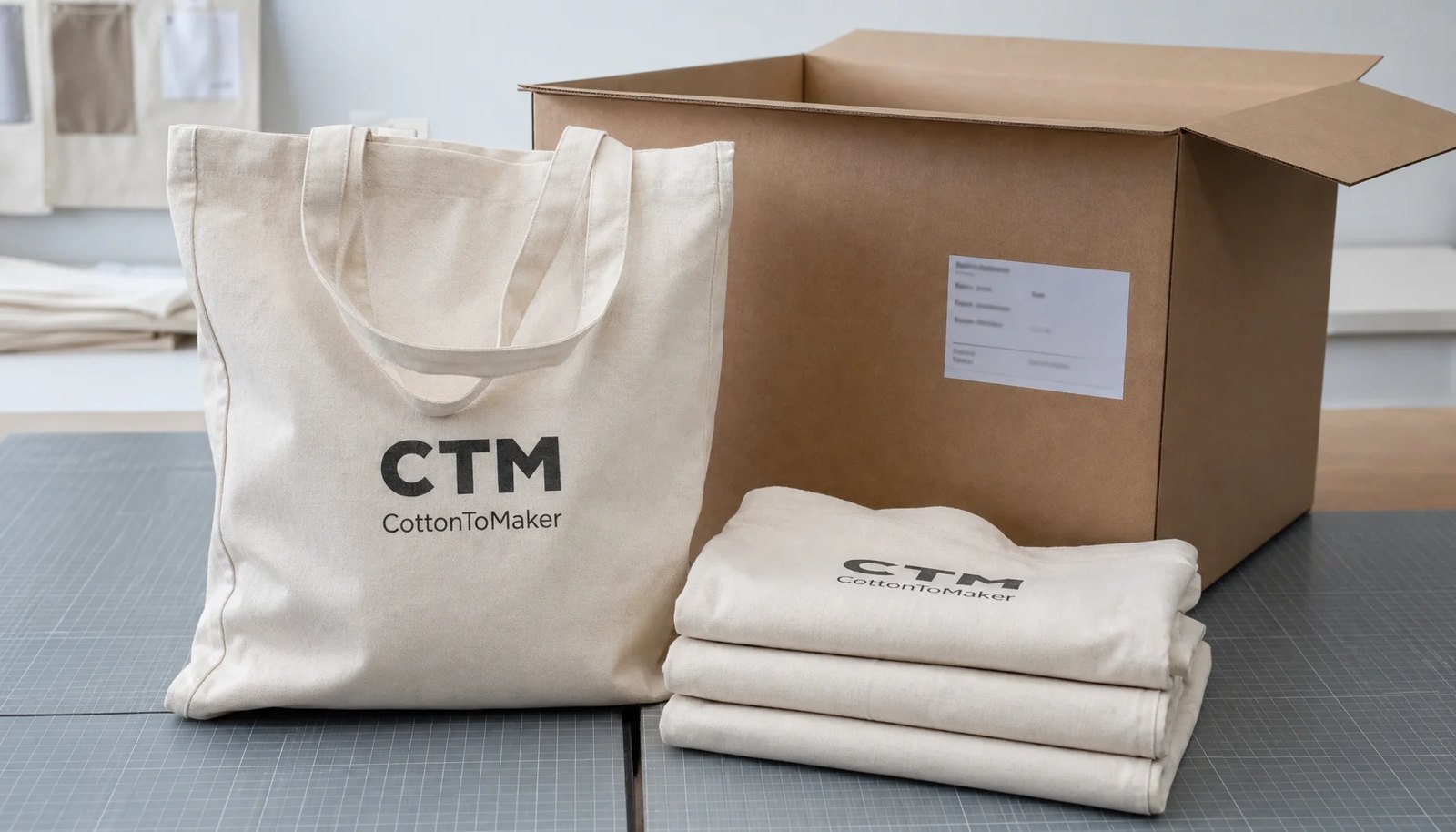
Why the carton plan belongs in the RFQ
For university bookstore organic cotton totes, carton packing is not a warehouse afterthought. It affects freight cube, receiving labor, product appearance, carton damage risk, and chargeback disputes. A tote that looks correct as a loose sample can arrive with crushed handles, rubbed ink, dirty corners, or mixed SKU cartons if the packing plan is not defined early.
The RFQ should treat packing as part of the product specification. A practical quote must show bag specs and carton data together: fabric weight, size, handle length, print method, folding method, pieces per carton, carton dimensions, gross weight, net weight, and CBM. Without these details, two suppliers may quote the same tote at similar unit prices while the landed cost and receiving efficiency are very different.
- Use carton packing data to compare suppliers on landed cost, not only FOB unit price.
- Decide whether the bookstore will receive bulk stock, store allocations, or event-ready bundles.
- Put carton markings and packing list format in the PO before mass production starts.
- Treat the approved packed sample as part of the approval package when the logo area is large or the fabric is heavy.
Set the tote spec before calculating cartons
Carton planning starts with the tote structure. A typical university bookstore retail tote may use 10 oz organic cotton canvas, roughly 280-340 GSM depending on weaving and finishing. Lighter 5 oz to 7 oz cotton can work for giveaway events, but it may feel too thin for resale beside sweatshirts, textbooks, stationery, and drinkware. Heavier 12 oz canvas improves perceived value but increases carton volume and weight.
Size also changes packing efficiency. A flat tote around 38 x 42 cm packs differently from a gusseted tote with a 10 cm bottom. Long shoulder handles add bulk at one end of the carton if all bags are folded in the same direction. The factory should test the real folded size using the approved fabric and handle construction, not estimate carton quantities from a catalog bag.
- For resale totes: consider 10 oz organic cotton canvas with reinforced handles.
- For orientation giveaways: 7 oz to 8 oz may be acceptable if budget and carton cube matter more than premium hand feel.
- For book-heavy usage: add a bottom gusset and stronger handle stitching instead of only increasing fabric weight.
- For natural cotton color: allow visible cotton seed flecks unless a cleaner bleached or dyed fabric is specified.
Choose fabric weight with freight in mind
A heavier organic cotton tote often improves retail value, but the buyer should see the freight effect before approving the spec. A 12 oz tote may reduce the number of pieces per carton or push carton weight above a comfortable receiving limit. If the shipment goes by air for a tight campus launch, volume weight can become more important than the small difference in sewing cost.
The clean way to compare options is to request two or three quote lines using the same bag size and artwork. For example, ask for 8 oz, 10 oz, and 12 oz organic cotton canvas with the same print and packing method. Require estimated carton dimensions and CBM for each option. This prevents the common mistake of selecting fabric by unit price and discovering the freight penalty only after the PO is issued.
- Compare GSM, fabric hand feel, carton pieces, carton weight, and CBM in one quote table.
- Avoid specifying both ounce and GSM loosely; ask the factory to state the actual production fabric standard.
- Expect shrinkage and finishing to affect measured GSM; agree on tolerance before inspection.
- If the bookstore wants a premium retail tote, calculate margin using landed cost per sellable unit, not factory price alone.
Print method affects folding and blocking
Most university bookstore tote artwork uses campus names, mascots, department marks, or alumni graphics. For one to three solid colors, water-based screen printing is usually the practical choice because it keeps a softer hand and works well on cotton canvas. Digital printing can be useful for gradients or many colors, but it may require different pretreatment, curing, and wash or rub testing.
Packing pressure matters. If ink is thick, under-cured, or placed across a tight fold line, print blocking or transfer can appear after cartons sit in a warm container. A pre-production sample should be folded the same way planned for shipment and left under pressure for a short internal test. This is especially important for large front logos, dark ink on natural cotton, and orders packed with high carton compression.
- Place the main logo away from the sharpest fold line when possible.
- Use interleaving paper only when needed because it adds cost, labor, and carton volume.
- Approve a printed strike-off on the actual fabric, not only a digital artwork proof.
- Define print position tolerance, commonly measured from top edge and side seam reference points.
Build MOQ logic around real constraints
MOQ for organic cotton totes is rarely one simple number. The real constraint may come from fabric purchasing, certified organic cotton availability, dye lot, print setup, sewing line efficiency, or carton labeling. A supplier may accept a low order quantity but apply higher unit cost because fabric is bought from stock, printing screens are amortized over fewer units, and packing labor is less efficient.
For university bookstores, the order is often split by campus, department, event, or season. The buyer should separate total order quantity from per-SKU quantity. A 3,000-piece order split into six logos may have a very different cost and production risk than one 3,000-piece logo. The quote should show whether MOQ applies per logo, per fabric color, per bag size, or per shipment.
- Request MOQ by fabric color, print design, bag size, and carton label version.
- Ask whether leftover fabric can support reorder continuity for the same semester.
- Use shared blank tote specs across departments to reduce MOQ pressure.
- If each campus needs separate cartons, include allocation packing cost in the quote.
Create a carton quantity rule that receivers can use
The best carton quantity is not always the maximum number of bags the factory can compress into one box. For organic cotton totes, a realistic range is often 50 to 100 pieces per export carton, depending on fabric weight, gusset, handle bulk, and whether bags are individually packed. The carton should be strong enough to protect the product but light enough for safe handling at bookstore receiving.
A useful rule is to set both a pieces-per-carton target and a gross weight limit. If the tote is heavy, reduce carton quantity rather than forcing a carton that staff cannot lift safely. If the tote is light but bulky, choose carton dimensions that palletize well and avoid excessive void space. For mixed destination shipments, carton quantity should also match store allocation needs so receivers do not need to split cartons immediately.
- Target carton weight should be agreed before production; many buyers prefer keeping cartons below about 15-18 kg.
- Use uniform carton quantities where possible to simplify counting and receiving.
- Mark partial cartons clearly with quantity and SKU details.
- Request a carton loading photo if the order is large, mixed-SKU, or shipping by sea.
Specify folding, bundling, and inner packing
Folding method changes appearance at receipt. A flat fold may preserve the front print better but uses more carton space. A double fold improves carton efficiency but can create crease lines through the logo or distort handles. Rolling is usually not ideal for retail bookstore totes because it can create uneven pressure, twisted handles, and more labor during unpacking.
Inner packing should match the sales channel. Bulk bundles of 25 or 50 with paper bands can work well for bookstore stockrooms. Individual polybags may be necessary for e-commerce fulfillment or clean shelf handling, but they increase material cost, labor, and carton volume. If the university has sustainability requirements, recyclable bands or master polybags may be better than individual plastic packaging.
- Define whether handles are folded inside, laid flat, or aligned in one direction.
- Use paper bands or counted bundles when receiving speed is more important than individual presentation.
- Use individual packing only when the store needs barcode-ready, dust-protected, or fulfillment-ready units.
- Include barcode sticker placement if the tote is scanned as a retail SKU.
Use sample approval to prevent packed-carton defects
A loose sample is not enough for a carton-sensitive tote order. The buyer should approve a fabric swatch, a printed strike-off, a finished pre-production sample, and a packing reference. The packing reference does not always need to be a full carton, but it should show the fold, bundle count, inner protection, carton mark, and how the printed face is protected.
Approval should include measurable acceptance criteria. The sample should state fabric weight, finished dimensions, handle length, print location, print color reference, stitching reinforcement, and packing method. Photos are useful, but physical samples are still important when hand feel, fabric thickness, print texture, and fold memory affect the retail result.
- Keep one approved sample with the factory and one with the buyer or inspection team.
- Record approved carton dimensions and pieces per carton in the PO.
- Test one folded printed sample under pressure before confirming final packing.
- Reject sample approval packages that show only artwork renderings without fabric and packing evidence.
Control carton labels and shipping documents
Carton labels are small details that prevent large receiving problems. A university bookstore may receive totes at a central warehouse, campus store, event venue, or distributor facility. If cartons are missing PO, SKU, campus name, color, quantity, carton number, and destination, staff must open cartons manually to identify stock. That adds labor and increases the chance of counting disputes.
The packing list should match the carton marks exactly. For multi-logo orders, request a carton-by-carton packing list that shows carton number, SKU, quantity, gross weight, net weight, and carton dimensions. If cartons are palletized, pallet labels should also show which carton numbers are on each pallet. This is especially useful when a shipment is split after import.
- Use clear carton numbers such as 1 of 60, 2 of 60, and so on.
- Separate different logos or campus destinations by carton whenever possible.
- Avoid mixing SKUs inside one carton unless the carton label and packing list state the exact mix.
- Confirm whether retail barcode labels are applied to bags, bundles, cartons, or all three.
Compare quotes by landed cost and schedule risk
The cheapest unit price may not be the lowest cost order. A quote with weak cartons, over-compressed packing, missing SKU labels, or individual polybags that were not needed can create extra cost after arrival. A better comparison includes unit price, setup charges, sample cost, packing material, carton CBM, gross weight, inspection cost, and expected receiving labor.
Schedule risk also belongs in the comparison. Organic cotton fabric may need longer sourcing time than conventional cotton, especially if the buyer needs documentation. Printing cannot start until artwork and strike-off are approved. Packing cannot be finalized until the factory confirms folded dimensions from production fabric. A realistic lead time should separate fabric procurement, sampling, printing, sewing, packing, final inspection, and loading.
- Ask suppliers to quote bulk pack and individual pack as separate options.
- Compare estimated CBM per 1,000 pieces across fabric weights and packing methods.
- Build approval dates into the PO so late artwork does not get blamed on production.
- Reserve time for final inspection after packing, not only during sewing.
Specification comparison for buyers
| Spec decision | Recommended option | When it fits | Buyer risk to check |
|---|---|---|---|
| Fabric weight for bookstore retail totes | 10 oz organic cotton canvas or 280-340 GSM plain canvas | Good balance for course materials, apparel add-ons, alumni gifts, and repeat retail handling | Too-light 5 oz to 7 oz fabric may reduce carton CBM but can feel promotional rather than retail grade |
| Handle construction | Self-fabric handles, 2.5-3 cm width, cross-stitch or box-X reinforcement | Suitable for books, drinkware, and campus merchandise purchased together | Long handles without reinforcement can tear during customer use even if fabric GSM is acceptable |
| Print method | Water-based screen print for 1-3 solid colors; digital print only for complex artwork | Best for bookstore logos, mascots, department marks, and reusable retail collections | Thick plastisol or poorly cured ink can block during folded packing and leave transfer marks |
| Folding plan | Flat fold once or twice with print face protected; avoid tight rolling | Keeps cartons stable and reduces creasing on the main logo area | Over-compressed folding can create permanent crease lines through the artwork |
| Inner packing | Bulk pack by counted bundles of 25 or 50 with paper band or recyclable master polybag | Works for stores that unpack into stockroom shelves or point-of-sale displays | Individual polybags increase labor, plastic use, and carton volume unless required for e-commerce picking |
| Carton quantity | 50-100 pcs per export carton depending on GSM, bag size, and handle thickness | Useful for balancing carton weight, warehouse handling, and freight cube | Packing only by maximum pieces can create cartons above safe lifting weight or crush lower layers |
| Carton grade | 5-ply export carton with moisture-resistant liner when sea freight is used | Recommended for importers, distributors, and campus store groups receiving palletized goods | Weak cartons may bow during consolidation and cause dirty or wrinkled bags |
| Labeling route | Carton marks with PO, SKU, color, size, quantity, gross weight, net weight, carton number, and destination | Reduces receiving delays when bookstores split stock by campus, department, or retail event | Missing SKU-level carton data forces manual counting and slows chargeback reconciliation |
| Inspection point | Pre-shipment inspection using AQL with carton drop spot-check and packed-carton count verification | Best when the order ships direct to a bookstore warehouse or distributor | Only checking loose bags before packing can miss carton shortages, wrong labels, and compression damage |
Buyer checklist before sampling
- Define the tote size, gusset, handle length, fabric GSM or ounce weight, organic cotton claim level, and logo placement before requesting a packing quote.
- State whether the bag is a retail resale item, welcome-week giveaway, alumni event item, or bundled bookstore promotion because the packing method should match the receiving workflow.
- Request carton dimensions, pieces per carton, gross weight, net weight, and estimated CBM in the quotation, not after production.
- Limit carton weight to a safe receiving range for bookstore staff; many buyers prefer keeping packed cartons below about 15-18 kg unless warehouse equipment is available.
- Specify whether bags are bulk packed, bundle packed, individually packed, or packed by store allocation.
- Require a folded sample or packing photo during pre-production approval, not only a loose finished bag sample.
- Confirm print curing and blocking resistance before approving tight carton packing, especially for large solid logos.
- Use SKU-level carton labels if the shipment includes multiple campus logos, colors, sizes, or store destinations.
- Include carton drop condition, moisture protection, and palletization requirements in the PO for sea freight or long inland delivery.
- Keep a tolerance agreement for carton quantity, carton weight, fabric GSM, bag measurements, handle length, and print position.
Factory quote questions to send
- What organic cotton fabric options do you recommend for this tote size, and can you quote both GSM and ounce weight for comparison?
- Is the organic cotton certified at yarn, fabric, or finished goods level, and what documents can be provided with shipment?
- What is your proposed pieces-per-carton plan for our bag size and fabric weight, and what are the carton dimensions, gross weight, net weight, and CBM?
- Will the bags be packed flat, folded once, folded twice, or individually packed, and can you provide a packing photo from a similar order?
- How will you protect the printed logo from rubbing, blocking, or crease damage inside the carton?
- What MOQ applies to the fabric, dyeing if any, printing setup, and carton labeling, and which MOQ is the real constraint?
- How many samples are included: blank fabric swatch, printed strike-off, pre-production sample, and packed-carton reference sample?
- What tolerance do you apply for fabric GSM, bag measurements, print position, carton quantity, and carton dimensions?
- What lead time applies after sample approval, and how many days are required for fabric sourcing, printing, sewing, packing, and final inspection?
- Can you quote the same order in bulk pack and individual pack so we can compare unit cost, carton volume, and warehouse handling?
Quality-control points to confirm
- Fabric weight should be measured from production fabric and compared against the approved GSM or ounce specification with agreed tolerance.
- Bag size, gusset width, handle length, and handle width should be checked on finished bags after sewing and pressing.
- Handle attachment should use reinforced stitching suitable for bookstore loads such as books, bottles, apparel, and gift items.
- Print color, print position, ink coverage, curing, rub resistance, and crease resistance should match the approved strike-off and pre-production sample.
- Loose threads, oil marks, needle holes, skewed panels, uneven hems, and dirty natural cotton surfaces should be classified before packing.
- Carton quantity should be verified by count per carton and total carton count, not only by production line output.
- Carton strength, sealing, carton marks, SKU labels, and gross weight should be checked during final inspection.
- Packed bags should be reviewed for compression marks, print transfer, moisture risk, and excessive folding creases.
- Mixed-SKU shipments should include a carton-by-carton packing list that matches the PO allocation.
- Random packed-carton opening should be included in pre-shipment inspection to catch shortages and wrong packing before loading.