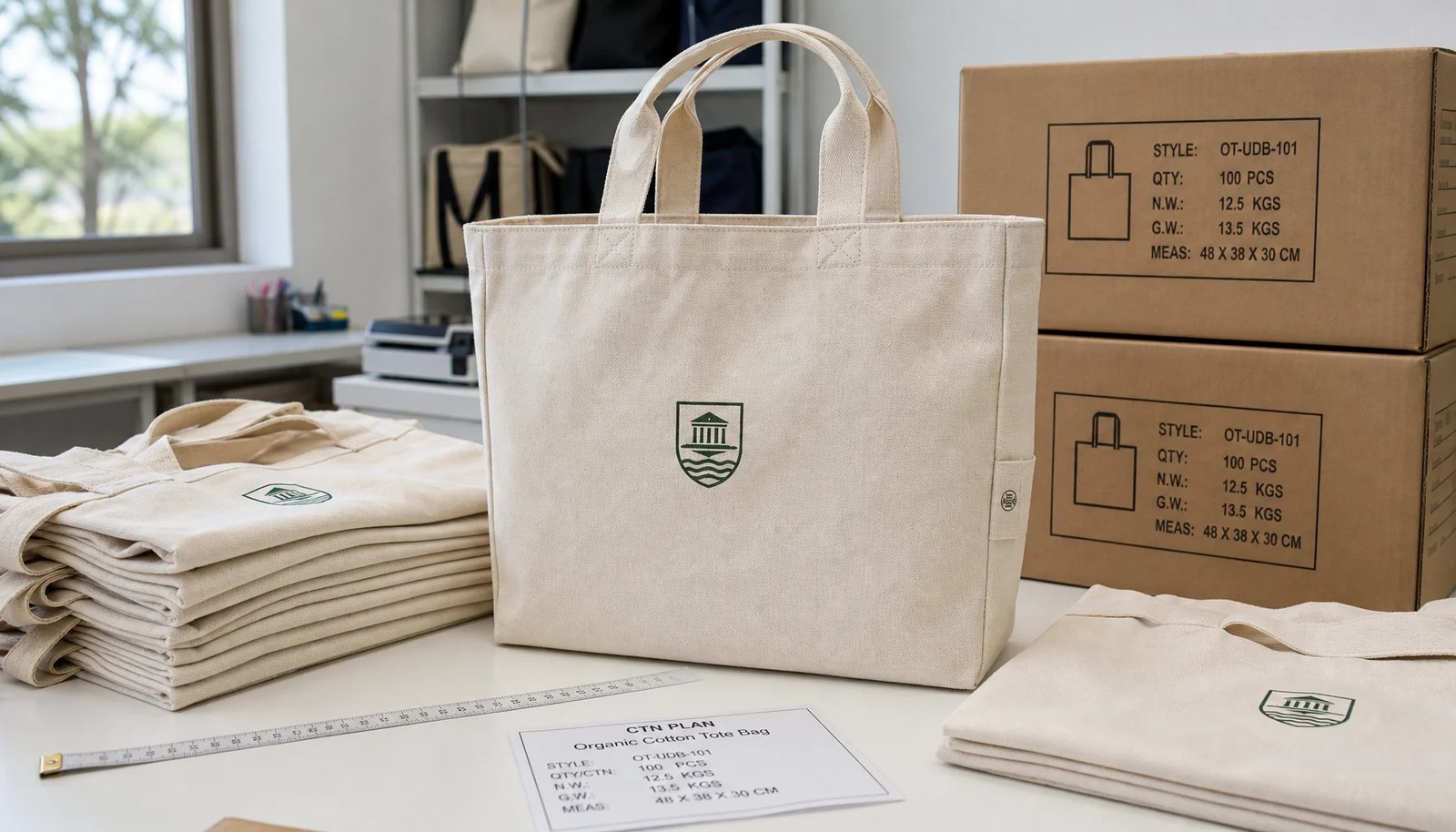
Start With the Carton, Not Only the Tote
University bookstore tote programs usually begin with a logo mockup, but procurement should ask for carton planning while the product quote is being built. Fabric weight, gusset depth, handle length, folding method, and print placement all affect the number of cartons, total CBM, receiving labor, and backroom storage. A tote that looks economical by unit price can become expensive if cartons are bulky, overweight, poorly labeled, or unsuitable for the receiving route.
Ask each supplier for planned carton dimensions, units per carton, carton count, net weight, gross weight, and total CBM before purchase order approval. Final figures can be confirmed after a packing trial, but a quote without planned carton data is not ready for freight comparison. If the order will move through a 3PL, campus warehouse, LTL transfer, export consolidation, or split delivery to multiple stores, carton details are part of the specification.
Use CBM per 1,000 units to compare packing efficiency across suppliers. Calculate carton length x width x height in centimeters divided by 1,000,000, then multiply by carton count. Divide total CBM by total units and multiply by 1,000. This normalizes different carton plans and helps buyers see when a lower unit price is offset by higher freight volume or handling cost.
- Request carton data in the first RFQ, not after production is finished.
- State the receiving route and any maximum gross weight per carton.
- Compare CBM per 1,000 units across suppliers and folding methods.
- Require packing trial photos before bulk cartons are sealed.
- Treat carton labels, SKU separation, and carton strength as procurement details.
Define the Bookstore Program and Claim
A tote for paid bookstore resale needs a different balance than a welcome-week giveaway. Resale totes should feel structured, sew cleanly, hold a campus mark well, and arrive in cartons that protect retail presentation. Orientation totes may prioritize cost, schedule, and enough capacity for folders, water bottles, apparel, and inserts. E-commerce totes may need barcode labels, dust protection, or individual packing. Specify the use case so the factory is not guessing.
Organic cotton language also needs precision. Natural, unbleached, recycled, low-impact, and organic are different claims. If the bookstore will use organic cotton in hangtags, web copy, purchasing reports, or sustainability messaging, ask which document supports the claim and whether the certificate applies to fiber, fabric, or finished goods. Confirm certificate holder, validity date, fabric lot reference, and wording limits before artwork and labels are approved.
For most paid bookstore programs, 10 oz to 12 oz organic cotton canvas is a practical starting range because it provides structure and perceived value. Lighter 6 oz to 8 oz fabrics can work for low-load promotions. GSM equivalents vary by weave, yarn, and finishing, so ask for both oz/yd² and GSM and approve a swatch instead of relying on generic fabric names such as heavy canvas or premium cotton.
- State whether the order is for resale, orientation, checkout, alumni, department, event, or e-commerce use.
- Confirm the exact organic claim before approving hangtags or product copy.
- Ask for document type, certificate holder, validity, lot reference, and claim scope.
- Approve actual fabric swatches for hand feel, shade, weight, and texture.
- Avoid vague material wording such as eco cotton, natural cotton, or green canvas.
Specify Dimensions That Can Be Measured
Finished tote dimensions should be written as inspection-ready measurements. A body around 38 x 42 cm with an 8 to 10 cm bottom gusset works for many bookstore programs because it can hold books, apparel, drinkware, and checkout purchases without becoming oversized. Larger bodies can look attractive on a sketch, but they increase folded area, carton footprint, storage volume, and freight CBM.
Measure the tote after sewing and pressing, not from cutting patterns. Fabric relaxation, seam allowance, shrinkage, gusset construction, and pressing affect the final size. Define how the gusset is measured, because opened depth, folded-flat depth, and bottom-panel depth can be interpreted differently. A simple measurement diagram prevents supplier and inspector disputes.
Use tolerances that reflect sewn fabric reality. A common starting point for canvas totes is ±1 cm on body width and height, ±0.5 to 1 cm on gusset depth, and ±1 cm on handle drop, but the supplier should confirm practicality for the fabric and construction. Tight control should focus on visible and functional points: logo placement, handle drop, body symmetry, gusset shape, and carton fold alignment.
- Specify finished body width, body height, gusset depth, handle width, and handle drop.
- Use a measurement diagram or marked sample photos.
- Confirm tolerances before the PO is issued.
- Keep artwork away from gusset folds and carton fold lines when possible.
- Review larger sizes as freight and storage variables, not only merchandising choices.
Build Handles for Real Campus Loads
Bookstore totes often carry dense and awkward items: textbooks, notebooks, laptops, hoodies, drinkware, and checkout purchases. The most common stress points are handle attachments, side seams, and bottom gusset corners. A bag can look acceptable in a photo yet fail when loaded if reinforcement is weak or seam allowance is inconsistent.
Self-fabric handles are common for organic cotton totes because they match the body material and avoid a contrasting synthetic tape. A width of about 2.5 to 3.5 cm is a useful range for shoulder comfort. Total handle length around 60 to 65 cm may work for many adult users, but handle drop is the clearer usability measurement because it shows whether the tote fits over a sweatshirt or jacket.
Approve reinforcement by sample, not by a vague phrase such as strong handle. Box stitch and cross stitch are common, but the exact shape, thread color, stitch density range, and reinforcement size should be visible in the approved sample. If load performance matters, define a simple static hang test with buyer-selected weight, duration, support method, and pass/fail criteria.
- Request handle drop in addition to total handle length.
- Approve close-up photos of handle reinforcement before bulk sewing.
- Specify thread color, seam finish, seam allowance, and stitch appearance.
- Define a static load test if the tote will carry books or laptops.
- Inspect handle patches and gusset corners as functional stress points.
Match Print Method to Artwork and Fabric
Water-based screen printing is often practical for one to three solid university colors on organic cotton canvas because it can provide a softer hand than heavy plastisol and suits many bookstore marks. This is a useful starting assumption, not a universal rule. Natural cotton is not a bright white base, and ink can appear warmer, flatter, or less saturated than it does on a coated proof. Approve color on actual fabric.
Other print methods may be better for specific artwork. Digital printing can suit gradients, full-color designs, or smaller batches, but density and wash behavior should be checked. Heat transfers can deliver sharp detail, though the hand feel may be less integrated with canvas. Embroidery can look premium for small marks, but large areas add stiffness, cost, and lead time. Let artwork complexity, quantity, brand standards, hand feel, and sustainability expectations guide the method.
Printing is also a packing risk. A logo folded tightly through the center may look creased when cartons are opened. Prints stacked too soon can transfer. Poor curing can cause tackiness, odor, cracking, or ink lift. Approve a print strike-off and then review packing trial photos showing fold direction and print-face orientation.
- Approve a strike-off on the actual organic cotton fabric.
- Use Pantone or brand references as targets, then approve final fabric color result.
- Set print placement tolerance from top edge and side seam.
- Ask which curing, rub, tape, adhesion, or stacking check will be used.
- Confirm that the main logo is not forced onto a hard fold line.
Break MOQ Into the Real Cost Drivers
MOQ is rarely a single number. It can be driven by organic fabric sourcing, custom dyeing, cutting efficiency, screen setup, sewing-line changeover, labels, carton sorting, or shipment release size. A supplier may offer a low MOQ for natural canvas already in stock, then require more units for custom-dyed fabric, multiple artwork versions, or special barcode packing.
University orders often become complicated after stakeholder review. The bookstore, admissions, athletics, alumni relations, and departments may each request their own design. A 3,000-unit order can be efficient if size, fabric, handle, print method, and packing are shared. The same 3,000 units split across six logos, four labels, and several destinations can require more screens, approvals, sorting, carton marks, and inspection steps.
Ask the supplier to separate MOQ by material, artwork, SKU, label, and shipment release. This helps procurement negotiate the right lever. The buyer may standardize the tote body and allow different one-color prints, or consolidate several departments under one shared artwork. Reorders should also be confirmed because fabric shade, lot availability, print setup, and organic documentation may not repeat exactly.
- Separate fabric MOQ, artwork MOQ, SKU MOQ, label MOQ, and release MOQ.
- Clarify screen charges, sample charges, label fees, and split-packing fees.
- Standardize fabric, size, handles, and carton plan where campus stakeholders allow it.
- Confirm reorder MOQ, shade expectations, and price validity in writing.
- Avoid approving multiple small artwork versions before knowing setup costs.
Choose Packing for Freight and Receiving
Packing style affects freight, presentation, count control, and damage risk. Flat packing usually gives a cleaner retail presentation and easier counting, but it can require longer cartons or more CBM. Half-fold packing can reduce carton footprint, but the fold line must be tested against the logo and fabric. Heavy compression can reduce quoted volume while creating hard creases, distorted gussets, bulging cartons, and slow receiving.
The best carton is not always the carton with the most units. A carton packed with 12 oz canvas totes may exceed manual handling limits or crush lower cartons in storage. A carton with too few units may be easy to lift but inefficient for ocean freight, air freight, or LTL movement. Set a maximum acceptable gross weight per carton based on the bookstore, warehouse, or 3PL policy.
Inner packing should reflect both sustainability goals and operations. Bulk stacks reduce packaging material but can slow item-level counting. Kraft belly bands, paper straps, or labeled inner bundles can improve count control without individual plastic. Polybags may be justified for e-commerce, dust control, barcode scanning, or direct-to-student shipments, but they should not be the default if the university has plastic-reduction rules.
- Compare flat pack, half-fold, and controlled compression with packing trial photos.
- Set inner bundle counts such as 10, 20, or 25 units for faster receiving.
- State whether polybags are prohibited, optional, or required.
- Approve separators only when they protect print or reduce handling damage.
- Review carton gross weight before approving units per carton.
Normalize Quotes for Landed Cost
A procurement-ready quote should include more than fabric, size, and FOB unit price. Ask for print method, artwork assumptions, MOQ, sample costs, setup charges, packing method, carton dimensions, units per carton, carton count, net weight, gross weight, total CBM, Incoterm, named port or place, currency, payment terms, production lead time, production-start condition, and quote validity.
Normalize carton efficiency before selecting a supplier. Calculate CBM per 1,000 units and review gross weight per carton. A low-volume carton plan may still be poor if cartons are too heavy for campus receiving or too weak for the handling route. For air freight, dimensional weight may make carton dimensions especially important. For split destinations, labels and carton allocation may affect labor more than the visible unit price.
Clarify what is included and what is separate. Barcode labels, hangtags, carton marks, destination labels, palletization, moisture protection, export documents, inspection support, and split-destination packing can be included by one supplier and excluded by another. A complete quote reduces late charges and makes internal approval easier.
- Request Incoterm, named place, currency, payment terms, lead time, and quote validity.
- Require carton L x W x H, carton count, units per carton, net weight, gross weight, and total CBM.
- Compare CBM per 1,000 units and gross weight per carton.
- Include labels, hangtags, palletization, inspection, and split packing in landed cost.
- Lock final carton data after a packing trial and before bulk sealing.
Approve Samples and QC Before Production
Many tote orders fail because the product sample is approved while packing and QC criteria remain vague. For bookstore buyers, cartons are part of the commercial result. Receiving teams see them first. Merchandising teams notice fold marks. Customers notice stains, odor, creases, print transfer, loose threads, and uneven handles. Samples, carton photos, and inspection standards should connect to one specification sheet.
A practical approval route includes fabric swatch, print strike-off, pre-production sample, and packing trial. The swatch confirms shade, texture, weight, and material documentation. The strike-off shows ink behavior on the actual organic cotton. The pre-production sample confirms finished size, handle reinforcement, seams, gusset, print, labels, and hangtags. The packing trial confirms fold direction, bundle count, carton dimensions, carton marks, SKU labels, and open-carton appearance.
Define critical, major, and minor defects before production. Critical risks may include wrong logo, wrong SKU, unsupported claim label, wet cartons, mildew odor, unsafe contamination, or missing required label. Major defects may include obvious stains, open seams, print outside tolerance, broken reinforcement, severe shade mismatch, count errors, or crushed cartons. Minor defects may include small trimable thread ends or natural slubs within the approved fabric grade.
- Keep approved samples and packing photos as inspection references.
- Use agreed tolerances for fabric weight, dimensions, handles, and print placement.
- Classify critical, major, and minor defects before production starts.
- Open random packed cartons to verify count, folding, labels, and moisture condition.
- Require inspection photos covering product details, open cartons, sealed cartons, labels, and packing list.
Specification comparison for buyers
| Option to compare | Best fit | Quote data to request | Trade-off to verify |
|---|---|---|---|
| 6 oz to 8 oz organic cotton tote | Orientation giveaways, event bags, light checkout use, or low-load promotional programs | GSM and oz/yd², fabric swatch, finished size, handle construction, print sample, carton count, and units per carton | Lower cost and smaller folded bulk may come with a softer hand, more show-through, lower resale feel, and less confidence for books or laptops |
| 10 oz organic cotton canvas tote | Most bookstore resale programs that need structure without excessive carton weight | GSM, weave, shrinkage expectation, handle drop, gusset depth, print strike-off, planned carton dimensions, and gross weight per carton | Often a balanced specification, but GSM equivalents vary by weave and finish, so confirm by swatch and tolerance rather than relying on ounce labels alone |
| 12 oz organic cotton canvas tote | Premium merchandise, alumni shop items, heavier checkout loads, and gift programs where hand feel matters | Actual GSM range, fold test, handle reinforcement, seam finish, carton CBM per 1,000 units, and maximum carton weight | Better perceived value can increase folded thickness, freight volume, sewing stress, and carton compression risk |
| Flat pack cartons | Retail presentation, easier counting, fewer hard fold marks, and logos that should remain smooth | Carton L x W x H, units per inner bundle, units per carton, total CBM, carton photos, and print-face orientation | Cleaner presentation may require larger cartons or more total CBM than controlled folding |
| Half-fold cartons | Balanced freight efficiency when artwork and fabric tolerate a controlled fold | Fold line location, packing trial photos, print crease review, gross weight, carton count, and carton strength | Can reduce carton footprint, but a fold through the logo may make sellable totes look damaged |
| Bulk inner bundles without polybags | Universities with plastic-reduction rules and simple bookstore receiving | Bundle count, bundle tie method, separator need, carton liner if used, and count-check method | Less packaging waste, but more exposure to dust and slower item-level handling if bundles are not labeled |
| Individual polybags or barcode-ready packs | E-commerce fulfillment, dust-sensitive storage, barcode scanning, direct-to-student shipments, or 3PL intake | Bag material, suffocation warning if required, barcode position, carton allocation, and added CBM or labor cost | Improves protection and scan control, but may conflict with campus plastic policies and increase packing cost |
| Five-ply export carton or approved equivalent | International shipping, pallet stacking, LTL transfer, and heavier canvas programs | Board specification if available, carton dimensions, gross weight, burst or edge-crush data if the supplier can provide it, and pallet plan | Five-ply is a common request for heavier export cartons, but suitability depends on board grade, carton size, weight, handling route, and stacking plan |
| Supplier quote with full carton data | Procurement comparison, freight estimates, warehouse planning, and PO approval | Incoterm, named port/place, carton dimensions, carton count, total CBM, net/gross weight, label format, lead time, and quote validity | A low FOB price without carton data can hide higher freight, receiving, relabeling, damage, or storage cost |
Buyer checklist before sampling
- Define the program type: paid bookstore merchandise, orientation welcome tote, checkout substitute bag, alumni shop SKU, department reorder, event giveaway, or e-commerce item.
- Write the organic cotton claim exactly as it will appear on product pages, hangtags, purchasing reports, or campus sustainability materials, then ask the supplier which documents support that wording.
- Specify fabric weight in oz/yd² and GSM, plus weave, color, finish, shrinkage expectation, shade tolerance, and whether the fabric is natural, bleached, dyed, or custom-colored.
- Lock finished dimensions: body width, body height, gusset depth, handle width, handle drop, seam finish, reinforcement type, and measurement tolerance after sewing and pressing.
- Provide vector artwork, brand color references, print size, print location, number of colors, ink preference, and placement tolerance from top edge and side seam.
- Break MOQ into fabric MOQ, artwork MOQ, SKU MOQ, label or hangtag MOQ, custom dye MOQ, split-shipment MOQ, and reorder MOQ.
- Require quote packing data: folding method, units per inner bundle, units per carton, carton dimensions, net weight, gross weight, carton count, total CBM, carton mark format, and SKU label format.
- Decide whether individual polybags are prohibited, optional, or required for dust control, barcode scanning, e-commerce fulfillment, or campus receiving rules.
- Approve a sample route covering fabric swatch, print strike-off, pre-production tote, and packing trial photos before bulk packing starts.
- Set QC checkpoints for fabric defects, shade variation, sewing, handle strength, print placement, ink curing, odor, count accuracy, carton marking, carton crushing, and moisture exposure.
Factory quote questions to send
- What organic cotton standard or material documentation can support this order, who holds the certificate, and what claim wording should the buyer avoid?
- Is the supported claim for fiber, fabric, or finished goods, and can the supplier tie documents to the fabric lot used for this purchase order?
- What fabric weight will be supplied in GSM and oz/yd², what weave is used, and what fabric-weight tolerance can be controlled before cutting?
- Is the fabric washed, pre-shrunk, bleached, dyed, undyed natural canvas, or finished from greige fabric, and what shade or shrinkage variation should be expected?
- What are the finished tolerances after sewing and pressing for width, height, gusset, handle width, handle drop, and total handle length?
- Which seam finish, thread, stitch density range, seam allowance, and handle reinforcement are included in the quoted price?
- Which print method and ink type are included, how is curing checked, and what approval sample will show final color on the actual fabric?
- What print placement tolerance can be held in bulk production, and how will multi-color registration or small text be checked?
- Which MOQs apply to fabric sourcing, dyeing, cutting, print setup, artwork versions, labels, carton sorting, and shipment releases?
- How many units fit per carton under the proposed folding method, and what are carton dimensions, net weight, gross weight, carton count, and total CBM for the quoted quantity?
Quality-control points to confirm
- Verify fabric weight against the approved swatch using GSM or oz/yd², with a written tolerance such as ±5% only if the buyer and supplier agree it is practical for the fabric.
- Check finished tote dimensions flat after sewing and pressing, including body width, body height, gusset depth, handle width, handle drop, seam allowance, and fold alignment.
- Measure print placement from the top edge and side seam against the approved sample, using a defined tolerance such as ±5 mm for retail-visible logos when practical.
- Match print color to the approved strike-off under consistent lighting, and confirm curing through a dry rub, wet rub, tape, adhesion, or buyer-approved method suitable for the ink system.
- Inspect handle attachment for box stitch or cross stitch shape, skipped stitches, broken threads, needle damage, loose reinforcement corners, and symmetry between left and right handles.
- Run the agreed handle or load test with buyer-defined weight, duration, support method, and pass/fail criteria, then record any seam, handle, or gusset deformation.
- Inspect main seams, side seams, bottom gusset, and corners for open seams, fraying, puckering, uneven seam allowance, loose threads, weak back-tacking, and untrimmed thread tails.
- Review fabric surface for oil stains, dirt, mildew, odor, weaving defects beyond the approved grade, shade variation, dye marks, heavy creases, and contamination from packing materials.
- Verify unit counts by inner bundle and export carton, opening random cartons before sealing approval and rejecting mixed SKU cartons unless assortment packing is approved in writing.
- Check carton marks, SKU labels, PO numbers, destination labels, gross weight, net weight, carton dimensions, carton sequence, and final carton count against the approved packing plan.