Start with what the tote must carry
Many tote inquiries begin with a logo file and a size such as 15 x 16 inches. That is a weak starting point for procurement. The same-looking bag can be built as a light brochure carrier, a daily office tote, a merch item, or a kit bag for a hoodie, bottle, notebook, charger, and printed insert. Each use puts different pressure on the fabric, handles, seams, and packing.
Before asking for prices, define the job of the bag. A conference giveaway that holds a badge, stickers, and a few flyers does not need the same build as an onboarding tote mailed to new employees. A recruiting bag used on a busy campus should survive walking and repeated loading. A paid merchandise tote should feel intentional when someone opens the carton or picks it up from a retail display.
Write the brief around one realistic scenario. For example: a 4 kg kit with one bottle, one notebook, one folded shirt, and one small accessory box. That single line gives the factory a useful target for GSM, handle width, handle reinforcement, and seam construction. It also helps internal teams stop debating vague words like premium, sturdy, or eco-friendly.
There is also a brand question. Tech startup totes often appear in lobbies, coworking spaces, trade show halls, onboarding photos, and office kitchens. Even if the load is light, a flimsy bag can make the whole campaign feel under-specified. Procurement should balance functional load with perceived quality, then choose materials accordingly.
- For very light conference handouts, 140-180 GSM may work if the bag carries brochures and small gifts only.
- For general tech startup events, recruiting, onboarding, and sponsor kits, 220-280 GSM is a safer mainstream range.
- For paid merchandise or heavier employee kits, 300-340 GSM canvas can be justified, but carton volume and freight rise.
- State the estimated loaded weight, such as 3 kg, 5 kg, or 8 kg, so handle reinforcement is quoted correctly.
- Tell the factory whether users will carry the tote by hand, over the shoulder, while commuting, or only from a pickup table to a hotel room.
Select fabric weight by outcome, not by GSM alone
GSM matters, but it is not the whole specification. A tightly woven 240 GSM canvas can feel stronger and print cleaner than a loose 280 GSM fabric. Yarn quality, weave density, finishing, and shrinkage control all affect how the finished bag behaves. Buyers should compare swatches in hand, not just numbers in a spreadsheet.
For most organic cotton totes for tech startups, 220-280 GSM canvas gives a good balance. It feels substantial enough for brand use, folds into cartons without becoming bulky, and normally works well with screen printing. Heavier canvas gives more structure, but it also increases material cost, sewing effort, and freight volume. A heavier bag may reduce the number of units per carton, which can change landed cost more than expected.
Finish matters too. A brushed or prewashed canvas may feel softer and more retail-ready, but it can alter shrinkage, measurements, and color absorption. A more basic unfinished canvas may cost less, yet it may arrive stiffer and show fold lines more clearly after a long shipment. If the tote will be used for a product launch, investor event, or new-hire kit, that arrival condition is not a small detail.
Ask where GSM is measured. Some quotes refer to greige fabric, others to finished fabric, and others to post-dye fabric. Those are not always equivalent. The cleaner approach is to request a target GSM, a written tolerance, and a swatch from the same production route that will be used for the order.
Do not isolate fabric weight from bag shape. A large gusseted tote carrying boxy items puts more stress on handle joints and bottom corners than a flat tote with flyers. If the kit includes bottles, hardware boxes, or thick notebooks, ask the factory for a construction recommendation instead of choosing GSM alone.
- 140-180 GSM: lower-cost giveaway range; lighter hand feel; not ideal for dense kits.
- 200-220 GSM: economical reusable tote range for many event programs.
- 240-280 GSM: strong everyday choice for startup branding, onboarding, and recruiting use.
- 300-340 GSM: more structured and premium, with higher sewing and freight cost.
- Above 360 GSM: usually unnecessary for standard totes unless the product is designed as a structured retail bag.
- Request a swatch or sample using the exact finish, because print feel and folding behavior change with finishing.
Decide whether natural, bleached, or dyed cotton fits the brand
Natural unbleached organic cotton is popular because it looks honest, simple, and aligned with sustainability messaging. It also has a warm tone that can vary from lot to lot. That variation is normal. The problem starts when a buyer expects every shipment to look like the same exact cream color but never states a shade tolerance.
Bleached cotton gives a cleaner, brighter print background. Dyed organic cotton supports stricter brand systems, campaign palettes, or retail color stories. Both can be appropriate, but they add decisions: lab dips, shade approval, rub testing, colorfastness, and sometimes higher MOQ. Dark dyed fabric also changes print planning because light logos may need an underbase or adjusted ink density.
Think about the context. Natural cotton works well for sustainability campaigns, developer events, volunteer programs, and low-waste internal merchandise. Dyed cotton may be better when the tote sits beside other launch materials, branded apparel, or packaging that must match a design system. The most responsible choice is the one that fits the use case, not automatically the one that looks most rustic.
For procurement, the useful step is to approve the visual range early. Ask for natural swatches, bleached swatches, or dye lab dips before the quote is locked. If the company has brand standards, send them with the first RFQ. That lets the supplier quote the real production route instead of assuming natural stock fabric will be accepted.
Repeat orders need extra attention. Natural cotton can shift from bale to bale; dyed lots can shift from batch to batch. Decide whether future orders must match the original master swatch, match the previous shipment, or simply stay within a general shade band. That single decision can prevent receiving disputes later.
- Use natural cotton when shade variation is acceptable and the sustainability presentation is part of the message.
- Use bleached cotton when artwork needs a brighter background and cleaner contrast.
- Use dyed cotton when the bag itself must match brand guidelines, launch assets, or retail color stories.
- For dyed fabric, include the shade standard and approval method in the RFQ.
- For dark colors, budget time for print testing before full production approval.
- Ask whether the chosen finish affects shrinkage, rub resistance, or print opacity.
Specify handles and seams before they become the failure point
A tote can use good fabric and still fail at the handle. Startup bags often carry dense items: bottles, notebooks, small electronics, cables, product samples, and packaging inserts. The stress concentrates at the handle attachment and bottom corners. A simple straight stitch may look tidy in a photo, but it may not survive repeated loading.
Specify handle width, handle drop, material, stitch type, and reinforcement. Cotton webbing usually gives better stability and comfort than thin self-fabric handles. Self-fabric handles can look more integrated, but they need the right construction. For shoulder carry, a handle drop around 25-30 cm is common, though the right number depends on bag height and regional preference. Shorter handles may save cost but reduce reuse.
Reinforcement should look deliberate. Box stitching, cross stitching, or bartacks need to be even, consistent, and aligned. Ask about stitch length, thread color, and the appearance of the inside and outside of the joint. Uneven handle reinforcement is one of the quickest ways for an otherwise good organic cotton bag to look cheap.
Construction also affects artwork. If the logo is close to the top edge, handles, gusset, or seam, the print area may not stay flat during production. A measured placement drawing avoids last-minute artwork changes. It is especially important for QR codes, sponsor grids, or centered front-panel logos.
Before bulk approval, request clear photos or a sewn pre-production sample showing the handle joint from both sides. If the supplier cannot show the construction clearly, do not assume the bulk bags will match your expectation.
- Handle width: 2.5 cm is a practical minimum for many programs; wider handles improve comfort.
- Handle drop: 20-22 cm works for hand or elbow carry; 25-30 cm is better for shoulder carry.
- Reinforcement: box stitch, cross stitch, or bartack should be visible, consistent, and approved on the sample.
- Seam allowance: enough fabric inside the seam helps prevent fraying and seam slippage.
- Thread: cotton thread supports a natural material story; polyester thread can improve strength and consistency.
- Ask for a sewn handle-detail sample before approving bulk production.
Match the print method to startup artwork
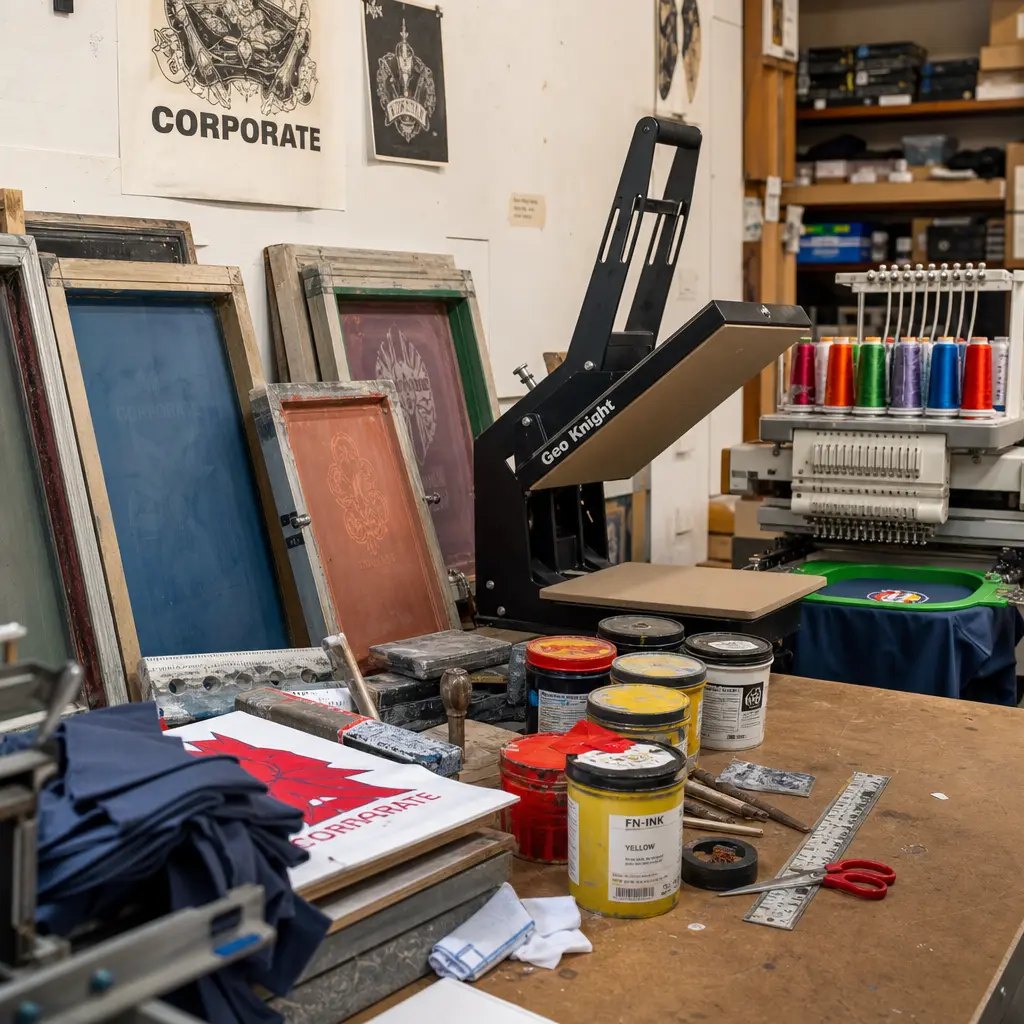
Most startup tote artwork is straightforward: a logo, short line of copy, QR code, sponsor mark, or event graphic. For that type of artwork, screen printing is usually the practical choice. Water-based screen print works well on organic cotton and keeps the hand feel softer than many heavier ink systems. Still, fine text, small QR codes, and low-contrast colors should be tested on the final fabric.
Digital printing and heat transfer have their place. They can help with gradients, many colors, or short runs. They are not automatically better. Heat transfers may look sharp at first but can crease or crack when folded tightly. Digital print depends on pretreatment, fabric color, color vibrancy, and wash or rub performance. Choose the process after reviewing quantity, artwork complexity, fabric color, and packing fold.
Procurement should connect print choice to the business outcome. A hackathon bag may need speed and reliable unit cost. A product-launch tote may need sharper color control. A retail insert may need clean folding and minimal surface marking. If the tote is meant to be reused in public, the logo must remain readable after packing, handling, and abrasion.
Set artwork requirements early. Provide vector files for screen printing, with Pantone references or equivalent color callouts. Send separate files for each print area. Ask the factory to confirm minimum line thickness and smallest readable text size for the selected fabric. Canvas texture can swallow tiny type.
QR codes deserve a real-world check. Print a strike-off at the actual size, then scan it with at least two common phones under normal indoor light. A code that looks good in a mockup but fails at an event is not acceptable. The same caution applies to small URLs and legal lines.
- Screen print: best for one to three solid colors, repeat orders, and clean logo work.
- Water-based ink: softer feel and good fit for natural cotton, but less opaque on dark fabric unless adjusted.
- Pigment or specialty effects: require testing and may vary by fabric lot.
- Heat transfer: useful for complex small graphics, but fold position and adhesion must be checked.
- Embroidery: premium look, but adds cost and may pucker lighter fabric.
- Ask for a strike-off on the final fabric and review a folded sample before bulk approval.
Understand MOQ before comparing prices
MOQ is rarely one simple number. Organic cotton totes can have separate minimums for fabric sourcing, dyeing, cutting, printing, labels, packing materials, and carton setup. A supplier may accept a low quantity in natural stock fabric but require much more for custom dyeing or woven labels. That is why two quotes for the same final quantity can have very different unit prices.
Break the RFQ into the details that drive production. State total quantity, number of artwork versions, number of colorways, label requirements, packing method, and shipment split. Three thousand bags with one natural fabric and one print is not the same as three thousand bags split across four artwork versions, two destinations, and individual barcode packing.
MOQ also affects risk. A very small pilot run can be useful, but if the fabric, label, or color is custom, there may be little flexibility to replace defects quickly. Ask which parts of the build are stock and which are custom. Also ask which materials must be booked before sample approval if the timeline is tight.
The best quote conversation separates the bag body, printing, labels, and packing. Once those numbers are visible, buyers can simplify the tote, consolidate artwork, or increase volume where it makes sense. That is much better than discovering setup charges after the sample is approved.
For repeat programs, ask about re-order terms. Can the supplier hold screens, patterns, label artwork, or carton mark templates? Will future orders use the same MOQ? These details affect long-term unit economics more than a first-order discount.
- Fabric MOQ: affected by stock availability, organic documentation requirements, and dyeing.
- Print MOQ: affected by screen setup, color count, and artwork versions.
- Label MOQ: woven labels often have separate minimums and setup charges.
- Packing MOQ: custom inner bags, hangtags, belly bands, or barcode labels may create extra minimums.
- Shipment split: multiple destinations add carton marking, packing, documentation, and possible pallet work.
- Ask for a cost breakout so the minimum-driving feature is visible.
Send an RFQ that makes supplier quotes comparable
A complete RFQ protects buyers from comparing unlike products. Without enough detail, the lowest quote may simply be for a thinner bag, shorter handle, weaker stitching, or cheaper packing. The RFQ should include finished size, fabric type, GSM, color, finish, print method, artwork details, handle construction, labels, packing, inspection expectations, shipment terms, and required documents.
Ask for quote data in a format that supports real comparison. Unit price is only one line. Procurement also needs sample cost, setup cost, print cost, packing cost, carton quantity, carton size, gross weight, net weight, lead time, MOQ, and quote validity. These details expose landed-cost differences before the purchase order is issued.
Name the approval path. If design approves artwork and procurement approves cost, the supplier should know who signs the pre-production sample, who checks production photos, and who confirms carton marks. Many delays happen because a factory waits for the wrong person or because internal teams assume another department approved the detail.
A strong RFQ can be short, but it must be specific. The goal is to let the supplier turn the brief into a production sheet without guessing. When that happens, quote turnaround improves and hidden assumptions decrease.
If goods ship to several sites, include destination rules from the beginning. Trade show contractors, retail DCs, 3PLs, and office locations may use different carton marks, pallet heights, delivery windows, or weight limits. Those rules may not change the bag, but they can change cost and timing.
- Finished size: width x height x gusset, measured after sewing, with tolerance.
- Fabric: organic cotton canvas or twill, GSM, color, finish, and certification document requirement.
- Artwork: vector file, print size, print position, Pantone references, and color count.
- Construction: handle width, handle drop, reinforcement type, seam type, and label placement.
- Packing: folding method, bags per carton, individual packing if required, carton marks, and pallet rules.
- Commercial data: MOQ, tier pricing, sample timing, bulk lead time, payment term, and quote validity.
Use sampling to test the final production path
A showroom sample is useful for inspiration, not approval. The signed sample should use the intended organic cotton fabric, final GSM range, final handle construction, actual print method, and planned folding style. If a supplier sends a sample made from substitute stock fabric, treat it as a shape reference only.
Event deadlines often compress sample review. That is where mistakes enter production. Artwork position may be approved by eye instead of by measurement. Handles may look fine on a table but feel too short over a jacket. A transfer print may look good flat, then mark the opposite panel after carton compression. Sample review needs to imitate the real use and packing conditions.
Measure the bag. Then load it. Put the expected kit inside and lift it repeatedly. Check whether the handles twist, the seams distort, the bottom corners pull, or the print falls on a hard fold. If the tote includes an insert card, hangtag, or label, confirm it does not wrinkle the fabric or scratch the print during packing.
Keep one sealed reference sample at the factory and one with the buyer. If a material lot changes or a packing method is adjusted, both sides have a shared baseline. That reduces argument later because the approved target is physical, not just described in email.
When teams are remote, request a production-ready photo pack as support. It should show the front, back, inside, handle joint, seam close-up, label, and folded packing view. Photos help decision-making, but they should not replace the signed physical sample when quality expectations are tight.
- Measure finished width, height, gusset, and handle drop, then record the agreed tolerance.
- Load the tote with realistic kit weight and lift it repeatedly by the handles.
- Fold the sample exactly as it will be packed, then check print cracking, ink transfer, and crease marks.
- Review print color under consistent lighting, not only warm office light.
- Approve the physical sample and keep one sealed reference at the factory for bulk comparison.
- Use pre-production photos as support, not as a replacement for the signed sample.
Write QC thresholds before fabric is cut
Quality control should not rely on comments like clean print or good sewing. Those words mean different things to different people. The purchase order or QC annex should state measurement tolerance, GSM tolerance, print-position tolerance, color approval method, seam requirements, packing count, and defect categories.
Many buyers use random inspection based on AQL. Even without a formal AQL level, the defect list must be clear. A tote can look acceptable at a glance but fail in use if handles tear, seams open, the print rubs off, or carton packing damages the front panel. QC should cover appearance, measurements, printing, sewing, load handling, packing, and carton labels.
A one-page QC annex is often enough. List what will be checked, how it will be measured, what counts as minor or major, and what happens if cartons or samples fail. Agreeing on this before cutting fabric gives the factory a practical target and gives procurement a fair basis for inspection.
Natural shade variation needs its own rule. Many teams say variation is acceptable, then reject cartons that look different in the warehouse. Decide whether the shipment must match the approved swatch, stay consistent within the production lot, or be sorted if visible shade variation is significant.
For retail, e-commerce, and premium onboarding, packing appearance is part of quality. A functional bag can still disappoint if it arrives with hard creases, crooked labels, crushed handles, or barcode stickers in the wrong place.
- GSM tolerance: commonly plus or minus 5 percent unless the program requires tighter control.
- Size tolerance: often plus or minus 0.5 cm to 1.0 cm, depending on bag size and fabric behavior.
- Print placement: define allowable movement from top edge, side edge, or centerline.
- Handle strength: test with the expected load plus a reasonable safety margin.
- Stitch defects: open seams, broken thread, skipped stitches, and loose handle reinforcement should be major defects.
- Packing count: carton quantity must match the packing list, especially for event distribution.
- Shade control: approve whether natural variation is acceptable or whether lot-to-lot matching is required.
Plan packing as part of the product, not the afterthought
Packing changes cost, appearance, warehouse speed, and user experience. Bulk folded packing is efficient for conferences and internal handouts. It uses less plastic and usually fits more units per carton. But if cartons are overloaded, natural cotton can hold hard fold lines and printed panels can show pressure marks.
Retail, direct mail, and 3PL programs usually need more control. Individual recycled polybags, paper belly bands, hangtags, barcode stickers, and SKU labels all add labor and material. They also reduce carton efficiency. If a shipment goes to a distribution center, carton marks, dimensions, weight limits, and pallet rules belong in the RFQ, not in a late email after production.
Think about who opens the carton. Event staff want fast handling, so bulk folded bags packed by location may be best. A retail team may need individual barcodes and presentation folds. An onboarding team may want bags grouped by department or kit type. There is no universal packing answer; there is only the correct answer for the next handler.
Ask for a carton pack plan before bulk approval. It should show how many bags fit per carton, how they are folded, which side faces up, whether inserts are included, and how much compression is used. This is not busywork. It affects crease risk, print condition, and distribution speed.
For international shipments, request carton dimensions, gross weight, net weight, and pallet pattern early. These numbers support freight booking and can reveal whether a tote that looks economical at unit-price level becomes inefficient in real logistics.
- Bulk carton packing: lower cost, faster for events, less plastic, but less individual protection.
- Individual polybag: useful for retail, direct mail, or courier handling, but adds material and labor.
- Paper band or hangtag: good for presentation, but test tearing, barcode readability, and placement.
- Carton compression: avoid packing so tightly that print panels, labels, or handles are damaged.
- 3PL compliance: include SKU count, carton marks, gross weight, and pallet requirements early.
- Ask for carton pack photos if bags will be distributed to multiple sites or departments.
Specification comparison for buyers
| Spec decision | Recommended option | When it fits | Buyer risk to check |
|---|---|---|---|
| Main fabric weight | 220-280 GSM organic cotton canvas for most tech startup totes | Conference kits, recruiter handouts, employee onboarding, sponsor packs, and retail-style merch | Below 180 GSM can feel thin and collapse under load; above 340 GSM increases sewing cost, carton volume, and freight |
| Fabric weave | Plain canvas or twill canvas with stable yarn count and tight construction | Plain canvas gives a flatter print surface; twill can feel softer and slightly more premium | Loose weave can cause ink spread, seam distortion, uneven shrinkage, and a less polished finished bag |
| Color base | Natural unbleached cotton or controlled dyed fabric with an approved shade standard | Natural works for sustainability-led messaging; dyed fabric suits strict brand systems | Natural cotton varies by lot; dyed cotton needs shade approval, rub testing, and often higher MOQ |
| Handle construction | Self-fabric handles or heavy cotton webbing with reinforced attachment points | Self-fabric gives an integrated look; webbing improves comfort and load performance | Narrow handles dig into the shoulder; weak bartacks, poor box stitching, or short stitch length can fail with repeated use |
| Print method | Water-based screen print for simple logos; transfer or digital only when artwork requires it | Startup logos, QR codes, sponsor marks, short taglines, and one-to-three-color graphics | Water-based ink can look softer on natural cotton; transfers may crack or mark if folded or carton-compressed too tightly |
| Bag structure | Flat tote for basic giveaways; gusseted tote for kits, bottles, notebooks, and retail bundles | Flat totes pack efficiently; gussets improve usable volume and help the bag stand with contents | Gussets add sewing labor and carton volume; weak bottom corners look poor and may fail under load |
| MOQ planning | Separate MOQ by fabric, color, print version, label type, and packing format | Useful when several teams want the same tote body with different artwork or destinations | A low unit quote may hide surcharges for custom dyeing, woven labels, print screens, or individual packing |
| Packing format | Bulk folded in export cartons for events; individual recycled polybag only for retail, direct mail, or barcode control | Bulk packing reduces cost and plastic; individual packing supports 3PL handling, retail presentation, and SKU control | Over-tight packing can create hard fold marks, print transfer, crushed labels, and distorted handles |
Buyer checklist before sampling
- Define the expected loaded weight in kilograms; do not specify only tote dimensions.
- Match GSM to the actual use case: light event handout, onboarding kit, paid merch, retail bundle, or sponsor pack.
- State whether the cotton must be certified organic and list the exact documents required with shipment.
- Provide finished dimensions with tolerance: body width, height, gusset depth, handle length, and handle drop.
- Lock logo size and position with a measured artwork placement drawing, not only a visual mockup.
- Clarify whether natural cotton shade variation is acceptable or whether lab dip, swatch, or shade-band approval is required.
- Choose the packing format before quoting: bulk folded, individual bagged, barcode labeled, packed by department, or packed by event site.
- Approve a pre-production sample made from final fabric, final print method, final handle construction, and final folding method.
- Include carton weight limits, pallet rules, and carton mark requirements for 3PLs, retail DCs, trade show contractors, or office deliveries.
- Request a quote breakout for bag body, printing, labels, packing, sampling, tooling, carton data, and freight-ready dimensions.
Factory quote questions to send
- What organic cotton fabric weights are in regular production, and which weights require custom weaving or special finishing?
- Is the quoted GSM measured on greige fabric, finished fabric, or after dyeing and washing?
- What is the MOQ for natural fabric, dyed fabric, custom labels, each print design, and each packing style?
- Which print method do you recommend for our logo size, color count, fabric color, and expected folding method?
- Can you provide a strike-off or lab print on the final fabric before making the full pre-production sample?
- What seam construction and reinforcement will be used at the handle joint, side seams, gusset, and bottom corners?
- What finished-size tolerance, print-position tolerance, and color tolerance will be used during inspection?
- How many bags are packed per export carton, what is the estimated carton size, and what is the gross weight?
- What is the realistic production lead time after sample approval, and which materials must be booked before final approval?
- Which documents can ship with the order: packing list, commercial invoice, carton marks, organic cotton certificate copy, test report, or supplier declaration?
Quality-control points to confirm
- Fabric GSM should be checked against the approved specification with a written tolerance, commonly plus or minus 5 percent unless otherwise agreed.
- Finished bag width, height, gusset depth, and handle drop should match the approved sample within documented tolerance.
- Print adhesion should pass a tape test, rub test, or wash/rub standard suitable for the chosen ink system and end use.
- Logo placement should be measured from bag edges and centerlines, not judged only by eye.
- Handle attachment should include visible reinforcement such as cross-stitching, box stitching, or bartack reinforcement according to the approved sample.
- Side seams and bottom seams should have no open stitches, skipped stitches, broken threads, or loose trimming on the visible face.
- Natural cotton shade should be compared under consistent light against the approved fabric swatch or shade band.
- Carton packing should avoid excessive compression that creates permanent fold lines, print marks, or distorted handles.
- Carton labels should match purchase order, SKU, artwork version, quantity, gross weight, net weight, and destination requirements.
- Random inspection should include load handling, print appearance, measurements, packing count, and needle or metal contamination controls where required.