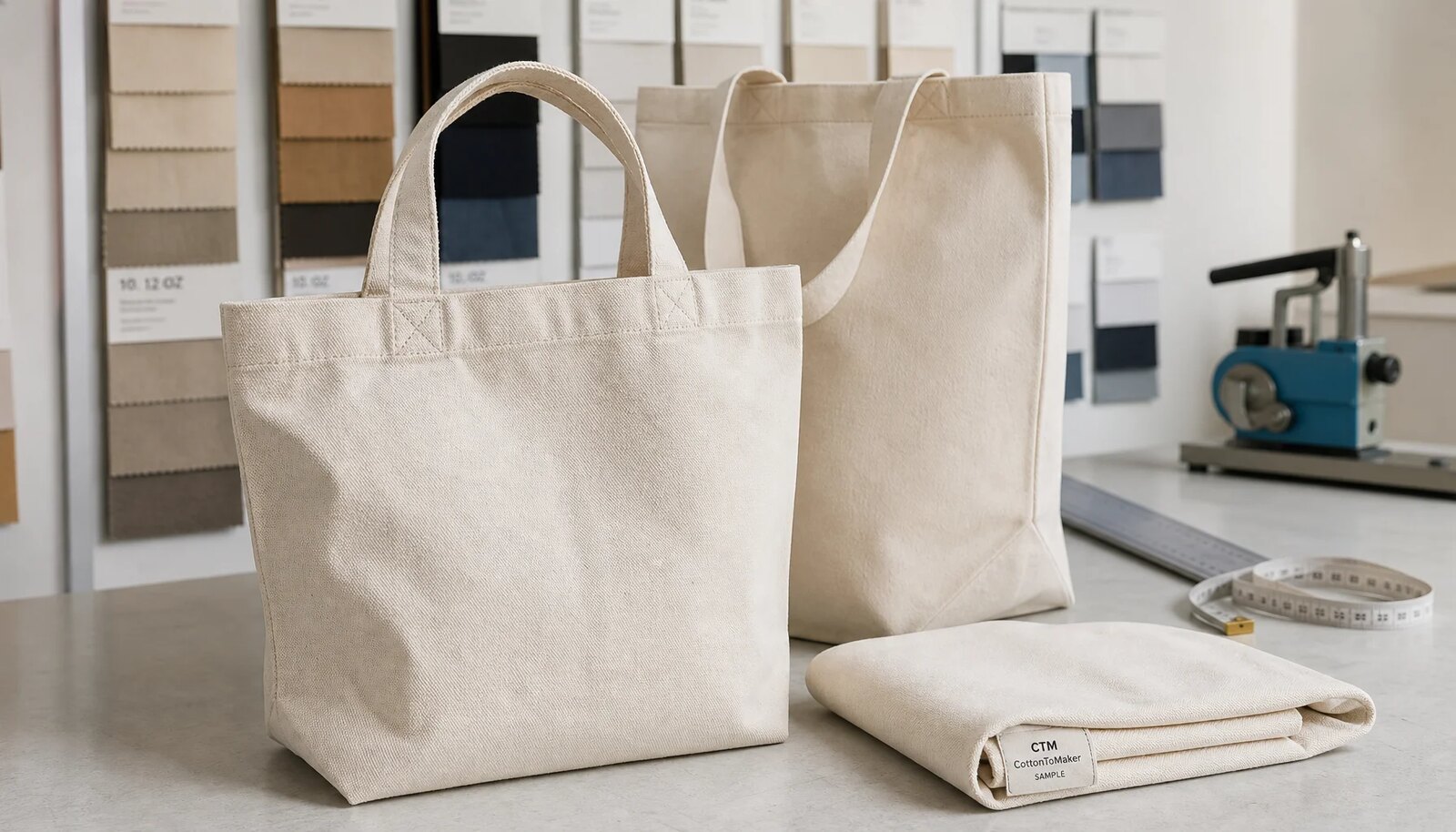
Start With the Buying Risk
Organic cotton totes for craft fairs look simple, but a B2B order can carry several risks at once: organic wording, fabric weight, logo decoration, event delivery, packing accuracy, and supplier documentation. If the RFQ says only "organic cotton tote, natural, logo printed," suppliers may quote very different products. One may price stock cotton with a declaration. Another may price certified organic cotton canvas with stronger fabric records. A third may reduce GSM or exclude print strike-offs to look cheaper.
A supplier compliance checklist should make the quote comparable and the finished tote inspectable. A giveaway used for brochures does not need the same construction or claim evidence as a tote sold as branded merchandise. A one-logo order shipped to one warehouse is also different from a craft fair program with ten maker logos, separate booth kits, and destination-specific carton labels.
Before deposit, define the claim level, fabric, dimensions, construction, artwork, sample path, packing format, and inspection acceptance. These decisions help suppliers quote the actual job and reduce disputes after fabric has been cut or printed.
- Treat the tote as claim-bearing when organic wording appears on labels, hangtags, product pages, event signage, invoices, or retailer forms.
- Separate organic evidence from physical quality; strong canvas and neat stitching do not prove chain-of-custody.
- Use measurable acceptance criteria so suppliers price the same documents, fabric, construction, artwork, and packing.
- Assign owners for claim wording, artwork approval, quality approval, and delivery planning before production starts.
Define the Organic Claim
The first sourcing decision is the claim your company intends to make. Organic cotton may refer to certified organic fiber input, certified yarn or fabric, batch-related material evidence, certified processing, finished-product certification support, or only a supplier declaration. These levels are not interchangeable for consumer labels, marketplace listings, distributor forms, or retailer compliance manuals.
A facility scope certificate can be useful, but it does not automatically prove that your specific tote order is covered. Buyers should review the certification body, validity date, certified scope, facility or mill name, and product category. If the order requires a transaction certificate or equivalent batch document, ask whether it can be issued for this PO, when it will be available, and whether extra fees or buyer certification details are required.
Some brands use organic cotton only as an internal sourcing preference. In that case, a supplier material declaration may be enough for the purchasing file if consumer-facing organic claims are avoided. If the tote is promoted or sold as organic, the RFQ should require stronger evidence and claim wording should be approved before labels, hangtags, or product pages are finalized.
- Internal preference: supplier declaration may be acceptable when no consumer-facing organic claim is made.
- Marketing claim: product pages, booth copy, invoices, and event listings should be supported by appropriate material evidence.
- Certification mark use: logos and formal claim language require permission and document review before artwork approval.
- Document review: check certificate holder, issuing body, validity, scope, product category, facility name, and connection to the ordered material.
- RFQ wording: ask what is included, optional, extra cost, unavailable, or dependent on buyer certification details.
Specify Measurable Fabric
Fabric choice should follow the tote's job. A 6-8 oz cotton tote can work for brochures, paper goods, catalogs, and light giveaways. A 10 oz canvas is often a practical starting point for reusable craft fair totes because it balances structure, print surface, and cost. A 12 oz canvas is better for candles, jars, books, small ceramics, boxed kits, and heavier merchandise. A 14-16 oz canvas can feel premium, but it increases fabric cost, sewing difficulty, needle stress, carton weight, and sometimes MOQ.
Ask for fabric weight in both ounces and GSM. As a rough reference, 6 oz is about 200 gsm, 8 oz about 270 gsm, 10 oz about 340 gsm, 12 oz about 407 gsm, and 16 oz about 542 gsm. The approved swatch and roll record should control the order because finishing, moisture, and test method can affect readings.
Weave and finish also matter. Plain sheeting behaves differently from canvas. Natural unbleached organic cotton may show seed flecks and tone variation, which can suit craft brands but may affect pale ink or strict retail presentation. Dyed fabric adds lab dips, shade-lot control, crocking review, and often higher MOQ. If consumers may wash the tote, request shrinkage data or approve a wash-test result.
- 6-8 oz: suitable for paper goods and light giveaways; check opacity under large or dark logos.
- 10 oz: balanced reusable weight for many craft fair programs.
- 12 oz: stronger choice for merchandise, books, jars, candles, boxed kits, and repeat use.
- 14-16 oz: premium structure; confirm sewing capability, handle reinforcement, carton weight, and MOQ.
- Finish controls: specify natural, bleached, dyed, washed, brushed, stiffened, or soft-finished fabric with a physical swatch.
- Fabric standard: state GSM or oz tolerance, shade reference, seed-fleck limit, shrinkage expectation, and stock or made-to-order status.
Lock Size and Construction
A tote specification should use finished dimensions after sewing, trimming, pressing, and normal packing. Cut-panel size is a factory planning detail; it does not tell the buyer what the customer receives. The RFQ should include body width, body height, gusset type, gusset depth, handle width, handle length, handle drop, seam allowance, thread color, reinforcement type, and label position.
Gusset choice affects function and cost. A flat tote ships efficiently and works for prints, apparel, postcards, catalogs, and light samples. A bottom gusset improves carrying capacity and makes the bag more useful after the event. Side-and-bottom gussets create a fuller shopping-bag shape, but they add sewing operations, fabric consumption, measurement points, and corner-defect risk.
Handle reinforcement should be written into the quote. A plain single stitch may work for a very light giveaway, but it is not a strong default for reusable merchandise. Box stitch, cross stitch, bartack, or double-row stitching gives inspectors a visible pattern to check. For heavier expected loads, add a buyer-defined handle pull check or request a lab-style strength test when a retailer requires it.
- Flat tote: best for carton efficiency and simple use with stationery, apparel, brochures, and lightweight items.
- Bottom gusset: better for candle boxes, books, jars, kits, and general craft fair shopping.
- Side-and-bottom gusset: higher capacity and retail shape, with more sewing time and tighter inspection needs.
- Practical tolerance: plus or minus 5 mm on body and gusset and plus or minus 10 mm on handle length or drop unless otherwise agreed.
- Handle spec: define width, length, drop, reinforcement pattern, thread color, stitch-density target, and folded or enclosed handle ends.
- Approval file: use a dimensioned drawing and signed pre-production sample as the final inspection reference.
Choose the Logo Method
Decoration is one of the biggest cost and QC variables. Screen printing is usually the strongest default for solid artwork, one to four colors, and repeat quantities. It can give good opacity on natural canvas and predictable unit cost once screens are made. The RFQ should state artwork file type, Pantone or target color, print size, placement from seams, number of colors, ink type, curing expectation, and position tolerance.
Digital printing can help when a craft fair program has many artist designs, gradients, or smaller quantity splits. It still needs approval on the actual fabric because natural cotton texture, pretreatment, and base shade can change color and hand feel. Heat transfer may solve urgent or low-MOQ needs, but buyers should inspect edge lifting, shine, cracking, and whether the finish fits the brand position. Embroidery can look premium, but lighter canvas may pucker if backing, stitch count, needle size, and placement are not controlled.
Multi-design orders need a different price structure. Two thousand totes with one logo is not the same as two thousand totes split across ten maker logos. Sewing may be one run, but screens, ink changes, strike-offs, counting, carton labels, and inspection sampling are separate controls.
- Screen print: best for solid logos, repeat orders, strong opacity, and stable pricing over volume.
- Digital print: useful for gradients and many designs; approve pretreatment marks, color, and hand feel on actual fabric.
- Heat transfer: useful for urgent small runs; inspect edge adhesion, cracking, gloss, and compatibility with cotton texture.
- Embroidery: premium option; specify backing, stitch count, needle size, thread color, placement, and puckering limits.
- Artwork file: confirm vector file where possible, final size, location, Pantone or target color, edge clearance, and file conversion approval.
- Print limits: define color target, position tolerance, opacity, registration, curing, rub result, and visible defect limits before bulk printing.
Compare MOQ and Real Cost
MOQ for organic cotton totes usually comes from several sources: fabric lot, sewing efficiency, print setup, trim minimum, documentation, and packing format. Stock natural canvas may allow lower MOQs. Made-to-order organic canvas, dyed fabric, specific GSM, or batch-related paperwork may require higher quantities. A low MOQ can be useful, but only if the quote still includes the requested evidence, fabric weight, construction, and inspection scope.
Price breaks should reflect the actual order structure. One thousand totes with one logo is simpler than one thousand totes split across five designs, two handle colors, and three destinations. Each added design may require separate screens, strike-offs, artwork approvals, counting, carton labels, and inspection sampling. Labels, hangtags, barcode stickers, paper bands, and custom cartons can also have independent MOQs.
A clean quote separates one-time costs from unit costs. Screens, sample courier, Pantone matching, testing, organic documents, reinspection, inland freight, and export handling should be visible. Procurement should compare landed usable cost, not only ex-factory unit price. A higher unit price may be cheaper overall when it includes correct carton marks, SKU separation, and documents that prevent receiving delays.
- Fabric MOQ: driven by stock availability, mill lot, GSM, dye lot, traceability requirement, and made-to-order status.
- Print MOQ: driven by screen setup, ink mixing, curing setup, digital changeover, artwork count, and color count.
- Trim MOQ: woven labels, printed labels, hangtags, barcode stickers, and paper bands may each have separate minimums.
- Packing MOQ: custom cartons, inner bundles, destination labels, and pallet requirements affect the real order size.
- Quote breakout: request fabric, cutting, sewing, printing, labels, packing, documentation, testing, samples, tooling, freight, and export handling separately.
- Comparison rule: quote both the base SKU and the real event split by artwork, carton group, and delivery destination.
Review Supplier Evidence
Supplier evidence is most useful before deposit, when the buyer still has leverage to clarify documents, change suppliers, or adjust claim wording. The evidence should match the full production route: fabric source, organic documentation, cutting and sewing capability, printing control, packing process, and QC ownership. A capable supplier should explain whether fabric is stock or booked, how rolls are inspected, whether printing is in-house or subcontracted, and who approves rework.
Direct factories can offer strong construction control, but they may need support with export paperwork, retail packing, or claim language. Trading companies can be valuable when coordinating fabric, sewing, printing, and packing for mixed orders, but the buyer should know who is producing, printing, inspecting, and signing off. If process ownership is unclear, defect correction becomes harder as the event date approaches.
Organic evidence deserves a separate review. A screenshot is not enough. Confirm document type, current validity, product scope, facility or mill name, whether the document relates to fabric or finished goods, and whether any order-level document can be issued after production. If a marketplace, distributor, or retailer may audit the claim, request sample document formats before PO approval.
- Business evidence: company profile, production scope, relevant tote photos, machine capability, export experience, and clear commercial contact.
- Organic evidence: document type, issuing party, validity date, certified scope, facility or mill name, and batch document availability where applicable.
- Production evidence: fabric inspection method, cutting control, sewing capacity, print process, subcontractor use, and in-line QC responsibility.
- Print evidence: strike-off process, curing method, color control, defect segregation, and correction procedure for misprinted goods.
- Packing evidence: carton specification, bundle count, carton marks, moisture protection, pallet option, and warehouse or venue shipment experience.
- Corrective action: define who approves sorting, rework, replacement, reinspection, and cost responsibility when factory error occurs.
Use Samples as Controls
A reliable sample path has three stages: fabric swatch, print strike-off, and pre-production sample. The fabric swatch confirms weight, weave, shade, hand feel, seed-fleck level, and finish. The print strike-off confirms ink color, opacity, placement, hand feel, and artwork behavior on the tote fabric. The pre-production sample confirms construction, finished measurements, handle reinforcement, label position, folding method, and packing format.
Sales samples are useful for ideas, but they are risky as bulk references when they are not made from the final fabric and final print process. If a prototype uses substitute fabric, sample-room stitching, different handles, or temporary decoration, the approval note should say "construction reference only" or "print layout reference only." A partial prototype should not become approval for organic claim, fabric shade, GSM, or production printing.
For repeat programs, keep one sealed approved sample with the supplier and one with the buyer or third-party inspector. The sample tag should include PO number, SKU, artwork code, fabric weight, color, approval date, and approved exceptions. If bulk production differs from the sealed sample in fabric lot, construction, print method, label, or packing, the supplier should request written approval before continuing.
- Fabric swatch: confirm GSM, weave, shade, seed flecks, hand feel, finish, shrinkage expectation, and whether it represents bulk material.
- Print strike-off: confirm color, opacity, registration, position, edge quality, curing, rub result, and appearance on natural cotton texture.
- Pre-production sample: confirm finished size, gusset, handle drop, reinforcement, thread, labels, folding, packing, and carton label.
- Approval wording: use measurable notes such as "print center 120 mm below top seam" instead of subjective notes such as "looks balanced."
- Sample retention: keep signed or sealed samples in buyer and supplier files and reference them in the inspection booking.
- Deviation rule: no fabric, construction, print, label, or packing change should proceed without written buyer approval.
Set QC and Packing Rules
Quality control should be staged, not saved for final inspection only. Incoming fabric should be checked before cutting for GSM, shade, stains, weaving defects, odor, moisture, roll width, and match to the approved swatch. Cutting should be controlled by fabric lot and SKU. Sewing QC should verify dimensions, seam allowance, handle placement, reinforcement, stitch quality, loose threads, and gusset shape. Print QC should monitor placement, color, registration, curing, opacity, and contamination.
Defect classification should match the tote's use. A small natural seed fleck may be acceptable if it matches the approved swatch. Oil stains, mildew odor, open seams, twisted handles, severe print misregistration, wet ink, wrong artwork, and damp cartons should be major defects. Sharp foreign objects, needle fragments, mold contamination, or incorrect claim labels should be treated as critical risks. Totes sold as merchandise should have tighter cosmetic limits than one-time giveaways.
Packing is also a quality issue. Bulk flat packing is usually lowest cost and works when a warehouse will count and distribute the bags. Paper-band bundles help booth kits and retail programs because they improve counting without individual plastic. Individual protective bags can reduce dirt and moisture exposure, but they may conflict with sustainability goals unless the buyer approves the material and reason. Cartons should match the shipping route, destination labels, and manual handling limits.
- Incoming fabric: verify GSM, shade, stains, weaving defects, roll width, moisture, odor, and match to approved swatch.
- Sewing inspection: check seam allowance, stitch density, skipped stitches, handle alignment, reinforcement, gusset shape, loose threads, and final measurements.
- Print inspection: check seam-based position, color target, opacity, registration, curing, dry rub, ink bleeding, pinholes, ghosting, and contamination.
- Packing inspection: verify units per bundle, SKU separation, artwork count, carton marks, barcode or label placement, carton strength, and maximum carton weight.
- Carton marks: include PO, SKU, artwork code, fabric color, quantity, gross weight, net weight, carton number, and destination where needed.
- Moisture control: require dry cartons, clean folding tables, no floor packing, and suitable protection for humid routes or long storage.
Specification comparison for buyers
| Supplier option | What to verify | Commercial advantage | Buyer risk to control |
|---|---|---|---|
| Direct sewing factory | fabric batch documents, dye-lot photos, approved sample archive, and final QC record | Better sample-to-bulk control and faster production feedback | May be weaker on export paperwork or branded packing unless checked early |
| Trading company | Factory name, production photos, trim-source proof, and who owns QC decisions | Can coordinate small mixed orders and extra services | Markup can hide real factory capability and slow defect decisions |
| Specialized bag workshop | seam allowance, handle reinforcement, label attachment, fabric pre-shrink note, and batch shade control | More practical for detailed construction, trims, and repeat programs | Capacity may be limited during peak seasons |
| Low-price general supplier | organic cotton canvas, batch documentation where available, undyed or low-impact dyed fabric, and shrinkage control | Useful for simple promotional runs with loose specs | Material downgrades, weak packing, and vague inspection scope can erase savings |
| Retail-ready supplier | plastic-reduction request, recycled carton note, bundle count, carton mark, and moisture protection without overpacking | Can handle labels, SKU separation, carton marks, and receiving rules | Higher unit cost must be compared against reduced warehouse work |
| Compliance-focused supplier | Fabric records, labeling review, test plan, and production traceability | Safer for retail programs and repeat brand orders | Documentation claims need evidence, not only sales language |
| Local sample room plus bulk factory | Signed sample, bulk factory handoff, first-piece photos, and deviation owner | Good for complex branding before large production | Sample room quality may not match bulk line unless handoff is controlled |
Buyer checklist before sampling
- Decide the organic claim level before quoting: internal material preference, certified organic cotton input, batch-related fabric evidence, certified processing support, finished-product certification support, certification mark use, or supplier declaration only.
- List every claim location: sewn label, hangtag, care label, invoice, product page, craft fair listing, booth signage, retailer form, carton mark, or internal purchasing record.
- Ask which documents are included in price, which cost extra, which require buyer certification details, and which cannot be issued for this PO.
- Specify fabric in measurable terms: cotton content, weave, oz and GSM, buyer-agreed tolerance, natural or dyed finish, shade standard, seed-fleck acceptance, shrinkage expectation, and stock or made-to-order status.
- Quote finished dimensions after sewing and pressing: body width, height, bottom gusset, side gusset, handle width, handle length, handle drop, seam allowance, and agreed measurement tolerance.
- Match fabric weight to use: 6-8 oz for brochures and light giveaways, 10 oz for standard reusable craft fair totes, 12 oz for heavier merchandise, and 14-16 oz only when premium structure justifies cost and carton weight.
- Lock artwork before price comparison: print method, file type, number of colors, Pantone or target color, ink type, print size, seam-based placement, edge clearance, curing requirement, and rub or wash-test expectation.
- Require staged approvals: fabric swatch, print strike-off, pre-production sample, first-piece production photos, and sealed approved sample before bulk cutting or bulk printing continues.
- Ask suppliers to separate cost drivers: fabric, cutting, sewing, printing, labels, hangtags, packing, cartons, organic paperwork, testing, samples, screens, inland freight, export handling, and reinspection.
- Define QC acceptance before deposit: fabric defects, shade variation, stains, slubs, skipped stitches, reinforcement, print registration, ink bleeding, odor, moisture, size tolerance, SKU count, carton marks, and carton condition.
Factory quote questions to send
- What organic claim is your quote supporting: organic cotton material preference, certified organic input, batch-related fabric evidence, certified processing support, finished-product certification support, or supplier declaration only?
- Which documents can be supplied for this PO: scope certificate, transaction certificate where applicable, fabric certificate, mill declaration, supplier material declaration, test report, or none? State timing and cost.
- Is the fabric stock, reserved by lot, greige, dyed to order, woven to order, or purchased after deposit, and how does that affect MOQ, lead time, shade consistency, shrinkage, and traceability?
- What is the fabric weight in both oz and GSM, what buyer-agreed tolerance applies before cutting, and how can our inspector verify weight against the approved swatch or roll record?
- What are the finished measurements after sewing, trimming, pressing, and packing, and what tolerances apply to width, height, gusset, handle width, handle length, and handle drop?
- Which handle attachment is included: box stitch, cross stitch, bartack, double row, or another reinforcement? Provide close-up photos and stitch-density target if available.
- Which print method is quoted, and does the price include screen setup, Pantone matching, ink mixing, curing, print strike-off, artwork positioning template, and correction if agreed limits are missed?
- Can the pre-production sample use the same fabric specification and final print method, and who pays for remake, courier, or delay if it fails approved technical requirements?
- What in-line and final inspection checks will be used for GSM, shade, dimensions, seam strength, loose threads, handle pull, print placement, ink adhesion, odor, moisture, carton strength, and packing accuracy?
- How are multiple craft fair designs priced and controlled: by total order quantity, fabric color, print design, print color, label type, SKU, packing group, carton mark, or delivery destination?
Quality-control points to confirm
- Fabric weight should be verified against the approved swatch or roll record using a GSM cutter, scale, or lab method. Plus or minus 5 percent is a common buyer-agreed commercial starting point, not a universal rule.
- Incoming fabric should be checked before cutting for shade lot, roll width, stains, oil marks, mildew, weaving defects, heavy slubs, moisture, odor, and visible mismatch against the approved natural or dyed standard.
- Natural unbleached organic cotton may show seed flecks and tone variation. The buyer should define acceptable fleck level and reject dark stains, mildew marks, colored contamination, and panel-to-panel shade mismatch.
- Finished dimensions should be measured on unpacked totes after sewing and pressing. Practical buyer-defined tolerances often start at plus or minus 5 mm on body and gusset and plus or minus 10 mm on handle length or drop.
- Handle attachment must match the approved reinforcement pattern. Inspect box stitch, cross stitch, bartack, or double-row sewing for skipped stitches, weak corners, fabric tearing, inconsistent placement, and loose thread ends.
- Seams should be inspected for open seams, broken stitches, skipped stitches, puckering, uneven topstitching, twisted handles, raw edges where enclosed seams were specified, and inconsistent corner or gusset sewing.
- Print position should be measured from the top seam, side edge, and centerline. Plus or minus 3 mm can work for many standard logo prints, but large artwork or retailer programs may require artwork-specific limits.
- Ink adhesion and curing should be checked during production through dry rub, tape pull where appropriate, surface tack review, and wash testing when totes are sold as reusable merchandise or expected to be washed.
- Print defects should be classified before inspection: misregistration, pinholes, bleeding, ghosting, poor opacity, scorched fabric, transfer edge marks, pretreatment stains, uneven ink film, and wrong artwork.
- Odor, mildew, damp cartons, oil marks, dirty folding tables, trimming waste inside bags, broken needles, or foreign objects should be treated as major or critical issues because customers handle craft fair totes directly.