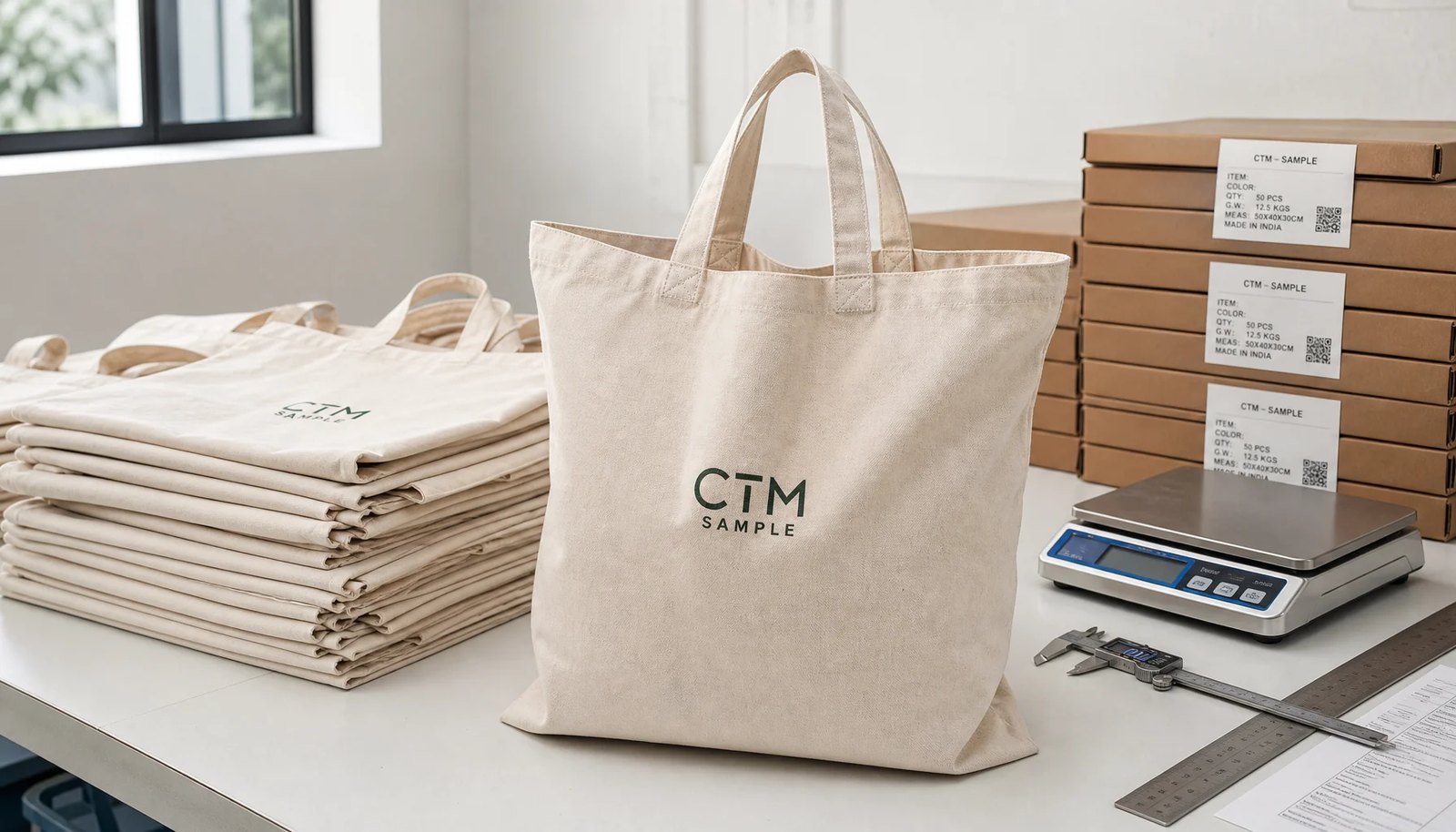
Start carton planning before the tote is sewn
Organic cotton totes shipping carton planning for university bookstores should begin during the RFQ, not after production is finished. Cartons influence the fabric choice, fold method, print protection, carton count, freight cube, warehouse labor, and receiving accuracy. A tote can look profitable on unit price and still lose margin if it ships in oversized cartons, exceeds campus handling limits, arrives with crushed folds, or forces staff to recount mixed designs during textbook rush.
Bookstore orders are usually attached to dates that do not move: orientation, move-in, homecoming, commencement, athletics launches, alumni weekends, department events, and semester rush. The goods may pass through a forwarder, 3PL, campus warehouse, mailroom, bookstore dock, and event storage room before anyone hands the bag to a student. If the quote includes only unit cost and production lead time, procurement cannot compare true landed cost or operational risk.
A stronger B2B quote includes pieces per inner bundle, pieces per export carton, carton dimensions, gross weight, net weight, CBM per carton, total CBM, total carton count, packing method, carton label fields, and carton construction. When these details are written into the quote, procurement, licensing, marketing, sustainability, and receiving teams can review the same assumptions before the purchase order is released.
- Treat the carton plan as part of the product specification, not a warehouse afterthought.
- Compare suppliers by total cartons, total CBM, gross carton weight, packing method, and label compliance as well as unit price.
- Ask for pack-plan data before choosing air, ocean, courier, LTL, or campus delivery.
- Review the folded and packed condition, not only a flat sample photo.
- Align carton labels with bookstore routing guides, PO structure, SKU setup, and event allocation.
Define the bookstore use case first
A retail tote sold at the bookstore is not the same product as a one-day orientation giveaway. Retail resale needs a better shelf impression, cleaner folding, stronger print consistency, and often SKU or price labeling. Orientation totes may be unpacked by volunteers in a gym or student center, so inner bundle counts and visible carton identification can matter more than retail presentation. E-commerce totes may need individual unit protection and barcode scanning, which changes both packing cost and carton volume.
The best RFQs use operational language. Instead of asking for an “organic cotton tote with logo,” write something closer to: “8 oz natural certified organic cotton canvas tote, 38 x 42 x 10 cm gusset, two-color front screen print, bulk packed in 25-piece bundles, one design per carton, maximum 15 kg gross carton weight, labels by PO and campus event.” That sentence gives the factory enough information to price, sample, and pack the order realistically.
The use case also affects defect standards. Light shade variation may be acceptable for a bulk welcome-week giveaway but not for premium alumni merchandise. Stronger handle reinforcement may be needed for checkout bags because students may carry books, bottles, and apparel across campus. Department allocations may prioritize compact cartons because office storage is limited. Decide the use case first; the tote specification follows.
- Retail resale: specify fabric body, clean folds, print appearance, SKU labels, and carton label accuracy.
- Orientation kits: specify low handling friction, bundle counts, event-date allocation, and fast unpacking.
- Checkout bags: specify handle strength, backroom access, and practical carton weights.
- E-commerce: specify individual packing, barcode position, cleanliness, and unit-level protection.
- Multi-campus orders: specify one design per carton, carton numbering, and allocation labels.
Specify organic cotton fabric in measurable terms
Fabric weight needs to be quoted in terms buyers can compare. For university bookstore resale totes, 8 oz to 10 oz organic cotton canvas is a common practical range, roughly 270-340 GSM depending on yarn count, weave density, and finishing. For orientation or sponsor giveaways, 5 oz to 7 oz organic cotton may be enough, roughly 170-240 GSM. Heavier canvas, such as 12 oz, can feel premium, but it also increases folded bulk, freight cube, carton weight, and storage space.
Do not rely on ounce weight alone. In fabric sourcing, oz usually refers to fabric weight per square yard, while GSM means grams per square meter. Supplier conversations are not always perfectly consistent because finishing, moisture content, and construction affect the actual hand feel. Ask for the nominal oz, target GSM, weave type, finishing process, and tolerance. A common commercial tolerance may be around plus or minus 5%, but the correct tolerance should be written into the purchase specification.
The organic cotton claim needs the same precision. Natural, unbleached, undyed, raw, eco, green, recycled-look, and organic-style are not equivalent to certified organic cotton. If the university, bookstore, sustainability office, or licensed merchandise program will market the tote as organic cotton, confirm the documentation requirement before the PO. The approved claim should match the evidence available and stay consistent across the quotation, invoice, product page, hangtag, packing list, and carton label.
- 5 oz to 7 oz: suitable for high-volume giveaways, lower CBM, and budget programs.
- 8 oz to 10 oz: stronger choice for resale, daily use, and campus logo merchandise.
- 12 oz and above: premium but bulky; review carton weight, compression, and fold lines early.
- Natural cotton may include seed flecks, slubs, neps, and shade variation; approve these by sample standard.
- State whether certified organic documentation is mandatory or whether a material declaration is sufficient for the buyer’s internal use.
Lock the size, gusset, handles, and tolerances
Finished bag size should be written as width x height x gusset, with units and measurement points. A common bookstore size is around 38 x 42 cm, but a flat 38 x 42 cm tote behaves differently from a 38 x 42 x 10 cm gusseted tote. The gusset makes the bag more useful for books, hoodies, boxed drinkware, and gift bundles. It also adds fabric, sewing time, folded thickness, and carton CBM.
Handles deserve more than a quick note. Specify handle width, total handle length, handle drop, attachment position, reinforcement type, and stitch density expectation. A shoulder tote should fit over sweatshirts and winter coats. A shorter checkout-style handle can reduce cost and folded bulk, but it may be less comfortable when students carry items across campus. If the tote will carry books, review reinforced box-X stitching, cross-stitching, or comparable stress-point construction on the pre-production sample.
Set measurement tolerances before production starts. The right tolerance depends on fabric weight, cutting method, washing or finishing, and construction. Buyers often use separate tolerances for width, height, gusset, handle width, and handle drop because each dimension affects function differently. Avoid approving an approximate sample and then rejecting production for a dimension that was never controlled in writing.
- Confirm all dimensions are finished measurements after sewing, not cut-panel dimensions.
- Set separate tolerances for width, height, gusset depth, handle width, and handle drop.
- Specify seam type: inside seam, overlock, bound seam, French seam, or other construction.
- Confirm reinforcement method and location for handles expected to carry books.
- Recalculate price, carton count, and CBM if gusset, handle drop, or fabric weight changes after sampling.
Plan print method, campus color, and fold protection
Most university bookstore totes use screen printing because campus marks, mascots, department names, and slogans often rely on solid brand colors. Water-based or pigment screen print is common for cotton totes and can give a softer hand than heavy ink deposits. Digital print may be useful for short runs, gradients, or complex artwork, but it changes color expectations, unit cost, setup logic, and sometimes wash or rub performance.
Approve campus color on the actual tote fabric. A Pantone reference on coated paper will not look identical on natural organic cotton with visible weave, seed flecks, and slight shade variation. If licensing standards are strict, request a strike-off on production fabric before mass printing. Look closely at small reverse text, fine mascot lines, distressed effects, halftones, and tight registration between colors. Canvas can make those details less forgiving than a digital proof suggests.
Packing can damage a good print if it is rushed. Bags folded before full curing, heavy handles resting across a large ink area, or hard carton compression can cause blocking, transfer, pressure marks, or gloss changes. Large solid prints, dark inks, two-sided artwork, and rush schedules need extra attention. Ask for photos of the folded bundle and open-carton arrangement before mass packing, not only the printed sample laid flat.
- Provide vector artwork, Pantone targets, print dimensions, placement, and color count in the RFQ.
- Use strike-offs for sensitive school colors, mascot detail, and small typography.
- Set print placement tolerance, commonly 5-8 mm for standard tote prints unless a tighter licensed standard is required.
- Confirm curing method and minimum cure time before stacking or packing.
- For two-sided prints, review fold direction and whether tissue, slip sheets, or lower compression are needed.
Separate MOQ logic for multi-design campus programs
University bookstore programs often include several related designs: bookstore logo, admissions, athletics, residence life, alumni association, department events, and orientation themes. Supplier MOQ may apply to fabric purchase, dyeing, cutting, sewing, printing, packing, or shipment. Unless the buyer knows which operation drives the minimum, supplier quotes can look inconsistent and become hard to compare.
A cleaner structure separates the base tote MOQ from the print MOQ. If every design uses the same natural organic cotton fabric, size, gusset, and handle construction, the factory may be able to cut and sew one larger base batch while printing smaller design quantities. Even then, each artwork may require separate screens, ink mixing, press setup, strike-off approval, production control, packing separation, and carton labeling.
Decide how overruns and underruns will be handled by design. A 2% quantity variance across the total order may be fine on paper, but it can create a real problem if the orientation design is short and a department design is long. Event quantities are often fixed. The purchase order should say whether tolerance applies to each SKU/design or only to the total shipment.
- List each design, quantity, print colors, and delivery destination separately.
- Ask whether price breaks apply to total order, base tote batch, artwork quantity, or delivery lot.
- Separate screen charges, setup fees, and ink matching costs from unit cost if needed for comparison.
- Avoid mixed-design cartons unless the bookstore approves them in writing.
- Define overrun and underrun tolerance per design, especially for event-dated orders.
Turn the tote specification into carton math
Carton planning converts product decisions into logistics data. Buyers should request pieces per carton, carton length, width, height, gross weight, net weight, CBM per carton, total carton count, and total shipment CBM. These figures support air versus ocean decisions, courier versus LTL comparisons, warehouse storage estimates, and receiving labor planning. Without them, procurement may choose a low unit price that performs poorly after freight and handling are added.
Gross carton weight should be controlled before production packing begins. Many tote programs target about 12-18 kg gross per export carton, but the correct limit depends on the bookstore’s receiving team, campus mailroom rules, 3PL requirements, parcel carrier limits, pallet plan, and whether cartons will be hand-carried into a stockroom. A carton that is too heavy may split or trigger complaints. A carton that is too light may multiply handling charges and take up unnecessary storage space.
CBM also needs balance. Over-compressing organic cotton totes can create hard fold lines, distorted gussets, handle impressions, and print pressure marks. Under-packing wastes freight. Ask the supplier for a proposed pack plan, then adjust pieces per carton based on maximum weight, acceptable compression, carton strength, and the route from factory to bookstore.
- Require carton dimensions in centimeters or inches and calculate CBM per carton.
- Ask for total carton count and total CBM by design, not only total order quantity.
- Set maximum gross carton weight and any preferred carton dimension range.
- Review whether cartons will ship loose, palletized, floor-loaded, by courier, or through LTL.
- Do not reuse last year’s carton count if fabric weight, gusset, packing method, or unit packaging has changed.
Choose bulk bundles, unit packaging, and moisture controls
Bulk packing is often the practical choice for university bookstore totes. Bags can be folded flat, grouped into 25-piece or 50-piece bundles, and packed into export cartons. This reduces packaging waste, speeds event distribution, and keeps labor lower than individual unit packing. It works best when production handling is clean, prints are fully cured, and inner bundle counts are consistent.
Individual polybags or paper sleeves may be required for e-commerce, 3PL scanning, retail pre-ticketing, or light natural cotton items that must stay clean through multiple handling points. If unit packaging is required, define the bag or sleeve material, thickness or paper specification, suffocation warning text where applicable, barcode label size and position, retail price tag rules, and whether recycled or plastic-free options are acceptable. Unit packaging almost always changes carton CBM and labor cost.
Moisture control matters because cotton absorbs moisture and odor. Factories should pack only dry goods, keep cartons off wet floors, use clean packing tables, and protect goods from humidity during staging. Desiccants, carton liners, or inner bags may be useful for humid routes, but they should be specified rather than added casually. Packaging components also need to fit destination rules and university sustainability requirements.
- Use 25-piece bundles for thicker canvas or careful count control; use 50-piece bundles only when practical for fabric thickness and handling.
- Define whether bundles use paper bands, cotton ties, recyclable sleeves, or no additional wrap.
- Specify barcode rules before mass labeling, including scan test and label location.
- Require clean packing tables, dry goods, and no odor before sealing cartons.
- Confirm whether desiccants, carton liners, or pallets are included in the quote.
Control labels, packing lists, and routing-guide details
Carton labels are procurement documents, not decoration. University bookstores may receive through a central distribution center, 3PL, campus warehouse, bookstore dock, or event office. Each path may require specific label fields, barcode formats, carton numbering, pallet labels, delivery appointments, or routing-guide references. If the factory seals cartons before the label template is approved, relabeling becomes slow, expensive, and prone to errors.
At minimum, labels should show PO number, SKU or style code, design name, fabric color, quantity, carton number and total cartons, gross weight, net weight, carton dimensions, country of origin, destination, and barcode if required. Multi-campus orders should show allocation clearly, such as “Orientation 2026 - North Campus - Carton 3 of 18.” Generic descriptions like “cotton bags” are not enough for bookstore receiving.
The packing list must match the physical cartons. If a label says 50 pieces but the carton contains 48, or if designs are mixed without approval, the bookstore may stop receiving and recount. For larger orders, request a carton-level packing list by design instead of only a shipment total. First-carton label photos and final packed-carton photos are simple controls that prevent many receiving disputes.
- Approve label templates before mass packing starts.
- Use one SKU/design per carton unless mixed cartons are specifically approved.
- Require carton-level packing lists for multi-design or multi-campus programs.
- Ask for photos of first sealed carton labels before shipment release.
- Match supplier labels to PO, routing guide, freight forwarder, and 3PL requirements.
Approve samples in the condition they will ship
Flat sample approval is useful, but it is not enough for bookstore tote orders. A table photo can confirm general construction and print appearance. It does not show folded bulk, handle position, bundle tightness, carton compression, or how the tote looks after transit. Add folded and packed review to the sample process, especially for retail resale totes or event-dated orders with no time for correction.
A good sequence starts with fabric swatch approval if shade, seed flecks, texture, or certified organic documentation matter. Next comes print strike-off approval on the actual fabric when campus color or mascot detail is sensitive. Then the pre-production sample should show finished size, gusset, handle reinforcement, stitching, label or hangtag, print, and intended fold method. If unit packaging or barcode placement is required, review it before bulk production.
Before mass packing, request photos of the folded tote, inner bundle, open carton arrangement, sealed carton, and carton label. For high-volume or high-risk orders, a sample carton or first-carton approval gives the buyer a better view of carton bulging, print pressure, carton count, and label accuracy. This step costs far less than repacking hundreds of cartons at destination.
- Approve fabric shade and organic documentation before production commitment when claims matter.
- Approve print strike-off before mass printing for brand-sensitive university artwork.
- Approve finished pre-production sample against a written spec sheet, not only visual preference.
- Review folded bundle photos to detect handle marks, print transfer risk, and uneven folds.
- Hold mass packing until first-carton label and pack method are approved.
Specification comparison for buyers
| Spec decision | Recommended option | When it fits | Buyer risk to check |
|---|---|---|---|
| Retail bookstore fabric weight | 8 oz to 10 oz organic cotton canvas, commonly about 270-340 GSM depending on yarn count, weave, finishing, and allowable tolerance | Campus logo retail totes, alumni merchandise, apparel add-ons, checkout displays, and reusable bags expected to carry books or hoodies | A low unit price may hide thin fabric; fabric that is too heavy increases CBM, carton weight, fold marks, receiving labor, and freight cost |
| Orientation or event giveaway fabric | 5 oz to 7 oz organic cotton plain weave or light canvas, commonly about 170-240 GSM depending on construction | Student welcome packs, department giveaways, sponsor events, high-volume orientation kits, and budget-sensitive campaigns | Lower GSM may wrinkle after compression, show more print-through, feel less premium, and perform worse with large ink coverage |
| Organic cotton claim | Certified organic cotton with buyer-approved documentation such as transaction certificate, chain-of-custody record, or supplier certificate where required | Orders marketed as organic cotton by the university, bookstore, sustainability office, or licensed merchandise program | Do not treat natural, raw, unbleached, eco, green, or organic-style as equivalent to certified organic cotton |
| Finished size and gusset | Common finished size around 38 x 42 cm; add 8-12 cm bottom gusset when books, drinkware, hoodies, or gift bundles must sit inside | Retail totes, bookstore checkout bags, course-pack promotions, campus gift bundles, and event merchandise | A gusset changes fabric consumption, sewing operation, fold thickness, pieces per carton, and shipment CBM; do not add it after quote without recalculation |
| Handle construction | Self-fabric handles about 2.5-3.5 cm wide, with box-X, cross-stitch, or reinforced bartack at stress points | Reusable campus totes, bookstore resale, heavier books, daily student use, and alumni premium merchandise | Handle drop, stitch density, reinforcement size, and seam allowance must be specified; weak handles create returns and brand complaints |
| Print method | Water-based or pigment screen print for 1-3 solid logo colors; digital print only when artwork complexity, gradients, or short runs justify it | Most university logos, bookstore slogans, department marks, and mascot graphics on natural cotton | Pantone targets shift on undyed cotton; require strike-off approval, registration tolerance, curing confirmation, and rub testing |
| Unit packing | Bulk folded in 25-piece or 50-piece inner bundles; individual polybag only when retail scanning, e-commerce, cleanliness, or 3PL rules require it | Bulk pack fits bookstore receiving and events; unit pack fits online fulfillment, pre-ticketed retail, or multi-location allocation | Individual bags add labor, plastic or paper packaging cost, label work, carton volume, and possible sustainability objections |
| Gross carton weight target | Set maximum gross carton weight before production, often 12-18 kg unless the bookstore, 3PL, parcel carrier, or campus warehouse requires less | Manual receiving teams, bookstore stockrooms, campus mailrooms, LTL deliveries, and palletized inbound freight | Overweight cartons can split, crush folded totes, cause chargebacks, trigger repacking, or violate routing guides |
| Carton strength and closure | Export carton appropriate to weight and route; double-wall should be considered for heavy cartons, long ocean routes, pallet stacking, or mixed handling | International sea freight, LTL, warehouse transfer, floor-loaded containers, and cartons stacked before event distribution | Single-wall cartons may be acceptable for light orders but can fail under stacking, humidity, or rough last-mile campus delivery |
Buyer checklist before sampling
- Define the tote program type first: retail resale, student orientation giveaway, bookstore checkout bag, athletics merchandise, alumni event, department allocation, e-commerce item, or licensed campus merchandise.
- State the finished bag size in width x height x gusset, not only approximate dimensions; identify whether measurements are finished size after sewing and pressing.
- Specify fabric in both ounces and GSM where possible, including weave type, natural or dyed color, shrinkage expectation, and acceptable GSM tolerance.
- Confirm the organic cotton documentation required by the university before quoting: certified organic claim, transaction certificate, chain-of-custody evidence, mill certificate, or internal supplier declaration.
- Approve the natural cotton standard: shade range, seed flecks, slubs, neps, weave variation, and whether bleaching, washing, or enzyme finishing is allowed.
- Define handle width, handle drop, handle length, seam attachment, reinforcement method, stitch density target, and practical load expectation for books or merchandise.
- Provide final vector artwork, print size, Pantone references, number of colors, placement position, two-sided print requirements, underbase needs, and small-text or registration risks.
- Separate MOQ by base tote, fabric color, artwork design, print setup, delivery lot, and packing style so multi-department programs can be compared correctly.
- Ask whether screen charges, strike-offs, barcode labels, hangtags, inner bundles, polybags, desiccants, recycled cartons, and palletization are included or separate.
- Choose bulk pack, inner bundle pack, or individual unit pack before price comparison; define pieces per inner bundle and pieces per export carton.
Factory quote questions to send
- What exact fabric are you quoting: organic cotton canvas or plain weave, ounce weight, GSM target, yarn count if available, weave density if available, finishing process, and GSM tolerance?
- Which organic cotton documents can you provide for this order, and at what stage: scope certificate, transaction certificate, chain-of-custody record, mill certificate, purchase invoice evidence, or buyer-specific compliance packet?
- Is the quoted size the finished size after sewing? Please confirm width, height, gusset depth, seam allowance, handle width, handle length, handle drop, and reinforcement dimensions.
- What is the estimated finished weight per bag, and how does that convert to pieces per carton, gross carton weight, net carton weight, carton dimensions, CBM per carton, total cartons, and total CBM?
- Which print method is included, how many colors, what maximum print area, what ink system, what curing method, and what color tolerance will you use for campus brand colors on natural cotton?
- Can you review the artwork before sampling for fine lines, small text, reverse text, distressed effects, halftones, mascot detail, ink coverage, registration risk, and underbase requirement?
- What is the MOQ per base tote, per fabric color, per artwork, per print color count, and per shipment? Can several artwork designs share one cutting batch if the bag construction is identical?
- Are screen charges, setup fees, strike-off cost, ink matching, hangtags, barcode labels, inner bundles, individual polybags, carton liners, desiccants, recycled cartons, or pallet charges included?
- How many pieces will be packed per inner bundle and per export carton? Will each carton contain one design only, or are mixed cartons proposed?
- What export carton specification will be used: single-wall or double-wall, flute type if known, burst test or ECT rating if available, liner quality, tape method, and maximum stacking recommendation?
Quality-control points to confirm
- Fabric GSM should be verified by an agreed method, such as a cutter-and-scale GSM test or approved mill report, with tolerance stated before production; common commercial tolerance may be around plus or minus 5%, but the buyer and supplier must agree in writing.
- Organic cotton claims should be supported by the agreed documents, and the wording on quotation, invoice, carton label, hangtag, product page, and internal item master should not overclaim beyond available evidence.
- Finished bag measurements should be checked on relaxed bags before packing; set separate tolerances for width, height, gusset, handle width, and handle drop rather than using one general tolerance.
- Handle attachment should be inspected for reinforcement size, stitch density, backtacking, skipped stitches, loose threads, broken stitches, needle damage, uneven attachment, and symmetry between left and right handles.
- Seams should be checked for open stitching, seam slippage, uneven folding, raw edge exposure where not intended, excessive puckering, twisted panels, and inconsistent seam allowance.
- Print adhesion should be checked after proper curing with agreed dry rub and light wet rub tests suitable for cotton tote printing; rushed packing before cure is a common cause of ink transfer.
- Logo placement should be measured against an approved position, commonly with 5-8 mm tolerance for standard tote prints unless the artwork or licensing guide requires tighter control.
- Print appearance should be checked for smears, pinholes, ink bleed, off-registration, lint contamination, color drift, poor opacity, missing strokes, overprint shadows, and transfer from one folded bag to another.
- Cleanliness inspection should distinguish acceptable natural cotton seed flecks from unacceptable oil marks, rust stains, mildew, water marks, handling dirt, insects, odor, and carton dust.
- Load-related checks should include handle pull review or an agreed practical load test using the buyer’s expected use; bookstore totes carrying books need stronger review than light giveaways.