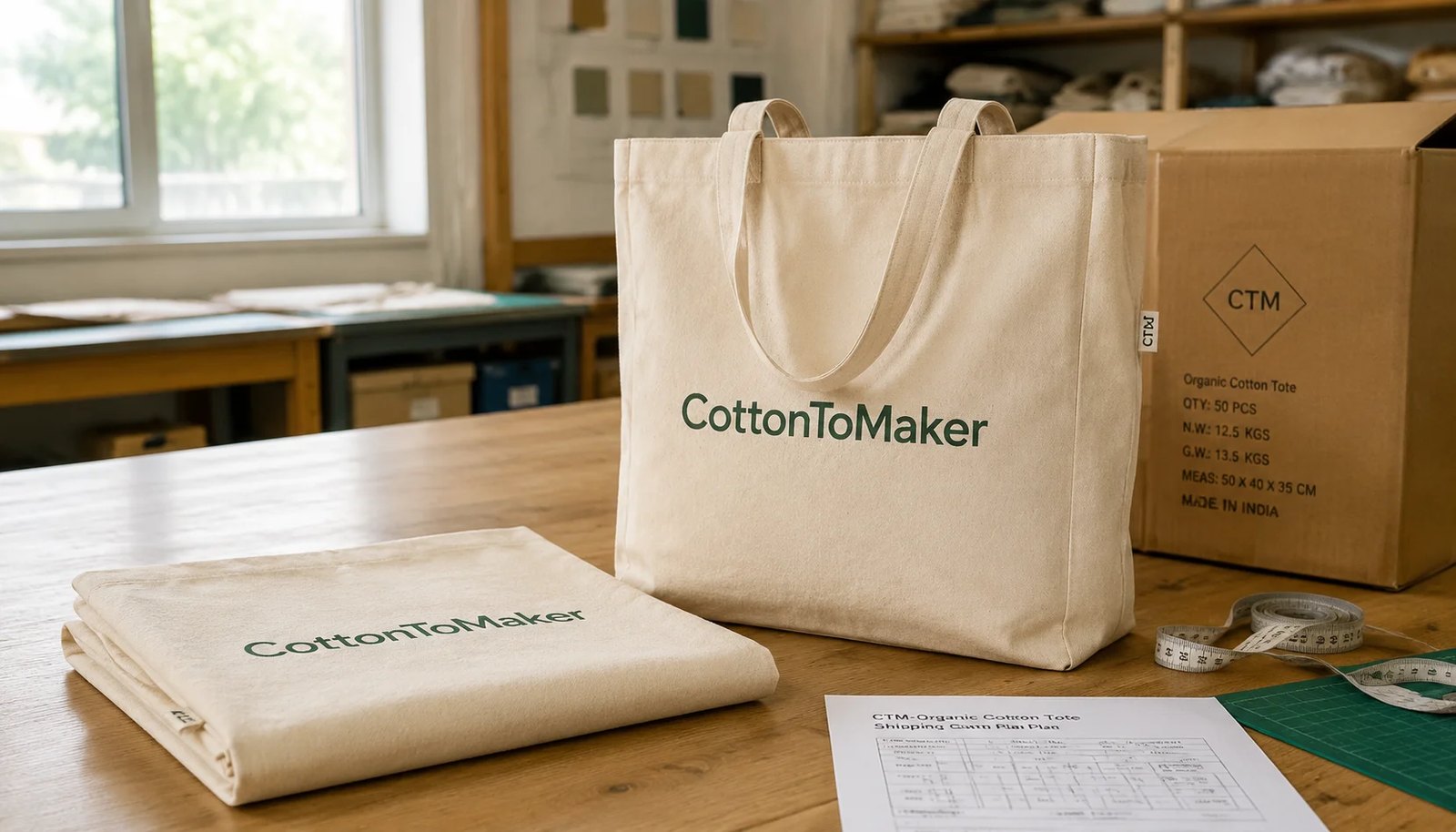
1. Why carton planning matters as much as the tote itself
When procurement teams source organic cotton totes for natural grocers, unit price is only one part of the decision. Carton planning changes freight spend, warehouse handling, damage risk, and how easily the goods move through a distributor or store network. A tote that looks inexpensive at FOB can become a poor buy if it ships in oversized cartons, arrives in overweight masters, or requires relabeling before it can enter a DC.
The practical goal is not simply to buy the lowest-cost bag. It is to buy a saleable tote that arrives in the right pack format, with manageable carton weight, clear labels, and predictable cube. For natural grocers, that often means balancing several realities at once: store-use versus retail-sale presentation, sustainability preferences, manual handling limits, and mixed allocations for multiple locations.
This is why carton details should appear in the first serious quote, not after the PO is placed. If a supplier waits until production is underway to confirm pieces per carton, gross weight, or bundle count, the buyer is no longer comparing like for like. Early carton planning lets the team compare landed cost per usable tote, not just sewing cost per piece.
- Request carton dimensions and gross weight in the initial quotation.
- Compare total CBM and pieces per CBM, not just pieces per carton.
- Set a maximum gross carton weight before sampling begins.
- Separate bag cost from retail packaging, labels, and special carton rules.
2. Build the tote specification around real grocery use
Natural grocer totes are not the same as event giveaways. They may carry produce, jars, cartons, chilled items, and refill products, so the bag specification needs to reflect actual use. For many programs, 8 oz to 10 oz organic cotton is the practical starting range. That usually gives enough structure for repeated shopping use without pushing cube and gross weight as high as a 12 oz premium canvas build.
Bag shape matters too. A flat tote can pack efficiently and may work for promotional or lighter-duty use, but a bottom gusset is often better for checkout loading because it holds rectangular goods more naturally. A common grocery-friendly size is around 15 x 16 inches with a 4 inch gusset and shoulder-length handles in the 22 to 24 inch range. Exact dimensions should follow the retailer’s intended use, but every dimension should be listed separately in the RFQ so suppliers cannot interpret size differently.
Reinforcement should not be left vague. For grocery applications, specify handle attachment style, seam type, and stitch quality expectations. Cross stitch or box stitch at the handle join is standard good practice, but the PO should also state that skipped stitches, weak back-tack, or seam opening at stress points are unacceptable.
- Use 8-10 oz organic cotton as the main comparison range unless the channel needs heavier fabric.
- Choose gusseted construction when checkout loading and stability matter more than maximum packing density.
- List width, height, gusset, handle length, and handle drop as separate fields.
- Require handle reinforcement and clear seam construction details in the sample approval.
3. Clarify organic documentation before price comparison
Buyers should define what the organic claim means for the order. Some natural grocer programs only need evidence that the fabric itself is organic. Others need documentation strong enough for retailer compliance files, internal sustainability review, or chain-of-custody claims. These are not interchangeable requirements, and they can affect both source availability and timing.
This point matters because two suppliers may both say they offer organic cotton totes, yet only one can provide the exact paper trail your compliance team expects. If the requirement is not defined up front, the buyer may approve a low quote that later fails documentation review. That creates delay, re-sourcing pressure, or last-minute claim changes on packaging and marketing materials.
The easiest route, when brand standards allow it, is often natural unbleached fabric with simple one-color or two-color printing. It tends to be easier to source, easier to compare across mills, and less likely to trigger dye-lot MOQs or extra approval cycles. Dyed organic fabric can still be the right choice, but it should be treated as a separate lead-time and MOQ discussion rather than as a routine default.
- State whether the order requires fabric-stage evidence only or finished-goods support as well.
- Put document requirements in the PO and compliance checklist, not only in emails.
- Use unbleached fabric when it fits the brand and simplifies sourcing.
- Treat custom dyeing as a different MOQ, cost, and timeline case.
4. Printing choices affect both appearance and packing density
Most natural grocer tote programs use one-color or two-color screen printing, often with water-based inks. This approach usually suits the visual style of organic grocery brands and folds better than thick, raised decoration. It also keeps setup simpler than more complex decoration methods. Even so, buyers should not approve artwork based only on a mockup. Natural cotton texture can show through large solid areas, and unbleached cloth may create a softer, less uniform printed surface than a coated synthetic bag.
Packing performance is part of print approval. A very large dark block may crease more visibly when bags are folded and compressed in export cartons. Logos placed too close to seams may look inconsistent if normal cut-and-sew tolerances shift slightly. These are not reasons to avoid bold artwork, but they are reasons to define measurable standards before bulk production.
A practical print spec should state color count, print size, placement from seams, acceptable registration tolerance, curing expectation, and acceptable appearance on natural fabric. If the bag will ship in dense bulk pack, ask to see how the printed face looks after folding and carton compression, not just when the sample sits flat on a table.
- Use strike-offs on the actual bulk fabric, not digital proofs alone.
- Define print placement with measured distances from top and side seams.
- Check large solid coverage for crease visibility after folding.
- Confirm rub resistance and curing as part of sample approval.
5. Set carton targets that fit warehouse reality
Good carton planning starts with clear limits. For many natural grocer tote programs, a gross master carton weight below about 14 to 16 kg is a practical target because the cartons are still manageable for manual handling in a DC or store backroom. If your distributor has a formal cap, use that number instead of a generic target. The important point is to state the limit before suppliers decide how tightly to pack.
The second control is carton size and cube. A quote that says only 100 pcs/carton is incomplete. Buyers need outer dimensions, net weight, gross weight, and CBM. Two suppliers can both offer 100 pieces per carton while using very different carton footprints, fold methods, and compression levels. The result is very different freight density and receiving performance.
Natural grocers should also think beyond the master carton itself. Some DCs work better with counted bundles of 25 or 50 because store allocations can be split quickly without recounting loose pieces. Others may require carton labels in a specific format or expect pallets to stay under a height limit. These requirements can change the ideal carton plan, even if the densest possible carton looks cheaper on paper.
- Set maximum gross carton weight before quoting.
- Require outer dimensions, net weight, gross weight, and CBM for each option.
- Decide whether bundles of 25 or 50 improve DC counting and store allocation.
- Confirm carton board grade and whether sea-freight storage strength is needed.
6. Use cube math to compare quotes on landed cost
A simple cube calculation can expose false savings quickly. If a supplier quotes 20,000 gusseted totes packed 100 pieces per carton in cartons measuring 55 x 45 x 40 cm, the cube per carton is 0.099 CBM. At 200 cartons total, the shipment volume is about 19.8 CBM before pallet effects. If another supplier offers the same-looking tote in a belly-banded format at 75 pieces per carton with cartons measuring 58 x 46 x 42 cm, the cube rises to about 0.112 CBM per carton. At roughly 267 cartons, shipment volume climbs to about 29.9 CBM.
That difference is commercially important. The second quote may have a similar sewing price or even a slightly lower unit price, but it can land materially higher because the presentation format reduces pieces per CBM. At the same time, the lower-density option might still be justified if the bags are sold as a retail SKU and need easier shelf presentation or barcode handling. The key is that the buyer sees the tradeoff clearly instead of finding it later in freight invoices.
This is why every serious quote should be normalized into a small landed-cost worksheet. Compare unit price, setup cost, pieces per carton, cube per carton, total CBM, estimated freight, and any warehouse handling implications. Procurement decisions become much cleaner when the team can see cost per saleable tote under the actual pack format being considered.
- Supplier A example: 20,000 pcs / 100 = 200 cartons; 200 x 0.099 CBM = 19.8 CBM.
- Supplier B example: 20,000 pcs / 75 = about 267 cartons; 267 x 0.112 CBM = about 29.9 CBM.
- Pieces per CBM is a useful quick comparison when freight is a major cost line.
- Do not compare FOB prices until packing assumptions are aligned.
7. Choose the packing format by channel, not habit
Bulk folded packing is usually the right default for store-use tote programs. It reduces extra packaging, lowers labor, and keeps pieces per carton relatively high. If stores or DCs simply unpack the bags into a backroom or checkout area, individual retail presentation often adds cost without adding value. Counted bundles inside the master carton can still give inventory control without the cube penalty of full retail-ready packing.
Retail-sale programs are different. If the tote sits on a shelf as a paid item, belly bands, hangtags, or unit-level barcode presentation may be justified. The buyer should still ask what each step costs. Added packaging does not only increase material spend; it also changes fold method, reduces carton density, adds packing labor, and sometimes slows receiving if fragile paper bands shift or break.
A mixed-channel plan is common in natural grocery retail. One version of the same tote may go in bulk to stores for operational use, while another goes retail-ready for front-end sale. In that case, ask suppliers to quote the same bag construction in two distinct pack formats. That keeps the bag specification stable while showing the real cost difference caused by packing choices.
- Bulk folded pack is usually best for operational store-use programs.
- Counted bundles help DCs split stock and verify counts faster.
- Belly bands and hangtags should be priced separately from the sewn tote.
- Use separate SKUs or clear carton marks if bulk and retail-ready versions ship together.
8. Natural-grocer receiving details to include in the RFQ
Some of the most expensive mistakes happen after the goods arrive, not while they are being sewn. Natural grocers often receive through third-party logistics providers, regional DCs, or mixed store allocation systems. That means the tote carton has to work with routing guides, pallet rules, and basic warehouse scanning processes. If these rules are not in the RFQ, suppliers will usually apply their own default packing logic, which may not match the importer’s receiving flow.
Useful details to define early include pallet footprint, maximum pallet height, maximum pallet weight, whether the load can be stacked, and whether slip sheets or corner boards are expected. Carton labels may need PO number, item code, color, quantity, carton sequence, country of origin, and a scannable barcode. If stores are allocated in mixed quantities, the buyer may prefer bundle counts that divide cleanly into the replenishment plan, such as 25 or 50 pieces per inner count.
These details can influence the best carton option. A slightly larger carton with stable palletization and clean labels may be commercially better than a denser carton that triggers repalletizing, relabeling, or extra count verification on arrival. For procurement, the right question is not only how many pieces fit in a carton, but how efficiently that carton moves through the receiving system.
- State pallet footprint and maximum pallet height in the RFQ.
- Define carton label fields and barcode type if scanning is required.
- Match bundle counts to store replenishment quantities where possible.
- Ask whether the supplier can palletize to your routing guide rather than to factory default.
9. Sample approval should include the packed result
Approving one attractive tote sample is not enough for a freight-sensitive order. A buyer should separate construction approval, print approval, and packing approval. The blank sample confirms size, fabric, seam build, handle drop, and hand feel. The print strike-off confirms color, curing, and appearance on the actual cloth. The pre-production sample confirms the final combination. But the process should not stop there if carton planning matters.
Ask for a packed sample or at least a documented packing trial. Photos or video should show fold method, bundle count, liner use if any, carton fill level, carton label, and gross packed weight. This step often catches preventable issues: a print face that creases too much, a carton that bulges after compression, or a bundle count that does not match the warehouse allocation plan.
The benefit is simple: once packing is approved, late carton changes become less likely. That protects freight booking assumptions and prevents the common problem where a supplier increases carton dimensions after production because the approved pack plan was never tested physically.
- Approve blank construction and print strike-off separately.
- Measure the finished pre-production sample, not only cut panels.
- Request packing photos with dimensions and gross weight visible.
- Do not let the supplier change pcs/carton without written approval.
10. QC and quote comparison: the final buyer controls
Quality control for organic cotton totes should focus on function, appearance, and packed execution. For natural-fabric goods, buyers should explicitly note which natural characteristics are acceptable and which are not. Small approved slubs may be normal; oil marks, mildew odor, severe panel mismatch, broken handle stitching, and print smears are not. Carton and label compliance should also be part of QC, not treated as an afterthought.
Inspection should verify measurements across multiple cartons, confirm fabric weight against tolerance, review print quality, and test handle attachment against the defined grocery load target. If the order must follow a routing guide, carton labels and pallet presentation should be checked before shipment release. These controls matter because a perfect tote can still become a receiving problem if the carton count is wrong or the labels are unreadable.
When quote comparison reaches the final stage, normalize every serious offer to the same specification and the same pack plan. If one supplier appears cheaper because they assumed lighter fabric, weaker reinforcement, fewer labels, or heavier cartons, that is not a true cost saving. The cleanest decision metric is landed cost per saleable tote under the exact receiving and QC conditions the natural grocer actually needs.
- Use AQL with written defect examples, not a vague pass/fail standard.
- Include carton and label checks in final inspection scope.
- Compare suppliers on normalized bag construction and normalized pack format.
- Make landed cost per saleable tote the final buying metric.
Specification comparison for buyers
| Carton / packing option | Example specification | Carton cube and load profile | Landed-cost implication |
|---|---|---|---|
| Option A: flat bulk pack for store-use programs | 8 oz organic cotton flat tote, 100 pcs/carton, approx. 50 x 40 x 35 cm, 12-14 kg gross | 0.070 CBM/carton; strong freight density; simple to unload and count in backroom | Usually the best freight efficiency when presentation is not required. Confirm logo creasing risk if compression is high. |
| Option B: gusseted bulk pack for grocery checkout use | 10 oz organic cotton, 4 inch bottom gusset, 100 pcs/carton, approx. 55 x 45 x 40 cm, 15-16 kg gross | 0.099 CBM/carton; higher cube than flat bags but better in-use grocery performance | Often the practical balance for natural grocers. Check warehouse weight cap before approving 100 pcs/carton. |
| Option C: gusseted tote in counted bundles | 10 oz organic cotton, bundled in 25s or 50s inside master carton, 80-100 pcs/carton, approx. 56 x 45 x 40 cm, 14-15.5 kg gross | Approx. 0.101 CBM/carton; slightly lower density than loose bulk pack but easier count control | Useful when DCs split stock by store allocation or need fast carton audits. Small freight tradeoff may be worth the receiving speed. |
| Option D: belly band retail-support pack | 10 oz organic cotton gusseted tote, belly banded in 25s or 50s, 75 pcs/carton, approx. 58 x 46 x 42 cm, 13-15 kg gross | 0.112 CBM/carton; lower pcs/carton because of added paper and reduced compression | Better presentation and easier shelf staging, but freight density drops. Quote should separate bag cost from belly band labor and materials. |
| Option E: individual retail pack with barcode control | 10-12 oz organic cotton, hangtag or insert, optional paper sleeve, 50 pcs/carton, approx. 60 x 45 x 45 cm, 12-15 kg gross | 0.122 CBM/carton; lowest packing density and more handling steps | Use when the tote is sold as a retail SKU and each unit needs barcode visibility or cleaner shelf presentation. Landed cost rises from both packaging and cube. |
| Option F: dense overweight pack to avoid unless approved | 8-10 oz tote, 150-200 pcs/carton, dimensions vary, above 18 kg gross | Can look efficient on paper but often leads to bulging cartons, rough handling, and receiving pushback | Only acceptable with written approval from the buyer and warehouse. Savings from fewer cartons can be offset by damage, claims, and manual handling issues. |
| Pre-quote control point: normalize tote construction | Match fabric weight, finished size, gusset, handle length, stitch reinforcement, and print method before price comparison | Prevents false carton comparisons caused by different bag build | If one supplier quotes lighter cloth or weaker handle build, the cheaper carton result is not a true like-for-like saving. |
| Pre-quote control point: normalize packing assumptions | Match bundle count, fold method, liner use, barcode label requirement, and max gross weight | Prevents pcs/carton differences from hiding in packing details | Without matching these rules, landed-cost comparison is weak even if the unit price table looks precise. |
| Receiving control point: align pallet and label rules | State pallet height limit, pallet footprint, palletization method, carton labels, SSCC or barcode format, and store/DC allocation rule | Improves inbound handling and reduces relabeling or repalletizing after arrival | A slightly less dense carton can still be the better buy if it fits routing guide rules and avoids warehouse rework. |
Buyer checklist before sampling
- Define body width, body height, gusset width, handle length, and handle drop as separate RFQ and PO fields, not as one general size note.
- Specify fabric as organic cotton with target oz or GSM, tolerance, weave, color, shrinkage expectation, and whether the weight reference is before or after finishing.
- Clarify what organic documentation is required: certified fabric evidence, transaction certificate, finished-goods scope, or retailer compliance file support.
- State intended bag load, such as 8-10 kg, so reinforcement, seam construction, and handle attachment can be quoted for real grocery use rather than for promo use.
- Lock print method, ink type, color count, artwork size, seam clearance, and acceptable appearance on natural slub fabric before approving bulk.
- Set master carton limits for maximum gross weight, outer dimensions, pcs/carton, bundle count, carton board grade, and whether a liner is required.
- Ask for at least two packing options when freight matters: maximum-density bulk pack and warehouse-friendly counted-bundle or retail-ready pack.
- Require carton details with the first quote: outer dimensions, net weight, gross weight, pcs/carton, packing style, and CBM/carton.
- Define pallet rules if the order ships to a distributor or retailer DC: pallet footprint, max pallet height, max pallet weight, stackable or not, and stretch-wrap standard.
- Confirm carton labeling fields such as PO number, SKU, color, quantity, carton sequence, country of origin, barcode format, and DC routing marks if used.
Factory quote questions to send
- For a natural grocer tote expected to carry 8-10 kg, what fabric GSM and handle reinforcement do you recommend, and what finished weight tolerance can you hold?
- Can you provide the exact basis for the organic claim in your quote, and what shipment documents will be available for our compliance team before dispatch?
- What are the exact finished bag dimensions, gusset construction, handle drop, seam type, stitch density, and reinforcement method included in the quoted price?
- How many pieces fit per export carton for this exact bag build, what fold method do you use, and how much compression is applied during packing?
- What are the proposed outer carton dimensions, net weight, gross weight, bundle count, and total CBM for the full order quantity?
- Can you quote at least two packing formats for the same bag: bulk pack for DC replenishment and a retail-support option such as bundle banding or belly band?
- What carton board grade do you use, and is the quoted carton suitable for sea freight, pallet stacking, and normal DC handling without bulging?
- If we set a gross weight cap of 14 kg or 16 kg, how does that change pcs/carton, cube, and unit price?
- Can you align packing to our pallet and routing rules, including pallet footprint, pallet height limit, carton labels, barcode format, and mixed-store allocation if required?
- Does the print quote include screen charges, strike-off, color matching, curing, and any surcharge for large dark coverage on natural cotton?
Quality-control points to confirm
- Use a written inspection plan based on ANSI/ASQ Z1.4 or ISO 2859-1 sampling, with critical, major, and minor defects defined before production. Keep critical defects at zero acceptance and set major and minor limits by order value and channel risk.
- Measure finished bags from cartons pulled across the lot, not only from top bundles or pre-set aside samples. Record body width, body height, gusset width, handle length, handle drop, print location, and carton count against the approved tolerance.
- Set realistic tolerances in the PO. As a working example, many buyers use about plus or minus 0.5 inch on major bag dimensions and tighter print-placement tolerance where logo alignment matters at retail.
- Verify fabric weight against the agreed GSM or oz tolerance and keep the test method consistent with the approved sample. If the supplier quotes 10 oz fabric, confirm whether the actual shipment remains within the agreed variance after finishing.
- Check handle attachment with a defined load test. For grocery use, a static load around 8-10 kg for an agreed hold time is a common starting point; pass criteria should state no broken stitches, fabric tear, or severe seam distortion.
- Inspect seams and stitching for skipped stitches, open seams, uneven seam allowance, weak back-tack, and loose thread build-up at stress points. Handle joins and gusset corners deserve extra attention because that is where failures often appear first.
- Review print quality for registration, placement, curing, rub resistance, pinholes, ghosting, edge sharpness, and shade consistency against the approved strike-off under controlled lighting.
- Distinguish acceptable natural-cotton character from real defects. Approved slubs, tiny seed specks, and mild natural shade variation may be acceptable; dirty marks, oil stains, mildew odor, heavy panel mismatch, and print smears are not.
- Count verification should match the packing style. If cartons are packed in bundles of 25 or 50, confirm both total piece count and bundle count. For retail packs, verify that inserts, bands, tags, and barcodes are present and correct.
- Inspect export cartons for correct dimensions, dry board, intact seams, no bulging, no crushed corners, correct shipping marks, country-of-origin marking, barcode readability, and carton sequence labels where required.