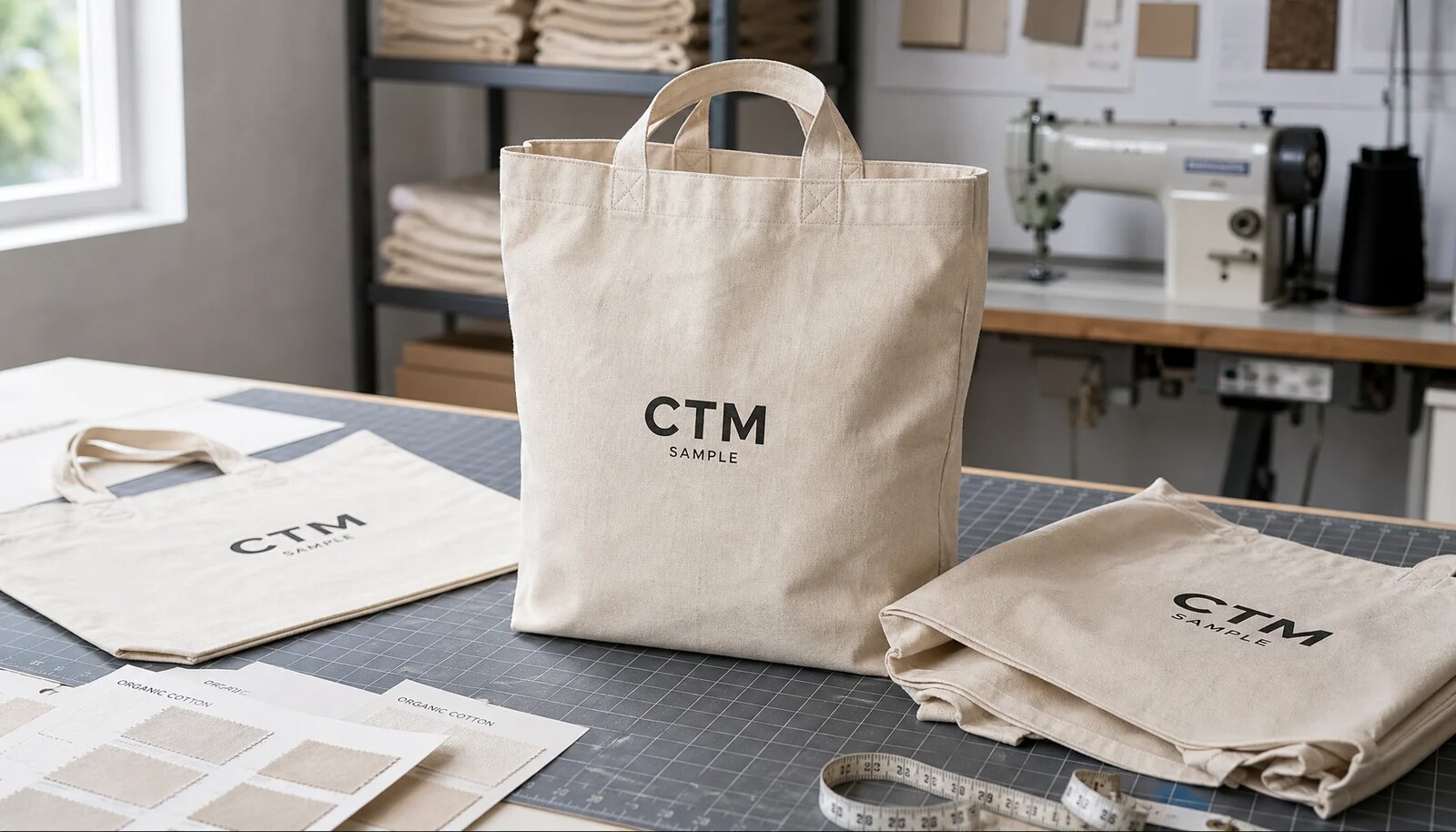
Start With the Real Buying Scenario
An organic cotton tote for a craft fair sounds simple until the order has to be quoted, sampled, packed, and delivered by a fixed event date. “Natural organic cotton tote with logo” could mean a thin entrance giveaway, a reusable 10 oz canvas shopper, a gusseted checkout bag, or a premium tote sold as merchandise. All can be made from organic cotton. They will not carry the same cost, print risk, carton weight, sewing time, or documentation requirement.
Start the RFQ with the job the bag must do. A visitor may carry postcards, candles, books, folded textiles, jewelry boxes, packaged food, small ceramics, and event materials for several hours. A sponsor bag may only need to hold flyers and light samples. A paid merchandise tote has to feel cleaner and sturdier because the bag itself is being judged. Those differences should become measurable specs: target contents, load expectation, carry style, fabric weight, construction, handle reinforcement, print method, packing, and delivery wave.
Distribution is part of the product brief. One craft fair shipped to a single warehouse is easier than a seasonal program with ten artwork versions, sponsor logos, city-specific carton labels, and staged delivery. If the supplier prices only the bag and misses sorting, labeling, carton marks, or split shipments, the low quote may not stay low for long.
A clear opening statement helps suppliers make better recommendations. For example: “Organic cotton totes for a three-day craft fair, distributed at entry and reused by visitors to carry paper goods, apparel, boxed candles, and small gifts. Bulk packed in counted bundles and shipped to one event warehouse.” That one paragraph gives the factory context for fabric, handles, carton count, and print durability.
- Define the use: free giveaway, resale merchandise, retail checkout bag, sponsor gift, vendor kit, welcome bag, or recurring reorder item.
- State expected contents and realistic load range, such as paper goods, folded apparel, books, candles, boxed products, ceramics, or mixed purchases.
- Identify distribution: one warehouse, multiple event sites, city-by-city drops, sponsor allocation, vendor allocation, or staged shipment.
- Separate must-have specs from preferences so suppliers do not quietly change fabric, handles, or packing to hit a target price.
- Ask suppliers to confirm any proposed alternative in writing, including GSM, structure, print method, handle construction, and packing format.
Lock Structure, Dimensions, and Handles
Tote structure controls capacity, fabric consumption, print position, carton volume, and sewing complexity. A flat tote gives the cleanest front print area and packs efficiently. It works well for brochures, apparel, cards, prints, and light handmade items. It is less helpful for boxed products because the bag can distort and become awkward to carry.
A bottom-gusset tote is often the practical middle option for craft fair buyers. It keeps a broad printable front panel while adding space for books, folded apparel, packaged food, and booth purchases. A side-and-bottom gusset opens more like a shopping bag and improves usable volume, but it uses more fabric, adds sewing steps, and increases carton bulk. Boxed-bottom construction can look premium for resale, although it needs tighter sewing control and may be unnecessary for a giveaway.
Dimensions should be written as finished measurements, not only as a catalog name. State width x height x gusset and how the factory should measure the bag after sewing. A common working tolerance for sewn cotton totes is around ±10 mm for width and height, with separate tolerances for gusset depth and handle drop. Tighter tolerances may be possible, but they need discussion because cotton shifts during cutting, printing, sewing, and pressing.
Handle language deserves care. Buyers often say “long handles” when they mean shoulder carry. Suppliers may quote total handle length while the buyer expects handle drop. Handle drop is the vertical distance from the bag opening to the top of the handle when the bag is laid flat. For shoulder-carry totes, many buyers request about 25-30 cm handle drop; shorter drops may suit hand-carry checkout bags. The RFQ should name handle width, fabric type, reinforcement method, thread color, and stitch expectations.
- Flat tote: lowest sewing cost, efficient cartons, strong print area, best for light goods and promotional distribution.
- Bottom gusset: better carrying volume while preserving a broad front panel for event graphics.
- Side-and-bottom gusset: stronger retail utility for boxes and mixed purchases, with higher fabric and freight impact.
- Boxed-bottom tote: premium presentation for resale programs, but more demanding in sewing and packing.
- Dimension wording: “35 x 40 x 10 cm bottom-gusset tote, measured flat after sewing, tolerance ±10 mm unless otherwise approved.”
- Handle wording: “Shoulder-carry handle drop 28 cm ±10 mm, handle width 25-30 mm, self-fabric handles, box-X reinforcement at all four handle ends.”
Specify Fabric Beyond “Organic Cotton”
Fabric is one of the biggest cost drivers and one of the easiest places for quotes to drift apart. Do not ask only for “organic cotton.” Name the fabric construction and finished weight. Sheeting is lighter and folds compactly; it can work for budget giveaways but may feel less substantial. Canvas has the firmer craft-market look many buyers expect from a reusable tote. Duck canvas is often used for a tighter, sturdier canvas style, but terminology varies by mill. Twill has a diagonal texture and should be tested with the intended print method.
For many craft fair programs, 10 oz / about 340 GSM organic cotton canvas is a useful starting point. It balances reusable feel, booth presentation, print visibility, and cost. A 7 oz / about 240 GSM tote can suit light-use entrance giveaways where carton efficiency matters. A 12 oz / about 407 GSM tote supports a premium retail position, but it also brings heavier cartons, higher freight, more sewing resistance, higher ink use, and possible needle-hole visibility near reinforced handles.
Ask whether the quoted GSM is nominal, measured before finishing, or measured on finished fabric. A reasonable tolerance depends on the mill and finishing process, but buyers often ask suppliers to state a finished-fabric tolerance such as ±5% or ±8%. Treat this as a control point, not a universal law. If the supplier cannot explain how fabric weight is measured, two “10 oz” quotes may not be comparable.
Natural organic cotton has its own look. Seed flecks, slubs, neps, small weave irregularities, and cream-to-beige shade variation may be perfect for a craft fair aesthetic. They can also become a dispute if the buyer expected a clean white print surface. Approve physical swatches before bulk cutting. If the program requires a consistent white, black, or dyed color, specify bleaching, dyeing, or finishing and ask how that changes organic documentation, color fastness, MOQ, and lead time.
- Avoid adjectives such as heavy, eco, premium, natural, or durable unless they are tied to fabric construction and GSM.
- Ask whether fabric weight is measured as greige, finished, washed, or nominal catalog weight.
- Require the supplier to state GSM tolerance and test method, especially when comparing 7 oz, 10 oz, and 12 oz quotes.
- Approve natural shade, seed flecks, slubs, neps, stiffness, and weave texture from physical swatches before bulk cutting.
- Specify whether the bag is natural undyed, bleached, dyed, enzyme washed, pre-shrunk, softened, or left untreated.
- RFQ wording: “Quote 10 oz / approx. 340 GSM organic cotton canvas, natural undyed, finished fabric tolerance stated, with document scope listed separately.”
Define the Organic Claim Early
Organic cotton claims are not just marketing language. They affect procurement, compliance, documentation, facility selection, and sometimes lead time. Decide what support the program needs before comparing prices. Some buyers only need a material claim supported by supplier documentation. Others require certified fabric, chain-of-custody records, transaction certificates, or finished-product certification. The stricter the claim, the more important it is to confirm that the cotton source, fabric mill, printer, sewing facility, and exporter can support the document path.
A common mistake is asking for organic documentation after the unit price has been negotiated. If the supplier quoted a general organic cotton fabric and the buyer later requires finished-bag documentation, the supplier may need a different fabric lot, certified facilities, additional paperwork, or a revised lead time. Put the document requirement in the RFQ. Ask whether copies are available before shipment release and whether fees are included.
Avoid vague phrases such as “must be certified” unless the buyer defines what is certified. “Organic cotton material,” “organic cotton fabric,” “made with organic cotton,” and “certified finished product” can mean different things depending on the customer policy and sales market. Procurement should align with legal, compliance, or sustainability stakeholders before approving labels, hangtags, website copy, or event signage.
Also separate facility capability from shipment-level documentation. A factory may hold a relevant scope certificate, but that does not automatically mean every order can carry a finished-product claim. The purchase order should state the required document package and any names or references that must appear on invoices, packing lists, labels, or shipment records.
- State claim level: organic cotton material claim, certified fabric claim, certified chain-of-custody claim, or certified finished-product claim.
- Ask which facilities appear on documents and whether spinning, weaving, printing, sewing, and export are covered where required.
- Request document names and sample document formats before final price comparison, not after production starts.
- Ask whether transaction certificates, scope certificates, inspection documents, or equivalent records add cost or lead time.
- Confirm whether documents are available before shipment, with shipment documents, or only after final invoice and packing data are issued.
- Align product labels, website copy, hangtags, and event signage with the documentation level approved by internal compliance.
Control Artwork Before It Reaches Bulk Print
Printing is where many tote orders go from acceptable to disappointing. Organic cotton canvas has texture, absorbency, and natural shade variation. Artwork that looks crisp on a digital mockup can soften or fill in on woven fabric. Bold logos, solid shapes, fair names, sponsor marks, and one-to-three-color graphics are usually good candidates for water-based screen printing. The result can have a softer handfeel on natural cotton, but it still depends on mesh, ink deposit, curing, and the fabric surface.
Fine lines, distressed artwork, gradients, small reversed text, and photo-style graphics need more testing. Small white text knocked out of a dark ink area may fill in. Thin strokes can break. Multiple sponsor logos can become unreadable if they were designed for screens, not canvas. Ask the printer to flag risk areas before screens are made. A strike-off is not decoration paperwork; it is the buyer’s chance to confirm color, detail, edge sharpness, handfeel, and cure.
Digital pigment printing or transfer methods may help when the order has many artwork versions, full-color graphics, or low quantities per design. They are not automatic upgrades. Transfers can create a noticeable patch feel and may crack or lift if application is poor. Digital pigment print depends on pretreatment, fabric absorbency, resolution, color management, and curing. Dark or dyed fabric may need an underbase, which changes handfeel and cost.
Placement should be defined with a real reference point. “Centered on front” leaves room for arguments, especially on gusseted bags where panels can shift. State print size, distance from the top edge, center line, side seam, or bottom seam, and the allowed placement tolerance. Many buyers use ±5 mm for small logos or ±10 mm for larger tote graphics, but the best tolerance depends on artwork size, construction, and inspection method.
- Supply vector artwork when possible, plus print size, file format, Pantone references, print color count, and print location diagram.
- For simple logos, request water-based screen print with a physical strike-off before bulk approval.
- For complex artwork, require a printed panel or full sample to test readability, edge quality, handfeel, curing, and rub resistance.
- For dark fabric, ask whether an underbase is required and how it affects price, handfeel, opacity, and curing time.
- Define print placement tolerance and reference point, such as “logo centered, 90 mm below top edge, tolerance ±5 mm.”
- Require checks for dry rub, light wet rub, blocking, folding marks, ink transfer, pinholes, registration movement, and cracking before packing.
Build the MOQ Matrix Around the Actual Order
Factories do not calculate MOQ from total quantity alone. Fabric booking, fabric color, bag size, cutting efficiency, sewing setup, print screens, artwork versions, labels, packing style, and delivery splits all affect minimums and price. A 5,000-piece order with one size, one fabric, one logo, and bulk packing is a very different job from 5,000 pieces split across ten craft fair logos, two handle lengths, hangtags, barcodes, and three destinations.
Use a SKU matrix instead of a paragraph of assumptions. List each line by bag size, fabric color, GSM, artwork version, print colors, label, hangtag, packing method, quantity, destination, and delivery date. If allocations are not final, ask suppliers to quote likely scenarios and explain what changes when the order is split. This keeps procurement from comparing a simple bulk quote with a complex multi-version quote.
Price breaks should match real buying choices. Tiers such as 500, 1,000, 3,000, 5,000, and 10,000 pieces are useful only if those quantities are possible. Too many unrealistic tiers slow the quote process and invite assumptions. For seasonal craft fair programs, ask whether one bulk production run can be held for staged shipment or whether each wave requires separate production, packing, and inspection.
Setup costs need their own lines. Screen charges, strike-offs, barcode labels, hangtags, carton labels, artwork revisions, and separate packing lists can become material in a multi-version program. Ask whether screens can be retained for repeat orders and for how long. If reorders are likely, include that in the RFQ so the supplier can quote a repeatable standard, not a one-off workaround.
- Quote matrix fields: SKU, size, fabric, GSM, color, artwork, print colors, label, packing, quantity, destination, and delivery date.
- Ask for MOQ separately by fabric color, bag size, artwork version, print method, label type, and packing format.
- Request itemized costs for screens, strike-offs, digital setup, full samples, courier, barcode labels, hangtags, and special packing.
- Clarify whether price breaks apply to total order quantity or only to each artwork version quantity.
- Ask whether approved screens, cutting patterns, samples, and fabric records can be retained for reorders.
- Reduce unnecessary SKU variation when event dates are fixed because approvals, sorting, and packing allocation consume schedule time.
Ask for Quote Data That Supports Landed Cost
A unit price by itself is not a procurement quote. Buyers need enough information to compare landed cost, warehouse handling, quality risk, and schedule risk. The quote should state bag construction, fabric specification, organic documentation scope, print method, print colors, artwork version count, labels, packing format, pieces per carton, carton dimensions, gross weight, estimated CBM, sample lead time, production lead time, Incoterm, payment terms, and quote validity.
Exclusions should be visible. Organic document fees, courier charges, screen costs, artwork revisions, barcode labels, hangtags, individual packing, inner liners, palletization, inspection support, export documents, and domestic trucking may or may not be included. If every supplier structures these costs differently, the cheapest quote may simply be the least complete quote.
Carton data matters more than many buyers expect. Moving from 7 oz to 12 oz canvas changes gross weight. Moving from bulk flat pack to individual polybag or folded retail pack changes carton volume and labor. A lower unit price can become less attractive if cartons are oversized, too heavy, poorly marked, or inefficient to sort by event. Ask for estimated carton assumptions at the quote stage and final carton data after pre-production approval.
Timing should be just as explicit as price. An EXW quote cannot be compared directly with an FOB or DDP quote. Lead time should also have a start point: deposit, artwork approval, sample approval, document approval, or receipt of bulk fabric. Craft fair dates rarely move, so unclear timing belongs in the risk column.
- Unit price basis: state EXW, FOB, FCA, CIF, DAP, DDP, or another agreed Incoterm and location.
- Specification basis: include fabric weave, GSM, size, gusset, handle detail, print method, color count, label, and document scope.
- Setup basis: itemize screen fees, digital setup, artwork version charges, strike-off cost, sample cost, courier, and revision costs.
- Packing basis: include pieces per bundle, pieces per carton, carton size, gross weight, net weight, estimated CBM, and carton mark requirements.
- Schedule basis: show sample lead time, production lead time after approval, inspection window, shipment handover point, and latest dispatch date.
- Validity basis: state quote validity and variables that may change price, such as cotton cost, exchange rate, freight, artwork scope, or certification scope.
Use Samples as Control Tools
Sample approval should prevent bulk surprises, not merely prove that a supplier can sew something shaped like a tote. Start with fabric swatches when weight, natural color, texture, or organic appearance matters. This stage lets the buyer approve seed flecks, slubs, neps, shade, stiffness, thickness, and weave before a full sample is made. If washing, shrinkage, or finishing matters, ask whether the swatch represents finished bulk fabric.
Print approval comes next. For screen printing, a strike-off or printed panel confirms ink color, edge sharpness, ink deposit, handfeel, detail, and cure. For digital or transfer printing, a physical test is even more important because the finish can vary by fabric and application conditions. Review the sample under consistent lighting. Fold it, stack it, rub it lightly, and check whether ink transfers or cracks.
For larger or repeat orders, the pre-production sample should use bulk fabric, final handles, final stitching, final labels, final artwork, and intended packing. This sample becomes the production and inspection standard. The buyer and factory should each retain an approved reference. Record measurements, photos, comments, tolerances, approval date, and revision number so final inspection has a clear comparison point.
Packing may also need a sample, especially when event allocation is complex. A carton-packed reference can confirm folding direction, bundle count, paper bands, polybags, labels, carton marks, carton sequence, and destination data. Without this step, the totes may look good but still cause operational problems because counts are unclear or artwork versions are mixed.
- Fabric swatch approval: color, GSM, weave, texture, natural specks, stiffness, finishing, shrinkage expectation, and document scope.
- Print strike-off approval: ink color, print size, edge sharpness, detail, handfeel, curing, rub result, and placement reference.
- Full sample approval: final size, gusset, handle drop, reinforcement, seams, label, print, and overall presentation.
- Pre-production sample approval: made with bulk fabric and final production method before full cutting, printing, or sewing.
- Packing approval: folding method, bundle count, band or polybag, barcode position, carton quantity, carton marks, and destination labels.
- Approval record: keep measured photos, signed comments, tolerance notes, approval date, revision number, and retained samples at buyer and factory side.
Set QC Standards Before the PO
Quality control should be agreed before the purchase order is placed. For organic cotton totes, inspection should cover material, function, appearance, print, measurement, documentation, and packing. Critical defects may include mold, contamination, sharp objects, serious odor, wrong artwork, wrong material claim, or unsafe foreign matter. Major defects may include broken handles, open seams, size outside tolerance, severe stains, heavy ink transfer, missing labels, wrong print color, or incorrect carton allocation. Minor defects may include small loose threads, slight natural shade variation within the approved standard, or tiny print specks that do not affect normal presentation.
Measurement rules must be specific. Bag width, height, gusset depth, bottom width, and handle drop should each have separate tolerances. Fabric weight should be checked with a GSM cutter or equivalent method, not judged by handfeel. Stitch quality should be inspected at stress points, especially handle attachments, side seams, gusset corners, and bottom seams. If a load check is needed, define the load, duration, and method before price is finalized.
Print QC should cover placement, color, registration, edge quality, curing, dry rub, light wet rub, cracking, and transfer risk during folding and stacking. Natural cotton can absorb ink unevenly, so the approved strike-off should define acceptable variation. Inspection should also include bundle counts and carton marks because event distribution can fail even when the product looks fine.
For larger orders, buyers may use a recognized sampling approach such as ANSI/ASQ Z1.4 or ISO 2859-1 with general inspection level II and buyer-defined AQL levels. Some buyers use AQL 0 for critical defects, 2.5 for major defects, and 4.0 for minor defects; others adjust to customer requirements. The important part is the written defect list, sampling plan, and authority to rework, replace, or hold shipment.
- Critical defects: mold, contamination, sharp objects, wrong organic claim, wrong artwork, serious odor, or unsafe foreign matter.
- Major defects: broken handles, open seams, large stains, wrong size, wrong print, ink transfer, missing labels, or incorrect carton allocation.
- Minor defects: small loose threads, minor print specks, slight shade variation, small trimming issues, or cosmetic marks within approved limits.
- Functional checks: handle reinforcement, seam strength, bottom corners, stitch density, fabric holes, skipped stitches, raw-edge control, and thread trimming.
- Print checks: color match, placement tolerance, rub resistance, curing, registration, fine detail, cracking, pinholes, and ink transfer.
- Packing checks: carton strength, moisture condition, bundle count, SKU separation, carton marks, gross weight, carton sequence, and destination labels.
Plan Packing, Moisture Control, and Event Allocation
Packing should match the way the totes move through the buyer’s operation. Bulk flat packing is usually efficient for distributors, importers, and event warehouses because it reduces material cost and carton volume. Counted inner bundles, such as 25 or 50 pieces, help receiving teams allocate bags quickly without individual packaging. Paper bands can control bundles with less plastic. Individual polybags may be justified for white bags, resale, barcode scanning, moisture protection, or premium presentation, but they add cost and unpacking labor.
Carton weight is practical, not cosmetic. A carton of 12 oz canvas bags can become heavy quickly, while a carton packed too loosely wastes freight space. The RFQ should ask the supplier to recommend pieces per carton and state gross weight, carton dimensions, net weight, and estimated CBM. Buyers may set a maximum carton gross weight based on warehouse handling rules. Over-compression should be avoided because fresh prints can mark adjacent bags, handles can crease, and folded edges can become permanent.
Moisture control should fit the route and season. Cotton products should be packed dry in clean cartons. If the shipment route, climate, or storage period creates higher moisture risk, ask whether inner liners, desiccant, humidity indicators, or pallet protection are recommended. Do not add materials without a reason, but do make the supplier responsible for dry packing, clean storage, and cartons that arrive free of mold or damp odor.
Event allocation belongs in the RFQ because it affects labor and labeling. If one master order is split across several craft fairs, cartons may need destination labels, PO number, SKU, artwork version, fabric color, quantity, carton number, and gross weight. Without clear carton marks, receiving teams may open cartons unnecessarily, mix versions, or delay booth setup. For multi-city programs, request a packing list that matches the allocation exactly.
- Bulk flat pack: best for importers, distributors, and warehouses where individual retail handling is not needed.
- Counted bundles: useful for quick receiving, booth replenishment, event allocation, and vendor distribution.
- Individual polybag: consider for white fabric, retail resale, barcode scanning, moisture protection, or premium presentation.
- Carton data: require pieces per carton, carton dimensions, gross weight, net weight, estimated CBM, and maximum handling weight if applicable.
- Carton marks: include PO number, SKU, artwork version, fabric color, quantity, carton number, destination, gross weight, and country requirements if applicable.
- Moisture controls: require dry goods and clean cartons; add liners or desiccant only when shipping route, season, or storage risk justifies it.
Specification comparison for buyers
| Spec decision | Recommended option | When it fits | Buyer risk to check |
|---|---|---|---|
| Core craft fair fabric | 10 oz / about 340 GSM organic cotton canvas, natural undyed, with supplier-stated finished GSM tolerance | Reusable tote programs, artist merchandise, vendor gift bags, checkout bags, and light grocery-style use | A supplier may quote 8 oz, sheeting, or a looser weave unless the RFQ names weave, finished GSM, and tolerance |
| Economy giveaway fabric | 7 oz / about 240 GSM organic cotton sheeting or light canvas | Entrance giveaways, brochure bags, apparel handouts, cards, small packaged goods, and budget-driven event runs | Thin fabric can look transparent, wrinkle quickly, and feel less retail-ready when visitors carry mixed purchases |
| Premium retail fabric | 12 oz / about 407 GSM organic cotton canvas with reinforced handle stitching | Paid merchandise, boutique fairs, museum shops, bookstore events, ceramic vendors, and heavier product categories | Higher GSM increases unit cost, carton gross weight, freight, ink use, sewing difficulty, and needle-hole visibility |
| Dimension tolerance | Flat measurement after sewing; typical target ±10 mm for width/height and ±5-10 mm for handle drop unless tighter control is justified | Most B2B tote orders where natural cotton fabric is cut, sewn, and handled manually | If the RFQ only says “35 x 40 cm,” factories may use their own measurement point and acceptance range |
| Fabric tolerance | Request supplier-stated finished fabric tolerance, often quoted around ±5% to ±8% depending on fabric and mill control | Orders where buyers compare landed cost, durability, and handfeel across suppliers | A bag may feel “close” by hand while still falling below the quoted GSM without a defined test method |
| Bag construction | Flat tote, bottom-gusset tote, or side-and-bottom gusset tote selected by product mix | Flat totes suit prints and light goods; gussets suit boxes, books, folded apparel, and multi-item purchases | Same front dimensions do not mean same usable volume, fabric consumption, carton volume, or sewing cost |
| Handle specification | Self-fabric handles 25-30 mm wide, handle drop stated, box-X or bar-tack reinforcement at all four attachment points | Reusable bags carried for several hours at crowded craft fairs | Handle drop, stitch density, reinforcement type, and thread quality must be written down or lower-cost stitching may be substituted |
| Print method | Water-based screen print for simple 1-3 color artwork; physical strike-off required before bulk approval | Natural cotton totes with solid logos, fair names, sponsor marks, or seasonal graphics | Fine lines, distressed art, small reversed text, and untested Pantone targets can fail on coarse canvas |
| Full-color artwork | Digital pigment print or transfer method only after handfeel, curing, rub, and folding checks are approved | Short runs, multiple vendor logos, photo-style graphics, regional artwork versions, or low quantity per design | Transfers can change handfeel; digital print depends on pretreatment, color management, curing, and rub resistance |
Buyer checklist before sampling
- Define the commercial use: free giveaway, paid merchandise, retail checkout bag, sponsor gift, vendor kit, welcome bag, or recurring reorder item.
- State bag structure as flat, bottom gusset, side-and-bottom gusset, boxed bottom, or folded retail pack; do not price mixed structures as one SKU.
- Specify dimensions as width x height x gusset in centimeters or inches, with measurement point, finished measurement after sewing, and accepted tolerance such as ±10 mm unless tighter control is required.
- Define handle drop, total handle length if needed, handle width, reinforcement method, thread color, stitch density expectation, and whether the bag is designed for shoulder carry or hand carry.
- Confirm fabric construction, organic cotton claim level, yarn or fabric document requirement, finished GSM or oz weight, color, shrinkage expectation, and acceptable GSM tolerance.
- Approve natural cotton appearance in advance: seed flecks, slubs, shade variation, neps, minor weave irregularity, and whether these are acceptable within the retained swatch standard.
- Attach vector artwork where possible, with print size, print location, Pantone or CMYK references, number of colors, minimum line width, small text warning, and placement tolerance such as ±5 mm or ±10 mm.
- Separate total order quantity from quantity by artwork version, fabric color, bag size, label, packing format, delivery destination, and shipment wave.
- Request itemized quote lines for unit price, screen or setup cost, sample cost, strike-off cost, artwork version cost, packing cost, labeling cost, inspection support, carton data, and export documentation.
- Ask for sample stages: fabric swatch, print strike-off or printed panel, full printed sample, pre-production sample made with bulk materials, and carton-packed reference when event allocation is critical.
Factory quote questions to send
- What exact fabric construction are you quoting: sheeting, canvas, duck canvas, twill, or another weave, and what is the finished GSM or oz tolerance?
- Is the organic cotton claim supported at yarn, fabric, or finished-bag level, and which document names can be supplied before or with shipment?
- Are your quoted prices based on natural undyed cotton, bleached cotton, dyed cotton, or a custom color fabric lot, and does color change the MOQ?
- What is the MOQ by fabric color, bag size, print artwork, print color count, label type, and packing format?
- How many artwork versions are included in the quoted setup, and what are the added costs for extra screens, strike-offs, digital files, or print approvals?
- Which print method do you recommend for the supplied artwork, and what limitations apply to fine lines, small reversed text, underbase, registration, and color matching?
- What curing, dry rub, wet rub, blocking, folding, or ink transfer checks will you perform before packing printed organic cotton totes?
- What are the sample lead times for fabric swatch, print strike-off, full printed sample, and pre-production sample after artwork and deposit confirmation?
- Will the pre-production sample be made from bulk fabric and final trims, or from substitute sample-room fabric?
- What are your standard tolerances for bag width, height, gusset depth, handle drop, print placement, print color, seam allowance, and fabric GSM?
Quality-control points to confirm
- Fabric weight should be checked with a GSM cutter, calibrated scale, or equivalent method against the quoted finished-fabric tolerance, not judged only by handfeel or photos.
- Fabric construction should match the RFQ because sheeting, canvas, duck canvas, and twill can have similar weight but different structure, drape, print behavior, and durability.
- Bag dimensions should be measured flat after sewing, with separate tolerances for width, height, gusset depth, bottom width, and handle drop.
- Handle attachment should use the approved reinforcement method, with no skipped stitches, broken thread, loose bar tacks, open ends, or weak stress points.
- A practical handle load check should state weight, duration, and method, for example a buyer-agreed static load based on expected craft fair contents rather than an undefined “strong handle” claim.
- Seam inspection should cover side seams, bottom seams, gusset corners, raw edges, seam allowance, backstitching, thread trimming, and loose yarns.
- Print color should be checked against the approved sample or Pantone reference under consistent lighting, with allowance for natural cotton base shade.
- Print adhesion should pass buyer-agreed dry rub and light wet rub checks before packing; ink should not transfer onto adjacent folded bags after normal stacking pressure.
- Print placement should be measured from the top edge, side seam, center line, or agreed reference point, especially on gusseted bags where panels can shift.
- Artwork detail should be checked for filled-in fine lines, blurred edges, missing small text, pinholes, registration movement, cracking, and underbase show-through.