Start With the Bakery Buying Job
An organic cotton tote for an artisan bakery is rarely just a bag. It might be a paid counter item, a bread subscription carrier, a holiday hamper component, a wholesale buyer gift, or a repeat retail SKU across several stores. Each job points the supplier toward different choices for GSM, gusset, handle length, print method, labels, packing, and landed cost.
Open the RFQ with the commercial use before you list dimensions. A one-day market giveaway can often work with 8 oz cotton, simple flat packing, and a basic one-color print. A paid retail tote for a bakery group usually needs 10 oz to 12 oz canvas, stronger handle reinforcement, cleaner trimming, barcode control, and better repeat-order consistency. If suppliers only receive a photo and a target price, they may quote very different bags while appearing to quote the same product.
Make the load visible. A round sourdough loaf, a long baguette sleeve, a rectangular pastry box, a coffee bag, a jam jar, and a ceramic mug all stress the tote differently. Include the expected maximum load in kilograms if you know it. If not, provide item dimensions and approximate weights. Two coffee bags and two glass jars may need stronger handle stitching than one loaf and a receipt card.
The use case also changes the acceptable finish. A low-cost promotional bag can tolerate more wrinkle and lighter structure than a premium gift tote sold with bakery products. A distributor SKU may need barcode accuracy and carton sorting more than decorative hangtags. Spell out those priorities so the supplier can recommend a commercially sensible spec, not just a technically possible one.
- Paid retail merchandise: prioritize consistent fabric shade, clean sewing, strong handle reinforcement, and a print finish suitable for resale.
- Gift-with-purchase: balance cost and presentation; the tote should look clean at handoff without necessarily needing 16 oz canvas or premium labels.
- Bread subscription carrier: specify repeat use, shoulder comfort, and a gusset depth that holds loaf shapes without crushing or tilting.
- Corporate bakery gifts: confirm load capacity for jars, coffee, boxed pastries, inserts, and any outer gift presentation requirements.
- Wholesale or distributor resale: emphasize SKU version control, barcode labels, country-of-origin marks, carton count accuracy, and reorder consistency.
- Event giveaway: state if the tote is one-time promotional packaging so suppliers do not overbuild the spec and miss the target cost.
Translate Contents Into Finished Construction
A common tote RFQ problem is asking for an approximate panel size instead of a finished construction. A 38 x 42 cm tote can be flat, side-gusseted, bottom-gusseted, or built with a boxed base. For bakery use, that difference matters. A flat tote may look fine in a mockup, then crush a pastry box or make a round loaf sit awkwardly.
Specify finished measurements after sewing, not fabric cut dimensions. Include finished width, finished height, gusset style, gusset depth, handle total length, handle drop, handle width, seam construction, and reinforcement method. If the tote must fit a specific pastry box or stand in a retail display, attach a simple dimension drawing. Show whether gusset depth is measured flat, opened, or across the base seam.
Handle length deserves a decision, not a guess. A hand-carry tote can work for counter gifting, while a farmers market or commuter tote should fit over the shoulder. For many bakery programs, 60 to 65 cm total handle length and 2.5 to 3 cm handle width are practical starting points. Confirm the usable handle drop on a fit sample because thick gussets and heavy canvas can make the bag feel shorter on the shoulder.
Name the reinforcement method in the RFQ. Ask for box stitch plus cross stitch, bar tack reinforcement, or an agreed equivalent. Specify thread color, stitch density if required, and whether handles are self-fabric or webbing. For jars, coffee bags, and multiple loaves, handle attachment and bottom seam quality matter more than adding a little fabric weight to a weak construction.
- Standard bakery tote: finished body around 38 x 42 cm with 8 to 10 cm bottom gusset for loaves, coffee bags, and small pastry boxes.
- Compact bread tote: finished body around 35 x 38 cm for single-loaf programs or smaller counter displays.
- Premium gift tote: finished body around 40 x 45 cm with wider gusset and reinforced handles for heavier bundled contents.
- Shoulder carry handle: usually 60 to 65 cm total length, with handle drop confirmed using the fit sample and real contents.
- Hand-carry handle: useful for gift handoff or smaller bags, but it may reduce reuse value and comfort under load.
- Measurement tolerance: commonly ±1 cm for body size, ±1.5 cm for handle total length, and ±5 mm to ±10 mm for print placement depending on artwork.
Specify Organic Cotton Fabric Precisely
Organic cotton totes are often discussed in ounces, but procurement teams should also ask for GSM. Ounce labels can vary by market convention, weave, finishing, and supplier habit. Two factories may both quote 10 oz canvas and still send fabrics with different actual GSM, yarn count, handfeel, and structure. Asking for actual mill GSM, ounce reference, weave, and finishing makes comparison fairer.
For artisan bakery merchandise, 10 oz to 12 oz organic cotton canvas is a strong starting range. It gives more structure than light promotional cotton without the carton volume and freight burden of very heavy canvas. For premium holiday sets or corporate gifts with jars, coffee, and boxed pastries, 12 oz to 16 oz can be considered, but only after testing sewing quality, print performance, carton quantity, and load behavior.
Natural organic cotton has character. Expect seed specks, slubs, small shade differences, and a warmer ground color than bleached cotton. That may suit a bakery brand beautifully, but it still needs approval by swatch. If the brand wants a clean cream appearance, specify bleaching or shade requirements. If natural specks are acceptable, define the approved range so incoming QC is not based on personal taste.
Finishing changes both appearance and measurement. Greige or natural canvas can feel crisp and structured. Washed canvas feels softer but may increase size variation and shrinkage risk. Dyed organic cotton supports stronger brand color, yet it adds dye-lot control, shade tolerance, and fabric MOQ. Ask whether the quoted fabric is stock or made-to-order because that affects lead time, repeatability, and reorder risk.
- 5 oz to 7 oz cotton: light promotional range, usually not suitable for paid bakery merchandise or heavier product bundles.
- 8 oz cotton: acceptable for cost-sensitive campaigns and modest loads when structure and shelf presence are less important.
- 10 oz to 12 oz canvas: default range for bakery retail totes, bread subscriptions, market use, and repeat customer programs.
- 14 oz to 16 oz canvas: premium structure and handfeel, with higher sewing, packing, carton CBM, and freight cost.
- Natural finish: approve seed specks, slub level, shade range, and panel matching before bulk cutting.
- Dyed or washed finish: confirm shrinkage expectation, dye MOQ, shade tolerance, sample lead time, and reorder shade control.
Define Organic Claim and Documentation Scope
The word organic can mean several things in a supplier quote. One factory may mean a basic material declaration. Another may mean certified fiber documentation, chain-of-custody records, or order-specific transaction documents where applicable. Those levels are not interchangeable for procurement files, retail labeling, or customer-facing claims.
State what the bakery intends to claim. If the tote label, product page, hangtag, or invoice says organic cotton, ask for documentation that supports that claim for the actual order, not a generic certificate from an unrelated material lot. If organic cotton is only an internal sourcing preference, a supplier declaration may be enough, but that should be a deliberate choice.
Clarify the documentation scope. Does it cover only fiber, or also spinning, weaving, dyeing, printing, sewing, and trade flow? Printing inks, dyes, labels, and packing are separate topics and may not be covered by an organic cotton claim. If the bakery needs a specific certification, retailer compliance file, or country-specific record, name it in the RFQ instead of asking generally for organic certification.
Documentation can affect both cost and schedule. Transaction records, nominated fabric lots, certified processing partners, and special label review can add coordination. Ask whether the quoted price includes documentation preparation and whether certificates, declarations, or compliance files will be available before shipment.
- State the intended claim: internal material preference, consumer-facing organic cotton claim, certified fiber claim, or full compliance file.
- Request order-specific documents when the claim will appear on labels, hangtags, product pages, invoices, or distributor files.
- Clarify scope: fiber only, yarn, fabric, dyeing, printing, sewing, transaction flow, or finished-goods documentation.
- Check label wording: do not let factory marketing copy add certification claims the bakery has not verified.
- Include documentation cost: ask whether certificates, declarations, transaction records, and compliance support are included or quoted separately.
- Keep records: file swatches, supplier declarations, purchase orders, invoices, labels, and approved claim wording with the final spec.
Match Print Method to Bakery Artwork
Bakery artwork often uses hand lettering, wheat drawings, bread illustrations, small slogans, and warm neutral palettes. These designs can look excellent on organic cotton, but fabric is not paper. Canvas texture breaks fine lines, absorbs ink unevenly, and shifts perceived color. A digital mockup may look crisp while the real print loses thin strokes or low-contrast details.
For core branding, water-based screen print is often the practical choice for one to three solid colors. It can give a softer handfeel than heavy transfer prints and works well for logos, line art, and repeat replenishment. The RFQ should state print size in centimeters, placement from top and side edges, Pantone targets, number of colors, and whether the print must avoid seams, gusset folds, or labels.
Digital print and transfer methods can help with seasonal artwork, gradients, or small runs with many colors. Do not approve them from a visual mockup alone. Review color density, edge sharpness, handfeel, fold behavior, dry rub, wet rub if relevant, and whether the surface suits a natural organic cotton tote. Transfers can be useful, but some feel too plastic for an artisan bakery brand.
Set artwork limits before sampling. Ask the supplier for minimum line thickness, minimum text height, registration tolerance for multi-color prints, and expected Pantone variation on the actual fabric. Pale cream, white, and light yellow inks may disappear on natural cotton. Dark brown, charcoal, forest green, burgundy, and black often read more clearly. Final approval should be a physical strike-off on production fabric.
- Use screen print for bakery logos, slogans, single-color line art, simple illustrations, and repeat orders with stable artwork.
- Use digital print for multi-color seasonal graphics only after reviewing color density and detail on nominated fabric.
- Use transfer print cautiously when gradients or small quantities justify it, and test cracking, edge feel, fold marks, and heat sensitivity.
- Avoid very small legal text, thin rules, distressed textures, and pale ink unless the strike-off proves readability.
- Place logos away from gusset folds when the tote must hang flat, stack cleanly, or display on retail shelves.
- Retain signed strike-offs and production photos for factory QC, incoming inspection, and reorder color reference.
Build a Comparable Quote Sheet
A strong RFQ produces quotes that can be compared line by line. If one supplier includes 12 oz organic cotton canvas, reinforced handles, water-based screen print, woven labels, and export cartons while another includes an 8 oz blank tote with a basic print, the lower unit price is not a true saving. The quote sheet should force assumptions into the open.
When the final fabric is not fixed, ask suppliers to quote several weights. A useful comparison might show 8 oz, 10 oz, 12 oz, and 16 oz versions with actual GSM, estimated bag weight, pieces per carton, carton dimensions, gross weight, and CBM. This lets procurement compare FOB cost, freight impact, storage space, and warehouse handling, not just ex-factory unit price.
Separate one-time costs from recurring costs. Screen charges, sample charges, artwork setup, label tooling, and custom carton development may be launch costs. Printing, labels, hangtags, packing, inspection support, and carton supply may repeat. This split helps buyers see the difference between first-order cost and reorder economics.
Clarify incoterms and handover point. EXW, FOB, FCA, DDP, and delivered warehouse quotes can look similar in a spreadsheet but include very different responsibilities. If suppliers are in different regions, request carton data early so freight, duty assumptions, brokerage, inland delivery, and warehouse receiving costs can be estimated before award.
- Line items: blank bag, fabric upgrade, print, setup, label, hangtag, barcode, packing, carton, sample, documentation, inspection support, and freight if quoted.
- Fabric data: ounce reference, actual GSM, GSM tolerance, weave, finish, shrinkage expectation, unit weight, and stock or made-to-order status.
- Carton data: pieces per carton, carton dimensions, net weight, gross weight, CBM, carton marks, and maximum recommended stacking.
- Quantity matrix: total order, quantity per artwork, quantity per store name, quantity per barcode, and quantity per destination.
- Incoterms: state EXW, FCA, FOB, DDP, or delivered location clearly and do not mix them in supplier comparisons.
- Reorder view: separate one-time setup charges from recurring production costs so long-term SKU economics are visible.
Break MOQ Into Real Cost Layers
A headline MOQ is not enough for an organic cotton tote program. The real minimum may be driven by fabric procurement, cutting efficiency, screen setup, label production, hangtag ordering, barcode printing, packing materials, or carton sorting. A bakery group may order 2,000 units total, then split them across five store names, two seasonal artworks, and three barcodes. The factory may see that as many small runs.
Ask the supplier to separate the MOQ for the base tote from the MOQ for every customization layer. A blank tote may be efficient at 1,000 pieces, while print pricing may change at 300 pieces per artwork, woven labels may require 1,000 pieces, and custom hangtags may require 2,000 pieces. If those layers are hidden, the quote can change after artwork approval.
MOQ should also shape the design strategy. For a small seasonal drop, it may be cheaper to keep one printed tote and change only a paper hangtag, belly band, or insert. For a long-term retail SKU, better fabric, custom labels, and stronger documentation may be worthwhile because setup cost spreads across reorders.
Do not choose a supplier only because the published MOQ is low. A low MOQ may depend on stock fabric, limited color choices, higher setup fees, basic packing, or reduced documentation. A higher MOQ supplier may offer more stable fabric procurement, better repeatability, and lower unit cost at scale. Compare the whole program structure before award.
- Base tote MOQ: minimum quantity for cutting and sewing one construction efficiently.
- Fabric MOQ: minimum for a specific organic cotton weight, weave, shade, dye lot, finish, or made-to-order fabric.
- Print MOQ: minimum per artwork, print color, print position, screen setup, or seasonal design.
- Label MOQ: minimum for woven side labels, care labels, brand tabs, composition labels, or origin labels.
- Hangtag and barcode MOQ: minimum for retail presentation, price tickets, distributor scanning, and SKU compliance.
- Packing MOQ: minimum for custom cartons, paper bands, kraft sleeves, inner packs, destination sorting, or retail bundles.
Set Samples and Approval Gates
Samples prevent expensive mistakes only when each stage has a clear purpose. A quick mockup can confirm approximate shape, but it cannot approve final GSM, shade, ink opacity, handle strength, label placement, or carton creasing if substitute materials are used. For paid bakery merchandise or corporate gift programs, a staged sample path is risk control, not paperwork.
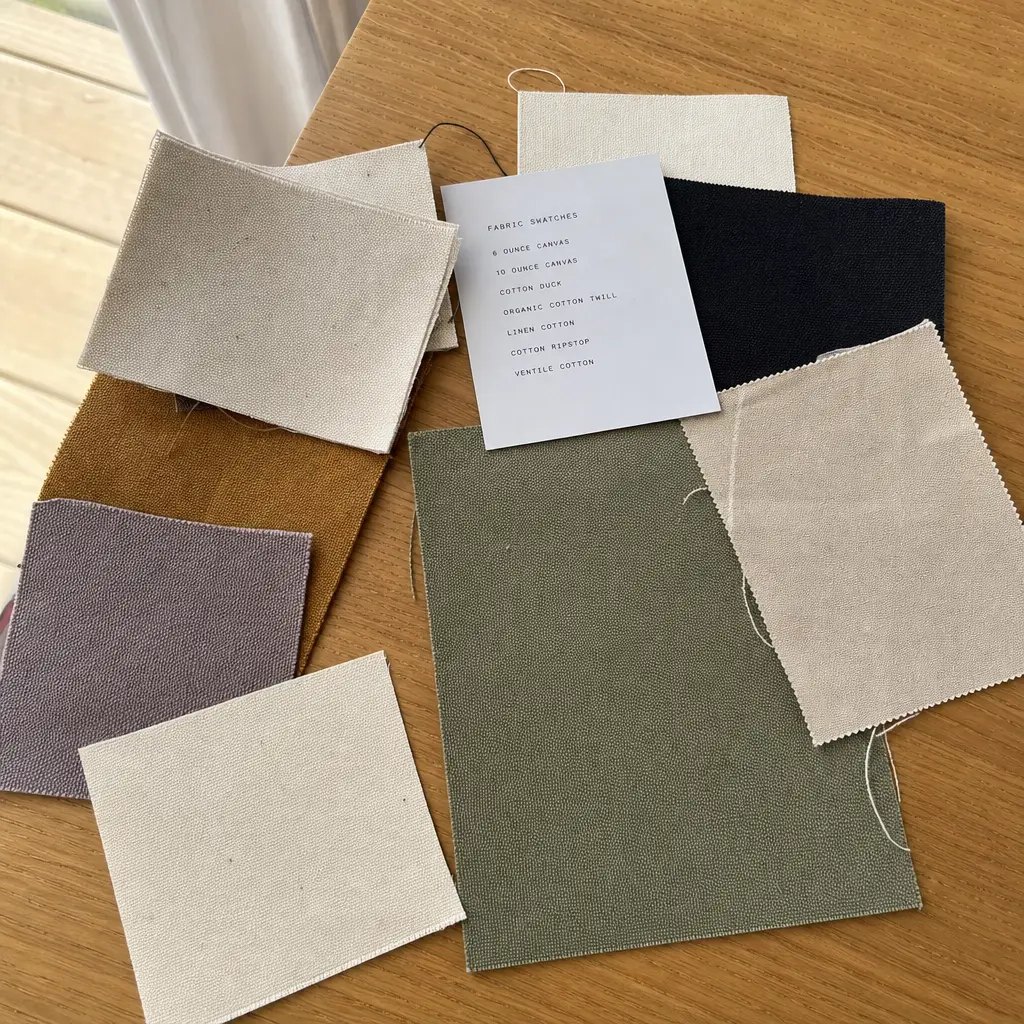
Start with a material swatch to approve GSM, weave, shade, seed specks, slub level, handfeel, and finishing. Then request a print strike-off on the nominated fabric to confirm ink coverage, Pantone appearance, line detail, curing, and handfeel. A fit sample should confirm dimensions, gusset capacity, handle drop, and how the tote behaves with real bakery items.
The pre-production sample should combine final fabric, final print method, final stitching, labels, hangtags if used, and folding method. This sample becomes the control reference for bulk production. If retail presentation matters, request a packed sample showing bundle count, folding direction, barcode position, carton label content, and whether the logo develops hard creases.
Keep signed samples and clear approval records. The supplier should retain one reference, the buyer should keep one, and any third-party inspector should receive the spec sheet, artwork file, packing plan, defect criteria, and reference photos. Without those references, disputes about natural cotton character or acceptable print texture become subjective.
- Material swatch: approves GSM, weave, shade range, natural specks, shrinkage expectation, and handfeel.
- Print strike-off: approves ink color, opacity, registration, edge sharpness, curing, rub behavior, and artwork readability.
- Fit sample: approves finished measurements, gusset capacity, handle comfort, seam placement, and load practicality.
- Pre-production sample: approves final fabric, final print, labels, stitching, reinforcement, thread trimming, and retail appearance.
- Packed sample: approves folding, bundle quantity, barcode placement, carton mark, crease risk, and moisture-protection approach.
- Approval record: sign and date samples, record version codes, and keep photos with the RFQ and purchase order.
Write QC Criteria Before Deposit
Quality control belongs in the RFQ, not in a rushed conversation after production. Cotton tote defects are predictable: weak handle stitching, size variation, skewed panels, uneven gussets, print misalignment, ink smearing, oil marks, damp odor, loose threads, wrong labels, and mixed carton versions. If these are not defined, the buyer receives a general promise instead of a measurable standard.
For bakery buyers, cleanliness carries extra brand weight because the tote is associated with food retail. The bag may not be direct food-contact packaging, but customers will still judge the bakery if it smells damp, has dusty folds, or contains loose thread debris. Specify that goods must be clean, dry, and free from mildew odor, oil stains, insect residue, and loose production waste.
Use written defect classification. Critical defects can include wet cartons, mold odor, wrong artwork, wrong label, broken handle, open seam that affects use, unsafe foreign matter, or severe version mixing. Major defects can include obvious stains, missing reinforcement, severe print shift, large measurement errors, incorrect barcode, or carton count errors. Minor defects can include small loose threads or natural slubs within the approved swatch range.
Define inspection timing and sampling approach. Many buyers use AQL-based final inspection, but the level should match order value and risk. Even without a formal AQL plan, the RFQ should say what will be checked: measurements, sewing, print, fabric appearance, labeling, packing, carton count, and a realistic load check. Inspection should happen after trimming and packing, not while goods are still unfinished.
- Measurements: check width, height, gusset, handle length, handle drop, handle width, print position, print size, and label position.
- Sewing: inspect handle reinforcement, bottom seam, side seams, stitch density, back-tacking, skipped stitches, loose threads, and panel skew.
- Printing: check placement, opacity, color, registration, curing, rubbing, cracking, tackiness, smearing, and readability.
- Fabric: check stains, odor, shade panels, dirty folds, holes, oil marks, seed specks, slubs, and fabric defects against approved swatch.
- Labels and packing: verify barcode, hangtag, care label, origin mark, artwork version, carton count, carton marks, and destination sorting.
- Function: test realistic bakery load and inspect handle seams, bottom gusset, and stitching after normal carrying.
Control Packing, Sorting, and Freight
Packing affects retail appearance, freight cost, warehouse receiving, and store-level accuracy. A loose sample may look excellent, but bulk goods can arrive with a hard crease through the logo if they are folded poorly, over-compressed, or packed before ink has fully cured.
Define folding method, bundle quantity, inner packing, pieces per carton, carton dimensions, gross weight, net weight, CBM, and carton mark format. For many 10 oz to 12 oz bakery totes, carton quantities around 100 to 150 pieces can be practical, but the final count depends on fabric thickness, gusset size, folding method, maximum carton weight, and whether retail hangtags are attached. Do not rely on a generic carton plan.
Sorting must be planned before production when the order includes multiple store names, artwork versions, languages, barcodes, or destinations. Mixed cartons may save factory labor, then create receiving errors and store-level shortages. Ask whether cartons can be packed by SKU, purchase order, store, distributor, or destination, and whether sorting affects price or lead time.
Plastic-free packing can be specified, but cotton still needs moisture protection. Options include bulk flat packing, paper bands, kraft sleeves, belly bands, or no individual polybag. For sea freight, humid storage, or long warehouse dwell time, require dry cartons, suitable inner protection, and instructions that cartons must not be stored directly on damp floors or compressed beyond the agreed stacking limit.
- Folding method: avoid hard folds through the main logo, especially on heavy canvas, water-based print, or transfer print.
- Bundle plan: define 25, 50, or another agreed quantity per bundle based on fabric thickness and retail handling.
- Carton plan: request carton dimensions, net weight, gross weight, pieces per carton, CBM, and maximum stacking guidance.
- Sorting plan: pack and mark cartons by artwork, store name, barcode, language, distributor order, or destination where required.
- Moisture plan: use dry cartons, suitable inner protection, and storage controls to reduce odor, dampness, and mildew risk.
- Retail presentation: quote paper bands, kraft sleeves, hangtags, barcode labels, and bulk packing as separate options.
Specification comparison for buyers
| RFQ decision | Recommended specification | When it fits | Quote and QC risk to control |
|---|---|---|---|
| Core bakery retail fabric | 10 oz to 12 oz organic cotton canvas, typically about 270 to 340 GSM; request actual mill GSM and finished bag unit weight | Paid merchandise, bread club totes, farmers market sales, coffee-and-pastry purchases, and repeat retail SKUs that need structure without excessive freight cost | Do not compare ounce labels alone. Require fabric swatch, GSM tolerance, unit weight, weave, shrinkage expectation, and carton CBM before selecting by price |
| Premium gift-set fabric | 12 oz to 16 oz organic cotton canvas, typically about 340 to 450 GSM, with reinforced handles and tested bottom seams | Holiday hampers, corporate bakery gifts, preserves-and-coffee bundles, subscription welcome kits, and higher-price retail tote SKUs | Heavier canvas can raise sewing difficulty, needle deflection, print curing sensitivity, carton volume, and freight cost. Test the actual filled bag before bulk approval |
| Cost-controlled promotional fabric | 8 oz organic cotton, often about 220 to 270 GSM, only for modest loads and short-term campaigns | Launch giveaways, event handouts, light counter bags, and simple customer appreciation programs carrying a loaf, receipt, or lightweight pastry box | Too-light cotton may stretch at the handles, collapse on shelf, wrinkle heavily, and feel promotional. Confirm the maximum expected load and do not use premium product photos for this spec |
| Bakery tote capacity | Finished size around 38 x 42 cm with 8 to 10 cm bottom gusset; specify whether the gusset is bottom-only, side, or boxed base | Sourdough loaves, baguette sleeves, pastry boxes, coffee bags, jars, and small retail add-ons without making the tote oversized | Flat width hides capacity. Provide a dimension sketch, finished measurement points, seam allowance assumptions, and tolerances such as ±1 cm for body dimensions |
| Handle construction | Self-fabric handles 2.5 to 3 cm wide, 60 to 65 cm total length, with box stitch plus cross stitch or bar tack reinforcement | Shoulder carry for customers walking from bakery counter to car, office, market, or public transit | Weak handle attachment is a common failure point under jars and coffee. Require stitch type, stitch density, thread type, reinforcement dimensions, and load-check method |
| Core logo printing | Water-based screen print for 1 to 3 solid colors; provide Pantone targets, print size, placement, and minimum line width | Bakery logos, hand lettering, simple bread illustrations, slogans, and repeat replenishment orders | Canvas texture breaks fine detail. Approve a strike-off on production fabric and define acceptable print placement tolerance, often ±5 mm to ±10 mm |
| Seasonal artwork printing | Digital print or transfer only after strike-off review for handfeel, color density, fold resistance, rub, and edge marks | Limited holiday drops, multi-color illustrations, gradients, or small quantities where screen setup is inefficient | Transfers can feel plasticky or crack on fold lines. Digital print may appear muted on natural cotton. Require test panels and buyer sign-off before bulk |
| MOQ structure | Separate MOQ for fabric, cut-and-sew, each artwork, each print color, labels, hangtags, barcodes, packing, and carton sorting | Bakery groups splitting one base tote across store names, seasonal art, language versions, wholesale customers, or distributor SKUs | A low headline MOQ can hide per-artwork setup, label minimums, custom carton minimums, or sorting fees. Request a quantity matrix before award |
| Sample path | Swatch, print strike-off, fit sample, pre-production sample, and packed sample when retail presentation or distribution accuracy matters | New bakery programs, paid merchandise, corporate gifts, multi-location rollouts, and any order with custom labels or carton sorting | Digital mockups cannot approve GSM, shade, handle drop, print opacity, curing, folding, or carton creasing. Approve physical samples from nominated materials |
Buyer checklist before sampling
- Define the commercial job first: paid retail merchandise, gift-with-purchase, bread subscription carrier, corporate bakery gift, wholesale resale SKU, farmers market giveaway, or distributor replenishment program.
- List the real contents by size and weight: loaf dimensions, baguette sleeve length, pastry box footprint, coffee bag weight, glass jar count, mug or merchandise weight, receipt folder, care card, and insert pack.
- State finished measurements after sewing: width, height, gusset style, gusset depth, handle total length, handle drop, handle width, seam construction, reinforcement dimensions, and tolerances.
- Specify the organic cotton claim required: material declaration only, certified organic fiber claim, chain-of-custody documentation, transaction certificate where applicable, dyeing/printing scope, and country-specific compliance files.
- Request fabric options by both ounce and GSM, including actual mill GSM, GSM tolerance, weave, finishing, shrinkage expectation, estimated finished bag unit weight, pieces per carton, carton gross weight, and carton CBM.
- Provide artwork as vector files with Pantone references, print size in centimeters, placement from top and side edges, minimum line thickness, permitted registration variation, and no-print zones near seams, folds, labels, and gussets.
- Ask suppliers to separate blank bag cost, printing cost, screen/setup fees, sample cost, label cost, hangtag cost, barcode cost, packing cost, carton cost, documentation cost, inspection support, and freight-ready carton data.
- Break quantities by total order, artwork version, store name, language version, barcode, label version, packing method, and shipment destination so MOQ and sorting charges are visible before approval.
- Require swatches and print strike-offs on the nominated fabric before final approval when shade, natural cotton specks, ink contrast, or handfeel are brand-sensitive.
- Approve one pre-production sample made with final fabric, final GSM, actual print method, correct handle reinforcement, labels, hangtags if used, folding method, carton label, and packing configuration before bulk production.
Factory quote questions to send
- Which organic cotton fabric options do you recommend for a bakery tote carrying bread, boxed pastries, coffee bags, glass jars, and small merchandise, and what are the actual GSM, ounce weight, weave, finishing, shrinkage expectation, GSM tolerance, and approximate finished bag unit weight for each?
- Is the quoted fabric greige, natural, bleached, piece dyed, garment washed, enzyme washed, or pre-shrunk, and what shade variation, seed speck level, slub level, and panel-to-panel shade tolerance should we expect in bulk?
- What organic cotton documentation can you provide for this exact order, and does it cover fiber, yarn, fabric, dyeing, printing, sewing, transaction records, or only a supplier material declaration?
- What is the MOQ for the base tote, and what are the separate MOQs for fabric procurement, cutting, sewing, each print artwork, each print color, woven label, care label, hangtag, barcode label, inner packing, and carton sorting version?
- Can you quote the same construction in 8 oz, 10 oz, 12 oz, and 16 oz organic cotton canvas with separate line items for blank bag, printing, setup, labels, hangtags, packing, samples, documentation, export cartons, and carton data?
- Which print method do you recommend for our artwork on the nominated fabric, and what minimum line thickness, Pantone tolerance, print-position tolerance, curing requirement, dry rub check, wet rub check, fold check, and wash expectation can you support?
- What sample stages are included in your quotation: material swatch, print strike-off, fit sample, pre-production sample, packed sample, approval photos, and retained reference sample, and how many working days are needed for each stage?
- What are your standard tolerances for finished width, finished height, gusset depth, handle total length, handle drop, handle width, print position, print size, label position, carton quantity, and carton gross weight?
- What stitch type, stitch density, thread specification, seam construction, and handle reinforcement will you use, and can you provide close-up photos of handle attachment, inside seams, bottom gusset, thread trimming, and label placement from the sample?
- How will the totes be packed for export, including folding method, pieces per bundle, pieces per inner pack, pieces per carton, carton dimensions, net weight, gross weight, CBM, moisture protection, pallet recommendation, and carton compression precautions?
Quality-control points to confirm
- Finished body width, height, and gusset should match the approved specification, commonly within ±1 cm for body dimensions unless a tighter retail-display tolerance is agreed in writing.
- Handle total length and handle drop should match the approved sample, commonly within ±1.5 cm, with no twisted handles, uneven attachment points, visibly mismatched handle pairs, or handle-width variation that affects comfort.
- Handle attachment should use the approved box stitch, cross stitch, bar tack, or agreed equivalent, with secure back-tacking, consistent stitch density, no skipped stitches, loose threads, broken threads, needle cuts, or weak corners at stress points.
- Seams should be straight enough for retail presentation, with no open seams, severe puckering, raw edges unless specified, asymmetric bottom gussets, exposed seam allowance that catches products, or panel skew that distorts the logo.
- Print placement should match the signed sample and artwork sheet, with practical tolerance such as ±5 mm to ±10 mm depending on artwork size, fabric movement, and whether the tote must align on a retail fixture.
- Ink coverage should be even on the approved organic cotton texture, with no tacky ink, smearing, obvious pinholes, poor opacity, cracked fold lines, registration errors, or ink transfer after proper curing.
- Pantone color should be judged under consistent lighting on the approved fabric, recognizing that natural cotton ground shade affects perceived color compared with paper proofs, screens, or digital mockups.
- Fabric should be clean, dry, and free from oil marks, mildew odor, dampness, insect residue, excessive dust, dirty fold lines, holes, panel shade mismatches outside the approved range, and slubs beyond the signed swatch tolerance.
- Labels, hangtags, barcodes, care statements, country-of-origin marks, and carton labels should match the approved artwork version, SKU table, and packing list, especially when orders are split by store or distributor.
- Packed cartons should match the agreed quantity, carton dimensions, gross weight, inner protection, folding method, carton marks, destination sort, and moisture-control plan, with no over-compression across the logo panel.