Start with the retail use, not the artwork file
Liquor retail totes have a narrower performance window than general promotional cotton bags. The bag has to carry glass safely, present the brand cleanly at checkout, and often support a seasonal or event deadline. A print that looks acceptable on a flat sample can look low, twisted, or uneven once a bottle opens the gusset and pulls the handles under load.
The first sourcing question is therefore not only what should be printed. It is how the tote will be used. A single wine bottle, a boxed spirit, and a two-bottle gift offer can require different dimensions, fabric weight, handle reinforcement, and packing. If procurement begins with a generic tote template, the factory may quote a bag that is technically printable but commercially weak for liquor retail.
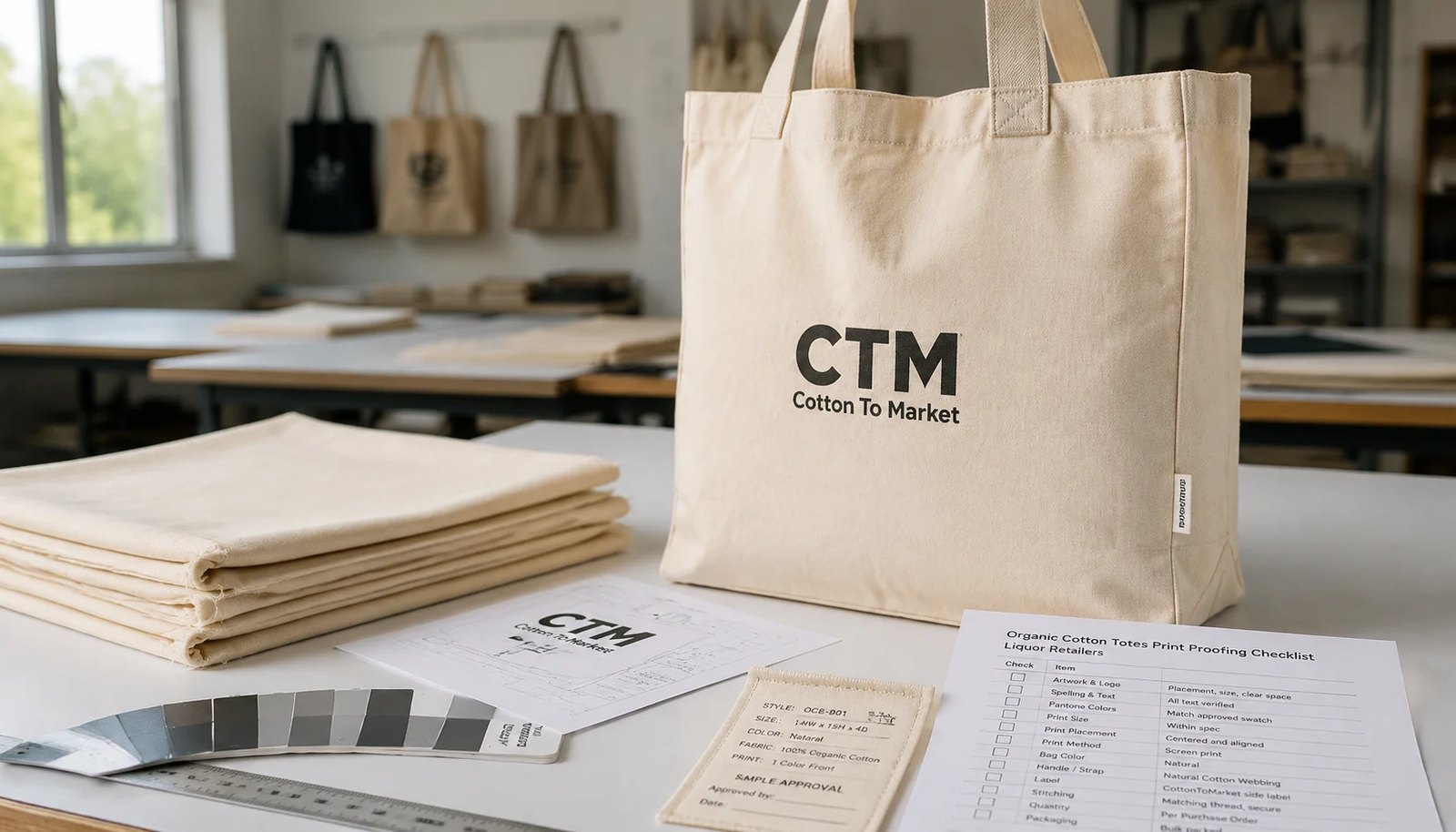
A practical organic cotton totes print proofing checklist should connect four items before bulk approval: bottle fit, organic cotton evidence, print behavior on actual fabric, and load-bearing construction. Keeping those items together prevents the common gap where design approves the logo, procurement approves the unit price, and quality control later discovers that neither approval covers filled-bag performance.
- Define whether the tote is for checkout sale, gift-with-purchase, tasting event, loyalty program, or store allocation.
- Confirm whether the printed tote must meet retailer brand guidelines or an alcohol partner's co-branding rules.
- Identify any state, venue, event, or responsible-drinking copy before artwork is converted to screens.
- Set the in-store date early so strike-off and PP sample approvals do not consume the production buffer.
Build the bag around real bottle dimensions
Bottle-fit specifications should be measured, not guessed. Record bottle height, base diameter, shoulder width, filled weight, and any secondary packaging. A neck tag, tissue wrap, carton sleeve, or rigid gift box can turn a workable bag into a tight fit. Two bottles also change the stress pattern: the issue is not just volume but how the weight pulls at the handle joins and how the base spreads under load.
For many single-bottle cotton liquor totes, a bottom gusset around 10-12 cm is a useful starting range, but it is not a universal rule. Tall narrow bottles, wider spirits bottles, and boxed gifts should be checked against an actual sample. The buyer should state finished dimensions in millimeters and confirm whether handle length is measured as full finished length or drop length. That small wording difference can create large sample disagreements.
The printed face also depends on fit. If the bag is too narrow, the bottle pushes the fabric outward and distorts the logo. If the gusset is too shallow, the bag may twist when carried. If the handle is too short, the shopper may carry it awkwardly, increasing stress at one side. Fit testing should be part of print proofing because print presentation changes when the bag is loaded.
- Measure bottle height, base diameter, shoulder width, and filled weight.
- Include wrap, neck tag, box, divider, or receipt insert where those affect fit.
- Ask for a sewn PP sample if the tote must stand upright or display well when filled.
- Check the logo on both the empty bag and the loaded bag before final approval.
Specify organic cotton evidence clearly
Organic cotton is a procurement claim, not just a fabric description. If the finished tote, hangtag, carton, or retailer product page will refer to organic cotton, buyers should request evidence that matches the claim being made. Common documentation includes a current GOTS or OCS scope certificate from the relevant supplier in the chain. Where a chain-of-custody claim is required, a transaction certificate may also be needed for the order.
Procurement should check the certificate holder name, validity date, certified product category, processing scope, and whether the supplier named on the quote is actually covered. A mill certificate alone may not support a finished-product claim if the bag maker is outside the certified chain. Likewise, using GOTS or OCS logos has rules; do not place certification marks on the tote or packaging unless the certification program and certifier approval allow it.
For natural or unbleached organic cotton, shade variation should be expected within controlled limits. That does not mean any shade is acceptable. Approve a fabric swatch or cutting, state whether the fabric is natural, bleached, or dyed, and ask the supplier to identify lot changes that may alter perceived print color. This matters for dark brand colors, cream backgrounds, and premium liquor branding where the fabric tone is part of the look.
- Request GOTS or OCS scope certificate details before confirming organic wording.
- Ask whether a transaction certificate can be issued for the specific order if your retailer requires it.
- Confirm labeling limits before using certification logos or organic claims on hangtags, cartons, or web copy.
- Approve a physical shade reference for natural cotton and keep it with the sealed sample record.
Choose fabric and construction with tolerances attached
A useful RFQ separates target specification from acceptable variation. For bottle-bearing totes, buyers often start with 10 oz to 12 oz canvas, roughly 280-340 GSM depending on weave and finishing. This is a practical commercial range, not an exact equivalence across all suppliers. Ask the factory to quote finished GSM and state its measurable tolerance instead of relying on ounce labels alone.
Construction language should be equally specific. State the top hem, side seam, bottom gusset, handle fabric, handle width, handle length, and reinforcement pattern. For liquor retail, box-x stitching or bartacks at the handle join are commonly requested, but the PO should define the exact method and location. If a reinforcement tape, extra fold, or double stitch row is expected, include it before the quote is finalized.
Dimensional tolerances should be agreed with the factory and written on the PO. Some suppliers can control finished width, height, and gusset within a few millimeters; others need a wider sewing tolerance depending on fabric, washing, and construction. The key is to avoid silent assumptions. A bag can pass a casual visual review while still being too tight for a bottle or inconsistent in carton packing.
- Ask for finished GSM and supplier-confirmed tolerance.
- Specify finished bag dimensions, not only cut panel dimensions.
- Define handle measurement method and reinforcement pattern.
- Tie tolerances to the sealed sample and final inspection plan.
Match print method to artwork and base fabric
For one to three solid colors, screen printing is often the most practical benchmark for organic cotton liquor totes. It can be repeatable at commercial quantities and works well for many logos, event marks, and retail graphics. Still, the quote should state whether printing is manual or automatic, how many colors are included, what print area is priced, and what ink system is proposed for cotton canvas.
Digital print can be useful for artwork with many colors or gradients, but it should be tested carefully on natural fabric. Unbleached cotton is not a neutral white base. It can warm the look of reds, dull subtle neutrals, and shift brand colors between fabric lots. Transfers or film-based decoration may solve some color problems but can introduce other issues such as stiffness, edge lift, or cracking under repeated folding.
Print method selection should consider reorder risk. If the retailer expects to reorder the same tote for seasonal programs or multiple stores, consistency matters as much as the first order. A physical strike-off and a retained color standard are more useful than a screen image or PDF because they show ink behavior on the actual surface.
- Use screen print as the comparison baseline for simple solid-color artwork.
- Require the supplier to state print area, color count, ink type, and setup charges.
- Test digital or transfer decoration on the actual fabric before approving bulk.
- Keep the approved strike-off for reorder comparison.
Convert artwork into measurable proofing rules
Artwork proofing should turn a design file into factory instructions. Provide vector artwork, final print size in millimeters, Pantone references or agreed color standard, and placement from fixed reference points. For front-panel totes, top seam and side seam references are easier to inspect than a general note such as centered.
Canvas texture affects fine detail. As a starting point, positive lines around 0.5 mm and reverse lines around 0.7 mm are more realistic than very fine paper-print detail, but the strike-off should decide the final rule. Small legal copy, event dates, distributor marks, and responsible-drinking statements should be reviewed at normal viewing distance. If a QR code or barcode is required, scan the physical strike-off, not just the digital file.
Liquor retail artwork may also need compliance-aware review. Confirm state or event legal copy, age-related wording, responsible-drinking language if required by the program, and retailer brand-guideline approval before screens are made. Late copy changes can trigger new screens, new strike-offs, and missed launch dates.
- Provide vector files with final print size and Pantone references.
- Set no-print zones near seams, gusset folds, and handle stitch areas.
- Physically test QR codes, small URLs, and legal copy on printed fabric.
- Get retailer, brand owner, or event approval before bulk print starts.
Approve in stages: proof, strike-off, PP sample
A PDF proof confirms content, scale, orientation, and placement intent. It does not confirm fabric shade, ink opacity, edge sharpness, cured handfeel, or rub resistance. That is why a physical print strike-off is the key approval step for printed organic cotton totes.
The strike-off should be printed on production fabric whenever possible. If production fabric is not available, the supplier should identify the substitute fabric and explain the difference in shade, weave, or finish. Review the strike-off under daylight and store-like indoor lighting. Check color, coverage, registration, small copy, and whether the ink feels suitable for a tote that will be folded, packed, and carried.
A PP sample is useful when construction affects the print or load performance. It confirms that the approved graphic still sits correctly after sewing, the gusset opens as intended, the bottle fits, and the handle reinforcement matches the spec. For repeat orders with no specification change, a strike-off or retained sample comparison may be enough; for first orders, new bottle formats, or premium gifting, a sewn PP sample reduces risk.
- Use the PDF proof for layout and version control only.
- Use the strike-off for print color, coverage, detail, and rub review.
- Use the PP sample for bottle fit, print placement on a sewn bag, and construction.
- Keep approved artwork version, strike-off, PP sample, and tolerance notes under one revision record.
Write RFQs that expose hidden cost differences
Two tote quotes are not comparable unless the suppliers are pricing the same fabric, construction, print area, sample route, tolerance, and packing. A low unit price may reflect lighter cloth, shorter handles, fewer reinforcement stitches, no strike-off, or a looser carton plan. The RFQ should force those assumptions into the open.
Ask suppliers to break out recurring unit cost and one-time costs such as screen charges, artwork checking, sample fees, courier, special labels, and cartons. MOQ should be stated by design, fabric color, print color count, and packing split. A chain with store-specific artwork or mixed allocations may have a very different cost structure from one national design packed in standard cartons.
Packing assumptions belong in the quote. Carton quantity, carton dimensions, gross weight, inner pack count, folding method, and assortment rules affect landed cost and receiving. They also affect print condition. A dense carton may reduce freight cube but increase pressure marks on dark prints or deform gussets.
- Compare fabric weight, construction, print area, and packing side by side.
- Ask what is included in the sample route and what is charged separately.
- Separate MOQ by design, color, print method, and mixed packing need.
- Request carton dimensions, gross weight, and inner pack quantity with the quote.
Inspect for liquor-retail defects, not generic promo defects
Final inspection should reflect the way the tote will be sold and used. Measure finished dimensions and print placement against the PO and sealed sample. Check front-panel print quality where shoppers and store staff will see it first. Review handle reinforcement because bottle weight creates higher stress than paper catalogs or light giveaways.
Print inspection should cover color versus strike-off, edge clarity, registration, pinholes, ghosting, smudges, contamination, and curing. Some natural slubs are inherent to cotton, but severe slubs across a logo, oil marks, mildew odor, or dirty fold lines are retail presentation problems. If small legal or responsible-drinking copy is part of the design, it should remain readable after printing and folding.
Load testing should be agreed before shipment. The method does not need to be complicated, but it must be defined: bottle-equivalent weight, duration, sample quantity, and pass/fail criteria. First orders, heavier bottles, two-bottle totes, and changed handle construction deserve extra attention. Packing inspection should then confirm inner counts, carton labels, assortment accuracy, fold direction, and absence of print transfer.
- Measure dimensions and print placement; do not rely on visual approval alone.
- Reject open seams, skipped stitches at stress points, incorrect reinforcement, and severe gusset asymmetry.
- Check cured print for rub transfer using the agreed method.
- Inspect cartons for count, labeling, gross weight, mixed assortment accuracy, and pressure marks.
Specification comparison for buyers
| Sourcing decision | Practical specification to request | Why it matters for liquor retail | Proofing or QC check |
|---|---|---|---|
| Bottle fit | State 1-bottle or 2-bottle use, bottle height, base diameter, shoulder width, and any gift wrap or carton allowance | Glass bottles create concentrated load and can push the front panel out of shape if the bag is sized like a generic tote | Fit-test the PP sample with the actual bottle or a dimensionally equivalent dummy load |
| Fabric weight | 10 oz to 12 oz organic cotton canvas as a common commercial starting range; ask supplier to confirm finished GSM and tolerance | Heavier canvas usually gives better body and print holdout than lightweight giveaway cloth, but the exact result depends on weave and finish | Check finished GSM from multiple sampled points or require mill/factory measurement records |
| Organic evidence | GOTS or OCS scope certificate from relevant supplier, plus transaction certificate where chain-of-custody claim is required | Retailers should avoid unsupported organic claims on product, hangtag, carton, or marketing copy | Verify certificate holder name, validity date, product category, and whether labeling claims are permitted |
| Construction | Bottom gusset around 10-12 cm for many single-bottle totes; wider body, stable base, and stronger handle reinforcement for 2-bottle use | A flat bag can twist around the bottle, distort the print, and concentrate stress at the top seam | Measure finished width, height, gusset, handle width, and handle length against the sealed sample |
| Print method | Pantone-referenced screen print for many 1-3 solid-color designs; digital only after testing on actual fabric | Natural cotton shade and weave texture can change color perception and edge clarity | Approve a physical strike-off on production fabric or a disclosed equivalent fabric |
| Artwork limits | Start with minimum positive line 0.5 mm and reverse line 0.7 mm, then validate on strike-off | Small legal lines, event copy, URLs, and partner logos can fill in on canvas | Read small copy at normal viewing distance and test QR/barcodes physically |
| Placement tolerance | Define print position from top seam and side seam; ±5 mm is a common starting point if supplier confirms capability | Crooked or low logos are obvious when totes are stacked, hung, or filled at checkout | Inspect placement with a ruler from the agreed reference points, not by eye only |
| Load check | Agree a bottle-equivalent dead-load test method, weight, duration, and sample frequency with the supplier | Visual approval does not confirm handle join strength under filled-bag use | Record test method in the PO or QC plan and compare against approved construction |
| Packing | Flat fold, controlled stack height, 10-20 pieces per inner bag, carton gross weight limit, and clear carton labels | Over-compression can mark dark prints, deform gussets, and slow store receiving | Inspect fold marks, print transfer, carton count, assortment ratio, and carton labeling before shipment |
Buyer checklist before sampling
- Define the retail use: single bottle, two bottles, gift-with-purchase, loyalty gift, tasting event, or premium checkout tote.
- Record actual bottle height, base diameter, shoulder width, filled weight, and whether wrap, neck tag, or gift carton must fit.
- Specify finished bag dimensions in millimeters: width, height, bottom gusset, side gusset if used, top hem, handle width, and finished handle length or drop length.
- State organic cotton claim requirements: GOTS or OCS scope certificate, transaction certificate if needed, and any restrictions on using certification marks or organic wording.
- Request fabric details: 100% organic cotton or blend, weave, natural/unbleached or dyed shade, target finished GSM, GSM tolerance, and approved fabric swatch.
- Confirm construction for bottle load: seam type, handle insertion method, box-x or bartack reinforcement, stitch density expectation, and thread color.
- Provide final vector artwork with Pantone references, print size, placement from measurable reference points, minimum line rules, and no-print zones near seams and folds.
- Require a physical print strike-off on actual production fabric where possible; if not possible, require the supplier to identify the substitute fabric and remaining risk.
- Approve a PP sample when bottle fit, handle reinforcement, print placement on a sewn bag, or packing fold pattern is commercially important.
- Write rejectable defects before production: print blur, ghosting, color drift, rub transfer, contamination, open seams, skipped stitches, incorrect reinforcement, odor, mildew, and severe shade mismatch.
Factory quote questions to send
- What exact fabric are you quoting: fiber content, organic standard available, weave, finished GSM, natural or dyed shade, and expected GSM tolerance?
- Can you provide current GOTS or OCS scope certificate details, and can you support transaction certificates if our claim or customer requires chain-of-custody evidence?
- What finished bag size, gusset, handle width, handle length, top hem, seam type, and reinforcement method are included in the unit price?
- Is the print cost based on manual screen, automatic screen, digital, transfer, or another method, and what print area and color count are included?
- What ink system is proposed for cotton canvas, and how do you check curing, rub resistance, opacity, and handfeel before packing?
- Does the quote include artwork checking, screen charges, strike-off, PP sample, sample courier, revision sample, carton labels, and export packing?
- What MOQ applies by design, fabric color, print color count, and packing assortment, and what changes if stores need mixed allocations?
- What production tolerances do you accept for finished dimensions, handle length, gusset, print placement, and print color versus approved strike-off?
- What bottle-equivalent load test do you perform, at what weight and duration, and on how many pieces during production or final inspection?
- What carton quantity, carton dimensions, net weight, gross weight, inner pack count, and folding method are assumed in the quote?
Quality-control points to confirm
- Check organic documentation before bulk approval: certificate holder, certificate validity, product scope, transaction certificate requirement, and permitted claim language.
- Verify fabric against the approved swatch and spec: fiber content, weave, shade, finished GSM, and visible fabric defects on the main retail face.
- Measure finished width, height, bottom gusset, side gusset if any, handle width, and handle length on sampled pieces during in-line and final inspection.
- Confirm print placement from agreed reference points such as top seam and side seam; use the PO tolerance and sealed sample as the benchmark.
- Compare print color, opacity, registration, edge sharpness, and fill evenness against the approved strike-off under consistent lighting.
- Check small copy, event dates, state or venue legal lines, responsible-drinking copy if required, URLs, QR codes, and partner marks for readability.
- Test cured print for dry rub or agreed rub method after the supplier's stated curing time; reject visible transfer in critical logo areas if not allowed.
- Inspect sewing: top hem, side seams, gusset symmetry, skipped stitches, open seams, loose threads, handle alignment, and reinforcement pattern.
- Perform the agreed bottle-equivalent load test on sampled production pieces, especially for first orders, changed fabric weight, or new handle construction.
- Review packing quality: fold direction, pressure marks, print offset, inner pack count, mixed assortment accuracy, carton labels, carton condition, and gross weight.