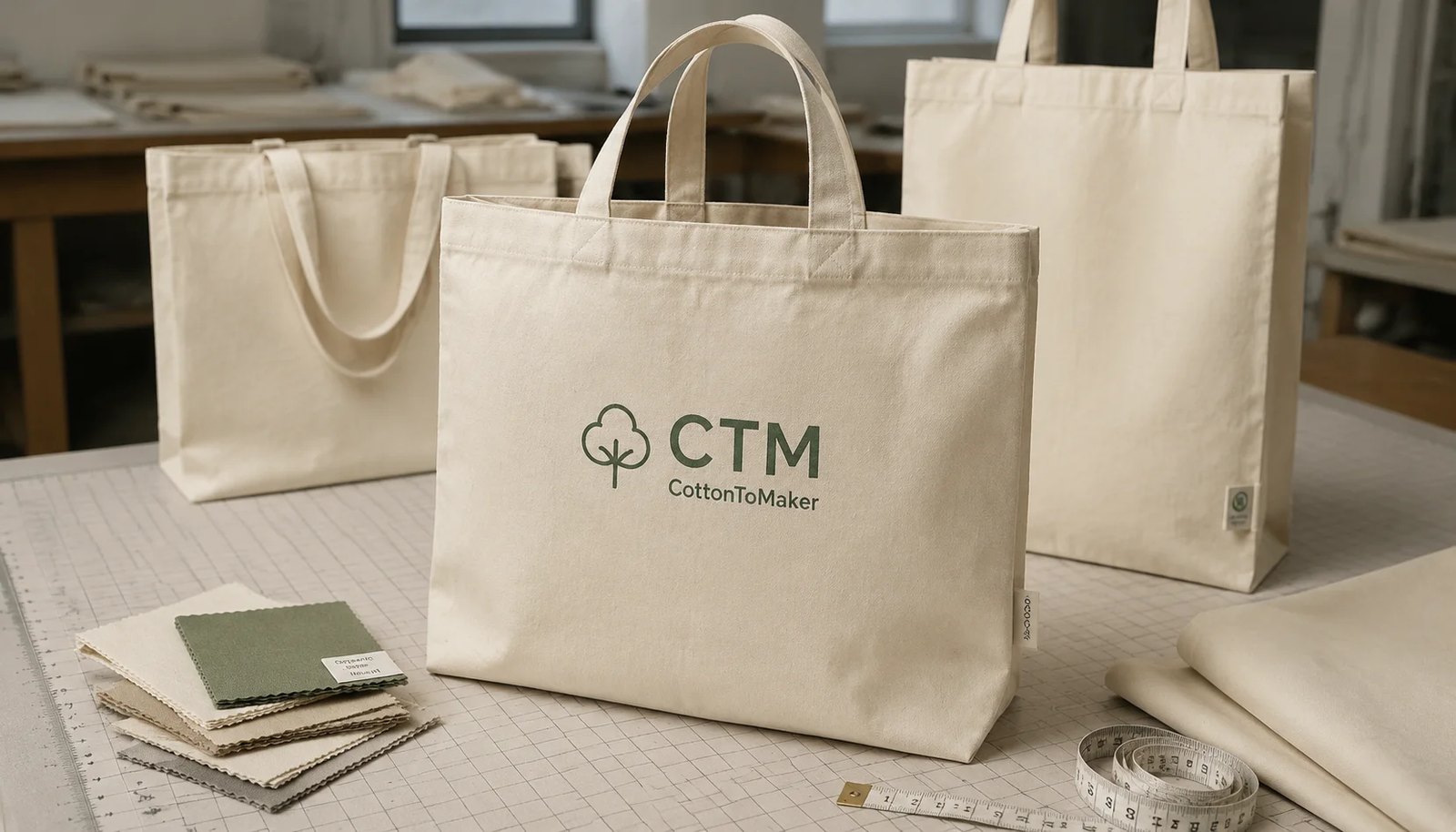
The buying problem: a tote that looks acceptable but fails in store
Organic cotton totes for natural grocers are not complicated products, but they fail in predictable ways when the RFQ is too loose. A buyer may request 'organic cotton tote, natural color, logo print' and receive quotes that look comparable on a spreadsheet. In reality, one supplier may quote 180 GSM stock fabric with simple side seams, another may quote 280 GSM certified fabric with reinforced handles, and a third may include only non-certified cotton while using the word organic in the description.
The quality inspection checklist should be written before the purchase order, not after production. Natural grocery customers will load these bags with glass jars, produce, bulk grains, frozen items, and beverage bottles. The bag must hold weight, keep a clean brand appearance, and support the sustainability claim without creating compliance risk. Procurement teams should define the physical performance standard, documentation standard, and retail presentation standard in the same RFQ.
- Use the checklist to make supplier quotes technically comparable.
- Treat organic claim documentation as a product requirement, not a marketing afterthought.
- Inspect load strength and print durability, not only sewing appearance.
- Approve the final packing method because poor folding can damage the print before store arrival.
Set the tote specification around grocery use, not just dimensions
A natural grocer tote is usually asked to do more than carry light promotional brochures. Customers may use it at checkout, farmers market events, membership drives, produce demos, and home delivery pickups. The required strength depends on the use case. A flat tote for a weekend wellness event can be lighter and lower cost. A paid reusable grocery tote should have a stronger body, wider handles, cleaner seams, and better print resistance.
The RFQ should include finished width, height, gusset depth, handle length, handle width, fabric GSM, stitching type, print size, print position, and packing format. If gussets are needed, state whether the tote needs a side gusset, bottom gusset, or full box bottom. A gusseted bag costs more because it uses more fabric and sewing time, but it stands and loads better for grocery items. A flat tote is cheaper and easier to pack, but it performs poorly with bulky produce or rectangular cartons.
- Common giveaway tote: 38 x 42 cm, flat body, 180-220 GSM, shoulder handles.
- Reusable grocery tote: approximately 38 x 40 x 10 cm gusset, 240-280 GSM, reinforced handles.
- Produce or bulk department tote: narrower profile, washable print, no loose internal threads.
- Retail shelf tote: heavier fabric, cleaner finishing, hangtag or belly band if required.
Fabric weight and organic cotton documentation must be separated
GSM tells you fabric substance; certification tells you material claim control. They are related to quality perception, but they are not the same thing. A 220 GSM organic cotton tote may be weaker than a 260 GSM conventional cotton tote, but the organic claim may be essential for brand positioning. Buyers should avoid approving a bag based only on the word organic and should avoid assuming all organic cotton fabrics have the same hand-feel, shrinkage, and shade.
Natural unbleached organic cotton has shade variation. This is normal, especially across cotton lots and weaving batches. If the program needs a clean consistent look across multiple stores, the buyer should approve a shade range using physical swatches. If the brand wants a fully controlled color, dyed organic cotton is possible but increases cost, MOQ, lead time, and color approval work. Bleaching and optical brighteners may conflict with the natural look some grocers want, so write these limits clearly.
- For low-cost promotions, 180 GSM may be acceptable if the load requirement is light.
- For reusable grocery carry, 240-280 GSM gives better hand-feel and durability.
- For premium paid retail totes, 300 GSM and above can work but raises freight and sewing cost.
- Define GSM tolerance, such as plus or minus 5%, and reject fabric that falls outside the agreed range.
- State whether the certification evidence must support internal purchasing policy, consumer-facing claims, or both.
Construction points that decide whether handles tear out
Most tote failures happen at stress points: handle attachment, upper side seam, bottom seam, and gusset corners. A bag can look clean on the inspection table but fail after a customer carries heavy items across a parking lot. For natural grocers, handle attachment needs more attention than decorative finishing. A box-X stitch or dense cross-stitch at each handle end usually performs better than a single straight stitch line.
Stitch count and seam allowance matter. Very high stitch density can perforate lighter cotton, while very low stitch density weakens the seam and looks cheap. The factory should provide a practical construction standard based on the chosen GSM. Internal loose threads also matter because grocery buyers dislike messy interiors and stray threads can catch packaging. For heavier bags, reinforced top hems and clean inside seams improve both strength and appearance.
- Handle width: 2.5-3 cm is a common comfortable range for reusable totes.
- Handle length: approximately 55-65 cm for shoulder carry; shorter for hand-carry grocery bags.
- Top hem: double folded or reinforced where handles attach.
- Side seam: overlock with secure back-tacking, or French seam for a cleaner internal finish.
- Reject obvious skipped stitches, broken stitch chains, loose back-tacks, and handle ends not fully captured in the top hem.
Print method: choose durability before choosing artwork effects
For natural grocer totes, water-based screen printing is often the safest commercial choice for one to three solid colors. It gives a softer hand-feel than heavy plastisol-type prints and suits natural cotton texture. It is also efficient for bulk orders once screens are made. Digital printing can be useful for complex vegetable illustrations, gradient artwork, or smaller test runs, but it should be tested for color strength and rub resistance on the actual fabric.
Artwork that looks excellent on a PDF can fail on unbleached cotton because the base fabric is not pure white. Fine lines may fill in during screen printing, pale colors may disappear into the natural cotton shade, and large solid print areas may feel stiff if the ink deposit is too heavy. Buyers should approve a print strike-off or pre-production sample with the final artwork size, final ink type, and final fabric. Print placement tolerance should be written in centimeters, not judged by eye after production.
- For solid logos: specify Pantone reference, ink type, print size, and print position.
- For multi-color prints: define registration tolerance and minimum line thickness.
- For large prints: test folding marks because bags may be packed flat under pressure.
- For dark dyed cotton: confirm whether underbase printing is required.
- For food retail environments: avoid prints that transfer ink during handling or storage.
Sampling workflow that prevents bulk surprises
The sample stage should prove the bag, not just show the logo. A sales sample from old fabric is useful for reviewing sewing capability, but it is not enough for bulk approval. The pre-production sample should use the actual organic cotton fabric, actual GSM, actual natural shade or dyed color, actual handle length, actual print method, and actual packing fold. If any of those details are changed later, the sample is no longer a full approval reference.
For larger or multi-store grocery programs, keep one approved sample with the buyer, one with the factory production team, and one with the inspection company if third-party inspection will be used. Sign or label the sample with approval date, version, fabric GSM, print method, and order number. This avoids arguments when natural cotton shade, print location, or handle length is questioned near shipment.
- Review actual finished bag weight per piece against the quoted specification.
- Load test the sample before approving bulk production.
- Rub test the print after the ink is fully cured or dried.
- Fold and pack the sample as it will be packed in bulk, then reopen after 24-48 hours to check creasing.
- Photograph approval details, but keep a physical reference because fabric shade and hand-feel do not translate reliably on screen.
MOQ and cost drivers behind supplier quotes
MOQ is not only a factory policy. It is driven by fabric availability, certification documentation, dyeing, print setup, sewing line efficiency, packing labor, and export handling. A stock natural organic cotton fabric with one-color screen print can support a lower order quantity than a custom dyed fabric with multiple print colors and retail packaging. If a supplier quotes a very low MOQ, the buyer should understand whether the fabric is truly the same lot and whether certification documents match the order.
The cheapest quote is often created by reducing GSM, using narrower handles, simplifying reinforcement, packing more tightly, excluding documentation fees, or assuming no third-party inspection. Procurement teams should compare quotes by finished specification and landed cost, not by factory unit price alone. A heavier tote may cost more ex-factory but reduce complaints and support a paid retail price. A lighter tote may be correct for a short campaign if it is not promoted as a durable grocery bag.
- Fabric consumption increases with GSM, gusset depth, handle length, and seam allowance.
- Printing cost increases with color count, print size, number of sides, and special ink requirements.
- Sewing cost increases with gussets, French seams, internal labels, reinforced handles, and tighter inspection standards.
- Packing cost increases with individual folding, hangtags, barcode labels, retail sleeves, or polybag restrictions.
- Freight cost increases with heavier GSM and less efficient packing volume.
Inspection checklist for bulk production and pre-shipment release
A practical inspection plan combines measurement, visual grading, functional testing, and packing verification. Standard AQL inspection can catch many visible defects, but grocery totes need added tests for handle strength, print rub, odor, and moisture. Inspection should pull cartons from different positions, not only the top layer. Cotton bags can show different issues depending on sewing line, print batch, and carton compression.
Acceptance criteria should be clear enough that the factory can self-inspect before the third-party inspector arrives. For example, define the maximum allowed print shift, handle length tolerance, carton count shortage, stain size, and broken stitch condition. Natural cotton will contain small slubs and texture variation; these should not automatically be treated as defects unless they are excessive or affect print appearance. The goal is to reject avoidable production faults without penalizing normal organic cotton character.
- Dimension tolerance: commonly plus or minus 0.5-1.0 cm depending on bag size and construction.
- Handle length tolerance: control tightly because uneven handles are obvious in use.
- Print placement tolerance: define distance from top edge and side edges, usually within an agreed centimeter range.
- Stains: reject oil marks, mildew, large dark specks, and visible handling dirt on front print panels.
- Odor: reject strong chemical, damp, mildew, or smoke smell.
- Load test: hold the required weight for a defined time and inspect handle attachment and seams afterward.
- Packing count: verify inner count, carton count, carton marks, gross weight, and carton condition.
Packing choices affect store presentation and defect rate
Organic cotton totes are easy to damage after they pass sewing inspection. Wet cartons, tight compression, dirty packing tables, rough folding across wet ink, and unstable pallet stacking can create defects that buyers discover only at the distribution center. Natural cotton also shows dirt easily. The packing area should be clean, dry, and separated from loose ink, oil, and floor dust.
Flat bulk packing is usually the most efficient for distributors and grocery DCs. Individual polybags may protect the bag but may conflict with sustainability expectations unless the retailer specifically requires them. Paper bands, belly bands, or recycled-content polybags can be considered for paid retail presentation, but they add labor, material cost, and packing volume. Whatever packing method is chosen, test whether the logo area develops hard creases during carton compression.
- Use carton liners or moisture-resistant inner protection for sea shipments.
- Avoid folding directly through large solid print areas when possible.
- Specify pieces per carton and maximum carton weight suitable for warehouse handling.
- Use clear carton marks with PO number, item code, quantity, gross weight, net weight, and carton number.
- If palletized, confirm pallet size, stacking height, corner protection, and stretch wrap requirement.
- If no polybag is allowed, strengthen carton cleanliness and moisture control standards.
Lead time risks natural grocer buyers often underestimate
Lead time should start from approved artwork, approved sample, confirmed deposit or payment terms, and confirmed documentation requirements. If certification paperwork, fabric booking, or color approval is not ready, production has not truly started. A common schedule mistake is counting from the first inquiry date while artwork revisions and sample changes continue for two weeks. The result is rushed printing, skipped inspection, or expensive air freight.
Organic cotton fabric availability can also shift quickly. Stock fabric may be available during quotation but sold before the purchase order is placed. Custom dyeing adds time for lab dips, bulk dyeing, shade approval, and possible rework. Multi-color screen printing adds screen preparation and strike-off approval. Buyers should build a schedule with decision deadlines and a buffer before the retail event or seasonal campaign.
- Typical schedule components: artwork review, fabric confirmation, sample making, sample courier time, buyer approval, bulk cutting, printing, sewing, finishing, inspection, packing, export handling, and transit.
- Avoid booking store launches or flyer promotions before the pre-production sample is approved.
- Reserve inspection time before the cargo-ready date, not after cartons are already scheduled for pickup.
- For repeat programs, book fabric earlier and use the previous approved sample as the technical baseline.
- If delivery is fixed, reduce complexity first: fewer print colors, stock natural fabric, simple packing, and standard dimensions.
Specification comparison for buyers
| Spec decision | Recommended option | When it fits | Buyer risk to check |
|---|---|---|---|
| Fabric weight | 180-220 GSM organic cotton for standard grocery giveaway; 240-280 GSM for paid retail tote | Use lighter GSM for high-volume promotions and heavier GSM when customers will carry produce, jars, and bottles repeatedly | Do not compare only unit price. A 180 GSM tote and 280 GSM tote are different products even if the dimensions match. |
| Cotton certification scope | Supplier should state whether fabric, dyeing, printing, and finished bag handling are covered or only yarn/fabric is certified | Important for natural grocers making organic or sustainability claims on packaging, shelf signage, or web pages | A transaction certificate or fabric certificate may not automatically cover finished printed bags. Define the claim your legal team will allow. |
| Bag construction | Side seams with inside overlock or French seam; boxed bottom only if load stability is required | Flat totes work for light grocery events; gusseted totes carry bulk foods and produce better | Low-cost side stitching can open at the top corner if handle reinforcement and seam allowance are not specified. |
| Handle style | Self-fabric handles 2.5-3 cm wide, reinforced with cross-stitch or box-X at stress points | Best for reusable grocery bags because it matches the bag body and avoids mixed material questions | Long handles increase fabric consumption. Short handles reduce carrying comfort over winter coats. |
| Print method | Water-based screen print for 1-3 solid colors; digital print only for detailed artwork or small test runs | Screen print is stable for natural grocery logos, simple slogans, and vegetable illustrations | Ink hand-feel, crocking, and wash resistance should be tested on the actual organic cotton fabric, not a white polyester sample. |
| Color of fabric | Natural unbleached cotton for lower processing impact; dyed cotton only when brand color consistency matters | Natural grocers often prefer unbleached tone for an organic shelf story and lower dye complexity | Natural cotton shade varies by lot. Set an approved shade range instead of expecting paper-white consistency. |
| MOQ logic | MOQ usually depends on fabric availability, print setup, dyeing, and packing method more than bag size alone | Stock natural fabric with custom print can support lower quantities; custom dyed fabric needs higher volume | A very low MOQ quote may use non-certified stock fabric or mixed lots unless the supplier separates and documents material. |
| Packing format | Flat pack 50-100 pcs per export carton with carton liner; retail folded pack only when store display requires it | Flat packing reduces labor and carton volume for distribution center handling | Over-tight packing can crease print areas, distort gussets, and make first-store presentation look poor. |
| Inspection level | Pre-shipment inspection using AQL plus added functional load and print rub tests | Suitable for importers distributing to multiple grocery banners or franchise locations | Standard visual AQL alone may miss handle strength, odor, carton moisture, and ink transfer problems. |
Buyer checklist before sampling
- Define tote use: free event giveaway, reusable grocery checkout bag, paid retail item, CSA pickup bag, or produce department promo.
- Lock bag dimensions with tolerance: width, height, gusset depth if any, handle length, handle width, seam allowance, and finished weight per piece.
- Specify organic cotton fabric weight in GSM and construction, not only 'organic cotton tote'.
- State acceptable natural cotton shade range and whether bleaching, dyeing, or optical brighteners are prohibited.
- Require handle reinforcement method and minimum load test based on intended grocery contents.
- Approve a physical pre-production sample with actual fabric, actual print, actual handle length, and actual packing fold.
- Include print method, ink type, Pantone reference, print size, print position tolerance, and acceptable registration tolerance.
- Require documentation matching the claim you will make: fabric certificate, transaction certificate, supplier scope certificate, or chain-of-custody paperwork where applicable.
- Set inspection thresholds for stains, broken stitches, skipped stitches, loose threads, uneven handles, print pinholes, ink smears, odor, and carton damage.
- Confirm packing: pieces per polybag if used, pieces per carton, carton strength, carton marks, pallet requirement, and moisture protection.
Factory quote questions to send
- What organic cotton certificate or transaction documentation can be provided for this order, and does it cover fabric only or finished printed bags?
- Is the quoted fabric greige, washed, bleached, dyed, or unbleached natural cotton, and what GSM tolerance will be guaranteed?
- What is the finished bag weight per piece for the quoted size and GSM?
- What seam construction will be used on side seams, bottom seam, gusset, and handle attachment?
- What handle length, handle width, and reinforcement stitch pattern are included in the quote?
- Which print method and ink type are quoted, and what are the limits for color count, line detail, and print area?
- Can the factory run a print rub test and basic load test on the pre-production sample before mass production?
- What MOQ applies to stock organic cotton fabric with custom print, and what MOQ applies to custom dyed organic cotton fabric?
- What is the lead time for lab dip or fabric shade approval, print strike-off, pre-production sample, bulk sewing, and final packing?
- How are goods packed per carton, what is the estimated carton size and gross weight, and will cartons be suitable for palletized grocery distribution?
Quality-control points to confirm
- Measure fabric GSM from bulk fabric or finished bag panels and compare against the approved tolerance, commonly plus or minus 5% unless otherwise agreed.
- Check finished dimensions on a representative sample size after the bag is pressed or naturally relaxed, not while stretched by hand.
- Verify handle length symmetry; uneven handles over 1 cm difference are visible on shelf and uncomfortable in use.
- Inspect handle reinforcement at all four attachment points for skipped stitches, broken threads, loose back-tacking, and insufficient stitch coverage.
- Perform a functional load test using a weight that reflects grocery use, such as 8-12 kg for standard reusable totes or higher if the buyer specifies heavy bulk goods.
- Review print placement against approved artwork, including distance from top edge, side edge, and seam line.
- Conduct dry and wet rub checks on printed areas to catch ink transfer onto hands, produce packaging, or adjacent bags.
- Inspect natural cotton shade variation under consistent lighting and compare against approved reference samples.
- Smell-test and moisture-check cartons for mildew, strong chemical odor, or damp packaging before shipment release.
- Open packed cartons from top, middle, and bottom of the pallet or stack to confirm packing count, folding method, barcode or carton mark accuracy, and print creasing.