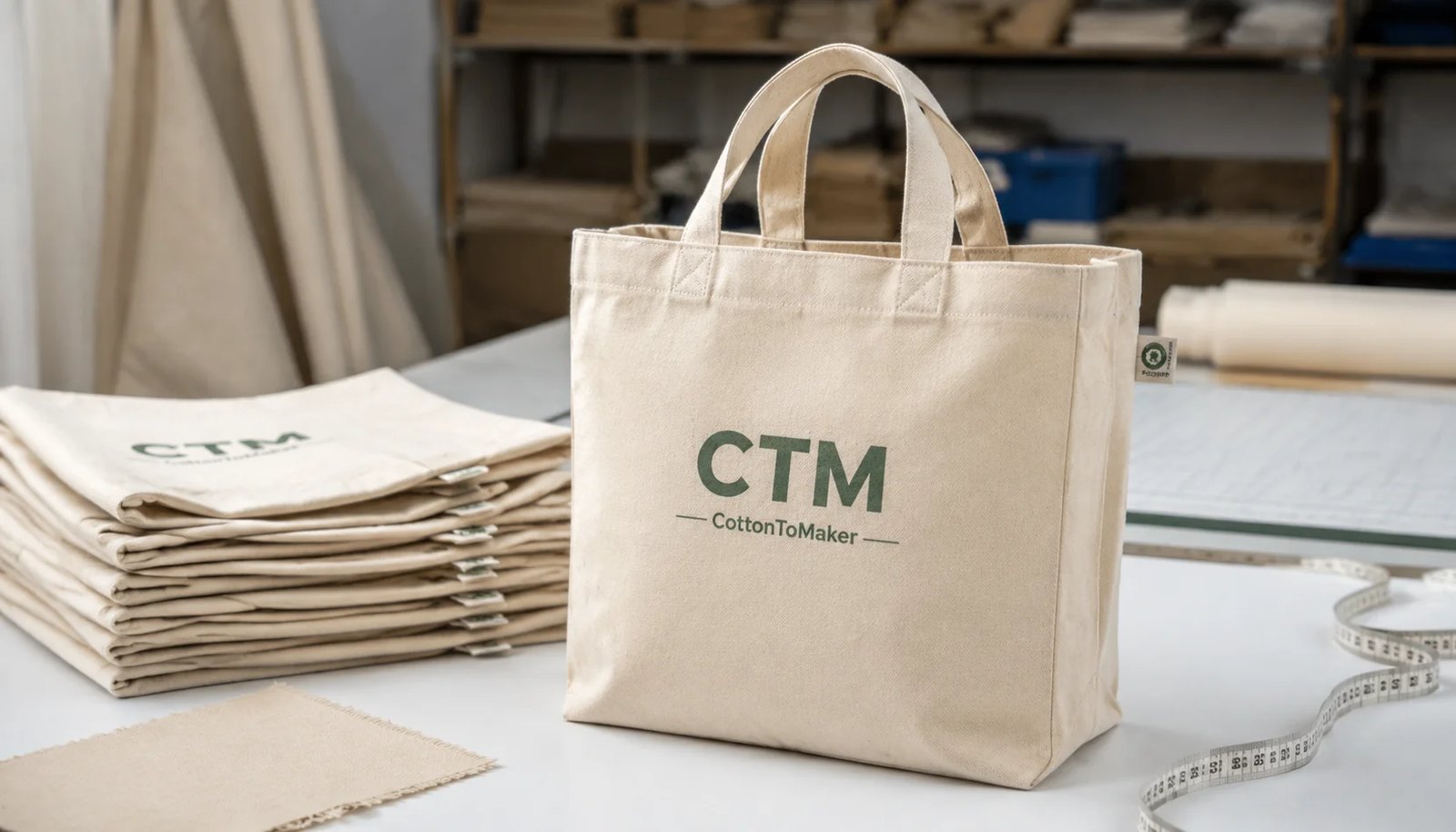
Buying problem: a low tote price can hide the wrong grocery bag
Natural grocers usually buy organic cotton totes for one of three reasons: checkout resale, member loyalty programs, or supplier-funded seasonal campaigns. The sourcing mistake is treating all organic cotton totes as the same product and comparing only the unit price. A 6 oz promotional cotton bag, a 10 oz grocery tote, and a 12 oz canvas retail bag can all be called an organic cotton tote, but they will not carry the same load, print the same way, or survive the same number of uses.
For bulk pricing, the useful target is not the cheapest bag on a spreadsheet. It is the lowest total cost for the performance your store or distributor actually needs. Procurement should lock the duty of the bag first, then compare quotes against the same fabric, same handle construction, same print area, same packing method, and same organic documentation route.
- For checkout resale: prioritize hand feel, print appearance, barcode or hangtag packing, and carton allocation by store.
- For giveaways: prioritize MOQ, print setup cost, campaign timing, and acceptable fabric weight for short-term use.
- For regular grocery reuse: prioritize 10 oz or 12 oz canvas, reinforced handles, bottom gusset, and load testing.
- For distributors: prioritize repeatable specs, neutral carton marks if needed, and clear re-order artwork control.
Set the organic cotton specification before requesting bulk pricing
A serious RFQ should state both fabric type and weight. For natural grocers, the common decision is between lighter organic cotton sheeting and heavier organic cotton canvas. Sheeting may be acceptable for lightweight produce or simple event bags. Grocery totes that carry milk cartons, glass jars, canned food, or bulk goods normally need canvas in the 10 oz to 12 oz range, roughly 280-340 GSM depending on yarn count and finishing.
Do not rely only on ounces because mills and suppliers may quote fabric differently. One supplier may describe greige fabric before finishing, while another quotes finished fabric weight. The PO should define the approved fabric swatch, target GSM, color shade, weave, and tolerance. If the tote is unbleached, allow natural shade variation but control it with an approved reference swatch so stores do not receive mixed yellow, grey, and cream tones in the same delivery.
- Economy organic cotton tote: 6 oz to 8 oz, suitable for light promotion, not ideal for heavy groceries.
- Standard natural grocer tote: 10 oz canvas, practical balance of weight, print quality, and price.
- Premium resale tote: 12 oz canvas or heavier, better structure and perceived value, higher freight and fabric cost.
- Organic cotton claim: define whether your business needs product labeling support, transaction certificate route, or supplier declaration only.
Use size, gusset, and handle choices to control real cost
The largest cost driver after fabric weight is fabric consumption. A few centimeters added to width, height, or gusset can matter across 10,000 pieces. Many buyers copy a favorite retail tote without checking carton volume or fabric yield. A grocery tote around 38 x 42 cm with a 10-12 cm bottom gusset is a practical starting point, but local checkout habits and basket size should decide the final dimensions.
Handles should be designed for both carrying comfort and sewing strength. Self-fabric handles look consistent with organic cotton branding, but they consume more fabric than webbing and need stable stitching. A 2.5-3.0 cm handle width is usually more comfortable than narrow economy handles. For shoulder carry, define handle drop; for hand carry, avoid excessive length that makes loaded bags drag or swing.
- Flat tote without gusset: lower cost and carton volume, but poor capacity for boxed groceries.
- Bottom gusset: better standing shape and carrying capacity, often preferred for grocery use.
- Side and bottom gusset: more volume and sewing steps, useful for premium retail totes.
- Cross-stitch reinforcement: recommended where shoppers may carry heavier loads.
- Inside overlock or bound seams: choose based on strength target, appearance, and budget.
Build a pricing plan around MOQ, not only total order quantity
Bulk pricing is usually controlled by fabric purchase, cutting efficiency, print setup, sewing line changeover, packing labor, and documentation. A total order of 10,000 pieces may still price like smaller runs if it is split across many artworks, many bag colors, or different packing formats. Procurement should request price tiers per artwork and per spec, then add any shared setup costs separately.
A practical quote comparison uses breaks such as 1,000, 3,000, 5,000, and 10,000 pieces. The first break shows whether the factory can support a pilot program. The middle breaks reveal where fabric and labor efficiency improves. The high break helps buyers judge whether a full-chain rollout, distributor stock order, or annual replenishment plan is worth committing to.
- MOQ may apply to fabric color, organic fabric purchase, print color, artwork, label, and packing style.
- Screen print setup is usually more efficient when the same artwork is repeated across all pieces.
- Separate store-specific cartons can increase packing labor even when the bag itself is identical.
- Small artwork changes for each store may create separate screens and slower approval work.
- Annual quantity does not automatically reduce first-order price unless shipment schedule and repeat specs are clear.
Choose the print method that matches organic positioning and budget
Water-based screen printing is often the best fit for organic cotton totes used by natural grocers. It handles simple logos, campaign slogans, and one to three spot colors well. It also gives a softer hand feel than heavy plastisol-style prints. On unbleached cotton, colors will look warmer and less bright than on white coated paper, so buyers should approve the print on actual fabric, not only a digital proof.
Digital printing may work for small quantities or full-color artwork, but it can be more expensive and may not give the same solid coverage on textured canvas. Heat transfer can reproduce detailed artwork but may feel less aligned with a natural cotton product if the print film is obvious. Embroidery is durable but costly and not ideal for large flat graphics on grocery bags.
- One-color logo: screen print is normally the most cost-effective and consistent.
- Two or three spot colors: screen print remains practical; provide Pantone references and trapping guidance.
- Full-color art: evaluate digital print or transfer with a physical strike-off.
- Large ink coverage: test hand feel, cracking, and fabric distortion before bulk approval.
- Fine text: confirm minimum line thickness because canvas texture can close small details.
Do not approve bulk production from a photo sample alone
The sample stage should prove construction, fabric, print, and packing assumptions. A photo can show general appearance but cannot confirm GSM, handle comfort, seam strength, print hand feel, or fabric shade. For organic cotton totes, a pre-production sample should be made from bulk-equivalent fabric and use the same print method planned for production.
Sample comments should be written as measurable corrections. Instead of saying the logo is too high, specify the required distance from the top edge. Instead of saying the bag is too thin, compare the sample weight with the approved GSM target. Keep one signed or sealed approval sample with the buyer and one with the factory so inspection has a physical benchmark.
- Measure finished width, height, gusset, handle length, and handle drop.
- Weigh the sample and compare fabric feel with the quoted GSM and approved swatch.
- Load the tote with a realistic grocery weight and watch handle joints and bottom seams.
- Rub the print lightly with a clean cloth to see whether ink transfers after curing.
- Review folded size, carton fit, hangtag position, barcode scan, and retail label placement.
- Confirm whether sample shrinkage or ironing changed the final dimensions.
Compare suppliers by evidence, not by the first quoted price
For organic cotton totes, supplier capability is a mix of fabric sourcing, sewing discipline, print control, and export packing. A trading company may offer broad sourcing options and lower communication friction. A factory with in-house sewing and stable print partners may give better control over repeat orders. A very low quote from an unknown route can become expensive if documentation, color consistency, or inspection fails.
Useful supplier evidence includes recent fabric swatches, sample photos with measurement points, export carton examples, inspection history, and clear explanation of certification documents. If the bag will carry an organic claim, the supply chain documentation must be discussed before order placement. Fixing paperwork after bulk production is difficult and sometimes impossible.
- Direct manufacturer: stronger control over sewing details, sample correction, and repeat specs.
- Exporter or trading route: may help with multiple products and smaller mixed orders, but verify factory control.
- Local distributor: faster replenishment and lower import work, usually higher unit cost and fewer custom options.
- Print-only supplier plus sewing factory: possible for special artwork, but responsibility for defects must be clearly assigned.
- Lowest-cost route: acceptable only if fabric, print, QC, packing, and documentation are still proven.
Define QC thresholds suitable for grocery retail use
Quality control should be written around actual buyer risk. For natural grocers, visible stains, oil marks, strong odor, weak handles, crooked logos, and inconsistent organic cotton shade create more problems than minor thread tails hidden inside the bag. A finished goods inspection should include visual inspection, measurements, print checks, seam checks, packing verification, and carton marking review.
Acceptance criteria should be clear enough that the factory, inspector, and buyer reach the same decision. Fabric slubs can be normal in natural cotton, but large knots in the logo area may be unacceptable. Unbleached shade variation can be normal, but mixed fabric lots in the same carton can look like a production error. Define what is critical, major, and minor before inspection starts.
- Critical defects: mold, mildew odor, sharp objects, wrong claim label, unsafe contamination, severely weak handle attachment.
- Major defects: wrong size outside tolerance, crooked print, heavy stains, open seams, missing labels, wrong packing count.
- Minor defects: small thread tails, slight shade variation within approved range, light removable lint.
- Measurement method: lay bag flat without stretching and measure from seam to seam.
- Print placement: define center tolerance and distance from top edge, not just visual alignment.
- Load test: set weight and duration based on expected grocery use, then record result by sample quantity.
Packing choices affect both sustainability claims and landed cost
Many natural grocers prefer reduced plastic packing, but the tote still needs protection from moisture, dust, and carton abrasion. Bulk packing with an inner carton liner can reduce individual polybags. Retail-ready packing may need a belly band, hangtag, barcode label, or individual bag. The right choice depends on whether the tote is unpacked at the store, sold from a shelf, distributed at checkout, or shipped to a third-party warehouse.
Packing also changes freight cost. A heavier 12 oz tote with a gusset takes more carton space than a light flat cotton bag. Buyers should request carton dimensions, gross weight, net weight, pieces per carton, and pallet loading estimate before comparing landed cost. A unit price that saves a few cents can lose that advantage if carton volume increases or store allocation requires additional labor.
- Bulk pack: lowest packing material and labor, suitable for checkout counters and warehouse distribution.
- Individual polybag: cleaner retail handling, but less aligned with plastic reduction goals unless required.
- Paper band or hangtag: useful for retail resale; confirm barcode position and scan quality.
- Carton liner: practical moisture and dirt protection for sea freight or long warehouse storage.
- Store allocation labels: reduce receiving confusion but add packing time and error risk.
- Moisture control: consider desiccant and dry cartons for humid routes, especially with unbleached cotton.
Plan lead time around approvals, not only sewing days
A factory lead time starts to become reliable only after artwork, fabric, sample, packing, and deposit are approved. Organic fabric availability can be the first schedule risk. If the exact canvas weight or organic certification route is not already in stock, fabric procurement may extend the calendar. Print strike-offs and sample courier time also add days before bulk cutting can begin.
For a natural grocer promotion, late delivery often costs more than a slightly higher unit price. Work backward from the in-store date and include sample review, revisions, production, inspection, export documentation, transit, customs, warehouse receiving, and store distribution. If the tote supports a seasonal campaign, build in a contingency for artwork approval delays and retail label corrections.
- RFQ and quote alignment: usually fastest when the buyer provides complete size, fabric, artwork, and packing details.
- Sample making: affected by fabric availability, print screens, label material, and courier time.
- Bulk production: starts after approved sample, approved artwork, deposit, and final PO details.
- Inspection: schedule before final carton sealing or before shipment booking when possible.
- Shipping: sea freight saves cost for bulk orders, air freight should be treated as an emergency option.
- Retail rollout: allow warehouse and store allocation time after customs clearance.
Specification comparison for buyers
| Spec decision | Recommended option | When it fits | Buyer risk to check |
|---|---|---|---|
| Main fabric weight | 10 oz or 12 oz organic cotton canvas, roughly 280-340 GSM depending on yarn and weave | Reusable grocery programs where the bag must hold produce, jars, and boxed goods without looking limp | A quote using only oz without GSM may not match your benchmark; request actual GSM tolerance and fabric swatch |
| Fabric construction | Plain weave canvas for stable printing; twill only when a softer hand feel is more important than sharp logo edges | Natural grocers using large front logos, nutrition campaign messages, or member program artwork | Loose weave lowers cost but can cause distorted print edges, more shrinkage, and weaker seam holding |
| Bag size and gusset | Approx. 38 x 42 cm with 10-12 cm bottom gusset, or buyer-specified local retail size | Checkout sales, loyalty giveaways, and curbside pickup kits needing a practical grocery capacity | Very large panels increase fabric consumption and carton volume; compare cost per usable liter, not only unit price |
| Handle design | Self-fabric handles, 2.5-3.0 cm width, cross-stitch reinforcement at handle joints | Daily reuse where shoppers carry heavier groceries and buyers want a clean organic cotton look | Cheap narrow handles may pass visual inspection but fail in load testing or feel uncomfortable when loaded |
| Print method | Water-based screen print for 1-3 spot colors; pigment digital print only for lower-volume full-color artwork | Most natural grocery branding where eco-positioning and cost control are both important | Discharge or specialty inks may behave differently on unbleached fabric; approve strike-off before bulk fabric cutting |
| Organic claim evidence | Transaction certificate or scope certificate route agreed before order placement, according to buyer claim needs | Retailers who will sell the tote as organic cotton or use the claim in packaging and web copy | A verbal organic claim is not enough; missing certificate chain can block customs documents, retail listing, or legal review |
| Packing format | Individual polybag only if required by retail channel; otherwise bulk pack with carton liner and moisture control | Natural grocers trying to reduce unnecessary plastic while keeping cartons clean during ocean or truck transit | Plastic-free packing must still protect against humidity, dirt, and carton abrasion; define acceptable packing in the PO |
| Bulk pricing structure | Tiered quote at realistic breaks such as 1,000, 3,000, 5,000, and 10,000 pieces per artwork | Procurement teams comparing launch quantity versus replenishment stock for multiple store locations | A low headline price may exclude sampling, print screens, certification documents, inland freight, or carton marking |
Buyer checklist before sampling
- Define whether the bag is sold at checkout, given away in campaigns, used for curbside pickup, or packed as a retail merchandise item.
- Set the fabric target in both oz and GSM, and request a physical swatch before approving the quote as final.
- Confirm organic cotton documentation requirements before sampling, especially if the bag or packaging will state organic cotton.
- Specify finished size, gusset, handle length, handle width, seam type, and load expectation instead of sending only a reference photo.
- Decide whether the artwork is one-color, multi-color, or full-color, and provide vector files with Pantone or standard color references.
- Require a pre-production sample using bulk-equivalent fabric, thread, handle construction, and print method.
- Request carton dimensions, gross weight, net weight, pieces per carton, and packing method for landed-cost calculation.
- Set acceptable tolerances for finished size, fabric weight, print placement, print color, seam strength, and stain control.
- Plan order quantity by artwork and store allocation, because changing artwork or dividing colors can reset MOQ and screen costs.
- Confirm inspection timing before shipment so defects are found before carton sealing and export booking.
Factory quote questions to send
- What fabric weight can you supply for organic cotton canvas in both oz and GSM, and what tolerance should we write into the PO?
- Can you quote 1,000, 3,000, 5,000, and 10,000 pieces for the same size and artwork, with setup charges separated?
- Is the quoted fabric certified organic cotton, and what documents can be provided for our intended claim level?
- Which print method do you recommend for our artwork on unbleached organic cotton, and what is the maximum print area?
- What are the sample costs, sample lead time, and conditions for refunding sample charges after bulk order placement?
- Will the pre-production sample be made with the same bulk fabric, thread, handle material, print ink, and washing or finishing process?
- What carton size, carton weight, pieces per carton, and pallet loading data should we use for freight estimates?
- What is your normal production lead time after sample approval and deposit, and what items can extend that schedule?
- What load test, seam test, size tolerance, and print tolerance do you use for grocery tote production?
- Which quote items are excluded, such as testing, certification documents, barcode labels, hangtags, retail packing, inland freight, or duties?
Quality-control points to confirm
- Finished fabric weight should match the approved GSM range, with swatches kept from sample approval and bulk cutting for comparison.
- Finished bag size should normally stay within +/-1 cm for width and height and +/-0.5 cm to +/-1 cm for gusset, depending on construction.
- Handle attachment must show consistent box or cross reinforcement with no skipped stitches, loose thread tails, or weak backtacking.
- Basic load testing should reflect grocery use, such as a defined static hanging load for a set time without handle tearing or seam opening.
- Print placement should be measured from the top edge or side seams, not judged by eye only, especially for multi-store branded programs.
- Ink should not crack, peel, or show heavy migration after normal handling and light rubbing on the approved fabric.
- Natural fabric shade variation should be controlled by approved swatch range; unbleached cotton is not pure white and should not be sold as such.
- Cartons should be clean, dry, correctly marked, and strong enough for stacking, with moisture protection agreed for sea freight routes.
- Needle holes, oil stains, mildew odor, fabric slubs outside the agreed standard, and dirty fold marks should be classified before inspection.
- Barcode labels, hangtags, side labels, and carton marks should be verified against the final packing list and retail allocation file.