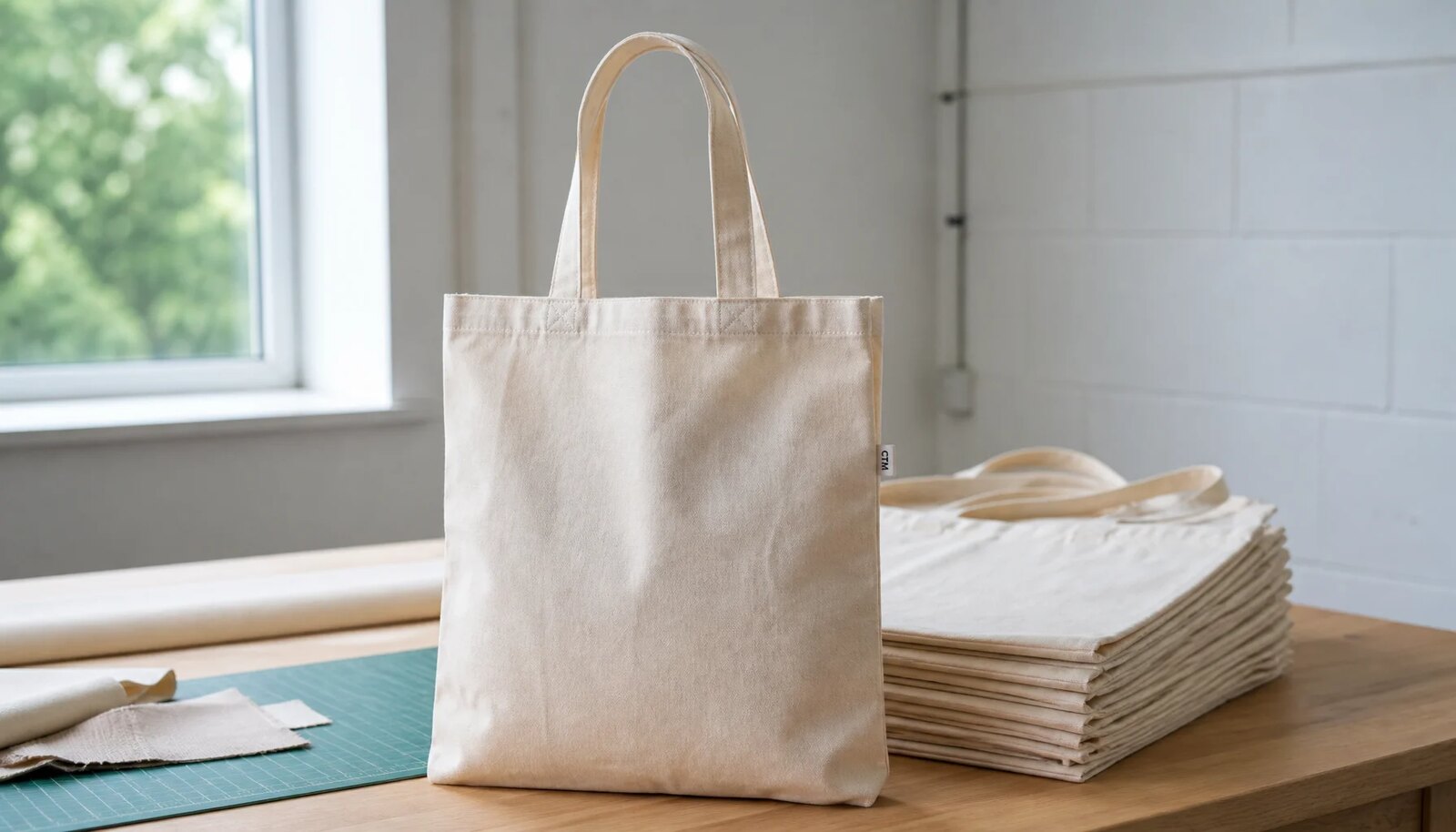
Why MOQ is more than a sewing number
Organic cotton totes look simple from the buyer side: fabric panels, handles, a logo, and export cartons. On the factory side, MOQ is built from several smaller minimums that may not move together. Fabric stock, cutting efficiency, sewing line setup, print screen setup, label minimums, packing labor, inspection time, and documentation requirements all affect the quantity a supplier considers workable.
For eco apparel brands, the tote is often more than a giveaway. It may support a store opening, ship with online orders, hold wholesale samples, or appear in customer photos. That makes quality consistency commercially important. A weak handle, crooked print, or mismatched natural shade can make a sustainable packaging choice look careless. MOQ negotiation should therefore target the lowest practical order at the right specification, not the lowest number at any quality level.
The real MOQ driver changes by order. If the factory has stock natural organic cotton fabric, the sewing minimum or print setup may drive the quote. If the fabric must be woven, dyed, finished, or documented for a specific certification claim, the fabric mill minimum may become the true floor. If the artwork uses several colors or a large solid print area, the print department may require more setup time and a higher defect allowance. If individual packing, barcode labels, or retailer carton sorting are required, the packing line becomes part of the minimum too.
A useful organic cotton totes MOQ negotiation guide for eco apparel brands starts by separating these cost drivers. Ask the supplier what is forcing the MOQ, then remove friction from that specific point. Standard dimensions, stock natural shade, one-color artwork, and bulk packing give a factory room to accept a smaller launch order. Highly customized specifications may still be worth the cost, but they should be selected deliberately.
- Separate material MOQ, cutting MOQ, sewing MOQ, print MOQ, trim MOQ, packing MOQ, and documentation requirements.
- Ask which single specification is driving the minimum before negotiating price or quantity.
- Lower MOQ usually comes from standardization, repeatability, and clear approval files.
- A customer-facing tote needs stronger QC than a one-day event bag, even if construction looks similar.
Write the RFQ like a production brief
A vague RFQ asks for an organic cotton tote with a logo. A procurement-ready RFQ tells the supplier exactly what must be made, what can stay standard, and which alternates should be quoted. Missing details force suppliers to protect themselves. If they do not know the finished size, fabric weight, print area, label position, or packing method, they may quote a higher MOQ or leave costs out until later.
Use finished measurements, not only approximate dimensions. State body width and height, gusset depth if any, handle length, handle drop, handle width, fabric GSM, weave type, fabric color, seam construction, print size, print location, label requirement, thread color, and packing. If you have a reference sample, clarify whether you want an exact match or only a similar feel. If you are flexible, ask the factory to quote its closest standard size and stock fabric as an alternate.
The RFQ should also describe the commercial use. A DTC apparel brand may care about low carton volume and clean fulfillment handling. A boutique retailer may prioritize hand feel and logo placement. A trade show team may care most about unit price and delivery date. When the supplier understands the channel, it can suggest a lower-MOQ specification without weakening the bag in the wrong place.
Mark requirements as fixed, flexible, or optional. Fixed items may include the organic claim, logo size, and delivery date. Flexible items may include body size within a few centimeters or handle type. Optional items may include inside labels, individual polybags, hangtags, and bottom gussets. This structure gives the supplier permission to engineer a lower-MOQ route instead of guessing what your team might accept.
- Include finished size, such as 38 x 42 cm flat tote with 65 cm handle length and 28 cm handle drop.
- State target use: retail shopping bag, e-commerce insert, wholesale gift, event tote, merchandise item, or launch kit.
- Attach vector artwork and specify printed size, ink color, side, and distance from top edge or side seam.
- Ask for your requested specification and the factory's MOQ-optimized standard option.
- Use revision numbers for spec sheets, artwork, sample approvals, and purchase orders.
Fabric GSM, weave, and natural shade decisions
Fabric is usually the largest cost component and one of the biggest MOQ drivers. GSM affects material consumption, hand feel, print behavior, sewing speed, carton volume, and freight. A 140 GSM organic cotton tote can work for light apparel, events, and simple customer gifts. A 160 GSM tote is often a balanced option for apparel retail programs. A 180 GSM tote feels more substantial and gives better structure, but it raises fabric cost, shipping volume, and sometimes sewing difficulty.
Buyers often try to solve strength concerns by increasing GSM. That is not always the best lever. If bags fail at the handle, reinforcement matters more than heavier fabric. If the bag needs capacity, a gusset may help more than extra weight. If the logo looks weak, print method and ink coverage matter more than thickness. Good MOQ negotiation starts with the lightest fabric that fits the use case, then reinforces stress points deliberately.
Weave and finishing also matter. Plain weave and canvas constructions can both be used for cotton totes, but the hand feel, surface texture, shrinkage behavior, and print result differ. Ask whether GSM is measured before or after finishing and what tolerance the factory can hold. For sewn cotton goods, plus or minus 5 to 8 percent is a common practical discussion range, but the agreed tolerance should come from the supplier's process and your quality need.
Natural, undyed organic cotton is usually the most MOQ-friendly choice because tote factories may run it regularly. Custom dyed fabric introduces dye lot minimums, lab dip approval, shade tolerance, and possible colorfastness checks. Contrast handles, colored thread, and custom tapes can also trigger trim minimums. If brand identity requires color, compare custom dye with a printed logo, woven label, or standard colored trim before committing.
- 140 GSM: light duty, efficient packing, suitable for soft goods, events, and cost-sensitive programs.
- 160 GSM: balanced hand feel for many apparel retail and customer gift programs.
- 180 GSM: stronger structure and more premium feel, with higher material and freight cost.
- Stock natural shade usually supports lower MOQ than custom dyeing or contrast components.
- Agree whether GSM tolerance is measured on fabric before cutting or finished goods after sewing.
Organic claim and documentation accuracy
Organic cotton terminology needs precision. A tote made with organic cotton fabric is not automatically a certified finished product. The documentation may support fiber content only, fabric certification only, or a finished-product claim depending on the supplier, certification scope, and chain-of-custody controls. Procurement should define the claim before asking for final price.
If the tote will be described as organic in product pages, retailer files, hangtags, wholesale decks, or sustainability reports, ask what evidence the supplier can provide. This may include a supplier declaration, fabric composition document, scope certificate copy, transaction certificate, testing report, or finished-product certification support. The right document depends on your market, claim language, and internal compliance requirements.
Documentation affects MOQ because certified material and certified production routes may be limited. A factory may offer low MOQ using organic cotton fabric in stock, but that does not mean it can provide a transaction certificate for your exact shipment or label the finished bag under a certification program. If your buyer, retailer, or legal team requires a specific document, include that requirement in the RFQ baseline.
Avoid vague language such as certified organic tote unless everyone agrees what is certified. A clearer RFQ line is: supplier to quote natural 160 GSM organic cotton tote and state whether documentation supports organic cotton fiber content, certified fabric, or finished-product certification. This protects your marketing claim and prevents late-stage re-quotation after the sample is approved.
- Define claim level: organic cotton fiber content, certified fabric, certified processing, or certified finished product.
- Ask whether documentation applies to the fabric roll, production facility, transaction, or finished tote.
- Confirm whether labels, inks, thread, and packing affect certification scope.
- Do not approve marketing copy until documentation matches the intended claim.
- Price documented and non-documented routes separately if your team is still deciding.
Decoration choices that protect margin
Decoration can quickly turn a low-MOQ tote into a complicated order. One-color screen printing is often the most practical choice for simple apparel branding because factories understand the process and setup is manageable. Even then, quality depends on artwork, ink selection, cotton texture, print size, and placement tolerance. Fine lines, small type, large solid areas, and multiple colors raise setup risk.
For many eco apparel brands, restrained branding works well. A small one-color print, woven side label, or sewn hem label can communicate the brand without forcing a large print area. Woven labels add a trim component and sewing step, so they are not automatically cheaper, but they can reduce ink-related risk and create a more apparel-like finish. Specify label size, fold type, background color, thread colors, placement, and orientation.
Embroidery may look premium, but it can distort lighter cotton, add machine time, and require backing. Digital printing can support colorful artwork, but it has different hand feel, wash and rub considerations, and cost assumptions. For MOQ negotiation, ask the supplier to quote two versions: the brand-preferred artwork and an MOQ-optimized artwork using one color, one location, and factory-standard placement.
Artwork should be reviewed at actual production scale. A logo that looks sharp on a screen can lose definition on textured natural cotton. Ask for minimum line thickness guidance and a print strike-off when the mark includes fine icons, small type, or tight registration. Define print position tolerance in measurable terms, often a few millimeters for small labels and around 5 to 10 mm for larger tote prints depending on design and factory capability.
- Use one print location and one ink color for the first order when MOQ and speed matter.
- State printed size, ink reference, side, and distance from top edge or side seam.
- Avoid gradients, tiny type, and hairline details unless tested on the chosen cotton surface.
- Quote woven label, embroidery, digital print, and multi-color screen print as separate alternates.
- Set print position and registration tolerance before approving bulk production.
Where MOQ negotiation actually works
MOQ is the point where the supplier believes material purchasing, setup, production handling, and overhead become workable. It is not always a fixed company rule. A factory may accept a smaller order if it can use stock fabric, standard handles, existing patterns, and an open sewing line. The same factory may reject that quantity if the order requires custom dyed fabric, several artworks, special packing, or certification paperwork it cannot support efficiently.
Negotiation works best when the buyer offers simplification. Material leverage comes from stock natural organic cotton, standard GSM, and common fabric width. Production leverage comes from a standard body size, simple construction, and fewer variants. Decoration leverage comes from one print color, one print position, and no special ink. Packing leverage comes from bulk cartons and simple SKU separation. Commercial leverage may come from accepting a slightly higher unit price for a lower first order or sharing a credible reorder forecast.
Be careful with mixed-SKU negotiation. A brand may ask for 1,000 bags split across four artworks and assume the total should satisfy MOQ. The supplier may treat each artwork as a separate print setup, each label as a separate trim lot, and each packing instruction as a separate handling requirement. If the order will be split by campaign, store, influencer kit, or wholesale customer, disclose that before quoting.
A practical request is: please quote your lowest workable MOQ using stock natural organic cotton fabric, your standard tote size, one-color screen print, and bulk packing, then quote our requested custom version separately. This shows the factory you are open to its efficient route while still protecting your brand preference.
- Ask whether MOQ is controlled by fabric, cutting, sewing, print setup, labels, packing, or documentation.
- Request identical price tiers so 1,000 / 3,000 / 5,000 piece breakpoints are visible.
- Offer standard size, stock shade, fewer print colors, and bulk packing before asking for a discount.
- Do not assume one total MOQ applies across multiple artworks, labels, sizes, or packing formats.
- A higher unit price at a lower launch MOQ can be rational if it validates demand and protects cash flow.
Make supplier quotes comparable
Procurement teams lose time when every supplier quotes a different bag. One assumes 140 GSM, another assumes 180 GSM. One includes screen fees, another hides them. One packs 100 pieces per carton, another packs 200. The result is not a price comparison; it is a collection of different assumptions. A strong RFQ forces a common baseline.
Ask every supplier for the same quote table: unit price by quantity tier, setup fees, sample fees, MOQ, lead time, payment terms, carton quantity, carton dimensions, gross weight, port, quote validity, documentation included, and exclusions. Also ask for a supplier-recommended alternate using its standard low-MOQ route. This lets you compare the brand target spec against the production-efficient spec.
Separate one-time and repeat-order costs. Screen charges, label setup, pattern charges, and sample fees may not apply in the same way on reorder. Ask whether screens are stored, how long tooling is retained, whether label minimums must be repurchased, and what changes would trigger new setup fees. A quote that looks expensive on the first order may become competitive if setup costs are reusable.
Ask suppliers to list exclusions clearly. Inspection, testing, export carton upgrades, barcode labels, hangtags, destination duties, transaction certificates, and local delivery may be excluded. Missing exclusions become painful after sample approval because leverage is lower and the timeline is tighter. Good quote discipline is a procurement control, not clerical work.
- Normalize GSM, size, construction, print method, packing count, and documentation before comparing prices.
- Request unit price, setup charges, sample cost, lead time, carton data, payment term, and quote validity.
- Ask what is reusable on reorder, including screens, labels, patterns, and approved artwork files.
- Require suppliers to list assumptions and exclusions in writing.
- Compare FOB price together with chargeable volume and quality risk, not only unit price.
Sampling should prove the full tote
A digital mockup can confirm approximate artwork placement, but it cannot prove that the tote will function or look right in hand. A pre-production sample should represent the actual fabric weight, handle construction, thread, print method, label placement, seam reinforcement, folding method, and packing planned for bulk. Substitute materials may be useful for concept review, but they should not be final approval standards.
Measure the sample as a finished bag. Check width, height, gusset depth, handle length, handle width, and handle drop after sewing and light pressing. Load the bag with realistic products, such as folded apparel, denim, footwear boxes, books, or the goods it will carry. Confirm whether the handle feels comfortable, whether the logo remains visible when filled, and whether the bag hangs evenly.
Print approval should be physical when presentation matters. Review ink opacity on natural cotton, edge sharpness, color match, print position, and distortion near seams or gussets. If bags will be folded tightly, rub the printed area lightly and check for transfer, cracking, tackiness, or abrasion. Natural cotton texture can make a print look softer than it appears in artwork, so expectations should be set on the actual fabric.
Packing approval is part of sample approval. Confirm fold method, bundle count, inner pack, carton quantity, carton mark, barcode position, and SKU separation. A well-made tote can still arrive with heavy creases, mixed counts, or incorrect retailer labels if packing is treated as an afterthought.
- Approve a physical sample for fabric, stitching, handle drop, print, label, and packing before bulk production.
- Measure finished goods against written tolerances instead of relying on visual approval.
- Test realistic load, handle comfort, seam stress, and logo visibility when the bag is filled.
- Reject final approval if the sample uses substitute fabric, approximate label placement, or a different packing method.
- Keep the approved sample and signed spec sheet as the standard for pre-shipment inspection.
QC tolerances and defect classification
Low-MOQ orders can be more vulnerable to margin loss because each defect represents a larger share of the shipment. Eighty unsellable bags in a 1,000-piece order hurts more than the same count in a larger reorder. Written tolerances protect both buyer and supplier by defining acceptable variation before production begins.
For dimensions, set realistic sewn-goods tolerances. A tote is not a molded item, so exact precision is unrealistic, but uncontrolled variation is unacceptable. Define tolerance for finished width, height, gusset depth, handle drop, handle placement, and print position. Premium retail totes may need tighter visual consistency than event giveaways. For GSM, agree both the target and tolerance range.
For stitching, focus on stress points. Handle anchors, top hems, side seams, bottom seams, and gusset corners should be inspected for skipped stitches, loose threads, broken seams, open seams, raw edges where not intended, uneven reinforcement, and distorted corners. Specify reinforcement type if strength matters. X-box stitching, bar tacks, or reinforced box stitching add time but can prevent functional complaints.
For print and appearance, define major and minor defects. Major defects include wrong artwork, wrong position beyond tolerance, severe smudging, missing labels, open seams, broken handles, incorrect packing count, and mixed SKUs. Minor defects may include loose thread ends, small cotton specks, slight natural shade variation, or minor ink texture if they do not affect brand presentation. The approved sample should guide borderline calls.
- Set tolerances for finished measurements, handle drop, GSM, print size, print position, and label placement.
- Classify open seams, broken handles, wrong artwork, severe print defects, and incorrect carton counts as major defects.
- Classify loose thread ends, small seed specks, and slight natural shade variation as minor only if brand presentation is not harmed.
- Inspect handle anchors more heavily than low-stress areas because failures affect usability.
- Use third-party inspection when the tote is retailer-bound, launch-critical, or customer-facing at scale.
Packing, freight, and landed cost
Organic cotton totes are light but often bulky. Freight cost depends on gross weight, carton volume, and how efficiently bags are folded or compressed. A low FOB price can lose its advantage if carton dimensions are large or if individual packing inflates chargeable volume. For international procurement, carton data is not a small detail; it is part of landed cost.
Packing should match the channel. Bulk packing is efficient for events, store backrooms, warehouse distribution, and wholesale replenishment. Individual polybags may protect cleanliness but add labor, material, and sustainability concerns. Belly bands, hangtags, barcode labels, retailer stickers, and carton sorting can improve merchandising but also create more handling steps and more error points. Price each packing feature separately.
Lead time is controlled by fabric readiness, document availability, sample approval, print setup, sewing capacity, packing complexity, inspection, and export scheduling. Buyers often focus on sewing time, but fabric, labels, and artwork revisions can cause longer delays than assembly. If artwork is not final, screens cannot be made accurately and placement cannot be approved confidently.
Build the timeline backward from delivery date. Include RFQ review, sample making, sample courier time, revisions, bulk production, inline or final inspection, corrective action time, export handling, transit, customs clearance, and local delivery. MOQ negotiation should include calendar risk. A supplier offering lower MOQ with uncertain fabric availability may be riskier than a slightly higher-MOQ supplier with stock fabric and stable carton data.
- Ask for pieces per carton, carton dimensions, gross weight, net weight if available, and packing method with every quote.
- Compare chargeable volume as well as FOB unit price, especially for air shipments and courier delivery.
- Price folding, polybags, belly bands, hangtags, barcodes, stickers, and carton sorting as separate line items.
- Reserve time for inspection and corrective action before shipment release.
- Confirm carton strength, carton marks, SKU separation, and moisture protection if bags will face long transit or warehouse storage.
Specification comparison for buyers
| Spec decision | Recommended option | When it fits | Buyer risk to check |
|---|---|---|---|
| Fabric weight | 140-180 GSM organic cotton plain weave or canvas, with GSM tolerance stated | Most apparel retail totes, gift-with-purchase bags, launch kits, and e-commerce inserts that need usable strength without excessive freight | Too light can feel transparent, distort in printing, or lose shape; too heavy raises fabric cost, needle stress, carton volume, and freight |
| Body size | Use a standard factory pattern such as 38 x 42 cm or 40 x 40 cm when brand fit allows | Lower-MOQ programs where repeatability, cutting yield, and fast sampling matter more than a unique silhouette | Non-standard dimensions can waste fabric width, change handle balance, require new patterns, and increase cutting loss |
| Handle construction | Self-fabric or cotton webbing handles with X-box, box stitch, or bar tack reinforcement | Retail-ready totes expected to carry apparel, footwear, books, or bundled store purchases | Handle drop must be measured on finished bags; weak anchors and uneven handle placement are common functional defects |
| Gusset choice | Flat tote for lowest MOQ; bottom gusset only when product volume requires it | Flat totes suit garments and promotional use; gussets suit boxed goods, folded knits, and higher-capacity shopping bags | Gusset depth affects cutting yield, sewing time, finished measurements, carton count, and customer perception of capacity |
| Logo method | One-color screen print, small woven side label, or blank bag for first orders | Simple eco branding, repeatable reorders, wholesale gifts, and lower setup risk | Fine artwork can fill in on textured cotton; multi-color prints require registration tolerance and may raise defect sorting time |
| Certification claim | Define whether you need organic fiber declaration, transaction certificate, scope certificate support, or finished-product certification | Brands using organic claims in product pages, hangtags, wholesale decks, retailer compliance files, or sustainability reporting | Do not assume organic cotton fabric automatically makes the finished tote GOTS-certified; documentation scope must match the claim |
| MOQ route | Factory direct using stock natural organic cotton fabric, standard trims, and bulk export packing | Eco apparel brands that need a controlled first order and repeatable reorders without unnecessary custom components | Custom dyeing, special labels, individual retail packing, multiple artworks, or retailer sorting can shift MOQ from sewing minimum to material or trim minimum |
| Sample path | Artwork proof, print strike-off if needed, then pre-production sample using intended bulk materials and packing | Orders where size, handle drop, logo placement, stitching, and shelf presentation affect sellability | Approving only a digital mockup misses cotton shrinkage, print opacity, stitch quality, label position, and carton presentation |
| Packing method | Bulk pack with agreed carton count; add polybag, belly band, barcode, or folding only when the channel requires it | Wholesale, DTC fulfillment, events, retail replenishment, and distributor programs that need predictable carton data | Retail prep adds labor, can crease bags, changes carton volume, and can create SKU or barcode errors if not specified |
Buyer checklist before sampling
- Define finished tote width, height, gusset depth if any, handle length, handle drop, handle width, fabric GSM, weave, construction type, thread color, print location, and packing method before requesting quotes.
- Choose a low-MOQ baseline first: stock natural organic cotton, standard body size, one print position, one-color artwork, no custom dye, no custom hardware, and bulk carton packing unless the sales channel requires more.
- State whether your organic claim requires a supplier declaration, fabric composition certificate, transaction certificate, scope certificate copy, finished-product certification, or retailer-specific compliance document.
- Ask suppliers to quote the same specification at 1,000 / 3,000 / 5,000 pieces, or your relevant buying tiers, so fabric, trim, printing, and labor breakpoints are visible.
- Request separate line items for unit price, screen or plate fee, sample fee, label setup, packing labor, carton cost, inspection support, export documentation, inland transport, and any refundable tooling charges.
- Set measurable tolerances for body width, body height, gusset depth, handle drop, handle placement, fabric GSM, print size, print position, stitch density, and acceptable visual defects in the RFQ or purchase order.
- Approve a pre-production sample made with the intended bulk fabric, thread, ink, label, seam construction, reinforcement method, folding method, and carton packing before mass production starts.
- Compare FOB price together with carton dimensions, pieces per carton, gross weight, estimated chargeable volume, origin port, lead time, payment term, documentation level, and expected defect allowance.
- Confirm whether the supplier can hold the same fabric weight, natural shade range, thread, label, print method, pattern, and packing standard for reorders, and ask what changes would trigger a new MOQ.
- Before shipment, review QC photos or inspection results showing finished measurements, handle reinforcement, print placement, print rub check, carton marks, pack count, SKU separation, and nonconforming goods handling.
Factory quote questions to send
- What is your MOQ for a natural 140 GSM, 160 GSM, and 180 GSM organic cotton tote with one-color screen print on one side using your standard body size?
- Which parts of the MOQ are controlled by fabric availability, cutting yield, sewing line setup, print setup, label production, packing labor, or certification documentation?
- Is the material GOTS-certified organic cotton, organic cotton with supplier declaration, organic cotton blend, or another organic-content claim? What documents can be provided with shipment?
- Can you quote 1,000 / 3,000 / 5,000 pieces using the exact same finished size, GSM, construction, print method, label, and packing so we can identify cost breakpoints?
- What standard tote body sizes, fabric widths, handle lengths, handle drops, natural fabric weights, and carton counts do you already run regularly?
- What are the sample charges, screen or plate fees, woven label setup fees, courier fees, and which charges are refundable or reusable on repeat orders?
- What production tolerances do you use for finished body width, height, gusset depth, handle drop, handle placement, stitch density, print size, and print position?
- Will the pre-production sample use the same bulk fabric type, thread, ink, label position, reinforcement stitch, folding method, and carton packing intended for production?
- How many pieces will be packed per carton, what are the carton dimensions, what is the gross weight, and will bags be compressed, folded flat, bundled, or individually packed?
- Can you separate the cost impact of custom dyed fabric, contrast thread, inside hem label, side seam woven label, bottom gusset, reinforced handle stitching, and individual polybagging?
Quality-control points to confirm
- Fabric GSM should be checked against the approved specification with an agreed tolerance, commonly plus or minus 5 to 8 percent depending on weave, finishing, and supplier capability.
- Finished tote dimensions should be measured flat after sewing and light pressing, not from cut panels; width, height, and gusset depth should match the approved sample and written tolerance.
- Handle length, handle width, and handle drop should be measured on finished bags, with attention to symmetry between left and right handles and consistency across sampled units.
- Handle anchor stitching should show the approved reinforcement, such as X-box, box stitch, bar tack, or double row stitching, with no skipped stitches, broken thread, loose thread nests, or distorted corners.
- Side seams, top hems, bottom seams, and gusset folds should be straight, secure, and free of open seams, exposed raw edges where not intended, excessive puckering, or inconsistent seam allowance.
- Print quality should match approved artwork for size, color, opacity, edge sharpness, centering, position, and registration; natural cotton texture and seed specks should be considered when setting visual standards.
- Ink adhesion, dry rub, and basic handling resistance should be checked when bags will be folded, packed tightly, used as retail packaging, or handled repeatedly in stores.
- Labels should be sewn in the approved position and orientation, with correct brand mark, fiber statement if used, care text if required, no fraying, no seam twisting, and no visible label skew beyond tolerance.
- Carton packing should match agreed pack count, folding method, inner pack requirement, carton mark, SKU separation, barcode label, moisture protection if used, and retailer or channel labeling rules.
- For pre-production approval, the sample must represent actual bulk materials and production method; substitute fabric, substitute ink, approximate label placement, or different folding should be clearly rejected or re-sampled.